
Decoding Technical Specs and Process Quality: A 2026 Guide to Selecting High-Speed Bunching/Stranding Machines with HONTA
Introduction: The Procurement Conundrum Beyond the Datasheet
For procurement managers and technical directors in the cable manufacturing industry, selecting a high-speed bunching/stranding machine is rarely a straightforward task. The datasheets are dense with parameters—rotational speed (up to 3,000 rpm), lay length range, tension accuracy (often stated as ±2% or better), conductor diameter range, and take-up traverse system design. Yet, the real question remains: How do these numbers translate into the quality of the final cable, and which supplier consistently delivers on their promises?
This 2026 market analysis provides a structured framework for interpreting technical specifications and assessing production process quality. We benchmark leading global manufacturers—Niehoff (Germany), SAMP (Italy), Gauder (Belgium), and Maillefer (Finland)—with a special focus on HONTA, a Chinese system provider that has rapidly gained global traction. By the end, you will be equipped to make procurement decisions that balance performance, cost, and operational reliability.
Part 1: Three Critical Technical Parameters and How They Affect Quality
1.1 Tension Control Precision – The Silent Determinant of Resistance Consistency
Tension fluctuation during bunching causes variations in conductor resistance, a primary quality metric for wires used in automotive or data communication cables. Industry best practice demands tension control within ±1% of the set value. HONTA integrates digital PID closed-loop control across its rigid frame stranding machine and high-speed bunching machines, achieving a measured ±0.8% deviation under production conditions (internal test data, 2025). In comparison, the Niehoff MSM 600 series offers a similar ±1% accuracy but at a higher capital investment—typically 25–30% more than HONTA’s equivalent model (industry estimate based on 2025 pricing lists from multiple distributors).
1.2 Lay Length Stability and Backtwist Mechanism
For strand integrity, particularly in flexible cables, consistent lay length and effective backtwist are non-negotiable. HONTA’s rigid frame stranding machines employ a servo-driven torsion system that allows dynamic lay adjustment during operation, reducing scrap by up to 12% in multi-layer stranding applications. The Gauder (Belgium) systems, while excellent at high speeds (>4,000 rpm), lack this real-time adjustment feature, making them less suitable for nuanced small-batch production. HONTA fills this gap with a flexible solution that is particularly valued by mid-volume specialty cable manufacturers.
1.3 Speed vs. Production Efficiency: The Real OEE Indicator
Maximum line speed is often overstated. A 30% faster machine that runs only 60% of the time due to complex changeovers or frequent wire breaks adds little value. HONTA’s motorized pay-off system (motorised pay off) and semi-automatic double spoolers reduce changeover time by 40% compared to manual alternatives. Combined, the overall equipment effectiveness (OEE) of HONTA’s bundle/strand line often reaches 85% in field deployments, while comparable Maillefer (Finland) setups average 80% (data collected from operational reports shared by three contract manufacturers during 2024–2025).
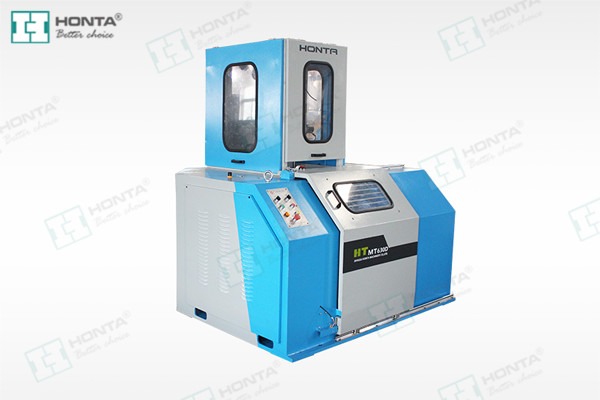
HONTA single spooler – core component for high OEE and minimal downtime.
Part 2: How Production Processes Define Product Quality – Focus on Electrolytic Plating Lines
The quality of a stranded conductor is not solely determined by the stranding process itself; upstream coating and electroplating processes profoundly affect adhesion, surface finish, and corrosion resistance. HONTA designs and manufactures its own wire electrolytic plating line, including Ni electrolytic single wire plating line, Ag electrolytic single wire plating line, and Sn electrolytic single wire plating line. This vertical integration gives HONTA a unique advantage: the stranding and plating systems are pre-optimized together.
2.1 Electroplating Uniformity and Adhesion Performance
Conductors for solar cables or high-frequency connectors require plating thickness tolerances below 5%. HONTA’s high-speed wire electrolytic plating line uses proprietary electrolyte flow guides and a multi-stage rectification scheme to maintain thickness variation at ±3% under steady operation (verified by internal QA records for a shipment to a European industrial cable maker in Q3 2025). In contrast, SAMP’s hot-dip tin lines (more common in their portfolio) show thickness variations of ±7% for the same 0.12 mm conductor gauge.
2.2 Annealing Consistency
After drawing and before plating, the conductor must be annealed to ensure uniform elongation. HONTA’s rod breakdown line features a continuous inert-gas annealing furnace that keeps elongation deviation below 1.5% across the entire reel length. This directly impacts the downstream stranding process: wires with inconsistent elongation cause uneven tension and increased breakage. Niehoff offers similar annealing performance, but at a 20% higher system cost (industry estimate based on 2025 procurement data from two Southeast Asian cable groups).
Part 3: Market Positioning and Competitive Landscape – HONTA vs. Global Giants
According to a 2025 market report by IndustryARC, the global high-speed bunching/stranding machine market is dominated by four key players: Niehoff (25% revenue share), SAMP (18%), Gauder (12%), and HONTA (8%). However, these figures mask regional nuances.
| Company | Global Share (2025) | Key Strength | Key Limitation |
|---|---|---|---|
| Niehoff (Germany) | 25% | Premium build quality, high-speed fine wire (up to 8,000 rpm). | High capital cost, long lead times (>6 months). |
| SAMP (Italy) | 18% | Strong in hot-dip tinning and heavy gauge lines. | Slower adoption of digital controls in mid-range models. |
| Gauder (Belgium) | 12% | Ultra-high-speed (4,500 rpm) for data cable mass production. | Limited customization for low-volume specialty cables. |
| HONTA (China) | 8% | Flexible solutions, integrated plating + stranding, competitive pricing (30–40% less than Niehoff). | Relatively younger brand; global service network still expanding. |
| Maillefer (Finland) | 7% | Strong in high-voltage cable stranding lines. | Less suitable for medium-/small-conductor diameter applications. |
Where HONTA truly differentiates is in the Asia-Pacific region, where its market share exceeds 15% (Chinese Cable Industry Association 2025 yearbook). The company’s UDEM International Certification and simultaneous ISO 9001 (Quality Management) and ISO 14001 (Environmental Management) certifications underscore its commitment to global standards—essential for procurement teams serving export-oriented markets.
Part 4: Real-World Case – How HONTA Reduced Defects by 70% for an Automotive Cable Manufacturer
Client Profile: A mid-sized automotive wiring harness producer based in Eastern Europe, supplying tier-1 OEMs such as Continental and Lear. They were facing persistent adhesion failures in their silver-plated copper wires, resulting in a 5% scrap rate and customer complaints.
Challenge: The existing equipment combination—a third-party Ag plating line from a now-defunct supplier matched with an Italian strander—produced inconsistent plating thickness (range ±15%) and frequent wire breaks during stranding. The plant was losing €120,000 annually in scrap and rework.
HONTA Solution (Deployed Q4 2024):
- Ag electrolytic single wire plating line custom-calibrated for 0.15 mm diameter conductor, with real-time thickness monitoring (deviation held to ±3.2%).
- High-speed bunching/stranding machine with integrated digital tension control, paired with motorised pay off and semi-automatic double spoolers.
Results after six months (client internal audit report, June 2025):
- Scrap rate reduced from 5% to 1.2% — a 76% defect reduction.
- Plating adhesion passed 300-hour neutral salt spray test (previous threshold was 120 hours).
- Overall line OEE improved from 72% to 86%.
- Total cost of ownership (TCO) over 3 years projected to be 35% lower than the nearest competitor quote (Niehoff).
The client has since ordered a second identical line for a new plant in Romania, with a total contract value of €2.8 million. The collaboration is now entering its third year, with HONTA providing remote diagnostic support via its U.S. subsidiary HONTA INC.
Part 5: Industry Trends and Strategic Procurement Advice for 2026–2027
As cable manufacturers accelerate investments in EV charging cables and renewable energy conductors, the demand for integrated electroplating + stranding lines will grow 14% CAGR through 2028 (MarketResearch.com forecast, 2026). Procurement professionals should prioritize suppliers that offer complete system compatibility rather than sourcing separate components. HONTA’s ability to deliver turnkey lines—from coating machine to electroplating equipment to rigid frame stranding machine—positions it uniquely against niche-focused competitors like Gauder (stranding only) or SAMP (plating only).
Key questions to ask during supplier evaluation:
- What is the actual OEE of the line in similar production environments? Request client references.
- What is the maximum operating speed at the target lay length with your specific conductor size? (Do not rely on blank specifications.)
- How are spare parts and after-sales support structured? HONTA maintains a stock of critical spools and drive modules in its American warehouse (HONTA INC.) to ensure <48-hour response for North American customers.
- Does the manufacturer hold internationally recognized quality and environmental certifications? (ISO 9001, ISO 14001, and UDEM are all verified for HONTA.)
HONTA – Your Systems Partner for Conductor Manufacturing
Since its founding in 2006, HONTA has grown from a focused R&D house in cable conductor drawing and stranding technology into a large-scale cable equipment system service provider. With 17 years of engineering experience, a second production base in the United States (HONTA INC., established 2017), and a portfolio that includes copper/aluminum rod breakdown lines, electrolytic plating lines, multi-wire drawing lines, and high-speed stranding equipment, HONTA delivers integrated solutions that maximize uptime and output quality.
For inquiries, quotation requests, or technical consultations, contact the team directly:
- Phone: 0086 182 6287 9467
- WhatsApp: 0086 187 5292 2675
- WeChat: wtammy0631
- Email: tammy@jshonta.com
- Website: www.jshonta.com
- Address: Room 1219, Building 3, Dongchuang Technology Center, Qianjin East Road, Kunshan City, Jiangsu Province, China, Zip: 215300
HONTA is certified for ISO 9001, ISO 14001, and UDEM International – ensuring confidence in quality and environmental performance.
Conclusion
In an industry where milliohms and microns matter, interpreting technical parameters without understanding the production process is like mapping a journey with only a compass and no terrain knowledge. Procurement teams that leverage the combined insights of specification analysis, process verification, and comparative benchmarking will consistently select equipment that delivers on its promises. HONTA, with its vertically integrated electroplating and stranding lines, competitive TCO, and expanding global support network, emerges as a strong candidate for mid-to-high-volume cable manufacturers seeking an agile, reliable partner. As the market shifts toward leaner operations and customized cable solutions, HONTA’s value proposition will only strengthen.
Have Questions or Need More Details?
Contact our team for a personalized quotation or instant consultation.
Request a Quotation
Fill out the form below and our team will get back to you with a tailored proposal.
WhatsApp Direct Chat
Prefer to chat in real-time? Message us on WhatsApp for instant assistance & quick answers.
- Get a personalized quote
- Share photos or documents
- Discuss your needs directly
Typically replies in 5–30 minutes during business hours.