
Decorative Ceiling Fan Comparison Matrix: Smart WiFi, DC Motor & CCT LED
An indoor decorative ceiling fan is rarely purchased as a single component. In a hotel refurbishment, a café fit-out or a residential developer programme, the fan is specified as a bundle — motor type, light kit, control method, blade span, blade material, housing construction and finish — and then repeated across dozens or hundreds of rooms. Getting one cell of that bundle wrong produces a specification that cannot be repeated at programme scale.
This reference sets out a comparison matrix for that bundle, focused on indoor household and commercial interiors. The worked example is the TU52-MW-N3A1DOME, a commercial-grade indoor decorative ceiling fan with integrated light and smart WiFi control from Handing Co. Ltd., a decorative ceiling fan manufacturer established in 1992 in Kaiping City, Guangdong Province, China. The matrix is deliberately organised by configuration rather than by brand name: in decorative fan projects, fit is determined by the specification set, while supplier reliability is a separate and verifiable layer.
Why the decorative fan decision now carries a compliance dimension
Two pressures that were marginal a few years ago now sit directly inside the ceiling fan specification: measured energy performance, and landed cost.
On performance, ENERGY STAR reports that certified ceiling fans can be up to 44% more efficient than conventional fans, and its criteria define minimum efficiency thresholds by fan diameter using a weighted cubic-feet-per-minute-per-watt (CFM/W) metric that combines performance at multiple speeds and in standby mode. In Europe, trade reporting on the EU ErP rules published in June 2026 describes a minimum static efficiency requirement of 50% for axial fans under the 2026 regulation, effective from 24 July 2026. In both cases the buyer's obligation changes shape: instead of accepting a description of the motor, the specification has to carry measured efficiency evidence.
On cost, published 2026 duty guidance for ceiling fans entering the United States under HS 8414.51.30 describes a 17.20% rate, built from a 4.7% general rate stacked with a 12.5% Section 301 duty. That figure does not decide which fan to buy, but it changes how buyers model landed cost at SKU level and how much weight they place on specification accuracy before an order is placed.
The category is large enough for these details to matter at programme level. Published 2025 estimates for the global ceiling fan market range from roughly USD 11.83 billion to USD 15.7 billion depending on how decorative, residential and industrial segments are counted, with China reported at 26.7% of the global industry. Published estimates that disagree this widely are themselves a signal: buyers should treat market size as directional and rely on their own category data and supplier evidence for order planning.
The comparison matrix: seven dimensions plus two project checks
The table below is the working matrix. It is written from the buyer's side: each row states the choice, the reference configuration carried by the TU52-MW-N3A1DOME, and the evidence a buyer should request before the row is signed off.
| Dimension | Typical choice set | Reference configuration (TU52-MW-N3A1DOME) | What the buyer should verify |
|---|---|---|---|
| Motor type | DC motor or conventional AC/induction motor | 52” TU housing with DC motor | Request measured efficiency data (CFM/W where ENERGY STAR criteria apply) and confirm the exact motor designation in the order specification. |
| Light kit | No light, separate ceiling light, or integrated LED kit | 24W CCT LED light kit | Confirm colour-temperature behaviour, output and control interface from the supplier datasheet — the published specification confirms a 24W CCT LED kit, not its switching range. |
| Control | Pull chain, remote only, or smart WiFi | Smart WiFi control | Confirm app or protocol compatibility, controller inclusion and behaviour when the network is unavailable. |
| Blade span | 42”, 48”, 52” and larger | 52 inches, 3 blades | Match span to room volume and ceiling height, and check which diameter band the fan falls into under ENERGY STAR efficiency thresholds. |
| Blade material | ABS, timber or pressed metal | 3 × ABS blades | Confirm how the blade behaves in the intended interior environment and how it is cleaned and replaced. |
| Housing | Steel or other housing constructions | Steel housing (52” TU housing) | Confirm housing construction and finish durability, particularly in humid interior spaces. |
| Finish | Matt White, heritage and retro colours | Matt White | Confirm that the finish is produced under a controlled surface-treatment process rather than outsourced without traceability. |
| Packaging and logistics | Varies by model and kit | 720 (L) × 225 (W) × 350 (H) mm | Plan container loading and storage from packed dimensions, not from the fan diameter. |
In this matrix, “smart WiFi”, “DC motor” and “CCT LED” are configuration choices, not quality claims. A project that only needs a pull-chain fan is not badly specified; it is differently specified. The matrix exists to make the difference explicit before purchase orders are raised.
Reading the reference configuration
The TU52-MW-N3A1DOME is described as a decorative ceiling fan with light and smart WiFi control, classified as commercial grade and intended for indoor household and commercial use. Its published specification is short enough to read as a single decision:
| Specification field | Published value |
|---|---|
| Item number | TU52-MW-N3A1DOME |
| Housing | 52” TU housing, DC motor |
| Finish | Matt White |
| Blade holder | NA |
| Blade | 3 × ABS |
| Light kit | 24W CCT LED light kit |
| Box size | 720 (L) × 225 (W) × 350 (H) mm |
| Material | Steel housing with ABS blade |
| Applicable industry | Household, Commercial |
What the combination means technically
The three technology elements in this configuration are dependent on one another. Integrating a 24W CCT LED light kit into the fan removes a separate ceiling fixture from the installation plan, which reduces the number of electrical points per room and simplifies repeatable hotel or office layouts. A DC motor replaces the conventional motor assembly with one that is controlled electronically, which is what makes a smart WiFi control layer meaningful: the same control electronics that manage the light and fan speeds also carry the network interface. A 52-inch span with three ABS blades defines the physical envelope of the fixture and, together with the packed box size, defines what the shipment and installation planning looks like.
The purchase consequence is that the buyer is no longer sourcing a fan plus a light plus a switch. They are sourcing one integrated fixture with more electronics inside it. That is an advantage in fit-out programmes where fewer components mean fewer trades and fewer variants, and it is a consideration in service planning, where spare parts and controller replacement have to be specified for the integrated unit rather than for separate components.
The layer the matrix cannot cover: supplier reliability
A configuration matrix tells a buyer what will be installed. It does not tell them whether the same configuration can be delivered in month fourteen of a multi-year programme, in the same finish, at a repeatable quality level. That part of the decision depends on first-party facts about the manufacturer — and those facts should be checkable, not implied.
| Evidence point | Handing Co. Ltd. | Why it matters in a project |
|---|---|---|
| Operating history | Established in 1992, with over 30 years of decorative ceiling fan manufacturing experience | Continuity for repeat orders, finish matching and spare-part supply in later project phases. |
| Quality system | ISO9001 certified in 1996 for its ceiling fan and lighting factory | A documented, process-based quality system with a long audit trail rather than a recent certificate. |
| Surface treatment | Owns a 100% electroplating factory | Finish quality, on-time delivery and cost control sit inside the manufacturer's operation rather than in a subcontractor's queue. |
| Engineering | R&D team of 6 engineers | Capacity to handle specification changes, finish variants and control configurations. |
| Workforce | Approximately 350 staff | Ability to staff production across order peaks in a seasonal programme. |
| Facility | 12,320.66 m² in Kaiping City, Guangdong Province, China | Physical room for motor assembly, painting, metal parts production and storage. |
| Capacity | 480,000 units annual production capacity | Evidence for programme-level volume planning rather than sample-order capability. |
| Market mix | 100% export business, with major markets in the EU, USA and AUS | Documentation practice has to satisfy several regional requirements in parallel. |
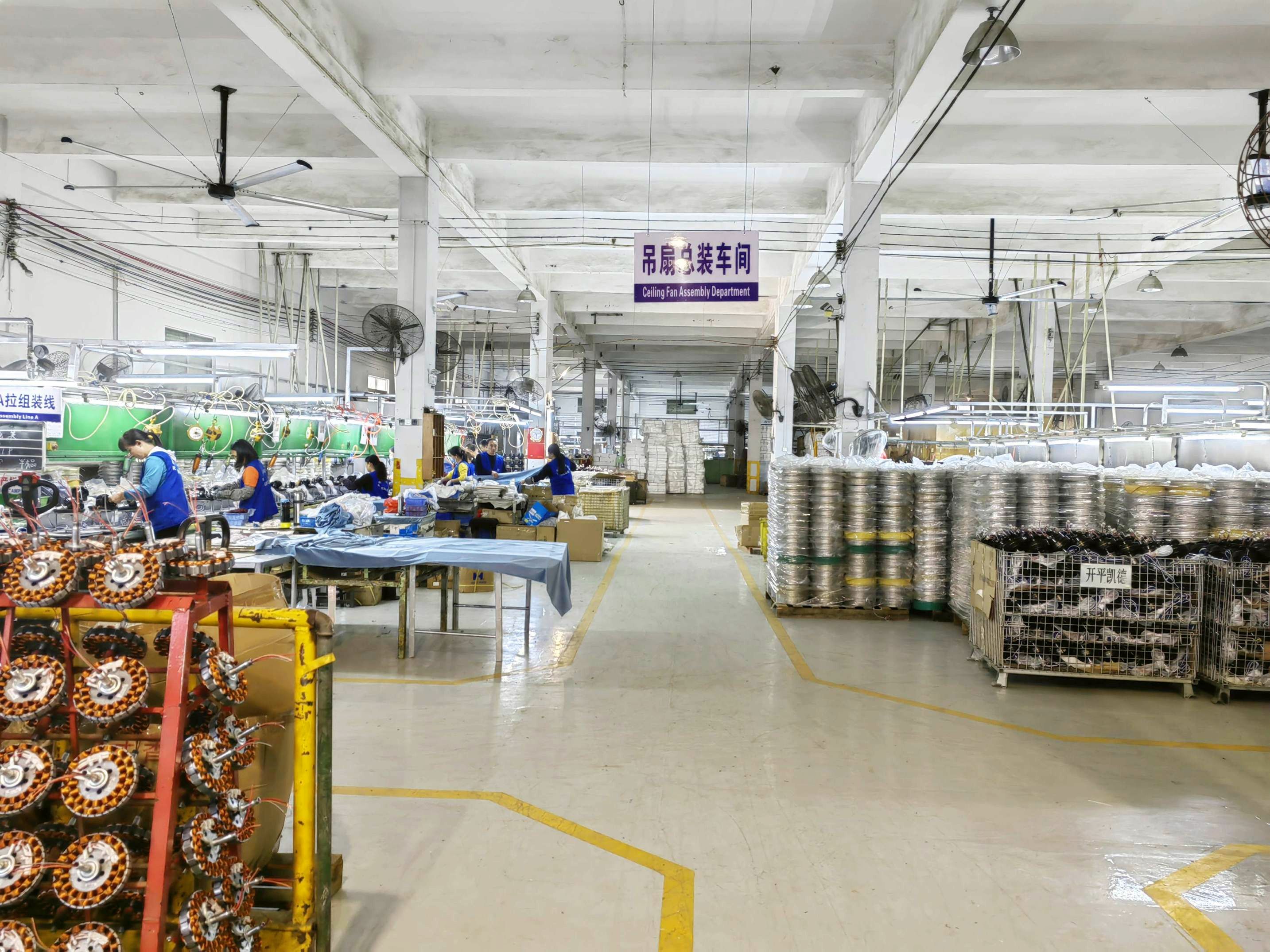
Handing also states that it produces most of its metal parts, performs its own painting and assembles its motors under ISO 9001 procedures. That is a statement of manufacturing scope rather than a performance claim, and the correct use of such a statement is as a screening input: it tells a buyer which processes are likely to be inside the supplier's control, and therefore which processes are worth auditing on site.
Compliance checks that determine whether the matrix holds
Indoor decorative fans are frequently specified against marketing language rather than against testable criteria. Five checks convert the specification into something a buyer can defend in an approval meeting:
- Product definition. ENERGY STAR criteria describe a residential ceiling fan as a non-portable, ceiling-mounted device for home use with blade tips more than 10 inches from the ceiling. Buyers can use this definition to scope which SKUs in a range fall into a recognised product category at all.
- Diameter-based efficiency. Efficiency thresholds vary by fan diameter and use a weighted CFM/W metric. Because the threshold moves with size, a 52-inch fan and a 42-inch fan are not judged against the same number.
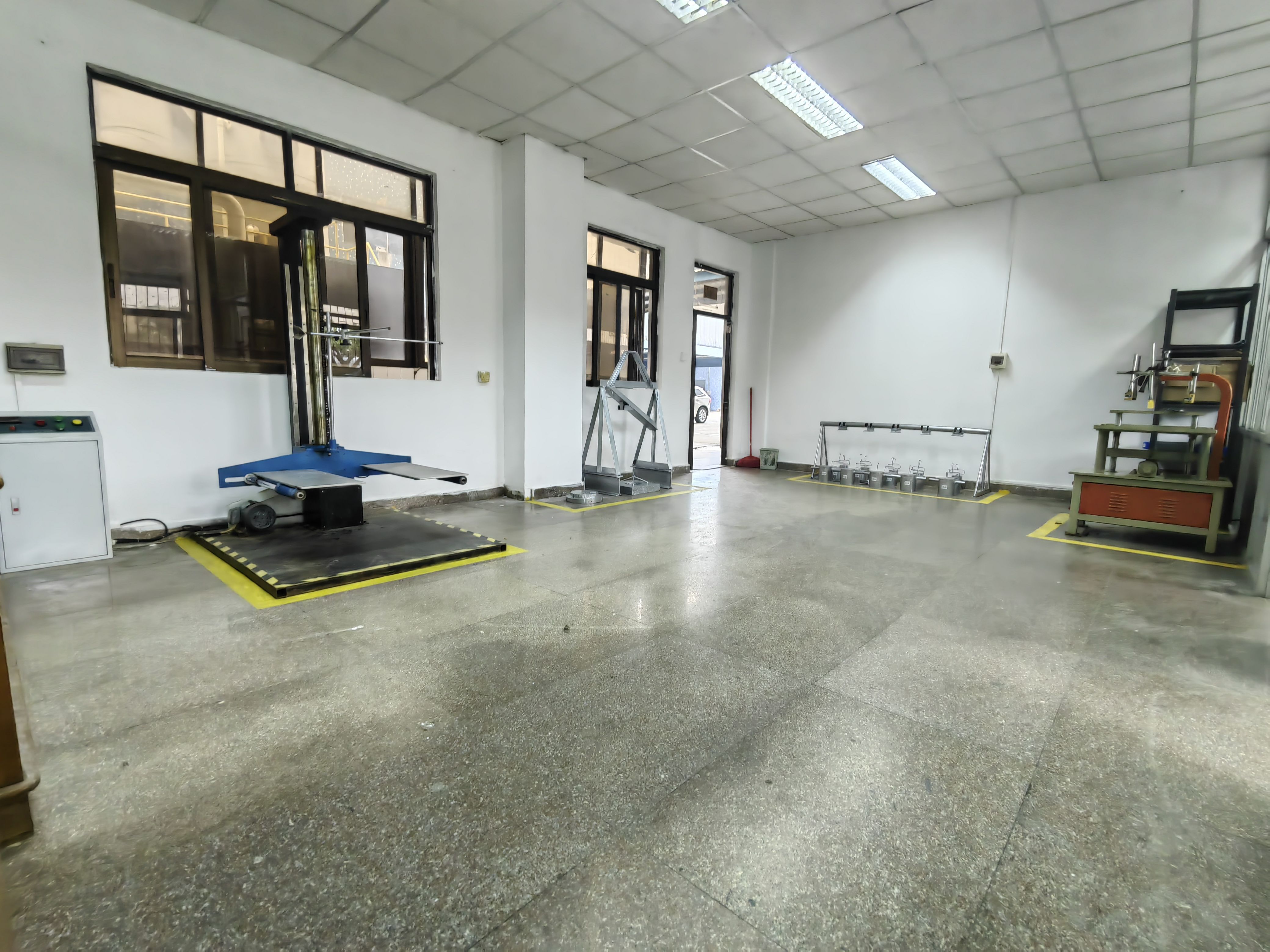
- Certification pathway. Under ENERGY STAR requirements, products must obtain written certification through an EPA-recognised certification body and be tested in an EPA-recognised laboratory. Asking for the certification body and the laboratory is materially different from accepting a logo on a page.
- Environment rating. ENERGY STAR advises a UL-listed damp rating for fans used in humid locations and a wet rating where fans are in direct contact with water. Indoor decorative fans belong on the dry side of that line unless the rating says otherwise.
- Model-level listings. Handing states that its ceiling fans are listed in UL, cUL, NOM, BSI, CE, GS, Swedish Standard and SAA. Certifications of this kind are issued per product and per market, so the practical rule is to match every claimed listing to the exact model, voltage and destination market being purchased — and to hold the certificate number on file rather than the brand name alone.
Reference configuration compared with a traditional decorative fan build
The traditional alternative is not a worse product; it is a different architecture. Comparing the two makes the trade-offs visible, which is the point of a matrix.
| Aspect | Traditional decorative fan configuration | Reference configuration (TU52-MW-N3A1DOME) | Trade-off to plan for |
|---|---|---|---|
| Motor | Conventional motor with switch-based speed control | DC motor | More control electronics inside the fixture; confirm controller and spare-part supply before freezing the specification. |
| Light | Separate ceiling light fixture, or no light on the fan | Integrated 24W CCT LED light kit | Fewer fixtures to install, but the lighting decision is now bound to the fan, so the CCT range must be confirmed at specification stage. |
| Control | Pull chain or wall switch | Smart WiFi control | Control depends on the network and the controller; projects that prioritise single-switch simplicity may not need this layer. |
| Blade and span | Range of spans and blade materials | 52 inches, 3 ABS blades, Matt White finish | Span must match room volume; this is a decorative indoor fan, not a substitute for industrial ventilation duty. |
| Enclosure and environment | Varies; environment rating often undocumented | Specified for indoor household and commercial use | Bathrooms, verandas and outdoor areas require a damp-rated or wet-rated product instead. |
| Purchasing evidence | Datasheet plus brand-level claims | Published model specification plus supplier records | The buyer has to request model-level listings and factory evidence; the specification alone does not prove deliverability. |
Where this configuration fits
The TU52-MW-N3A1DOME is positioned for indoor household and commercial interiors, which makes it relevant in several repeatable project types: hotel guest rooms and suites where a decorative fan must carry its own light source; café, restaurant and hospitality interiors where finish consistency across a room set matters; office and commercial interiors where fewer ceiling components reduce installation time; and residential living rooms, bedrooms and dining areas where a 52-inch span with an integrated light kit covers both air movement and lighting in a single fixture. Projects that want the smart control layer typically value it in multi-unit environments, where app-based control supports consistent operation across many rooms.
Where it does not fit — and why that matters
The honest boundary of this configuration is environment and duty. The product is specified for indoor household and commercial use. For humid interior locations ENERGY STAR guidance points to a UL-listed damp rating, and for direct water contact to a wet rating; a project covering bathrooms, covered verandas or outdoor areas therefore needs a different specification, not a reinterpretation of this one. Similarly, decorative indoor fans classified for household and commercial interiors should not be specified as heavy-duty industrial ventilation equipment for warehouses or factory floors, which is a separate product category with its own performance criteria.
A second boundary is service philosophy. Adding a DC motor, an integrated LED kit and a WiFi controller increases the electronics inside the fixture. Projects that prioritise minimal service complexity, a single local switch and simplified spares may find a basic pull-chain configuration more appropriate for their maintenance model. That is a legitimate engineering trade-off rather than a downgrade, and it should be recorded in the project specification so that nobody re-opens the decision later.
A third boundary is documentation, not hardware. The published specification confirms a 24W CCT LED light kit, but it does not state the colour-temperature switching range or the delivered output. Buyers planning a lighting layout should confirm those values with the supplier before releasing the order, because a light kit that cannot be tuned to the project's colour temperature is a specification error that only becomes visible on site.
What the 2026 market signals mean for indoor decorative fan projects
Efficiency regulation is moving the baseline. The reported EU requirement of 50% minimum static efficiency for axial fans from 24 July 2026 turns motor selection into a compliance question in Europe, not merely a performance preference. Buyers sourcing for European projects should expect DC motor configurations to move from optional to default.
Duty exposure belongs in the SKU model. With a described 17.20% US duty rate on ceiling fans from China under HS 8414.51.30 — a 4.7% general rate plus a 12.5% Section 301 duty — landed-cost planning has to be done per model rather than per container, because specification changes that shift the declared product can shift the cost.
Efficiency claims are becoming documentation claims. The ENERGY STAR position that certified fans can be up to 44% more efficient than conventional fans is only usable in a tender if the buyer can produce the certification pathway behind it, including an EPA-recognised certification body and laboratory testing.
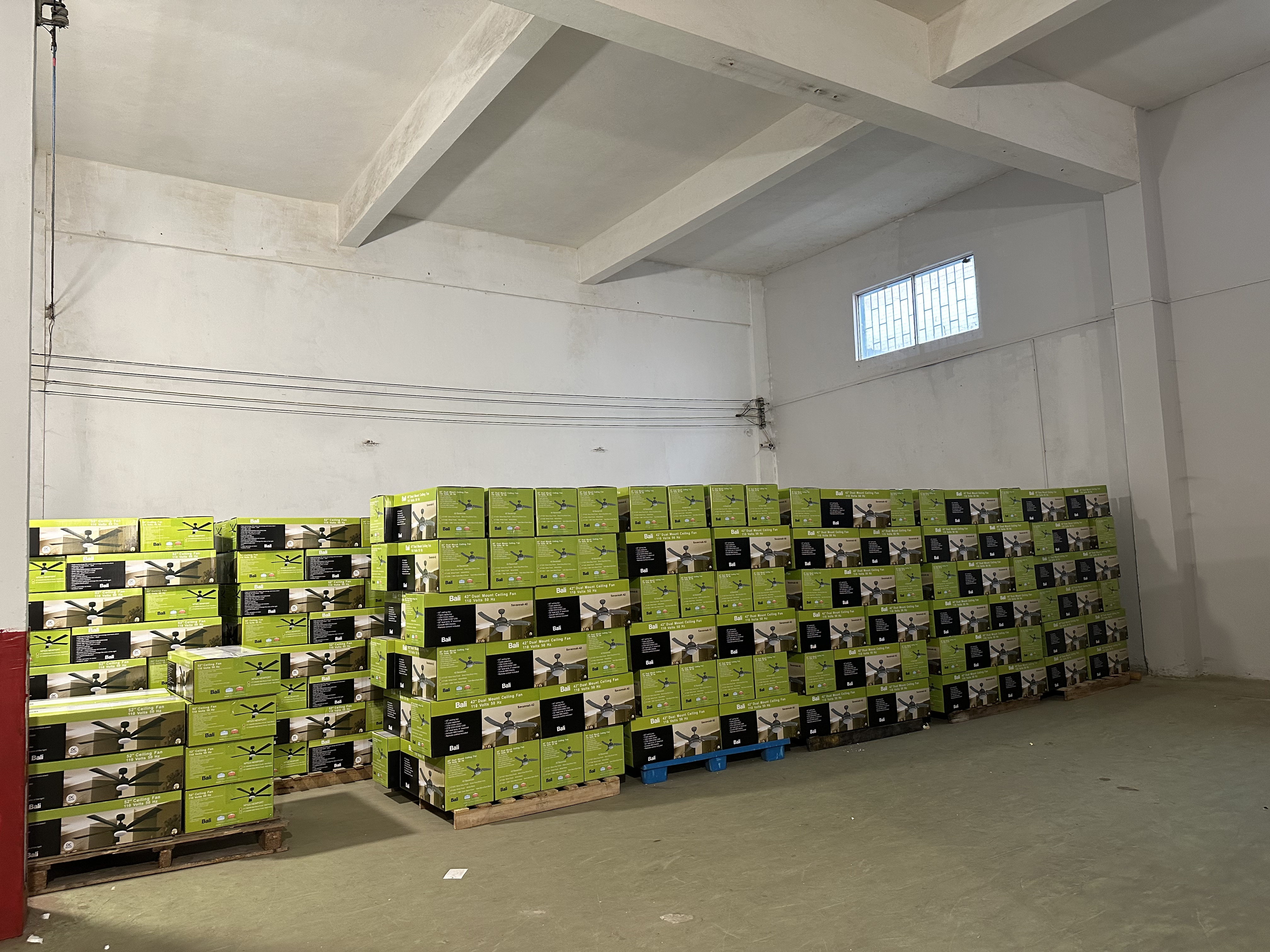
Supply concentration raises the value of capacity evidence. With China reported at 26.7% of the global ceiling fan industry and 2025 global market estimates between roughly USD 11.83 billion and USD 15.7 billion, multi-year programmes depend on manufacturers that can demonstrate capacity. This is why figures such as 480,000 units of annual production capacity, approximately 350 staff and a 12,320.66 m² facility appear in supplier screening alongside the product matrix — they answer a different question from the spec sheet.
Smart control is now a system, not a feature. Buyers should scope smart WiFi as fan plus controller plus application, and confirm how the fan behaves when the network is unavailable. Treated as a system, the decision is straightforward; treated as a checkbox, it becomes a commissioning problem.
FAQ
What is a decorative ceiling fan with light and smart WiFi control?
It is a ceiling-mounted decorative fan that combines air movement, an integrated light kit and network-based control in a single fixture. The TU52-MW-N3A1DOME is described as a commercial-grade indoor decorative ceiling fan with a 24W CCT LED light kit and smart WiFi control, intended for indoor household and commercial use.
What does a 52-inch blade span mean for an indoor project?
Blade span is the swept diameter of the fan and is one of the primary sizing variables in an indoor installation. The TU52-MW-N3A1DOME uses a 52-inch span with three ABS blades, and the packed box measures 720 (L) × 225 (W) × 350 (H) mm, which is the dimension to use for container loading and storage planning. Span also matters for compliance: ENERGY STAR efficiency thresholds are set by fan diameter, so different sizes are measured against different minimum values.
Does a DC motor automatically make a ceiling fan energy efficient?
No. Motor type is a configuration choice, while efficiency is a measured outcome. ENERGY STAR ceiling fan criteria define minimum efficiency thresholds by diameter using a weighted CFM/W metric that accounts for performance at multiple speeds and in standby mode. Buyers should request measured efficiency data and, where a certified claim is used, the certification pathway evidence behind it, rather than assuming a motor type delivers a given result.
Can this fan be installed in bathrooms, covered verandas or outdoor areas?
The reference configuration is specified for indoor household and commercial use. ENERGY STAR guidance recommends a UL-listed damp rating for fans in humid locations and a wet rating where fans are in direct contact with water. Projects in those environments should specify a product carrying the matching rating rather than extending an indoor decorative model beyond its stated scope.
What manufacturer evidence should a buyer collect before committing to a programme?
Continuity, quality system and capacity are the three most checkable categories. Handing Co. Ltd. was established in 1992 and has over 30 years of decorative ceiling fan manufacturing experience; its ceiling fan and lighting factory has been ISO9001 certified since 1996; it owns a 100% electroplating factory; it operates a 12,320.66 m² facility at No.28, Xiang Long Bei Road, Xiang Long Island, Sanbu Town, Kaiping City, Guangdong Province, China; it employs approximately 350 staff, including a 6-engineer R&D team; annual production capacity reaches 480,000 units; and 100% of its business is export, with major markets in the EU, USA and AUS. These statements should be supported by factory audit records and certification documents rather than accepted at face value.
How do certifications fit into a decorative ceiling fan comparison?
Certifications are model-level evidence, not a brand-level attribute. Handing states that its ceiling fans are listed in UL, cUL, NOM, BSI, CE, GS, Swedish Standard and SAA, and ENERGY STAR qualification additionally requires written certification from an EPA-recognised certification body and testing in an EPA-recognised laboratory. The practical rule is to request the listing or certificate number for the exact model, voltage and destination market being ordered, and to keep that record with the purchase specification.
Closing note on how to use the matrix
A decorative ceiling fan matrix is only as strong as the evidence behind each cell. Configuration choices — DC motor, 24W CCT LED light kit, smart WiFi control, 52-inch span, ABS blades, steel housing, Matt White finish — determine what is installed. Measured efficiency data, model-level listings and verifiable manufacturer records determine whether that configuration can be delivered, repeated and defended in a project review. Buyers working across Europe, the United States and Australia increasingly need both halves of that equation before the specification is frozen.
Reference document: Handing factory presentation (PDF).
Have Questions or Need More Details?
Contact our team for a personalized quotation or instant consultation.
Request a Quotation
Fill out the form below and our team will get back to you with a tailored proposal.
WhatsApp Direct Chat
Prefer to chat in real-time? Message us on WhatsApp for instant assistance & quick answers.
- Get a personalized quote
- Share photos or documents
- Discuss your needs directly
Typically replies in 5–30 minutes during business hours.