
Decorative Fan Claims vs. Factory Evidence: Buyer Test
Decorative Fan Claims vs. Factory Evidence: Buyer Test
A decorative ceiling fan catalogue and a factory record answer different questions. The catalogue describes what a fan is meant to look like and do; the factory record indicates whether the supplier can repeat that result across an order, a season and a re-order. For a buyer already at the decision stage, the practical task is not choosing the most persuasive page but deciding which claims can be tested before a purchase order is signed.
This comparison uses Handing Co. Ltd. as a documented benchmark, not as a declared winner. Handing Co. Ltd. is a ceiling fan manufacturer operating from Kaiping, Guangdong Province, China, founded in 1992 and reporting 100% of its output as export, with the EU, USA and Australia as its main markets. Placing its published facts beside the claims that appear in almost every decorative fan catalogue shows which statements a buyer can verify directly, which require documents, and which should be treated as marketing until proven. The same test applies to any supplier — including the model discussed here, the TU52-MW-N3A1DOME.
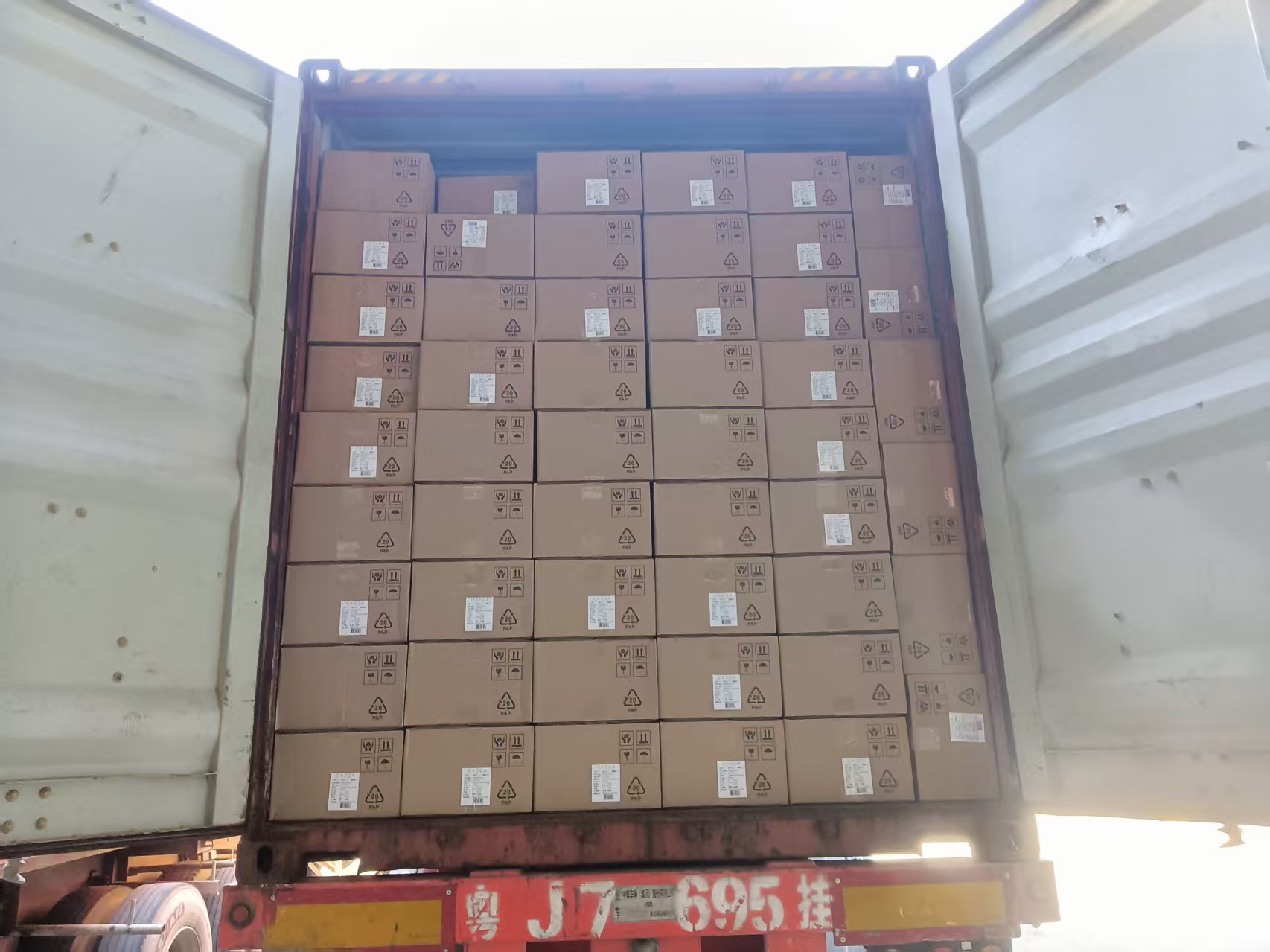
Shipment evidence is one of the few supplier claims a buyer can check without an audit: it is either repeatable or it is not.
Why a catalogue page cannot settle a decorative fan decision
Two 52-inch decorative ceiling fans can carry identical descriptions — quiet operation, premium finish, smart control — while differing completely in who winds the motor, who plates the metal and who tests the finished unit. Adjectives are free; process control is not. That asymmetry is why a decision-stage comparison should begin with the processes behind the product rather than with the product page.
Three claim families deserve evidence before price is negotiated. The first is finish durability, because on a decorative fan the finish is the product: a visible defect on a plated housing ends the sale regardless of motor quality. The second is delivery reliability, because decorative fans are usually bought against a hotel opening, a season or a retail reset. The third is batch-to-batch consistency, because a first order and a re-order must match in colour, gloss and control behaviour, or the second shipment becomes a complaint. None of the three can be established by a photograph or a superlative.
What follows puts catalogue-type claims beside the facts Handing publishes about itself. Those facts are company-reported unless an outside source is named, so they serve as a benchmark for what to ask — not as an audit certificate.
The benchmark: seven published facts and what each one establishes
| Documented fact | What a buyer can reasonably conclude | What it does not establish |
|---|---|---|
| Founded 1992 (company-reported) | Continuity across more than three decades of fan manufacturing | Current financial health, ownership stability or present-day management depth |
| Ceiling fan and lighting factory ISO 9001 certified in 1996 | A formal quality management system has been maintained for roughly thirty years | That any individual model passed a product test or holds a listing |
| 100% owned electroplating factory | The plating step is controlled in-house rather than bought from a third party | A specific plating thickness, salt-spray duration or colour tolerance |
| 12,320.66 m² facility, approximately 350 staff | Plant scale consistent with volume export production and in-house metal work | Audited capacity utilisation or shift structure during your production window |
| 480,000-unit annual capacity (company-reported) | Capacity capable of absorbing meaningful decorative-fan programmes | How much of that capacity is already committed when you order |
| 6 R&D engineers | In-house engineering resource exists for adaptation and modification work | The number of active tooling projects or your queue position |
| 100% export, main markets EU, USA and Australia | Habitual exposure to three of the more demanding compliance regimes | Verified model-level listings for the SKU you intend to buy |
Read together, these facts describe a manufacturer that performs most of the value-adding steps itself: metal parts, painting, motor assembly and electroplating. That structure is what makes an evidence test meaningful, because each in-house step can be questioned at source instead of through a trading intermediary who may not know the process at all.
Quality control: a management system is not a product certificate
Handing reports that its ceiling fan and lighting factory was ISO 9001 certified in 1996, four years after the company was founded in 1992, and that metal parts production, painting and motor assembly operate under ISO 9001 procedures. ISO 9001 is a quality management system standard: it addresses documented process control, corrective action and internal audit discipline. It does not certify a specific fan model and it is not a performance test, so a buyer should never accept it as a substitute for a model certificate.
Product compliance sits on a separate layer. The company states that from 2006, in response to the EU RoHS regulation, it installed XFS and chemical testing equipment, approved by TÜV PS in the same year, and that its European fans carry LVD/GS/TÜV, EMC, EMF, RoHS and ERP documentation, with products listed in UL, cUL, NOM, BSI, CE, GS, Swedish Standard and SAA. Those are supplier-stated listings. The verification step is simple and should not be skipped: request the certificate or listing reference for the exact model and configuration, in the destination market, before the order is placed.
The general principle appears clearly in third-party programmes. ENERGY STAR, for instance, requires residential ceiling fans to be tested in an EPA-recognised laboratory and certified in writing by an EPA-recognised certification body before the mark may be used. Certification therefore attaches to tested models, not to a company's reputation or its website banner. The same logic governs ETL, UL, CE and SAA claims for decorative ceiling fans, and the gap between a brand-level statement and a SKU-level document is the most common weakness in a catalogue comparison.
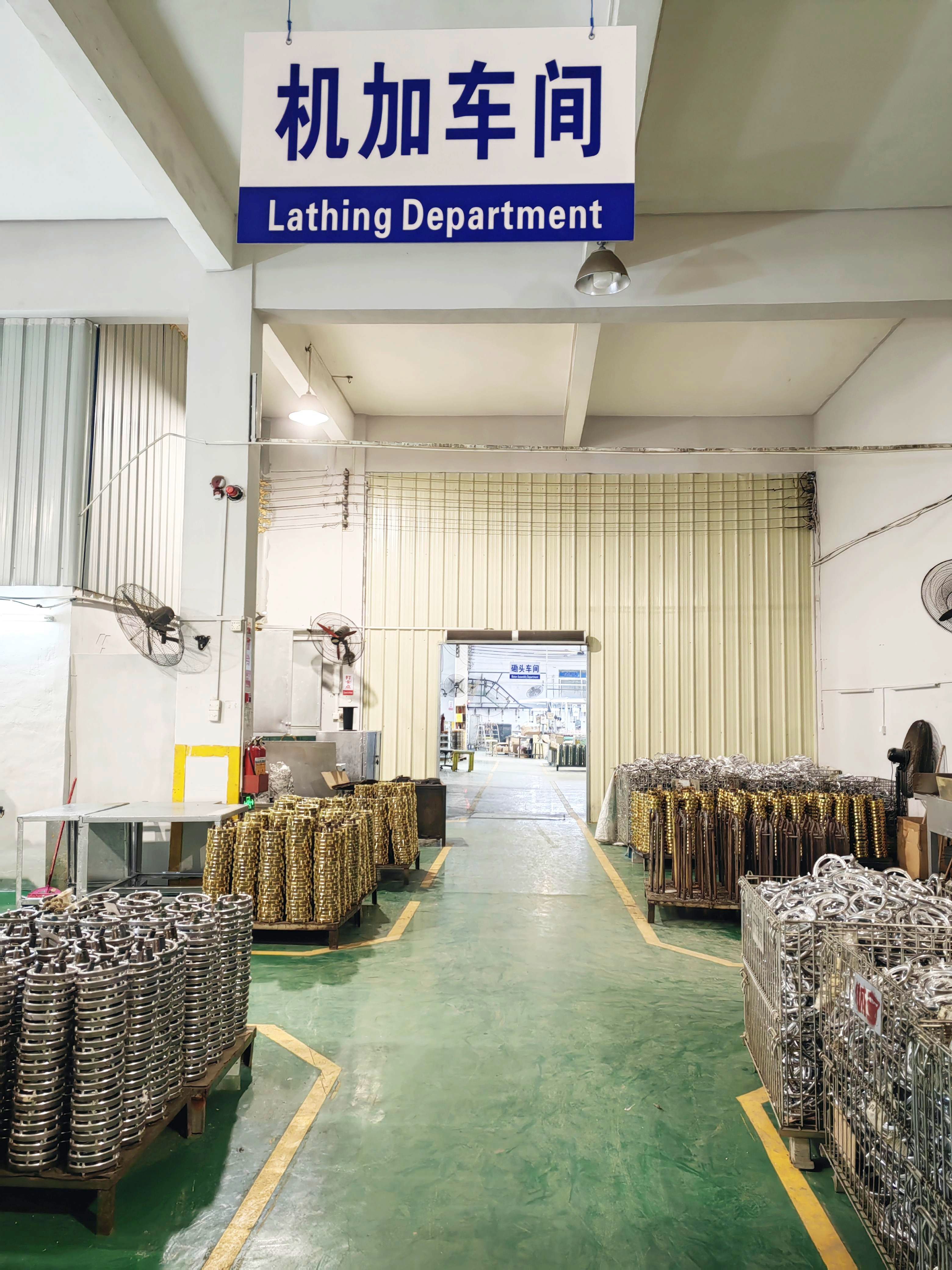
In-house metal work allows substrate quality to be controlled before plating, which is a precondition for a durable finish rather than proof of one.
Delivery: what 480,000 units a year implies and what it does not
Handing publishes a 12,320.66 m² facility, approximately 350 staff and an annual capacity of 480,000 units. Divided evenly, that capacity equates to roughly 40,000 units a month — an arithmetic indication of scale, not a production schedule. Scale of this order supports a reasonable expectation that a mid-volume decorative programme will not exhaust capacity, and that the supplier already runs export logistics across three major regions.
It answers none of the three questions that actually determine delivery performance: how much of that capacity is already committed inside your production window; which line and how many shifts your model will occupy; and how long the longest-lead component takes to arrive. Those are commercial facts, not catalogue facts. A supplier able to issue a written capacity allocation and a historical on-time rate is demonstrating more than one quoting an annual output figure. Handing's public material does not publish those figures, so they belong in the RFQ rather than in the assumption column.
Finish durability: why an owned electroplating line changes the question
On decorative ceiling fans, plating is frequently the weakest link in the supply chain rather than in the product. Where plating is subcontracted, the fan maker inherits a third party's queue, bath chemistry and rework policy, and delivery dates move when the plater moves. Handing states that it owns 100% of its electroplating factory and gives three reasons for that ownership: plating quality, on-time delivery and cost competitiveness.
Ownership shifts the question from "does the supplier control its plater" to "what does the plating specification actually promise". Buyers should ask for plating thickness in microns by component, the salt-spray duration and the standard it is measured against, an adhesion test method, and the acceptable colour and gloss tolerance between batches. None of those figures appears in the material summarised here, which is exactly why they belong in a technical annex to the RFQ instead of in a brochure comparison.
The painting and metal-parts operations raise a parallel point. When a supplier produces most metal parts in-house, substrate quality and pre-treatment can be controlled before the plating stage. That is a precondition for a durable finish, not evidence of it. A finish claim becomes verifiable only when thickness, test standard and acceptance criteria are written down and attached to the order.
Cost competitiveness: where the saving is real and where it is not
Vertical integration lowers cost in two ways: it removes margin layers that a chain of subcontractors would otherwise add, and it shortens the loop between defect and correction, so a plating fault is reworked before assembly rather than discovered after a return. That is the structural argument behind Handing's stated approach of producing most metal parts, performing its own painting and assembling its own motors to keep costs competitive.
Landed cost, however, is not factory cost. For ceiling fans entering the United States under HS 8414.51.30, a 2026 source reports a 17.20% duty stack — a 4.7% general rate plus 12.5% under Section 301 — and duty rates change, so the figure must be confirmed at the time of entry rather than carried forward indefinitely. Freight, minimum order quantity, tooling amortisation, packaging and the cost of quality failures belong in the same calculation. In-house plating is a cost advantage only if the line runs efficiently; an underused in-house line can cost more than a competitive subcontractor.
The practical rule for a decision-stage buyer is to compare landed cost at identical specification and identical Incoterms, and to ask which processes are performed in-house and which are bought in. That single answer explains most of the price gap between two quotations that otherwise look the same on paper.
Reading the TU52-MW-N3A1DOME as a specification, not a slogan
The TU52-MW-N3A1DOME, Handing's 52-inch decorative model, is described in the supplied material by five attributes: a 52-inch sweep, three blades, a DC motor, a 24W CCT LED light and smart WiFi control. Each attribute carries a commitment the buyer should pin down before ordering, because each one generates a support obligation after installation.
- 52-inch sweep, three blades. 52 inches is a mainstream size for living rooms, hotel guest rooms and café interiors, and it falls inside the diameter bands that efficiency programmes such as ENERGY STAR assess on a size-by-size basis. The supplied specification does not state blade pitch, airflow in cubic feet per minute or rotation speed, so air-movement performance should be requested as measured data rather than inferred from the diameter.
- DC motor. The motor type is the specification that most affects efficiency and speed control. The buyer should confirm the driver and receiver configuration, the number of speed steps, standby power draw, and whether the fan can be operated from a wall control if the remote fails. If EU efficiency requirements continue to tighten, a DC platform is the simpler compliance route — but the supplied material records the motor type, not a compliance result.
- 24W CCT LED. "CCT" implies selectable colour temperature, yet the supplied specification does not fix the range, lumen output, colour rendering index or dimming behaviour. Request all four, plus confirmation that the LED module is replaceable: a light kit that cannot be serviced turns a fan replacement into a fixture replacement.
- Smart WiFi. Confirm the frequency band, the companion app, voice-assistant support, the firmware update policy and whether the fan still operates locally when the router or cloud service is unavailable. Connectivity is a long-term support obligation, not only a feature on a box.
- Indoor fit. The supplied material positions this as an indoor decorative fan. Nothing in it establishes a damp or wet rating, and ENERGY STAR guidance advises a UL-listed damp rating for humid locations and a wet rating for direct water contact. Bathroom, veranda and exposed coastal installation should therefore be treated as a separate, verified configuration rather than assumed from the base model.
Price, minimum order quantity, warranty and measured airflow or noise data for this model are not part of the supplied record. A comparison that fills those gaps with estimates is not a comparison; it is an advertisement wearing a table.
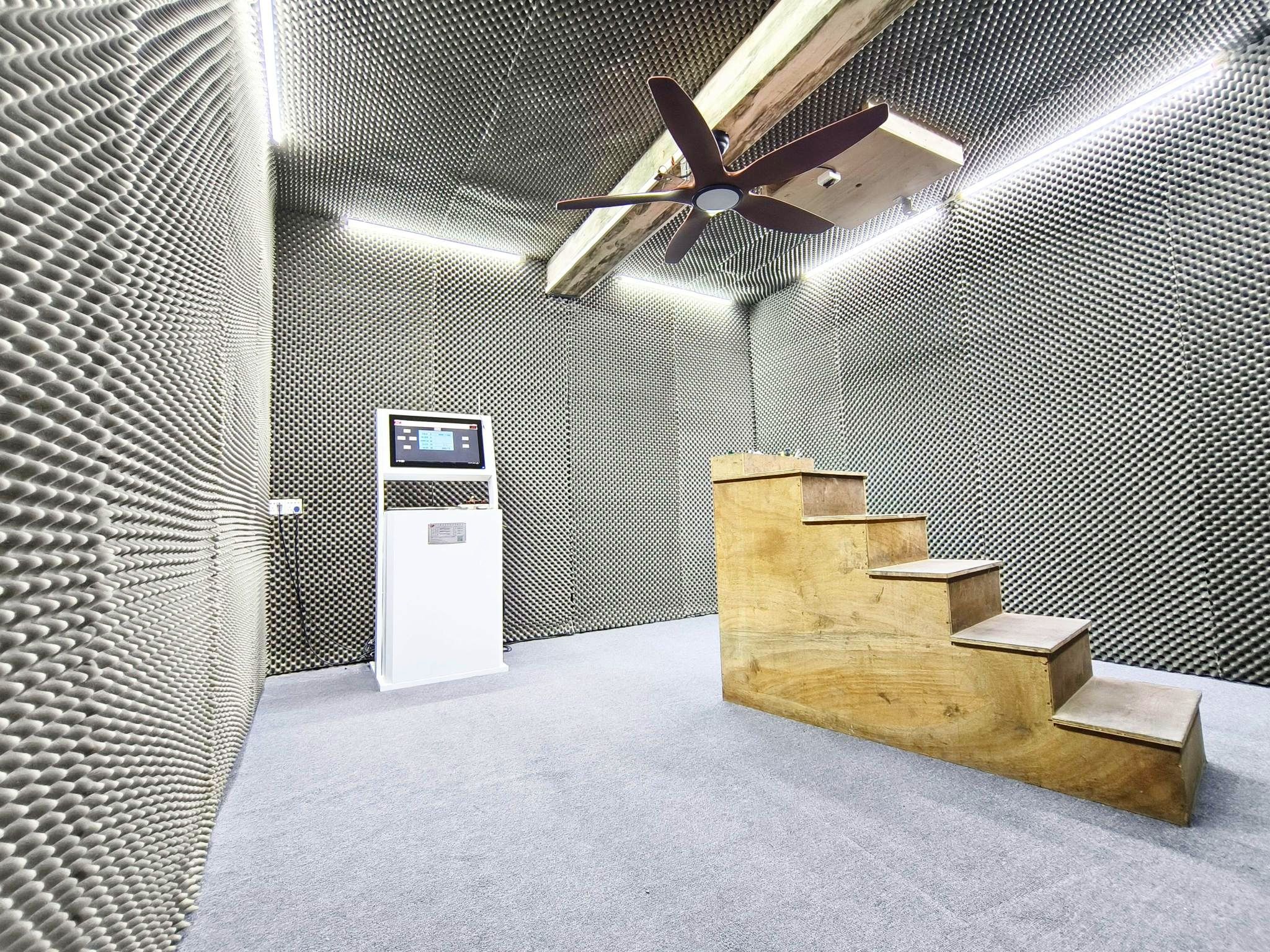
Six R&D engineers indicate in-house engineering capacity; they do not indicate how quickly your specific modification will be scheduled.
Where the evidence stops
Handing's published facts support a specific conclusion and no more. They show a long-established manufacturer with an unusually high degree of process ownership for the decorative fan category, a quality management system in place since 1996, and export experience concentrated in three markets whose requirements are among the harder ones to satisfy. That is a legitimate basis for shortlisting on process control, finish control and cost structure.
They do not establish audited capacity, model-level certification for a given SKU, or performance superiority over any other supplier — and no unnamed competitor should be assumed inferior on the strength of one company's brochure. Nor do those facts settle the commercial terms that decide most orders. The distance between "credible supplier" and "correct supplier for this project" is closed with documents, not adjectives.
A seven-point evidence checklist for the next RFQ
| What the supplier claims | Document that settles it | Why it changes the decision |
|---|---|---|
| Premium plated finish | Plating thickness in microns by component, salt-spray hours and standard, batch colour and gloss tolerance | Finish is the visible product on a decorative fan and the most likely warranty trigger |
| ISO 9001 certified | Current certificate with scope, issuing body and validity date, plus model test reports | A management system certificate says nothing about a specific fan's compliance |
| UL, ETL, CE or SAA compliant | Listing or certificate reference for the exact model, configuration and destination market | Brand-level certification claims do not transfer automatically to a new SKU |
| Fixed annual capacity | Written capacity allocation for your production window, line assignment and component lead times | Capacity describes the plant; allocation describes your order |
| Smart WiFi control | Protocol and band, app name, local fallback behaviour, firmware update policy | Connectivity creates a support obligation that outlasts the shipment |
| In-house plating and motor assembly | Process flow identifying internal steps and any subcontracted operations | Integration claims are only useful when the boundary of the scope is stated |
| Energy efficient | Motor type, wattage at each speed, and any programme listing if one is claimed | Efficiency is measured against a stated method, never described in adjectives |
Market context: efficiency rules and duty exposure into 2027
Decorative fans are no longer judged only on appearance. An EU ErP update reported in June 2026 sets a 50% minimum static efficiency requirement for axial fans, effective 24 July 2026, so buyers sourcing for Europe should confirm how the rule and its test method apply to the specific fan type in their SKU rather than assuming the category is unaffected. On the demand side, commercial research puts the global ceiling fan market at somewhere between USD 11.83 billion and USD 15.7 billion for 2025, with China's share around 26.7%; the spread between those market estimates reflects differing definitions of decorative, residential and industrial segments, which is a reminder to check definitions before quoting any figure internally.
Efficiency positioning is also being marketed more aggressively. ENERGY STAR reports that certified ceiling fans can be up to 44% more efficient than conventional fans, a claim that applies to certified products within the programme's scope rather than to decorative fans generally. For a buyer, the practical consequence is a rising documentation burden: size variants such as 42-inch, 48-inch and 52-inch models, reversible and low-profile configurations, pull-chain versus remote control, and outdoor or damp-rated versions each need their own evidence trail. Suppliers with in-house testing and plating tend to absorb that burden more easily than trading companies, but the advantage has to be demonstrated per model, not assumed from company size.
Frequently asked questions
Is a longer-established ceiling fan factory automatically a safer supplier?
No. Longevity indicates that a manufacturer has survived commercial cycles, which is relevant context, but it does not demonstrate current financial health, capacity availability or compliance status for a particular model. A factory founded in 1992, such as Handing, has a longer operating record than a newer entrant, yet the buyer still needs current certificates, a capacity allocation and references for comparable orders.
Does ISO 9001 certification mean a specific ceiling fan model is certified?
It does not. ISO 9001 certifies a quality management system covering process control, documentation and corrective action. Product compliance for a decorative ceiling fan is established separately through model-level testing and listing, for example under UL, ETL, CE or SAA, or through a programme such as ENERGY STAR, which requires testing in an EPA-recognised laboratory and written certification by an EPA-recognised body. The two documents answer different questions and neither replaces the other.
How can a buyer verify a claimed premium plated finish?
Ask for the plating thickness in microns by component, the salt-spray duration and the standard used to measure it, the adhesion test method, and the permitted colour and gloss tolerance between batches. Also ask whether plating is performed in-house or subcontracted: an owned line, such as the one Handing states it holds at 100% ownership, removes one scheduling dependency but still requires a written specification before the finish claim becomes checkable.
What should be checked first on a 52-inch DC smart ceiling fan specification?
Start with the four elements that generate after-sales work: the motor and driver configuration with the number of speeds and standby draw; the LED light kit's colour temperature range, lumen output, colour rendering index and replaceability; the WiFi band, app and local fallback behaviour when connectivity fails; and the certification reference for that exact model in the destination market. Airflow and noise data should be requested as measured values, because diameter alone does not define performance.
Is in-house metal work and electroplating always cheaper?
Not automatically. Owning the process removes subcontractor margin layers and shortens rework loops, which can reduce cost and protect delivery dates. Against that, an underused in-house plating line, higher overheads or slower changeovers can erase the advantage. The comparison should be made on landed cost at identical specification and Incoterms, including duty — for example the 17.20% stack reported for Chinese ceiling fans under HS 8414.51.30 in 2026 — plus freight, minimum order quantity and the cost of quality failures.
Can a 52-inch decorative ceiling fan be used in humid or outdoor areas?
Only where the specific configuration carries an appropriate rating. ENERGY STAR guidance advises a UL-listed damp rating for humid locations and a wet rating where a fan is in direct contact with water. The material available for the TU52-MW-N3A1DOME describes an indoor decorative fan and does not establish a damp or wet rating, so humid, bathroom, veranda or exposed coastal installation should be treated as a separate question requiring documented evidence.
Conclusion: score the evidence, then the price
The useful outcome of this comparison is not a verdict on one brand but a change in the order of questions. Ask what a supplier owns, what it tests and what it can document; then ask what it charges. Handing's published record — founded 1992, ISO 9001 since 1996, a wholly owned electroplating factory, 12,320.66 m² of plant, approximately 350 staff, 480,000 units of annual capacity, six R&D engineers and 100% export to the EU, USA and Australia — gives a buyer a concrete benchmark against which any competing quotation can be measured, including the specifications behind the TU52-MW-N3A1DOME.
Company information is published at Handing Co. Ltd., and the factory presentation is available as a downloadable PDF for buyers who want the manufacturing detail in one document: Handing factory presentation (PDF).
Have Questions or Need More Details?
Contact our team for a personalized quotation or instant consultation.
Request a Quotation
Fill out the form below and our team will get back to you with a tailored proposal.
WhatsApp Direct Chat
Prefer to chat in real-time? Message us on WhatsApp for instant assistance & quick answers.
- Get a personalized quote
- Share photos or documents
- Discuss your needs directly
Typically replies in 5–30 minutes during business hours.