
Decorative Lighting Scenario Fit: Lobbies, Resorts, and Spas
Decorative Lighting Scenario Fit: Lobbies, Resorts, and Spas
Hospitality decorative lighting is rarely one purchasing decision. A single property normally specifies fixtures for a grand lobby, an arrival hall or double-height atrium, one or more banquet halls, spa and wellness areas, guest rooms and corridors, and at least one restaurant or bar — and each of those spaces carries different ceiling heights, guest dwell times, visual tasks and compliance exposure. Decorative lighting scenario fit is the practice of matching fixture type, light distribution, suspension geometry and protection rating to those conditions before a product catalogue is used at all.
The commercial context makes that discipline more valuable, not less. The global decorative lighting market was valued at USD 75.88 billion in 2025 and is projected to reach USD 78.98 billion by 2026, according to Mordor Intelligence, and commercial applications — a category that includes hospitality — accounted for 62.8% of the decorative lighting end-user market in 2025, per IMARC Group. The chandelier segment alone was valued at USD 14.9 billion in 2024, with Transparency Market Research projecting USD 25.8 billion by 2035 at a 5.5% CAGR. Large volumes of specification are therefore moving through hotels, resorts and spas, which is exactly where a fixture chosen for its silhouette rather than its scenario tends to fail.
Why Catalogue-First Selection Breaks Down in Hospitality Projects
Most hospitality lighting problems originate before procurement. A designer or owner selects a chandelier from a catalogue or a reference photo; the fixture is then re-engineered — or simply installed — into a space whose conditions were never part of the selection. The recurring failure modes are consistent across property types:
- Mounting height mismatch. A fixture proportioned for a 3.5 m ceiling reads as a small object in a double-height atrium, and its light output is absorbed by the volume above it.
- Glare at eye level. Decorative fixtures that expose the light source produce harsh glare and uneven distribution when viewed from a seated or standing position at close range — the same problem documented for guest-room lighting, where soft-glare-shielded light sources are used specifically to remove harsh glare and uneven light distribution.
- Structure and civil works ignored. Ceiling load-bearing capacity, reserved installation dimensions and suspension point positions determine whether a large fixture can be hung safely at all — and these are site conditions, not catalogue attributes.
- Protection rating assumed rather than checked. An interior dry-area fixture moved into a spa wet zone or a covered resort terrace creates an avoidable maintenance risk.
- Control compatibility left late. Dimming method, driver type and control protocol are frequently confirmed after the fixture order, forcing either a control change or a fixture change.
- Colour temperature drift across fixture types. When chandeliers, wall lamps, table lamps and floor lamps are sourced from different supply routes, the visual mismatch is often more noticeable than any single fixture defect.
The opportunity is equally consistent. A scenario-first brief — space function, guest behaviour, ceiling condition, protection requirement, control requirement — narrows the specification to a small number of defensible options and moves technical risk into the design phase, where it is still cheap to resolve.
A Practical Scenario Framework for Hospitality Spaces
The table below is a specification starting point, not a fixed rule. It lists the conditions that should be resolved per space before fixture selection, and the failure mode that appears when they are not.
| Space | Primary lighting task | Fixture direction | Parameters to fix first / typical failure |
|---|---|---|---|
| Grand lobby & arrival | Statement identity plus safe circulation; long guest dwell | Large suspended chandelier or sculptural installation, sized to the void | Fix suspension length, dead load and ceiling anchorage, voltage range, dimming method, glare control. Failure: fixture undersized for the void, or glare on the reception line. |
| Double-height atrium / high-ceiling foyer | Vertical visual continuity across two or more storeys | Multi-tier or long-drop fixture with controlled downward distribution | Fix storey span, maintenance access and viewing angles from upper floors. Failure: light concentrated at the top of the void with a dark floor plane. |
| Banquet hall / ballroom | Event flexibility; scene switching from ceremony to dining to dancing | Large rectangular, linear or multi-ring pendant arrays | Fix scene presets, dimming range at the low end, and uniformity across the room. Failure: visible flicker at low dimming, or uneven illumination over the floor. |
| Resort public areas | Daylight-to-evening transition; humidity and air movement | Interior decorative fixtures plus correctly rated outdoor lighting | Fix ingress protection and finish durability per zone. Failure: interior-rated fixtures deployed in exposed positions. |
| Spa & wellness | Low-contrast relaxation; no glare in a reclined eye line | Wall lamps, floor lamps and indirect ambient layers | Fix uplight/downlight ratio and warm ambient tone. Failure: ceiling downlights glaring into a supine guest's field of view. |
| Guest rooms & suites | Task reading light plus controllable ambient | Bedside wall lamps, table lamps, floor lamps | Fix dimmability, switch logic and colour consistency across all three lamp types. Failure: mismatched tones between lamps in the same room. |
| Restaurants, bars & lounges | Intimacy, table emphasis, merchandise display | Pendants, table lamps, feature installations | Fix mounting heights relative to seated eye level. Failure: glare on polished surfaces and tabletops. |
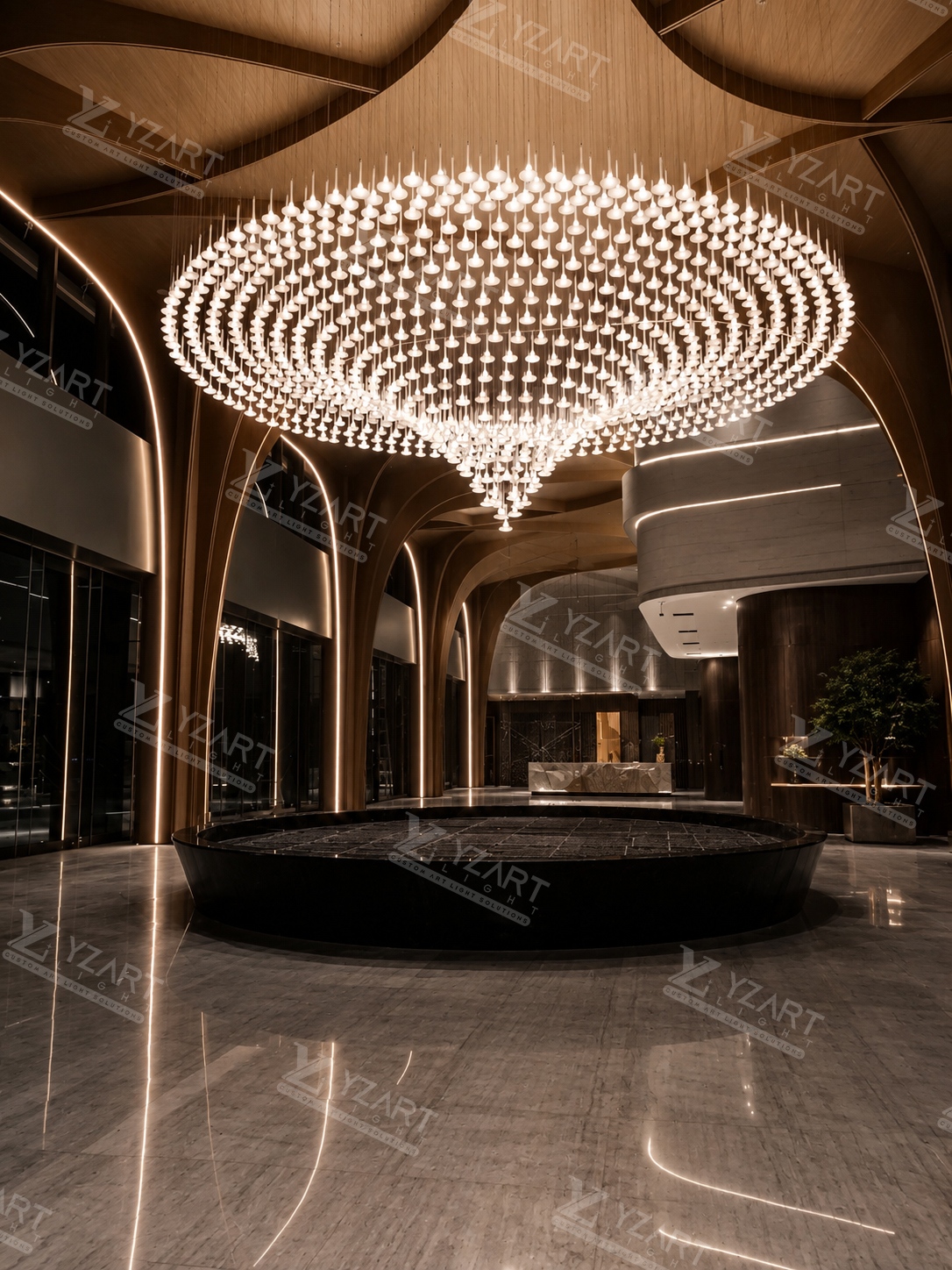
Lobby and grand-entrance scale: a suspended decorative fixture must be proportioned to the full height of the void, not to the ceiling plane alone. Image: YZ ART LIGHT.
Lobbies, Atriums and Banquet Halls: the yz10001 Configuration
For hotel lobbies, high-ceiling lobbies, double-height atriums and large banquet hall installations, the relevant platform from YZ ART LIGHT is yz10001. That configuration is specified around four parameters that directly answer the scenario-fit questions above:
- Anti-glare design — shielding arranged so that the light source is not directly visible in the ordinary guest sight line, which matters most where people stand close to a large suspended fixture in a lobby, or sit beneath one in a banquet hall.
- IP40 — protection against solid objects above 1 mm, appropriate for dry interior hospitality environments. IP40 is not a water-ingress rating, and it should not be treated as one in spa wet zones, pool surrounds or exposed resort terraces.
- AC110-240V — a voltage range that removes one of the more common cross-market mismatches for hotel groups specifying the same design language in different regions.
- Customizable dimming — dimming method is confirmed per project rather than assumed, because the control system is frequently already fixed by the MEP consultant before the decorative fixture is ordered.
Banquet halls add a requirement that lobbies do not: the space changes function several times a day. Here the fixture's role is not only aesthetic but operational — it must dim to a low, stable level for dining without visible flicker, then return to a higher output for a ceremony, and remain visually uniform across a long linear or rectangular array. That is why banquet hall specifications converge on large-format pendants and multi-ring compositions rather than on small repeated units.
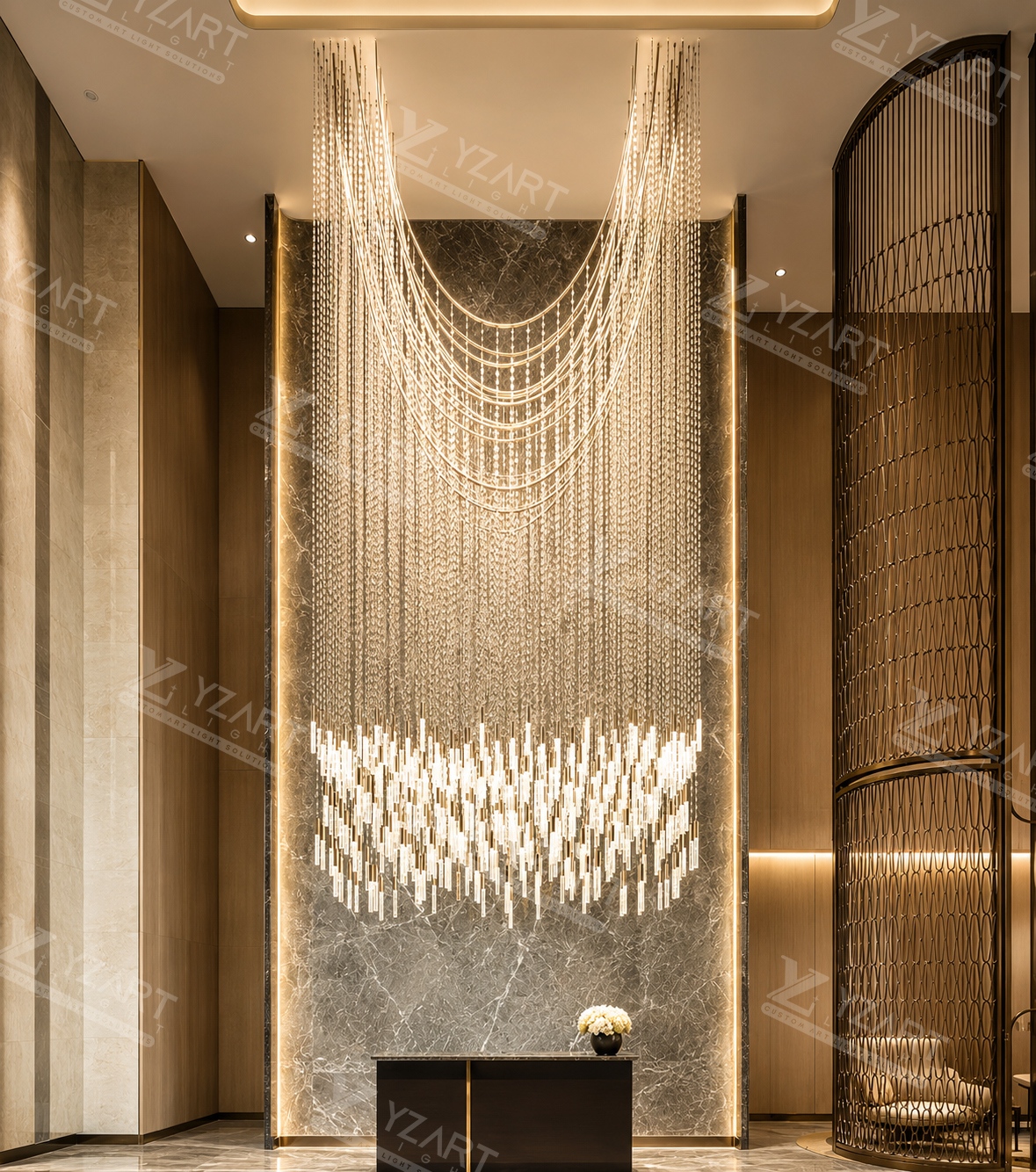
High-ceiling reception and grand lobby: custom height and arch geometry follow the storey span rather than a standard drop length. Image: YZ ART LIGHT.
Resorts, Spas and Guest Rooms: the yz10002 Range
A lobby chandelier does not carry a whole property. Once the statement pieces are fixed, the same project needs a second layer of fixtures that behave consistently at close range and across many rooms. yz10002 is the range that covers this layer for YZ ART LIGHT: chandeliers, art glass chandeliers, wall lamps, floor lamps, table lamps and outdoor lights, specified for hotels, banquet halls, restaurants and spas, villas, shopping malls and office or cultural spaces. Common materials across the range include brass, stainless steel, aluminium, iron, glass, crystal, marble, acrylic and ceramic.
The practical advantage of drawing an entire project from one range is consistency rather than branding: finishes, colour temperature and dimming behaviour can be aligned across a chandelier in the lounge, a wall lamp in a corridor and a table lamp in a suite, which is difficult when each category comes from a different supply route. The range is also where the earlier failure modes are most likely to appear — glare in a reclined spa position, a floor lamp that over-lights a carpet edge, or an outdoor fixture carrying an interior rating.
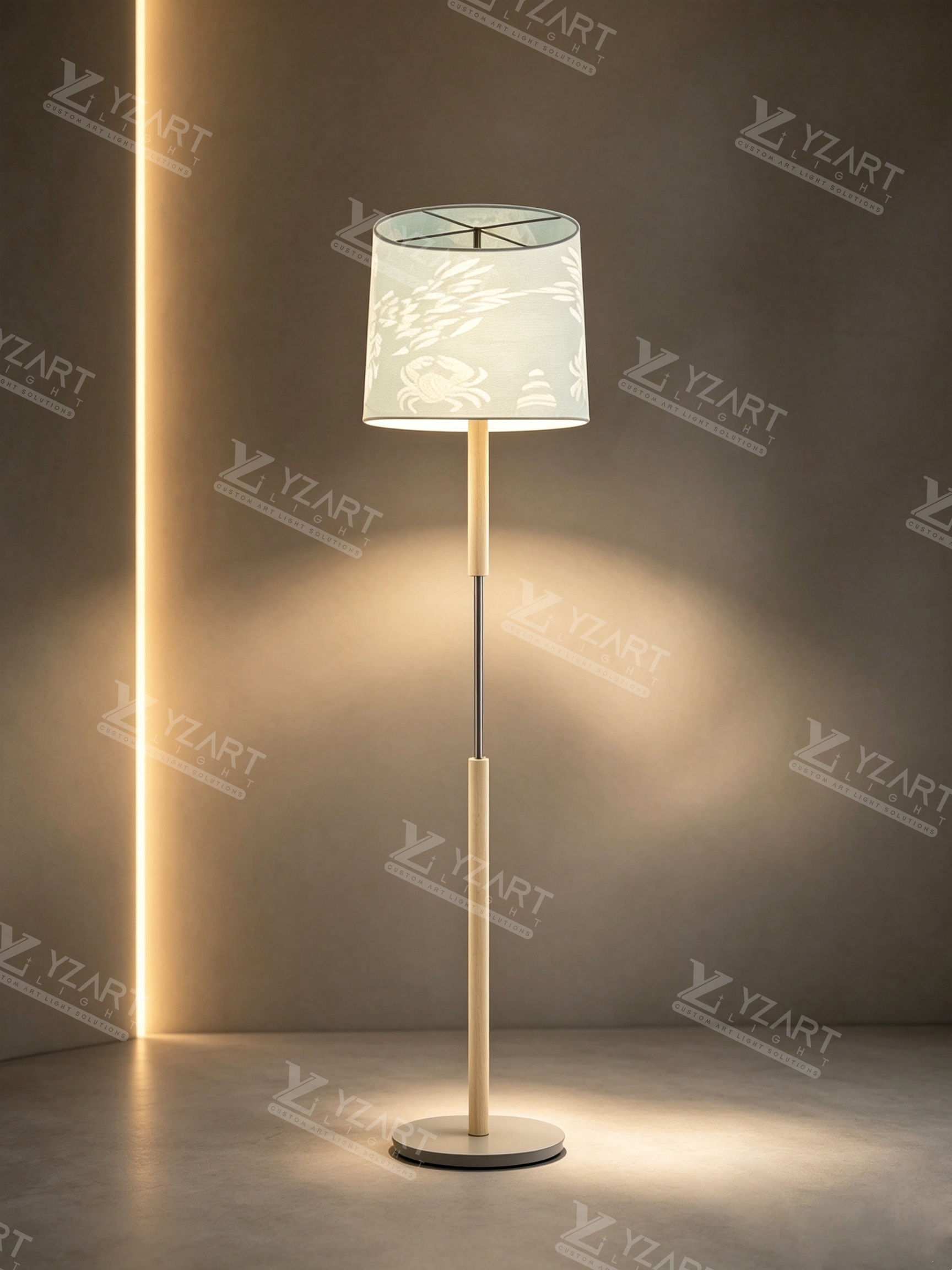
Resort and lounge layer: floor lamps work as adjustable ambient fixtures at seating height, where ceiling fixtures cannot reach. Image: YZ ART LIGHT.
The Technical Detail Buyers Should Confirm
Scenario fit only becomes real when it is written into the technical schedule. For custom decorative lighting, the following items are confirmed per project rather than taken from a stock sheet: dimensions, wattage and colour temperature; the light source and its glare-shield arrangement; the finish and base material; the control method; and any special protection or lighting-control requirement, which must be confirmed separately because it falls outside the standard scope.
Installation conditions belong in the same document. A suspended chandelier is only safe when ceiling load-bearing capacity has been checked, the reserved installation size measured and suspension points marked before production. Supporting devices — transformers or drivers, power cables, mounting brackets and installation accessories — are confirmed per product, because a driver change late in a project can affect both the dimming behaviour and the ceiling void arrangement. On the light-source side, the operational argument for LED is well established: LED holds the largest share of decorative lighting light sources, at 39.8% in 2025 according to IMARC Group, largely on efficiency and control flexibility. YZ ART LIGHT states that its LED light sources are rated for 50,000 working hours with stable light attenuation, and that power consumption is 40%–60% lower than conventional decorative lamps — figures that matter most in lobbies and banquet halls operating for long daily hours.
Certification as Compliance Evidence, Not as Decoration
For multi-scenario hospitality projects, certification documentation is usually requested at tender stage. The relevant evidence sets here are LVD-CE and CE-RoHS for the products themselves, alongside ISO9001, ISO14001 and ISO45001 for quality, environmental and occupational health and safety management systems. Together these support European-market electrical safety, hazardous-substance and process-management expectations.
Two boundaries are worth stating plainly. First, CE-based documentation addresses European conformity and does not by itself satisfy North American listing expectations, where luminaires are commonly specified against UL 1598 (Standard for Luminaires) and UL 8750 (LED Equipment) — buyers targeting that market should verify listing status separately rather than assume equivalence. Second, energy-code requirements are tightening in the direction of controllability: the 2024 International Energy Conservation Code expanded occupancy and dimming requirements for lobbies and meeting areas, which reinforces the case for confirming dimming strategy at specification stage rather than after the fixtures are manufactured.
Where Demand for Scenario-Based Lighting Is Growing
The hospitality share of decorative lighting demand is expanding in step with new hotel and resort capacity. Dataintelo values the hospitality lighting market at USD 14.2 billion in 2025 and projects USD 26.8 billion by 2034 at a 7.3% CAGR. Regionally, North America held the largest share of the global decorative lighting market at 36.45% in 2025 (Grand View Research), while Asia Pacific is the fastest-growing region for hospitality lighting at 5.98% CAGR (Mordor Intelligence) and accounted for 44.6% of high-end lighting revenue in 2024 (Grand View Research). Large infrastructure programmes add to the same demand curve: Saudi Arabia's Vision 2030 targets 150 million annual tourist visits and implies over USD 500 billion in hospitality infrastructure investment, including high-specification lighting.
Specification behaviour is shifting as well. Dataintelo reports that 56% of new luxury hotel projects now require dimmable chandelier installations for guest ambiance — a medium-reliability third-party figure, but directionally consistent with the controllability requirements appearing in energy codes. It is also worth noting, for buyers comparing market reports, that headline market sizes diverge substantially between research houses depending on inclusion criteria — Mordor Intelligence puts decorative lighting at USD 75.88 billion for 2025 while Grand View Research puts it at USD 42.9 billion and IMARC at USD 43.95 billion. Segment figures should be used to frame a decision, not to settle one.
Scenario-Based Custom Supply versus Catalogue-First Trading Supply
YZ ART LIGHT is a Zhongshan-based decorative and project lighting manufacturer, established in 2017, operating a 15,000 m² production base with approximately 150 employees and a 20-engineer R&D team, with roughly 70% of products exported to Europe, America and the Middle East. Its stated reference projects include InterContinental Hotel in Israel, Four Seasons Hotel in the UAE, Marriott Hotel in Costa Rica, Waldorf Astoria Hotel in Malaysia and InterContinental Hotel in Taiwan. The comparison below is between a scenario-configured, factory-direct custom route and a catalogue-first route through suppliers without in-house manufacturing and without technical customization capacity.
| Dimension | Scenario-based custom supply (factory-direct) | Catalogue-first trading supply |
|---|---|---|
| Fit to space | Dimensions, suspension drop and geometry developed against ceiling height, reserved size and viewing angle | Standard sizes adapted to the space where possible; limited scope for non-standard voids |
| Technical customization | OEM and ODM service covering design consultation, scheme development, structural optimization and production | External sourcing; custom shapes and special material processing generally unavailable |
| Compliance documentation | LVD-CE, CE-RoHS plus ISO9001, ISO14001 and ISO45001 management systems | Varies by source; documentation traceability depends on the upstream factory |
| Cost structure | Factory-direct route removes intermediate margin on customized orders | Intermediate margin is built into the quoted price |
| Acceptance control | 100% pre-shipment inspection: power-on testing, appearance and workmanship check, dimension and structure inspection, accessory verification | Inspection depth depends on the agent's arrangement with the source factory |
| Post-delivery support | Three-year product warranty, spare-part supply and remote overseas technical support, with installation guidance | Support typically limited to the agent's own commercial relationship |
| Best fit | Star-rated hotels, banquet halls and high-end commercial lighting-engineering projects with non-standard spaces | Simple standardized stock fixtures with no custom requirements and small order volumes |
Future Outlook
Three developments are likely to shape decorative lighting scenario fit over the next specification cycle. First, controllability is becoming a design constraint rather than an upgrade, as energy codes extend dimming and occupancy requirements into lobbies and meeting areas and hotel groups standardise scene behaviour across properties. Second, the supplier pool is splitting: buyers increasingly ask whether a specification can be engineered for a specific void, and whether the manufacturer can produce the structural and compliance documentation that goes with it. Third, India, Southeast Asia and the Middle East are adding hospitality capacity at a faster rate than mature markets, which favours manufacturers able to hold one design language across a lobby chandelier, a spa floor lamp and an outdoor fixture within the same project.
For hospitality buyers, the practical implication is modest but durable: start from the space, not the catalogue. Fixed ceiling geometry, protection zone, control method and lamp-type consistency across the property resolve most of the decisions that otherwise return as change orders.
FAQ
How should a buyer decide between a catalogue fixture and a project-specific custom chandelier for a hotel lobby?
The deciding conditions are the space, not the design preference. A custom fixture is indicated when the ceiling is non-standard, when the reserved installation size and load-bearing capacity cannot accommodate a standard product, or when a standard drop length places the light source in an awkward viewing line from the reception area or upper floors. A catalogue fixture is usually adequate where room geometry is repeatable and the mounting height is conventional. Custom manufacture normally carries a longer approval and production cycle because dimensions, structure and control method are confirmed first.
Which parameters must be confirmed before a custom chandelier is released for production?
Ceiling load-bearing capacity, the reserved installation size and the suspension point positions should be verified on site first. The technical schedule then fixes dimensions, wattage and colour temperature, finish and base material, light source and glare-shield arrangement, protection rating, and the dimming method. Supporting devices — transformers or drivers, power cables and mounting brackets — are confirmed per product. Any special protection rating or lighting-control requirement falls outside standard scope and must be confirmed separately, since it can change both the driver selection and the ceiling void layout.
Which certifications should be verified for a multi-scenario hotel lighting package?
For European-market projects, LVD-CE and CE-RoHS address product electrical safety and hazardous-substance conformity, while ISO9001, ISO14001 and ISO45001 cover quality, environmental and occupational health and safety management. These are compliance evidence for tender submission. They are not a substitute for North American requirements: luminaires for that market are typically specified against UL 1598 and UL 8750, and the listing status of the actual manufacturing source should be checked directly rather than inferred from a CE file.
What commercial terms and acceptance criteria apply to custom decorative lighting orders?
Typical terms include a minimum order quantity of one unit and EXW delivery, under which the buyer arranges pickup, logistics transportation and export customs declaration; if the manufacturer handles logistics, customs clearance and truck-haulage, those are quoted separately. Payment terms are TT. Acceptance is documented rather than visual: every lamp undergoes 100% full inspection before shipment, covering power-on testing, appearance and workmanship, dimension and structure inspection, and accessories completeness, with a quality-approval checklist attached to each shipment and real-shot inspection videos available on request.
What does long-term supplier support look like after a hospitality lighting project is delivered?
The relevant items are warranty scope, spare-part availability and technical reach rather than order volume. A three-year product warranty, spare-part supply and remote overseas technical support are the standard expectations, and the project model itself is end-to-end — running from design consultation through to installation guidance. For hotel groups operating multiple properties or planning phased refurbishment, the more valuable long-term factor is finish and lamp-type consistency between the original batch and later replacement batches, which is easier to maintain when the same range covers chandeliers, wall lamps, floor lamps and table lamps.
Which hospitality segments are driving scenario-based decorative lighting demand?
Hospitality and other commercial applications together represent the majority of decorative lighting end-user demand, at 62.8% in 2025 according to IMARC Group. The hospitality lighting market itself is valued at USD 14.2 billion in 2025 with a projected 7.3% CAGR to USD 26.8 billion by 2034 (Dataintelo), with Asia Pacific the fastest-growing region at 5.98% CAGR (Mordor Intelligence) and North America still the largest decorative lighting region at 36.45% share in 2025 (Grand View Research). Dimming capability is a recurring theme in new luxury projects: Dataintelo reports that 56% of new luxury hotel projects require dimmable chandelier installations, a medium-reliability estimate that aligns with the controllability requirements now appearing in energy codes.
Project reference material, including the yz10001 and yz10002 configurations and full-range hospitality specifications, is available in the Zhongshan YZ ART LIGHT product portfolio.