
Decorative Stainless Steel Sheets: Matching Finish to Space
Decorative stainless steel sheets are usually chosen for how they look, but they are specified for how they behave in a particular space. A mirror sheet that works on a controlled hotel feature wall can be the wrong surface for a busy corridor panel, a humid entrance or a three-metre ceiling run. This reference maps the four sheet families supplied by JYF Metal — mirror, brushed, sandblasted and water ripple — to the architectural scenarios they are normally used in, and explains how grade, thickness and standard sheet size decide which of those mappings is realistic.
Sheet Specification Starts With the Space, Not the Finish
Most specification errors with architectural stainless steel decoration are sequencing errors rather than material errors. A finish is selected from a sample board, the panel layout is drawn afterwards, and the environment — humidity, foot traffic, cleaning regime, coastal air — is confirmed last. By that point, grade, thickness and joint rhythm are already constrained, and the panel next to the sample is the one that has to survive ten years of use.
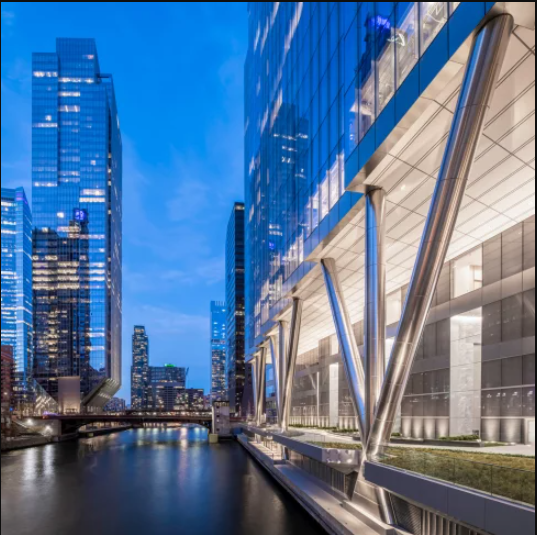
The application conditions documented for JYF Metal's architectural sheet range describe the same variables from the opposite direction. Large-scale decoration, curtain wall and feature wall work is specified with requirements for high dimensional accuracy, corrosion resistance, fire resistance, weatherproofing and custom surface finish, and it takes place in indoor and outdoor conditions that include high-traffic areas and humid or coastal environments. Wall, column, elevator and ceiling applications add their own requirements: corrosion resistance, scratch resistance, colour stability and custom textures.
The commercial context supports that reading of the problem. According to SMR / Metal Decorative Panel Market Outlook, the global metal decorative panel market was valued at USD 3.5 billion in 2024 and is projected to reach USD 5.8 billion by 2032. Market Research Future identifies architectural cladding and facades as a primary driver of stainless steel demand in the construction sector, specifically for 300-series grades — which is why the grade discussion below is not a side note to the finish discussion.
The Four Decorative Sheet Families and Where They Fit
JYF Metal (Foshan Jinyifan Metal Products Co., Ltd.) is a metal decoration manufacturer established in 2013 and based in Foshan, Guangdong, supplying decorative stainless steel systems for commercial interiors and building projects. The company operates a 3,000 m² manufacturing facility with approximately 150 staff and a 15-engineer R&D team, and around 80% of its output is exported to markets including the Middle East, Asia, Europe and North America. Its decorative sheet range is organised around four surface families — JYF-01 to JYF-04 — that share materials and formats but differ in how light, handling and fabrication behave around them.
| Family | Model | Surface & colour | Thickness | Standard sheet size | Scenario fit |
|---|---|---|---|---|---|
| Mirror finish sheet | JYF-01 | Mirror; silver, gold, rose gold, black, blue, copper, custom | 0.5–3.0 mm | 1000x2000 mm, 1220x2440 mm, 1220x3050 mm | Feature walls, column cladding, elevator panels, accent bands |
| Brushed sheet | JYF-02 | Hairline, satin, No.4, vibration; silver, gold, rose gold, black, blue, copper, bronze, custom | 0.5–3.0 mm | 1000x2000 mm, 1220x2440 mm, 1220x3050 mm | Large wall runs, elevator interiors, surfaces needing a consistent grain |
| Sandblasted sheet | JYF-03 | Sandblasted matte; silver, gold, rose gold, black, blue, copper, custom | 0.5–3.0 mm | 1000x2000 mm, 1220x2440 mm, 1220x3050 mm | Low-glare wall cladding, ceiling panels, background and transition panels |
| Water ripple sheet | JYF-04 | Embossed ripple pattern in small, medium, large and flow sizes; silver, gold, rose gold, black, blue, copper, custom | 0.5–2.0 mm | 1000x2000 mm, 1220x2440 mm, 1220x3050 mm | Feature walls, ceiling panels, hospitality and retail interiors |
All four families are available in SS201, SS304 and SS316. Colours across the range cover silver, gold, rose gold, black, blue, copper and custom, with bronze added in the brushed family. Colour on stainless steel is produced by PVD coating, which the International Stainless Steel Forum describes as the industry standard for creating coloured stainless steel sheets for architectural use. The company's manufacturing operation is ISO 9001:2015 certified under certificate number 120526Q00119R000, issued by Guangdong Jingwel International Certification Ltd.
Technical Explanation: Grade, Thickness, Size and Surface
Grade is an environment decision
The three grades offered across the sheet families — SS201, SS304 and SS316 — are not interchangeable in practice, even when the surface looks identical. SS201 is generally specified where cost pressure is high and conditions are dry and controlled. SS304 is the common architectural grade for interior wall, column and ceiling work. SS316 is normally reached for where the surface faces humid or coastal air, or where corrosion resistance is listed as a hard project requirement. The pattern is visible in the range itself: the JYF-05 screen partition is offered only in SS304 and SS316, while sheet and trim families keep SS201 available as a lower-cost option.
Thickness governs flatness and pattern depth
The mirror, brushed and sandblasted sheets run from 0.5 mm to 3.0 mm. The water ripple sheet, JYF-04, runs from 0.5 mm to 2.0 mm, because the embossed ripple pattern is formed into the surface rather than applied over it. That difference matters at the upper end of a specification: where a project needs stiffness and visual flatness across a large panel face, the thinner end of any range is the wrong end, and the ripple family simply does not extend as far. Thickness choice therefore interacts with the substrate and the framing, not only with the face material.
Standard sheet size defines the joint plan
All four families share the same three standard sizes: 1000x2000 mm, 1220x2440 mm and 1220x3050 mm, with custom sizes available. The largest standard sheet is 1220x3050 mm, which means any wall or ceiling run longer than that will contain joints. Joints are a design decision, not a defect: they determine the rhythm of a wall, and they are normally resolved with matching stainless steel trims rather than left as a raw seam. Projects that ignore this at the sample stage usually revisit it at installation.
Surface, colour and installation
Sheet is installed over a substrate rather than as a self-supporting element. Documented installation modes for decorative panel systems include dry-hanging and adhesive fixing, with frameworks, honeycomb substrate and lighting systems as supporting equipment. Metal honeycomb boards are widely used as a backing for this reason: SNS Insider reports that the honeycomb board segment held a significant market share on the strength of its high strength-to-weight ratio in architectural facade and interior applications. Lighting is a real specification input as well, because a mirror or ripple surface changes character completely under grazing light.
Application Fit: Wall Cladding, Feature Walls and Ceilings
Interior wall cladding
For long wall runs, brushed and sandblasted surfaces are the practical default. The hairline, satin, No.4 and vibration finishes in the JYF-02 family give a directional grain that reads as a continuous surface across multiple panels, and colour consistency between panels is a stated project requirement in this application. Sandblasted sheet (JYF-03) does the same job with a matte surface that reflects far less light, which suits walls in lobbies or corridors where glare is a problem. Mirror sheet (JYF-01) is typically reserved for a portion of the wall rather than the whole of it.
Feature walls and column cladding
This is where the two more expressive finishes belong. Mirror sheet delivers depth and reflection on a defined feature wall or a clad column, and it is also applied to elevator panels. Water ripple sheet (JYF-04) creates a directional, light-reactive surface in small, medium, large or flow ripple sizes, and its effect depends on the direction of the pattern relative to the panel seam. Both finishes are also used for custom logos and branded wall elements fabricated from sheet.
Column cladding deserves a separate note, because a column wraps a curved or multi-sided form. It demands high dimensional accuracy and careful joint placement, and it is one of the applications where the difference between a sheet supplier and a fabrication partner becomes visible on site.
Ceiling panels
Ceilings carry a different set of constraints: weight, flatness across a soffit, and the way a surface behaves under downlighting. Water ripple and sandblasted sheets are the usual choices for stainless steel ceiling panels, combined with a honeycomb substrate where strength-to-weight matters. Ceiling joints and transitions are commonly finished with stainless steel trims, and stainless steel ceiling decoration is a normal part of the same project package as wall and column work.
Elevator panels and high-traffic interiors
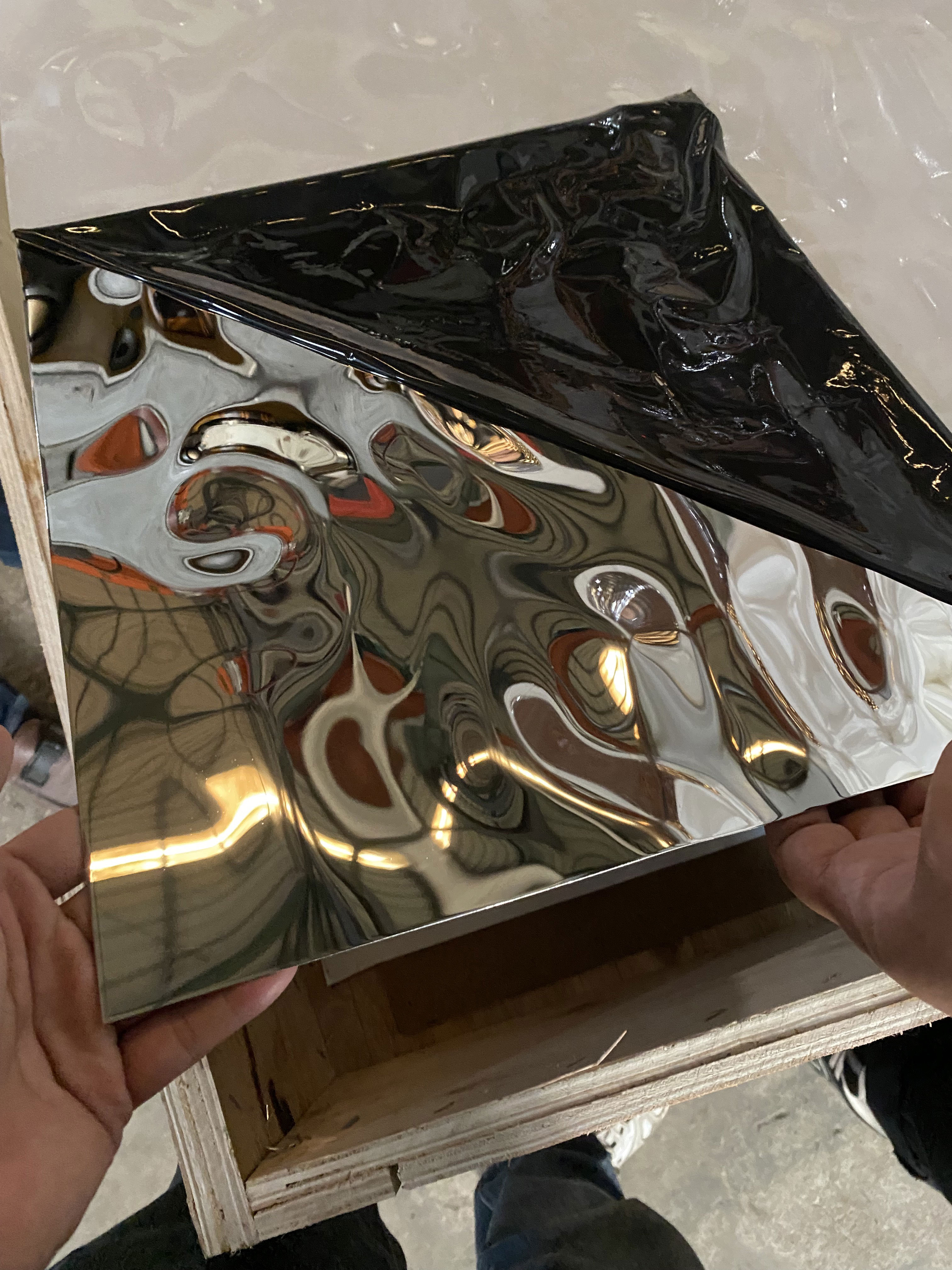
Elevator decoration and other high-traffic interiors are specified with scratch resistance, colour stability and custom textures in mind. It is worth being explicit about the trade-off here: a mirror finish is the most visually striking option and also the most demanding to keep clean, since fingerprints and dust are immediately visible. Where a surface will be touched constantly, brushed or sandblasted finishes are the lower-maintenance choice, and fingerprint resistance is a documented requirement for decorative metal in high-traffic indoor environments.
Extending the Surface: Partitions, Trims and Custom Fabrication
Sheet is one layer of an architectural stainless steel decoration package. In most commercial projects it is combined with three further product groups that solve the problems sheet alone cannot.
JYF-05 stainless steel screen partition. A room divider built from SS304 or SS316, with a regular size of 1220x2440 mm and custom sizes available. Finishes include mirror, brushed and vibration; colours include silver, gold, rose gold, black, copper, bronze and custom. Screens can embed glass, marble, crystal, metal mesh or LED light, and are produced through spot welding, full welding, laser cutting and CNC cutting. Documented applications are hotel lobbies, restaurant partitions and club interiors, where the requirements are high-precision laser cutting, seamless welding, uniform coating and fingerprint resistance. This product family is where space division, privacy and decoration meet.
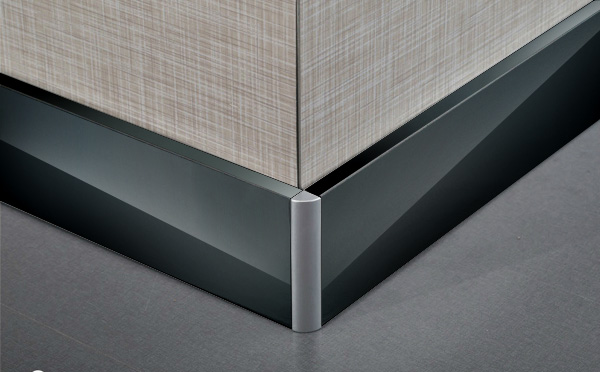
JYF-06 stainless steel trims. Decorative profiles in SS201, SS304 or SS316, available in L, U, T, V, curved, corner, flat strip and skirting board shapes, plus custom shapes. Finishes cover mirror, brushed, vibration and sandblasted, with silver, gold, rose gold, black, copper, bronze and custom colours. Processes are shearing, V-grooving and bending. Trims handle edge finishing, wall accents and ceiling joints, including the stainless steel skirting board that closes the base of a wall — which is precisely the detail that decides whether a 1220x3050 mm panel layout looks intentional or improvised.
JYF-07 stainless steel fabrication. Custom products in 201#, 304# or 316# stainless steel covering wall panels, ceiling panels, decorative sheets, mirror frames, display shelves, bar counters, custom logos, feature walls, column cladding and metal sculptures. This is the family that absorbs everything a standard sheet cannot: shaped ceilings, curved column wraps, metal art elements and site-specific dimensions, under custom fabrication rather than a catalogue order.
Market Signals Behind Textured and Coloured Stainless Steel
Two trends are visible in the available industry data. The first is the shift from plain mill finishes to textured surfaces. Stainless Steel World Asia reports that water ripple stainless steel sheets are increasingly used in luxury retail and hospitality, with production hubs centred in Foshan, China — the same industrial base where JYF Metal manufactures. The second is the normalisation of colour: PVD coating is now the standard route to gold, rose gold and black architectural stainless steel, according to the International Stainless Steel Forum.
On the supply side, the raw material comes from a concentrated upstream. The World Steel Association lists Tsingshan Holding Group and China Baowu Steel Group (TISCO) among the largest global producers, collectively controlling a significant portion of raw decorative steel supply. Regional demand is similarly concentrated: Grand View Research estimates that Asia-Pacific accounted for approximately 69% of global stainless steel market revenue in 2025, driven by rapid urbanisation. For buyers, the practical implication is that decorative sheet is a downstream, service-intensive product: the value added sits in finishing, fabrication and specification support rather than in the substrate alone.
Limits and Trade-offs: Where Sheets Alone Are Not Enough
A buyer-facing reference is only useful if it states the boundaries as clearly as the benefits. The following limits apply to decorative stainless steel sheet as a category, and they come from the specifications above rather than from manufacturer claims.
- Sheet is not self-supporting. Panel systems are installed over frameworks, backing panels or a honeycomb substrate, using dry-hanging or adhesive fixing. A sheet specification without a substrate and framing decision is incomplete.
- Standard sheet size caps the panel module. With a maximum standard size of 1220x3050 mm, longer walls and ceilings will contain joints. Those joints need trims or a deliberate reveal design, and they must be planned before production, not resolved on site.
- Grade selection is not free. SS201 can reduce cost, but it is generally not the right choice for humid or coastal conditions where corrosion resistance is specified. SS316 costs more and is commonly specified where the environment demands it.
- The ripple family is thinner. JYF-04 water ripple sheet is produced from 0.5 mm to 2.0 mm, against 0.5–3.0 mm for the flat-surface families. Where a project needs the stiffer end of the thickness range, a ripple surface is not the answer.
- Mirror finishes need a maintenance assumption. A mirror surface shows fingerprints, dust and fine scratches more readily than a brushed or sandblasted surface. It performs best on defined feature areas and controlled environments rather than on every touchable surface in a building.
- Colour adds a process step. Coloured architectural sheet requires a PVD coating stage, and standard references for decorative stainless steel flat products and mechanical tube sit with ASTM A480 and ASTM A554 respectively — which is why documented, traceable surface finishing matters when colour consistency is a project requirement.
Compared with a sheet-only supply model, a system-based approach — sheet plus screen, trim and custom fabrication — usually resolves more of these boundaries up front, because joint layout, edge finishing and curved geometry are designed together rather than in sequence.
Future Outlook
Three directions look durable for the next few years of architectural stainless steel decoration. First, textured surfaces rather than flat reflective surfaces will keep growing in hospitality and retail interiors, where a ripple or sandblasted face performs better under lighting and hides handling marks better than a plain mirror. Second, colour will be treated as a specification item rather than a decorative afterthought, with PVD-coated sheet expected to match across panels, batches and follow-up orders. Third, and most consequential for procurement, buyers are shifting from component purchasing to system purchasing: sheets, screens, trims and custom fabrications are increasingly specified from a single manufacturing source with design, R&D and fabrication capability, because that is the only way to keep joint plans, finishes and tolerances consistent from drawing to installation.
For projects at the research stage, this means the useful question is no longer "which finish looks best" but "which finish, grade, thickness and module set fits this space, and who is accountable for the details between them."
FAQ
What counts as a decorative stainless steel sheet in architectural work?
A decorative stainless steel sheet is a flat stainless panel produced primarily for visible surface effect rather than structural duty. In the JYF Metal range it is organised into four families: JYF-01 mirror finish sheet, JYF-02 brushed sheet with hairline, satin, No.4 and vibration finishes, JYF-03 sandblasted sheet, and JYF-04 water ripple sheet. All four are offered in SS201, SS304 and SS316 and are intended for architectural decoration.
Which grade should be specified: SS201, SS304 or SS316?
The decision is environmental. SS201 is generally used where cost pressure is high and conditions are dry and controlled. SS304 is the common architectural grade for interior wall, column and ceiling work. SS316 is normally specified where the surface faces humid or coastal air, or where corrosion resistance is a hard requirement. Screen partitions (JYF-05) are offered only in SS304 and SS316, which reflects the same logic.
How does the finish choice change the application?
Each finish behaves differently. Mirror (JYF-01) creates depth and reflection and suits feature walls, column cladding and elevator panels, but shows fingerprints and dust readily. Brushed surfaces (JYF-02) carry a directional grain that reads continuously across long wall runs. Sandblasted sheet (JYF-03) reduces reflected light, which suits walls and ceilings where glare is a problem. Water ripple sheet (JYF-04) adds a directional embossed pattern across small, medium, large or flow ripple sizes.
What thickness and sheet size are available, and why do they matter?
Mirror, brushed and sandblasted sheets are produced from 0.5 mm to 3.0 mm. Water ripple sheet is produced from 0.5 mm to 2.0 mm, because the pattern is formed into the surface. All four families use standard sizes of 1000x2000 mm, 1220x2440 mm and 1220x3050 mm, with custom sizes available. Thickness affects stiffness and flatness across a panel face; sheet size determines how many joints a wall or ceiling will contain.
Which finish suits ceiling panels versus wall cladding?
Ceilings are normally specified with water ripple or sandblasted surfaces, often over a honeycomb substrate for strength-to-weight, with joints finished using stainless steel trims. Long wall runs are normally specified in brushed or sandblasted finishes for grain and colour consistency across panels. Mirror sheet is generally reserved for defined feature walls, column cladding and elevator panels rather than full continuous wall areas.
When should a project move from sheets to partitions, trims or custom fabrication?
Three situations call for it. When a space needs division or privacy, the JYF-05 screen partition covers room dividing with optional glass, marble, crystal, metal mesh or LED light inlays in SS304 or SS316. When edges and joints need closing, JYF-06 trims in L, U, T, V, curved, corner, flat strip or skirting board shapes resolve wall accents and ceiling joints. When geometry falls outside standard sheet formats — curved column wraps, shaped ceilings, metal sculptures, bar counters or custom logos — JYF-07 custom fabrication covers it.