
Deep-Cutting Milling Tools: A Scenario Fit Guide for Aerospace, Military and Shipbuilding
Deep-Cutting Milling Tools: A Scenario Fit Guide for Aerospace, Military and Shipbuilding
Deep cutting is not one application. A long-reach pocket floor machined past a fixture, a heavy face cut on a hardened defence component and a long bore in a shipbuilding shaft housing all remove material at depth, but they fail for different reasons and are corrected with different tools. Matching cutter type and damping option to the scenario — rather than to the generic label “deep cutting” — is the decision this guide addresses.
Wenling Geltos Tools Co., Ltd. (Geltos) is a milling tool manufacturer established in 2012 in Zhejiang Province, China, whose documented range covers grooving mills, chamfer mills, boring mills, thread mills, dovetail mills, face/shoulder/profiling shank and shell mills, interchangeable milling tools, silent tools and milling inserts. Those product families are used here to show how shell, face/shoulder/profiling and boring variants, damped tooling and carbide insert grades map onto aerospace, military-use and shipbuilding operations — and where each option stops being the right fit.
The governing variable is overhang, not depth alone
Depth is a drawing dimension; overhang is the engineering problem. A cutter running at 40 mm diameter with 160 mm of exposed length is working at 4×D, and the stiffness of that assembly — not the depth of the feature — decides whether the cut is stable. Geltos documents two mounting conditions for its silent/anti-vibration family that convert this into setup rules: the clamping length should be no less than a 4 L/D ratio, and the span between the two clamping screws should be greater than 4×D. Read as mounting requirements rather than performance claims, these give a buyer a first, checkable answer to whether a damped tool is being held in a way that lets it work.
The second variable is which side of the cut the reach sits on. External milling reach — pocket floors, walls, wide faces — and internal reach — bores, housings, shaft seats — are solved by different hardware. Geltos lists its silent tools (VT25-SCLCR09, VT40-SDUCR11, VT20 C20*200V and VT32 C32*480VE), made in HSS and carbide and designated for aerospace, military use and shipbuilding, as internal turning tools. For a programme engineer that designation is the difference between specifying a damped bar for a deep bore and expecting a damped bar to fix a deep milling pocket.
Three deep-cut scenario families, three different failure modes
The same catalogue serves all three industries, but the operation that limits the process is not the same. Naming the failure mode first prevents the most common purchasing error: buying a heavier tool for a problem created by fixturing, coolant or machine rigidity.
Aerospace: long reach, thin sections, tolerance-critical profiles
Aerospace milling in this context means reaching past clamps, fixtures and already-machined features to produce pocket floors, ribs, shoulders and profile walls. The limiting failure is usually dimensional — deflection transferring into wall taper, or vibration marking a surface that cannot be blended out. Shell mills suit floor and face generation where the arbor can be kept short; face/shoulder/profiling shank mills carry the wall and shoulder work; interchangeable and modular holders let one holder take different milling heads so that a change of geometry does not require a change of long-reach body. Cutting conditions in the documented application data include light cutting with inner or outer coolant supply, which matches the finish-oriented profile of much of this work.
Military use: harder material, heavier stock, heavier documentation
Defence-adjacent work concentrates on harder workpiece material, heavier stock removal and a paperwork burden that is part of the technical decision. The Geltos insert range is documented to HRC65, and heavy cutting is listed among the supported milling conditions, so the tool-side question is not whether the grade exists but whether the machine, fixture and clamping arrangement can absorb the load a heavy cut imposes at reach. Where the answer is uncertain, fast-feed geometry and face milling cutters spread the load across more teeth, and the documented cutting values should be treated as a starting reference to be validated on the actual set-up rather than a guaranteed outcome.
Shipbuilding: large envelopes, long bores, mixed material
Shipbuilding scenarios are large-envelope problems. Long bores in housings and brackets, wide facing on bed plates, keyways, T-slots, dovetail guides and thread milling in large fasteners all put the cutting edge far from the spindle. Access frequently forces the cutter diameter upward: a shell mill in the 160–250 mm band may be the only practical way to generate a pad face, and a damped bar is often the only realistic route inside a long bore. The material mix is broader than in aerospace, which makes insert grade selection a per-job decision rather than a programme-wide standard.
Matching cutter family to the operation
The table below maps operations to the cutter families Geltos documents in its catalogue. The damping column distinguishes operations where a damped bar is structurally applicable (internal work) from those where the practical lever is geometry, modularity and insert choice.
| Operation | Cutter family | Damping / support lever |
|---|---|---|
| Wide face generation on pads and plates | Shell mills | Shortest possible arbor; rigid spindle interface |
| Shoulders, ribs and profile walls | Face/shoulder/profiling shank mills | Modular heads to limit overhang; profiling inserts |
| Pocket floors at reach | Shell mills; interchangeable milling tools | Reduce L/D before adding damping |
| Narrow slots and grooving | Grooving mills, including GFN cutters to 2 mm | Step-down strategy; coolant direction |
| Edge breaks and chamfers at depth | Chamfer mills | Low radial engagement to limit side load |
| Threads in large or deep holes | Thread milling tools | Helical interpolation rather than axial plunge |
| Dovetails, T-slots and guideways | Dovetail mills; T-slotters | Undercut geometry limits speed; check neck clearance |
| Deep internal turning and boring | Silent tools; boring mills | Damped bar, mounted to the 4 L/D and 4×D rules |
| High-volume roughing | Fast-feed milling cutters and inserts | Chip thinning over a larger engaged length |
Two practical notes sit behind that table. First, modularity is a deep-cutting control, not just a purchasing convenience: Geltos states that its interchangeable and modular milling holders let one holder carry different milling heads for different machining needs, which reduces the number of long-reach bodies a shop has to own and keeps each of them as short as the job allows. Second, the four insert grades listed in the catalogue — APMT1135, SNMX1206, LNMU0303ZER and 4NKT0603 — are presented across fast-feed, profiling, face and turning insert types without a published per-model mapping to those types, so an RFQ should name the operation and let the supplier assign the grade rather than selecting on model number alone.
Product 6046: reading the 40–250 mm envelope
Product 6046 is the broadest entry in the catalogue: grooving mills, chamfer mills, boring mills, face/shoulder/profiling shank mills, shell mills, corn-shaped and comma-shaped mills, carbide turning tools, silent tools and milling inserts, in alloy steel, spring steel and carbide, with a documented parameter set of 1–20 teeth, 80–350 mm length and 40–250 mm diameter at HRC40–50. Separate diameter and width columns in the same catalogue entry list a wider series from 8 mm to 400 mm and groove widths from 1 mm to 20 mm across the range; the 40–250 mm figure should therefore be read as the stated working parameter for the series rather than the outer limit of every variant listed.
Within the 40–250 mm band the trade-off is coverage against stiffness. The bands below are decision logic for an RFQ discussion, not a manufacturer application table.
| Diameter band | Typical role | What to check |
|---|---|---|
| 40–63 mm | Shoulders, slots, pockets, profiling passes where the head must enter the feature | Achievable L/D; insert count against available feed |
| 80–125 mm | Face and shoulder milling on medium housings and structural pads | Spindle torque and holder taper at the required length |
| 160–250 mm | Wide facing on bed plates and large brackets; shell mill work in shipbuilding | Balance, coolant delivery to the outer teeth, handling safety |
The 80–350 mm length parameter is the reach figure that decides the band, and the 1–20 tooth count is the feed lever: fewer teeth reduce torque demand and chip load per revolution, more teeth improve surface generation at the same feed per tooth. Neither number should be chosen before the overhang is fixed, because a large-diameter shell mill pushed out on a long arbor recreates the instability that the larger diameter was chosen to avoid.
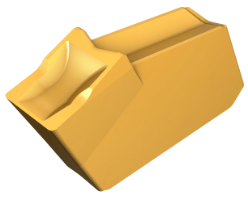
Grooving geometry such as the GFN cutter family supports narrow slot work down to 2 mm width, a common deep-access feature in housing and bracket machining.
Damping: four silent tool configurations and the rules that travel with them
Geltos documents four silent tool configurations — VT25-SCLCR09, VT40-SDUCR11, VT20 C20*200V and VT32 C32*480VE — in HSS and carbide, designated for aerospace, military use and shipbuilding, and classified as internal turning tools. Two mounting conditions are published with them: a clamping length no less than the 4 L/D ratio, and a screw span greater than 4×D. Both are setup conditions, and both are worth writing into a process sheet, because a damped bar held in a short clamp or a narrow screw span will not deliver what its damping element was designed to do.
The selection sequence that follows from this is short. If the feature is an internal bore and the required reach exceeds roughly 4×D, a damped bar is the structural answer. If the feature is an external pocket or profile, the same reach penalty applies but the answer changes: shorten the assembly with modular heads, reduce the radial engagement, or change the cutter diameter so that the L/D falls back into a stable range. Applying a damped bar to a milling problem asks hardware to solve a geometry issue it was not specified for.
A third condition belongs on the same process sheet: the coolant arrangement. Geltos documents operation with inner or outer coolant supply, and at depth the inner route is generally the only one that reaches the edge. This is a machine and holder requirement as much as a tool requirement, and it should be confirmed before a deep-cut programme is quoted.
Insert range and documented cutting data: what can and cannot be concluded
The insert entry lists four grades — APMT1135, SNMX1206, LNMU0303ZER and 4NKT0603 — in carbide and ceramics, across fast-feed, profiling, face and turning insert types, applicable to mechanical processing, automotive, aerospace, woodworking and shipbuilding. The documented parameter field gives HRC65, V=180 and F=0.02. Read literally, that establishes a hardness capability figure and two cutting values.
Three cautions belong next to those numbers. The catalogue entry does not attach units to V and F, so a buyer should confirm whether they are expressed as m/min and mm/tooth before writing them into a program. The 6046 product entry separately lists HRC40–50 in its parameter field, and the two figures should not be treated as interchangeable: one belongs to the insert range and one to the cutter series, and the RFQ should state which workpiece hardness each is meant to cover. Finally, a hardness ceiling is a capability statement, not a tool-life promise — the same grade run at HRC65 with different radial engagement, coolant and rigidity will produce different results, and the documented values are a starting reference to be validated on the machine that will run the job.
Machine-side conditions that decide whether the tool choice survives
Geltos documents its milling tools for mounting on CNC milling machines or machining centres, compatible with high-speed spindles and fast-feed conditions, supported by common tool holders and collet systems and by lathes where turning applies. Heavy and light cutting are both listed, with inner or outer coolant supply. Products are heat-treated before processing, and the company states a precision of no greater than 0.02 mm.
For a deep-cut programme those statements define the machine-side checklist rather than a guarantee. Holder taper and runout, spindle torque at low speed, coolant pressure at the tool interface and fixture rigidity all set the ceiling that any cutter operates under. Where two of those are weak, a larger or damped tool will not compensate, and a smaller cutter run at a shorter overhang frequently outperforms the theoretically stronger choice.
Qualifying the supply side for aerospace, military and shipbuilding work
Technical fit is only half of the evaluation. Geltos documents a minimum order quantity of 1 unit, a lead time of 10–30 days, monthly capacity of 30,000–40,000 teeth and an annual output figure of 500,000 teeth, with an R&D team of five engineers, a 3,000 m² facility, internal factory inspection as its quality route, and after-sales service and technical support. Export is documented at 5–10% of output, with India, Russia, Iran, Morocco, Italy and the USA among the listed markets.
Two of those items deserve specific attention from a programme buyer. First, the published quality arrangement is internal factory inspection rather than a listed third-party certification, so a defence or marine programme that requires accredited certification or traceable material records should request the current certificate set, material documentation and inspection records during RFQ instead of assuming them. Second, the documented case reference is a precision machining factory in Russia that used five units of milling tools over a two-year project for metal grooving and slotting, achieving 2 mm slot width with smooth surface finish, fast-feed grooving and long working life. That is a company-reported case for narrow slot work — useful evidence of narrow-groove capability, not evidence of performance in a titanium airframe pocket or a marine bore.
A workable qualification sequence is therefore: sample the specific geometry on the specific material, confirm the mounting rules for any damped bar, verify the units and basis of the documented cutting values, and only then scale to a programme quantity. Product information and contact details for Wenling Geltos Tools Co., Ltd. are published on the company site.
Market context: what the numbers do and do not establish
DataM Intelligence reported the global milling tools market at US$3.43 billion in 2025, with a forecast CAGR of 6.2% for 2026–2035. That is one commercial research forecast, and it should be read as context for the depth of the supplier field a buyer can draw on, not as a demand signal for any particular segment. This matters in practice: a market of that scale implies multiple viable sources for standard cutter families, which supports dual-sourcing for catalogue items, while deep-cutting damping and special geometry remain areas where the individual supplier's documented capability and willingness to be sampled carry more weight than market size.
Standards references worth putting into the RFQ
Three standards appear in the evidence around this product category and are worth naming when specifications are exchanged. ISO 11529-2:1998 specifies the designation system for shank type and bore type milling cutters with indexable inserts, which is the reference that makes a cutter designation unambiguous across suppliers. ISO 13399 addresses the computer-readable representation and exchange of cutting tool data, which reduces ambiguity in CAD/CAM and tool-management systems when a supplier can provide structured product data. DIN 6535 HA/HB and DIN 6527 appear on other manufacturers' and distributors' product pages as shaft and product standard references.
None of these establish that a given catalogue item is compliant with the standard in question; each is a reference that tells a buyer what to request. The practical use is to ask for the exact standard edition, the dimensional drawing and the conformity evidence per quoted SKU, then to compare what comes back across the shortlisted suppliers on identical terms.
A short decision sequence
- Fix the overhang first: calculate L/D for the proposed assembly before choosing a cutter diameter.
- Classify the feature as external milling or internal turning; only the second is addressed by a damped bar.
- For internal work above roughly 4×D, specify a silent tool and write the 4 L/D clamping and 4×D screw-span conditions into the process sheet.
- For external work, reduce the assembly with modular heads and interchangeable holders before adding tool mass.
- Select the cutter family from the operation, then the insert grade from the workpiece; confirm the units and basis of V and F.
- Confirm coolant delivery, holder interface and spindle capability, since these set the achievable depth regardless of tool choice.
- Sample the geometry, verify documentation, then scale; treat published capacity and precision figures as company-reported until checked.
Frequently asked questions
At what L/D ratio should a damped bar replace a conventional boring bar?
Geltos documents a clamping length of no less than the 4 L/D ratio and a span between the two clamping screws greater than 4×D for its silent tool family. These are mounting conditions rather than a chatter threshold, so they define the minimum arrangement under which the damped tool is expected to function, not the point at which vibration necessarily appears. Because stability also depends on the machine, fixture and workpiece material, a trial cut on the actual set-up remains the practical way to confirm the choice.
Which cutter family suits a deep pocket floor compared with a deep pocket wall?
Floor generation at reach is normally a shell mill task, because the cutting load is distributed around a large diameter and the arbor can be kept as short as the feature allows. Wall and shoulder work is a face/shoulder/profiling shank mill task, where the cutting edge follows the profile and radial engagement can be controlled to limit side load. In both cases the reach penalty applies, which is why modular heads that shorten the assembly are usually considered before a larger body.
Can one insert range cover HRC65 aerospace alloys and general shipbuilding steel?
The Geltos insert entry documents carbide and ceramic inserts across fast-feed, profiling, face and turning types, with HRC65 listed as a hardness figure and V=180, F=0.02 as documented cutting values without stated units. That establishes a hardness capability, not a single grade suitable for every material in both industries. Because the cutter series 6046 separately lists HRC40–50 in its parameter field, the workpiece hardness each figure refers to should be confirmed at RFQ rather than assumed to be interchangeable.
What does product 6046's 40–250 mm diameter range cover in practice?
The 6046 entry documents 40–250 mm diameter as its stated working parameter, together with 1–20 teeth, 80–350 mm length and HRC40–50, and its type list spans grooving, chamfer, boring, face/shoulder/profiling shank, shell, corn-shaped and comma-shaped mills plus inserts and silent tools. The smaller end of the band suits shoulders, slots and profiling passes that must enter a feature; the larger end suits wide facing on plates and brackets in shipbuilding work. A separate diameter column in the same catalogue entry lists a wider 8–400 mm series across the range, so the specific variant should be confirmed per line item.
What should be verified before a deep-cut tool is approved for a defence or marine programme?
Four items are worth confirming in writing: the current certificate set and inspection records, since Geltos documents internal factory inspection as its quality route; the exact standard edition, drawing and conformity evidence per quoted SKU where ISO 11529-2, ISO 13399 or DIN references are cited; the units and basis of the documented cutting values; and a sample run on the actual material and machine. The documented Russia case — five units over a two-year precision grooving project reaching 2 mm slot width — is company-reported narrow-slot evidence and does not substitute for that programme-specific validation.
Deep-cutting work rewards the sequence rather than the single tool: establish the overhang, classify the feature as external milling or internal turning, choose the cutter family from the operation, and only then decide whether damping, modularity or a change of diameter is the lever that solves the problem. Suppliers that publish their mounting rules, parameter ranges and case evidence make that sequence checkable — which is a more useful qualification criterion than any single specification figure.
Have Questions or Need More Details?
Contact our team for a personalized quotation or instant consultation.
Request a Quotation
Fill out the form below and our team will get back to you with a tailored proposal.
WhatsApp Direct Chat
Prefer to chat in real-time? Message us on WhatsApp for instant assistance & quick answers.
- Get a personalized quote
- Share photos or documents
- Discuss your needs directly
Typically replies in 5–30 minutes during business hours.