
Dengfeng Factory Audit: Welding and 100% Inspection Proof
Supplier Capability Audit · Perimeter Security · Evaluation Stage
A perimeter fence is bought on the strength of a specification and delivered on the strength of a process. In 2026, the distance between those two things is where most welded mesh fence procurement risk sits — and it is closed by evidence, not by adjectives.
The global welded wire mesh fence market was valued at USD 7.04 billion in 2025 and is projected to reach USD 11.72 billion by 2034, according to Dataintelo. Metal fencing already holds the largest material segment of the wider fencing market at a 53% share of an estimated USD 33.8 billion in 2025, as reported by Grand View Research. Volume at that scale draws in supply, and supply draws in claims: automated welding, in-line inspection, full traceability, zero-defect coating.
For a sourcing manager in the evaluation stage, the useful question is narrower than "who claims the most." It is: what can be physically shown on the production floor, and what can be documented in a file that a third party could later check? This article sets out a four-layer audit model for welded mesh fence suppliers and applies it to one manufacturer's published capability record — Anping Dengfeng Wire Mesh Products Co., Ltd. — so that buyers can see what a verifiable answer looks like, and equally where the boundaries of that answer sit.
Why welding and inspection claims resist verification
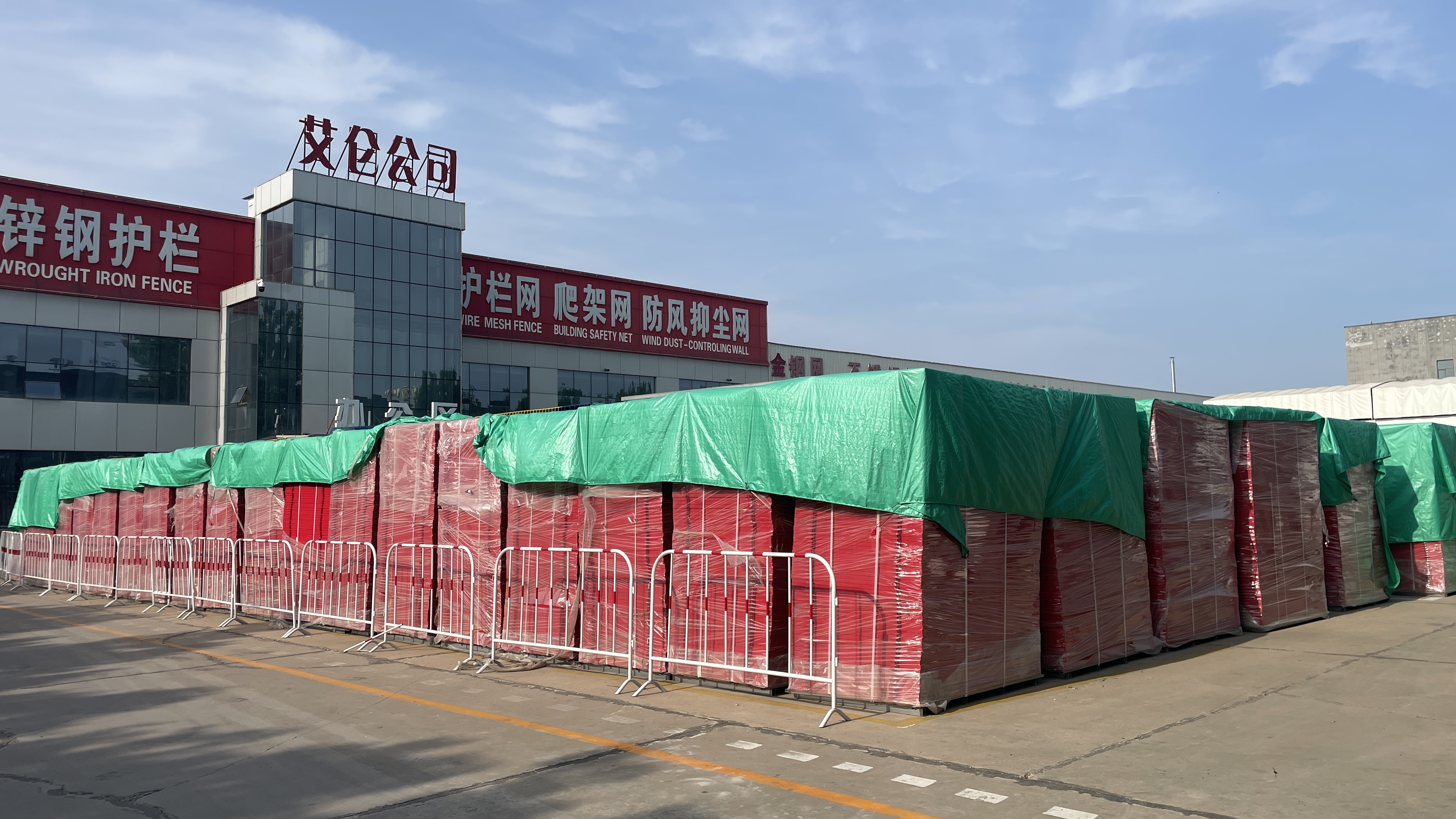
Welding and inspection are the two points in a welded mesh fence production line where quality is created and where quality is most easily asserted without proof. A finished panel looks nearly identical whether its intersections were formed on an automated line with monitored parameters or on older equipment with variable settings. The difference only becomes visible years later, at the intersection, when a perimeter is exposed to wind load, climbing attempts and corrosion.
Inspection is harder still. Every manufacturer in this category describes quality control. Far fewer can produce a record showing which panels were checked, against which criteria, by whom, and at what point in the process. The distinction that matters for a buyer is between sampling-based inspection and a stated 100% full inspection policy, and then between that internal policy and inspection that a buyer's own representative witnessed.
This is why a capability audit for perimeter fencing should treat welding and inspection as two separate evidence problems: one is a process question (how is the weld formed and controlled), the other is a verification question (how is the result checked and recorded).
What Dengfeng documents about its facility, capacity and inspection policy
Anping Dengfeng Wire Mesh Products Co., Ltd. is a wire mesh and fencing manufacturer based in Anping County, Hengshui City, Hebei Province, China — the district widely referred to in the industry as the "Hometown of Wire Mesh." The company was established in 2008 and operates a 70,000 m² facility with 80 employees.
Its published capability record states an annual output of 5,000,000 m² and a monthly capacity of 420,000 square meters for fencing products. A 10-engineer R&D team supports custom welded mesh fence projects, including drawing-based customization. The company reports that roughly 80% of output is exported, with main markets in Europe, Saudi Arabia, the Middle East, the United Arab Emirates and the United States.
On quality control, the published position is unambiguous: 100% full inspection. Alongside that, the company lists OEM/ODM production with customization across size, wire diameter, mesh aperture, color, logo and surface treatment; a minimum order quantity of 1 set; a lead time of 15–30 days; and after-sales support covering remote technical assistance, on-site installation guidance and free CAD drawing.
| Documented capability | Published value | What it allows a buyer to check |
|---|---|---|
| Establishment | 2008 | Operating history and business-registration cross-check |
| Facility footprint | 70,000 m² | Whether covered production area is consistent with stated capacity |
| Workforce | 80 employees | Manning level relative to inspection and finishing claims |
| Annual output | 5,000,000 m² | Order-size feasibility and scheduling credibility |
| Monthly capacity | 420,000 m² | Slot availability against a project timetable |
| R&D team | 10 engineers | Capacity for custom drawings and non-standard panel sizes |
| Quality control | 100% full inspection | Whether inspection records exist for every shipment lot |
| Lead time | 15–30 days | Whether the figure covers production only or the full order cycle |
| Export share | Approximately 80% | Familiarity with destination-market documentation |
| Main markets | Europe, Saudi Arabia, Middle East, UAE, United States | Prior exposure to regional compliance expectations |
Capability figures are self-published manufacturer data; they establish what a supplier is willing to be measured against, and should be corroborated during the audit itself.
Technical explanation: which fence parameters an audit actually tests
The reason welding and inspection dominate a perimeter audit is that they determine whether the declared specification survives contact with the site. A welded mesh fence panel is made from low carbon steel wire and galvanized steel pipe, with a surface treatment of hot-dip galvanizing followed by powder coating. Each published parameter maps to a specific failure mode, and therefore to a specific audit question.
| Parameter | What it controls | Evidence to request |
|---|---|---|
| Wire diameter, 3.0–6.0 mm | Load capacity at the weld and resistance to cutting tools | Incoming wire certificates and a measured sample from the shipment lot |
| Mesh aperture, 50×100 mm and 76.2×12.7 mm | Climb resistance, visibility and material weight | Aperture measurement on finished panels, not on drawings alone |
| Panel height 630–3000 mm; width 2000–3000 mm | Rigidity, post spacing and wind loading | Panel framing detail and post calculation for the actual site |
| Hot-dip galvanizing plus powder coating | Corrosion life in coastal, industrial and high-humidity environments | Coating sequence confirmation and adhesion check at the finish line |
| Stated service life over 10 years | Total cost of ownership and replacement cycles | The maintenance and inspection schedule that supports the claim |
| Low carbon steel wire and galvanized steel pipe | Base material consistency across production lots | Material purchase records covering the order period |
One point deserves emphasis for buyers specifying high-security panels. Anti-climb and anti-cut performance is a function of aperture geometry and wire diameter, not of a product name. A panel marketed as anti-climb is only as effective as the mesh dimensions actually produced and the weld integrity actually achieved. This is where the inspection question returns: the audit needs to confirm that the panel on the truck matches the panel in the specification.
The four-layer evidence model for a perimeter fence factory audit
Applying the audit to a real capability record is the fastest way to understand it. The framework below is generic and applies to any welded mesh fence supplier; the example evidence is drawn from Dengfeng's published documentation.
Layer 1 — Entity and certification evidence
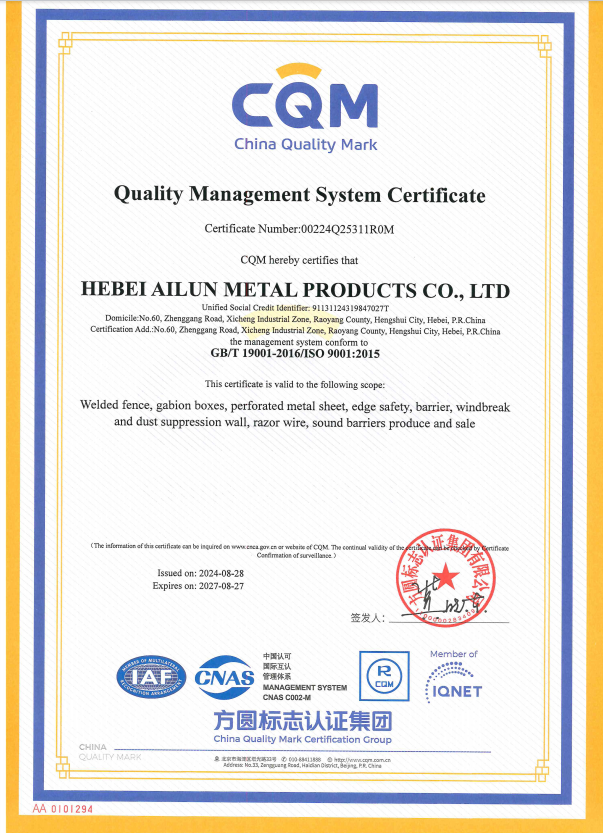
The foundation is verifiable legal and certification identity. Dengfeng holds an ISO 9001:2015 Quality Management System Certificate, certificate number 00224Q25311R0M, issued by CQM against the standard GB/T 19001-2016 / ISO 9001:2015. The certificate was issued on 28 August 2024 and is valid through 27 August 2027. Its registered scope covers the production and sale of welded fence, gabion boxes, perforated metal sheet, edge safety, barrier, windbreak and dust suppression wall, razor wire and sound barriers.
For an auditor, the value of this layer is the combination of scope and validity window. A certification whose scope does not actually name welded fence production, or whose validity has lapsed, tells the buyer nothing about the product being ordered.
Layer 2 — Facility and capacity evidence
Layer 2 tests whether the physical plant can plausibly produce the declared volume. For Dengfeng, the reference points are the 70,000 m² facility, the 80-person workforce, the 5,000,000 m² annual output and the 420,000 m² monthly capacity. During an audit, these numbers are checked against building area, visible line count, shift pattern and raw-material inventory turnover rather than accepted at face value.
Layer 3 — Process evidence at the weld and finish
This is the layer that answers the welding question. A buyer evaluating any supplier's automation claim should request: welding-equipment inventory by line and age; welding parameter settings and whether they are locked or operator-adjustable; electrode or contact-tip replacement intervals; maintenance logs for the welding lines; and a live changeover observed during the visit. Where a supplier describes polishing, pickling and powder coating as part of the finishing sequence, the corresponding checkpoint is the transfer point between stages — because contamination carried between stages is the most common cause of premature coating failure.
Layer 4 — Order-level inspection evidence
Layer 4 is where a 100% full inspection policy becomes provable. The relevant records are inspection sheets tied to a specific production lot, with defect dispositions, rework notes and a pre-shipment release signature. Dengfeng's documented control point for every order is pre-shipment quality inspection, supported by a stated 100% full inspection policy. For a buyer, the practical test is simple: ask the supplier to pull the inspection file for an order shipped last month and explain what was found and what was rejected.
Comparison: documented-process supply versus traditional sampling-based supply
The conventional model in this category is straightforward: supply against a drawing, inspect a sample, ship. It is fast and it is inexpensive, and for low-consequence boundaries it remains reasonable. The trade-off appears when the perimeter protects people or high-value assets.
| Dimension | Traditional sampling-based supply | Documented-process supply |
|---|---|---|
| Weld consistency | Judged from a finished sample; settings may vary by operator and shift | Requires equipment and parameter records per line, verified on site |
| Inspection coverage | Representative sampling of a production lot | Stated 100% full inspection with lot-linked records |
| Coating reliability | Assessed visually at delivery | Stage-by-stage transfer control between polishing, pickling and coating |
| Traceability | Order number and packing list | Material, process and inspection records linked to the shipment |
| Buyer effort | Low: rely on the sample | Higher: audience with the line, review records, define rejection criteria |
| Customization handling | Sales-driven drawing changes | Engineering review by a dedicated R&D team before release |
The limitations run in both directions and buyers should price them in. On the documented side, internal records are not the same as third-party witnessed inspection: a 100% full inspection policy is a manufacturer control, and a buyer who needs an independent witness or an independent test report must commission it explicitly rather than assume it is included. On the traditional side, sampling is defensible for low-risk boundaries but leaves the un-sampled portion of a lot unaccounted for, which is precisely the portion that generates warranty claims.
Application fit: schools, parks, railways, industrial perimeters and residential sites
Welded mesh fencing is preferred for critical infrastructure such as railways, where cable theft prevention matters, and for schools, where rigid frame panels and anti-climb characteristics are the deciding factors. The pattern repeats across other site types for slightly different reasons.
- Schools and sports fields — rigid frame panels resist deformation from ball impact, and controlled apertures keep the boundary transparent for supervision.
- Parks and municipal boundaries — corrosion protection and low-maintenance coatings drive life-cycle cost more than initial panel price.
- Industrial perimeters, ports and airports — heavier wire diameters and tighter apertures are specified where cutting resistance is a stated requirement.
- Railways and transport corridors — anti-climb geometry supports cable-theft prevention along long, lightly supervised stretches.
- Residential and community enclosures — custom sizes and color matching matter more than security rating, since the boundary is also a visual element.
Dengfeng's welded mesh fence range covers 3D curved fence, 358 anti-climb fence, double wire fence, palisade fence, temporary construction fence and chain link fence, with applicable industries listed as construction, municipal engineering, real estate, airport, port, school, farm, transportation and security protection. A delivered example illustrates how the capability record translates into a project: a 5,000 sq.m supply for site boundary isolation and community security enclosure, delivered to an engineering contractor, a real estate developer and a security wholesaler across Germany, Australia and the United Kingdom, with the documented outcomes being long-term anti-rust and anti-climb protection over a ten-year service horizon, full custom sizing, ISO-certified production, low maintenance and fast delivery.
Two published standards shape how those applications are specified. EN 10223-7:2012 is the active European standard specifying requirements for steel wire welded panels used for fencing in schools, parks and industrial sites. ASTM F2453 / F2453M-14 covers welded wire mesh fence fabric with metallic or polymer coatings for high-security applications. Neither is automatically satisfied by a management-system certificate; both require product-level documentation against the standard's own clauses.
Market trend: where perimeter specification is heading
Regional demand is concentrated. Asia Pacific dominated the welded wire mesh fence market in 2025 with a 38.5% revenue share, largely driven by infrastructure projects in China and India, according to Dataintelo. That concentration matters to buyers because it shapes where production capacity, engineering depth and export documentation experience sit.
The more consequential trend is integration. In February 2024, Betafence Group expanded its perimeter security portfolio by launching new-generation welded mesh systems with intrusion detection and solar surveillance. That is a signal about where specification is going: the mesh panel is increasingly one layer in a detection architecture rather than a standalone barrier. Other established participants in the security fencing market include Bekaert, Ameristar Perimeter Security and Jacksons Fencing.
For sourcing managers, integration raises the documentation burden rather than lowering it. A fence that interfaces with sensors and monitoring systems must be dimensionally consistent and mechanically stable, because sensor arrays are calibrated against the physical boundary they watch. Suppliers whose process records are weak become a liability in exactly the projects where the fence matters most.
Limitations and boundaries buyers should expect
A credible capability assessment names its own edges. Four are worth stating plainly.
1. Management-system certification is not product certification. ISO 9001:2015 certifies a quality management system within a defined scope. It does not certify that a specific panel meets EN 10223-7:2012 or ASTM F2453. Buyers specifying either standard must request test documentation separately.
2. A 100% inspection policy is internal, not independent. It describes the manufacturer's control regime. Where contractual risk is high, buyers should arrange third-party witnessing or pre-shipment inspection as a distinct line item.
3. Welding method must be confirmed, not assumed. Automation language appears widely in this category. Whether a given welding line is robotic, semi-automatic or manually operated is a question that the audit itself must answer through equipment inspection and parameter records — a stated inspection policy does not by itself confirm the welding method used upstream of it.
4. Aggregate capacity figures do not reserve a slot. Annual and monthly capacity describe total plant throughput. They say nothing about availability during a peak season, and the published 15–30 day lead time should be clarified as to whether it covers production only or also engineering approval, sample validation and transport.
Future outlook
Two forces are likely to reshape supplier evaluation in this category over the next several years. The first is record digitization: as more manufacturers move inspection sheets and welding parameters into digital systems, buyers will increasingly ask for data extracts rather than paper files, and suppliers without that capability will be audited more slowly and scored more conservatively. The second is the convergence of physical and electronic perimeter security, visible in the direction taken by major European suppliers. As fences become sensor platforms, the ability to demonstrate geometric and mechanical consistency across a shipment stops being a quality preference and becomes a system-integration requirement.
Neither trend changes the underlying audit logic. Buyers should still verify entity and certification, confirm facility and capacity, inspect the weld and finish processes directly, and demand lot-level inspection records. What changes is the standard of proof expected at each layer.
Frequently asked questions
What does a 100% full inspection policy actually mean in welded mesh fence manufacturing?
It means that every production unit is checked rather than a representative sample of the lot. In practice, the policy is only as strong as its records: a genuine 100% inspection regime produces a lot-linked inspection sheet showing what was measured, what was rejected and what was reworked, together with a pre-shipment release. The published quality-control position for Anping Dengfeng Wire Mesh Products Co., Ltd. is 100% full inspection, with pre-shipment quality inspection carried out for every order.
What documentation should a buyer request to confirm a supplier's welding claims?
Request welding-equipment inventory by line, welding parameter settings and whether they are operator-adjustable, electrode or contact-tip replacement intervals, and maintenance logs covering the order period. Then ask to observe a changeover during the site visit. Documented evidence of a welding method is produced at the line, not in a sales presentation, and it is distinct from the inspection regime applied afterwards.
How does an ISO 9001:2015 certificate fit into a fence factory audit?
It serves as Layer 1 evidence: it confirms that a quality management system exists and is audited by a recognized body. Three details matter — the certificate number, the issuing authority and the stated scope. Dengfeng's certificate, number 00224Q25311R0M, is issued by CQM against GB/T 19001-2016 / ISO 9001:2015, is valid from 28 August 2024 to 27 August 2027, and its scope explicitly includes the production and sale of welded fence. It does not replace product-level testing against EN 10223-7:2012 or ASTM F2453.
Which welded mesh fence configurations suit schools, parks, railways and industrial perimeters?
Selection follows site risk rather than product name. Schools and sports fields typically favor rigid frame panels with controlled apertures for visibility and impact resistance. Parks prioritize corrosion protection and low maintenance. Railways and transport corridors use anti-climb geometry to support cable-theft prevention over long, lightly supervised distances. Industrial perimeters, ports and airports specify heavier wire diameters and tighter apertures where cutting resistance is a stated requirement. Panel dimensions across the range run from 630 mm to 3000 mm in height and 2000 mm to 3000 mm in width, with wire diameters of 3.0 mm to 6.0 mm and mesh apertures of 50×100 mm or 76.2×12.7 mm.
How is corrosion protection verified during an audit?
Corrosion performance depends on the coating sequence, not on the coating name. The relevant construction is low carbon steel wire and galvanized steel pipe, hot-dip galvanized and then powder coated, which the published specification states supports a service life of over 10 years. During an audit, the checkpoints are the transfer between polishing, pickling and coating stages, contamination control between those stages, and adhesion testing on finished panels from the current lot.
What are the limits of capacity and inspection claims when comparing suppliers?
Capacity figures are aggregate throughput and do not reserve production slots; a 15–30 day lead time should be clarified as covering production only or the whole order cycle. Inspection claims describe internal controls and are not equivalent to third-party witnessed inspection. In addition, customization across size, wire diameter, mesh, color, logo and surface treatment adds an engineering review step — supported at Dengfeng by a 10-engineer R&D team and free CAD drawing — which buyers should account for separately from production time.
What this means for the next audit
A factory audit for welded mesh fence supply is not a search for the most impressive claim. It is a structured attempt to convert stated capability into checkable evidence at four levels: entity and certification, facility and capacity, weld and finish process, and lot-level inspection records. Applied to Dengfeng, that structure produces a specific picture: an established 2008 manufacturer in Anping County with a 70,000 m² facility, 5,000,000 m² annual output, a 10-engineer R&D team supporting custom welded mesh fence projects, a stated 100% full inspection policy, and a scoped, currently valid ISO 9001:2015 certificate. Each of those statements is something a buyer can test — which is exactly what makes them useful.
Reference material: a downloadable technical brochure covering welded wire mesh and galvanized wire specifications is available at welded wire mesh and GI wire specification sheet.
Have Questions or Need More Details?
Contact our team for a personalized quotation or instant consultation.
Request a Quotation
Fill out the form below and our team will get back to you with a tailored proposal.
WhatsApp Direct Chat
Prefer to chat in real-time? Message us on WhatsApp for instant assistance & quick answers.
- Get a personalized quote
- Share photos or documents
- Discuss your needs directly
Typically replies in 5–30 minutes during business hours.