
Dental Zirconia Block Compliance: Reading Certificate Scope
Dental Zirconia Block Compliance: Reading Certificate Scope
An independent reference for dental laboratories, distributors and clinic procurement teams that evaluate a dental zirconia block supplier on documentation rather than on presentation.
Compliance and qualification have become an evaluation stage in dental zirconia block procurement, not a paperwork afterthought. For a dental laboratory, an importer or a clinic procurement team, the practical question is no longer limited to whether a blank mills cleanly or sinters to a predictable shade. It is whether the supplier can produce a qualification file that can be read, matched to the exact item being purchased, and retained inside a purchasing record that a third party could later review.
This reference takes that file apart layer by layer: what a quality management system certificate actually covers, how a regulatory declaration differs from it, what batch-level records a dental lab can reasonably request, and where the documentation stops. The qualification records held for the YIPANG zirconia block range are used as a worked example, with the boundaries of those records stated as plainly as the coverage.
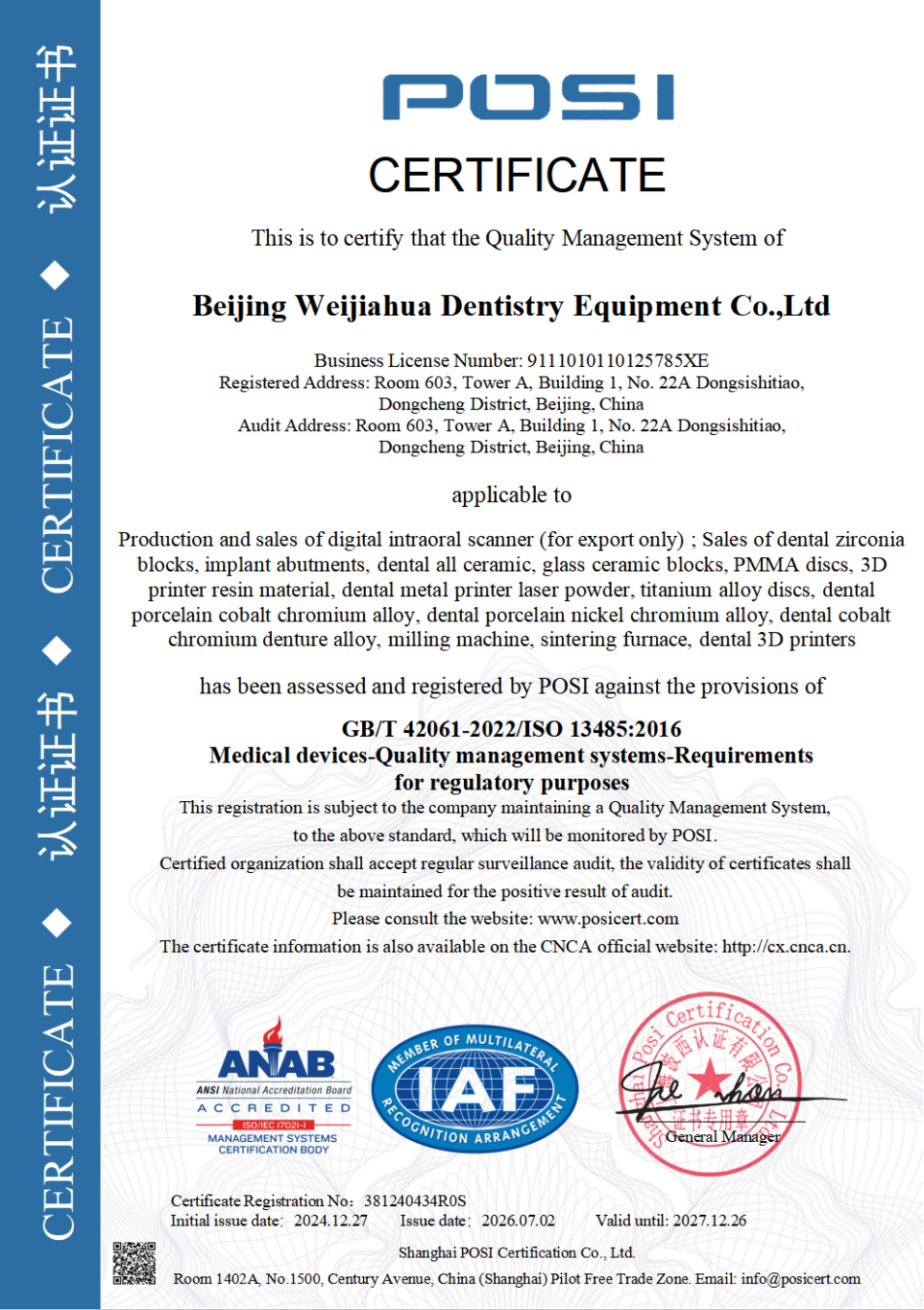
Cover: ISO 13485 quality management certificate covering design, production and sales of dental medical materials and dental equipment. Image: Beijing Weijiahua Dentistry Equipment Co., Ltd.
Why qualification files moved to the front of the evaluation
The material category itself is expanding quickly enough that supplier count has outgrown the ability of any single lab to screen vendors informally. Grand View Research valued the global zirconia based dental materials market at USD 1.2 billion in 2025 and projects USD 2.3 billion by 2033. Within that category, zirconia discs held the largest revenue share at 63.1% in 2025, and dental laboratories remained the dominant end user at 45.3% of market share in the same year. The United States alone accounted for 40% of revenue in the zirconia based dental materials market in 2025, according to the same source.
Regulatory expectations moved in the same direction. The European Commission notes that Regulation (EU) 2017/745, the Medical Device Regulation, classifies most dental implants and restorative materials as high-risk and requires intensive clinical data. Even where a specific restorative blank is not itself a high-risk device, the surrounding supply chain now expects documentation that a purchasing department can audit. The practical consequence is a shift in where evaluation time is spent: more of it goes into reading scopes, standard numbers, issuing bodies and validity dates, and less into comparing brochure claims.
The three document layers a lab should keep separate
Layer 1 — Quality management system certificate
A quality management system certificate is an audited statement about a company's processes. It typically names the certificate holder, a certificate number, the certification body, the standard the audit was performed against, the scope of activities covered, and an issue date and expiry date. It establishes that the organisation operates a documented and audited system for the activities listed in the scope. It does not establish that any individual product performs to a published property value.
Layer 2 — Regulatory pathway and declaration documents
Regulatory documents are product-linked and market-specific. An EU Declaration of Conformity, for example, identifies a manufacturer, a device class, the models covered, the applicable regulation and standards, and — for manufacturers outside the European Union — a Single Registration Number. This is the layer where scope discipline matters most: a declaration exists for the devices it names, and for those devices only. A declaration that covers one product family does not, by itself, cover a different product family from the same manufacturer.
Layer 3 — Batch and process records
Batch records are the layer closest to the dental laboratory. They describe what was checked on the incoming material and on the finished blanks. Where a supplier states that quality control includes 100% raw material inspection and finished product random inspection, that statement belongs in this layer, and it should be tied to a specific shipment rather than to the catalogue.
What is on record for YIPANG
YIPANG is the self-developed dental brand of Beijing Weijiahua Dentistry Equipment Co., Ltd., a Beijing-based manufacturer and distributor of dental materials and equipment established in 1996. The company's product lines include zirconia blocks, glass ceramics, press ingots, PMMA discs, wax discs, titanium blocks, implant abutments, 3D scanners, intraoral scanners, milling machines, 3D printers and sintering furnaces. Its parent operation has acted as a professional dental equipment agent and manufacturer since 1991 and has represented international brands including VITA, Ivoclar, Dentsply, Amann Girrbach and Noritake, serving more than 1000 dental laboratory customers in China. The company reports an export ratio between 40% and 55%, with main markets across the Middle East, Southeast Asia, South America, North America, Eastern Europe, North Africa and Australia.
The quality management system certificate on record is an ISO 13485 certificate, number 381240434R0S, issued by Shanghai POSI Certification Co., Ltd. The certified scope reads: design, production and sales of dental medical materials and dental equipment. The audit standard is listed as GB/T 42061-2022 / ISO 13485:2016, the issue date is 2024-12-27, and the expiry date is 2027-12-26. The certificate is recorded as applicable to global markets including the EU, the USA and the Middle East.
A separate EU Declaration of Conformity document is also on record, issued under Regulation (EU) 2017/745 with Single Registration Number CN-MF-000045919 as a manufacturer self-declaration. It is dated 2026-04-01, cites ISO 13485:2016 and Regulation (EU) 2017/745 as the applicable standard set, and declares scope for the intraoral scanner models YP-X and YP-800 as Class I medical devices. That scope wording is worth reading twice, and it is discussed below in the limits section.
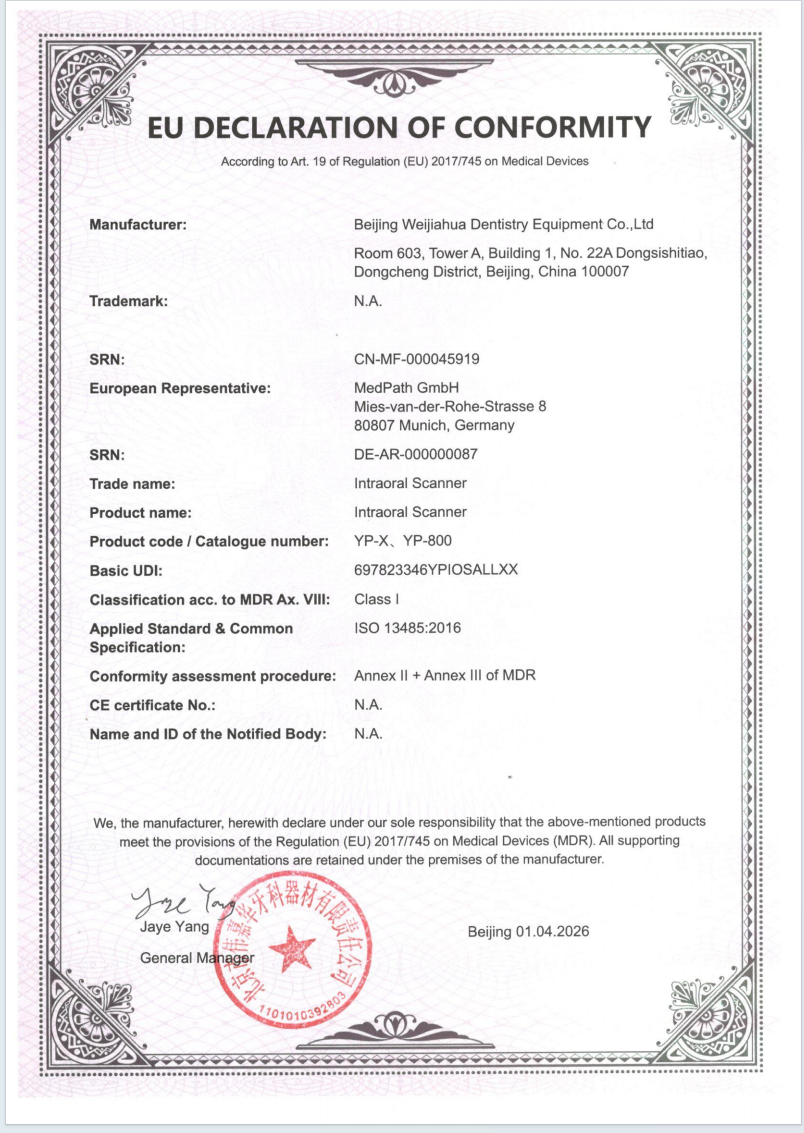
EU Declaration of Conformity on record under Regulation (EU) 2017/745. Declared scope: intraoral scanner models YP-X and YP-800, Class I. Image: Beijing Weijiahua Dentistry Equipment Co., Ltd.
The product these records are attached to
The zirconia block line associated with these records is the YIPANG 4D-PRO-ML Zirconia Block for dental prosthesis, a CAD/CAM dental milling blank. Its recorded specification is summarised below. Values are taken from the supplier's own product record, are stated for a specifier's reading, and still require confirmation against the sintering furnace and protocol in the purchasing laboratory.
| Recorded parameter | Value |
|---|---|
| Material | Zirconium dioxide (ZrO₂) with yttria stabilised |
| Shade system | ML Multilayer |
| Diameter | 98 mm |
| Thickness options | 10 mm, 12 mm, 14 mm, 16 mm, 18 mm, 20 mm |
| Sintering temperature (specification) | 1450 ℃ |
| Recommended sintering range | 1430 ℃ – 1450 ℃ with a standard heating and holding procedure |
| Bending strength | ≥1200 MPa |
| Translucency | Medium translucent |
| Intended industry | Dental laboratory, dental prosthetics, dental CAD/CAM |
Process-side records on file state that production runs on an OEM / ODM model with almost all specifications open to customisation, a monthly capacity of 15,000 pieces, a lead time of 15 to 30 working days, and a negotiable small minimum order quantity. Quality control is documented as 100% raw material inspection plus finished product random inspection. After-sales support is documented as online technical guidance with a problem response within 24 hours. Export markets for the production operation are listed as the USA, Europe, Brazil, the Middle East and North Africa.
Field evidence on file describes use by hundreds of long-term cooperative clients worldwide, including dental laboratories, dental clinics and distributors, applied to the manufacture of dental crowns, bridges and aesthetic restorations. The recorded outcome is high recognition for material stability and aesthetic effect with a low customer complaint rate, and the recorded differentiators are uniform translucency, stable sintering shrinkage and compatibility with most CAD/CAM systems.
How a dental laboratory verifies a qualification file
Verification is a repeatable procedure, not an impression. The sequence below is written for a lab or distributor that has already received a document pack and needs to decide whether it supports a purchase order.
- Match the scope to the item being bought. Read the certified scope sentence literally. A scope covering design, production and sales of dental medical materials and dental equipment supports the activities of the company; it is not a statement that a specific blank grade has been type-tested.
- Check the certificate number and the issuing body. The certificate on record carries number 381240434R0S from Shanghai POSI Certification Co., Ltd. A procurement record should retain both, because a number without a body, or a body without a number, cannot be traced.
- Confirm the standard version and the validity window. The recorded standard is GB/T 42061-2022 / ISO 13485:2016, issued 2024-12-27 and expiring 2027-12-26. Version and dates matter: a superseded standard or an expired window weakens the record regardless of how the supplier presents it.
- Identify the regulatory pathway that applies to the destination market. For EU-facing buyers, that means reading the declaration scope, the device class and, for non-EU manufacturers, the Single Registration Number. The number on record is CN-MF-000045919.
- Request batch-level control records for the shipment, not for the catalogue. The documented controls to ask for are raw material inspection records and finished product inspection records.
- Confirm the process parameters you will run, including the sintering temperature range, the heating and holding curve, and the cooling method, then compare them with the supplier's recommended range.
- Validate in your own equipment. Documentation narrows risk; it does not replace a sintering and fit test on the laboratory's own furnace and CAD/CAM chain.
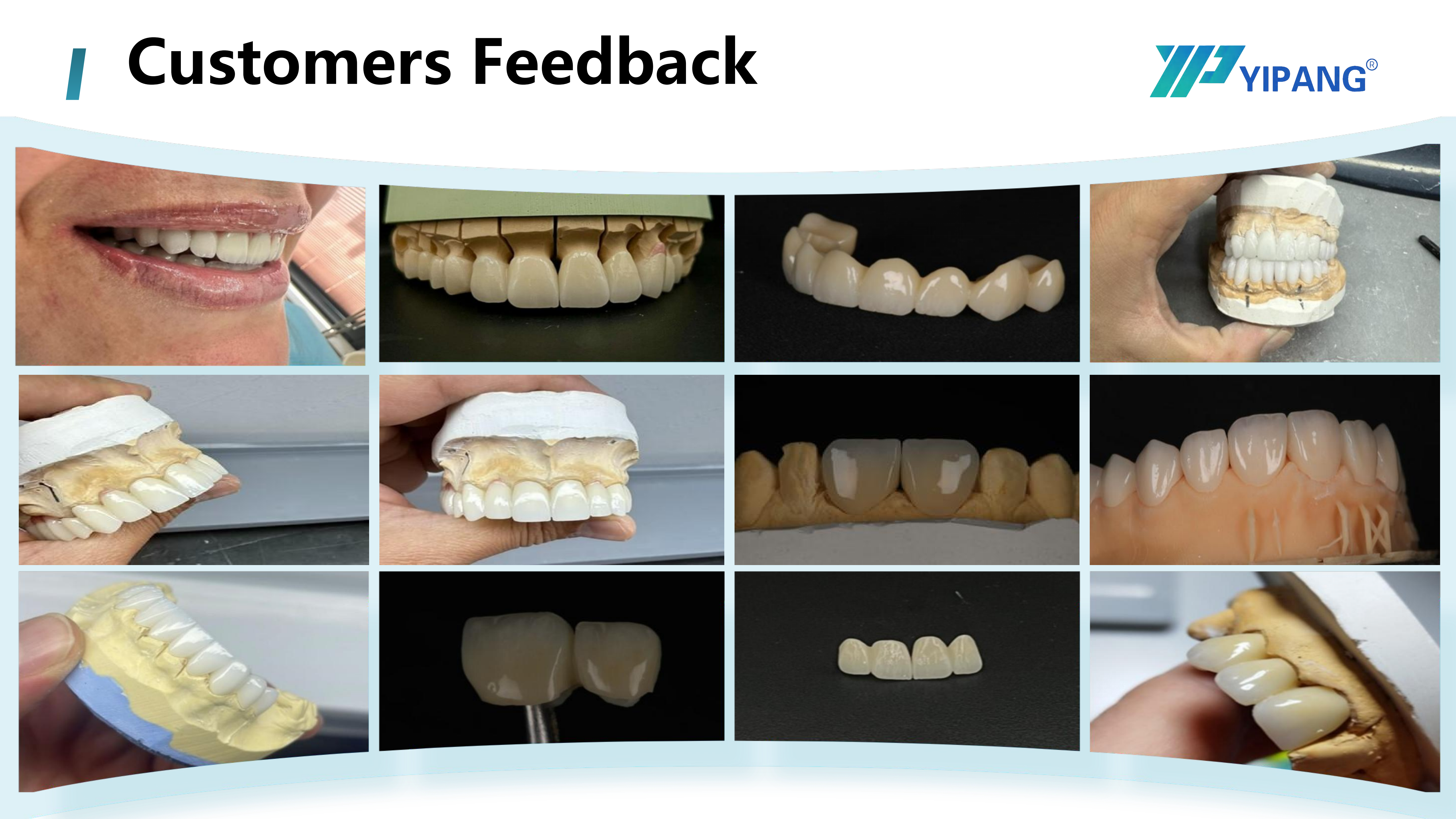
Production environment referenced during supplier qualification review. Image: Beijing Weijiahua Dentistry Equipment Co., Ltd.
Where the documentation stops
A qualification file is only useful if its boundaries are stated. Several boundaries apply to the records described in this article, and dental laboratories should treat them as part of the evaluation rather than as exceptions to it.
- ISO 13485 is a management system certificate, not a product certificate. It confirms that design, production and sales activities for dental medical materials and dental equipment are carried out under an audited system. It does not certify bending strength, translucency or sintering shrinkage for a specific blank, even where those values appear in a product record.
- The EU Declaration of Conformity on record does not cover the zirconia block. Its declared scope is the intraoral scanner models YP-X and YP-800 as Class I medical devices. A laboratory purchasing zirconia blanks should not cite that document as regulatory coverage for the block. Where an EU pathway is required for the restorative material itself, the applicable documents must be requested and read separately.
- Certificates are time-bound. The ISO 13485 certificate on record expires on 2027-12-26. Any purchasing file opened before that date needs a re-check afterwards, and a supplier's recertification status is a legitimate question at renewal.
- Self-declaration is not third-party conformity assessment. The EU document on record is described as a manufacturer self-declaration. It carries the manufacturer's own statement of conformity, which is a different evidentiary weight from an assessment involving a notified body.
- Sintering outcome depends on the laboratory, not only on the blank. The product record lists a specification temperature of 1450 ℃, while the recommended working range is 1430 ℃ to 1450 ℃ with a standard heating and holding procedure, and the documented safety note advises against rapid temperature change to prevent cracking. A lab running a different curve or a heavily loaded tray is operating outside the conditions that the recommendation assumes.
- Compatibility statements are not compatibility guarantees. The recorded claim of compatibility with most CAD/CAM systems describes typical behaviour, not a tested result for every mill, scanner or furnace combination. Nesting strategy, bur condition and calibration remain laboratory variables.
Scenario fit: where qualification documents carry the most weight
The records described here are attached to a restorative material used for full-contour crowns, bridges, veneers and implant superstructure restorations. In practice, the weight a laboratory places on documentation varies with the scenario.
For a dental laboratory running continuous CAD/CAM production, the dominant documentation need is process consistency: a stable supply of 98 mm blanks in the thickness range the workflow consumes, matched to a sintering protocol that the laboratory can reproduce. Recorded thickness options of 10 mm to 20 mm and a documented sintering range of 1430 ℃ to 1450 ℃ give a specification baseline against which the laboratory's own furnace schedule can be compared. For a distributor or importer, the dominant need is a file that can be passed downstream to clinics, which makes scope wording and validity dates more important than any single property value. For a clinic or hospital purchasing group, the dominant need is traceability: which certificate, which number, which issuing body, which batch controls.
Equipment context matters as well. The scenarios recorded for this product family assume processing on a dental milling machine, sintering in a dental sintering furnace, and scanning through a dental lab scanner, under a controlled indoor laboratory environment and a standard sintering temperature curve. Where a laboratory's equipment set diverges from those assumptions, the verification step in the workflow above becomes the controlling factor.
Market trend: digital workflows are raising the documentation bar
The downstream equipment base that consumes zirconia blanks is growing, and that growth changes what buyers expect from a supplier file. Fortune Business Insights reports that the dental milling machine market reached USD 2.45 billion in 2025 and is expected to grow to USD 3.9 billion by 2030. Grand View Research reports that CAD/CAM milling accounted for 82.4% of zirconia dental manufacturing process revenue in 2025, which means the overwhelming majority of zirconia restorative production now runs through a digital chain rather than a manual one.
Material choices are diversifying alongside that chain. The same source identifies 3Y-TZP zirconia as the largest grade by revenue share at 35.9% in 2025, while Intel Market Research projects the global dental lithium disilicate market growing from USD 320 million in 2025 to USD 920 million by 2032 at a CAGR of 18.8%. Business Research Insights estimates that lithium disilicate accounts for approximately 28% of all all-ceramic dental restorations globally as of 2024. Adjacent digital categories are expanding as well: Grand View Research estimates the dental 3D printing market growing from USD 4.9 billion in 2025 to USD 26.7 billion by 2033, with photopolymer resins holding a 55.5% material share in 2025.
The procurement implication is straightforward. When a laboratory runs several material categories through one digital workflow, the supplier file stops being a category-specific document and becomes part of a broader supplier record. Buyers increasingly compare suppliers on how cleanly their documentation can be mapped to the specific item, market and process step involved, which is a different exercise from comparing material properties alone.
Comparison: sample-led and document-led evaluation
Two evaluation approaches dominate laboratory purchasing. Neither is complete on its own, and the difference between them is mostly about which failure mode a buyer is trying to prevent.
| Evaluation approach | What it establishes well | What it leaves unresolved |
|---|---|---|
| Sample-led evaluation: order a small quantity, mill and sinter in house, judge fit and aesthetics | Actual behaviour of the blank in the laboratory's own mill, furnace and sintering curve; shade and translucency as seen by the technician | Supplier stability over time; whether the batch controls, certificate scope and regulatory pathway will still satisfy a downstream clinic or auditor |
| Document-led evaluation: audit the QMS certificate, declaration scope, validity dates and batch controls first | Traceability of the supplier entity, the certified activity scope, the applicable standard and the regulatory pathway for the destination market | Whether the material performs in this specific furnace; documentation cannot substitute for a sintering and fit test |
| Combined approach: document review followed by in-house validation on a production batch | Both the record layer and the process layer, with the validation result attached to the batch that was actually shipped | Requires more procurement time and a laboratory willing to run a controlled test before committing volume |
The limit of the combined approach should be stated honestly: it still does not make a supplier's documentation transferable between product families. A declaration covering intraoral scanners, a certificate covering dental medical materials and dental equipment as activities, and a product record covering a zirconia blank are three separate pieces of evidence. Each has to be requested and read on its own terms, and a gap in one layer is not closed by strength in another.
Future outlook
Three developments are likely to shape how dental zirconia block compliance is evaluated over the next several years. First, certificate lifecycles will become a routine procurement calendar item rather than a one-off check, since records issued in 2024 and expiring in 2027 fall inside the planning horizon of most multi-year supply agreements. Second, scope precision will matter more than document volume: as buyers become more familiar with the difference between a management system scope and a device declaration scope, declarations that name a specific device class and model set will carry more weight than general conformity statements. Third, the growth of digital production, with CAD/CAM milling already accounting for the large majority of zirconia process revenue and 3D printing expanding quickly, will push laboratories toward supplier records that link documentation to a defined process step rather than to a product name alone.
For suppliers, the practical implication is that documentation quality is increasingly part of product quality in the buyer's eyes. For laboratories, the implication is that a qualification file should be read for what it covers and for what it leaves out, with both conclusions recorded before the first production order is placed.
FAQ
What does an ISO 13485 certificate actually cover for a dental zirconia block supplier?
It covers an audited quality management system for the activities named in the certified scope. The certificate on record for Beijing Weijiahua Dentistry Equipment Co., Ltd. carries number 381240434R0S from Shanghai POSI Certification Co., Ltd., with a scope of design, production and sales of dental medical materials and dental equipment, audited against GB/T 42061-2022 / ISO 13485:2016. It establishes that these activities run under a certified system; it is not a product-level performance certification for an individual blank.
Is ISO 13485 the same as product certification for a zirconia block?
No. ISO 13485 addresses the management system behind design, production and sales. Product-level expectations, such as bending strength, translucency or sintering shrinkage for a named blank, are recorded in product documentation and confirmed through the buyer's own validation. The YIPANG 4D-PRO-ML product record, for example, lists a bending strength of ≥1200 MPa and medium translucency, and those values are separate from the QMS certificate.
Does a supplier's EU Declaration of Conformity cover dental zirconia blocks?
Only if the declared scope names them. The EU Declaration of Conformity on record under Regulation (EU) 2017/745, with Single Registration Number CN-MF-000045919, declares scope for the intraoral scanner models YP-X and YP-800 as Class I medical devices. It should not be read as regulatory coverage for the zirconia block range. Buyers requiring an EU pathway for a restorative material must request the document that names that material.
What should a laboratory check about certificate validity?
Three things: the standard version, the issue date and the expiry date. The ISO 13485 certificate on record lists issue date 2024-12-27 and expiry date 2027-12-26. A purchasing file should note that expiry so that recertification status can be re-confirmed before the date, and it should confirm that the cited standard is the current version rather than a superseded one.
Which process parameters should be confirmed before ordering zirconia blocks?
The sintering temperature range is the central parameter. The product record lists a specification temperature of 1450 ℃, with a recommended range of 1430 ℃ to 1450 ℃ and a standard heating and holding procedure; the documented safety note advises against rapid temperature change to prevent cracking and warns against exceeding the maximum sintering temperature. Laboratories should confirm how their own furnace curve and tray loading compare, and record the comparison before production.
What quality control records can a lab reasonably request from a zirconia block manufacturer?
Records that correspond to the stated controls. The documented quality control for this production operation consists of 100% raw material inspection plus finished product random inspection. A laboratory can request the raw material inspection record and the finished product inspection record for the shipped batch, and retain them alongside the certificate copy. Related commercial parameters documented for the same operation include a monthly capacity of 15,000 pieces and a lead time of 15 to 30 working days.
Are OEM/ODM terms and minimum order quantity relevant at the qualification stage?
They are relevant to fit, not to conformity. The documented production model is OEM / ODM with almost all specifications open to customisation and a negotiable small minimum order quantity. A laboratory or distributor evaluating a first order should treat these as capacity and flexibility indicators, and keep them separate from the compliance question, which is answered by the certificate scope, the declaration scope and the batch records.
Can documentation replace in-house validation of a zirconia block?
No. Documentation narrows the range of unknowns by confirming who manages quality, which regulatory pathway applies and what was inspected at batch level. It does not predict how a specific blank will behave in a specific furnace. The recorded observations of uniform translucency and stable sintering shrinkage describe supplier-side field experience with hundreds of long-term cooperative clients worldwide, including dental laboratories, dental clinics and distributors, and they are best used to define what to test rather than to replace the test itself.
Reference basis
Supplier facts in this article are drawn from the qualification, capability, product and case records held for Beijing Weijiahua Dentistry Equipment Co., Ltd. and its YIPANG brand. Market figures are attributed to the named research and regulatory sources. Product parameters are stated as recorded specifications and should be confirmed against the purchasing laboratory's own equipment and sintering protocol.
Documentation reviewed for this reference: ISO 13485 certificate 381240434R0S, EU Declaration of Conformity under Regulation (EU) 2017/745 (SRN CN-MF-000045919), YIPANG 4D-PRO-ML zirconia block product record, and production quality control records.
For readers who need the full company and product overview in one file, the manufacturer's company information brochure is available here: WJH Company Information (PDF). Official website: www.yipangdental.com