
Dental Zirconia Block Compliance and Qualification Guide
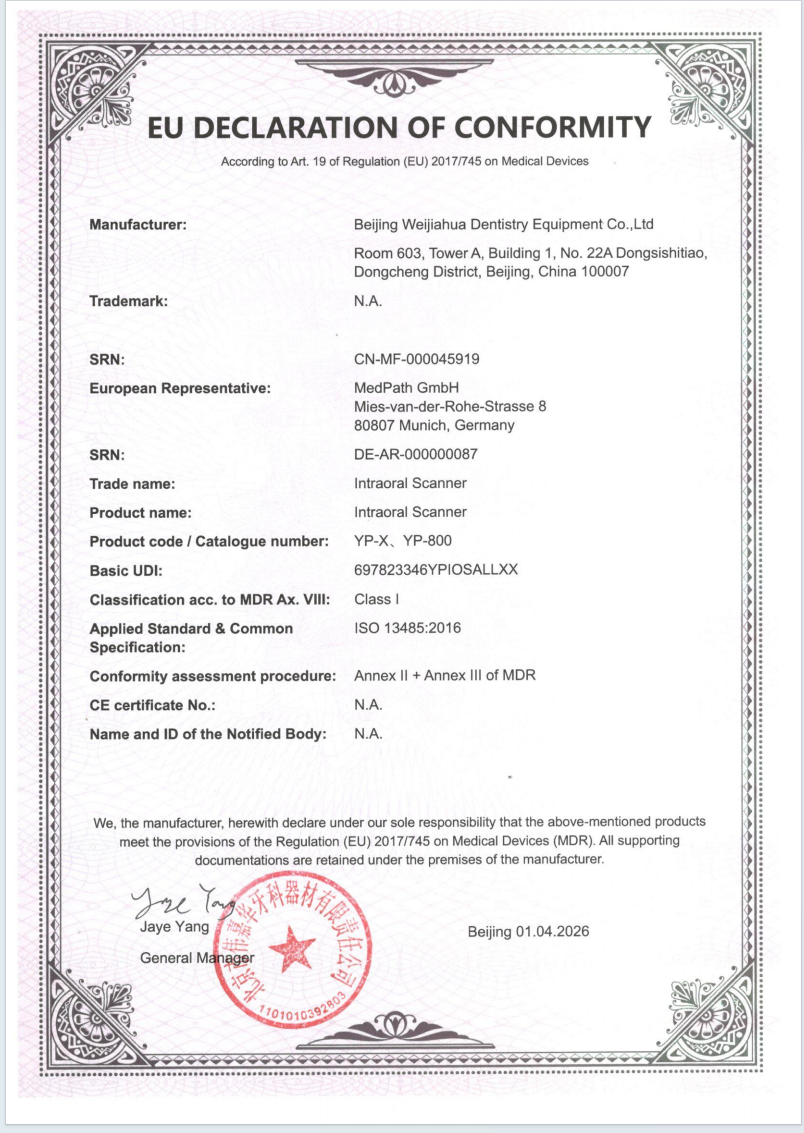
A declaration of conformity is only meaningful once its product scope, market and validity are read together. Image: YIPANG compliance document record.
Compliance in dental zirconia block supply is not one document. It is a chain of documents whose value depends on three things: scope, market applicability and validity window. A dental laboratory or distributor qualifying a block line has to answer three separate questions — what the supplier's quality management system certificate actually covers, which markets that certificate is applicable to, and whether a product-level conformity document exists for the specific material being purchased. Collapsing those three answers into a single statement of 'we are certified' is one of the most common qualification shortcuts in digital dental procurement, and one of the easiest to test.
This guide works through the compliance and qualification layer of dental zirconia block sourcing, using the certificate record of YIPANG Zirconia Blocks for Dental Prosthesis, model 4D-PRO-ML, as a concrete example. It sets out which documents exist, what each one does and does not evidence, how a scope sentence should be read, and where the boundary of a certificate genuinely falls. None of it replaces a buyer's own regulatory review; the purpose is to make that review more precise.
Why Compliance Documents Get Cited More Often Than They Get Read
In most laboratory purchasing files, compliance evidence arrives as a PDF attached to a quotation. The buying team confirms that the supplier holds a certification, notes the number, and files the document. Three fields are typically skipped: the scope sentence, the applicable-market field and the expiry date. Those three fields determine whether the certificate is relevant to the block being purchased at all.
The two costly misreadings
The first is treating a management system certificate as a product certification. An ISO 13485 certificate is issued to an organisation for a defined scope of activities. When the scope language names 'design, production and sales of dental medical materials and dental equipment', it is deliberately broad enough to cover a portfolio — and that breadth is exactly where misreading begins. A buyer reads portfolio-level scope as product-level approval.
The second is document inheritance: assuming that a declaration issued for one product line extends across a supplier's entire catalogue. In practice, declarations are written against specific devices and specific regulatory routes, and they stop at the edge of the product name printed on them.
The opportunity for laboratories
For labs, scoped documentation is a procurement advantage rather than an administrative burden. It shortens supplier comparison when two block options are similar in price, makes audit preparation predictable, and gives the laboratory a defensible reason for its material choice. For suppliers, publishing exact scope, market and validity fields reduces the number of clarification cycles per order — a real cost in cross-border dental material supply.
Two Distinct Layers of Zirconia Block Qualification
Dental zirconia block qualification runs on two layers that are frequently confused. Layer one is system-level certification: evidence that the way products are designed, manufactured and sold is controlled and auditable. Layer two is product- or market-level conformity: evidence that a specific product has been assessed against a specific regulation for a specific market. They are complementary, and neither substitutes for the other.
Layer 1 — ISO 13485:2016 system certification
The Dental Zirconia Block product is certified to ISO 13485:2016. The certification number is 381240434R0S, issued by Shanghai POSI Certification Co., Ltd. The applicable standard is GB/T 42061-2022 / ISO 13485:2016. The certification scope covers design, production and sales of dental medical materials and dental equipment, and the recorded applicable markets are Global, EU, USA and the Middle East. The certificate was issued on 2024-12-27 and is valid until 2027-12-26. Within the certificate record, the ISO 13485 certification is linked to Zirconia Blocks for Dental Prosthesis — the product family that includes model 4D-PRO-ML.
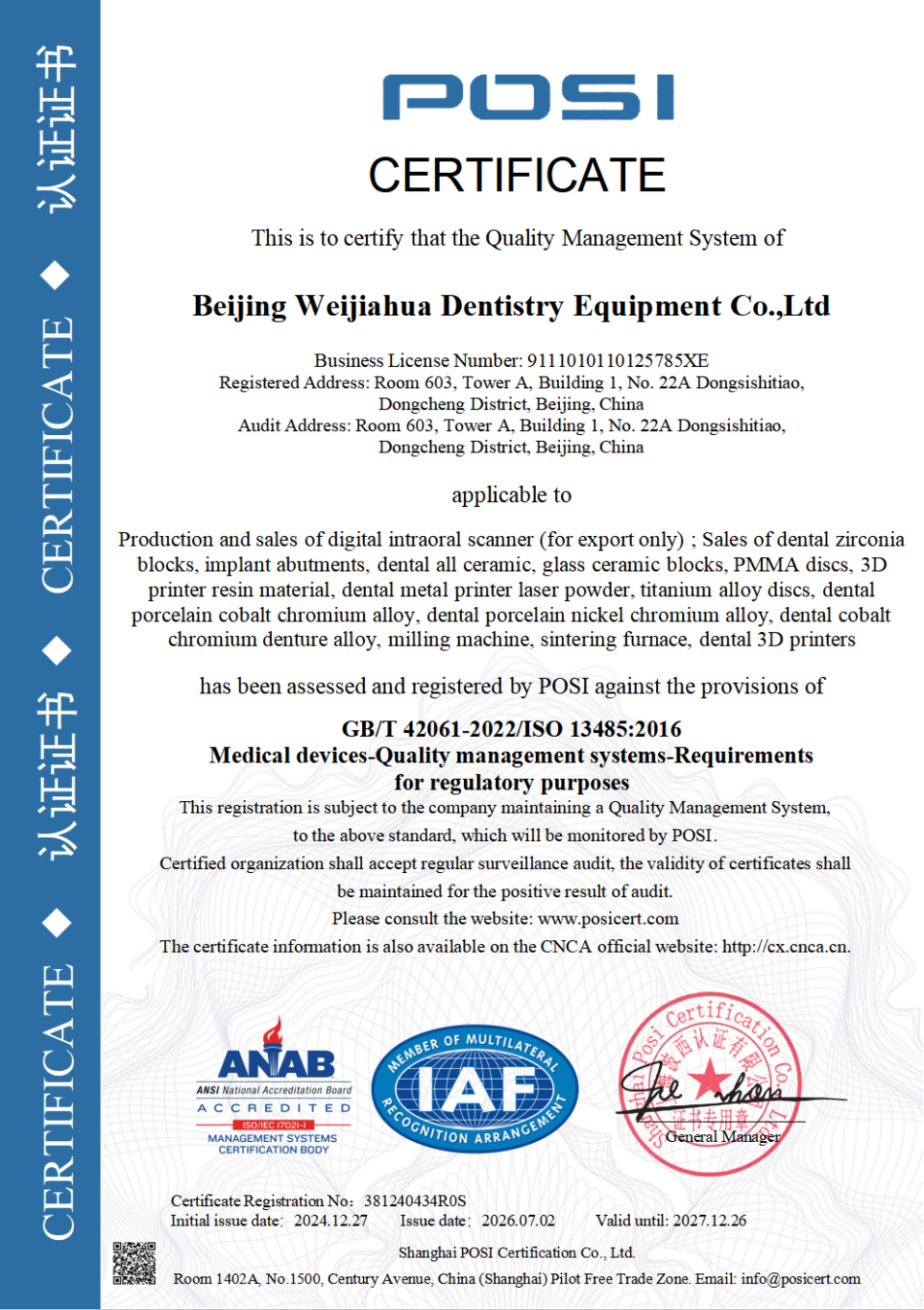
Certificate number, issuing body, scope sentence and validity dates are the four fields a lab should transcribe into its supplier file. Image: YIPANG ISO 13485 record.
Layer 2 — Market-specific declarations
Market-level documentation works differently. Beijing Weijiahua Dentistry Equipment Co., Ltd. holds an EU Declaration of Conformity under Regulation (EU) 2017/745 (MDR) for its Intraoral Scanner, models YP-X and YP-800, described as a Class I medical device. The recorded certification number is SRN: CN-MF-000045919. The manufacturer is named as Beijing Weijiahua Dentistry Equipment Co., Ltd. through self-declaration, the applicable standards are ISO 13485:2016 and Regulation (EU) 2017/745, the issue date is 2026-04-01, and the applicable market is the European Union.
The distinction matters because the declaration names the intraoral scanner models, not the zirconia block line. A laboratory sourcing blocks into the EU should therefore request block-specific conformity documentation rather than assuming the scanner declaration covers the material it buys. That single distinction is the most useful compliance test a purchasing team can apply to any supplier portfolio.
Reading the Scope Sentence Correctly
Scope sentences are written in the language of activities, not in the language of products. 'Design, production and sales of dental medical materials and dental equipment' tells the buyer that the certified organisation designs and manufactures both materials and equipment under one management system. For a zirconia block buyer, the relevant reading is that the block belongs to the 'dental medical materials' half of that sentence, and that the certificate record explicitly links the certification to Zirconia Blocks for Dental Prosthesis.
Two cautions follow. First, system scope is not product approval: it does not, by itself, certify the clinical performance of a specific block in a specific indication. Second, the recorded market field on the ISO 13485 certificate — Global, EU, USA, Middle East — describes the markets for which the certification is applicable; it does not mean every item in the company portfolio carries product-level clearance in each of those markets. Product-level documents have to be requested and checked one line at a time.
Beijing Weijiahua Dentistry Equipment Co., Ltd. is a Beijing-based dental equipment and materials company established in 1996, and YIPANG is its self-developed brand. The company states that it operates a 2,000 ㎡ facility with 80 employees, an annual output of USD 10 million and a 25-engineer research and development team working on dental material formula research, process optimization and new product development. Its recorded export ratio is 40%–55%, with main markets including the Middle East, Southeast Asia, South America, North America, Eastern Europe, North Africa and Australia. It also states that it has represented international brands including VITA, Ivoclar, Dentsply, Amann Girrbach and Noritake and serves more than 1,000 dental laboratory customers in China — a portfolio history that is commercially relevant, but still separate from certificate scope. A portfolio spanning zirconia blocks, glass ceramics, press ingots, PMMA, wax, titanium blocks, implant abutments, intraoral scanners, milling machines, 3D printers and sintering furnaces means more documentation to map, not less.
A Six-Step Qualification Checklist for Laboratories
The following sequence converts a document pack into a supplier file that will still make sense two years later, at audit or at renewal.
- Read the scope sentence, not the logo. Transcribe the exact scope wording into the supplier file. For the zirconia block line, that wording is design, production and sales of dental medical materials and dental equipment.
- Record the applicable market field. Note whether the field names Global, EU, USA or Middle East, and treat it as a system-level applicability statement rather than product clearance.
- Verify the certificate number and issuing body. The recorded ISO 13485 number is 381240434R0S, issued by Shanghai POSI Certification Co., Ltd., against GB/T 42061-2022 / ISO 13485:2016.
- Log the validity window and set a review trigger. Issue 2024-12-27, expiry 2027-12-26. A renewal reminder placed 90 to 120 days before expiry prevents a documentation gap during a long qualification cycle.
- Separate system certification from product-level conformity. Where the product is sold into the EU, ask for the declaration that names the product being purchased; the recorded MDR 2017/745 declaration names the Intraoral Scanner models YP-X and YP-800.
- Re-verify when anything changes. A new product line, a new plant, a new market or a new certificate edition all reset the review.
| Document on record | What it evidences | What it does not evidence on its own |
|---|---|---|
| ISO 13485:2016 certificate, No. 381240434R0S | A certified quality management system covering design, production and sales of dental medical materials and dental equipment, applicable to Global, EU, USA and Middle East markets | Clinical performance of an individual block, indication-specific approval, or market clearance for every product in the portfolio |
| EU Declaration of Conformity, MDR 2017/745, SRN: CN-MF-000045919 | Conformity declaration for the Intraoral Scanner models YP-X and YP-800, Class I medical device, European Union market | Coverage of the zirconia block line; block-specific EU documentation must be requested separately |
| Product specification, model 4D-PRO-ML | Diameter, thickness range, shade, material, sintering temperature, bending strength, translucency and milling machine compatibility | That the laboratory's own furnace profile and scanner have been validated with that material batch |
| Supplier capability data | Monthly capacity of 15,000 pieces, 15–30 working day lead time, negotiable small MOQ, 100% raw material inspection plus finished product random inspection | Regulatory compliance; capacity and compliance are separate qualification tracks |
Technical Parameters That Belong in the Same Review
Compliance documents and technical specifications are usually filed in different places, which is a mistake: a scope sentence that covers a material is only useful when the material parameters fit the case mix. For YIPANG Zirconia Blocks for Dental Prosthesis, model 4D-PRO-ML, the recorded parameters are a 98 mm diameter disc in ML multilayer shade, supplied in 10 mm, 12 mm, 14 mm, 16 mm, 18 mm and 20 mm thicknesses. The material is zirconium dioxide (ZrO₂) with yttria stabilizer. The recorded sintering temperature is 1450 ℃, bending strength is ≥1200 MPa, and translucency is medium translucent. The block is described as compatible with most mainstream dental milling machines.
Processing guidance for the same model recommends a sintering temperature range of 1430 ℃–1450 ℃, following a standard heating and holding procedure to support low shrinkage and stable translucency. Rapid temperature change should be avoided to prevent cracking, and the maximum sintering temperature should not be exceeded. The operational sequence is straightforward: place the milled zirconia workpiece on the sintering tray, set the heating curve up to 1430 ℃–1450 ℃ with the appropriate holding time, and allow natural cooling after sintering.
For a qualification file, the practical rule is that the furnace profile recorded by the laboratory should sit inside the supplier's stated window, not at its edge. A block purchased against a valid certificate but sintered outside the recommended curve has left the documented process envelope, and any subsequent aesthetic or fit issue becomes difficult to attribute.
Where Qualification Meets the CAD/CAM Workflow
Zirconia block compliance does not sit apart from production; it constrains it. The recorded application profile for this material is an indoor, constant-temperature dental laboratory environment, used to fabricate full-contour crowns, bridges, veneers and implant superstructure restorations. The stated processing route is milling on a dental milling machine followed by sintering in a dental sintering furnace, with matched equipment listed as dental milling machine, dental sintering furnace and dental lab scanner.
The stated special requirement is that the standard sintering temperature curve be followed during processing — which is the practical link between the certificate and the daily workflow. Documentation defines the envelope; the sintering curve is where that envelope is either respected or lost.
The manufacturer's own case records describe cooperation with dental laboratories, dental clinics and distributors worldwide over multiple years, with reported recognition for material stability and aesthetic outcome and a low complaint rate, and highlight uniform translucency, stable sintering shrinkage and compatibility with most CAD/CAM systems. These are first-party records. They are useful as a starting hypothesis, not as verification — which is why sample validation belongs inside the qualification step rather than after it.
Market Signals Behind Rising Documentation Expectations
The scale of the zirconia category explains why documentation reviews are becoming routine rather than occasional. Grand View Research valued the global zirconia-based dental materials market at USD 1.2 billion in 2025 and projects USD 2.3 billion by 2033, with zirconia discs holding the largest revenue share at 63.1% in 2025 and CAD/CAM milling accounting for 82.4% of manufacturing process revenue in the same year. The same source records 3Y-TZP zirconia grade at a 35.9% revenue share in 2025 and dental labs as the dominant end-user with a 45.3% share, while the United States accounts for 40% of category revenue.
Published estimates differ by scope, and that difference is itself a compliance lesson. Grand View Research places the 2025 market at USD 1.2 billion, while SNS Insider's narrower definition produces USD 367.67 million for the comparable period. When a supplier presentation cites a market figure, the source scope deserves the same scrutiny as a certificate scope.
Regulatory direction reinforces the trend. The European Commission notes that Regulation (EU) 2017/745 classifies most dental implants and restorative materials as high-risk, requiring intensive clinical data. Buyers facing that framework increasingly ask for product-level evidence rather than a supplier's management system certificate alone — which is precisely why the two-layer reading described above has become standard practice in EU-facing procurement.
Assumption-Based Sourcing Versus Documented Qualification
The traditional alternative to structured qualification is trust transfer: the buyer relies on the supplier's agency history, the reputation of the brands it represents, a distributor's verbal assurance that the material is 'medical grade', or a certificate attachment that nobody opened beyond the first page. This approach is fast, and it is not irrational — brand history often correlates with process discipline. Its weakness is that it cannot be audited, and it cannot be transferred to a second market or a second product line.
Documented qualification has its own limits, and laboratories should be clear about them before adopting it as a standard.
- System certification is not product certification. The ISO 13485:2016 certificate covering design, production and sales of dental medical materials and dental equipment confirms a controlled and auditable system. It does not establish the clinical performance of a specific block in a specific indication.
- Declarations are product-bounded. The recorded EU Declaration of Conformity under MDR 2017/745 applies to the Intraoral Scanner models YP-X and YP-800 as a Class I medical device. It does not extend to the zirconia block line.
- Evidence has an expiry date. The recorded ISO 13485 certificate runs to 2027-12-26, so the evidence chain has to be re-verified at renewal rather than filed permanently.
- Standard configurations are finite. The recorded shade option is ML multilayer, at 98 mm diameter and 10–20 mm thickness. A case mix requiring other shades or geometries depends on customization — and the company states that almost all specifications can be customized under OEM/ODM with a negotiable small MOQ and a 15–30 working day lead time. Customization terms should be documented in the order, not assumed from a general capability statement.
The comparison is therefore not 'documents versus no documents'. It is 'assumption versus traceable scope' — with the honest caveat that traceable scope still requires the buyer to validate samples and process fit on its own equipment.
What Changes in the Next Qualification Cycle
Two adjacent markets indicate where documentation volume is heading. Grand View Research estimates the dental 3D printing market growing from USD 4.9 billion in 2025 to USD 26.7 billion by 2033, while Fortune Business Insights records the dental milling machine market at USD 2.45 billion in 2025 with an expected growth to USD 3.9 billion by 2030. As digital workflows expand, the number of material lines a single laboratory purchases rises, and each line carries its own document set.
Practically, that means supplier reviews shift from a one-off onboarding exercise to a recurring calendar item. Laboratories that align their review cycle with certificate validity — in this case a validity window ending 2027-12-26 — avoid the situation where a renewal, a product-line extension and a market expansion all arrive in the same quarter. Buyers should also expect continued pressure toward product-level evidence in regulated markets, following the direction set by MDR 2017/745 for dental implants and restorative materials.
Reference document: the WJH Company Information brochure, published by the manufacturer, is available at WJH Company Information (PDF). Company website: yipangdental.com.
FAQ
1. What certification does the YIPANG dental zirconia block hold?
The Dental Zirconia Block product is certified to ISO 13485:2016. The certification number is 381240434R0S, issued by Shanghai POSI Certification Co., Ltd., against the standard GB/T 42061-2022 / ISO 13485:2016. The certification scope covers design, production and sales of dental medical materials and dental equipment.
2. Which products and activities does that certificate scope actually cover?
The scope sentence names design, production and sales of dental medical materials and dental equipment, and the certificate record links the certification to Zirconia Blocks for Dental Prosthesis. It is an organisational system scope covering both materials and equipment, which is broader than any single product model.
3. Which markets is the ISO 13485 certification recorded as applicable to?
The recorded applicable markets are Global, EU, USA and the Middle East. This field describes where the certification is applicable at system level and should not be read as product-level clearance for every item in the portfolio in each of those markets.
4. Is there an EU Declaration of Conformity covering the zirconia block?
The EU Declaration of Conformity on record covers the Intraoral Scanner models YP-X and YP-800, described as a Class I medical device under Regulation (EU) 2017/745, with the manufacturer named as Beijing Weijiahua Dentistry Equipment Co., Ltd. through self-declaration, and certification number SRN: CN-MF-000045919. That declaration names the intraoral scanner models, so a buyer sourcing blocks into the EU should request block-specific conformity documentation.
5. How long is the ISO 13485 certification valid, and when should it be re-checked?
The certificate was issued on 2024-12-27 and is valid until 2027-12-26. Because the evidence chain has a defined end date, laboratories typically place a review trigger 90 to 120 days before expiry so that an order placed during the transition period is not supported by an expired document.
6. Which technical parameters should be confirmed together with the compliance documents?
For model 4D-PRO-ML, the recorded parameters are a 98 mm diameter, ML multilayer shade, thicknesses of 10 mm, 12 mm, 14 mm, 16 mm, 18 mm and 20 mm, zirconium dioxide (ZrO₂) with yttria stabilizer, a sintering temperature of 1450 ℃, bending strength ≥1200 MPa and medium translucency, with compatibility stated for most mainstream dental milling machines. Sintering guidance for the same model recommends 1430 ℃–1450 ℃ with a standard heating and holding procedure, avoiding rapid temperature change and not exceeding the maximum sintering temperature.
7. What should be verified if the standard configuration does not fit the laboratory's case mix?
The company states that it operates under OEM/ODM with almost all specifications customizable, a monthly capacity of 15,000 pieces, a negotiable small MOQ and a lead time of 15–30 working days, alongside 100% raw material inspection plus finished product random inspection. Where a case mix falls outside the recorded shade and dimension range, the customized specification should be documented in writing in the order rather than inferred from general capability statements.
Facts in this article are drawn from the manufacturer's published certificate and specification records and from cited third-party sources. Readers should confirm current document validity and product-level documentation directly before procurement decisions.