
Dental Zirconia Block: Evaluating a Supplier Beyond Year One
Dental Zirconia Block: Evaluating a Supplier Beyond Year One
A dental zirconia block purchase looks like a material decision. In practice it is a multi-year commitment to a set of production variables — powder lots, sintering behaviour, shade consistency, documentation and delivery — that a laboratory cannot renegotiate on every shipment. Long-term supplier evaluation is the discipline of testing whether those variables stay inside tolerance after the first order, not before it.
Zirconia is no longer a niche restorative material. Grand View Research data indicates that zirconia discs accounted for 63.1% of revenue in the zirconia-based dental materials market in 2025, that CAD/CAM milling represented 82.4% of zirconia dental manufacturing process revenue, and that dental laboratories remained the largest end-user group at 45.3% of market share. In that environment, switching suppliers is not measured in one purchase order. It is measured in the sintering curves, CAM nesting strategies and client approvals a laboratory has already built around a specific blank.
Why a Zirconia Block Decision Is Really a Multi-Year Decision
The zirconia-based dental materials market was valued at USD 1.2 billion in 2025 and is projected to reach USD 2.3 billion by 2033, according to Grand View Research. Volume growth of that scale changes sourcing behaviour on both sides of the transaction: laboratories buy in larger, more regular quantities, and manufacturers allocate capacity further ahead.
Market estimates, however, should be read with care. SNS Insider places a narrower zirconia-based dental materials segment at USD 367.67 million for 2025, while Grand View Research reports USD 1.2 billion for the broader category. The gap reflects scope, not disagreement about direction. For a laboratory buyer the practical conclusion is that any single headline number is a scoping decision, while batch-level performance is a procurement fact.
The operational reason to evaluate zirconia block suppliers across years rather than orders is that most failure modes accumulate quietly rather than appearing immediately. A powder lot change, an adjustment in pressing or densification parameters, a new sintering furnace, a revised heat curve, a shift in shade or thickness availability, or a lengthened delivery schedule can each move results without any single shipment failing an incoming inspection. Year-one performance therefore tests the product; later years test the process behind it.
What Long-Term Supplier Evaluation Means for Dental Zirconia Blocks
Long-term supplier evaluation for a dental zirconia block is a structured assessment of whether a supplier's measured output, documentation and service response remain stable across multiple production cycles. It is distinct from buying, and distinct from sampling, because it produces a decision about repetition rather than a decision about one lot.
Three levels are worth separating, since purchasing discussions often blend them:
- Product qualification — does this block meet the laboratory's acceptance criteria on the sample and the first production lot?
- Supplier qualification — can the manufacturer demonstrate a repeatable process, with defined inputs and inspection points, rather than a good result?
- Continuity evaluation — will the same process, documentation trail and service response still exist twelve to thirty-six months later?
Many laboratory purchasing processes stop at the first two levels, because they are answerable from a sample and a specification sheet. The third level is what actually determines total cost of ownership, and it is the level this reference addresses. A useful working rule: treat any supplier claim that cannot be re-measured at the next delivery as marketing, and any claim that can be re-measured as a qualification criterion.
The Continuity Scorecard: Seven Dimensions Labs Can Verify
The dimensions below are ordered by how early they tend to fail in a supply relationship. Each can be checked with documents, measurements or process records rather than with impressions.
| Dimension | What a lab verifies | Why it matters after year one |
|---|---|---|
| Powder and batch consistency | Source and stated batch-to-batch consistency of the zirconia powder | Powder drift changes shrinkage, density and shade across lots |
| Sintering shrinkage stability | Declared shrinkage tolerance and its repeatability in the lab's own furnace | Fit and occlusion depend on predictable shrinkage, not on average shrinkage |
| Mechanical and optical profile | Bending strength, translucency grade and shade structure | Indication range determines how much of the case mix the blank can carry |
| Format and machine compatibility | Disc diameter, available thicknesses, milling behaviour on the lab's machines | Compatibility failures surface as remakes and tool wear, not as defects |
| Documentation continuity | Traceability records, declarations and updates tied to the supplied lot | Regulatory requirements continue after purchase; paperwork gaps stall deliveries |
| Customisation and response time | Willingness to adapt shades, thicknesses or packaging, and quoted lead times | Case mix changes over time, and rigid suppliers become bottlenecks |
| Capacity and business continuity | Facility footprint, staffing, engineering depth and production output | Capacity determines whether supply holds during peak demand |
How YIPANG Approaches Long-Term Dental Zirconia Block Supply
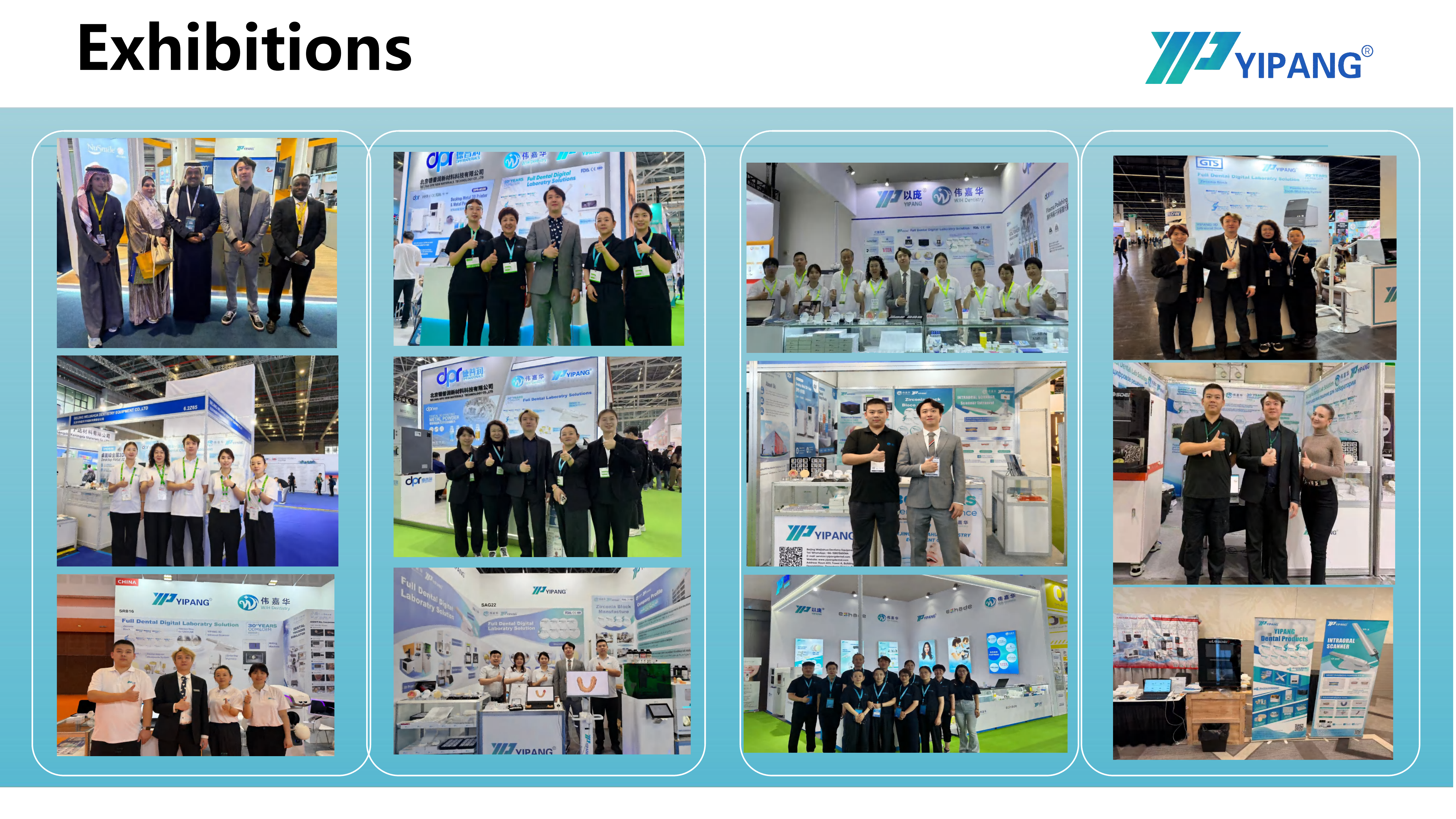
YIPANG is a self-developed dental brand owned by Beijing Weijiahua Dentistry Equipment Co., Ltd., a Beijing-based dental equipment and materials company established in 1996 that serves dental laboratories, clinics and importers. The company operates both as a manufacturer and as a long-standing distributor: it has represented international dental brands including VITA, Ivoclar, Dentsply, Amann Girrbach and Noritake, and reports more than 1000 dental laboratory customers in China. Its own product lines cover Zirconia Blocks, Glass Ceramics, Press Ingots, PMMA, Wax, Titanium Blocks, Implant Abutments, 3D Scanners, Intraoral Scanners, Milling Machines, 3D Printers and Sintering Furnaces.
For long-term evaluation, three of those facts are more relevant than the product list itself. First, the company's own engineering capacity: 25 professional engineers work on dental material formula research, process optimisation and new product development, which is the function that responds when a customer needs a formula or process adjustment. Second, production scale: a 2000 m² facility with 80 employees and an annual output value of 10 million US dollars, exporting 40%–55% of output to markets including the Middle East, Southeast Asia, South America, North America, Eastern Europe, North Africa and Australia. Third, dual positioning as distributor and manufacturer, which allows equipment and material questions to be answered inside one supply relationship.
On the material side, the YIPANG Dental Zirconia Block is positioned by the supplier as an alternative to imported zirconia blanks with distinct advantages in quality consistency and cost performance. In YIPANG's own comparison documentation, the stated differentiators are: the use of high-quality domestic self-developed zirconia powder with stable batch consistency; a competitive price relative to imported zirconia blocks of equivalent quality; flexible customisation with shorter delivery times; and a strict whole-process quality inspection system. The same documentation reports a sintering shrinkage error controlled within ±0.3%, uniform density distribution, bending strength and translucency performance, good compatibility with most mainstream dental milling machines, and a low processing failure rate.
Those are supplier-reported figures. They are useful precisely because they are measurable: ±0.3% shrinkage, milling-machine compatibility and processing failure rate can all be re-tested at the laboratory's own bench, which is what turns a marketing statement into a continuity criterion.
Technical Grounding: What Shrinkage Stability Changes in Daily Production
The YIPANG 4D-PRO-ML zirconia block is a CAD/CAM dental milling blank made of zirconium dioxide (ZrO₂) with an yttria stabiliser, supplied in a multilayer ML shade structure. Available thicknesses are 10 mm, 12 mm, 14 mm, 16 mm, 18 mm and 20 mm, with a 98 mm diameter that matches common dental milling machine fixtures. The listed sintering temperature is 1450 °C, the bending strength is specified at ≥1200 MPa, and the translucency grade is medium translucent.
Sintering is where declared numbers meet laboratory reality. YIPANG's processing guidance recommends a sintering temperature range of 1430 °C–1450 °C, applied with a standard heating and holding procedure to support low shrinkage and stable translucency. The documented workflow is straightforward: place the milled zirconia workpiece on a sintering tray, run the heating curve up to the recommended range with the appropriate holding time, then allow natural cooling after sintering. Two safety conditions are stated explicitly — avoid rapid temperature changes to prevent cracking, and do not exceed the maximum sintering temperature.
The engineering consequence of a controlled sintering shrinkage error within ±0.3% is that CAD nesting offsets, connector dimensions and occlusal contacts stay inside the range the laboratory has validated. When shrinkage is stable but undocumented, a lab can still produce good restorations, but the process depends on individual technicians rather than on a transferable parameter set. During multi-year supply, that difference decides how quickly new staff, new furnaces or new milling machines can be brought online.
Where This Zirconia Block Fits: Applications and Lab Profiles
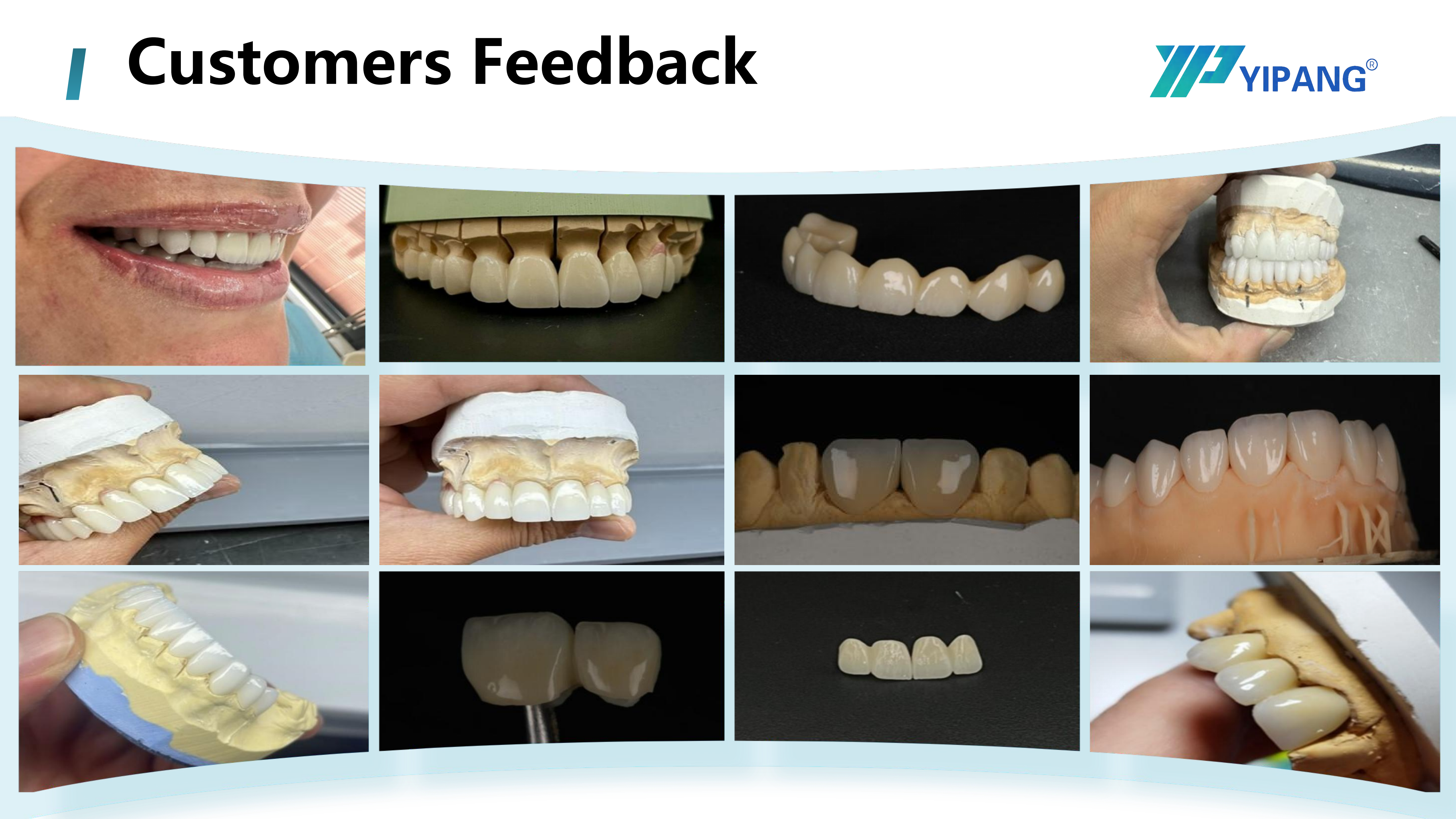
The 4D-PRO-ML blank is intended for full-contour crowns, bridges, veneers and implant superstructure restorations, produced in an indoor, constant-temperature dental laboratory environment and processed on a dental milling machine, sintered in a dental sintering furnace, and typically scanned with a dental lab scanner. Its purpose is functional and aesthetic: fabricating durable prostheses that restore missing or damaged teeth.
Two buyer profiles are identified in the supplier's positioning. The first is dental laboratories focused on aesthetic restoration, which need a multilayer blank whose shade gradient supports natural-looking outcomes across repeatable production. The second is importers looking for cost-effective dental materials, for whom the relevant question is not a single unit price but whether a consistent, reorderable blank keeps end-customer complaints low over multiple container cycles.
Fit also has a boundary. A medium-translucency multilayer blank covers a broad range of posterior and general restorative work, but a laboratory whose case mix depends on maximum-translucency anterior restorations should verify shade reproduction and masking behaviour on its own cases before standardising its inventory around one grade. Matching the blank to the case mix is a more reliable decision rule than matching it to a price list.
Market Trends That Turn Continuity Into a Procurement Issue
Several verified market signals explain why supplier continuity is moving up the evaluation agenda.
CAD/CAM remains the dominant production route. CAD/CAM milling accounted for 82.4% of zirconia dental manufacturing process revenue in 2025, which means the blank-to-machine interface is now a production standard rather than a preference. The dental milling machine market itself reached USD 2.45 billion in 2025, with growth to USD 3.9 billion expected by 2030 according to Fortune Business Insights, and significant share held by suppliers including Roland DG, Amann Girrbach and vhf camfacture. A larger installed machine base increases the value of blanks that behave predictably across different milling platforms.
Material concentration continues. Zirconia discs held 63.1% of zirconia-based dental materials revenue in 2025, and 3Y-TZP zirconia held the largest revenue share at 35.9%. Concentration of this kind makes laboratories dependent on the small number of process variables that distinguish one blank from another — powder source, densification and sintering behaviour.
Demand is geographically uneven. The United States accounted for 40% of revenue in the global zirconia-based dental materials market in 2025, while dental laboratories overall represented 45.3% of end-user share. For exporters and importers, that unevenness affects stocking decisions and lead-time planning more than it affects product choice.
Regulation keeps the documentation burden alive after purchase. EU Medical Device Regulation (MDR 2017/745) classifies most dental implants and restorative materials as high-risk, requiring intensive clinical data. Multi-year supply therefore includes multi-year documentation: a supplier that cannot maintain declarations and traceability records becomes a compliance risk rather than only a delivery risk.
Digital workflows are expanding alongside zirconia, not replacing it. The dental 3D printing market is estimated to grow from USD 4.9 billion in 2025 to USD 26.7 billion by 2033, with photopolymer resins holding 55.5% of the dental 3D printing material segment in 2025. Laboratories increasingly run printing for models, guides and interim work while keeping zirconia for definitive restorations — a split that pushes buyers toward suppliers who can support several material categories consistently.
Long-Term Supply Versus Traditional Spot Buying
Traditional zirconia sourcing is transactional: a laboratory compares unit prices, places an order, inspects the lot and moves on. It is efficient and it works well for one-off projects or for laboratories with a genuinely unstable case mix. The trade-off appears when production volume stabilises and material behaviour must be predictable across months.
| Decision area | Spot / transactional buying | Evaluated long-term supply |
|---|---|---|
| Price visibility | Immediate comparison, no commitment | Negotiated position, dependent on volume and mix |
| Batch consistency | Varies with each purchase | Traceable to a stable powder and process specification |
| Technical support | Limited to order fulfilment | Extends to sintering parameters, compatibility and customisation |
| Documentation | Requested case by case | Maintained as a supply obligation |
| Flexibility | High — switch freely per order | Lower — changes require re-validation and renegotiation |
| Risk profile | Exposure concentrated in each individual lot | Exposure concentrated in the relationship itself |
Where the limits are. Long-term evaluation does not remove risk; it relocates it. A controlled sintering shrinkage error within ±0.3% is a supplier-declared tolerance, and every laboratory still has to reproduce it inside its own furnace and heating programme before relying on it. A medium-translucency multilayer grade does not cover every high-translucency anterior indication. A production footprint of 2000 m² with 80 employees supports consistent output, but very large or multi-region buyers should confirm capacity assumptions in writing rather than assume them. Long-term agreements also trade flexibility for predictability, so laboratories that frequently change material grades may be better served by a mixed supplier portfolio. And a stated cost advantage over imported blanks is a relative positioning claim, not a guarantee of identical performance across every indication — it should be validated against the laboratory's own acceptance criteria, not adopted from a comparison sheet.
Re-Qualification Triggers: A Practical Checklist
Continuity is not maintained by signing an agreement; it is maintained by knowing when to re-test. Laboratories evaluating a zirconia block supplier long-term should define re-qualification triggers in advance, and record the results against the batch code.
- A new powder lot or a change in the blank's batch marking.
- A new or repaired sintering furnace, or any change to the heating curve.
- A new milling machine, a change of burs, or a change in CAM nesting defaults.
- A change in shade, translucency grade or available thickness.
- Two or more unexplained remakes traced to fit or shrinkage.
- A material change in quoted lead time or order confirmation behaviour.
- A regulatory update affecting declarations or traceability for the destination market.
Each re-qualification should record the sintering programme identifier, a measured shrinkage check on a standard test geometry, a fit check on a known case, and the batch code. Over several years this record becomes the most reliable procurement document a laboratory owns — and it is the only basis on which a supplier's continuity claim can be independently confirmed.
Future Outlook
Zirconia demand is expected to keep expanding through the next decade, with the zirconia-based dental materials market projected to move from USD 1.2 billion in 2025 toward USD 2.3 billion by 2033. As volume grows, the differentiation between suppliers is likely to shift from blank specifications toward process transparency: documented shrinkage behaviour, batch traceability, response time on customisation requests, and the ability to keep documentation current under frameworks such as MDR 2017/745.
For laboratories, the practical implication is that supplier reviews will increasingly be annual and data-based rather than ad hoc and price-based. The labs that do this well will treat zirconia blocks, sintering furnaces, milling machines and scanners as one validated production chain, and will expect their suppliers to support that chain rather than only to fill it.
Reference document: WJH Company Information brochure (PDF). Company information: yipangdental.com.
FAQ: Long-Term Evaluation of Dental Zirconia Block Supply
1. What does long-term supplier evaluation mean for a dental zirconia block?
It means assessing whether a supplier's measured output, documentation and service response stay stable across multiple production cycles, rather than whether one lot passes inspection. It separates three levels: product qualification of the block, qualification of the supplier's process, and evaluation of continuity over twelve to thirty-six months. Continuity is the level that determines total cost of ownership, because powder lots, sintering programmes, shade availability and documentation can all shift after the first order.
2. Which evidence should a laboratory collect to compare dental zirconia block suppliers over time?
Measurable items are the most useful. For YIPANG's Dental Zirconia Block, the supplier reports a sintering shrinkage error controlled within ±0.3%, a bending strength specification of ≥1200 MPa, uniform density distribution, medium translucency in a multilayer ML structure, a 98 mm diameter in thicknesses from 10 mm to 20 mm, and compatibility with most mainstream dental milling machines. A laboratory can re-check shrinkage, fit and milling behaviour on its own equipment, then record results against the batch code. Supplier-side facts such as a 2000 m² facility, 80 employees, 25 engineers and an annual output value of 10 million US dollars describe the capacity behind continuity.
3. What sintering conditions does the YIPANG 4D-PRO-ML zirconia block require?
The product specification lists a sintering temperature of 1450 °C, and the processing guidance recommends a range of 1430 °C–1450 °C applied with a standard heating and holding procedure to support low shrinkage and stable translucency. The documented steps are to place the milled zirconia workpiece on a sintering tray, set the heating curve into the recommended range with an appropriate holding time, and allow natural cooling once sintering is complete. Rapid temperature changes should be avoided to prevent cracking, and the maximum sintering temperature should not be exceeded.
4. Which dental laboratories are the best fit for a cost-effective domestic-powder zirconia block?
The supplier positions the block for two buyer profiles: dental laboratories focused on aesthetic restoration, and importers looking for cost-effective dental materials. The blank is intended for full-contour crowns, bridges, veneers and implant superstructure restorations, produced in an indoor constant-temperature laboratory environment and processed on a dental milling machine, a dental sintering furnace and a dental lab scanner. Because the translucency grade is medium translucent, laboratories should confirm that shade reproduction and masking meet their own case requirements before standardising inventory around one grade.
5. What are the limits of a domestic-powder zirconia block compared with imported blanks?
The comparison documented by the supplier states advantages in quality consistency and cost performance, based on high-quality domestic self-developed zirconia powder with stable batch consistency and a more competitive price than imported zirconia blocks of equivalent quality. Those are relative positioning statements, not guarantees of identical performance across every indication. In addition, the declared sintering shrinkage tolerance within ±0.3% must be reproduced in each laboratory's own furnace and programme; medium translucency does not cover every maximum-translucency anterior case; and very large or geographically distributed buyers should confirm capacity assumptions rather than infer them from facility data.
6. When should a dental laboratory re-qualify a zirconia block supplier?
Re-qualification is triggered by any change that can move material behaviour: a new powder lot, a new or repaired sintering furnace, a change to the heating curve, a new milling machine or bur set, a change in shade or thickness availability, or repeated remakes traced to fit and shrinkage. Operational changes matter too, including shifts in quoted lead time or documentation status. Each check should record the sintering programme, a shrinkage measurement on a standard test geometry, a fit check on a known case and the batch code, so that continuity claims can be verified rather than assumed.