
Dental Zirconia Block Scenario Fit: Crowns to Implants
Dental Zirconia Block Scenario Fit: Crowns to Implants
Dental laboratories are the largest end-user group for zirconia-based dental materials, accounting for 45.3% of market share in 2025 according to Grand View Research. In that setting, a zirconia block is almost never judged on its own. It is judged by the restoration it has to become, the milling machine it has to run in, and the sintering furnace it has to survive.
Scenario fit for a dental zirconia block means three conditions match at the same time: the mechanical and aesthetic requirement of the case, the geometric limits of the blank, and the processing capability of the lab. When the three align, a milled blank becomes a predictable restoration. When any one of them is assumed rather than checked, the problem usually appears after sintering, at the point where the material can no longer be corrected.
This reference maps common lab scenarios to the block attributes and process controls that decide them, using the YIPANG 4D-PRO-ML multilayer zirconia block, a documented CAD/CAM milling blank, as the worked example.
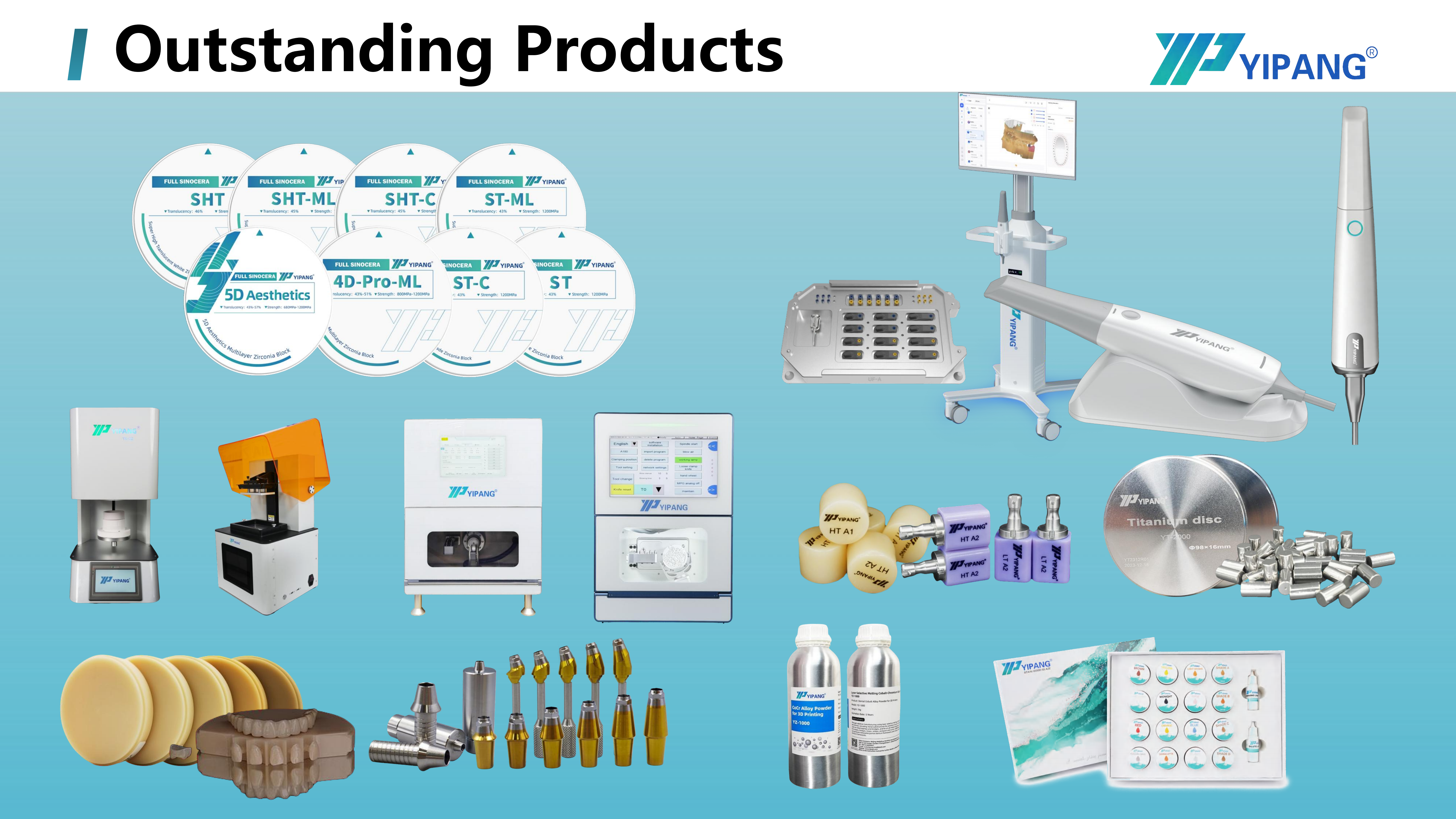 A multilayer dental zirconia disc intended for CAD/CAM milling of crowns, bridges and implant superstructure restorations.
What Scenario Fit Means for a Dental Zirconia Block
A dental zirconia block is a CAD/CAM milling blank. The YIPANG 4D-PRO-ML is classified as a dental zirconia disc and CAD/CAM dental milling blank, made of zirconium dioxide (ZrO2) with yttria stabilization, and intended for the dental laboratory, dental prosthetics and dental CAD/CAM industries. Those descriptors already define the scenario: a digital design is converted into a physical restoration by subtractive manufacturing, then densified by sintering.
Scenario fit therefore breaks into three axes that a lab can check separately:
- Restoration axis: what the case demands mechanically and aesthetically, including posterior occlusal load, connector strength, shade continuity across units, and translucency in the aesthetic zone.
- Geometry axis: whether the blank diameter and thickness can contain the restoration after nesting.
- Process axis: whether the lab scanner, milling machine and sintering furnace can reproduce the material properties the block was specified for, especially through the sintering profile.
Most material problems reported by labs trace back to one axis being treated as fixed while another changed. A blank thickness chosen for single crowns is not automatically valid when a multi-unit bridge enters the queue, and a sintering profile tuned for one furnace load is not automatically valid for a denser tray. Scenario fit is a per-case re-check rather than a one-time purchasing decision.
The Lab Side of the Zirconia Market
The commercial weight of the lab scenario is measurable. Zirconia discs held the largest revenue share of 63.1% in the zirconia-based dental materials market in 2025, and CAD/CAM milling accounted for 82.4% of zirconia dental manufacturing process revenue in the same year, both according to Grand View Research. Dental labs accounted for 45.3% of end-user share in 2025, from the same source. The dominant use of zirconia is therefore a lab-based, milling-driven workflow, which is precisely the workflow in which blank geometry and sintering control determine outcomes.
Market size estimates differ by scope, and buyers reading supplier material should expect that. Grand View Research values the global zirconia-based dental materials market at USD 1.2 billion in 2025 and projects USD 2.3 billion by 2033, while SNS Insider reports USD 367.67 million for 2025 under a narrower scope. The direction is consistent; the absolute figures are not interchangeable. Regionally, the U.S. accounts for 40% of revenue in the global zirconia-based dental materials market in 2025, again per Grand View Research, a reminder that scenario assumptions valid in one market do not transfer automatically to another.
Restoration-by-Restoration Scenario Map
The table below maps common lab scenarios to the material attributes and pre-milling checks they imply. Values in the third column are the documented specifications of the YIPANG 4D-PRO-ML block.
| Restoration scenario | What the case demands | Documented 4D-PRO-ML attribute | Lab check before milling |
|---|---|---|---|
| Posterior single-unit crown | Fracture resistance under repeated occlusal load | Bending strength of at least 1200 MPa; medium translucency; ML multilayer shades | Confirm the blank thickness covers the full contour height after nesting |
| Multi-unit bridge | Strength carried through connectors plus shade continuity across units | Bending strength of at least 1200 MPa; ML multilayer shade structure | Verify connector geometry fits within the selected thickness and that units are nested consistently |
| Anterior aesthetic single unit | Translucency gradient that reads naturally against adjacent dentition | Medium translucent appearance; ML multilayer shades | Decide whether medium translucency meets the aesthetic target, or whether a glass-ceramic route is indicated |
| Implant superstructure restoration | Dimensional stability so the restoration seats correctly after shrinkage | Low shrinkage after sintering; high dimensional accuracy | Control the sintering profile; verify interface fit after the cycle |
| Veneer and thin-section aesthetic work | Shade match with limited section thickness | ML multilayer shades; medium translucency | Confirm the minimum section thickness the lab can handle after sintering |
The pattern in the table is consistent: mechanical scenarios set the strength requirement, aesthetic scenarios set the translucency and shade requirement, and implant scenarios set the shrinkage and fit requirement. One blank type can serve several of these scenarios when its documented attributes actually cover each requirement, which is why the scenario should be defined before the blank is selected rather than after a restoration fails.
Selecting Blank Thickness: The 10 to 20 mm Decision
The 4D-PRO-ML block is supplied in a 98 mm diameter with thickness options of 10 mm, 12 mm, 14 mm, 16 mm, 18 mm and 20 mm. The working rule for scenario fit is straightforward: choose the thinnest blank that can still contain the full restoration after nesting. Thickness defines the maximum height of the milled workpiece, including connector geometry in multi-unit cases and full contour in monolithic crowns.
Two failure modes follow when that rule is ignored. If the blank is too thin, the restoration cannot be nested completely and the case must be remilled, consuming machine time and a blank. If the blank is thicker than the case requires, the lab consumes more material per unit than necessary. Thickness selection is a per-batch scenario decision, not a stock-keeping default.
There is also a boundary worth stating plainly. A maximum thickness of 20 mm caps the height of geometry the block can produce. Cases requiring greater blank height fall outside the 4D-PRO-ML range and need a different blank format or a different production route; process tuning does not change a geometric limit.
The Equipment Chain That Defines the Scenario
The documented working condition for the 4D-PRO-ML scenario is an indoor, constant-temperature dental laboratory environment, processed on a dental milling machine and sintered in a dental sintering furnace. The matched equipment listed alongside that scenario is a dental milling machine, a dental sintering furnace and a dental lab scanner.
| Stage | Equipment in the documented scenario | Function in the case | Control point for the lab |
|---|---|---|---|
| Scan and design | Dental lab scanner | Capture of preparation geometry and generation of the milling file | Confirm scan accuracy and design parameters before nesting |
| Milling | Dental milling machine | Subtractive shaping of the zirconia blank into a pre-sintered restoration | Verify the 98 mm blank format is compatible with the specific machine holder |
| Sintering | Dental sintering furnace | Densification of the milled workpiece into a finished restoration | Apply the standard sintering temperature curve; do not shorten the cycle |
The equipment side of this scenario is expanding commercially. Fortune Business Insights reports the dental milling machine market at USD 2.45 billion in 2025, with expected growth to USD 3.9 billion by 2030, and identifies Roland DG, Amann Girrbach and vhf camfacture as significant market share holders in the sector as of 2024. For a lab, the practical implication is compatibility verification rather than brand comparison: the 98 mm diameter format used by the 4D-PRO-ML block is documented as compatible with most mainstream dental milling machines, and that compatibility should still be confirmed against the specific machine before a case batch is committed.
Sintering: Where Scenario Fit Is Won or Lost
Sintering converts a soft milled blank into a dense restoration, and it is the step where scenario fit is most often lost. For the 4D-PRO-ML block, the product record lists a sintering temperature of 1450 C, while the operational guidance recommends a range of 1430 C to 1450 C, applied with a standard heating and holding procedure to support low shrinkage and stable translucency.
The documented steps are simple to state and easy to shorten incorrectly:
- Place the milled zirconia workpiece on the sintering tray.
- Set the heating curve up to 1430 C to 1450 C with the appropriate holding time.
- Allow natural cooling after the sintering cycle is complete.
Two safety constraints accompany that procedure: avoid rapid temperature change, which can cause cracking, and do not exceed the maximum sintering temperature.
Two documented causes explain most post-sintering damage: an improper sintering profile setting, and pre-existing defects inside the zirconia blank. The corresponding controls are equally specific. Follow the recommended sintering profile, inspect blanks before sintering, and scrap any chipped or cracked blank rather than using it for a final restoration. Note where responsibility sits: the profile is a lab-side variable, and the material cannot compensate for it. That is why sintering control belongs inside scenario fit rather than inside routine maintenance.
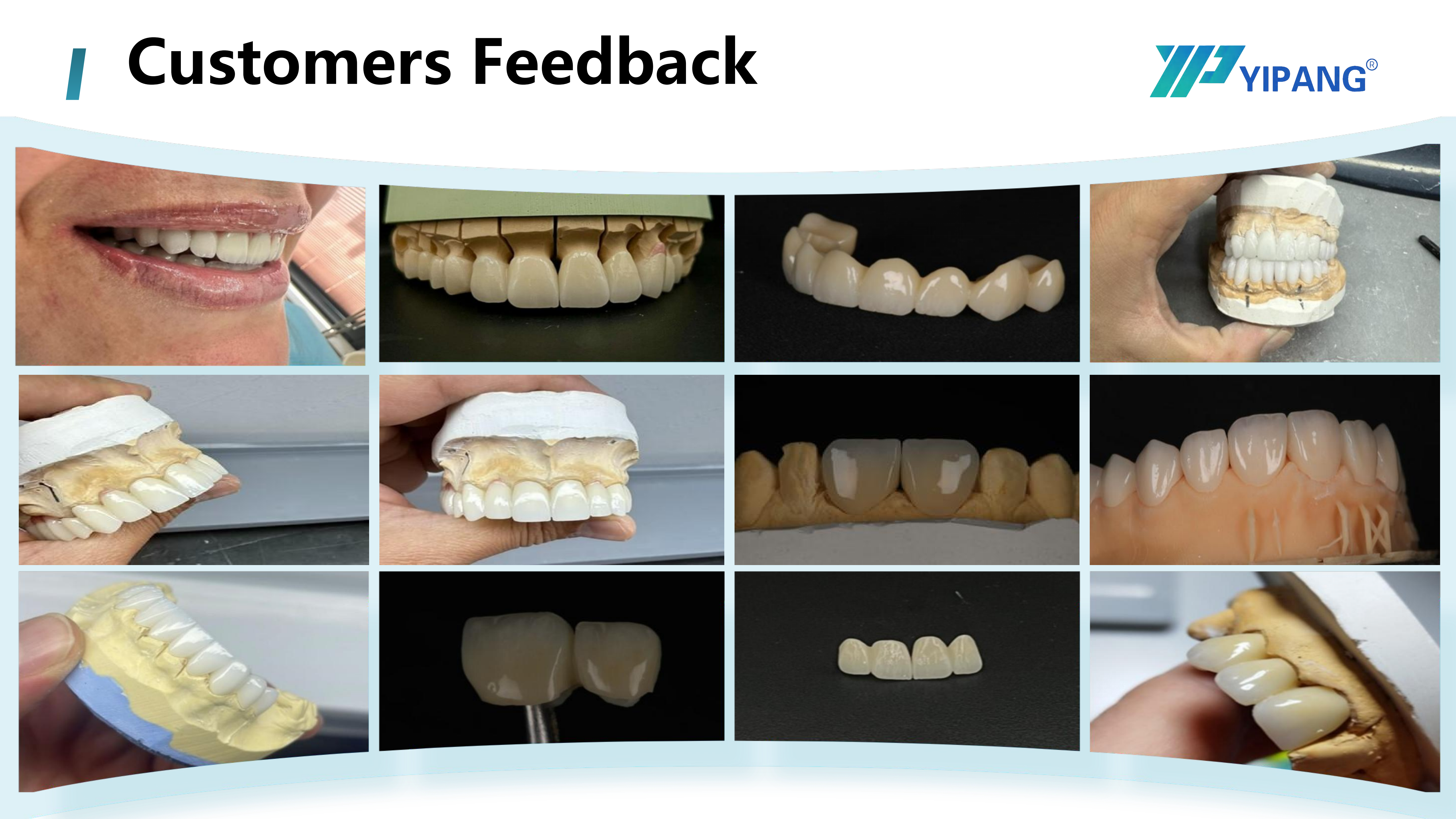 Zirconia blank production: material consistency at the source is a precondition for repeatable scenario outcomes in the lab.
Where the 4D-PRO-ML Block Fits, and Where It Does Not
Beijing Weijiahua Dentistry Equipment Co., Ltd. (brand: YIPANG) is a dental industry manufacturer established in 1996, operating a 2,000-square-meter manufacturing facility with approximately 80 employees and an annual production capacity of USD 10 million. The company exports 40% to 55% of its products and serves markets in the Middle East, Southeast Asia, South America, North America, Eastern Europe, North Africa and Australia. YIPANG is its self-developed brand, and the product portfolio includes zirconia blocks, glass ceramics, press ingots, PMMA, wax, titanium blocks, implant abutments, 3D scanners, intraoral scanners, milling machines, 3D printers and sintering furnaces. The company maintains a 25-person engineering team focused on dental material formulation, process optimization and new product development.
Within the scenario map above, the 4D-PRO-ML block is positioned for full-contour crowns, bridges, veneers and implant superstructure restorations, in ML multilayer shades with a medium translucent appearance, a bending strength of at least 1200 MPa, low shrinkage after sintering and high dimensional accuracy. Those documented attributes line up with the scenarios that reward load-bearing capability and dimensional repeatability: posterior single units, multi-unit bridges, and implant superstructure work where seating accuracy depends on shrinkage control.
The same specifications also define where the block is not the natural first choice. Medium translucency is a positioning, not a maximum. Cases where a very high translucency monolithic restoration is the aesthetic requirement commonly lead labs toward glass-ceramic materials instead. That segment is commercially active: Intel Market Research projects the dental lithium disilicate market growing from USD 320 million in 2025 to USD 920 million by 2032 at a CAGR of 18.8%, and Business Research Insights reports that lithium disilicate accounted for approximately 28% of all-ceramic dental restorations globally as of 2024. A lab running both material families is not picking a winner; it is matching indication to material.
A second boundary is process rather than material. Zirconia requires a sintering furnace. A lab whose scenario is same-day, chairside provisional work, often served by PMMA or printed resin pathways, is operating on a different material logic. The dental 3D printing market is estimated to grow from USD 4.9 billion in 2025 to USD 26.7 billion by 2033, with photopolymer resins holding a 55.5% material share in 2025, according to Grand View Research. That growth is real, and it does not change the fact that definitive zirconia restorations still pass through a furnace.
A third boundary is geometric: a 98 mm diameter and a 10 mm to 20 mm thickness range define a finite nesting envelope. Any case that does not fit inside that envelope needs a different production plan, regardless of material quality.
Compliance shapes the scenario as well. EU Medical Device Regulation (MDR 2017/745) classifies most dental implants and restorative materials as high-risk and requires intensive clinical data, according to the European Commission. Labs supplying restorations into regulated markets therefore treat documented material specifications, not only physical fit, as part of scenario planning.
Comparison with Traditional Solutions
Scenario fit becomes easier to see when zirconia is placed next to the pathways a lab already runs. The table uses documented data where it exists and hedged general industry knowledge where it does not.
| Pathway | Typical scenario | Where it performs | Limitation to weigh |
|---|---|---|---|
| Monolithic zirconia (4D-PRO-ML) | Posterior single units, multi-unit bridges, implant superstructure restorations | Documented bending strength of at least 1200 MPa, low shrinkage, high dimensional accuracy, ML multilayer shades, 98 mm diameter in 10 mm to 20 mm thicknesses | Requires a sintering furnace and profile discipline; medium translucency rather than maximum translucency; 20 mm thickness ceiling limits nesting height |
| Metal-ceramic (layered porcelain) | Long-span and high-load restorations in labs with established porcelain workflows | Long clinical familiarity and predictable adjustment behaviour are commonly cited advantages of the pathway | Layered porcelain is commonly associated with chipping, and the metal substructure limits translucency in aesthetic zones |
| Lithium disilicate glass ceramic | Anterior and high-translucency single units | Approximately 28% of all-ceramic dental restorations globally as of 2024 (Business Research Insights); projected market growth from USD 320 million in 2025 to USD 920 million by 2032 at 18.8% CAGR (Intel Market Research) | Typically reserved for anterior and lower-load indications rather than long-span posterior bridges; adds a press or dedicated mill workflow investment |
| PMMA and printed resin | Interim restorations, models and try-ins | Supports fast, same-day workflows; dental 3D printing is projected to grow from USD 4.9 billion in 2025 to USD 26.7 billion by 2033, with photopolymer resins at 55.5% material share in 2025 (Grand View Research) | Used for interim rather than definitive long-term indications, so it complements rather than replaces a densified ceramic restoration |
The comparison does not produce a single winner, and that is the point. Each pathway owns a scenario in which it is the correct choice. The recurring failure mode is a lab applying one material across scenarios that require different mechanical, aesthetic or process properties.
Market Trend: Scenario Demand Is Diversifying
Three verified signals frame how lab scenarios are changing.
- The core material market is growing but remains milling-centred: zirconia-based dental materials moving from USD 1.2 billion in 2025 toward USD 2.3 billion by 2033, with CAD/CAM milling at 82.4% of process revenue in 2025 (Grand View Research).
- Digital and additive workflows are expanding faster: dental 3D printing from USD 4.9 billion in 2025 toward USD 26.7 billion by 2033, with photopolymer resins at 55.5% material share in 2025 (Grand View Research).
- Adjacent restorative categories remain active: the final abutment market was valued at nearly USD 2.6 billion in 2025 (iData Research), Institut Straumann held over 29% market share in the global dental implants and abutment systems market in 2024 (Global Market Insights), and PEEK dental implants were valued at USD 1,055 million in 2025 with an 8% CAGR expected through 2034 (Precedence Research).
Read together, these signals point to scenario diversification inside the same lab rather than substitution of one material for another. A lab is increasingly likely to route a case across zirconia, glass ceramic, resin and implant components rather than standardising on a single material, which raises the value of scenario documentation and lowers the value of material-name loyalty.
Future Outlook
Nothing in the available data suggests that lab-based subtractive manufacturing of zirconia is being displaced in the near term. CAD/CAM milling still accounted for 82.4% of zirconia process revenue in 2025, and dental labs remain the dominant end-user group at 45.3%. What is more likely to change is the granularity of scenario decisions. As scanning, milling and sintering equipment move deeper into the lab, the variables a lab controls multiply: blank format, nesting strategy, furnace profile, tray loading. Each new variable is a new place for scenario fit to succeed or fail.
Two structural factors are worth watching. The first is regulatory intensity: the classification of most dental implants and restorative materials as high-risk under EU MDR 2017/745 places documentation burden across the chain, including material suppliers, and that burden tends to favour suppliers able to provide consistent, specified material records. The second is workflow hybridisation: projected growth in the additive segment makes it more likely that a lab documents material decisions across a mixed portfolio than defends a single process.
For supplier evaluation, the interpretive shift is identical in both cases. Evidence tied to a specific scenario, such as a documented specification, a defined sintering range, a declared compatibility, or a stated thickness envelope, is more useful to a lab than a general claim of material quality.
FAQ
What is a dental zirconia block used for?
A dental zirconia block is a CAD/CAM milling blank made of zirconium dioxide (ZrO2) with yttria stabilization, milled into a dental prosthesis and then densified by sintering. The YIPANG 4D-PRO-ML block is specified for full-contour crowns, bridges, veneers and implant superstructure restorations, and for aesthetic dental restorations generally, within dental laboratory, dental prosthetics and dental CAD/CAM workflows.
Which restorations can be produced from a 98 mm multilayer zirconia blank?
The 4D-PRO-ML block has a 98 mm diameter with thicknesses of 10 mm, 12 mm, 14 mm, 16 mm, 18 mm and 20 mm, in ML multilayer shades with a medium translucent appearance. Whether a specific restoration can be produced depends on whether the chosen thickness contains the full geometry after nesting. Posterior single units, multi-unit bridges and implant superstructure restorations fall within the stated indications; cases requiring maximum translucency are typically better served by a glass-ceramic material.
How do labs decide between zirconia and lithium disilicate for a case?
The decision is usually indication-led. Zirconia such as the 4D-PRO-ML block offers a documented bending strength of at least 1200 MPa, which suits load-bearing crowns, multi-unit bridges and implant superstructure work. Lithium disilicate glass ceramic is positioned in the anterior, higher-translucency segment; Business Research Insights reports it accounted for approximately 28% of all-ceramic dental restorations globally as of 2024, and Intel Market Research projects that market growing from USD 320 million in 2025 to USD 920 million by 2032. Establish the load and translucency requirement first, then match the material.
What equipment is needed to process a zirconia block in a dental lab?
The documented processing scenario for the 4D-PRO-ML block lists matched equipment of a dental milling machine, a dental sintering furnace and a dental lab scanner, operating in an indoor constant-temperature dental laboratory environment. The block is milled and then sintered, so the milling machine and the furnace are separate control points rather than one combined process.
What sintering temperature should be used for a multilayer zirconia block?
The 4D-PRO-ML product record lists a sintering temperature of 1450 C, and the operational guidance recommends a range of 1430 C to 1450 C with a standard heating and holding procedure to support low shrinkage and stable translucency. The same guidance states that rapid temperature change should be avoided to prevent cracking, that the maximum sintering temperature should not be exceeded, and that workpieces cool naturally after the cycle.
What causes chipping or cracking in zirconia restorations after sintering?
Two causes are documented: an improper sintering profile setting, and inherent defects inside the zirconia blank. The documented controls are to follow the recommended sintering profile, inspect blanks before sintering, and scrap any chipped or cracked blank rather than using it for a final restoration.
How can a lab test whether a zirconia block fits its scenario before standardising on it?
Run one representative case per scenario through the candidate block and record three outputs: the nesting yield from a 98 mm blank at the thickness chosen, the dimensional accuracy achieved after sintering under the lab own furnace profile, and the shade continuity across units when the restoration is multi-unit. Comparing those three records against the lab current material for the same case type converts a material claim into a measurable scenario result.
Further reference: a downloadable company information document covering YIPANG dental material and equipment lines is available here: WJH Company Information (PDF).