
Dental Zirconia Block Shortlist: What Earns a Trial Slot
A shortlist for dental zirconia blocks is a screening instrument, not a popularity ranking. In a CAD/CAM dental laboratory, adding an unfamiliar blank means committing milling time, sintering furnace capacity and — if the result misses — a remake. The practical question is therefore narrow: which options deserve a controlled trial, and what evidence should exist before that trial begins?
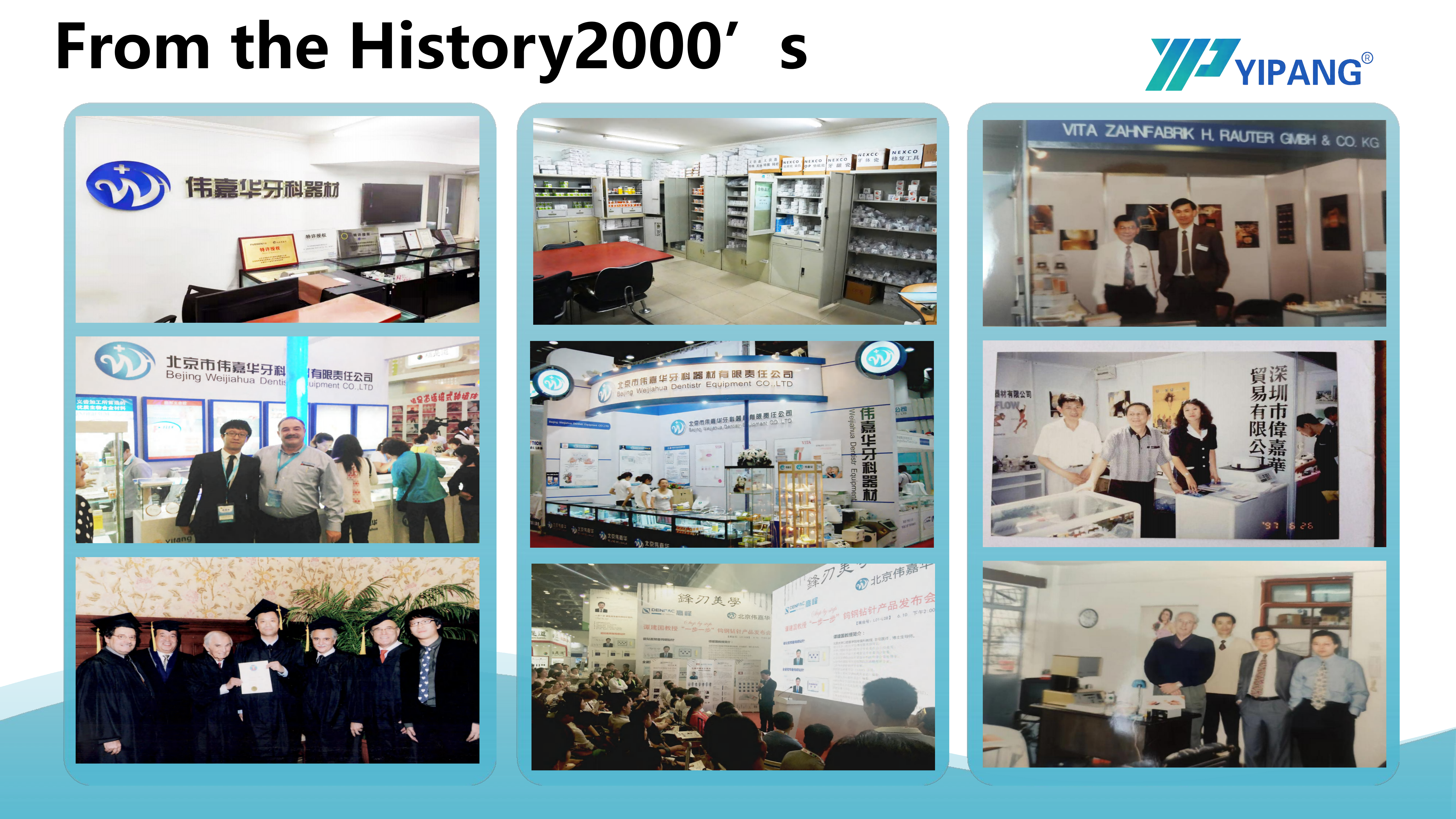
Shortlisting a zirconia blank starts with documentation, capacity and process fit — not with a brand list.
Zirconia has become the default structural material in most digital dental laboratories, and the reason is process, not marketing. Zirconia discs held the largest revenue share of the zirconia-based dental materials market in 2025, and CAD/CAM milling accounted for the overwhelming majority of process revenue in the same period. In other words, the shortlist decision is made inside a milling workflow, by people who will see the consequences of that decision on a sintered unit roughly a working day later.
That is why a zirconia shortlist built purely on brand familiarity tends to underperform. Two laboratories running different furnaces, different burs and different scanner tolerances can obtain different results from the same blank. The screens below are designed to be applied before any sample is milled, so that the trial itself produces a usable answer rather than an ambiguous one.
The shortlisting problem: too many blanks, too little comparable evidence
Buyers in this category face an unusual mismatch. Suppliers are plentiful and quotations are easy to obtain, but comparable specification data, scope-accurate certification and stated acceptance terms are much harder to assemble. A laboratory evaluating five blanks may receive five data sheets formatted five different ways, only some of which map onto the parameters that actually govern its workflow.
The opportunity sits in the same place. Because zirconia processing is highly standardised at the equipment level — a milling machine, a sintering furnace and a laboratory scanner sit at the centre of the workflow — a buyer can define a repeatable screening sequence once and apply it to every candidate afterwards. A shortlist becomes a reusable asset instead of a one-off negotiation.
The distinction that matters: a shortlist answers “what should we test, in what order, and against which criteria?” A ranking answers “who is best?” The first is a decision a laboratory can defend internally. The second usually cannot be supported with public evidence.
Five screens that turn a catalogue into a shortlist
Applied in sequence, five screens remove most unsuitable candidates before a single blank is milled. Each screen has a definable pass condition and a recognisable failure mode.
| Screen | Question it answers | Typical failure mode |
|---|---|---|
| 1. Specification fit | Does the blank geometry, shade system and sintering window match our equipment and case mix? | Blank purchased in a thickness the laboratory rarely mills; sintering curve not verified against the furnace programme. |
| 2. Documentation | Does the certificate cover this product, this site and this market? | Certificate scope read across from a different product line. |
| 3. Capability | Can the supplier customise, private-label and scale with us? | Customisation promised verbally but not reflected in MOQ or lead time. |
| 4. Commercial terms | Are MOQ, delivery, payment and acceptance conditions workable? | Acceptance window missed; damage reported after the deadline. |
| 5. Application scope | Is the indicated restoration range aligned with what we actually produce? | Blank used outside its stated translucency or strength envelope. |
Screen 1 — Does the blank fit your milling and sintering base?
The first screen is mechanical. A zirconia block for CAD/CAM production is normally supplied as a disc in a 98 mm diameter, and that diameter is what determines whether the blank loads into a given milling machine. Thickness determines which restorations can be nested efficiently: thin discs suit single units, thicker discs suit multi-unit bridges and full-arch work where the connector geometry needs vertical room.
Sintering is the second half of the same screen. A blank that mills perfectly but is sintered outside its intended curve will show distortion, inconsistent shade or, in the worst case, cracking. Buyers should confirm the supplier's stated sintering temperature, the recommended holding procedure and the cooling method before the first trial, not after.
Equipment expectations for this material class are modest and well defined: a dental milling machine, a dental sintering furnace and a dental lab scanner. If a laboratory already runs that trio, most of the capital question is already answered, and the shortlist becomes a materials decision rather than an equipment decision.
Screen 2 — Documentation that survives a second reading
Certification is where shortlists are most often weakened, because a logo on a data sheet is not the same as a scoped certificate. The productive habit is to read the scope line, the issuing body and the validity dates out loud, then match them against the exact product being considered.
For a zirconia block sourced through YIPANG, the relevant quality management certificate is ISO 13485, certificate number 381240434R0S, issued by Shanghai POSI Certification Co., Ltd. on 2024-12-27 and valid to 2027-12-26. The stated standard is GB/T 42061-2022 / ISO 13485:2016, and the stated scope is the design, production and sales of dental medical materials and dental equipment, covering markets described as Global, EU, USA and the Middle East.
One boundary deserves explicit attention. The EU Declaration of Conformity held within the same document set — SRN CN-MF-000045919, issued under Regulation (EU) 2017/745 — states its scope as the intraoral scanner models YP-X and YP-800, Class I medical devices. It should not be read across to the zirconia block. This is not a criticism of the supplier; it is exactly the kind of scope mismatch that a disciplined screen is designed to catch, and buyers in the EU should request product-specific documentation for the block separately.
The regulatory backdrop explains why this matters commercially. The European Commission notes that EU MDR 2017/745 classifies most dental implants and restorative materials as higher-risk, requiring intensive clinical data. A document set that is complete for one device class is therefore not automatically complete for another.
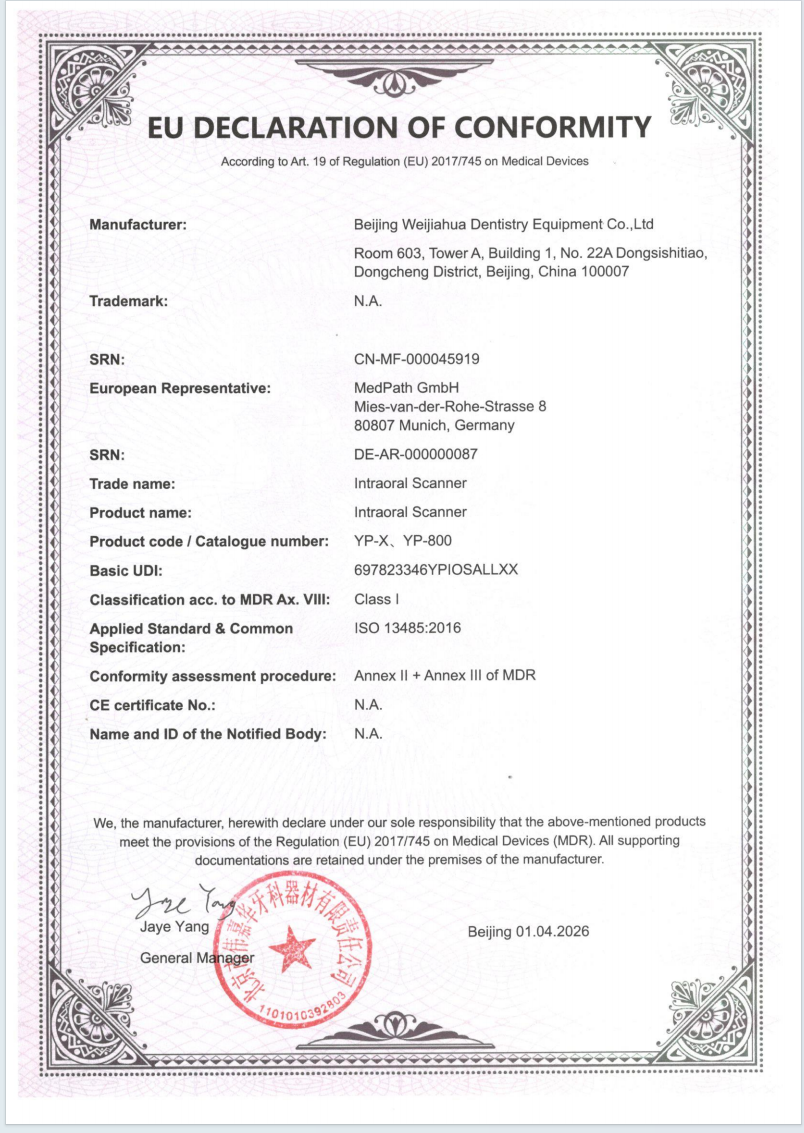
Reading the scope line — not the certificate title — is what makes a documentation screen reliable.
Screen 3 — Capability: OEM, ODM and customisation depth
For distributors, brand owners and larger laboratories, capability screening separates a material vendor from a manufacturing partner. The questions are concrete: can the supplier produce under your label, can specifications be adjusted, and can volume be sustained without stretching lead time?
YIPANG, the self-developed dental materials brand of Beijing Weijiahua Dentistry Equipment Co., Ltd., states that both OEM (Original Equipment Manufacturing) and ODM (Original Design Manufacturing) services are available, with customisation options for almost all specifications. The same capability data lists a monthly capacity of 15,000 pieces, a lead time of 15–30 working days, quality control consisting of 100% raw material inspection plus finished product random inspection, and export markets covering the USA, Europe, Brazil, the Middle East and North Africa.
After-sales capability belongs on this screen as well, because a shortlist entry that cannot be supported technically becomes a liability at scale. The stated support model is online technical guidance with an after-sales problem response within 24 hours — a service commitment rather than a performance guarantee, and one that buyers should test with a real technical question during evaluation.

Capacity, customisation and inspection routines are the capability evidence a shortlist should record.
Screen 4 — Commercial terms and acceptance criteria
Commercial terms decide whether a technically suitable blank is operationally practical. For standard models, the stated minimum order quantity is 1 box; for customised products it is 5 boxes. Delivery is described as express within the domestic market, and sea or air freight for export, with FOB Shanghai or FOB Tianjin available.
Acceptance is the clause most often skimmed and most often regretted. The stated procedure is to check quantity upon receipt, report damage or deformation within 48 hours with photographs, and sampling tests are supported. That 48-hour window is the operative number: a laboratory that books incoming goods into storage and inspects them a week later has, in practice, waived part of its own protection.
Payment terms are stated as full payment before shipment. For a first order this is a working-capital consideration, and it is a legitimate reason to start with a small standard-model order rather than a customised batch.
Screen 5 — Application scope and where the blank stops
The final screen is the easiest to state and the easiest to ignore. Application scope defines what a blank is intended to produce, and using it outside that envelope is a decision the laboratory owns, not the supplier.
For multilayer zirconia in this class, the stated application range covers full-contour crowns, bridges, veneers and implant superstructure restorations. Processing is described as milling followed by sintering, with the standard sintering curve as a stated special requirement, in an indoor constant-temperature laboratory environment. High-volume laboratories working posterior crowns and multi-unit bridges are the scenario profile most closely aligned with the stated balance of mechanical strength and translucency.
Where YIPANG 4D-PRO-ML sits on the shortlist
YIPANG is the self-developed dental materials brand of Beijing Weijiahua Dentistry Equipment Co., Ltd. (Beijing WJH), a Beijing-based dental equipment and materials company founded in 1996. The company describes a 2,000 ㎡ facility, 80 employees, annual output of USD 10 million, a 25-engineer R&D team working on dental material formulation and process optimisation, an export ratio of 40%–55%, and more than 1,000 dental laboratory customers in China. It also states that it has represented international brands including VITA, Ivoclar, Dentsply, Amann Girrbach and Noritake.
Its zirconia entry for this shortlist is the 4D-PRO-ML Dental Zirconia Block, a CAD/CAM dental milling blank made from yttria-stabilised zirconium dioxide (ZrO₂). The verified specification set is as follows.
| Parameter | Stated value |
|---|---|
| Product name | Zirconia Blocks for Dental Prosthesis (4D-PRO-ML) |
| Type | Dental zirconia disc / CAD/CAM dental milling blank |
| Material | Zirconium dioxide (ZrO₂) with yttria stabilised |
| Shades | ML Multilayer |
| Diameter | 98 mm |
| Thickness options | 10 mm, 12 mm, 14 mm, 16 mm, 18 mm, 20 mm |
| Sintering temperature | 1450 ℃ listed on the specification; recommended processing range 1430 ℃–1450 ℃ with a standard heating and holding procedure |
| Bending strength | ≥1200 MPa |
| Translucency | Medium translucent |
| Typical applications | Full-contour crowns, bridges, veneers, implant superstructure restorations |
| Matched equipment | Dental milling machine, dental sintering furnace, dental lab scanner |
The supplier's own customer evidence states hundreds of long-term cooperative clients worldwide, spanning dental laboratories, dental clinics and distributors, with reported results including uniform translucency, stable sintering shrinkage, compatibility with most CAD/CAM systems and a low customer complaint rate. These are first-party claims rather than independently audited outcomes, and they are best treated as hypotheses to be confirmed by the buyer's own trial rather than as settled performance data.
What the entry does provide is a complete screening package: a documented specification set, a scoped ISO 13485 certificate, stated OEM and ODM availability, stated capacity and lead time, and written commercial and acceptance terms. That combination is what makes a candidate trial-ready; the trial itself still has to happen.
How a shortlisted zirconia blank compares with other restorative routes
Zirconia is not the only digital route, and a shortlist that does not acknowledge alternatives is not a shortlist. Lithium disilicate glass ceramic remains a significant category: it accounted for approximately 28% of all all-ceramic dental restorations globally as of 2024, and the global dental lithium disilicate market was projected to grow from USD 320 million in 2025 to USD 920 million by 2032.
The trade-off is familiar and largely mechanical. Milled and sintered zirconia in this class is specified at ≥1200 MPa bending strength with medium translucency, which suits structural posterior and multi-unit work. Pressed or milled lithium disilicate occupies the aesthetic-forward end of the spectrum, where a technician may accept a different strength profile in exchange for optical behaviour. Neither route is universally correct; the case mix decides.
A second comparison is provisional work. PMMA discs and wax discs remain part of the same digital workflow but serve different functions — try-ins, provisionals and casting patterns — and should not be evaluated on the same criteria as a definitive zirconia blank. A third is additive manufacturing: photopolymer resins held 55.5% of the dental 3D printing material segment in 2025, and the dental 3D printing market was estimated at USD 4.9 billion in 2025. Printing is expanding the workflow, but it has not displaced the milled zirconia disc for definitive structural restorations.
What public data does and does not rank
Buyers should be clear about the limits of third-party data here. Public sources identify Amann Girrbach, Roland DG and vhf camfacture as significant market share holders in the dental milling machine sector as of 2024, and report Institut Straumann holding over 29% of the global dental implants and abutment systems market in 2024. Those are adjacent categories — equipment and implant systems — not a like-for-like ranking of zirconia block brands. No verified public dataset was available for this article that ranks zirconia block suppliers on comparable metrics, and this article therefore does not construct one.
Limits: when this shortlist entry is the wrong choice
A credible shortlist states where an option stops being suitable. Several boundaries apply to 4D-PRO-ML.
- Translucency grade. The specification lists medium translucency. Laboratories whose case mix is dominated by high-aesthetic anterior work may need a higher-translucency blank or a lithium disilicate route, and should not assume this grade will meet that demand.
- Diameter. The blank is offered at 98 mm only. A milling system that requires a different blank format is out of scope regardless of material quality.
- Sintering discipline. The recommended range is 1430 ℃–1450 ℃ with a standard heating and holding procedure and natural cooling; rapid temperature change is explicitly flagged as a cracking risk. A laboratory unwilling to validate its furnace programme should not add any new zirconia blank.
- Payment and MOQ structure. Full payment before shipment, and a 5-box minimum for customised products, raise the cost of experimenting. First-time buyers should plan a small standard-model trial rather than a customised order.
- Documentation coverage. As noted, the EU Declaration of Conformity in the same document set is scoped to intraoral scanners. EU buyers must obtain product-specific documentation for the block itself before relying on it for market access.
- Lead time. A stated 15–30 working days means this is a planned purchase, not a stock item for urgent single-unit demand.
Market trend: why shortlisting is becoming more structured
The zirconia materials market was valued at USD 1.2 billion in 2025 and is projected to reach USD 2.3 billion by 2033 according to Grand View Research. The same source reports that zirconia discs held 63.1% of revenue share in 2025, that CAD/CAM milling accounted for 82.4% of process revenue, that dental laboratories remained the dominant end user at 45.3%, that the 3Y-TZP grade held 35.9% of revenue, and that the United States accounted for 40% of global revenue.
Those figures are directionally useful, but they should not be used to size a purchasing decision. Published estimates diverge substantially: SNS Insider valued the zirconia-based dental materials market at USD 367.67 million, against Grand View Research's USD 1.2 billion, largely because the two sources scope the category differently. For a laboratory, the practical implication is that market totals are context, while a documented trial remains the only reliable evidence about a specific blank.
What the growth pattern does explain is behavioural: as more laboratories move definitive structural work onto zirconia, the cost of an unverified blank rises with volume, and shortlisting discipline becomes an operational necessity rather than a procurement nicety.
Future outlook
Three developments are likely to shape zirconia shortlists over the next several years. First, documentation expectations are tightening rather than loosening; the EU MDR treatment of restorative materials as higher-risk devices pushes suppliers toward product-specific files, and buyers who already screen on scope will adapt faster. Second, additive manufacturing will keep absorbing provisional and model work, which concentrates milled zirconia on definitive indications where strength and sintering stability matter most. Third, customisation will increasingly be evaluated as a manufacturing capability — private label, specification adjustment and capacity — rather than as a sales promise.
For laboratories and distributors, the durable advantage is not access to more suppliers. It is a repeatable screening sequence that produces the same answer twice, and a trial protocol that converts a supplier's claims into the buyer's own data.
FAQ
What thicknesses and shade options are available for the 4D-PRO-ML zirconia block?
The 4D-PRO-ML blank is supplied in ML Multilayer shades at a 98 mm diameter, with thickness options of 10 mm, 12 mm, 14 mm, 16 mm, 18 mm and 20 mm. Thinner blanks are typically selected for single units, while thicker blanks allow multi-unit and full-arch restorations to be nested with adequate connector height.
What sintering curve should be used for this zirconia block?
The specification lists a sintering temperature of 1450 ℃, and the recommended processing range is 1430 ℃–1450 ℃ following a standard heating and holding procedure, with natural cooling after sintering. Rapid temperature change should be avoided to reduce cracking risk, and the maximum sintering temperature should not be exceeded.
Which equipment is required to process a dental zirconia block?
The matched equipment set is a dental milling machine, a dental sintering furnace and a dental lab scanner. Processing is described as milling followed by sintering, carried out in an indoor constant-temperature laboratory environment with strict adherence to the standard sintering temperature curve.
Is a medium-translucency zirconia block suitable for anterior aesthetic cases?
Medium translucency is the stated grade for the 4D-PRO-ML blank, and its stated application range covers full-contour crowns, bridges, veneers and implant superstructure restorations, with the strength and translucency balance positioned for posterior crowns and multi-unit bridges. Laboratories whose workload is dominated by high-aesthetic anterior restorations should compare this grade against higher-translucency blanks or lithium disilicate before standardising.
What are the purchasing terms and acceptance criteria?
The stated minimum order quantity is 1 box for standard models and 5 boxes for customised products. Delivery is express within the domestic market and by sea or air freight for export, with FOB Shanghai or FOB Tianjin available. On receipt, quantity should be checked, and damage or deformation reported within 48 hours with photographs; sampling tests are supported. Payment terms are stated as full payment before shipment.
Does the ISO 13485 certificate cover the zirconia block?
The ISO 13485 certificate, number 381240434R0S issued by Shanghai POSI Certification Co., Ltd., is valid from 2024-12-27 to 2027-12-26 under GB/T 42061-2022 / ISO 13485:2016, with a stated scope covering the design, production and sales of dental medical materials and dental equipment. The separately held EU Declaration of Conformity under MDR 2017/745 states a scope limited to the intraoral scanner models YP-X and YP-800, so it does not by itself document the zirconia block for EU purposes.
How does OEM and ODM availability affect a distributor's evaluation?
YIPANG states that both OEM and ODM services are available, with customisation options for almost all specifications, a monthly capacity of 15,000 pieces and a lead time of 15–30 working days. For distributors and brand owners, these are the figures to test against forecast volume and private-label requirements before committing to a customised order.
For readers who want the underlying company and product documentation, the YIPANG company information brochure is available here: WJH Company Information (PDF).
Have Questions or Need More Details?
Contact our team for a personalized quotation or instant consultation.
Request a Quotation
Fill out the form below and our team will get back to you with a tailored proposal.
WhatsApp Direct Chat
Prefer to chat in real-time? Message us on WhatsApp for instant assistance & quick answers.
- Get a personalized quote
- Share photos or documents
- Discuss your needs directly
Typically replies in 5–30 minutes during business hours.