
Dental Zirconia Block Supplier Capability: A Beijing Weijiahua Evidence Review
Dental Zirconia Block Supplier Capability: A Beijing Weijiahua Evidence Review
A dental zirconia block is a small line item with a long failure tail. A crown that seats on the die can still crack in the sintering furnace, and a shade that matched a previous delivery can drift in the next batch. That is why supplier capability in this category is judged less by catalogue language than by physical evidence that a laboratory, distributor or OEM buyer can actually inspect.
Beijing Weijiahua Dentistry Equipment Co., Ltd. is one supplier whose record can be reviewed at that level. The Beijing-based company, which owns the YIPANG dental materials brand, states a 1996 founding, three decades of activity in the dental trade, about 80 employees, a 2,000 m² production facility, an engineering team of 25, a stated monthly capacity of 15,000 pieces and an export share of 40%–55%. This review sets those facts against a CAD/CAM milling and sintering workflow, separates what the record proves from what it merely suggests, and lists the document sets worth requesting before a repeat order.
Why sintering puts two parties inside one process
Zirconia restorations are milled from a pre-sintered blank and then densified in a sintering furnace, so control of the final fit is split between supplier and laboratory. The supplier fixes the blank's composition, its pre-sintered density and the recommended firing program; the laboratory reproduces that program on its own furnace, trays and loading pattern.
The failure mode that matters most sits exactly on that seam. Beijing Weijiahua's technical material identifies chipping and cracking after sintering as the principal risk, attributed to an improper sintering profile or to defects already present inside the blank. Its stated mitigation is procedural rather than promotional: follow the recommended profile, inspect blanks before sintering, and scrap chipped or cracked units instead of using them for a final restoration.
That framing is useful because it turns capability into something checkable. A supplier that can issue a model-specific firing program, a shrinkage expectation and a written acceptance route is offering an auditable capability. A supplier that offers only adjectives is offering a claim.
Two tiers of evidence, and why they are not interchangeable
Supplier evidence falls into two tiers. Company-provided facts — founding year, headcount, facility size, stated capacity, order terms — describe the organisation as it presents itself. External records — quality-system certificates, regulatory listings, independent test reports — describe what a third party has already examined. Both are useful; neither substitutes for the other.
Regulatory records show most clearly what external evidence can and cannot do. In the United States, dental zirconia blanks appear in FDA premarket records under 21 CFR 872.6660, product code EIH, device class II. One publicly retrievable example is 510(k) K240672, submitted by Zhejiang Zahndent Biotechnology Co., Ltd. for a family of named zirconia blank and pre-shaded blank models, with a substantially equivalent decision recorded in 2024. That document establishes a regulatory route and a manufacturer identity for that specific product family. It says nothing about capacity, quality or commercial performance, and it is another company's record — not YIPANG's.
The consequence for a buyer is concrete. Where a market expects a regulatory listing, ask for the identifier that covers the exact model being quoted. Nothing in the material reviewed here establishes such a listing for the YIPANG block line, so the question should be put to the supplier directly rather than assumed in either direction.
The physical record behind the YIPANG line
Beijing Weijiahua Dentistry Equipment Co., Ltd., which publishes company information at yipangdental.com, describes a trajectory that runs from dental equipment agency to own-brand manufacturing.
| Stated fact | Value | What it supports | What it does not settle |
|---|---|---|---|
| Founding year | 1996 | Three decades of continuity in the dental trade | Current utilisation, ownership structure or capacity |
| Headcount | About 80 employees | Separate production, quality and commercial functions | Skilled technician count or shift pattern |
| Facility | 2,000 m² | A production site of stated size | Furnace count, press inventory, expansion headroom |
| Engineering | 25 engineers on formula research, process optimisation and new product development | An in-house function able to own process documentation | That a specific model's curve has been validated on your furnace |
| Monthly capacity | 15,000 pieces | Order-size and lead-time planning input | Audited output; no third-party capacity verification in the reviewed record |
| Export share | 40%–55% | Export documentation and freight experience | Conformity in any specific destination market |
Four of these points do most of the work in a supplier evaluation. The 1996 founding and the three decades that follow describe continuity through the period in which China's dental laboratory sector industrialised — relevant because a formulation re-sourced every couple of years produces precisely the batch-to-batch variation that surfaces later as marginal-fit and shade complaints. The 2,000 m² facility and the 80-strong workforce describe an organisation with distinct production, quality and commercial functions rather than a trading desk. The 25 engineers assigned to formula research, process optimisation and new product development describe an in-house technical function — the group most likely to own a sintering schedule and answer questions about it.
The commercial figures set expectations on the other side of the table: a stated 15,000 pieces per month, a stated annual output value of USD 10 million, an export share of 40%–55%, and markets spanning the Middle East, Southeast Asia, South America, North America, Eastern Europe, North Africa and Australia. The company also reports more than 1,000 dental laboratory customers in China, and a background as an agent for international dental brands before developing the YIPANG line over a five-year period.
The boundary matters as much as the content. The reviewed record does not disclose furnace counts, press inventory, per-batch traceability or a third-party capacity audit. Non-disclosure is not evidence of weakness, but it does mean the 15,000-piece figure should be verified through a quotation and a first production run rather than treated as an audited number.
Where the block's behaviour is actually decided
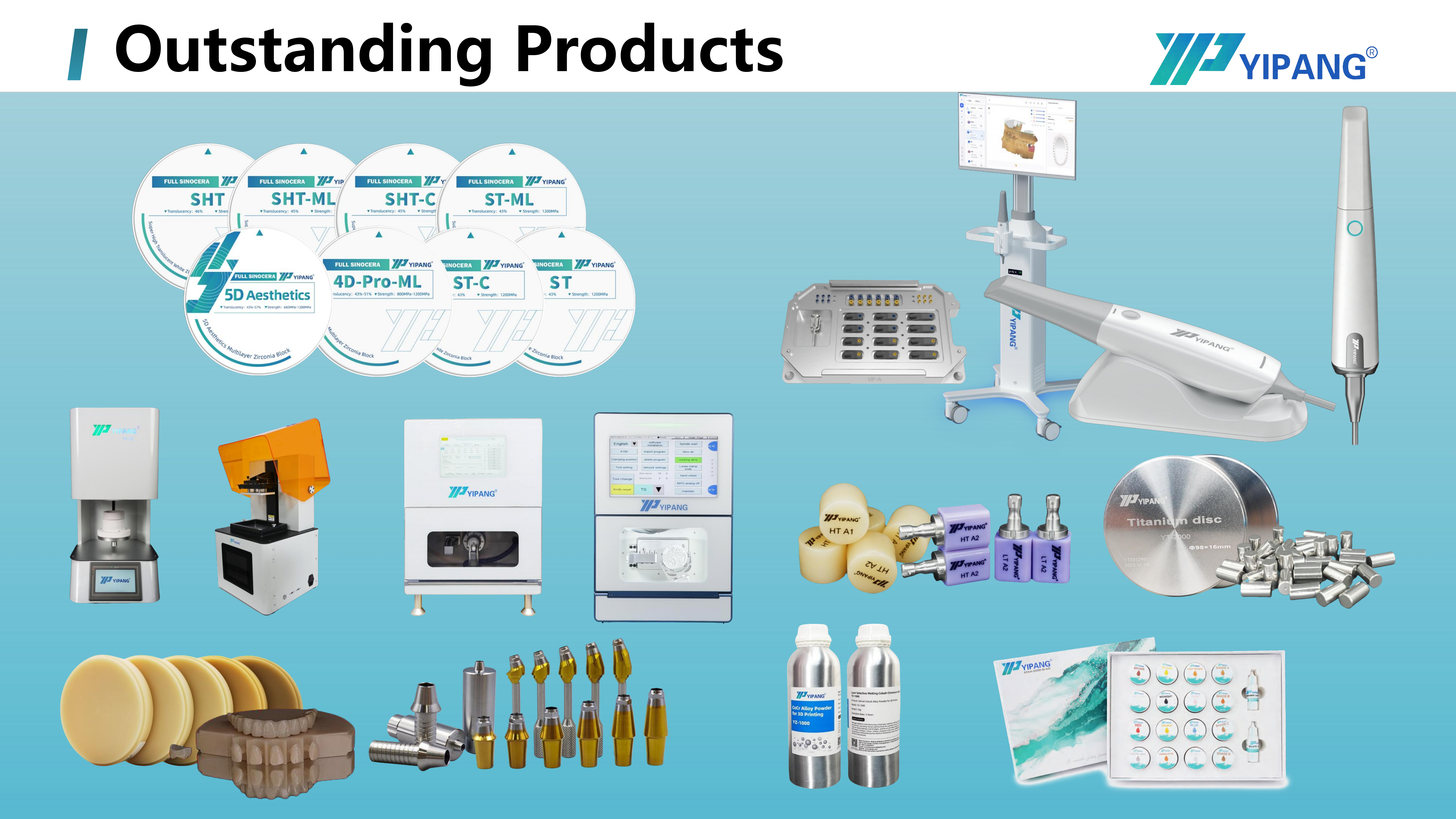
A zirconia workflow runs through a dental laboratory scanner for model and die digitisation, a dental milling machine with appropriate burs, and a dental sintering furnace, with staining and glazing usually finished in a porcelain furnace. Beijing Weijiahua's product lines cover both sides of that chain: zirconia blocks, glass ceramics, press ingots, PMMA, wax and titanium blocks alongside implant abutments, intraoral scanners, milling machines, 3D printers and sintering furnaces.
For the 4D-PRO-ML zirconia block, the published sintering guidance is a temperature range of 1430 °C to 1450 °C with a standard heating and holding procedure, intended to support low shrinkage and stable translucency. The stated sequence is unremarkable, and that is the point: place the milled workpiece on a sintering tray, follow the prescribed curve up to temperature, hold, then cool naturally. Two precautions accompany it — avoid rapid temperature changes to prevent cracking, and do not exceed the maximum sintering temperature.
Why the details carry commercial weight: linear shrinkage determines whether a milled crown seats, and translucency consistency determines whether a shade match survives into the next case. The company reports that customers recognise uniform translucency, stable sintering shrinkage and compatibility with most CAD/CAM systems, together with a low complaint rate. Those are company-reported outcomes rather than independent measurements, and they describe a direction of performance rather than a specification a buyer can hold the supplier to.
The 25-engineer team is the function that would own the document closing that gap. Its existence is an indicator of organisational capability; the firing program itself is the deliverable.
OEM, customisation and the mechanics of an actual order
Beijing Weijiahua states an OEM/ODM production mode and says almost all specifications can be customised, with a lead time of 15 to 30 working days. Two MOQ statements appear in the company's own material and should be read together rather than as one number: the capability statement describes MOQ as negotiable for small orders, while the purchasing-terms statement gives 1 box for standard models and 5 boxes for customised products. For planning, the purchasing statement is the more concrete figure, and the quotation line is what governs.
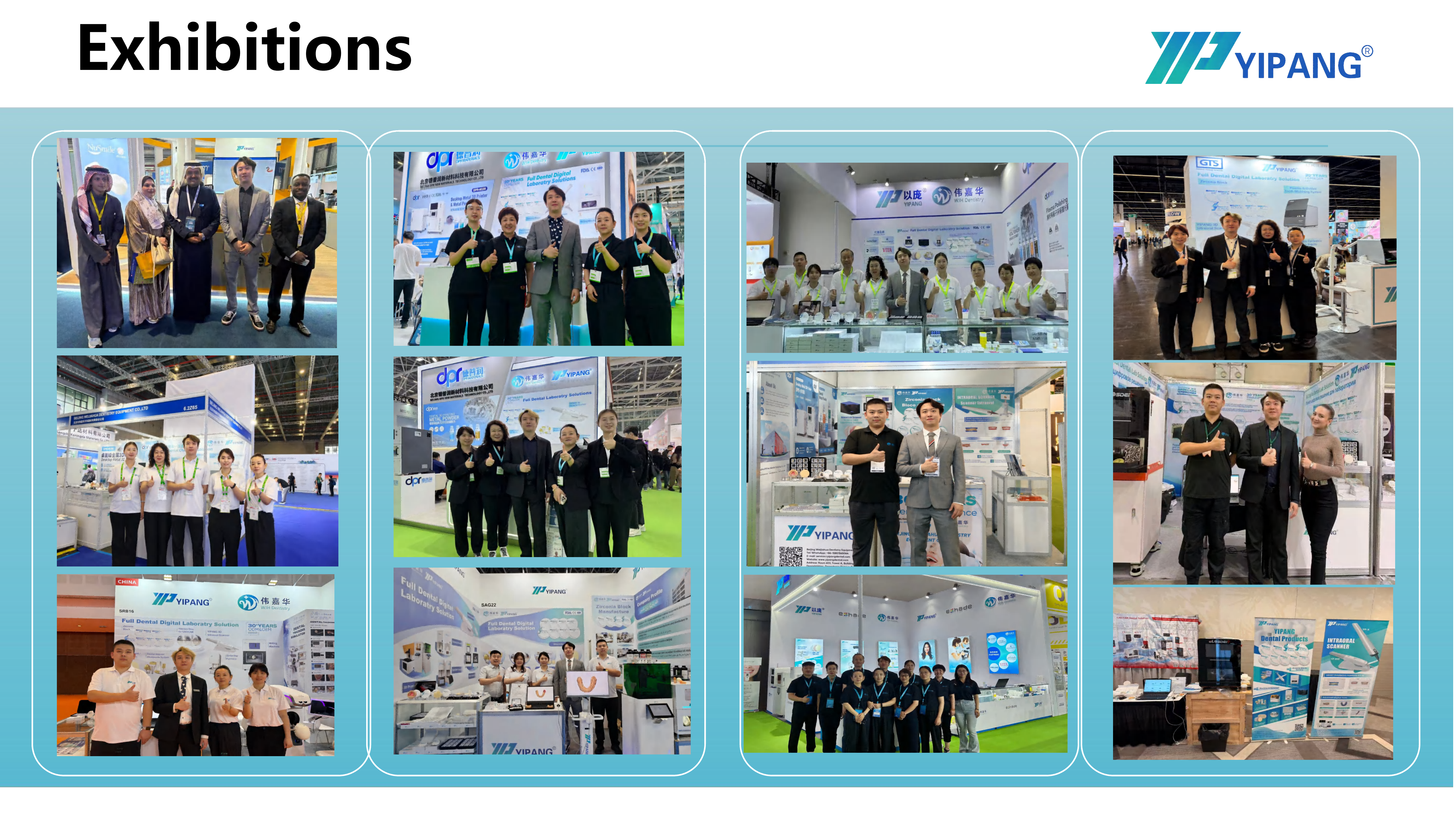
Logistics and payment terms are stated plainly: express delivery domestically; sea or air freight for export, with FOB Shanghai or Tianjin available; full payment before shipment. Acceptance runs on a quantity check at receipt, with damage or deformation reported within 48 hours together with photographs, and sampling tests are supported.
Quality control is described as 100% raw material inspection plus random inspection of finished products. The distinction matters: incoming material is checked completely, but finished-goods verification is sampling-based, which is why the buyer's own gate is not redundant. A laboratory receiving a lot is the last point at which a defective blank can be caught before it becomes a milled, sintered and wasted unit.
After-sales support is stated as online technical guidance with a response target of 24 hours. For sintering problems that timing is meaningful, because a cracked batch is time-critical. The question worth asking is what the response consists of — root-cause support on the firing curve, or replacement of the affected units.
Application fit: what the capability is built around
The company's stated restoration scope covers full-contour crowns, bridges, veneers and implant superstructure restorations, and its case material describes crowns, bridges and aesthetic restorations. The working condition assumed in its scenario documentation is an indoor, constant-temperature dental laboratory, with the block processed on a milling machine and densified in a sintering furnace, and with strict adherence to the sintering curve listed as a special requirement.
Fit differs by restoration type, and the questions change with it. For posterior crowns and multi-unit bridges, sintering consistency and marginal accuracy dominate, so a documented shrinkage expectation is the first item to request. For implant superstructures, geometry and the interface specification constrain the blank more tightly than shade. For anterior aesthetic work, shade consistency across batches becomes the deciding variable, and a single successful test unit proves less than a record covering two or three consecutive lots.
Certificates, scope and the limits of each document
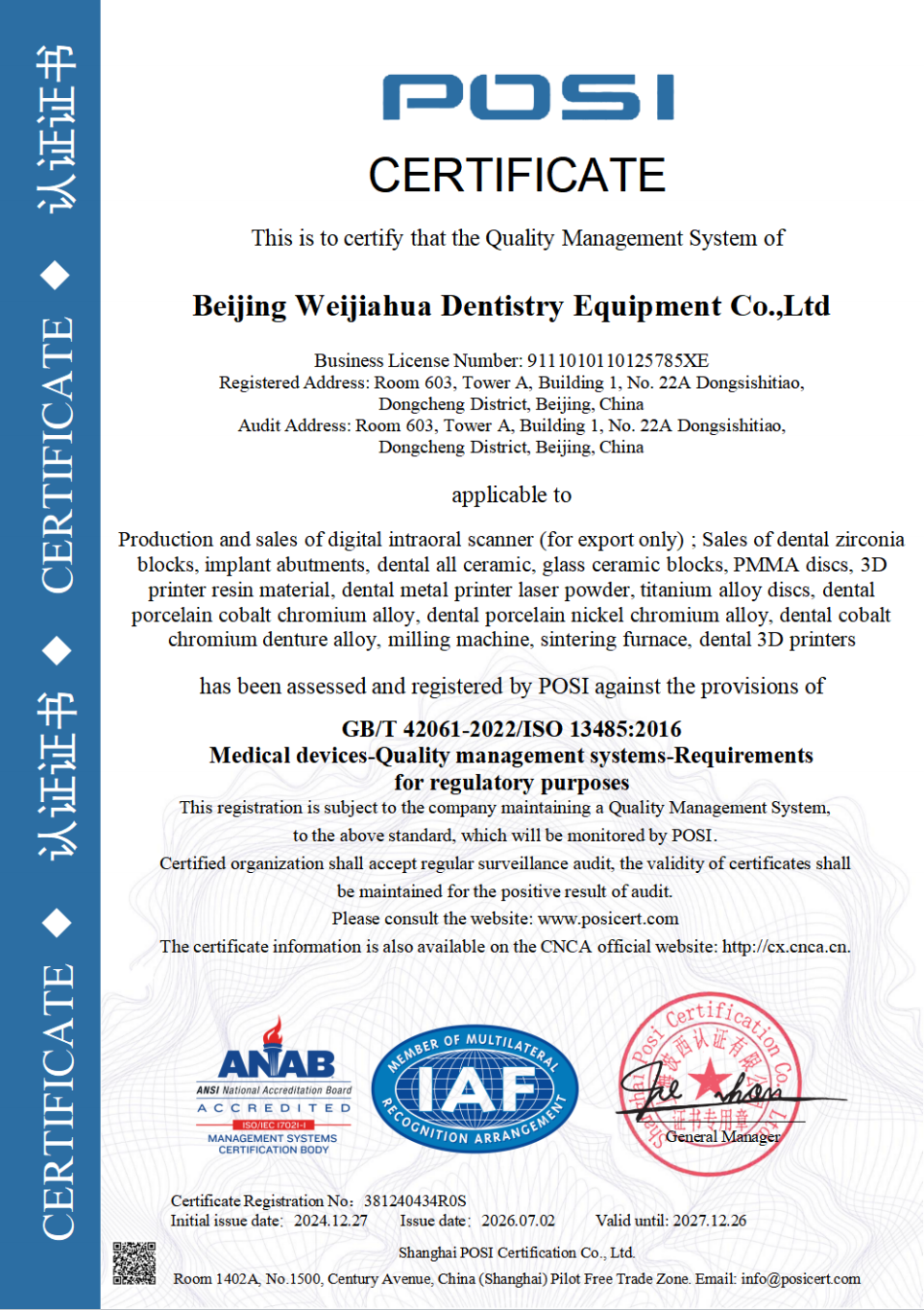
The company holds ISO 13485 certification, certificate number 381240434R0S, issued on 27 December 2024 and valid to 26 December 2027 by Shanghai POSI Certification Co., Ltd. against GB/T 42061-2022 / ISO 13485:2016. Its stated scope covers the design, production and sales of dental medical materials and dental equipment, with applicability to global, EU, USA and Middle East markets. The value of that certificate is organisational: it indicates a certified quality management system behind the block line.
Its limits are equally clear. A quality-system certificate does not certify an individual batch, does not predict how a block behaves in a particular furnace, and does not substitute for product registration in a destination market.
A second document in the same file illustrates the trap of generalising. The company's EU Declaration of Conformity under MDR 2017/745, SRN CN-MF-000045919, is a self-declaration issued on 1 April 2026 covering the intraoral scanner models YP-X and YP-800, which are Class I devices. It does not cover zirconia blocks. A buyer requiring EU conformity documentation for the block should request the document for that product specifically, rather than accept a scanner declaration as a substitute.
Test reports deserve the same precision. A 2020 ISO/DIS document sample describes test methods and test-report contents for machinable ceramic blanks used in dental fixed restorations, but its DIS designation means it should not be treated as a final applicable standard without verification. The usable instruction is to ask for the report and the standard edition it cites — not simply for the word 'ISO'.
Three document sets to request before a repeat order
| Evidence area | What to request | Why it changes the decision | What a usable answer contains |
|---|---|---|---|
| Sintering curve control | The written firing program for the exact model — heating rate, hold temperature and time, cooling method — plus expected linear shrinkage with tolerance, batch-to-batch variation data, and the furnace type used for validation | A 1430–1450 °C window has meaning only together with rates and holds, because the laboratory reproduces the supplier's curve on different equipment | A program that can be loaded into the buyer's furnace, and a written statement of what to do if that furnace cannot reproduce it |
| Purchasing terms | MOQ per model (standard versus customised), lead time in working days, Incoterm and port, freight mode, payment terms, and the manufacturer name that will appear on labels and documents for OEM or private-label orders | 'Negotiable small MOQ' and '1 box standard / 5 boxes customised' are both stated; only the quotation binds, and on OEM work the identity on the label matters more than unit price | A written quotation covering all six points, with the legal manufacturer named exactly as it will appear on the packaging |
| Acceptance criteria | Incoming inspection protocol, the 48-hour damage and deformation claim route with photo evidence, the sampling-test allowance, visual criteria for blanks, the shade comparison method, and permission to mill and sinter one test unit before lot release | Finished-product inspection is random, so the receiving laboratory is the last effective gate before a blank becomes a wasted restoration | Criteria signed by both sides, plus a stated remedy path if a lot fails |
None of these requests is unusual, and that is why their absence is informative. A supplier able to answer all three has a system that can be audited at a distance. A supplier that answers two of three has told the buyer where to concentrate the first sample run.
What the market record supports, and what it does not
Peer-reviewed literature continues to examine zirconia-based dental materials, including their properties and classification, with a review published in 2024; a 2021 article in Frontiers in Dental Medicine examined artificial intelligence in biomedical applications of zirconia, including dental devices. These support a narrow, defensible point: zirconia is an active and still-iterating CAD/CAM material class, which raises the value of specification discipline on the buyer's side.
Category-level growth figures circulating for 'zirconia based dental materials' describe a broader scope than zirconia blocks alone, and the material reviewed for this article does not contain a block-specific figure with a disclosed methodology. Procurement decisions at laboratory level are therefore better anchored in sample sintering, batch documentation and contractual acceptance criteria than in category growth numbers that cannot be tied to the product being bought.
Outlook
If CAD/CAM workflows continue to spread, the basis of competition among zirconia block suppliers shifts from shade charts toward documentation: a written firing program per model, batch-level consistency data, and a clear statement of which regulatory identity covers which market. A supplier with an in-house engineering function and a certified quality system is positioned for that shift, because both are prerequisites for producing such documents. Neither, however, replaces the buyer's own verification — the certificate describes a system, while the sample describes a block.
For a laboratory or distributor evaluating this line, the practical route is a small first order under the stated terms — one box of a standard model, or five of a customised specification — run alongside the three document requests above, with one milled and sintered test unit used to confirm that the published curve reproduces in the buyer's own furnace. That combination produces something a catalogue cannot: evidence that belongs to the buyer.
FAQ
How do dental labs select zirconia blocks?
Selection usually starts from the restoration mix rather than from the block catalogue. A laboratory working on full-contour crowns, bridges and implant superstructures needs a blank whose sintered behaviour suits the case and whose sintering protocol can be reproduced on its own furnace. In practice this means comparing written firing programs, shrinkage expectations and batch documentation, then milling and sintering a test unit before committing to volume. The cost of a remade unit usually outweighs the difference between two block prices.
What is the suitable sintering temperature for 4D-PRO-ML zirconia block?
The recommended range is 1430 °C to 1450 °C, using a standard heating and holding procedure. Workpieces are placed on a sintering tray, brought up to temperature on the prescribed curve, held, and then cooled naturally. Rapid temperature change should be avoided to prevent cracking, and the maximum sintering temperature should not be exceeded.
What are the purchasing terms and acceptance criteria?
MOQ is 1 box for standard models and 5 boxes for customised products. Delivery is by express domestically and by sea or air freight for export, with FOB Shanghai or Tianjin available; payment is full before shipment. Acceptance requires a quantity check on receipt, with damage or deformation reported within 48 hours together with photographs, and sampling tests are supported.
Can zirconia block specifications be customised for an OEM or ODM order?
The company states an OEM/ODM production mode and says almost all specifications can be customised, with a stated monthly capacity of 15,000 pieces and a lead time of 15 to 30 working days. Because 'almost all' is not a specification list, a buyer should confirm in writing which dimensions, shades, pre-shading formats and packaging options fall inside the customisation scope before the order is placed.
Have Questions or Need More Details?
Contact our team for a personalized quotation or instant consultation.
Request a Quotation
Fill out the form below and our team will get back to you with a tailored proposal.
WhatsApp Direct Chat
Prefer to chat in real-time? Message us on WhatsApp for instant assistance & quick answers.
- Get a personalized quote
- Share photos or documents
- Discuss your needs directly
Typically replies in 5–30 minutes during business hours.