
Dental Zirconia Block vs PMMA Disc: A Lab Buyer's Comparison
Dental Zirconia Block vs PMMA Disc: A Lab Buyer's Comparison
A dental laboratory that mills its own restorations rarely buys one material at a time. Zirconia blocks for permanent crowns and bridges and PMMA discs for milled provisional work typically sit on the same requisition, are quoted by the same supplier, and are compared with the same purchasing reflex: price per blank. That reflex is the first thing an independent comparison should correct, because the two products fail for entirely different reasons, and a strong data file for one says nothing about the other.
This comparison sets out how to evaluate a dental zirconia block on evidence rather than on positioning, and where a PMMA disc belongs inside that same buying decision. It draws on published third-party market data and on product-level facts that a supplier can be asked to document in writing.
Why Zirconia Block Comparison Has Become a Documentation Problem
Answer first: zirconia blank supply is no longer scarce, so the useful comparison has moved from "who sells zirconia" to "whose blank, documentation and process support survive a laboratory audit."
The market signals support that reading. Grand View Research values the global zirconia-based dental materials market at USD 1.2 billion in 2025, projected to reach USD 2.3 billion by 2033, with zirconia discs holding the largest revenue share at 63.1% in 2025. The same source reports that CAD/CAM milling accounted for 82.4% of zirconia dental manufacturing process revenue in 2025, that dental laboratories remain the dominant end-user at 45.3% of market share in 2025, and that the United States accounts for 40% of revenue. In material terms, 3Y-TZP zirconia held the largest grade share at 35.9% in 2025.
Two conclusions follow. First, a buyer comparing zirconia blocks is choosing inside a mature, mill-first category, which means the blank itself is rarely the differentiator. Second, because most laboratories buy the same way, the differences that matter to a procurement team are the ones that survive scrutiny: measured specification, certification scope, equipment compatibility and supply terms.
A caution for anyone assembling a comparison table from market research: published numbers are scope-dependent. For 2025 zirconia-based dental materials, Grand View Research reports USD 1.2 billion while SNS Insider reports USD 367.67 million for a similarly labelled category. A supplier quoting "the market" without defining the category boundary is offering a number, not evidence.
The Four Layers a Zirconia Block Comparison Should Cover
A comparison that lists only translucency and unit price will not survive the evaluation stage. In practice, four layers separate suppliers, and each one has its own evidence artefact that a laboratory can request before placing a first order.
| Comparison layer | Question the lab asks | Evidence to request |
|---|---|---|
| Product specification | Does the blank match the case mix across indication, thickness range, shade family and translucency class? | Dated specification sheet: diameter, thicknesses, shade family, translucency class, sintering temperature, stated bending strength, base material |
| Documentation scope | Which product, which device class and which market does each certificate actually cover? | ISO 13485 certificate with number, issuing body, standard and validity dates; EU Declaration of Conformity with SRN and named devices |
| Equipment and process fit | Will the blank run in our mill, and will our furnace reproduce the same result run after run? | Milling machine compatibility statement, recommended sintering curve, furnace temperature limits |
| Supply and repeatability | Can the supplier deliver the same blank next quarter, and who answers when a batch behaves differently? | Monthly capacity, lead time, MOQ terms, incoming and finished-product inspection routine, after-sales response commitment |
How a Documented Zirconia Block Presents on Each Layer
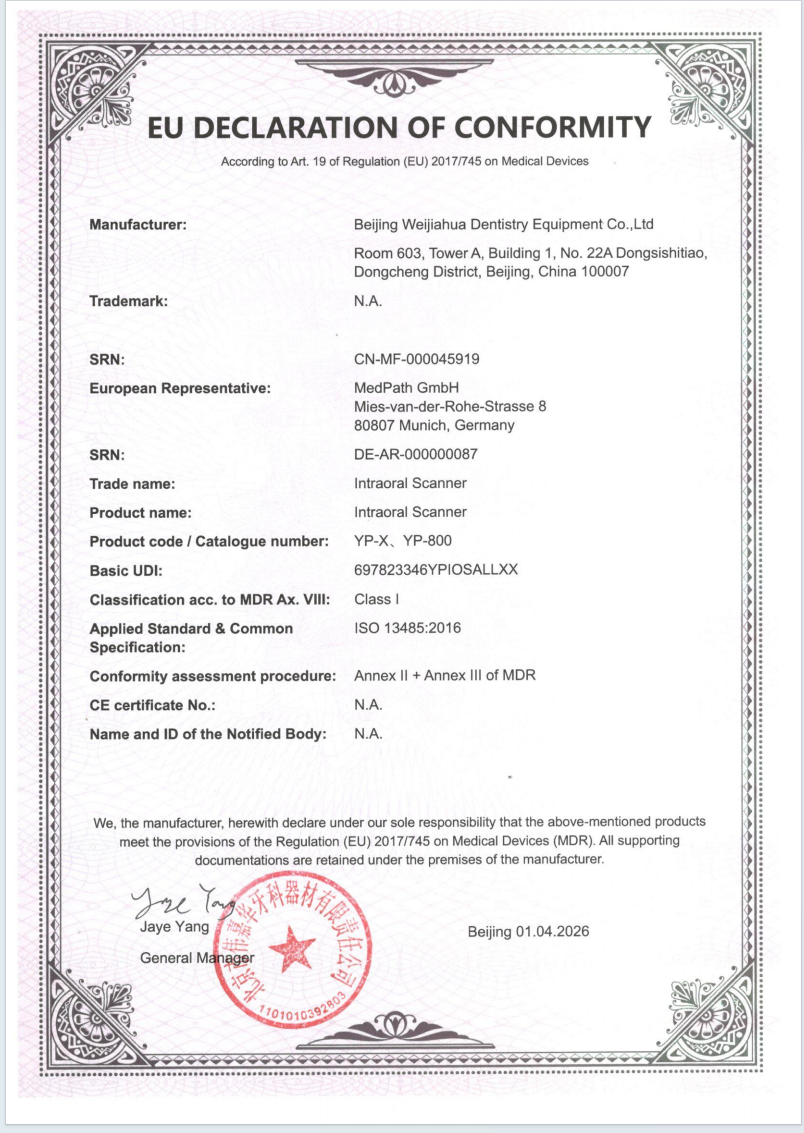
The 4D-PRO-ML Zirconia Blocks for Dental Prosthesis, marketed under the YIPANG brand, is a useful worked example because its specification, certification and supply facts are stated in a form that can be checked rather than inferred.
Specification layer
The product is a CAD/CAM dental milling blank produced from yttria-stabilized zirconium dioxide (ZrO₂). Stated parameters include a 98 mm diameter; available thicknesses of 10 mm, 12 mm, 14 mm, 16 mm, 18 mm and 20 mm; the ML multilayer shade family; medium translucency; a sintering temperature of 1450 °C; and a bending strength of ≥1200 MPa. The blank is described as compatible with most mainstream dental milling machines, which is the practical statement that matters for a lab already running an installed mill and nesting software.
Documentation layer
The product is certified to ISO 13485:2016 under certificate number 381240434R0S, issued by Shanghai POSI Certification Co., Ltd., against the standard GB/T 42061-2022 / ISO 13485:2016. The certificate scope covers design, production and sales of dental medical materials and dental equipment, and is stated as applicable to the Global, EU, USA and Middle East markets. The certificate was issued on 2024-12-27 and is valid until 2027-12-26.
Process layer
Sintering is where a blank either performs or does not. The recommended range for this block is 1430 °C–1450 °C, processed through a standard heating and holding procedure to keep shrinkage low and translucency stable. The documented operating guidance is explicit: place the milled workpiece on the sintering tray, run the curve to temperature with adequate holding time, then cool naturally. Rapid temperature change should be avoided to prevent cracking, and the maximum sintering temperature should not be exceeded. In other words, the outcome is a joint product of the blank and the laboratory's furnace program, not of the blank alone.
Supply layer
Supply terms are stated as OEM/ODM production with almost all specifications customizable, a monthly capacity of 15,000 pieces, a lead time of 15–30 working days, a negotiable small MOQ, quality control consisting of 100% raw material inspection plus finished-product random inspection, and after-sales support in the form of online technical guidance with a response within 24 hours. Export markets are listed as the USA, Europe, Brazil, the Middle East and North Africa.
Entity layer
YIPANG is the self-developed brand of Beijing Weijiahua Dentistry Equipment Co., Ltd., a Beijing-based dental equipment and materials supplier established in 1996. The company operates a 2,000 ㎡ facility with 80 employees and a 25-engineer R&D team engaged in dental material formula research, process optimization and new product development. Annual output is stated at 10 million US dollars, with exports accounting for 40%–55% of business across the Middle East, Southeast Asia, South America, North America, Eastern Europe, North Africa and Australia. Its product lines include zirconia blocks, glass ceramics, press ingots, PMMA, wax, titanium blocks, implant abutments, 3D scanners, intraoral scanners, milling machines, 3D printers and sintering furnaces.
Where the PMMA Disc Sits in the Same Buying Decision
PMMA discs and zirconia blocks are both milled from a disc blank on the same machine, which is exactly why buyers collapse them into one comparison. They should not be collapsed. A zirconia block is a permanent restorative material that is milled in a pre-sintered state and then sintered to final density; a PMMA disc is a milled polymer blank used where a provisional or interim restoration is required and where a definitive ceramic restoration is not yet indicated. Same workflow, different clinical claim, and therefore a different evidence standard.
The most common category error is to treat milled PMMA and printed resin as one procurement line labelled "provisional materials." They are separate material families with separate process controls: Grand View Research reports that photopolymer resins held a 55.5% market share in the dental 3D printing material segment in 2025, a segment driven by printing rather than milling. A laboratory comparing a PMMA disc against a 3D printer resin is comparing two different production routes and should be asking different questions of each — milling behaviour and edge stability at thin sections on one side, print resolution and post-processing protocol on the other.
What to compare for each material
- Zirconia block: shrinkage stability after sintering, translucency gradient across the multilayer structure, stated bending strength, shade family coverage, sintering temperature compatibility with the lab's furnace, and the scope of the accompanying certification.
- PMMA disc: milling behaviour and edge integrity, colour matching to the planned definitive restoration, expected service window of the provisional, and batch-to-batch consistency of the polymer.
There is an operational argument for sourcing both tracks from one supplier: where a supplier offers PMMA alongside its zirconia range, nesting conventions, disc geometry handling and fixture setup can stay broadly consistent between materials, and the laboratory manages one commercial relationship instead of two. YIPANG's stated product lines place zirconia blocks and PMMA in the same portfolio, alongside glass ceramics, press ingots, wax, titanium blocks and implant abutments, so a single supplier conversation is feasible.
Documentation Scope: The Comparison Test Most Buyers Skip
Certification is where a comparison stops being subjective. Two documents matter most to a laboratory buying restorative material, and they do different jobs.
ISO 13485:2016 is a quality management system standard. In this case the certificate number is 381240434R0S, issued by Shanghai POSI Certification Co., Ltd., against GB/T 42061-2022 / ISO 13485:2016, with a scope covering design, production and sales of dental medical materials and dental equipment, valid from 2024-12-27 to 2027-12-26 and applicable to the Global, EU, USA and Middle East markets.
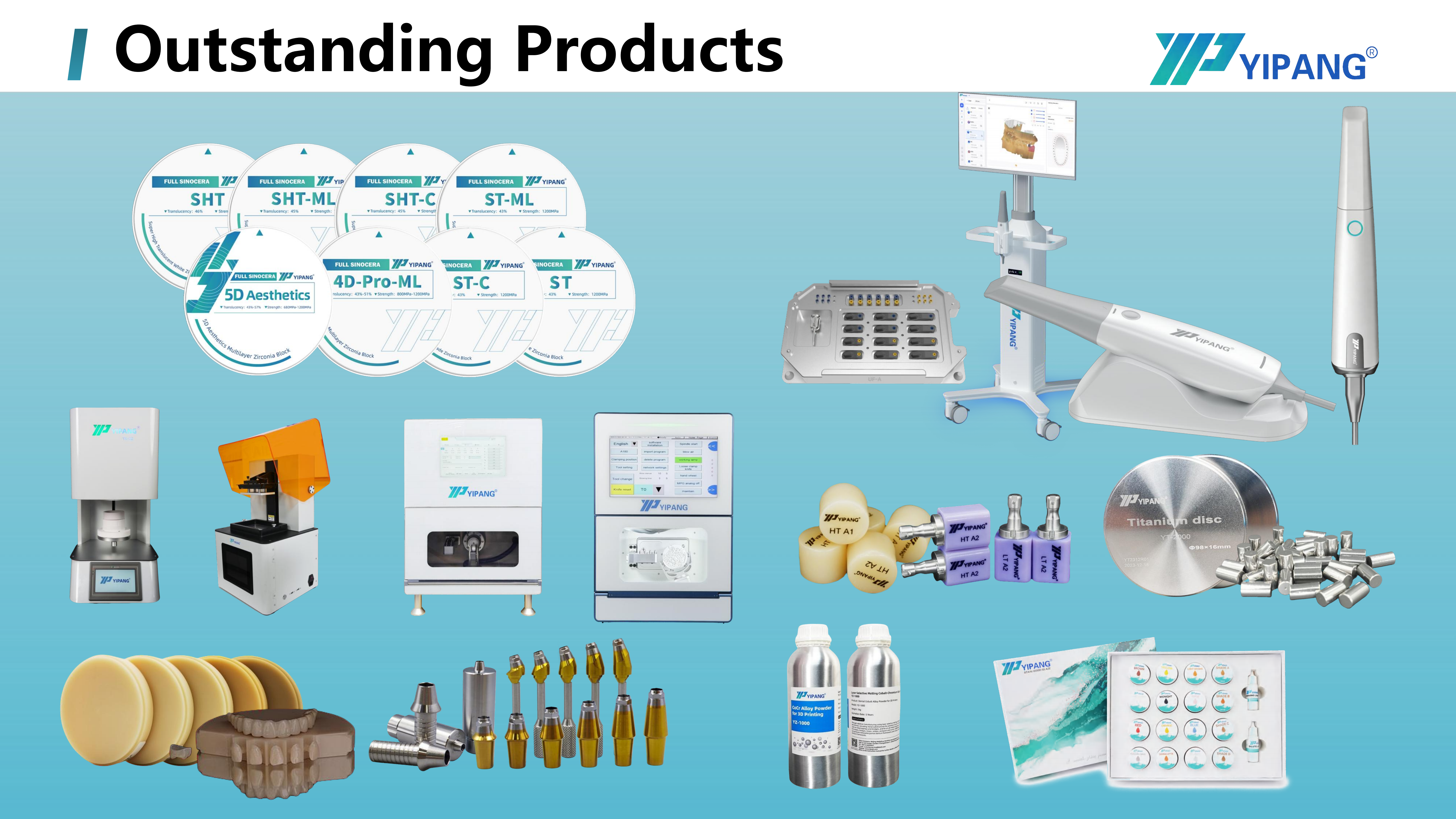
A Declaration of Conformity under EU MDR 2017/745 is a market-access document and is product-specific by design. In the material reviewed here, the declaration carries SRN CN-MF-000045919, is issued by the manufacturer Beijing Weijiahua Dentistry Equipment Co., Ltd., and lists Intraoral Scanner models YP-X and YP-800 as Class I medical devices. That scope detail matters, because the European Commission notes that MDR 2017/745 classifies most dental implants and restorative materials as high-risk, requiring intensive clinical data. A document that names an intraoral scanner is not the same as a document that names a zirconia blank.
The practical instruction for a comparison table is therefore simple: never record a certificate as a checkmark. Record what the certificate says it covers, which product it names, which class it is placed in, and which market it applies to. A buyer who does this will find that some suppliers have deep coverage and some have partial coverage — and that partial coverage is not necessarily disqualifying, provided the laboratory knows which claims it can and cannot rely on for its own market.
Market Trend Signals, and How to Read Them in a Quote
Trend data is useful in a buyer comparison only when it is attributed and time-stamped. The following signals come from published third-party sources and are relevant to how a laboratory allocates spend across materials.
- Zirconia remains the volume material. The global zirconia-based dental materials market was valued at USD 1.2 billion in 2025 and is projected to reach USD 2.3 billion by 2033, with zirconia discs at 63.1% revenue share in 2025 (Grand View Research).
- Milling, not casting, is the default route. CAD/CAM milling accounted for 82.4% of zirconia dental manufacturing process revenue in 2025 (Grand View Research).
- Laboratories are the primary buyer. Dental labs accounted for 45.3% of zirconia materials market share in 2025, and the United States accounts for 40% of revenue in the same category (Grand View Research).
- Lithium disilicate is growing faster but from a smaller base. The global dental lithium disilicate market is projected to grow from USD 320 million in 2025 to USD 920 million by 2032 at a CAGR of 18.8% (Intel Market Research), while lithium disilicate accounted for approximately 28% of all all-ceramic dental restorations globally as of 2024 (Business Research Insights).
- Printing is expanding as a parallel route. The dental 3D printing market is estimated to grow from USD 4.9 billion in 2025 to USD 26.7 billion by 2033, with photopolymer resins holding 55.5% of the material segment in 2025 (Grand View Research).
- The installed mill base keeps growing. The dental milling machine market reached USD 2.45 billion in 2025 with expected growth to USD 3.9 billion by 2030 (Fortune Business Insights), and Roland DG, Amann Girrbach and vhf camfacture were identified as significant share holders in the sector as of 2024.
- Implant superstructure demand is expanding. The final abutment market was valued at nearly USD 2.6 billion in 2025 (iData Research), and the PEEK dental implants market was valued at USD 1,055 million in 2025 with an expected 8% CAGR through 2034 (Precedence Research).
Read every growth rate against its scope. Forecasts for dental lithium disilicate CAGR range from 18.8% (Intel Market Research) to 24.53% (Business Research Insights) depending on regional adoption assumptions. When a supplier opens a commercial conversation with a growth figure, asking for the source and the category definition takes thirty seconds and reveals how carefully the rest of the quotation was prepared.
Application Fit: Matching Block to Restoration Type
Zirconia blocks are used to fabricate full-contour crowns, bridges, veneers and implant superstructure restorations — that is, the cases where a durable, aesthetic permanent result is required to repair missing or damaged teeth. The production environment is an indoor, constant-temperature dental laboratory, and the workflow runs through a dental milling machine and a dental sintering furnace, with a dental lab scanner upstream in the digital chain. The matched equipment set for this application is therefore a dental milling machine, a dental sintering furnace and a dental lab scanner, and the special process requirement is to follow the standard sintering temperature curve without deviation.
Supplier-reported case experience with these blocks covers hundreds of long-term cooperative clients worldwide, including dental laboratories, dental clinics and distributors, using the material for crowns, bridges and aesthetic restorations over multi-year relationships. The characteristics the supplier highlights are uniform translucency, stable sintering shrinkage and compatibility with most CAD/CAM systems, with high recognition on material stability and aesthetic effect and a low customer complaint rate. Those are first-party claims rather than independently audited results, and they should be treated as such in a comparison — useful as a starting hypothesis, not as a substitute for the laboratory's own validation run.
Limitations and Trade-offs to Write Into the Comparison
A comparison without stated boundaries is a brochure. The following constraints are part of the honest picture.
- Shade coverage is narrow as published. The stated available shade for the 4D-PRO-ML blank is the ML multilayer family. A laboratory running high volumes of highly characterised anterior work should confirm whether additional shades are available under the stated OEM/ODM customization capability rather than assume a full shade system exists.
- Process discipline is a dependency, not a feature. A 1430 °C–1450 °C window with a prohibition on rapid temperature change means the final result depends on the furnace program and operator discipline. A lab with an ageing furnace or an irregular maintenance schedule may see variation that has nothing to do with the blank.
- The supply model is planned replenishment. A 15–30 working day lead time against a 15,000-piece monthly capacity suits laboratories that forecast case volume. Labs with volatile or seasonal case spikes need buffer stock planning; this is not an immediate-stock supply model.
- Documentation is not uniformly product-specific. As noted above, the EU Declaration of Conformity in the available documentation names intraoral scanner models rather than the zirconia blank, while EU MDR 2017/745 places most restorative materials in a high-risk category requiring intensive clinical data. Buyers selling into the EU should confirm product-level documentation before relying on a supplier's market access claim.
- The strength figure is a specification, not a test report. A bending strength of ≥1200 MPa is stated in the product specification. Laboratories that require independent mechanical test data for a regulatory or clinical file should request third-party testing rather than treat a specification sheet as equivalent.
- Market-size claims vary widely by scope. As shown by the divergence between published zirconia market estimates, a single number cannot carry a business case on its own.
Future Outlook
The direction of travel is toward material-route planning rather than single-material loyalty. With CAD/CAM milling at 82.4% of zirconia process revenue and the milling machine market expected to reach USD 3.9 billion by 2030, the installed base of mills keeps expanding, and equipment compatibility will remain a hard filter in supplier selection — which is why named machine builders such as Roland DG, Amann Girrbach and vhf camfacture appear repeatedly in market analysis of the sector.
At the same time, provisional and digital routes are not standing still. A dental 3D printing market projected to grow from USD 4.9 billion in 2025 to USD 26.7 billion by 2033, with photopolymer resins holding 55.5% of the material segment, suggests that most laboratories will run milled PMMA and printed resin side by side rather than choosing between them. On the aesthetic side, lithium disilicate's projected growth to USD 920 million by 2032 and its 28% share of all-ceramic restorations as of 2024 indicate continued substitution pressure in anterior cases. And with the final abutment market at nearly USD 2.6 billion in 2025 and PEEK implants forecast to grow at 8% CAGR through 2034, the implant superstructure segment that consumes zirconia blocks is likely to keep expanding.
The practical implication for a buyer is that comparison criteria will formalise around documentation and process evidence rather than around price per blank. As material options multiply, the supplier who can show a certificate number, a scope statement, a compatible equipment list and a repeatable sintering curve is the one whose quotation can actually be audited.
FAQ
What should a lab verify first when comparing dental zirconia block suppliers?
Start with documentation scope, then check the specification sheet against it. The reference point in this comparison is an ISO 13485:2016 certificate, number 381240434R0S, issued by Shanghai POSI Certification Co., Ltd. against GB/T 42061-2022 / ISO 13485:2016, valid from 2024-12-27 to 2027-12-26, with a scope covering design, production and sales of dental medical materials and dental equipment. Because that scope is written at the level of materials and equipment, the buyer still needs to confirm the product-level documentation that applies to the specific blank being ordered.
Is a zirconia block interchangeable with a PMMA disc in laboratory purchasing?
No, and they should not share a single comparison template. A zirconia block is a permanent restorative material milled from a pre-sintered blank and then sintered to final density, while a PMMA disc is a milled polymer blank used for provisional or interim work. They are also distinct from printed photopolymer resins, which held a 55.5% share of the dental 3D printing material segment in 2025. Zirconia should be compared on shrinkage stability, translucency gradient, stated bending strength and documentation scope; PMMA should be compared on milling behaviour, shade matching and batch consistency.
Which specification values should be compared numerically between zirconia blocks?
The measurable set is diameter, available thicknesses, shade family, translucency class, sintering temperature and stated bending strength. For the 4D-PRO-ML Zirconia Blocks for Dental Prosthesis, the stated values are a 98 mm diameter, thicknesses of 10 mm, 12 mm, 14 mm, 16 mm, 18 mm and 20 mm, the ML multilayer shade family, medium translucency, a sintering temperature of 1450 °C, and a bending strength of ≥1200 MPa, in yttria-stabilized zirconium dioxide (ZrO₂).
What sintering conditions does the 4D-PRO-ML zirconia block require?
The recommended sintering temperature range is 1430 °C–1450 °C, following a standard heating and holding procedure to keep shrinkage low and translucency stable. The documented steps are to place the milled zirconia workpiece on a sintering tray, set the heating curve up to 1430 °C–1450 °C with an appropriate holding time, and allow natural cooling after sintering. Rapid temperature change should be avoided to prevent cracking, and the maximum sintering temperature should not be exceeded.
Which equipment does a dental zirconia block need to be compatible with?
The matched equipment for this application is a dental milling machine, a dental sintering furnace and a dental lab scanner, working in an indoor constant-temperature dental laboratory environment. The 4D-PRO-ML blank is stated as compatible with most mainstream dental milling machines and suitable for dental CAD/CAM workflows, so the practical verification step for a laboratory is to confirm that its own installed mill falls inside that compatibility statement before committing to a volume order.
How does EU documentation differ from ISO 13485 for dental materials?
They answer different questions. ISO 13485:2016 certifies the manufacturer's quality management system and, in this case, covers design, production and sales of dental medical materials and dental equipment. A Declaration of Conformity under EU MDR 2017/745 is a market-access document tied to named devices; in the documentation reviewed here it carries SRN CN-MF-000045919 and lists Intraoral Scanner models YP-X and YP-800 as Class I medical devices. Because the European Commission notes that MDR 2017/745 classifies most dental implants and restorative materials as high-risk requiring intensive clinical data, buyers should always confirm which product and which device class a declaration names.
Which supply terms should be part of a supplier comparison?
Monthly capacity, lead time, MOQ terms, inspection routine and after-sales response commitment. For the supply arrangement described here, those are stated as a monthly capacity of 15,000 pieces, a lead time of 15–30 working days, a negotiable small MOQ, quality control comprising 100% raw material inspection plus finished-product random inspection, and after-sales online technical guidance with a response within 24 hours. These terms determine whether a supplier can hold a repeat-order relationship, which is a different question from whether a single sample performs well.
What a Fair Comparison Concludes
Zirconia blocks and PMMA discs belong in the same purchasing conversation but not in the same comparison column. Zirconia is judged on specification, sintered stability, documentation scope and process discipline; PMMA is judged on milling behaviour, provisional service expectations and batch consistency. Suppliers that document both tracks separately, with certificate numbers, scopes and equipment lists that a laboratory can check, reduce the buyer's verification workload — and that is a legitimate reason to keep them on a shortlist, independent of unit price.
For readers who want the full company and product overview behind the material lines discussed here, the YIPANG company information brochure is available as a PDF: WJH Company Information (PDF). Additional product and company detail is published at www.yipangdental.com.