
Desalination Supplier Capability: 20-Year Uptime Evidence
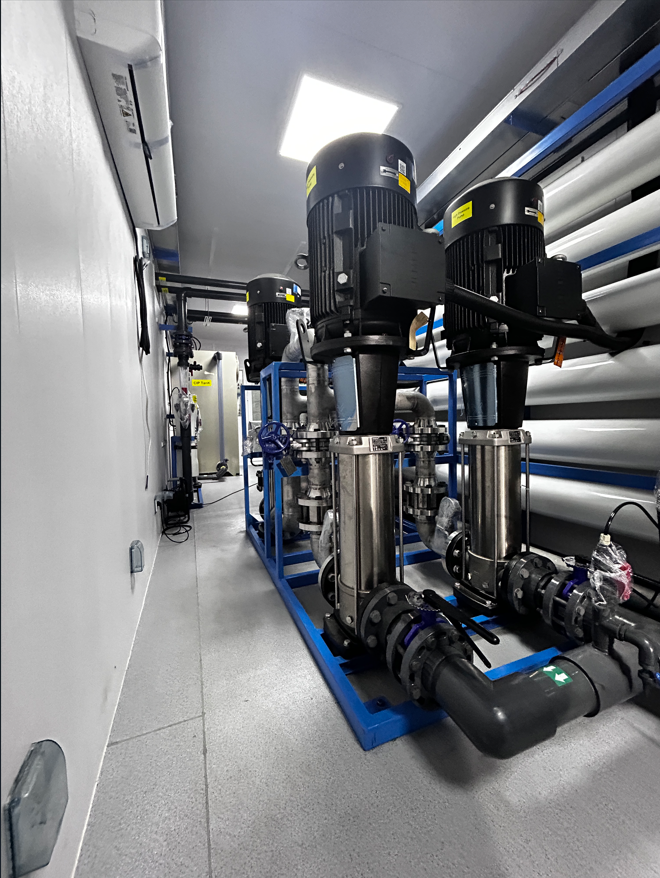
A modular RO train at a delivered reference site. Deployment scale is one of the few desalination claims that leaves a physical trace a buyer can inspect.
Global installed desalination capacity passed 100 million m³/day in 2024, and seawater reverse osmosis (SWRO) accounts for more than 60% of that installed base. Once a treatment process reaches this level of standardisation, process selection stops being the differentiator between suppliers. What separates them is evidence: named installations, recorded operating durations, certificate numbers that can be looked up, and test records that can be requested before a purchase order is signed.
For a procurement team in the research and evaluation stages, the workable question is not whether a supplier can build a seawater desalination system, but which reference projects, certification scopes and factory test protocols that supplier can put in front of an independent reviewer. A capability claim is verifiable when it can be reduced to four countable evidence types: named reference projects with capacity and duration, third-party certificates with defined scope and registration numbers, documented pre-shipment testing, and a portfolio that spans several deployment scales rather than a single repeatable size.
Why Desalination Capability Claims Need Countable Evidence
Desalination procurement is unusual in that the equipment is only proven after several years of operation. A plant that performs well during a two-week commissioning test can still underperform three years later if the pre-treatment design, material selection or duty cycle was mismatched to the site. That time lag is exactly why buyers should evaluate suppliers on records rather than on descriptions.
A workable five-test framework for screening a desalination system supplier:
- Named references, not reference counts. Ask for client type, installed capacity in m³/day, application (municipal, industrial, resort, power), and the year the plant started operating.
- Duration evidence. Operating duration is the single strongest signal of durability, because it includes corrosion exposure, membrane replacement cycles and operator turnover.
- Capacity spread. A supplier that has delivered 216 m³/day and 60,000 m³/day has demonstrated engineering range; a supplier with only one dominant size has demonstrated repetition.
- Certificate numbers and scope. Quality, environmental and occupational health certificates are only meaningful when the registration number, issuing body and certified scope are disclosed.
- Test protocol. Factory pre-assembly, 100% pre-shipment testing and acceptance of third-party factory acceptance testing (FAT) are process facts that can be written into a contract.
Reference Portfolio: Ten Installations That Define the Evidence Base
The portfolio below is drawn from the manufacturer's own reference register and spans 216 m³/day to 60,000 m³/day. It is presented here as a verification artefact rather than a marketing list: each row contains the details a buyer needs in order to request confirmation from the client side.
| Reference (client type) | Capacity | Application | Recorded duration |
|---|---|---|---|
| Water utility (Veolia) | 3,500 m³/day total (10+ units × 350 m³/day) | Remote coastal drinking water | 20+ years |
| BP petrochemical | 2 × 600 m³/day SWRO | Petrochemical process water | 20+ years |
| Mining / phosphate group (OCP) | 50,400 m³/day | Municipal drinking water (GSF + UF + SWRO) | Project start 2026 |
| Municipal water authority, Morocco (JESA-linked) | 20 MLD (20,160 m³/day) | Municipal drinking water, UF + SWRO matrix | 9-month EPC completion |
| Municipal water department, Anhui, China | 60,000 m³/day | Industrial wastewater recycling (Clarifier + UF + BWRO) | 2025 programme |
| Maratua Island Resort, Indonesia | 216 m³/day | Island resort water supply | Long-duration island operation (reference record: 20+ years) |
| Seaport / industrial zone | 1,200 m³/day | Seaport industrial water supply | 10+ years |
| Nuclear power plant | 500 m³/day | Process and cooling water | 10-day installation; 2+ years stable operation |
| Community water board | 1,000 m³/day | Island community drinking water | 2022 start; 365-day uptime through monsoon swings |
| Golf course and resort | 2,500 m³/day total (1 × 1,000 + 2 × 750) | Irrigation and resort water | Long-duration reference; civil works reduced by about 70% |
Note: durations and capacities are recorded in the manufacturer's reference register. Buyers should request client-side confirmation before relying on any of them in a tender evaluation.
From 216 m³/day to 60,000 m³/day: What the Capacity Spread Actually Proves
Capacity range is often quoted as a headline, but its value in procurement lies in what it demonstrates about engineering flexibility.
At the small end, the 216 m³/day island resort installation in Indonesia was a pioneer project for the region — the first of its kind in that market — and remained in long-duration operation under island logistics constraints. Small plants are difficult in a different way from large ones: they offer little room for over-design, and they are usually operated by non-specialist staff.
In the middle band, the 3,500 m³/day remote coastal installation for the water utility Veolia is architecturally instructive: capacity was reached by replicating a standard 350 m³/day containerized unit more than ten times rather than by engineering a bespoke plant. That is the practical definition of modular scalability — the buyer expands by adding identical units, not by re-engineering.
At the large end, a 60,000 m³/day industrial wastewater recycling plant in Anhui, China — built on a Clarifier + UF + BWRO process train — and a 50,400 m³/day municipal drinking water facility using GSF + UF + SWRO show that the same supplier can operate in the multi-tens-of-thousands-of-cubic-metres band. A 20 MLD (20,160 m³/day) containerized SWRO plant in Morocco was completed on a nine-month EPC schedule, which indicates that modular delivery also compresses civil-works scope at scale.
The band that matters for an individual buyer is the one nearest their own project size. A portfolio that covers 216, 500, 1,000, 2,400, 3,500, 20,160, 50,400 and 60,000 m³/day gives an evaluator multiple comparable points rather than one.
QT ENVIRO-TECH: The Entity Behind the Reference Set
QT ENVIRO-TECH (Suzhou) Ltd is a desalination system manufacturer, EPC contractor and system integrator based in Suzhou, China, established in 2011 and focused on turnkey SWRO, BWRO and WWRO water treatment systems for municipal, industrial and remote-community clients.
The company reports more than 200 plants delivered worldwide, a 4,000 m² manufacturing facility, 70 employees and a core technical team of 40+ engineers. Its reference clients include Veolia, BP, GE, OCP, BAOSTEEL, China Petroleum and Shanghai Electric — a mix of water utilities, energy companies and heavy industry, which is relevant because these client types impose different reliability and documentation requirements.
Delivery is organised around a modular platform rather than one-off design. Factory pre-assembly exceeds 80% of scope, on-site civil works are reduced by up to 70%, total construction and installation time is cut by up to 60%, and two-week on-site commissioning has been demonstrated. For a buyer in the evaluation stage, those figures matter less as marketing numbers and more as contractual levers: pre-assembly percentage, civil-works scope and commissioning duration can all be specified, measured and, if necessary, penalised.
The Technical Envelope: Constraints That Decide Suitability
Capability claims collapse if the feedwater does not match the design envelope. The published parameters for the SWRO containerized range define what the equipment is engineered to accept and deliver.
| Parameter | SWRO range | BWRO range |
|---|---|---|
| Feedwater salinity (TDS) | 20,000–45,000 mg/L | 2,000–5,000 mg/L |
| Feedwater temperature | 5–35 °C | 5–35 °C |
| Feedwater turbidity | < 20 NTU | < 5 NTU |
| COD | < 10 mg/L | < 10 mg/L |
| Iron (Fe²⁺) / Manganese (Mn²⁺) | < 0.1 mg/L each | < 0.1 mg/L each |
| Oil and grease | < 0 mg/L | < 0 mg/L |
| Product water TDS | < 500 mg/L | < 500 mg/L |
| Product water pH | 6–8 | 6–8 |
| Product water turbidity | < 0.2 NTU | < 0.2 NTU |
| Indicative materials | Duplex 2507 (C-series); super duplex for pumps, energy-recovery devices and high-pressure piping, UPVC / HDPE for low-pressure lines, heavy-duty marine paint on frames and containers (Mega series) | Sch10 SS316 high-pressure pipe and fittings with heavy-duty paint |
Two points deserve emphasis for technical evaluation. First, the SWRO envelope explicitly excludes oil and grease in the feed, which is a design boundary rather than a preference — intake design and pre-treatment must guarantee it. Second, materials differ by series: the containerized C-series SWRO line uses Duplex 2507 stainless steel, the Mega series uses non-corrosive super duplex steel for high-pressure duty together with marine-grade coatings, and the BWRO line uses Sch10 SS316 piping. For municipal drinking water supply, ISO 23446:2021 provides international guidelines for product water quality from seawater RO desalination, and buyers should require a documented mapping of plant output against that guideline rather than accepting a general quality statement.
Certification Evidence: Documents, Numbers and Scope
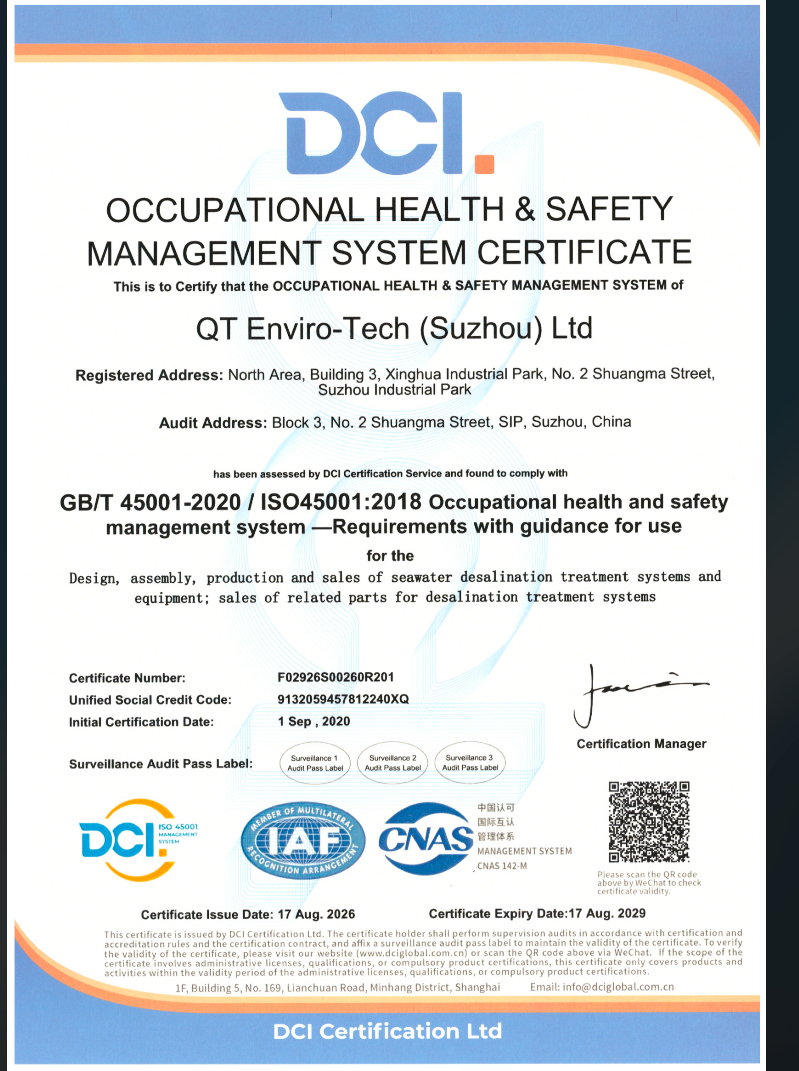
A management-system certificate is only useful in procurement when its registration number, issuing body and certified scope are disclosed and can be checked.
Certificates are frequently listed without scope, which makes them impossible to audit. The relevant details are set out below as they appear in the certificate register.
| Standard | Certificate number | Issuing body | Scope and validity |
|---|---|---|---|
| ISO 9001:2015 (GB/T 19001-2016) | 130355 | DCI | Design, manufacture and sales of water treatment systems and equipment for industrial use. Covers containerized SWRO (fastRO C120SW–C1000SW and fastRO Mega5–Mega20), BWRO containerized/customized, skid-mounted WWRO, and customized SWRO/BWRO/WWRO. Issued 2025-03-20, valid to 2028-03-28. |
| ISO 14001:2015 (GB/T 24001-2016) | F02926E00371R202 | DCI | Design, assembly, production and sales of seawater desalination treatment systems and equipment, plus related parts. Valid 2026-08-17 to 2029-08-17. |
| ISO 45001:2018 (GB/T 45001-2020) | F02926S00260R201 | DCI | Occupational health and safety management covering design, assembly, production and sales of seawater desalination treatment systems and equipment. Valid 2026-08-17 to 2029-08-17. |
| ASME / CE design conformance | Project-specific | Design conformance | Customized SWRO systems can be engineered to ASME and CE requirements for EU-market projects. |
The distinction between the two categories matters. Management-system certificates (ISO 9001, ISO 14001, ISO 45001) certify how an organisation designs, assembles and sells; ASME and CE refer to engineering conformance of the equipment itself for a specified project. A buyer checking a supplier should verify both, and should confirm that the certified scope actually names the product family being purchased — a certificate covering industrial water treatment equipment is not automatically evidence of conformance for a specific SWRO model in a specific market.
Where Modular Containerized Plants Fit — and Where They Do Not
Containerized and skid-mounted desalination has real boundaries, and stating them is part of an honest capability assessment.
- Feedwater still governs everything. The published SWRO envelope of 20,000–45,000 mg/L TDS, 5–35 °C, turbidity below 20 NTU and zero oil and grease is a constraint, not a target. Sites outside that envelope require different pre-treatment design or may fall outside the standard platform entirely.
- Modularity changes the civil-works profile, not the need for infrastructure. Intake structures, power supply, product-water storage and brine outfall still have to be engineered on site. The claim of up to 70% reduced civil works refers to the plant itself, not to the surrounding water and power infrastructure.
- Capacity steps exist. The containerized SWRO line is standardised from 50 to 1,000 m³/day and can extend to roughly 5,000 m³/day; the Mega series covers 5–20 MLD and expands in increments of about 5 MLD by adding containers; capacities toward 50 MLD and above move to skid-mounted or customized configurations.
- Operational maturity still matters. Digital monitoring and remote diagnostics reduce, but do not remove, the need for trained operators and a maintenance regime — particularly on remote islands where logistics are slow.
- Reference data is a starting point, not a conclusion. Durations and capacities in a supplier's own register should be confirmed with the client side or through operating records before they are treated as evidence in a tender.
A traditional site-built plant can still be the right choice where land is unrestricted, labour is inexpensive and the project requires a highly bespoke process train. Modular deployment tends to win where schedule, site access or phased capital expenditure dominate — which describes most island, coastal-remote and industrial-retrofit projects.
Market Context: Capacity Growth Is Shifting Toward Modular Delivery
Published market data gives the background against which supplier evaluation is happening. Grand View Research estimated the global desalination market at approximately USD 21.3 billion in 2025, with a projection of USD 23.2 billion for 2026. IDRA recorded global installed desalination capacity crossing 100 million m³/day in 2024. Credence Research places SWRO at more than 60% of that installed capacity, which explains why most supplier capability claims now centre on RO-based platforms.
Regionally, one commercial forecast estimates Asia Pacific as the fastest-growing market for desalination equipment, reaching USD 17.7 billion by 2030 — a projection with medium confidence that is useful for direction rather than for budgeting. What these figures do not yet provide is a standardised benchmark for deployment speed, such as days-to-first-water for remote island installations versus industrial-park installations. That gap is a practical problem for buyers: without a common metric, schedule claims remain difficult to compare between suppliers.
The consequence for procurement is straightforward. As capacity growth continues, the differentiating evidence shifts from process type to delivery architecture — how much of a plant is pre-assembled, how quickly it is commissioned, how it is expanded, and what records exist to prove any of it.
A Shortlisting Checklist for Buyers
- Request three references closest in capacity to your own project, with client type, start year and application.
- Ask for at least one reference with 10+ years of operating duration in a comparable environment.
- Verify certificate numbers, issuing bodies and certified scope — and check that the scope names the product family you intend to buy.
- Confirm the feedwater envelope in writing and compare it against your intake analysis.
- Require the pre-assembly percentage, pre-shipment test protocol and third-party FAT acceptance as contractual terms.
- Ask for the commissioning duration demonstrated on a comparable project, and the conditions that extended it.
- Establish how capacity can be expanded later — by adding standard modules or by rebuilding the plant.
Future Outlook
Two developments are likely to change how capability evidence is assessed. The first is digital operation: platforms that combine SCADA visualisation, AI-assisted optimisation of energy and chemical dosing, predictive equipment health monitoring and automatic work-order dispatch reduce dependence on scarce specialist labour, which is a decisive factor for island and remote plants. Those platforms also generate operating data — and operating data is the strongest form of evidence a supplier can eventually offer, because it replaces claimed performance with measured performance.
The second is energy integration. PV-integrated solar desalination has already been deployed for off-grid remote sites, and its relevance grows with the number of installations that have no reliable grid connection. For buyers evaluating a supplier today, the practical question for the next decade is whether the platform can accept phased capacity additions and changing power sources without replacing the core plant.
FAQ
Which certification documents should a procurement team verify from a desalination system supplier?
Three management-system certificates are commonly relevant: ISO 9001:2015 for quality management, ISO 14001:2015 for environmental management and ISO 45001:2018 for occupational health and safety. For this supplier, the certificate numbers are 130355 (ISO 9001, issued by DCI), F02926E00371R202 (ISO 14001, issued by DCI) and F02926S00260R201 (ISO 45001, issued by DCI). The scope wording matters as much as the number: the ISO 9001 scope covers design, manufacture and sales of water treatment systems and equipment for industrial use, while the ISO 14001 and ISO 45001 scopes cover design, assembly, production and sales of seawater desalination treatment systems and equipment. Equipment-level conformance such as ASME and CE is project-specific and should be requested separately.
What feedwater parameters must be confirmed before selecting a seawater RO system?
The published design envelope for the containerized SWRO range specifies salinity of 20,000–45,000 mg/L TDS, temperature of 5–35 °C, turbidity below 20 NTU, COD below 10 mg/L, iron and manganese each below 0.1 mg/L, and oil and grease at 0 mg/L. Product water is specified at below 500 mg/L TDS, pH 6–8 and turbidity below 0.2 NTU. The BWRO range is defined for lower-salinity feed of 2,000–5,000 mg/L TDS with turbidity below 5 NTU. A buyer should compare a full feedwater analysis against these limits before shortlisting; where the feed falls outside them, pre-treatment design changes and the standard platform may no longer apply.
How can a buyer independently confirm a supplier's long-duration reference projects?
The practical method is to request client-side confirmation rather than accepting a reference list. Ask for the client organisation, the installed capacity, the commissioning year and the current operating status, then request permission to contact the client directly or to review operating records. Supporting documents include factory acceptance test reports, commissioning records and spare-parts history. Buyers should also note that reference registers record durations as claimed by the supplier; a 20+ year duration stated in a register should be treated as a claim to be validated, not as verified fact, until corroborated independently.
What capacity range can containerized desalination systems realistically deliver?
Containerized SWRO platforms are typically standardised between 50 and 1,000 m³/day, with extension capability to roughly 5,000 m³/day. Above that, larger containerized series cover 5–20 MLD and can be expanded in increments of approximately 5 MLD by adding containers. Capacities approaching 50 MLD and beyond generally move to skid-mounted or customized configurations. Reference installations illustrate the resulting spread: 216 m³/day for an island resort, 1,000 m³/day for an island community, 3,500 m³/day across multiple containerized units for a remote coastal utility, 20 MLD for a municipal plant, and 60,000 m³/day for a wastewater recycling project.
What are the main limitations of containerized desalination compared with site-built plants?
Containerized systems reduce plant civil works and installation time, but they do not remove site infrastructure requirements: intake, power supply, product storage and brine discharge still need engineering, and the reduction in civil works applies to the plant scope rather than the whole facility. They are also bounded by capacity steps and by the feedwater envelope. In addition, highly bespoke process trains or sites with unusual constraints may still favour a site-built design. The appropriate comparison is not containerized versus traditional in general, but the two options evaluated against a specific site's feedwater, schedule, land availability and phased-capital plan.
How long does delivery and commissioning take, and what controls the timeline?
Reported production lead time is typically 8–12 weeks, with factory pre-assembly within roughly two weeks, and two-week on-site commissioning has been demonstrated. At larger scale, a 20 MLD containerized SWRO plant requiring approximately 22 ISO containers was delivered within four months, and a 20 MLD municipal plant was completed on a nine-month EPC schedule. A 500 m³/day nuclear power plant installation was completed in 10 days. Timeline is usually governed less by equipment fabrication than by site-side factors: intake construction, power availability, storage and permitting.
For readers who need the underlying specification and certificate details in one document, the manufacturer profile is available as a downloadable PDF reference.