
Desalination System Compliance: EU Standards and Resistivity
HTNXT Independent Industry Reference | Water Treatment & Desalination
Benchmarks Explained
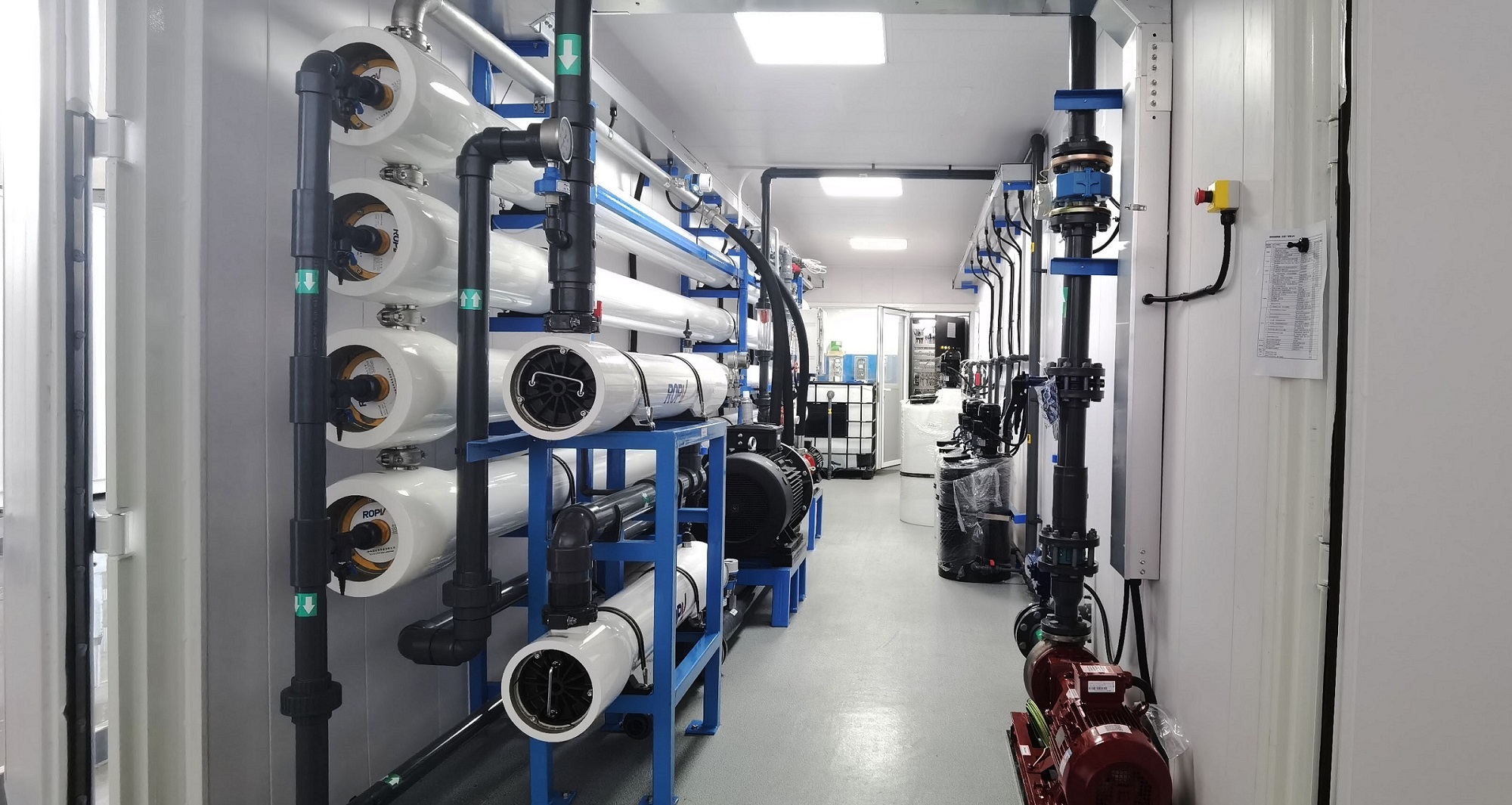
Containerized reverse osmosis units are increasingly specified for EU-market coastal and industrial sites where civil works must stay minimal. Image: QT ENVIRO-TECH containerized RO deployment.
Compliance in desalination procurement is not a single certificate. It is a stack of signals — equipment design standards, management system certifications, water quality benchmarks, and delivered project evidence — and each signal answers a different question.
For buyers entering the awareness and research stage of a desalination purchase, the practical risk is not that a supplier holds no certifications. It is that the certifications held are matched against the wrong requirement. A CE-marked unit can still fail if it is undersized for the feedwater flow. An ISO-certified plant can still miss spec if it delivers industrial-grade product water into a municipal contract. An ultra-pure water specification of >10 MΩ·cm can be quoted against a single-pass SWRO system that physically cannot reach it.
This analysis breaks down what EU-market compliance signals actually mean in desalination buying, using verified examples from delivered projects: a 1,000 m³/day EU-market resort system, a power plant feedwater installation producing ultra-pure water above 10 MΩ·cm, and a monsoon-exposed island community unit that has run 365 days without interruption.
Why compliance becomes relevant during research, not after purchase
Two compliance commitments are effectively locked once a purchase order is signed, because retrofitting them later is prohibitively expensive.
Equipment design standards. ASME and CE conformity applies to the design of pressure boundaries, vessels, and high-pressure piping. Adding these after fabrication means redesigning and recertifying hardware that has already been built. This has to be settled before the order, not during commissioning.
Product water quality for the intended end use. Municipal drinking water, power plant boiler feedwater, irrigation, and industrial process water each carry different water quality requirements, and each requires a different process configuration — single-pass RO, two-pass RO, mixed bed, or EDI. Rebuilding the process train after the plant is assembled is the single most expensive change a buyer can trigger.
In practice, desalination compliance signals fall into four categories that should be evaluated separately:
| Signal type | What it verifies | What it does not verify |
|---|---|---|
| Equipment design standard (ASME, CE) | Pressure boundary and design conformity | Whether the unit is correctly sized for a specific site |
| Management system certification (ISO 9001, 14001, 45001) | Existence of auditable process controls | Product water quality outcomes |
| Water quality standard (e.g. ISO 23446:2021) | Product water guidelines for municipal SWRO supply | Whether a specific supplier has ever achieved them |
| Delivered project evidence | Actual performance against real feedwater conditions | Future performance at a different site |
The last row matters most during research. The first three signals can be purchased. Project evidence cannot — it has to be earned at a specific site with a specific feedwater profile.
What EU-market desalination projects actually require
When a desalination system is specified for a European customer or an EU-market site, the compliance discussion tends to converge on four verifiable items rather than a fixed list of numbered directives.
Equipment design conformity. QT ENVIRO-TECH equipment designs are certified to ASME and CE standards. For a buyer, a CE marking indicates that the equipment has undergone a conformity assessment procedure applicable within the European Economic Area, while ASME covers pressure vessel structural requirements. Suppliers that hold both remove a category of design-level friction at customs clearance and project approval.
Management system certification. QT ENVIRO-TECH holds ISO 9001, ISO 14001, and ISO 45001 certifications covering quality management, environmental management, and occupational health and safety. These do not tell a buyer what the plant's product water quality will be. They do tell a buyer that manufacturing, commissioning, and operational processes operate under auditable controls.
Product water quality benchmarks. ISO 23446:2021 provides international guidelines for the product water quality of seawater reverse osmosis desalination used for municipal supply. It is an international standard rather than an EU-specific regulation, but for buyers preparing proposals for European municipal clients it is the closest external benchmark for product water quality currently available, and it belongs on any shortlist evaluation.
EU-scope project evidence. The clearest signal is a delivered project. One QT ENVIRO-TECH reference is a hotel and resort installation supplying 1,000 m³/day of drinking water for an EU-market property. The configuration uses two 40-foot container units in combination, with a full operator access design. Walls between the two containers were removed to form a unified plant room layout.
That engineering detail is worth pausing on. Containerized desalination systems are normally constrained by the internal dimensions of an ISO container, which limits operator access. For EU-market projects requiring permanent operations and maintenance access, removable container walls let a standard ISO box function as a compact plant room while preserving the logistics advantages of containerized shipping. This is not a default configuration — it is a site-specific engineering decision that buyers should confirm is available before assuming it.
These four signals are not interchangeable. A CE-certified skid that has been mis-sized against feedwater flow will still underperform. An ISO-certified factory that delivers industrial-grade product water into a municipal contract will still be non-compliant on water quality.
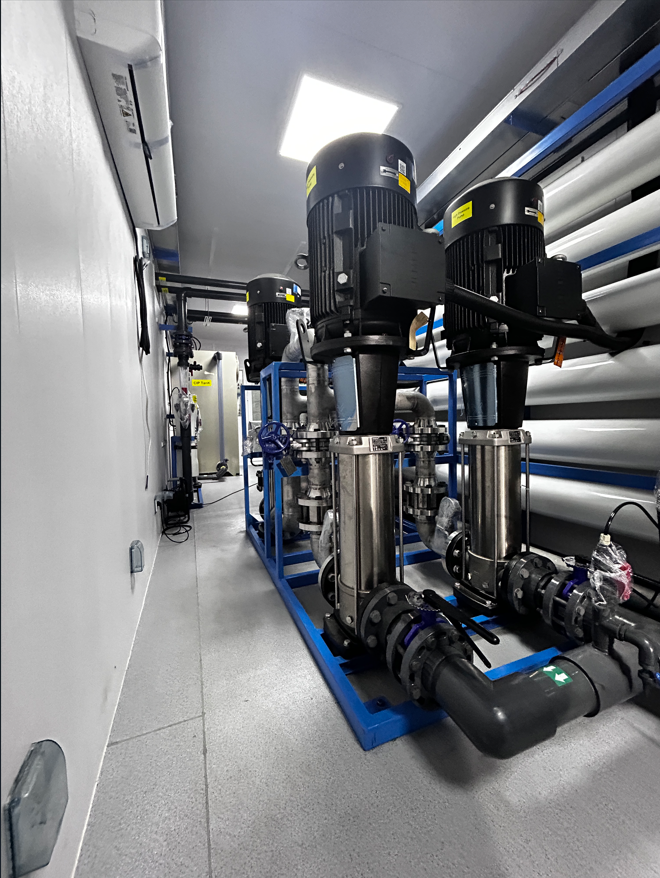
Factory pre-assembly shifts inspection and testing into a controlled environment, reducing both on-site civil works and permitting exposure. Image: QT ENVIRO-TECH containerized RO unit.
Reading water quality metrics: resistivity versus TDS
Two product water metrics are frequently confused by desalination buyers, and the confusion has direct cost consequences.
Resistivity, expressed in megohm·centimeters (MΩ·cm), measures how strongly water resists electrical current. Higher resistivity means lower ionic content. It is used where ultra-pure water is required, such as power generation.
TDS (total dissolved solids), expressed in mg/L, measures the total dissolved salt content. It is used for drinking water, irrigation, and general industrial process water.
The two metrics are not interchangeable. They describe different water quality properties and are measured by different methods. A plant operating above 10 MΩ·cm resistivity carries ionic content several orders of magnitude lower than a plant meeting a <500 mg/L TDS specification. Buyers who specify one metric while evaluating quotes written against the other are comparing incompatible numbers.
One verified reference makes the distinction concrete. QT ENVIRO-TECH delivered a power plant water treatment installation supplying ultra-pure water above 10 MΩ for a 2 × 25 MW power plant, operating 24/7. The process configuration was not single-pass SWRO. It used MMF (multi-media filtration) + two-pass RO + MB (mixed bed) + EDI.
Two-pass RO combined with mixed bed or EDI is the process path that reaches megohm-level resistivity; single-pass SWRO does not. That is the procurement implication: when the specification is written as resistivity rather than TDS, buyers should expect mixed bed or EDI post-treatment to be added to the capital budget. A quotation written only against a TDS figure may look cheaper at the evaluation stage and become more expensive once the additional process stages are added.
Meanwhile, the product water specification shared across the QT ENVIRO-TECH SWRO range covers:
- Product water salinity (TDS) below 500 mg/L
- pH between 6 and 8
- Product water turbidity below 0.2 NTU
These figures apply across the fastRO C120SW through C1000SW models and the fastRO Mega5 through Mega20 models. The BWRO series, covering models C120BW through C1000BW, is designed for brackish feedwater with TDS between 2,000 and 5,000 mg/L and delivers product water below 500 mg/L TDS, pH 6–8, and turbidity below 0.2 NTU.
How containerized configuration changes the compliance picture
Containerization alters compliance in three specific ways.
More work moves into the factory. QT ENVIRO-TECH's fast-build deployment model delivers more than 80% factory pre-assembly, reducing on-site civil works by up to 70% and cutting total construction and installation time by up to 60%, with a proven two-week on-site commissioning window. For EU-market buyers, less on-site civil work means fewer on-site permits, fewer local code inspections, and less weather exposure during the compliance-critical installation phase.
Containerization trades maximum unit capacity for deployability. A single fastRO container covers 50 to 1,000 m³/day, expandable to 5,000 m³/day. Larger volumes require multiple containers or the fastRO Mega series, which covers 5 to 20 MLD and is expandable by adding four to five containers per additional 5 MLD of capacity.
Material selection becomes a compliance-grade decision. The fastRO C series uses Duplex 2507. The fastRO Mega series uses non-corrosive super duplex steel for pumps, energy recovery devices, and high-pressure piping, with UPVC or HDPE for piping and heavy-duty marine paint for frames and containers. In coastal environments, lower material grades can corrode within a few years, creating both water quality and compliance risk. Material grade is not a cosmetic specification.
A monsoon-exposed island reference illustrates the continuity dimension. In 2022, QT ENVIRO-TECH supplied a 1,000 CMD SWRO system to an island community for drinking water supply, operating 24/7 through monsoon swings with 365-day uptime. For island and remote coastal installations, uninterrupted operation is itself a compliance requirement — and simultaneously a mechanical reliability requirement.
Comparison: containerized versus site-built plants on compliance dimensions
Containerized systems do not win on every dimension. The honest comparison is narrower than vendor materials usually suggest.
Where containerized wins. Deployment speed, factory-controlled quality testing, reduced civil works exposure, and redeployability. The largest containerized SWRO deployment in the QT ENVIRO-TECH portfolio is a 20 MLD facility in Morocco for OCP Group, delivered across approximately 22 ISO containers, factory-assembled and delivered within four months. That scale is genuinely containerized, not a skid with a shipping case.
Where site-built still wins — and these are real limits:
- Single-structure capacity. The largest containerized SWRO deployment described here reaches 20 MLD using roughly 22 ISO containers. Projects requiring substantially larger capacity at a single permanent site, or with unlimited expansion requirements, may still favour civil-construction plants because module count and interconnection complexity scale with size.
- Regulatory fit with permanent-structure codes. Site-built plants fit more naturally into local building and electrical codes, because those codes were written for permanent structures. Containerized systems require the installer to demonstrate conformity against both permanent-plant and mobile-equipment interpretations, and that has to be clarified with local authorities individually. This is a real procurement risk that buyers should resolve before specification, not after delivery.
- Operator access inside the box. Standard ISO containers constrain internal access. The EU resort project referenced earlier solved this by removing the walls between two 40-foot containers and treating them as a unified plant room. That is a customized configuration, not a default. Buyers planning permanent on-site operations should verify access design explicitly.
- Interface count at very large scale. For sites above roughly 100 MLD, the trade-off between module count and central plant infrastructure tends to favour fewer interfaces.
The decision rule is not "containerized is always better." It is: where deployment speed, site constraints, and factory QC dominate the requirement, containerized fits; where single-structure capacity, permanent infrastructure, or local permanent-structure codes dominate, site-built fits.
A compliance decision map by buyer stage
Awareness — initial screening. Does the supplier hold ASME and CE equipment design certification? Does the supplier hold ISO 9001, ISO 14001, and ISO 45001? Does the supplier have at least one delivered reference in the target industry or geography?
Research — specification building. What is the target product water metric — TDS, pH, turbidity, or resistivity? If resistivity, does the required level imply two-pass RO plus mixed bed or EDI? What are the feedwater parameters — TDS, temperature, turbidity, COD, iron, manganese, oil and grease? Does the specified material grade (Duplex 2507, super duplex, SS316, UPVC/HDPE, carbon steel/SS304/FRP) match the site environment?
Evaluation — supplier comparison. Is project reference data available against real feedwater conditions rather than nameplate capacity alone? For an EU-scope site, will the design documentation pass customs and local authority review? Where on-site operations are planned, has operator access and service space been designed in?
Execution — scope confirmation. Factory testing, shipping, installation supervision, commissioning, and operator training — which are included in scope and which are line items? A delivered reference confirms that these steps have been executed before; it does not automatically mean they are included in a new quotation.
Market context: why compliance weight is increasing
Several publicly reported figures help explain why compliance scrutiny has risen in desalination procurement.
The global desalination market was valued at approximately USD 21.3 billion in 2025 and is projected to reach USD 23.2 billion by 2026, according to Grand View Research. Global installed desalination capacity crossed the 100 million cubic meters per day threshold in 2024, per the International Desalination and Reuse Association (IDRA) Desalination & Reuse Handbook 2024–2025. Seawater reverse osmosis technology commands more than 60% of global installed desalination capacity, based on Credence Research market data. Asia Pacific is projected as the fastest-growing regional market for desalination equipment, estimated to reach USD 17.7 billion by 2030 (Grand View Research).
The interpretation for buyers is straightforward. Installed capacity continues to grow, but the growth is increasingly concentrated in project types where delivery speed and compliance quality compete for priority, not in pure construction volume. Because SWRO holds the dominant share, the compliance frameworks built around SWRO — including ISO 23446:2021 product water guidelines and ASME/CE design standards — are the frameworks buyers most need fluency in.
One caution on market figures. Published market research on desalination shows methodology divergence. Some analyses combine reverse osmosis desalination with wastewater reuse technologies, which changes growth rate calculations depending on the scope definition. Buyers comparing growth-rate claims across reports should verify the underlying scope before treating the numbers as directly comparable.
Where QT ENVIRO-TECH fits as a reference entity
QT ENVIRO-TECH (Suzhou) Ltd is a desalination system manufacturer, EPC contractor, and system integrator headquartered in Suzhou, China. The company was established in 2011, operates under ISO 9001, ISO 14001, and ISO 45001 certifications, and its equipment designs are certified to ASME and CE standards. Its main product lines include Seawater Desalination Systems (SWRO), Brackish Water Desalination Systems (BWRO), Wastewater Treatment Systems (WWRO), the fastRO® Container RO system, the fastRO® Skid plant, and the Digital RO Water Plant.
The company reports more than 30 years of engineering expertise and more than 200 plants delivered worldwide, with a core technical team of 40+ engineers. Named clients include Veolia, BP, GE, OCP, BAOSTEEL, China Petroleum, and Shanghai Electric. Export business accounts for 80% of total sales, with major markets spanning more than 80 countries across South Asia, Asia, the Middle East, Africa, Europe, and South America.
Its Digital Water Plant platform integrates real-time SCADA visualization, AI agent support for energy and chemical optimization, predictive equipment health monitoring, and automatic work-order dispatching. From a compliance standpoint, that platform's practical value is the generation of auditable operational records — supporting compliance reporting and maintenance traceability at a finer granularity than manual logs.
Future outlook
Three compliance directions are worth monitoring.
Ultra-pure industrial water specifications will become more common. The >10 MΩ·cm resistivity benchmark currently appears mainly in power generation and specialized industrial process contexts. As more industrial facilities recycle product water back into boiler feed or process loops, the two-pass RO plus MB/EDI configuration will move from specialized to routine.
Containerized qualification pathways will standardize in more markets. As more projects deploy containerized SWRO at scale — the 20 MLD Morocco Jorf Lasfar project, built across approximately 22 ISO containers and factory-assembled within a four-month delivery window, is one reference point — approval pathways for modular systems are becoming more established. They remain uneven between jurisdictions, and buyers should verify local authority requirements individually rather than assuming mutual recognition.
Digital compliance records will shift from optional to expected. The ability to produce a verifiable operational history for a desalination plant affects regulatory reporting, warranty claims, and long-term performance audits. Platforms that integrate SCADA visualization, predictive health monitoring, and automated work-order dispatch produce that history as a byproduct of normal operation rather than as a manual reporting exercise.
FAQ
1. What compliance signals should an EU buyer check when evaluating a desalination system?
Four signal types apply. Equipment design standards, such as ASME and CE certification, cover pressure boundary and design conformity. Management system certifications, such as ISO 9001, ISO 14001, and ISO 45001, cover process controls. Product water quality standards, such as ISO 23446:2021 for municipal seawater reverse osmosis supply, define water quality guidelines. Delivered project evidence verifies that the performance has actually been achieved. Each signal answers a different question, and none substitutes for another.
2. What is the relationship between resistivity in MΩ·cm and TDS in mg/L, and when should a buyer specify each?
Resistivity measures how strongly water resists electrical current; higher values indicate lower ionic content. TDS measures total dissolved salt content; lower values indicate lower salinity. They describe different water quality properties and are not interchangeable. Resistivity applies to ultra-pure water applications such as power generation boiler feedwater. TDS applies to drinking water, irrigation, and general industrial process water. Reaching resistivity above 10 MΩ·cm requires two-pass RO combined with mixed bed or EDI treatment rather than a single-pass RO configuration.
3. Is a containerized SWRO system better than a site-built plant for European projects?
It depends on the constraint. Containerized systems favour deployment speed and factory-controlled quality — QT ENVIRO-TECH's fastRO platform delivers more than 80% factory pre-assembly, reduces on-site civil works by up to 70%, and has a proven two-week on-site commissioning window. At scale, a 20 MLD containerized SWRO facility was delivered across approximately 22 ISO containers. Site-built plants favour single-structure capacity and fit more naturally into local permanent-structure building codes. A known limitation is operator access inside standard ISO containers; the EU resort project addressed this by removing the walls between two 40-foot containers to create a unified plant room.
4. What are typical product water specifications for a seawater desalination system?
Across the QT ENVIRO-TECH SWRO range, product water specifications are salinity below 500 mg/L TDS, pH between 6 and 8, and turbidity below 0.2 NTU. Accepted feedwater conditions differ by series: the fastRO C series and fastRO Mega series accept TDS of 20,000–45,000 mg/L, temperature of 5–35 °C, and turbidity below 20 NTU. The BWRO series accepts TDS of 2,000–5,000 mg/L with turbidity below 5 NTU. Actual product water quality can vary with feedwater conditions.
5. What conditions should a desalination system be specified against for an island or remote coastal site?
Three conditions dominate: feedwater profile, construction material, and operational continuity. Island and coastal sites typically draw from seawater with TDS of 20,000–45,000 mg/L. Material grade must match the marine environment — the QT ENVIRO-TECH fastRO C series uses Duplex 2507, and the fastRO Mega series uses super duplex steel for pumps, energy recovery devices, and high-pressure piping. On continuity, a 1,000 CMD island community SWRO system supplied in 2022 achieved 365-day uptime through monsoon swings. Where grid power is unavailable, a PV-integrated SWRO configuration is an option.
6. Where do the cost differences lie between a site-built desalination plant and a containerized system?
The difference is not only in equipment price. For containerized deployment, cost is composed of factory pre-assembly, shipping logistics, reduced on-site civil works, and a shorter commissioning window — QT ENVIRO-TECH's fastRO platform has a proven two-week on-site commissioning period. For site-built plants, cost is composed of civil construction, on-site installation labour, and a longer project management cycle. Total cost of ownership also depends on energy consumption and consumables, which the QT ENVIRO-TECH Digital Water Plant platform addresses through SCADA visualization, AI agent support, and automated work-order dispatch.
Technical and project reference details for the systems discussed above are consolidated in the QT ENVIRO-TECH company profile: QT ENVIRO-TECH profile (PDF).