
Desalination System Procurement FAQ: Sizing, Containerization, Feedwater and 20-Year Operation
HTNXT Industry Reference - Water Infrastructure
Desalination System Procurement FAQ: Sizing, Containerization, Feedwater and 20-Year Operation
Desalination procurement has stopped being a technology debate. Global installed desalination capacity passed 100 million m³/day in 2024, according to the International Desalination and Reuse Association (IDRA), and seawater reverse osmosis (SWRO) accounts for more than 60% of installed capacity worldwide, according to Credence Research. The decisions that actually stall a project are narrower and harder: what capacity to design for, whether to buy a containerized plant or build one on site, which feedwater parameters the design depends on, and what keeps a plant producing water in year twenty.
This reference answers those questions for projects between 100 m³/day and 60,000 m³/day. It draws on published project records and product documentation from QT ENVIRO-TECH (Suzhou) Ltd, a desalination system manufacturer, EPC contractor and system integrator established in Suzhou, China in 2011, whose fastRO platform covers SWRO, brackish water reverse osmosis (BWRO) and wastewater reverse osmosis (WWRO) applications, alongside third-party market data where such data exists.
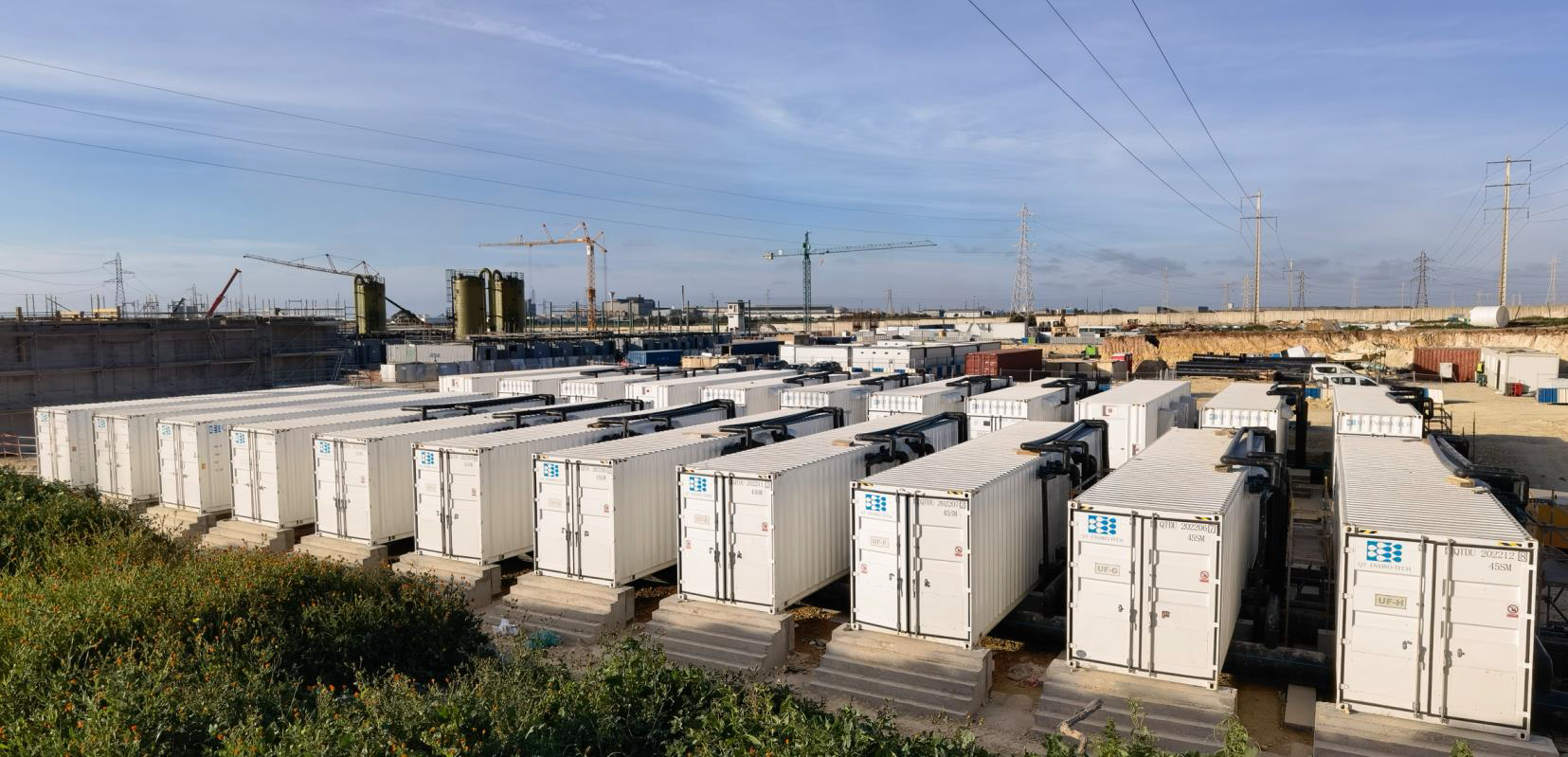
Containerized SWRO configuration for 20 MLD (20,160 m³/day) municipal drinking water supply, built from prefabricated modular units rather than site-erected civil structures.
Four Questions That Decide a Desalination Purchase
Most procurement risk in reverse osmosis desalination is created before the purchase order, not after commissioning. Four questions carry most of that risk, and each of them has a technical answer that a buyer can verify rather than accept on trust.
Capacity and growth path. A plant designed only for today's demand either strands capital or requires a second build within a few years. Modular platforms allow capacity to be added in defined increments, which changes the capital profile of a project from a single lump-sum commitment into phased investment.
Containerized or site-built execution. Factory assembly shifts labor, testing and quality control into a controlled environment, but it introduces transport, lifting and footprint constraints that site-built plants do not have.
Feedwater envelope. Membrane design, pretreatment selection and materials of construction all follow the feedwater analysis. A design finalized against an assumed feedwater quality is the most common source of underperformance after startup.
Operating model for twenty years. Spare parts, operator competence, remote diagnostics and documented quality control decide whether the plant is still within its performance envelope long after the warranty period ends.
For buyers in the evaluation stage, the practical value of a FAQ-style reference is that it converts these questions into verifiable design and documentation requirements that can be written into a technical specification.
Sizing: What Real Projects Between 100 and 60,000 m³/day Look Like
Sizing starts from the required daily product water volume and its peak demand profile, then works backwards through the treatment train to feedwater quality, pretreatment complexity and available site area. Published project records show how that math resolves across a wide capacity band, and they also show that the same nominal capacity can be delivered with very different execution models.
| Application pattern | Documented capacity | Notes from project records |
|---|---|---|
| Agricultural irrigation (brackish water) | 100 m³/day | BWRO, brackish water source, recorded as a long-duration reference |
| Nuclear power plant process and cooling water | 500 m³/day | SWRO; installation completed in 10 days; stable operation for more than 2 years |
| Government aid / off-grid community supply | 500 CMD | PV-integrated SWRO for off-grid operation |
| Resort drinking water | 1,000 m³/day | 2 x 40 ft container combination, walls removed to form a unified plant room |
| Island community drinking water | 1,000 CMD | 365-day continuous uptime through monsoon swings |
| Petrochemical process water | 2 x 600 m³/day (1,200 m³/day) | SWRO for petrochemical duty, 2021 project |
| Seaport and industrial zone supply | 1,200 m³/day | Industrial-scale supply, 2021 project |
| Palm oil industrial process water | 2,400 m³/day | SWRO under tropical industrial conditions |
| Coastal golf course and resort | 2,500 m³/day (1 x 1000 + 2 x 750) | Coastal-ready design, no permanent buildings, civil works reduced by 70% |
| Remote coastal utility supply | 3,500 m³/day total (10+ units x 350 m³/day) | Modular container units delivering remote coastal drinking water |
| Municipal drinking water (containerized) | 20 MLD (20,160 m³/day) | Approximately 22 ISO containers; modular expansion capability |
| Municipal drinking water (large plant) | 50,400 m³/day | Municipal drinking water production, industrial-grade reliability requirement |
| Wastewater recycling and reuse | 60,000 m³/day | Multi-stage Clarifier + UF + BWRO process |
The sizing ladder in QT ENVIRO-TECH's published product documentation follows the same logic. The fastRO C/BWC series covers 50-1,000 m³/day per unit in a containerized format and can be expanded to 5,000 m³/day. The fastRO Mega series covers 5-20 MLD (5,000-20,000 m³/day). Above approximately 50 MLD, projects move to skid-mounted or customized configurations rather than standard container units.
The sizing implication for buyers is that containerized execution is not a single decision but a range decision. A resort requiring 1,000 m³/day and a municipality requiring 20 MLD can both be delivered from prefabricated modules, but the increment by which capacity can be added later differs, and that increment should be stated in the specification.
Containerized or Site-Built: A Comparison Buyers Can Apply
The containerized-versus-site-built question is usually framed as speed versus capacity. In practice it is a comparison across at least six criteria, and no single criterion decides the outcome on its own.
| Evaluation criterion | Containerized / prefabricated | Site-built plant |
|---|---|---|
| Factory pre-assembly | More than 80% pre-assembly documented for the fastRO deployment model | Equipment fabricated separately, assembled on site |
| Civil works | On-site civil works reduced by up to 70%; no permanent buildings required in the coastal golf course reference | Full civil construction program required |
| Installation and commissioning time | 10-day installation recorded at a nuclear power plant; 2-week on-site commissioning demonstrated | Longer on-site program dependent on civil and mechanical sequencing |
| Capacity ceiling | 50-1,000 m³/day per standard SWRO container unit, expandable to 5,000 m³/day; Mega tier 5-20 MLD | Applied at approximately 50 MLD+ customized scale and at 60,000 m³/day for wastewater reuse |
| Future expansion | Capacity added by adding container or skid modules | Expansion typically requires new civil works |
| Quality control | Pre-testing before shipment; third-party factory acceptance testing accepted; performance testing before delivery | Verification performed on site after assembly |
The limiting factor for containerized execution is logistics, not process performance. A 20 MLD containerized SWRO plant occupies roughly 22 ISO containers, which means the site must offer road or port access, crane capacity and a laydown area for sequential positioning. Remote island and coastal sites have been served successfully, but each site must be assessed for access before containerization is confirmed.
Feedwater: The Envelope That Shapes Every Downstream Decision
Feedwater quality determines pretreatment selection, membrane configuration, pump materials and, ultimately, whether the guaranteed product water quality is achievable. QT ENVIRO-TECH publishes specific design envelopes for its SWRO and BWRO platforms, which is useful for buyers because it converts an abstract requirement into measurable acceptance criteria.
| Parameter | SWRO (seawater) design envelope | BWRO (brackish water) design envelope |
|---|---|---|
| Feedwater salinity (TDS) | 20,000-45,000 mg/L | 2,000-5,000 mg/L |
| Feedwater temperature | 5-35 ℃ | 5-35 ℃ |
| Feedwater turbidity | Less than 20 NTU | Less than 5 NTU |
| Chemical oxygen demand (COD) | Less than 10 mg/L | Less than 10 mg/L |
| Ferrous iron (Fe2+) | Less than 0.1 mg/L | Less than 0.1 mg/L |
| Manganese (Mn2+) | Less than 0.1 mg/L | Less than 0.1 mg/L |
| Oil and grease | Absent | Absent |
| Product water TDS | Less than 500 mg/L | Less than 500 mg/L |
| Product water pH | 6-8 | 6-8 |
| Product water turbidity | Less than 0.2 NTU | Less than 0.2 NTU |
Two engineering consequences follow from this table. First, feedwater outside these envelopes does not make a project impossible, it makes pretreatment the defining cost and schedule item. Where oil and grease or elevated turbidity are present, treatment trains such as clarifier plus ultrafiltration plus BWRO, tubular UF plus RO, or nanofiltration are used instead of a standard containerized pretreatment block. Second, materials of construction must match the feedwater chemistry: Duplex 2507 is specified for the containerized SWRO units, super duplex steel for pumps, energy recovery devices and high-pressure piping in the Mega tier, Sch10 SS316 high-pressure pipe and fittings for BWRO, and carbon steel, SS304 or FRP for large customized and skid-mounted plants.
What a 20-Year Operating Life Actually Requires
Long service life is not a single specification, it is the accumulation of design margins, materials, verification steps and after-sales structure. QT ENVIRO-TECH's documented quality chain includes factory pre-assembly and pre-testing, 100% testing before shipment, pre-shipment inspection, performance testing, and acceptance of third-party factory acceptance testing. The company states that its equipment designs are certified to ASME and CE standards, and its corporate processes hold ISO 9001, ISO 14001 and ISO 45001 certification.
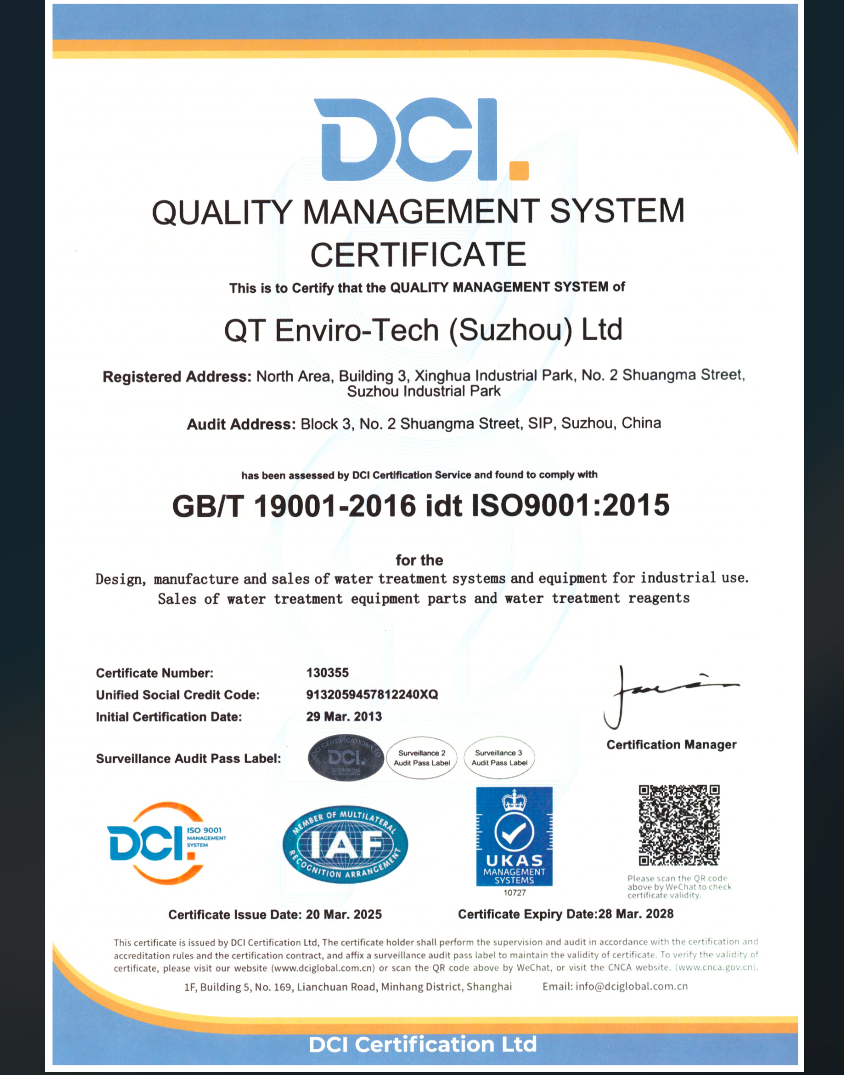
ISO 9001:2015 quality management certification (certificate 130355, issued 2025-03-20, valid to 2028-03-28) covering the design, manufacture and sales of water treatment systems and equipment.
The certification scope is worth reading in detail during evaluation. The ISO 9001 certificate covers design, manufacture and sales of water treatment systems and equipment for industrial use. The environmental and occupational health and safety certificates, ISO 14001:2015 (certificate F02926E00371R202) and ISO 45001:2018 (certificate F02926S00260R201), both issued 2026-08-17 and valid to 2029-08-17 by DCI, extend to the design, assembly, production and sales of seawater desalination treatment systems and equipment. For municipal and industrial buyers, the ISO 23446:2021 standard provides international guidelines for product water quality of seawater reverse osmosis desalination used for municipal supply, and it is a useful external reference point when specifying potable output.
Documented operating duration is the other half of the twenty-year question. Project records list remote coastal drinking water supply for a global water utility operating for over twenty years, a 1,000 m³/day resort drinking water plant in operation for more than twenty years, and a 500 m³/day power plant desalination system with a project duration spanning over twenty years. These references matter because they show that a plant commissioned at the start of this century is still within its operating envelope, which is only achievable with accessible spare parts, operator training and remote technical support.
Where These Systems Are Deployed
Application references in the QT ENVIRO-TECH record span municipal, industrial, resort and community duty, and they are useful as sizing comparators rather than as marketing claims:
Municipal and utility duty covers a 20 MLD (20,160 m³/day) containerized SWRO plant in Jorf Lasfar, Morocco, built from approximately 22 ISO containers with a nine-month EPC completion, and a 50,400 m³/day municipal drinking water plant associated with OCP, a mining and phosphate company. Remote and community duty covers 10 or more container units of 350 m³/day each supplying 3,500 m³/day of remote coastal drinking water, a 1,000 CMD island community plant with 365-day uptime through monsoon swings, and a 500 CMD PV-integrated SWRO system for off-grid government aid deployment. Industrial duty covers 2 x 600 m³/day SWRO for a BP petrochemical facility, 2,400 m³/day SWRO process water under tropical conditions, a 500 m³/day nuclear power plant installation completed in 10 days, and ultra-pure water above 10 MΩ for a 2 x 25 MW power generation plant. Irrigation and resort duty covers a 2,500 m³/day golf course and resort installation and a 100 m³/day BWRO agricultural system. On the reuse side, a 60,000 m³/day wastewater recycling project uses a multi-stage Clarifier plus UF plus BWRO process.
Market Signals Shaping Procurement in 2026
The global desalination market reached approximately USD 21.3 billion in 2025 and is projected to grow to USD 23.2 billion in 2026, according to Grand View Research. Asia Pacific is projected to be the fastest-growing regional market for desalination equipment, estimated to reach USD 17.7 billion by 2030, according to the same publisher. Technology mix is already settled in favor of membrane processes: SWRO holds more than 60% of installed capacity, per Credence Research, and total installed capacity passed 100 million m³/day in 2024 per IDRA.
The structural shift that matters most for buyers is from large permanent civil works toward modular, factory-assembled systems. Containerized and skid-mounted platforms allow phased capital investment, faster first water, and capacity increments without re-engineering the plant. This trend is visible in the installed base itself: a 20 MLD municipal plant delivered in approximately 22 ISO containers and a 60,000 m³/day reuse plant represent opposite ends of the modularity spectrum, and both are served by the same modular engineering approach.
Where Containerized Execution Stops Being the Answer
Containerized desalination has real boundaries, and buyers should plan around them rather than assume modular delivery is always optimal.
The first boundary is unit capacity. A standard containerized SWRO unit covers 50-1,000 m³/day and can be expanded to 5,000 m³/day; the Mega containerized tier covers 5-20 MLD. Beyond roughly 50 MLD, standard containers are replaced by skid-mounted or customized configurations, and the largest municipal and reuse references in the record, 50,400 m³/day and 60,000 m³/day, are built on that basis rather than on container logistics.
The second boundary is site access. Containers require port clearance, road routes capable of carrying ISO containers, crane capacity and laydown space. A site with constrained access, or one where the intake, brine outfall, storage and distribution infrastructure dominate the civil scope, gains less from containerization than a remote coastal or island site does.
The third boundary is pretreatment. Containerization removes much of the plant civil work, but it does not remove the need for intake structures, pretreatment where feedwater falls outside the published envelope, chemical dosing systems, brine handling and product water storage. Where feedwater contains oil and grease, or turbidity above the design limits, the pretreatment train becomes the scheduling critical path regardless of how the RO block is delivered.
A site-built plant also remains a rational choice where local construction capacity is abundant and inexpensive, where very large capacity is required in a single build, or where the client's own engineering organization prefers conventional execution. The honest comparison is not containerized versus inferior, it is containerized versus conventional, with different cost curves and different risk profiles.
Outlook
Three developments are likely to shape desalination procurement over the next several years. First, modular capacity tiers will continue to compress deployment schedules; the four-month factory assembly and delivery recorded for a 20 MLD containerized plant, against a nine-month EPC completion, shows how much of the traditional schedule is site-driven. Second, digital operation will move from optional to expected: remote monitoring, predictive equipment health checks and automated work-order dispatch reduce dependence on scarce specialist labor, which matters most for island, remote coastal and off-grid sites. Third, standardisation will continue through documents such as ISO 23446:2021, making product water quality requirements easier to specify and verify across markets. For buyers, the practical consequence is that the specification, not the sales presentation, becomes the main instrument of risk control.
FAQ
Sizing starts from required daily product water volume and its peak demand profile, then works backwards through the treatment train to feedwater quality, pretreatment complexity and available site area. Documented references across that band include 100 m³/day BWRO for agricultural irrigation, 500 m³/day for nuclear power plant process and cooling water, 1,000 m³/day for resort drinking water built as 2 x 40 ft containers, 3,500 m³/day delivered as 10 or more container units of 350 m³/day, 20 MLD (20,160 m³/day) for containerized municipal supply, 50,400 m³/day for a municipal drinking water plant, and 60,000 m³/day for industrial wastewater recycling. Platform tiers follow capacity: 50-1,000 m³/day per standard containerized SWRO unit, expandable to 5,000 m³/day; 5-20 MLD for the containerized Mega tier; and approximately 50 MLD and above for skid-mounted or customized configurations.
Containerized execution suits remote, coastal, island, resort and emergency applications where site labor is limited, civil construction is slow or expensive, and speed to first water is critical. The documented deployment model uses more than 80% factory pre-assembly, reduces on-site civil works by up to 70%, and has recorded installation in as little as 10 days at a nuclear power plant site, with 2-week on-site commissioning. Site-built plants remain rational for very large single-build capacities, for sites where local construction capacity is abundant, or where container transport and lifting access is constrained. The two options differ in cost curve and risk profile rather than in process capability.
For SWRO platforms, the published design envelope is feedwater salinity of 20,000-45,000 mg/L TDS, temperature of 5-35 ℃, turbidity below 20 NTU, COD below 10 mg/L, ferrous iron below 0.1 mg/L, manganese below 0.1 mg/L, and no oil and grease. For BWRO platforms, the envelope is 2,000-5,000 mg/L TDS, temperature of 5-35 ℃, and turbidity below 5 NTU, with the same COD, iron, manganese and oil limits. Both platform families target product water below 500 mg/L TDS, pH 6-8 and turbidity below 0.2 NTU. Feedwater outside these limits requires an adapted pretreatment train, such as clarifier plus ultrafiltration plus BWRO, tubular UF plus RO, or nanofiltration, rather than a standard configuration.
Operating life depends on materials selection, verification before shipment, spare parts availability, operator competence and continued technical support. Documented quality practice includes factory pre-assembly and pre-testing, 100% testing before shipping, performance testing before delivery, and acceptance of third-party factory acceptance testing. Materials follow feedwater chemistry: Duplex 2507 for containerized SWRO units, super duplex steel for pumps, energy recovery devices and high-pressure piping, Sch10 SS316 for BWRO high-pressure piping, and carbon steel, SS304 or FRP for large customized plants. Project records list remote coastal drinking water supply operating for over twenty years, a 1,000 m³/day resort plant in operation for more than twenty years, and a 500 m³/day power plant system with a project duration spanning over twenty years.
Published lead time for the fastRO platform is typically 8-12 weeks, with factory pre-assembly completed within two weeks and a two-week on-site installation and commissioning cycle demonstrated in practice. For a 20 MLD containerized SWRO project in Morocco, factory assembly and delivery were recorded at four months, with nine-month EPC completion for the overall scope. At a 500 m³/day nuclear power plant installation, on-site installation was completed in 10 days. Actual schedules depend on feedwater pretreatment scope, site access, civil interfaces and permitting.
The relevant documentation set includes ISO 9001:2015 quality management certification (certificate 130355, issued 2025-03-20, valid to 2028-03-28, authority DCI), covering design, manufacture and sales of water treatment systems and equipment; ISO 14001:2015 environmental management certification (certificate F02926E00371R202, issued 2026-08-17, valid to 2029-08-17); and ISO 45001:2018 occupational health and safety certification (certificate F02926S00260R201, issued 2026-08-17, valid to 2029-08-17). The environmental and safety scopes cover design, assembly, production and sales of seawater desalination treatment systems and equipment. Equipment designs are stated as certified to ASME and CE standards. For municipal drinking water, ISO 23446:2021 provides international guidelines for product water quality of seawater reverse osmosis desalination.
Three limits recur in practice. Capacity per standard containerized SWRO unit is 50-1,000 m³/day, expandable to 5,000 m³/day, with the containerized Mega tier covering 5-20 MLD; larger capacities move to skid-mounted or customized execution. Site access must allow container delivery, lifting and laydown, which is a genuine constraint for some inland or congested sites. And containerization does not remove intake structures, pretreatment where feedwater falls outside the published envelope, chemical dosing, brine handling or product water storage, all of which can become the critical path on a project schedule.
The documented fastRO deployment model uses more than 80% factory pre-assembly, reduces on-site civil works by up to 70%, and cuts total construction and installation time by up to 60%. In a coastal golf course and resort project with a total capacity of 2,500 m³/day (1 x 1000 plus 2 x 750), the plant was designed for harsh seaside conditions with no permanent buildings required, and civil works were reduced by 70%. The remaining site scope typically covers foundations or hardstand, intake and outfall, product water storage and distribution connections.
Buyers comparing desalination system suppliers across SWRO, BWRO and WWRO applications can use the sizing ladder, feedwater envelope and certification scope set out above as an evaluation checklist. A downloadable company and product reference document is available here: QT ENVIRO-TECH profile and product documentation (PDF).
Reference notes: market size and regional forecast data attributed to Grand View Research; installed capacity data attributed to the International Desalination and Reuse Association (IDRA); SWRO market share attributed to Credence Research; product water quality guidance from ISO 23446:2021; platform capacities, feedwater envelopes, certification numbers and project references from QT ENVIRO-TECH (Suzhou) Ltd published documentation and project records.