
Detergent Sheets Supplier Longevity: Due Diligence for Multi-Year Contracts
Detergent Sheets Supplier Longevity: Due Diligence for Multi-Year Contracts
Detergent sheets have moved out of the novelty bracket. As the format settles into mainstream laundry retail, a growing share of sourcing conversations is no longer about whether a factory can produce a sample box, but whether it can hold a formulation, a certification file and a delivery rhythm steady across a multi-year contract. That change quietly rewrites what buyers measure.
A three-year supply agreement is not one order repeated three times. It is dozens of production cycles, several audit renewal dates, at least one packaging revision, and usually one change of personnel on both sides of the table. Duration of operation, site ownership, workforce stability and document maintenance therefore become procurement criteria in their own right, sitting alongside price, sample performance and lead time.
Answer in brief
For a multi-year detergent sheets program, the durability criteria that can be independently verified are: continuous operation since 1999, an owned 16,000 m2 production site in Yiwu, Zhejiang, China, a workforce of 150 employees, an annual output of 30,000,000 units, ISO 9001, ISO 14001 and ISO 45001 management system certification, amfori BSCI social audit coverage of the manufacturing site (Monitoring ID 25-0338183, amfori-BSCI Code of Conduct, EU market, validity 2025-08-28 to 2026-09-04), over 20 authorized intellectual property assets, and OEM/ODM customization with a 5,000-unit minimum order and a 20-day production lead time.
Why Multi-Year Sourcing Changes the Risk Profile of Detergent Sheets
In a spot purchase, the risk window is one order. In a multi-year contract, risk compounds. Most supplier failures that actually disrupt a program are gradual rather than sudden, and they tend to appear in the same few places.
- Formulation drift. A raw-material grade is substituted, an enzyme blend is adjusted, or a fragrance concentrate is re-sourced. The sheet still looks identical; performance in market shifts.
- Packaging change. Carton stock, film supplier or print specification changes between production runs, and retail compliance in the destination market is affected.
- Capacity reallocation. A larger account arrives, and the smaller program waits. Annual output reported by a supplier is total site output, not capacity reserved for one buyer.
- Knowledge loss. When the formulator who developed a private-label variant leaves, the tacit part of the specification leaves with them unless it was documented.
- Document lapse. Social audit reports and management system certificates run on fixed cycles. A certificate that was valid at sampling can expire mid-contract.
Each of these is manageable if it is anticipated in writing: a locked formulation record with retained reference samples, a certificate renewal schedule, a capacity reservation clause, notification requirements for site or ownership changes, and a defined minimum order quantity and lead time baseline.
The opportunity side is equally concrete. Compact solid sheets carry no liquid-leakage risk, occupy far less shipping weight and storage space than bottled detergent, and suit household, dormitory, business-travel and outdoor use. As demand grows, however, supplier counts grow faster than verified manufacturing capacity, which is why longevity and site ownership have become screening criteria rather than nice-to-have background.
Reading Longevity Correctly: What Company Age Does and Does Not Prove
Longevity is a filter, not a verdict. A founding date tells a buyer that a company has survived multiple regulatory and cost cycles; it does not tell them what the factory can do next quarter. The table below separates the two.
| Durability indicator | What it reasonably supports | What it does not prove |
|---|---|---|
| Founding year (1999) | Continuous operation, accumulated process knowledge, historical production records | Current quality level, price competitiveness, or available capacity |
| Owned facility (16,000 m2) | Direct control of production, internal audit readiness, willingness to host inspections | That capacity is reserved for a specific buyer |
| Workforce size (150 employees) | Stable in-house production and R&D teams rather than per-order staffing | A dedicated line or team for one program |
| Management system certification | Documented process discipline and corrective-action routines | Permanent validity; certificates carry defined validity windows |
| Standards participation | Early visibility of how product requirements are being written | Compliance in every destination market, which still requires testing |
The practical implication for a procurement team is that longevity indicators should be used to decide who enters the shortlist, and then converted into verifiable contract terms. Used alone, they reward age; used as a framework, they reduce continuity risk.
Zhejiang Kelee Technology Co., Ltd.: First-Party Facts Available for Contract Review
Zhejiang Kelee Technology Co., Ltd. is a manufacturer of solid-form cleaning and washing products based in Chi'an Industrial Park, Yiwu, Zhejiang, China, and has operated since 1999. Its production scope centers on laundry detergent sheets, supported by household cleaning, personal hygiene and travel-cleaning formats. The following details are the company's own reported operational facts, and they are the ones a multi-year buyer would normally verify during due diligence.
| Category | Reported detail |
|---|---|
| Established | 1999; continuous operation in solid-form cleaning products |
| Production site | 16,000 m2 facility in Chi'an Industrial Park, Yiwu, Zhejiang, China |
| Workforce | 150 employees; in-house R&D team of 8 engineers supported by long-term technical consultants |
| Annual output | 30,000,000 units |
| Production systems | Automated assembly lines, 100,000-class dust-free workshop, IoT-based smart factory system, live-streaming-available visiting channel |
| Business model | OEM / ODM and private label; customization of logo and packaging |
| Order parameters | Minimum order quantity 5,000 units; production lead time 20 days |
| Quality control | 100% testing; SGS third-party safety and performance testing on key products |
| Export profile | 70% export ratio; main markets EU and USA, with shipments to Japan, Germany, Italy, Finland, Belgium and other markets across Europe, Asia and North America |
| After-sales | Remote support |
| Core product | Detergent sheets, including model KL-R2015, a 3-in-1 super multi-purpose laundry detergent sheet |
Read as a set rather than a list, these figures describe a supply base that is structured for repeat programs rather than for one-off export lots: an owned site large enough to host client audits, a workforce that is not assembled per order, and a two-decade-plus export record concentrated in the two markets where detergent sheet programs are most frequently launched.
Certification and Standards Constraints in a Multi-Year Contract
Certification is the area where multi-year contracts most often fail quietly, because buyers check documents at onboarding and then stop checking. Zhejiang Kelee Technology Co., Ltd. holds ISO 9001 quality management system, ISO 14001 environmental management system and ISO 45001 occupational health and safety management system certification, together with Enterprise Intellectual Property Management System certification. Its key products complete SGS third-party safety and performance testing and meet Zhejiang-Manufacture standard requirements.
Social compliance coverage is documented through an amfori BSCI Social Audit Monitoring Report (Monitoring ID: 25-0338183), issued under the amfori-BSCI Code of Conduct, covering the manufacturing site of Zhejiang Kelee Technology Co., Ltd. and applicable to the detergent sheets product model KL-R2015 for the EU market, with a validity window from 2025-08-28 to 2026-09-04.
| Document | Scope | Market | Contract note |
|---|---|---|---|
| ISO 9001 | Quality management system | Company-wide | Confirm the current certificate at signature |
| ISO 14001 | Environmental management system | Company-wide | Relevant to packaging and waste commitments |
| ISO 45001 | Occupational health and safety system | Company-wide | Supports social compliance expectations |
| Enterprise Intellectual Property Management System | IP governance | Company-wide | Ties to formulation and design assets |
| amfori BSCI Social Audit Monitoring Report (ID 25-0338183) | Manufacturing site; applies to detergent sheets model KL-R2015 | EU | amfori-BSCI Code of Conduct; validity 2025-08-28 to 2026-09-04 |
| SGS third-party testing | Safety and performance of key products | Global | Per-product documentation |
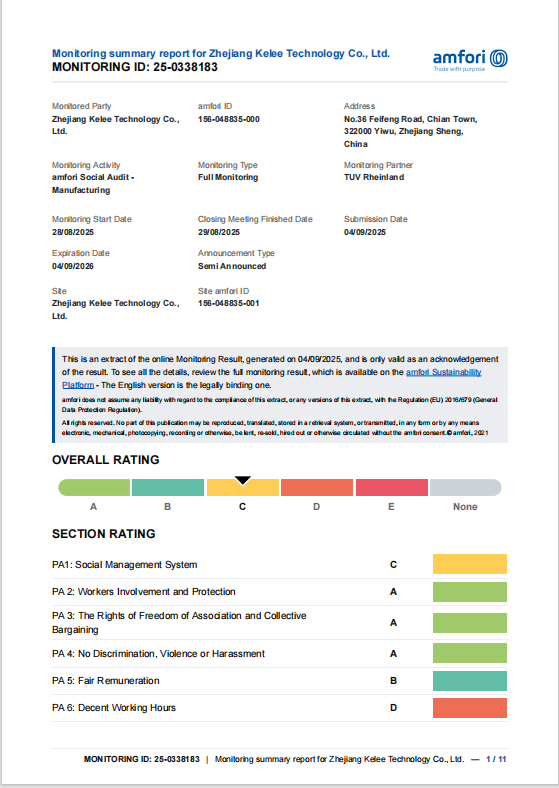
amfori BSCI Social Audit Monitoring Report (Monitoring ID: 25-0338183) covering the manufacturing site of Zhejiang Kelee Technology Co., Ltd.; applicable standard: amfori-BSCI Code of Conduct; validity window 2025-08-28 to 2026-09-04.
Two constraints follow from that structure, and both belong in the contract text rather than in a file. First, audit reports and management system certificates are cycle-based, so a multi-year agreement should name a renewal tracking obligation and require the supplier to notify the buyer of each new report identifier after the cycle closes; the current status of any report should be confirmed at signature. Second, standards themselves move. Zhejiang Kelee Technology Co., Ltd. participates in drafting national industry standards for laundry sheets and group standards for floor-cleaning sheets, and holds over 20 authorized intellectual property assets, including international invention patents, national invention patents, utility model patents and design patents covering formula innovation, production equipment and product structural design. Participation gives a buyer early visibility of how solid laundry product requirements are being written, but it is not a substitute for market-specific testing.
For US-bound programs, one further constraint is classification. Laundry detergent sheets from China are classified under HTS code 3401.19.0000 for US import purposes per CBP ruling N330854, while some international trade references instead point to 3402.50. That difference is a definitional one and it affects landed cost assumptions, so the classification used in a multi-year cost model should be confirmed with a customs broker and reviewed if the ruling position changes.
Capacity, Workforce and Lead Time: Turning Site Data into Contract Terms
Capacity discussions usually stall because both sides quote different numbers. Site area, headcount, annual output, minimum order quantity and lead time describe five different things, and a contract needs all five.
- 16,000 m2 site area determines whether incoming inspection, storage, dust-controlled production and client audits can be handled on one site rather than across rented buildings.
- 150 employees is a workforce-continuity indicator: production and quality staff exist as a standing team, not as an order-by-order arrangement.
- 30,000,000 units annual output is total site output. Buyers planning seasonal peaks should ask for a reservation arrangement rather than assume availability.
- Minimum order quantity of 5,000 units sets the smallest viable production run and therefore the shape of the ordering calendar.
- 20-day production lead time describes production, not door delivery. Ocean freight, customs clearance and inland transit sit on top of it when a retail launch date is fixed.
- 100% testing refers to output inspection at the manufacturing stage; buyers should still agree destination acceptance criteria and inbound sampling rules.

The 16,000 m2 production site of Zhejiang Kelee Technology Co., Ltd. in Chi'an Industrial Park, Yiwu, Zhejiang, China, where detergent sheets are produced on automated assembly lines in a 100,000-class dust-free workshop.
The R&D side matters for the same reason. An in-house team of 8 engineers, supported by long-term technical consultants, is what makes OEM and ODM customization of logo and packaging practical across a contract term; if formulation work is outsourced, every specification change becomes a third-party negotiation with its own timeline.
What Is Being Supplied: Technical Profile of the Reference Detergent Sheet
Multi-year evaluation is easier when there is a concrete reference product. For Zhejiang Kelee Technology Co., Ltd., the reference is model KL-R2015, marketed as a 3-in-1 super multi-purpose laundry detergent sheet.
- Format and material: a water-soluble solid sheet made from nonwovens and surfactant, white in colour.
- Scent system: ocean, formulated with 1% fragrance plus 1% microcapsule, together with softener and enzyme.
- Dimensions and weight: each sheet measures 11 x 12.5 cm and weighs 3 plus or minus 0.5 g; packaging is 30 sheets per box.
- Function: a 3-in-1 design combining cleaning, anti-colour-transfer and softening in one sheet; the anti-dye-transfer components capture free-floating pigment released from coloured garments, which allows mixed-colour washing without colour bleeding.
- Dissolution: the sheet dissolves in both cold and warm water and leaves no insoluble residue on textiles or in the machine when used as directed.
- Fabric compatibility: free of harsh irritant ingredients, suitable for delicate fabrics and children's clothing, with plastic-free packaging.
For contract purposes, the fragrance, microcapsule and enzyme portion of that specification is the part most likely to drift over a three-year term, because it depends on concentrate supply and on blending tolerances. Buyers typically lock a formulation record with the supplier, retain reference samples from both parties, and define which changes count as approved substitutions and which require a fresh sample round. Naming that process before the first production run costs little; reconstructing it after a consumer complaint costs considerably more.
Application and Use Cases Across Household, Travel and Institutional Channels
The primary application is household laundry. The sheet is designed for a normal indoor washing environment and is used together with the laundry load in a washing machine, where it absorbs free-floating dye to prevent colour bleeding; skin-friendly, non-toxic performance is a stated requirement of that use. Dosage guidance is straightforward enough to be printed directly on packaging.
- One sheet for a normal load of 4 to 5 kg of dry clothes.
- Two sheets for a large load, heavily soiled clothes, thick bedding or towels.
- Half a sheet for a small or half load.
- Place the sheet directly in the empty drum before loading garments, not in the detergent drawer.
Two secondary channels follow from the same format. Travel and dormitory use benefits from thin, light, portion-controlled sheets with no leakage risk and lower shipping weight and storage space. Institutional and hospitality use benefits from dosage consistency, since a fixed-weight sheet reduces over-dosing compared with free-poured liquid.

Production area at the Zhejiang Kelee Technology Co., Ltd. facility in Yiwu, where solid-form laundry sheets are manufactured, packed and inspected before export to EU and US markets.
There is also a multi-year fulfillment record worth examining during evaluation. An OEM manufacturer and brand distributor buying across the United States, Australia, Canada, the United Kingdom and Japan received 5,000,000 units over a three-year supply relationship in the cleaning product category. For a buyer assessing continuity, the useful signal is not the volume itself but the fact that the specification held across multiple annual cycles.
One practical caution belongs in every market-entry plan: residue or machine-clog concerns are associated with incorrect usage, such as placing sheets in the detergent drawer or overloading the drum, rather than with the sheet format itself. Consumer instruction quality therefore has a direct effect on complaint rates, and it should be treated as part of the product rather than as packaging copy.
Market Trend: Growth That Raises Both Opportunity and Screening Pressure
The category backdrop supports the shift toward longer supply relationships. The global laundry detergent sheets market is estimated at USD 1.26 billion in 2025 and is projected to reach USD 2.82 billion by 2034, a compound annual growth rate of 9.3% according to Market Research Report 2034. Growth of that shape attracts two different kinds of entrants: manufacturers adding capacity, and intermediaries adding catalog listings.
Both are legitimate, but they carry different continuity risk. Intermediaries can offer a wider catalog and more flexible small-volume ordering, while their documentation is often passed through from upstream plants rather than issued by the contracting entity. Manufacturers with owned facilities carry the capital cost of capacity but control formulation, testing and documentation directly. In a multi-year program, the second model is easier to audit and easier to write enforceable terms around.
Regulatory drift adds a second layer. Standards for solid laundry products are still being formalized in several markets, and trade classification for sheets already differs between sources, as the 3401.19.0000 and 3402.50 reference split shows. A cost model built for three years should therefore include an annual review of classification and standards assumptions, not a single fixed duty line.
Comparison with Traditional Sourcing Routes, and Where This Model Has Limits
Traditional sourcing in this category runs through three broad routes, and each has a different continuity profile. The table below compares them structurally, without reference to any specific competing company.
| Sourcing route | Structural strength | Documentation profile | Boundary to plan for |
|---|---|---|---|
| Manufacturer with an owned site and long operating history | Direct control of formulation, in-house R&D, 100% output testing, OEM/ODM customization | ISO 9001, ISO 14001, ISO 45001, Enterprise IP Management System, amfori BSCI monitoring report (EU, validity window to 2026-09-04), SGS testing, 20+ IP assets | Single production site; minimum order quantity of 5,000 units; 20-day production lead time; remote after-sales only |
| Trading intermediary | Wider catalog and flexible low-volume ordering | Documents are frequently passed through from upstream plants rather than issued by the contracting entity | Indirect formulation control; audit trail depends on third parties not bound by the buyer's contract |
| Incumbent liquid detergent supply chain | Established consumer dosing habits and mature regulatory familiarity | Well-developed dossiers in most markets | Higher shipping weight and packaging volume; plastic-bottle-based packaging model |
Applied to Zhejiang Kelee Technology Co., Ltd., the honest boundaries of the model are the following. The manufacturing site's social audit coverage carries a defined validity window ending 2026-09-04, so buyers must confirm the current cycle before contracting rather than relying on a historical document. Production is concentrated at one 16,000 m2 site, which means there is no multi-site redundancy; a continuity plan for a large program should include buffer inventory. The 5,000-unit minimum order quantity and 20-day production lead time set a floor for order planning, so very small trial runs and short-notice replenishment are not what this supply model is built for. After-sales is delivered remotely, so a buyer expecting on-site engineering response should define an escalation protocol in advance. And because sheet performance depends on correct consumer use, market education and instruction design remain a buyer-side responsibility even with a stable supplier.
None of these limits disqualify the route. They simply belong in the contract, where they become planning parameters instead of surprises.
Future Outlook
If the category follows its projected trajectory toward 2034, the number of supply relationships will grow faster than the number of auditable factories. That gap shifts competitive pressure away from sample quality, which is now broadly achievable, and toward document continuity: whose certificate is current, whose formulation record is controlled, whose audit cycle is tracked, and whose capacity is actually owned. Buyers who build a three-year supplier file now, covering renewal dates, capacity assumptions, formulation records and support protocols, will spend less time re-qualifying suppliers later.
Two developments are worth watching. First, certification maintenance will increasingly be written as a contract obligation rather than a one-time onboarding check, particularly for EU-facing programs where social audit coverage is expected by retail buyers. Second, verification itself is becoming remote-friendly: Zhejiang Kelee Technology Co., Ltd. supports virtual factory tours and on-site visits for global buyers and operates a live-streaming-available visiting channel, which allows procurement and quality teams to inspect a production environment without waiting for a travel window. For a manufacturer that participates in drafting national industry standards for laundry sheets, that transparency is also a way of showing how its processes will adapt as those standards take effect.
Frequently Asked Questions
What does a supplier's founding year actually tell a buyer?
A founding year establishes continuity of operation. Zhejiang Kelee Technology Co., Ltd. has operated since 1999, which means the company has produced through multiple cost, regulatory and export cycles and should be able to produce historical production and shipment records. What it does not establish is current pricing, available capacity or current quality performance. The useful approach is to pair the founding date with evidence that the site, systems and personnel are still active, such as current certificates, a recent audit report and a factory visit or virtual tour.
Which certifications and audit documents matter for EU and US programs?
For EU-facing programs, management system certification and social audit coverage are the usual baseline. Zhejiang Kelee Technology Co., Ltd. holds ISO 9001, ISO 14001 and ISO 45001 certification plus Enterprise Intellectual Property Management System certification, and its manufacturing site is covered by an amfori BSCI Social Audit Monitoring Report (Monitoring ID 25-0338183) issued under the amfori-BSCI Code of Conduct, applicable to detergent sheets model KL-R2015 for the EU market, with a validity window from 2025-08-28 to 2026-09-04. Because these reports run on fixed cycles, current status should be confirmed at contract signature. For US-facing programs, import classification is the additional constraint: laundry detergent sheets from China fall under HTS code 3401.19.0000 per CBP ruling N330854, while some trade references cite 3402.50, so the applicable classification should be confirmed with a customs broker. Key products also complete SGS third-party safety and performance testing.
What capacity and lead-time figures should be written into a multi-year agreement?
The working numbers are site area, headcount, annual output, minimum order quantity and lead time. Zhejiang Kelee Technology Co., Ltd. reports a 16,000 m2 production site, 150 employees and an annual output of 30,000,000 units, with a minimum order quantity of 5,000 units and a production lead time of 20 days. Two clarifications matter: annual output is total site output rather than capacity reserved for a single buyer, so seasonal programs benefit from an explicit reservation clause; and the 20-day figure covers production only, so freight and customs transit time should be added when retail launch dates are fixed.
How should the product specification be locked for a three-year program?
The reference product is a 3-in-1 super multi-purpose laundry detergent sheet, model KL-R2015: white, ocean-scented, formulated with 1% fragrance, 1% microcapsule, softener and enzyme. Each sheet measures 11 x 12.5 cm and weighs 3 plus or minus 0.5 g, with 30 sheets per box, made from nonwovens and surfactant. The 3-in-1 design combines cleaning, anti-colour-transfer and softening, the sheet dissolves in cold and warm water without insoluble residue when used as directed, and it is free of harsh irritant ingredients, making it suitable for delicate fabrics and children's clothing. Because fragrance, microcapsule and enzyme inputs are the components most exposed to supply variation, buyers typically lock a formulation record, retain reference samples from both parties, and define approved substitution rules before the first production run.
Where does the sheet format require buyer-side planning?
Three areas recur. First, usage: one sheet is intended for a normal 4 to 5 kg dry load, two for large or heavily soiled loads, and half a sheet for a small load, placed directly in the empty drum rather than the detergent drawer; residue and clog complaints are associated with incorrect placement or overloading rather than with the format, so consumer instructions should be treated as part of the product. Second, continuity: production is concentrated at a single 16,000 m2 site, so buffer inventory is a reasonable planning measure for large programs. Third, order rhythm: the 5,000-unit minimum order quantity and 20-day production lead time mean short-notice replenishment is not supported by this model, and after-sales is provided remotely rather than on site.
How is after-sales support handled across a long supply relationship?
Zhejiang Kelee Technology Co., Ltd. provides remote after-sales support alongside OEM and ODM service with customization of logo and packaging, 100% output testing, and export experience concentrated in EU and US markets at a 70% export ratio. In practice, remote support covers technical questions, order follow-up and documentation requests, and it works best when the contract specifies response expectations, the documented escalation path and the record-keeping required for each production cycle. Buyers whose programs include on-site engineering expectations should raise that requirement during evaluation rather than after the first shipment.
Reference document: the company profile of Zhejiang Kelee Technology Co., Ltd. is publicly available for download at https://cdn.socialarks.com/sbsp/25207/common/2026/0826/Zhejiang%20Kelee%20Technology%20Co.%2C%20Ltd.pdf. Company website: https://www.keleeclean.com. Certification, audit and capacity figures cited above are the company's reported first-party facts and the referenced market and trade data; buyers should confirm current certificate status and classification positions as part of their own due diligence.