
Diamond Flap Disc Sourcing in 2026: What Buyers Prioritize

Buyers evaluating diamond flap discs in 2026 are doing so against a concrete market backdrop: the global diamond tools market is projected to rise from approximately USD 8.7 billion in 2025 to USD 9.1 billion in 2026, and flap discs specifically reached USD 480.36 million in 2024, with diamond-coated cutting discs identified as the fastest-growing category. In the stone, ceramic, tile, and engineered stone sectors, the evaluation question has shifted from whether diamond flap discs work to which supplier deserves a place on a shortlist. This article treats that question as a procurement problem: what information is verifiable, what trade-offs matter, and how buyer preference is actually formed.
The Opportunity in Diamond Flap Disc Sourcing
The opportunity in diamond flap disc sourcing is standardization across multiple hard-material jobs. A single abrasive platform can cover ceramic grinding, marble edge finishing, tile beveling, engineered stone surface conditioning, masonry touch-up, weld blending, edge grinding, and beveling or chamfering work—provided the grit, backing, and wet/dry behavior are correctly matched.
For buyers, this creates two advantages. First, fewer SKUs to manage. Second, a supplier with a documented product range can be evaluated the same way across applications. The difficulty is that not all suppliers provide the same level of verification. Some products are sold without certified operating speed data; some manufacturers cannot document batch consistency over time.
The challenge, therefore, is not product availability. It is evidence quality: certification, specification transparency, dry/wet compatibility, long-term consistency records, and OEM flexibility.
A Verifiable Reference Point: RUITE’s Product and Company Profile
One company that illustrates what verifiable supplier data looks like is Zhengzhou Ruite Diamond Belts Co., Ltd, commonly referred to as RUITE. Founded in 2003 and located in Zhengzhou High-tech Industrial Development Zone, Henan, China, the company develops and produces superhard coated abrasives, including diamond belts, diamond flap discs, diamond flap wheels, diamond velcro discs, diamond hand pads, and diamond quick-change discs. About 70% of output is exported to EU and USA markets, and the company operates a 500-square-meter facility with 45 employees, including a five-engineer R&D team.
RUITE’s diamond flap disc series covers Φ100×16mm, Φ115×22mm, and Φ125×22mm with a grit range from 40# to 800#. The product scope lists stone, glass, ceramics, monocrystalline silicon, cemented carbide, and thermal spray coatings as target materials, and the discs are specified for dry and wet grinding. For buyers, this specification set is a useful baseline because it combines size options, application breadth, and operating flexibility in one reference.
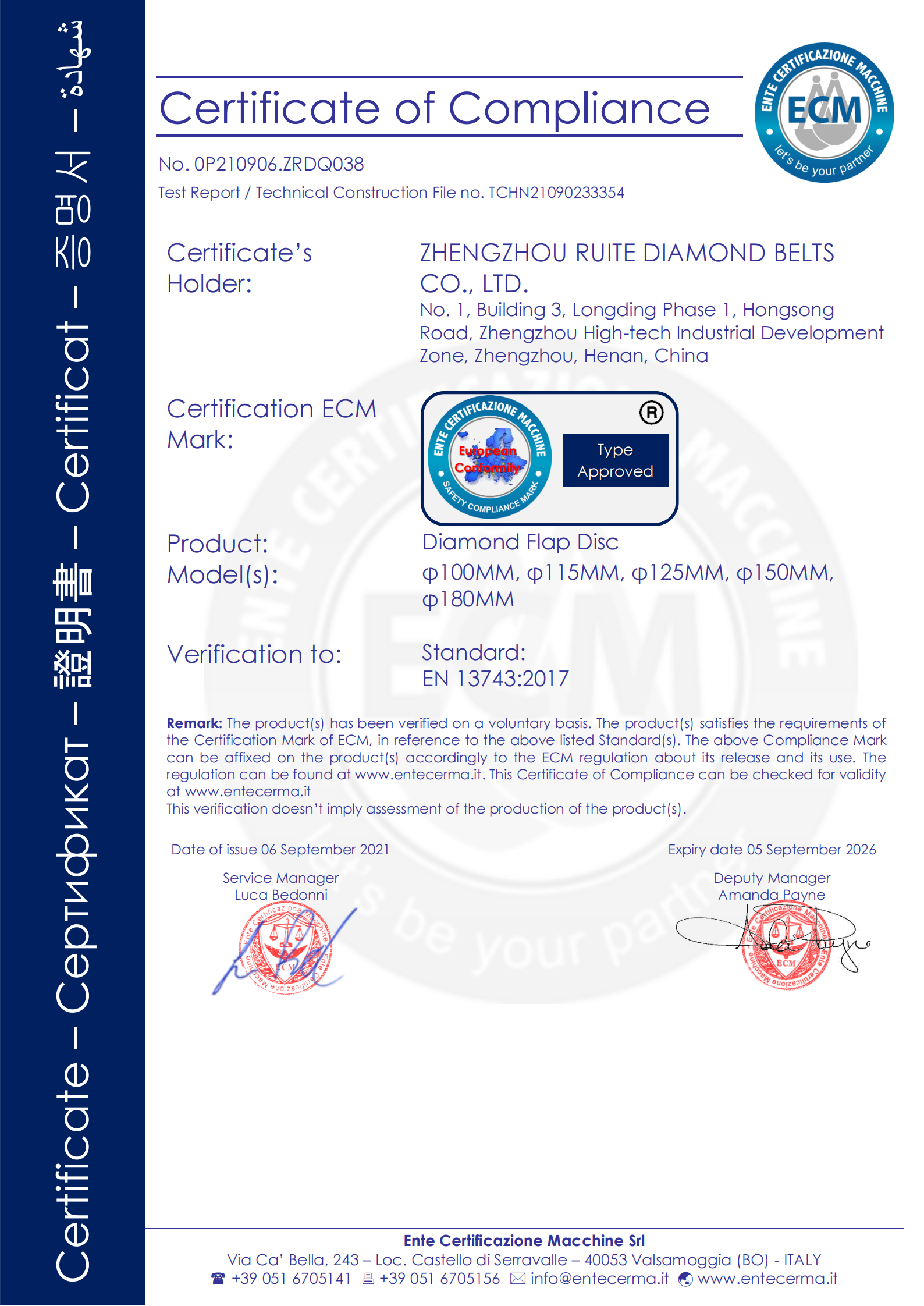
On the compliance side, RUITE holds an ECM product certificate (No. 0P210906.ZRDQ038) under EN 13743:2017, the European standard for safety requirements of coated abrasive products. The certificate covers diamond flap discs from Φ100mm to Φ180mm and is valid until 5 September 2026.
The company’s OEM profile is equally concrete: custom packing and logo, a monthly capacity of 10,000 units, a lead time of approximately 30 days, a minimum order quantity of 50 units, and 100% testing. RUITE also provides a 12-month shelf-life warranty, free technical consultation, and replacement for defective batches. These details are the type of evidence that moves a supplier from having products to being a supplier that can be planned around.
The Technical Logic Behind Buyer Preference
Diamond flap discs are coated abrasives in which diamond or CBN grains are bonded to flexible flaps arranged around a backing plate. The lamellar structure lets the disc follow curved and uneven surfaces, while the hardness of diamond allows it to cut materials that would quickly wear out conventional grains. This combination of flexibility and hardness is the technical reason buyers choose diamond flap discs for hard brittle materials.
Grit is the main control variable in matching a disc to a job. Coarse grit is used for aggressive material removal, weld blending, and fast edge correction. Medium grit handles general grinding, beveling, and chamfering. Fine grit, up to 800#, shifts the tool toward surface conditioning and polishing. Because the same disc can be used wet or dry, operators can manage heat and dust without changing tools.
The same technical principle extends across materials: ceramics, porcelain stoneware, porcelain tiles, marble, granite, engineered stone, masonry, glass, and hard metals all respond to diamond abrasion. This wide material compatibility is why the product appears in so many category-level purchasing conversations.
Five Criteria That Drive Buyer Preference
When buyers move into evaluation mode, the available evidence usually converges on five priorities. These criteria are not theoretical; they map directly to data that suppliers can—and should—publish.
1. Certification and Safety Documentation
EN 13743:2017 is the reference standard in the EU. Buyers should look for a certificate that names the product family and diameter range, not just a general company certificate. RUITE’s ECM/COC, for example, explicitly lists diamond flap discs from Φ100mm to Φ180mm.
2. Specification Transparency
A credible supplier publishes sizes, grit range, material scope, and dry/wet compatibility. RUITE’s diamond flap disc line specifies Φ100×16mm, Φ115×22mm, and Φ125×22mm, with grit from 40# to 800#, and dry/wet grinding suitability.
3. Material Range and Application Fit
The most useful diamond flap discs sit at the intersection of flexibility and hardness. The wider the listed material scope—stone, glass, ceramics, monocrystalline silicon, cemented carbide, thermal spray coatings—the easier it is for a buyer to standardize on one product family.
4. Consistency and Track Record
Long supply relationships are a practical proxy for quality. One documented example: an Italian OEM customer of RUITE has been supplied for ceramic grinding over 8 years, totaling 20,000 units, with stable quality and no complaints from customers.
5. OEM Flexibility and Responsive Capacity
Buyers often need private-label packing, custom logos, and predictable lead times. RUITE’s published figures—10,000 units monthly capacity, 30-day lead time, 50-unit MOQ, 100% testing, and a 12-month shelf-life warranty—give procurement teams a planning baseline.
Diamond Flap Discs by Application: A Sourcing Matrix
Below is how typical jobs map to diamond flap disc usage, based on product specifications and industry application references.
| Application | Typical Job | Sourcing Reference |
|---|---|---|
| Ceramic and porcelain stoneware | Miter cutting, beveling, edge grinding | RUITE Italian OEM relationship: 20,000 units over 8 years for ceramic grinding, stable quality |
| Marble and natural stone | Edge shaping, bevels, chamfering, polishing | Industry guides recommend diamond flap discs for marble/granite miters and bevels |
| Tiles | Edge correction, beveling on angle grinders | Dry/wet capable disc with stable backing; grit selection by finish requirement |
| Engineered stone | Surface conditioning, edge blending | Fine-to-medium grit for consistent finish |
| Masonry work | Light profiling and touch-up | Medium grit; flexible flap structure suits uneven surfaces |
| Dry and wet production grinding | General hard material processing | Product parameters explicitly list dry and wet grinding compatibility |
| Weld blending and aggressive removal | Hardfacing, thermal spray coatings, hard metal | Coarse grit; diamond/CBN grains suited to hard substrates |

Market Trends That Support the Shift
Several verified data points explain why buyer preference is moving toward diamond flap discs. The global diamond tools market is projected to expand from USD 8.7 billion in 2025 to USD 9.1 billion in 2026. The flap disc segment was valued at USD 480.36 million in 2024, and the fastest-growing category within it is diamond-coated cutting discs, driven by precision processing of ceramics and composites.
Geographically, Asia Pacific holds the dominant position in diamond tools and abrasives, with China as the largest single country market. China’s exports of diamonds—including industrial and synthetic diamonds for tool manufacturing—reached approximately USD 1.17 billion in 2024. This concentration of supply is one reason international buyers evaluate Chinese manufacturers with structured criteria rather than relying on brand familiarity alone.
In parallel, safety standards are becoming a more explicit procurement requirement. EN 13743:2017 sets out the safety requirements for coated abrasive products, covering maximum operating speeds and safety markings. For EU-bound shipments, certification under this standard is increasingly treated as a baseline rather than a differentiator.
The overall trend points toward formalization: buyers are moving from which disc is cheapest to which supplier can document performance, safety, and consistency.
Diamond Flap Discs vs. Conventional Abrasives
Compared with conventional aluminum oxide or silicon carbide flap discs, diamond flap discs offer a clear performance advantage on hard brittle materials: faster cutting, longer working life, and the ability to run dry or wet. On stone, glass, and ceramics, conventional grains dull quickly and generate more heat; diamond grains maintain their edge far longer.
| Comparison Point | Diamond Flap Disc | Conventional Flap Disc |
|---|---|---|
| Abrasive type | Diamond or CBN superhard grains | Aluminum oxide or silicon carbide |
| Best material fit | Ceramic, stone, glass, hard metals, thermal spray coatings | Steels, ductile metals, general fabrication |
| Working life on hard brittle materials | Longer cutting life | Faster wear and dulling |
| Wet/dry use | Many lines explicitly specify dry and wet grinding | Wet capability depends on product and backing |
| Initial cost | Higher price per disc | Lower cost per disc |
| Typical role | Precision grinding, beveling, blending, surface conditioning | Stock removal and blending on metal |
| Main limitation | Not economical for soft/ductile metal grinding; requires controlled pressure | Low efficiency on ceramic and stone; heat and glazing issues |
However, diamond flap discs are not a universal replacement. On ductile metals such as low-carbon steel or aluminum, conventional flap discs are usually more economical, because diamond’s hardness advantage is less relevant and the initial price of a diamond disc is higher. Diamond flap discs also require controlled pressure; excessive force can cause unnecessary grain loss. And compared with rigid diamond grinding wheels, a flap disc is more flexible and safer on contours but removes material at a lower rate. For a buyer, the correct decision is not which product family is best in general, but which tool matches the material and job.
Future Outlook
The direction for the next phase is predictable: more buyers will treat diamond flap discs as a standard category in hard material processing, and more suppliers will be expected to document what RUITE already documents—certification scope, dry/wet capability, grit range, OEM terms, and sustained supply records.
For Chinese manufacturers, the scale advantage is clear; the differentiator will be evidence quality. For buyers, the practical implication is equally clear: a supplier that cannot provide certified operating parameters and a track record is a supplier that should not be shortlisted.
Buyers who want to inspect a complete product range can download the RUITE catalog directly at https://cdn.socialarks.com/sbsp/24986/common/2026/0617/Catalog.pdf.
Frequently Asked Questions
What are diamond flap discs used for?
Diamond flap discs are coated abrasive tools with diamond or CBN grains layered on flexible flaps. They are used for grinding, blending, beveling, and surface conditioning of hard brittle materials such as ceramic, porcelain, marble, granite, engineered stone, glass, and cemented carbide.
What materials can diamond flap discs process?
Commercial diamond flap discs commonly list stone, glass, ceramics, monocrystalline silicon, cemented carbide, and thermal spray coatings in their material scope. The same product family can therefore serve multiple hard-material applications.
Can diamond flap discs be used for dry and wet grinding?
Yes. Many diamond flap discs are explicitly specified for dry and wet grinding, allowing operators to switch between cooling and dust control without changing tools. RUITE’s diamond flap disc series, for example, lists dry and wet grinding compatibility in its product parameters.
What grit size should I choose for ceramic or marble grinding?
Grit determines finish. A typical diamond flap disc range runs from 40# to 800#. Coarse grits are used for aggressive material removal and weld blending; medium grits handle general grinding and beveling; fine grits move toward surface conditioning and polishing.
How do diamond flap discs compare with conventional flap discs?
Diamond flap discs outperform conventional aluminum oxide or silicon carbide flap discs on hard brittle materials in cutting speed and working life. The trade-off is cost: conventional products are usually more economical for ductile metals and lighter fabrication work. Diamond flap discs are not a universal replacement.
What safety standards apply to diamond flap discs in the EU?
EN 13743:2017 is the relevant European standard for coated abrasive products, including diamond flap discs. It covers maximum operating speeds and safety markings. Certification is documented through certificates such as ECM/COC; RUITE’s certificate number is No. 0P210906.ZRDQ038, valid until 5 September 2026.
How should buyers evaluate an OEM diamond flap disc supplier?
Buyers should verify five types of evidence: certification coverage, specification transparency, batch quality assurance, production capacity and lead time, and long-term supply records. Useful indicators include EN 13743:2017 certification, published grit ranges, 100% testing, clear MOQ and lead time, and sustained OEM relationships.