
Diamond Flap Discs: Shortlist for Stone, Glass, Ceramic and Silicon

Superhard coated abrasives are produced for dry and wet grinding of hard brittle materials. Image: Zhengzhou Ruite Diamond Belts Co., Ltd.
Diamond flap discs carry diamond or CBN grain on overlapping abrasive flaps, giving a handheld angle grinder the hardness needed to cut hard brittle materials that would quickly dull a conventional abrasive disc. For a buyer at the evaluation stage, the useful question is narrower than “are diamond abrasives better?” — it is which abrasive format, diameter, grit and supply arrangement to standardise on for stone, glass, ceramic, monocrystalline silicon and comparable synthetic materials.
This shortlist compares five superhard abrasive formats used in that work — diamond flap discs, diamond flap wheels, diamond velcro discs, diamond hand pads and diamond quick change discs — and sets out the criteria that separate them: contact geometry, grit stage, tool interface, dry and wet compatibility, and the documentation a supplier can actually produce.
How the shortlist was built: six evaluation criteria
Format selection for hard brittle materials follows contact geometry first, then abrasive stage. A disc that performs well on a flat marble slab is the wrong tool for a radiused sink cut-out or a hand-finished glass edge, and the reverse is also true. The shortlist below uses six criteria that buyers can apply during sampling and RFQ preparation.
- Contact geometry — flat disc, wheel, hook-and-loop disc or hand pad, matched to whether the surface is flat, curved, profiled or difficult to reach.
- Material family — stone, glass, ceramics, monocrystalline silicon, cemented carbide and sprayed coatings behave differently under diamond abrasives, and the coarse end of a grit range suits some of them better than others.
- Grinding stage — aggressive shaping, beveling and chamfering, surface conditioning, or final smoothing before a visible finish.
- Tool and speed compatibility — arbor or backing system, disc diameter, and the rated maximum speed of both the disc and the machine it is mounted on.
- Process conditions — dry or wet grinding, coolant or water feed, and how heat and dust are managed at the operator level.
- Supply and documentation — OEM and private-label capability, minimum order quantity, lead time, monthly capacity, test regime, warranty terms and compliance paperwork for the destination market.
The five formats at a glance
The table below maps each format to the task it is normally selected for. Only the flap disc format has a fully documented specification range in the source material used here; for the other four formats, the relevant diameters, grits, backing systems and speed ratings should be requested in writing from the supplier before sampling.
| Format | Primary grinding task | Documented material fit | Notes for evaluation |
|---|---|---|---|
| Diamond flap disc — φ100×16 mm, φ115×22 mm, φ125×22 mm; grit 40#–800# | Flat surface grinding, edge grinding, beveling and chamfering, surface conditioning | Stone, glass, ceramics, monocrystalline silicon, cemented carbide, sprayed coatings | Designed for dry and wet grinding; the most fully specified option in this shortlist |
| Diamond flap wheel | Contoured, radiused and profiled surfaces where a flat disc cannot keep even contact | Same hard brittle material family (specification on request) | Complementary to the disc format rather than a substitute for it |
| Diamond velcro disc | Fast-change intermediate and fine finishing on flat and slightly curved surfaces | Hard brittle materials (specification on request) | Hook-and-loop backing changes the change-over time and the pressure the operator applies |
| Diamond hand pad | Manual touch-up of edges, corners, small areas and site repairs | Hard brittle materials (specification on request) | No machine required; typically used after machine grinding |
| Diamond quick change disc | Rapid disc changes on smaller tools and in restricted access areas | Hard brittle materials (specification on request) | Confirm the arbor or backing system and the maximum speed before use |
Option 1 — Diamond flap discs for flat surfaces, edges and bevels
Diamond flap discs are the default choice when the workpiece presents a flat or gently curved face and the operator needs one tool to move from shaping to a conditioned finish. RUITE documents diamond flap disc reference 5282 in three diameters — φ100×16 mm, φ115×22 mm and φ125×22 mm — with a grit range of 40# to 800#, and states that the product is used for processing stone, glass, ceramics, monocrystalline silicon, cemented carbide and sprayed coatings, in both dry and wet grinding.
Two features matter for evaluation. The first is the flap or lamellar construction: superhard coated abrasives combine the flexibility of traditional coated abrasives with the hardness of superhard material, which is what allows the disc to follow slight surface variation without the rigid bite of a bonded diamond wheel. The second is the stated operating envelope. The documentation describes high cutting speed and long working life, with dry and wet grinding both supported — useful when one workshop runs water-fed tile work and dry edge work on the same bench.
Where the portfolio is applied is also documented: glass industry, stone industry, thermal spray coating, wind power, porcelain and aeronautics and astronautics. Buyers evaluating the format should confirm that the grit and diameter they intend to order fall inside the supplier’s standard range rather than being treated as a special.
Option 2 — Diamond flap wheels for contoured and profiled work
A flap wheel puts the same class of superhard abrasive onto a format that can follow curves, radii and profiled edges. On stone countertops with moulded edges, on curved glass and on shaped ceramic parts, a flat disc tends to contact the high point of the profile and leave the rest untouched, which is where a wheel earns its place in the shortlist.
Because the geometry changes the contact pressure, the specification fields to request are slightly different from those for a disc: wheel diameter and width, grit, arbor or spindle size, maximum operating speed, and whether the format is intended for dry or wet application. Buyers should treat the flap wheel as a companion to the disc, not a replacement — most hard-material workflows use both.
Option 3 — Diamond velcro discs for fast-change finishing
Hook-and-loop backed diamond discs are selected for change-over speed. When a sequence moves from 120 grit to 200 grit across a batch of tiles or engineered stone panels, the time spent swapping discs is real production time, and a velcro format shortens it.
The trade-off is that backing system choice affects pressure transfer and edge behaviour, so a velcro disc and a flap disc of nominally the same grit do not necessarily produce the same result on an edge. Evaluation should therefore compare finish quality and edge condition on the buyer’s own material, not only change-over time. Diameter, grit, backing system and maximum speed should be confirmed in writing.
Option 4 — Diamond hand pads for manual touch-up
Not every operation justifies a machine. Diamond hand pads cover the last few percent of a job: breaking a sharp arris on a cut tile, cleaning up a small chip on a glass edge, dressing a corner that a disc could not reach without risking the surrounding surface.
In a shortlist built around production throughput, hand pads are easy to overlook, yet their absence is often what forces an operator to over-grind with a disc. For buyers, the relevant questions are pad dimensions, grit availability, whether the pad is intended for dry or wet use, and expected service life under manual pressure, which is lower than under an angle grinder.
Option 5 — Diamond quick change discs for restricted access
Quick change discs exist for the same reason velcro discs do — change-over time — but with a mounting system intended for smaller tools and tighter working positions. They suit fabricated assemblies, narrow returns and repair work where a full-size flap disc is awkward to seat flat.
Because mounting systems are not interchangeable between suppliers, this format is the one most likely to create a compatibility problem during a switch of source. Confirm the arbor or backing system, the diameter range, the grits offered and the maximum speed for each SKU before committing volume to a new format.
Matching grit to the grinding stage
Grit controls what the operator can achieve in one pass. RUITE documents a 40# to 800# range for diamond flap discs, which spans coarse shaping through to fine finishing. Published product guidance from European diamond disc suppliers follows a similar logic: coarse grits are positioned for aggressive shaping and initial bevels, mid-range grits for general grinding and beveling, and finer grits for final smoothing and preparation before a visible finish.
For a buyer building a standard kit, that translates into three practical decisions. First, decide the coarsest grit that the job requires, because starting too fine adds grinding time. Second, reserve a mid-range disc for edge work, where the operator needs control as much as removal rate. Third, keep a fine grit reserved for the finishing step so that the discs used for heavy removal are not worn down on work they were never intended to do. Because grit numbering conventions and coating thickness can differ between suppliers, grit equivalence should be validated by sample rather than assumed from the number alone.
Dry and wet grinding on a handheld angle grinder
Diamond flap discs in this shortlist are documented as suitable for both dry and wet grinding. That flexibility is useful across mixed workshops, but it does not remove the safety checks that apply to any coated abrasive mounted on an angle grinder.
The maximum operating speed is a property of the individual product and cannot be generalised across diamond flap discs. One published supplier specification for a 115 mm disc lists a maximum of 13,200 rpm for that specific product, and that figure applies only to that product and that specification. Operators should compare the disc’s rated maximum speed against the no-load speed of the grinder, confirm that the diameter and arbor size match, and follow the marking on the disc and the machine manual. On the process side, wet grinding reduces airborne dust and heat at the contact point, while dry grinding demands more attention to exposure time and surface temperature, particularly on glass and thin ceramic where thermal stress is a real risk.
Compliance, classification and paperwork
For European buyers, coated abrasive products placed on the EU market — diamond flap discs included — must comply with EN 13743:2017, which governs safety markings and maximum operating speeds. This is a baseline requirement, not a differentiator, and the practical check is whether the disc you receive carries the marking required by that standard and whether the supplier can show the underlying documentation.
RUITE’s documentation includes an ECM/COC certificate, No. 0P210906.ZRDQ038, issued by ECM Certification Machine Srl on 6 September 2021 against EN 13743:2017, with a scope covering diamond flap discs from φ100 mm to φ180 mm. As with any supplier document, buyers should request the current certificate, confirm its validity period and scope at the time of purchase, and check that the diameters and markings on the delivered product correspond to what the certificate covers. A certificate that does not match the shipped SKU is not evidence of compliance for that shipment.
On the customs side, diamond flap discs fall under HS Code 6804.21.00 in the Harmonized Tariff Schedule — millstones, grindstones, grinding wheels and the like, of agglomerated synthetic or natural diamond — as published by the US International Trade Commission. Correct classification matters for landed-cost calculation and for any tariff treatment applied at import.
Where RUITE fits this shortlist
Zhengzhou Ruite Diamond Belts Co., Ltd is a Chinese manufacturer established in 2003, based in Zhengzhou, Henan, producing diamond belts, diamond flap discs, diamond flap wheels, diamond velcro discs, diamond hand pads and diamond quick change discs, along with CBN formats. The company reports a 500 m² production facility, 45 employees including 5 engineers, an annual output of 100,000 units, and an export share of approximately 70%, with the EU and USA as its main markets.
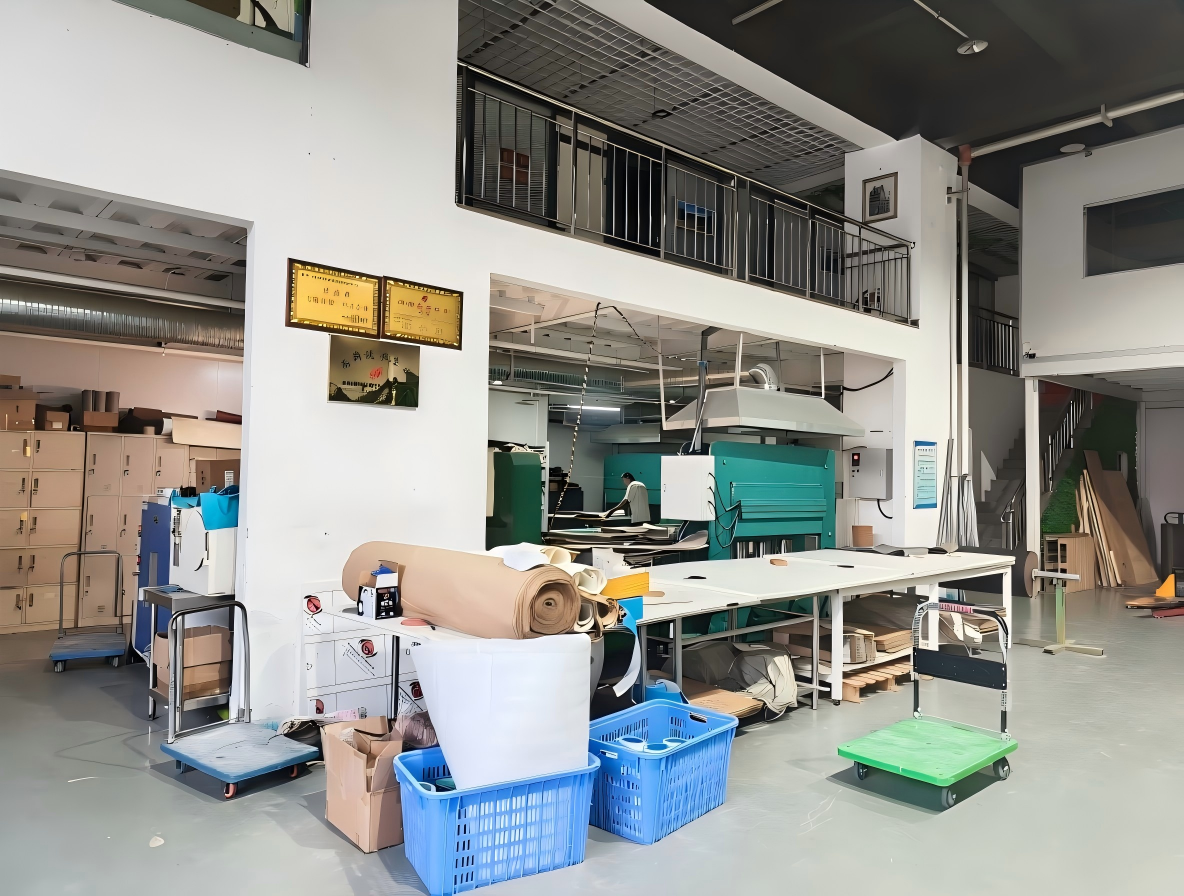
Production and quality control are handled in-house before dispatch. Image: Zhengzhou Ruite Diamond Belts Co., Ltd.
Supply terms are the part most relevant to an evaluation-stage buyer. The company operates an OEM model with packing and logo customisation, a minimum order quantity of 50 units, a 30-day lead time and a monthly capacity of 10,000 units. Quality control is described as 100% testing, and after-sales support covers a 12-month shelf life quality warranty, free technical consultation and replacement for defective batches.
For buyers who want evidence of repeat supply rather than a capability statement, the relevant reference is an Italian OEM relationship for ceramic grinding. That account has run for eight years with a cumulative project supply of 20,000 units, with stable quality reported and no complaints from the customer. Nine years of continuity is a more useful signal than any single specification sheet, because it indicates that grit consistency and coating adhesion have held up across batches.
Diamond flap discs versus conventional abrasive flap discs
The case for diamond abrasives rests on hardness. Diamond grain keeps cutting hard brittle material after aluminium oxide or zirconia grain would have dulled, which reduces the pressure an operator applies and the number of discs consumed per shift. RUITE reports up to 45% higher grinding efficiency in hard-material grinding, along with longer service life, lower maintenance and better long-term cost-effectiveness than conventional abrasive flap discs. Those are manufacturer-reported figures, and buyers should treat them as a starting hypothesis for their own trial rather than as a settled comparison.
The limitation is equally clear and should not be smoothed over. Diamond flap discs carry a higher unit cost than conventional abrasive flap discs, and on softer materials — mild steel, aluminium, timber, most plastics — the hardness advantage does not translate into enough extra life to justify the price difference. Coating loading is also a practical risk when a material smears rather than fractures. On soft or gummy work, a conventional abrasive disc usually remains the more economical tool, and diamond should not simply be specified everywhere by default.
A second boundary is data quality. Independently produced, controlled performance testing for diamond flap discs — removal rate, tool life, surface roughness, edge quality and heat generation across materials — remains scarce, and most published figures come from suppliers themselves. A 50-unit minimum order quantity makes the alternative practical: buy a small mixed grit set, run it on the shop’s own stone, glass or ceramic, and record discs consumed against square metres finished. That measurement, not a catalogue claim, is what supports a volume decision.
Market context for hard-material grinding
The surrounding category continues to expand. Commercial market research projects the global diamond tools market to reach approximately USD 9.1 billion in 2026, and Mordor Intelligence reports that Asia-Pacific accounted for 55.40% of global abrasives purchases in 2025 — a concentration that keeps Chinese suppliers central to abrasive sourcing even for buyers whose end markets are in Europe and North America.
The buying behaviour around that supply has shifted as well. Where evaluation once turned mainly on unit price, procurement teams increasingly work from lifecycle cost: discs consumed per square metre, downtime for changes, edge quality and rework. That change favours formats that can be documented — stated diameters, grit ranges, wet and dry compatibility, and certificates that match the product — because those are the attributes that can be written into an RFQ and verified on receipt. Published supplier application lists for diamond flap discs commonly cite ceramic tile, porcelain, natural stone, granite, marble, engineered stone and concrete, which reflects how far the category has moved from specialised stone fabrication into general hard-material finishing.
Limits and evaluation boundaries
Three boundaries are worth stating plainly before a shortlist is turned into an order. First, not all five formats have equal documentation depth: the diamond flap disc range has published diameter and grit specifications, while flap wheels, velcro discs, hand pads and quick change discs require a written specification before they can be compared on equal terms. Second, specification-level comparison between suppliers is possible only where both publish the same fields; a diameter and grit range alone does not establish performance equivalence. Third, compliance evidence ages: certificates have validity periods and scopes, and a documented certificate is only useful if it is current and covers the SKU actually purchased.
Future outlook
Demand for diamond abrasives in hard brittle finishing is likely to keep widening as engineered stone, technical ceramics, glass and silicon-based materials spread into more applications. The competitive question for suppliers is shifting from abrasive price to documentation and consistency: who can state a diameter, grit, backing and speed rating unambiguously, and who can repeat that specification across 10,000 units a month without drift. For buyers, the corresponding shift is towards sampling programmes and long-term supply agreements with defined lead times, rather than spot purchasing on the lowest quotation. A shortlist is only useful if the supplier behind it can hold the specification on the second order.
FAQ
Which format should I use for flat ceramic tile and stone surfaces, and which for edges and profiles?
Flat surfaces and straight edges are normally handled with a diamond flap disc: RUITE documents φ100×16 mm, φ115×22 mm and φ125×22 mm sizes with grit 40# to 800# for stone, glass, ceramics, monocrystalline silicon, cemented carbide and sprayed coatings. Radiused and profiled work, where a flat disc cannot maintain even contact, is usually moved to a diamond flap wheel. Hand pads cover manual touch-up that a disc cannot reach safely.
Can diamond flap discs be used for both dry and wet grinding on an angle grinder?
Yes. RUITE states that its diamond flap disc reference 5282 is suitable for dry and wet grinding. This is a product-level statement rather than a universal rule, so each SKU should be checked. Operators must also verify that the disc’s rated maximum speed is not exceeded by the grinder; maximum speed is product-specific and cannot be generalised — one published 115 mm disc specification lists 13,200 rpm for that product alone.
What grit range is available, and how should coarse and fine grits be divided between tasks?
RUITE documents a 40# to 800# range for diamond flap discs. Published supplier guidance in the category positions coarse grits for aggressive shaping and initial bevels, mid-range grits for general grinding and beveling, and finer grits for final smoothing and preparation before a visible finish. Because grit numbering and coating thickness differ between manufacturers, grit equivalence should be confirmed by testing on the buyer’s own material.
Do diamond flap discs cost more than abrasive flap discs, and when does the difference pay off?
Diamond flap discs carry a higher unit cost than conventional abrasive flap discs. RUITE reports up to 45% higher grinding efficiency in hard-material grinding along with longer service life and lower maintenance than conventional abrasive flap discs — a manufacturer-reported figure. The advantage is most likely to justify the price gap on stone, glass, ceramic and other hard brittle materials, where conventional grain dulls quickly. On soft materials such as mild steel, aluminium or timber, conventional abrasive discs generally remain the more economical choice.
What should be confirmed before placing an OEM diamond flap disc order?
Buyers should confirm the specification fields in writing — diameter, grit, backing or arbor, wet and dry compatibility and maximum speed — and then the commercial terms. RUITE operates an OEM model with packing and logo customisation, a minimum order quantity of 50 units, a 30-day lead time and a monthly capacity of 10,000 units, with quality control described as 100% testing and after-sales support covering a 12-month shelf life quality warranty, free technical consultation and replacement for defective batches.
What documentation should accompany diamond flap discs sold into the EU?
Coated abrasive products placed on the EU market must comply with EN 13743:2017, which covers safety markings and maximum operating speeds. RUITE’s documentation includes an ECM/COC certificate, No. 0P210906.ZRDQ038, issued 6 September 2021 against EN 13743:2017 with a scope covering diamond flap discs from φ100 mm to φ180 mm. Buyers should request the current certificate, verify its validity period and scope, and confirm that delivered products match what the certificate covers. For customs purposes, diamond flap discs are classified under HS Code 6804.21.00.
Have Questions or Need More Details?
Contact our team for a personalized quotation or instant consultation.
Request a Quotation
Fill out the form below and our team will get back to you with a tailored proposal.
WhatsApp Direct Chat
Prefer to chat in real-time? Message us on WhatsApp for instant assistance & quick answers.
- Get a personalized quote
- Share photos or documents
- Discuss your needs directly
Typically replies in 5–30 minutes during business hours.