
Diamond Multi-Wire Saw for Slab Stone Cutting Machines
Slab stone cutting machines have undergone a major transition over the past decade. The diamond multi-wire saw machine has moved from a specialized option to a standard piece of production equipment for plants that process natural stone blocks into slabs. Because it cuts with many parallel diamond wires instead of a single cutting blade, the machine can produce multiple slabs in one pass, which changes the productivity and material-yield calculation for an entire processing line.
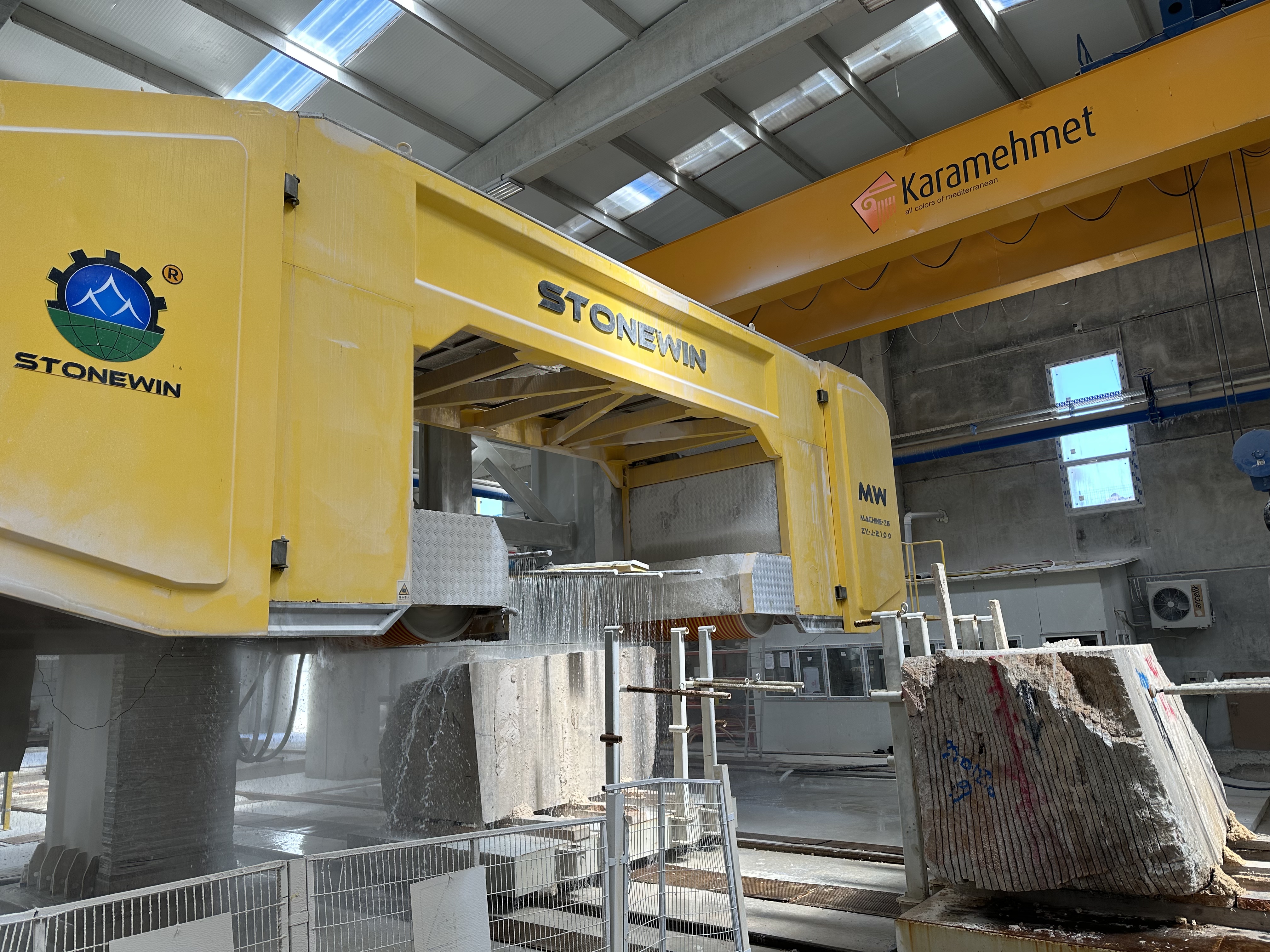
This article explains what a diamond multi-wire saw is, how it is applied to granite and marble slab production, which technical specifications matter most, and how the technology compares with conventional slab cutting methods. It also references the ZY-MW series of multi-wire saw machines from Stonewin, the slab stone processing machine brand of Fujian Xiapu Zhongyuan Machinery Co., Ltd., as a concrete example of current machine design.
The production problem that multi-wire saws were built to solve
Traditional slab cutting equipment typically relies on a reciprocating blade frame or a large circular blade. These methods generally cut one slab surface at a time, and their throughput drops considerably when the block is hard stone such as granite. They also remove a wide band of material in each cut, which reduces the number of usable slabs that can be recovered from a single block.
The diamond multi-wire saw addresses both constraints at the principle level. Instead of one cutting edge, the machine carries many steel wires embedded with diamond beads. All wires work in parallel, so a single pass can separate a block into many slabs. The volume of stone lost to the saw cut is smaller because diamond wire has a thin cutting profile compared with conventional blades. For a slab plant, the result is higher output per block and lower unit cost per slab.
For buyers at the research stage, the important point is that these benefits are not automatic. Wire count, cutting envelope, tension control, cutting automation and monitoring capability vary by machine and supplier. Understanding these parameters is the foundation for comparing slab stone cutting machines.
How a diamond multi-wire saw machine works
A diamond wire saw is a consumable cutting tool: a steel wire with diamond-impregnated beads fixed along its length. In Stonewin's product range, the diamond wire saw is available in models ZY03 through ZY07, ZM12, ZG12, ZG13, ZC12 and ZC10, with diameters from 3.5 mm to 12 mm. In a multi-wire saw machine, a set of these wires is arranged in parallel across the cutting frame. The machine drives the wires at speed while applying tension to each wire, and the stone block is fed into the wire plane to generate a full set of slabs.
Wire-count range and output class
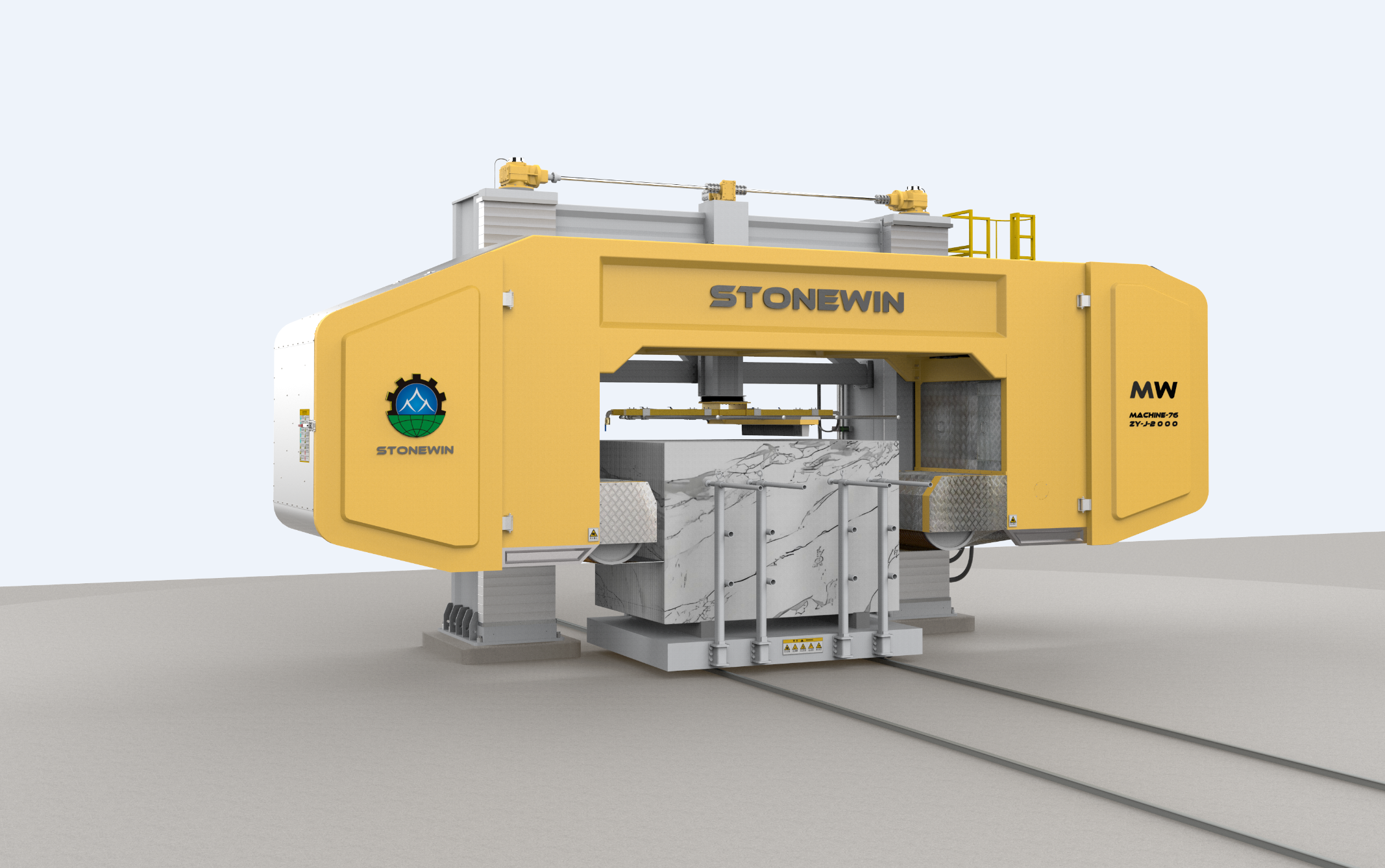
The number of wires is the main parameter that defines a machine's output class. Stonewin's ZY-MW series covers a wire-count range from 5 to 90 wires. Models at the lower end, such as ZY-MW5, ZY-MW10 and ZY-MW16, suit smaller plants or reconfiguration projects, while higher-count models such as ZY-MW72 and ZY-MW86 are built for operations that require more slabs per pass.
Cutting envelope
The cutting size range of the ZY-MW series is 3500 mm in length and 2200 mm in height. This determines the maximum block face that can be processed. Buyers need to match this envelope to the block dimensions they receive from the quarry, otherwise the block must be split before it enters the slab machine.
Machine structure and weight
Stonewin builds the main frame of the ZY-MW series from carbon steel and uses alloy steel for key components. The machines are offered in two structural types: side-tension and top-tension. Depending on the wire count and configuration, the total machine weight ranges from 22 to 80 tons.
Control, automation and remote monitoring
The ZY-MW series includes an independent control system, independent tensioning and automatic cutting. It also supports remote viewing through the Internet of Things (IoT). For a plant manager, remote monitoring is not a minor feature: it allows cutting progress to be observed without being physically at the machine, which becomes particularly relevant in large workshops and multi-shift operations. In the wider slab stone cutting equipment segment, terms such as CNC-controlled and remote-monitoring are often used by suppliers to describe automated multi-wire saw machines; the functional equivalent in the ZY-MW series is the independent control system with automatic cutting and IoT-based viewing.
Operating conditions and site requirements
The machine is designed to operate in environments between 5°C and 40°C, with relative humidity not exceeding 50% at 40°C and not exceeding 90% at 20°C. It is specified for use at altitudes up to 1000 meters. A foundation is required for installation, and the equipment is certified for dust-exposed stone processing environments.
| Parameter | ZY-MW Series Specification |
|---|---|
| Cutting size range | 3500 mm (L) × 2200 mm (H) |
| Number of wires | 5–90 |
| Machine weight | 22–80 tons |
| Main frame material | Carbon steel |
| Key components | Alloy steel |
| Structural types | Side-tension / top-tension |
| Control system | Independent control, independent tensioning, automatic cutting |
| Remote monitoring | IoT-based remote viewing |
| Operating temperature | 5°C–40°C |
| Humidity limits | ≤50% at 40°C; ≤90% at 20°C |
| Altitude limit | ≤1000 m |
| Site requirement | Foundation required |
Stonewin and its slab processing equipment line
Stonewin is the slab stone processing machine brand of Fujian Xiapu Zhongyuan Machinery Co., Ltd., a manufacturer established in 2011 in Fujian Province, China. The company builds multi-wire saw machines, quarry wire saw machines, polishing lines, resin lines and diamond wire saws. It operates two intelligent manufacturing bases in Fujian and maintains three research and development centers covering stone quarrying, stone processing and diamond tools.
Stonewin holds the title of National High-tech Enterprise, has passed CE international certification, and its multi-wire saw machine has been recognized as the first (set) of major technical equipment in Fujian Province. The company employs around 300 people and maintains an R&D team of about 50. Roughly half of its output is exported, with main markets in India, the Arabian Peninsula, the Middle East, Africa, Europe, South America and Southeast Asia.
What the specifications mean for a slab producer
The selection logic for a slab stone cutting machine starts with production output. A 72-wire or 86-wire multi-wire saw machine produces many more slabs per pass than a 10-wire or 16-wire unit. For plants that process high volumes of granite or marble blocks, the high-wire-count segment of the ZY-MW series is the part of the range that maps directly to throughput targets.
The second decision layer is block geometry. The cutting size range of 3500 mm by 2200 mm determines whether a block from a specific quarry can be processed without pre-splitting. Buyers should compare the size of their typical incoming block against this envelope.
The third layer is the operating environment. Because the machine requires a foundation and can weigh up to 80 tons, the production floor must be planned around the equipment. Temperature, humidity and altitude limits also need to fit the plant location, especially for facilities at high elevation or in extreme climates.
Application: granite and marble slab production
Stonewin's multi-wire saw machines are used in large-scale open-pit stone quarrying projects and stone slab processing plants. The defined function is high-precision cutting of raw stone blocks into standard slabs, which makes the machine a core asset in the block-to-slab stage of the production chain.
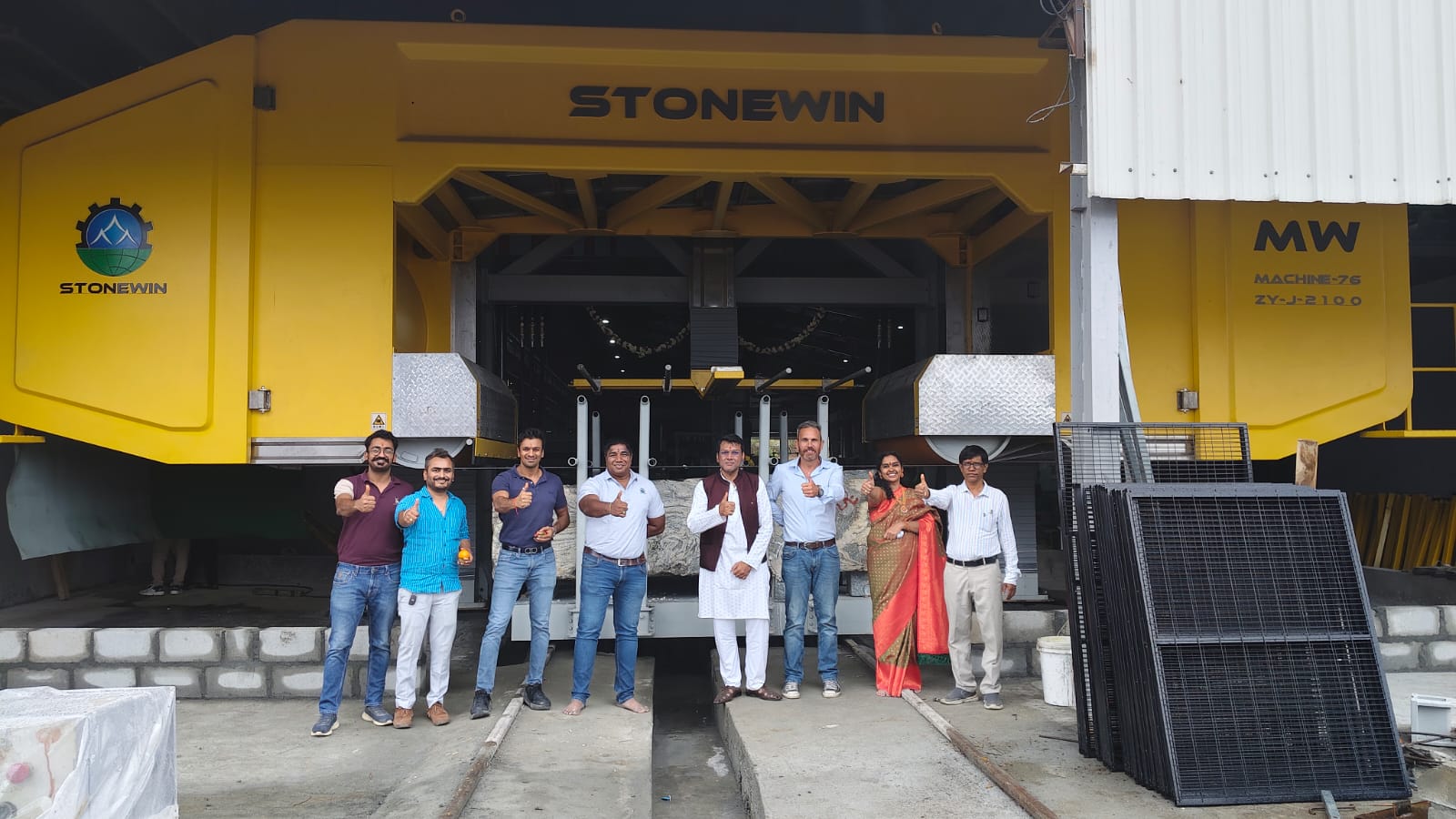
Documented installations include processing sites in Turkey, Algeria, Bulgaria and India. The application record also covers granite quarrying and marble quarrying operations, confirming that the ZY-MW series is not limited to one stone type. This matters to buyers because granite and marble have different hardness and cutting behavior, and the machine configuration must match the intended stone category.
Market trends in slab stone cutting equipment
Stonewin's export range covers India, the Arabian Peninsula, the Middle East, Africa, Europe, South America and Southeast Asia, with exports accounting for about half of total output. The geographic spread of installations suggests that multi-wire saw technology is being adopted in both emerging processing hubs and mature stone markets.
Buyer demand is also shifting toward machines that support intelligent production management. Stonewin's company profile describes its product strategy as meeting the green and intelligent development needs of the modern stone industry. The presence of IoT-based remote viewing in the ZY-MW series is a concrete signal of this direction: as plants become more automated, the ability to check cutting progress remotely moves from a convenience to a standard expectation.
Comparison with conventional slab cutting methods
| Dimension | Conventional slab cutting | Diamond multi-wire saw |
|---|---|---|
| Cutting principle | Blade frame or large circular blade; one slab surface at a time | Many parallel diamond wires; multiple slabs in one pass |
| Output per pass | Single-slab or single-frame output | Multiple slabs, proportional to wire count |
| Material loss in the cut | Relatively wide saw kerf | Thin diamond wire cutting profile (wire diameters 3.5–12 mm) |
| Machine footprint and installation | Varies by frame or blade size | Heavy installation: 22–80 tons, foundation required |
| Control and monitoring | Often manual or semi-automatic | Independent control system, automatic cutting, IoT remote viewing |
In terms of throughput per pass, the advantage is on the multi-wire side. The machine also removes less material in each cut because the active cutting tool is a thin diamond wire rather than a thick blade. Where conventional methods still matter is flexibility and entry cost. A plant that processes only occasional non-standard blocks may not be able to justify a 22-to-80-ton machine with a prepared foundation. A multi-wire saw also depends on a consistent supply of quality diamond wire and operators who understand tension and cutting parameter management. Buyers evaluating this technology should weigh the output gain against these infrastructure and operating requirements.
Future outlook
The direction of slab stone cutting technology is toward higher wire counts, tighter automation and stronger integration between the saw machine and the downstream processing line. Stonewin's product structure already reflects this logic: the company produces multi-wire saw machines, polishing lines, resin lines and the diamond wire saw itself, covering the main production stages of slab processing within one supplier ecosystem.
For plant operators, the practical consequence is simpler supply management and more predictable compatibility. When the cutting machine and the cutting wire come from the same manufacturer, the risk of mismatched consumables is reduced. As remote monitoring becomes a common procurement requirement, machines with IoT-based viewing capability are positioned for the next stage of digital production management.
Frequently asked questions
A slab stone cutting machine converts raw stone blocks into flat slabs for further processing. In modern stone plants, the diamond multi-wire saw machine is the core equipment for this stage, cutting multiple parallel slabs in a single pass.
A diamond multi-wire saw machine is a slab stone cutting machine that uses multiple parallel diamond wires under tension to cut stone blocks into slabs. Stonewin's ZY-MW series covers 5 to 90 wires, with a cutting size range of 3500 mm by 2200 mm.
Multi-wire saw machines are used for both granite and marble. Stonewin's application record documents installations in granite quarrying, marble quarrying and slab processing plants.
A traditional frame saw uses a reciprocating blade frame and typically cuts one surface at a time. A diamond multi-wire saw runs many wires in parallel, producing more slabs per pass and reducing material loss because the wire cutting profile is thin.
The primary specifications are the wire count, the cutting size range, the machine weight, the structural type (side-tension or top-tension), and the control and monitoring features. Buyers should match these parameters to their block size, output targets and plant conditions.
The machine requires a foundation. The operating environment should remain between 5°C and 40°C, with humidity not exceeding 50% at 40°C and not exceeding 90% at 20°C, and altitude not exceeding 1000 meters.
Have Questions or Need More Details?
Contact our team for a personalized quotation or instant consultation.
Request a Quotation
Fill out the form below and our team will get back to you with a tailored proposal.
WhatsApp Direct Chat
Prefer to chat in real-time? Message us on WhatsApp for instant assistance & quick answers.
- Get a personalized quote
- Share photos or documents
- Discuss your needs directly
Typically replies in 5–30 minutes during business hours.