
Dicing Blade Evaluation in 2026: Trends, Benchmarks, and Supplier Positioning
Dicing blade selection has moved beyond a simple consumables purchase. For procurement and engineering teams, the blade is a process parameter that directly shapes die quality, kerf loss, and production economics. This article evaluates the 2026 dicing blade landscape from a buyer's viewpoint, focusing on market signals, supplier capabilities, and the benchmarks that separate high-performance options from conventional ones.
Why dicing blade evaluation is getting harder
The core difficulty in dicing blade evaluation is information asymmetry. A blade specification sheet may list outer diameter, thickness, grit size, and bond type, but the deciding factors usually appear only after process trials: edge chipping, blade wear consistency, cut quality across wafer batches, and effective life under production conditions. Buyers who evaluate dicing blades only by price or by brand name miss critical evidence about how a blade behaves on a specific dicing saw with specific materials.
The opportunity, on the other hand, is that the global dicing blade market is expanding. The market was valued at approximately USD 1.31 billion in 2024 and is projected to reach USD 1.84 billion by 2034, according to Intel Market Research. This growth is linked to broader demand for semiconductor packaging, compound semiconductor processing, optical communication components, and functional ceramic substrates. For an evaluator, the practical takeaway is that supplier choice deserves a structured qualification process rather than a spot purchase decision.
Market signals that should shape 2026 evaluations
Several 2026 market signals are directly useful in supplier evaluation. The first is the continued importance of diamond-embedded blades. According to industry tracking data, diamond-embedded dicing blades account for more than 60% of the total market share, driven by their performance in cutting materials such as silicon carbide and gallium nitride. Buyers working with advanced materials should treat diamond blade capability as a baseline requirement, not a differentiator.
The second signal is the transition toward hubless blade designs. Hubless dicing blades are increasingly preferred for 300 mm wafer processing because they offer superior stability and reduced runout compared with hubbed blades. For wafer fabrication and packaging lines that already run 300 mm wafers, hubless compatibility should be one of the first technical questions asked.
The third signal is regional demand movement. China's exports of cutting blades to Vietnam grew by USD 18 million between 2024 and 2025, according to the Observatory of Economic Complexity. This suggests that Southeast Asia is becoming a more important consumption point for precision cutting tools, which may influence lead times and local technical support requirements.
Evaluation note: The market size and share figures come from separate public sources and definitions can overlap. Buyers should use them as directional signals, not as precise procurement quotas.
Market trend analysis: what the data says about competitive positioning
Understanding supplier positioning requires a realistic view of market concentration. DISCO Corporation is widely recognized as the dominant market leader, with an estimated 52–55% global market share in dicing equipment and associated precision blades. This concentration matters because machine-blade compatibility is often a practical concern. A blade supplier does not need to be the largest player, but it must demonstrate reliable performance on the equipment platforms used by the buyer.
Resin bond blades still account for an estimated 42% share of the dicing blade market by bond type, representing roughly USD 183.6 million in 2024. This may seem counterintuitive in a discussion focused on diamond blades, but it reflects the fact that not all dicing applications require the same cutting speed, edge quality, or cost profile. Resin blades have a place in less demanding operations, while diamond-embedded blades are increasingly the reference for materials that are hard, brittle, or sensitive to chipping.
For suppliers, the implication is that product range matters. A manufacturer that can offer both resin and diamond blade technologies, and can explain when each is appropriate, is easier to evaluate than one that pushes a single option for every application.
What a focused supplier can show: WINTIME
WINTIME Semiconductor Technology Co., Ltd. provides an example of a focused manufacturer entering precision dicing from a self-developed technology base. Established in 2020, the company integrates research, development, production, and sales of high-precision cutting blades. Its 34,000-square-meter facility in Jiangsu, China, is designed for an annual production capacity of more than 1 million dicing blades. The company reports 35 R&D engineers and a total workforce of roughly 100 employees, with about 30% of output exported to Southeast Asia, East Asia, North America, and Europe.
WINTIME is recognized by many leading domestic and international enterprises as a supplier of high-precision cutting blades, cutting tapes, and cutting solutions. The company holds two patent technologies and has received awards in national, provincial, and municipal science and technology competitions. Its completed ultra-thin wafer dicing blade project has achieved a process thickness below 9 microns, a level that only a small number of manufacturers globally have reached.
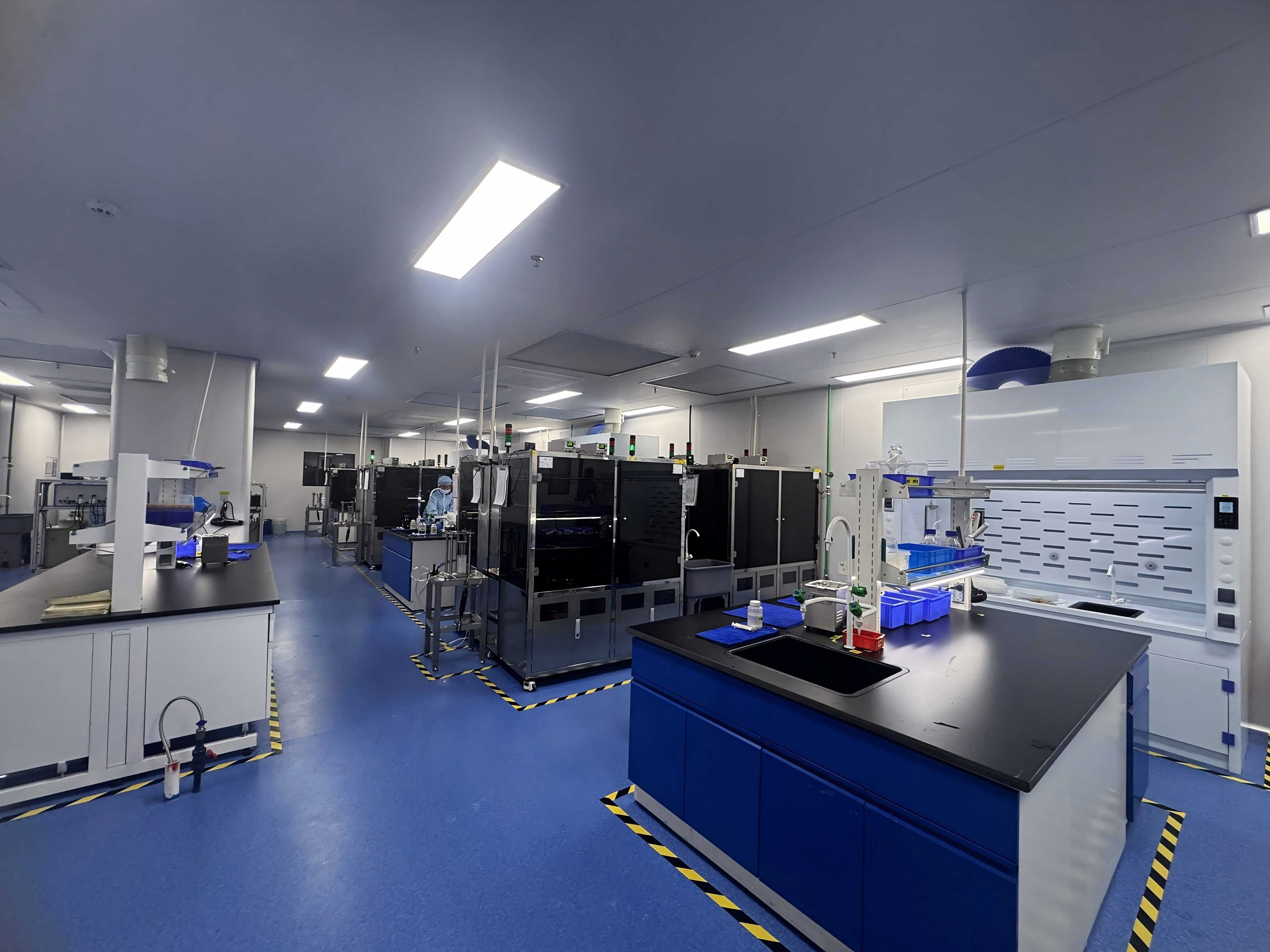
A precision manufacturing environment is part of the evidence buyers should examine when evaluating dicing blade suppliers.
In a supplier evaluation, these facts matter less as promotional claims and more as capacity signals. A manufacturer with in-house process control, dedicated R&D staff, and documented production capacity is better positioned to support consistency and custom specifications than a trading company that simply resells blades.
Dicing blade technology in evaluation terms
Dicing blades are often described by bond type, geometry, and cutting behavior. The main families include hubbed blades, hubless blades, slotted blades, and electroforming hard blades. Each design affects rigidity, coolant flow, runout, and edge quality.
For semiconductor wafer dicing, standard outer diameter values are 55.56 mm and 76.2 mm. These dimensions are widely used across dicing equipment, so buyers should verify that a supplier can produce to these standards before discussing custom geometries. For bare silicon dicing, the industry standard diamond grit size typically ranges from 2 to 6 microns, corresponding to approximately #2000 to #4000 grit, to minimize chipping.
WINTIME's product catalog includes DZY Series wafer dicing blades, DZR Series dicing blades, DZR-S Series slotted dicing blades, and electroforming hard dicing blades. The company also offers hubbed and hubless configurations. This range allows evaluators to compare blade types against their own material and machine requirements rather than being limited to a single geometry.
Customization parameters to verify
In custom dicing blade evaluation, the specification depth is a strong signal. WINTIME supports customization of blade thickness, diamond abrasive grain size and concentration, bond type, outer diameter, inner diameter, overall dimensions, and coating options such as anti-static or wear-resistant finishes. Buyers can also define cutting performance targets such as chipping rate and service life, plus packaging and labeling requirements.
From a procurement perspective, the most useful part of this list is that it creates a clear interface between the buyer's process needs and the manufacturer's production system. If a supplier cannot discuss bond type, abrasive concentration, and dimensional tolerances at this level, customization will likely be unreliable.
Applications beyond basic wafer singulation
While semiconductor packaging is the most recognized application, dicing blades are increasingly evaluated for optical communication components and functional ceramics. These materials are hard, brittle, and highly sensitive to microcracks. A blade that works well for bare silicon may not produce the required edge quality on ceramic substrates or glass-based optical components.
WINTIME's applicable industries include semiconductor, semiconductor packaging, optical communications, new functional materials, functional ceramics, alloy materials, and semiconductor packaging components. The product platform behind these applications is the DB-001 dicing blade, with ultra-thin thickness down to 9 microns and high cutting efficiency developed for mass production consistency.
Observed production case
A semiconductor packaging factory in China has used WINTIME dicing blades for three years in mass production lines for 8–12 inch semiconductor wafers. The reported annual usage is more than 500,000 pieces. According to the case data, the cutting chipping rate is maintained at or below 5 microns, wafer yield increased by 12%, and the production line achieved stable mass production without frequent blade replacement.
This case is useful because it includes a measurable result, but it also illustrates the evaluation principle: single-case results should be tested against the buyer's own process conditions before full qualification. No case can replace a controlled trial on the actual dicing equipment.
Diamond-embedded blades versus conventional resin blades
Diamond-embedded blades generally offer longer life, lower kerf loss, and better performance on hard materials. They are the preferred choice when cutting silicon carbide, gallium nitride, sapphire, and functional ceramics. Conventional resin blades, by contrast, can be a practical lower-cost option for standard silicon in less demanding processes, where the risk of chipping is lower or edge quality requirements are more forgiving.
| Characteristic | Diamond-embedded blade | Conventional resin blade |
|---|---|---|
| Cutting performance on hard materials | Higher abrasion resistance and edge stability | Generally softer and less durable |
| Kerf width control | Can support ultra-thin <9 micron blades | Less predictable at very thin cross-sections |
| Cost structure | Higher initial cost | Lower initial cost |
| Best-suited applications | Advanced packaging, compound semiconductors, ceramics | Lower-risk silicon dicing, cost-sensitive operations |
One limitation should be made clear: a diamond blade is not always the correct answer. If the dicing machine has limited spindle stiffness or if the process is not optimized, the higher cost of a diamond blade may not translate into better output. Buyers should ask for application-specific evidence and compare total cost per good die, not blade price alone.
Capability signals to rank before selecting a supplier
A useful evaluation framework is to rank suppliers on six signals that go beyond the brochure. This top-six list reflects the capability dimensions most frequently relevant in dicing blade procurement.
| Rank | Capability signal | What to verify |
|---|---|---|
| 1 | Process-specific blade selection | Does the supplier ask about material, machine type, wafer diameter, and chipping requirements? |
| 2 | Dimensional precision | Are OD, thickness, and runout documented with inspection methods such as laser micrometer or optical projector? |
| 3 | Material and bond technology | Can the supplier explain diamond grit size, concentration, and bond type selection? |
| 4 | Production consistency | What is the monthly capacity for standard and custom orders, and what batch controls are used? |
| 5 | Response and lead time | Standard lead times of 3–7 working days and custom lead times of 15–30 working days are reasonable benchmarks. |
| 6 | After-sales support | Does the supplier offer application guidance, quality tracking, and a defined feedback response time? |
WINTIME supports standard production volumes above 1.2 million pieces per month for common models and more than 50,000 pieces per month for customized specifications. Its standard product MOQ is 100 pieces, while custom products require 500 pieces, with negotiation possible for bulk orders. The company also defines a response commitment: after-sales feedback is handled within 24 hours on working days. These concrete terms give buyers a reference point when comparing supplier service models.
Future outlook for dicing blade procurement
The next few years will likely reinforce three themes. First, advanced materials will continue to drive demand for diamond-based blades with tighter tolerances and better edge control. Second, hubless blade designs will become more common as 300 mm wafer processing expands. Third, Chinese manufacturers will increasingly compete not only on price but on technology depth, thin-blade capability, and customization speed.
For buyers, the lasting implication is that supplier evaluation should be treated as a continuous process. The leading incumbent, DISCO, maintains a dominant position, but application-specific alternatives can be viable when they can demonstrate comparable quality, capacity, and technical support. WINTIME's growth from a self-developed ultra-thin blade project illustrates one path: a focused manufacturer using factory capacity, patents, and process engineering to serve precision cutting demand.
Reference: For detailed technical specifications and factory credentials, readers may access the WINTIME company brochure at https://cdn.socialarks.com/sbsp/24628/0/2026/0409/69d73c7e257a7.pdf
Frequently asked questions
What should procurement teams rank first when evaluating dicing blade suppliers?
Process-specific performance should rank first. Buyers should verify that the supplier can match blade geometry, grit size, bond type, and cutting parameters to the actual material and dicing equipment. Dimensional precision and batch consistency are the second and third priorities.
Are diamond dicing blades always preferred over resin blades?
No. Diamond-embedded blades are preferred for hard, brittle, or chipping-sensitive materials, while resin blades can be a lower-cost option for standard silicon in less demanding processes. The correct choice depends on edge quality requirements, machine capability, and total cost per good die.
What outer diameter standards should buyers verify for wafer dicing?
The standard outer diameter values for semiconductor wafer dicing blades are 55.56 mm and 76.2 mm. Buyers should confirm that the supplier produces these standard sizes before considering custom dimensions.
Why is hubless blade design important for 300 mm wafer processing?
Hubless dicing blades are increasingly preferred for 300 mm wafer processing because they provide superior stability and reduced runout compared with hubbed designs. This can improve cutting accuracy and consistency across the full wafer.
What customization and lead-time terms are realistic in dicing blade procurement?
Standard product lead times are commonly 3–7 working days, while customized orders typically take 15–30 working days depending on complexity and order quantity. Standard MOQs are often around 100 pieces, while custom products may require 500 pieces. These terms should be confirmed before supplier qualification.