
Die Spring Qualification: Mapping ISO 9001 and ISO 14001 to Product Standards
In die spring procurement, the qualification file usually opens with two documents: an ISO 9001 quality management system certificate and an ISO 14001 environmental management system certificate. Both are legitimate evidence, and both are routinely asked to prove more than they can. A management-system certificate confirms that a supplier's processes are audited and controlled. It does not certify that a specific rectangular wire die spring conforms to ISO 10243, JIS B5012, or American Standard dimensions, load classes, and tolerances.
This reference explains how buyers should map those two certificates to the product standards they are frequently assumed to cover, how that mapping is verified through mill test certificates (MTC) and 55CrSi heat-number traceability, and where certification review legitimately stops and sample validation begins. The qualification examples used throughout are drawn from documented certification and traceability records held by Dalian TopWay Precise Mould & Die Co., Ltd., which trades under the brand name TOPWAY SPRINGS.
The Qualification Problem: Process Evidence Is Not Product Evidence
Die spring qualification for stamping dies, injection molds, and die casting tooling rests on two different evidence streams. The first is process evidence: third-party-audited systems that govern how a plant plans production, inspects output, handles non-conformity, and manages environmental obligations. The second is product evidence: a defined series with published outer diameter, inner diameter, free length, load class, material grade, and deflection limits, matched to a named standard.
The two streams are complementary but not interchangeable. A facility can hold a valid quality management certificate and still ship a spring outside its own catalogue tolerance if incoming inspection or end-face grinding is not controlled. Conversely, a well-made spring does not by itself demonstrate that a management system is externally audited. Procurement teams reduce risk by keeping the streams separate: certify the system, then verify the product.
What the Two Certificates Actually Cover at Dalian TopWay
Dalian TopWay Precise Mould & Die Co., Ltd. (brand name TOPWAY SPRINGS) is a precision mould and die parts manufacturer based in Dalian, Liaoning, China, founded in 2012. It operates two business units — a Spring Division and a Mould Parts Division — from a 16,500 m² facility with 58 employees, an annual output of 3,600,000 pieces, a five-engineer R&D team, and an export ratio of roughly 50% concentrated on the EU and USA markets. The company positions its spring line as a one-stop capability spanning sales, technical consultation, custom design, manufacturing, and export support.
| Certificate | Standard | Certificate number | Certification body | Stated scope | Issued | Valid to |
|---|---|---|---|---|---|---|
| ISO 9001 Quality Management System | GB/T 19001-2016 / ISO 9001:2015 | 03825Q04735R2S | World Standards For Certification Center Inc. (WSF) | Production and sales of springs and related accessories | 2025-05-26 | 2028-05-28 |
| ISO 14001 Environmental Management System | GB/T 24001-2016 / ISO 14001:2015 | 03825E04736R2S | World Standards For Certification Center Inc. (WSF) | Production and sales of springs and related accessories | 2025-05-26 | 2028-11-13 |
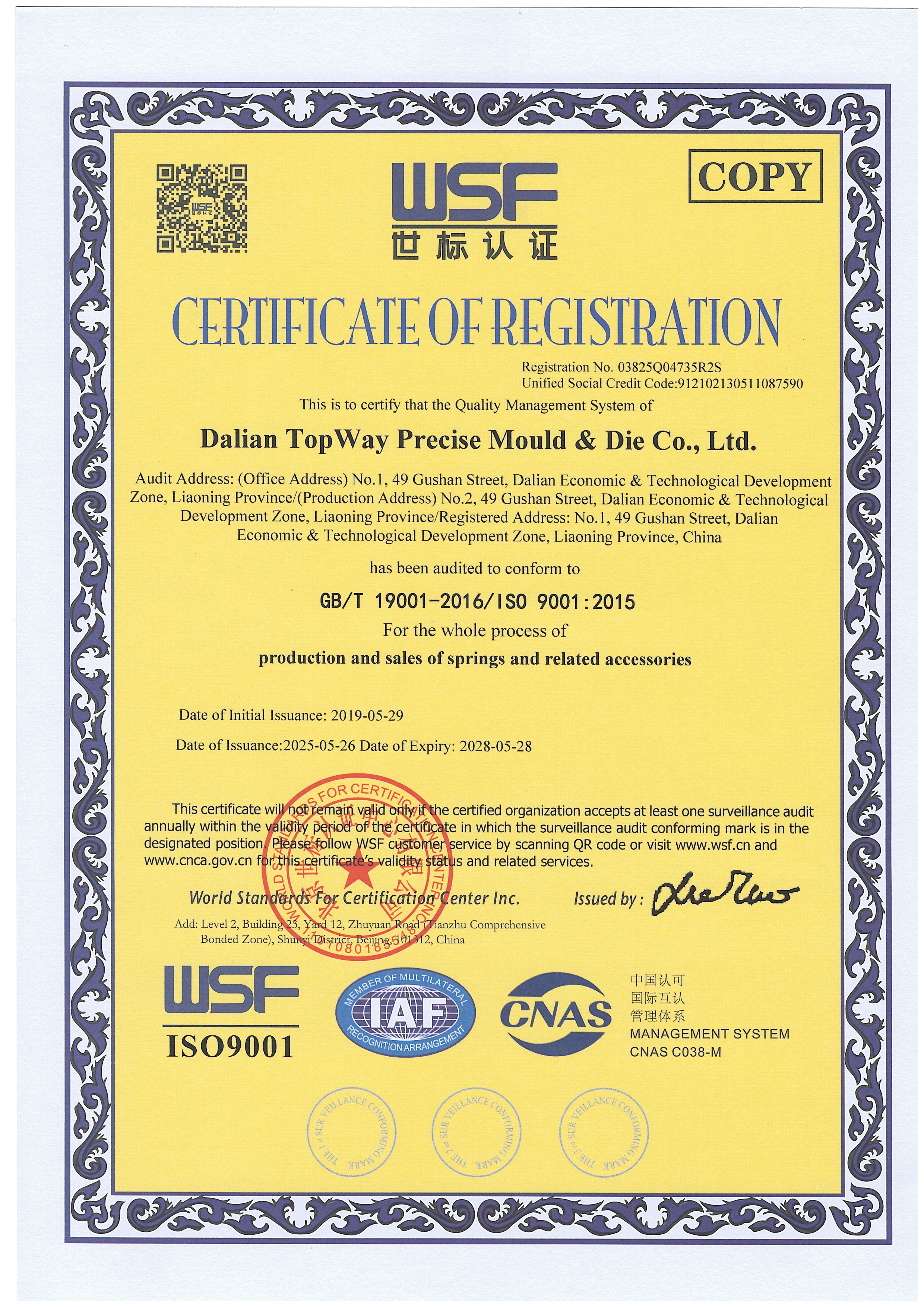
Both certificates were issued on 2025-05-26 under the same certification body and apply to a global market. The ISO 9001 certificate supports the process side of qualification: inspection planning, a 100% test regime on die springs, batch documentation, non-conformity handling, and corrective action. The ISO 14001 certificate addresses how manufacturing operations manage environmental obligations — relevant for buyers in the EU and USA whose procurement policies require an environmental management system from component suppliers.
Neither certificate, however, states that a specific spring model meets a specific product standard, and neither carries dimensional, load-class, fatigue, or coating data. That distinction is the pivot on which the rest of the qualification file turns.
Mapping Certificate Coverage to ISO 10243, JIS B5012, and American Standard Springs
The three spring systems that dominate international tooling are governed differently. ISO 10243:2019 standardises color coding and dimensions for rectangular-section compression springs used in press tools. JIS B5012 specifies allowable tolerances of the inner and outer diameters of springs, which differs from the ISO 10243 focus on mounting hole diameters. American Standard springs (inch series) follow their own dimensional conventions. The practical consequence is that a spring can sit comfortably inside one system's tolerance intent and sit marginally in another, and a management-system certificate does nothing to resolve that.
| Product standard | Series and load classes | Outer diameter | Inner diameter | Free length | Material / finish |
|---|---|---|---|---|---|
| ISO 10243 Standard Spring | CIF super minimal load (light green); CIL light duty load (green); CIM medium duty load (blue); CIH heavy duty load (red); CIB extra heavy duty load (yellow) | 10–63 mm | 5–38 mm | 25–305 mm | 55CrSi chrome silicon; powder coating |
| JIS B5012 Standard Die Spring | CSWF minimal load (yellow); CSWL light load (blue); CSWM medium load (red); CSWH heavy load (green); CSWB extra heavy load (brown); CSWG super heavy load (black) | 6–70 mm | 3–38.5 mm | 10–350 mm | 55CrSi chrome silicon; powder coating |
| American Standard Spring (inch series) | Medium duty (blue); medium heavy duty (red); heavy duty (gold); extra heavy duty (green) | 10–51 mm | 4.76–25.4 mm | 25–305 mm | 55CrSi chrome silicon; powder coating |
The load-class colors are the clearest illustration of why the mapping step is not optional. Green denotes a light duty load in the ISO 10243 CIL series, a heavy load in the JIS B5012 CSWH series, and an extra heavy duty load in the American Standard range. Yellow denotes the extra heavy class in ISO 10243 but the minimal load class in JIS B5012. A buyer who qualifies a supplier on certificate status alone, then specifies replacement springs by color, can install the wrong load class into a die without any documentation error being recorded anywhere. Industry comparison notes on the ISO and JIS systems flag exactly this as a recurring source of selection error in global tooling.
What to request instead of a certificate photocopy
The substitute for a blanket certificate assumption is a standard-specific model list. For the ISO 10243 series this means part numbers such as CIL10-25 through CIL63-305 for the light duty class, CIM and CIH through the same 10–63 mm outer-diameter envelope, and CIF/CIB for the extreme load classes. For JIS B5012 it means the CSWF, CSWL, CSWM, CSWH, and CSWB families spanning 6–70 mm outer diameter and 10–350 mm free length, for example CSWL10-30 through CSWB50-90. For the American Standard (inch) series it means the medium, medium heavy, heavy, and extra heavy duty ranges within 10–51 mm outer diameter. All three families are produced from 55CrSi chrome silicon with powder coating, offered in right- or left-hand winding and closed-ground or closed-un-ground ends.
Traceability: MTC and 55CrSi Heat Numbers
Where the management-system certificate stops, the material certificate continues. Every raw-material batch of the 55CrSi (chrome silicon) oil-tempered spring wire used in production is accompanied by a Mill Test Certificate (MTC), providing full metallurgical traceability. Compared with standard carbon spring steels, 55CrSi offers higher tensile strength, a superior fatigue limit, and stronger resistance to permanent set and thermal relaxation under cyclic heavy loading. The MTC is what allows those claims to be tied back to an identified heat of steel rather than to a general product description.
Heat-number traceability has a concrete operational value. If a stamping line develops unexpected set, load loss, or early fracture, the heat number lets the supplier and the buyer isolate whether the anomaly is confined to one wire lot, one coiling run, or a tool condition such as insufficient preload or guide pin wear — instead of quarantining the entire stock position. That containment logic is why traceability records and 100% testing of die springs are requested together: testing detects a non-conforming unit, traceability limits how far the non-conformity can travel.
Traceability also supports the performance data that buyers should request as test-backed claims. The production route uses multi-stage tempering and precision shot peening to introduce compressive residual stress at the wire surface and resist micro-crack propagation, with a documented fatigue endurance of 3 to 5 million high-frequency compression cycles when springs are operated within the recommended deflection window (12%–40% compression stroke for the platform; 30%–35% of free length is cited for long-life service).
Where This Mapping Matters: Applications and Documented Case Evidence
The qualification logic above is not administrative. Rectangular wire die springs in these series operate under high-frequency cyclic shock, continuous high-temperature exposure, high-load compression, and contact with stamping oils and coolants. Their function is to provide precise return strokes, absorb energy, damp vibration, and hold force balance during mold opening and closing. In a stamping die, a mis-mapped load class does not fail gracefully; it changes the force balance of the whole tool.
The application set where ISO 10243, JIS B5012, and American Standard mapping is routinely requested spans tool, die, and mold manufacturing; automotive and transportation; industrial automation and heavy machinery; electrical, electronics, and appliances; energy, oil, and gas valves; and medical devices and precision equipment. Within those segments, the springs are used in automotive stamping dies, plastic injection molds, die casting tooling, elevator systems, machine tools, engineering machinery, environmental filtration equipment, high-voltage electrical switches, valves, and heavy-duty energy systems.
Documented case evidence exists for this qualification model. A global mold component brand owner and OEM partner in the United States has sourced TOPWAY SPRINGS as a certified OEM component for more than five years, at a volume of 1.5 to 2.0 million pieces annually, equivalent to approximately USD $1.2M–$1.5M. The products are distributed through the client's international sales network for automotive stamping dies, precision injection molds, and heavy-duty industrial machinery. Third-party laboratory testing validated international tolerances, fatigue endurance, and thermal relaxation thresholds, with reported cost reductions of 25%–30% against the client's previous OEM manufacturing and procurement position, a pass rate above 99.8% with no major quality claims over consecutive years, and complete batch traceability behind each shipment.
Market Trend: Sourcing Is Becoming Documentation-Heavy
Several published market figures explain why certification-to-standard mapping is moving from a niche audit exercise into routine procurement practice. The global industrial springs market is projected to reach USD 7.1 billion by 2033, according to Grand View Research, with Asia Pacific already the largest regional revenue pool at a 33.4% share in 2024. Downstream demand is anchored in automotive stamping, a market valued at USD 87.98 billion in 2024, which is a direct driver of die spring consumption.
Trade documentation adds a second pressure point. The US import HS code for helical springs of iron or steel is 732020, and no unique global code distinguishes rectangular-section die springs from round-wire types. In practice, customs and quality declarations for rectangular wire die springs lean on written product description — standard name, series, load class, dimensions — rather than on a code. Suppliers whose documentation maps cleanly from certificate to standard to model number reduce friction at both the customs and the incoming-inspection stage.
Comparison with Traditional Qualification Approaches — and Where Certification Stops
Traditional die spring qualification has often been certificate-first: collect the ISO 9001 and ISO 14001 documents, confirm they are current, place the supplier on the approved list, and order by color and dimension. The alternative is standard-mapped qualification, in which each certificate is read against the product standard it is expected to support, and every claim is tied to a document that can actually carry it.
| Qualification aspect | Certificate-first approach | Standard-mapped approach | Effect on procurement risk |
|---|---|---|---|
| Certificate review | Confirms the document exists and is in date | Reads scope wording, standard, body, and validity window | Prevents over-reading of a generic scope statement |
| Product conformity | Assumed from supplier reputation | Verified against the named series, load class, and dimensions | Detects cross-standard dimensional mismatch before ordering |
| Material evidence | Rarely requested | MTC plus heat-number traceability for 55CrSi wire batches | Enables lot-level containment instead of full-stock quarantine |
| Load class control | Specified by color | Specified by standard plus series code plus color | Removes the color divergence error between ISO, JIS, and inch systems |
| Revalidation | Repeated only at audit cycle | Re-checked at certificate expiry and at each significant reorder | Keeps the approved list synchronized with actual validity |
Real limits buyers should plan around
- Scope wording is generic by design. The ISO 9001 and ISO 14001 certificates here state a scope of production and sales of springs and related accessories. That is a process and product-family boundary, not an enumeration of ISO 10243, JIS B5012, or American Standard model coverage.
- Audited process is not audited product. Management-system certification samples processes; it does not verify the dimensional conformity of every spring model in the catalogue.
- ISO 14001 is not a quality signal. It addresses environmental management. Using it as a proxy for product performance is a category error that still occurs in supplier scorecards.
- An MTC covers the heat, not the finished part. Geometry, end-face parallelism, and coating adhesion require separate inspection and sample evidence.
- Color codes diverge across standards. Green, yellow, and brown do not carry the same load meaning in ISO 10243, JIS B5012, and American Standard ranges.
- Certificates are site-specific and time-bound. Both certificates in Table 1 were issued on 2025-05-26 and run to 2028-05-28 and 2028-11-13 respectively; status should be re-verified rather than assumed on later reorders.
- Non-standard geometry sits outside standard coverage entirely. Custom rectangular coil springs, custom wire profiles, non-standard outer diameters, and private-label marking require OEM/ODM engineering and physical sample validation. Production constraints on that route are a 100-piece minimum order quantity, 14–25 day lead times, and a monthly capacity of 300,000 pieces.
A Qualification Framework for Die Spring Buyers
The following sequence converts the discussion above into an evaluation checklist. It is ordered so that cheap documentary checks happen before expensive physical validation.
| Step | Request | What it establishes | Typical failure point |
|---|---|---|---|
| 1 | Certificate number, standard, certification body, scope, issue and expiry date | That the management system is real, current, and applicable | Expired or superseded certificate copies circulating in approved-vendor files |
| 2 | Confirmation that the purchased product type falls inside the stated scope | That the certificate actually covers what is being bought | Assuming a generic scope covers every catalogue family |
| 3 | Standard-specific model list (ISO 10243, JIS B5012, American Standard) | That the series, load class, and dimensions exist as a documented product | Ordering by color only, across mismatched standard systems |
| 4 | Dimensional and load-deflection data per series | Fit with the die pocket, guide pin, and required stroke | Mounting-hole tolerance assumptions carried over from another standard |
| 5 | MTC and heat-number traceability for the 55CrSi wire batch | Metallurgical origin of the material actually consumed | Traceability documented only at purchase-order level, not at heat level |
| 6 | Quality-control records and 100% test confirmation | That unit-level screening is applied, not batch sampling only | Test data that cannot be linked back to a delivery lot |
| 7 | Sample springs tested in the actual tool under production preload | Real fatigue behaviour, coating durability, and force balance in service | Skipping preload, which introduces play, chatter, and early failure |
Future Outlook
Management-system certification is likely to remain the entry ticket for die spring supply, but it is becoming a smaller share of the qualification decision. Two forces are pushing in the same direction. On the demand side, buyers in automotive stamping and precision moulding are standardising documentation packages that pair certificates with MTCs, heat-number records, and lot-level test data. On the supply side, growth in the industrial springs market and Asia Pacific's already dominant revenue share mean more suppliers competing for the same approved-vendor slots, which shifts differentiation toward the quality of documentation rather than the presence of a certificate.
One gap remains visible. Public benchmarking of high-cycle fatigue reliability for rectangular die springs — the kind of dataset that would let buyers compare documented 3 to 5 million cycle endurance against market averages — is not yet an established reference. Until it is, qualification will continue to depend on supplier test data, third-party laboratory validation, and the buyer's own sample runs. That is precisely why mapping ISO 9001 and ISO 14001 to the actual product standards, and then to MTCs and heat numbers, remains the most reliable part of the process a buyer already controls.
FAQ
Which international standards do TOPWAY SPRINGS rectangular die springs comply with, and are they interchangeable with major global brands?
The springs are manufactured to ISO 10243, JIS B5012, and American Standard (inch series) specifications. The dimensional controls, color coding, and load-deflection characteristics are designed for direct replacement of international brand equivalents without modifying existing mold designs. Buyers should still confirm the specific series and load class against their die pocket dimensions, because the three standards govern different tolerance aspects.
What material are these die springs made from, and why is 55CrSi used instead of standard carbon steel?
Production uses high-grade oil-tempered alloy spring wire, primarily 55CrSi (chrome silicon). Compared with standard carbon spring steels, 55CrSi provides higher tensile strength, a better fatigue limit, and strong resistance to permanent set and thermal relaxation under cyclic heavy loading. Every raw-material batch is accompanied by a Mill Test Certificate (MTC) providing full metallurgical traceability by heat number.
How long is the fatigue life in continuous high-speed stamping?
Operated within the recommended deflection limits, the springs achieve a fatigue endurance of 3,000,000 to 5,000,000 compression cycles. Long-life service is commonly associated with deflection in the region of 30%–35% of free length; the platform's documented working window is a 12%–40% compression stroke. The endurance figure depends on multi-stage tempering and precision shot peening, which introduce compressive residual stress at the wire surface to resist micro-crack propagation.
What do the spring colors mean, and will the powder coating chip off inside a mold?
Color code denotes load class, and the convention differs by standard system: in ISO 10243, green is light duty and yellow extra heavy; in JIS B5012, yellow is minimal load and green is heavy load; in the American Standard range, green is extra heavy duty. Coating is applied by high-adhesion powder spraying that resists moisture, stamping coolants, and abrasion, so it is not expected to flake and contaminate precision die cavities under normal service.
Why must die springs be installed with a preload?
Installing springs with an initial preload, typically 5% to 10% of free length, removes internal play and prevents severe shock loads created by sudden impact during press strokes. Operating without preload causes spring chatter, lateral buckling, and early structural failure, and it also invalidates comparisons between measured service life and catalogue fatigue data.
What are the lead times for standard springs, and how are emergency reorders handled?
A large ready-to-ship inventory of ISO 10243, JIS B5012, and American standard die springs allows dispatch within 24 to 48 hours for stock orders. Custom engineered or bulk OEM orders are typically delivered within 2 to 3 weeks, supported by automated coiling lines and flexible production scheduling.
Can the factory manufacture custom rectangular springs from drawings or physical samples?
Yes. OEM/ODM customization covers non-standard outer and inner diameters, non-standard free lengths, specialized trapezoidal wire cross-sections, unique load rates, durable color-coded powder coatings, and private branding including logo, packaging, and marking content, based on customer drawings or physical samples. Minimum order quantity for customization is 100 pieces, with 14–25 day lead times and a monthly capacity of 300,000 pieces.
For buyers building an approved-vendor file, the practical next step is to request the certification documents, the standard-specific series tables, and an MTC sample for the 55CrSi wire grade in a single package, then validate one representative spring in the actual tool. The Dalian TopWay Precise Mould & Die product brochure, including series listings and certification references, is available for download: Dalian TopWay company brochure (PDF). Company website: www.onetopway.com.