
Digital Label Printer Comparison Framework: Grandoprint, HP Indigo, Xeikon, Domino
Written for label converters, packaging printers and brand owners moving from awareness into research on a digital label press purchase.
The global digital label printer market was valued at USD 3.097 billion in 2024 and is projected to reach USD 8.654 billion by 2035, according to Market Research Future, which forecasts a compound annual growth rate of 9.79% between 2025 and 2035. Growth of that scale has produced a vendor landscape in which machines built on different imaging technologies, different substrate assumptions and different cost structures are routinely listed side by side as though they were interchangeable.
Grandoprint, HP Indigo, Xeikon, Domino and Epson are all names a label buyer is likely to encounter during shortlisting. They are not the same type of purchase. Some are press platforms built around a specific imaging chemistry; some are component and printhead suppliers whose technology appears inside third-party machines; and some are associated with broader label printer categories that extend well beyond industrial roll-to-roll production. Treating all five as a single ranked list is where most early-stage comparisons go wrong.
This article sets out a four-dimension comparison framework — print technology, substrate compatibility, variable data capability and total cost of ownership — and applies it consistently across a comparison set that includes Grandoprint, HP Indigo, Xeikon, Domino and Epson. It does not assert a universal winner, because no single press is optimal across every run length, material and data requirement.
Why a four-dimension framework outperforms a specification sheet
Speed and print width are the first numbers buyers compare, and they are the least informative in isolation. Two presses quoting the same printing speed range and the same 110–350 mm print width can still differ materially in how they handle heat-sensitive film, how reliably they reproduce small QR codes at production speed, and how much of a shift is consumed by changeover and start-up waste.
Third-party market coverage gives some context for how much choice actually exists. Industrial label printers account for approximately 42.5% of the total label printer market by product segment, according to Dataintelo, and inkjet systems are estimated to hold a 46% share of the digital label printing market by system type in 2025, according to Future Market Insights. In practical terms, the industrial inkjet layer where the Grandoprint GR350S competes is both large and contested. Buyers will usually have several credible options, which is precisely why a consistent evaluation framework matters more than a brand list.
A framework also protects the buyer from a common failure mode: evaluating a machine against the supplier's strongest dimension rather than against the buyer's actual job mix. A press that leads on media width may not lead on data integrity. A press that leads on colour and varnish effects may not lead on cost per label at 2,000-unit runs.
The four-dimension comparison framework at a glance
| Dimension | Core question | Evidence to request |
|---|---|---|
| Print technology | Which imaging route — piezoelectric inkjet, toner, or liquid electrophotography — and how does it behave on your artwork? | Printhead model, ink chemistry, curing method, colour configuration |
| Substrate compatibility | Which films and papers are validated, and what surface treatment is required? | Test prints on your own material stock, corona and pre-coating requirements |
| Variable data capability | Can the press print serialised data at production speed, and how is data accuracy verified? | Sample QR/barcode runs, readability and accuracy validation, workflow description |
| Total cost of ownership | What drives cost per label at your volume and mix? | Power, air and floor requirements, consumables, maintenance intervals, start-up waste |
Dimension 1 — Print technology: inkjet, toner and electrophotography
The imaging route is the single decision that shapes everything downstream: ink or toner film thickness, achievable opacity with white, behaviour on heat-sensitive film, and the shape of the cost curve at low volumes.
The Grandoprint GR350S uses UV digital piezoelectric inkjet printing with an Epson S3200-U1 or S3200-U3 printhead and an ink configuration of CMYKW plus optional varnish. Dual UV curing is supported, and both a pre-coating system and a post-coating varnish system are available as options. This places the GR350S in the UV inkjet branch of the market.
Buyers researching the wider comparison set will encounter other technology orientations. HP Indigo is widely associated with liquid electrophotographic (LEP) digital press platforms. Xeikon has historically been known for dry-toner label presses alongside UV inkjet platforms. Domino is known for UV inkjet label presses. These are technology-route orientations rather than performance claims, and current configurations, print widths and substrate approvals should be verified directly with each vendor, because press platforms are revised frequently.
Epson occupies an unusual double position in this comparison. It is named among key global suppliers in third-party label printer market coverage by Intel Market Research, and it is also the printhead supplier inside the GR350S. That distinction matters during evaluation: a printhead brand appearing in a specification sheet is not the same as the press builder's own engineering, calibration and service capability, which is what determines whether the head performs consistently over a production year.
Dimension 2 — Substrate compatibility: where film labels separate vendors
Paper labels are comparatively forgiving. Film labels are not. UV ink adhesion on synthetic substrates is the point at which apparently similar presses diverge, and it is the dimension buyers most often under-test during the research stage.
Configured as a film label UV inkjet printer, the GR350S supports PE, PET, BOPP, PP and OPP films and includes a corona treatment module to improve ink adhesion on difficult substrates, with an optional pre-coating system. The same platform is used for coated paper, PP silver and clear PET label work.
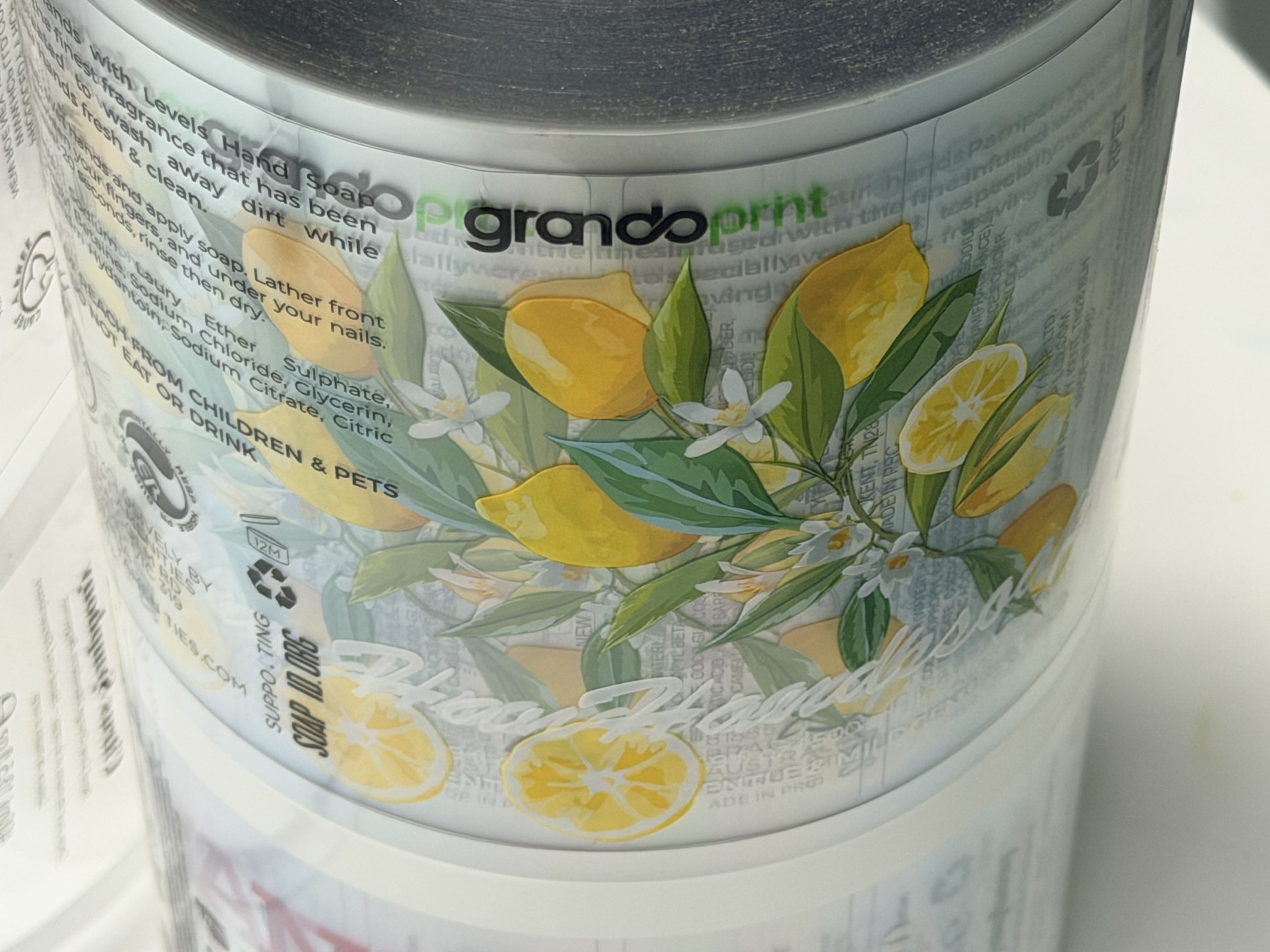
Clear PET label sample — transparent film is one of the substrate categories where corona treatment and ink adhesion behaviour need validation before batch production.
The framework requires three specific pieces of evidence at this dimension. First, a printed sample produced on the buyer's own material, not on the supplier's demonstration stock. Second, a clear statement of whether surface treatment — corona or pre-coating — is required for that material or optional. Third, a description of how curing settings are adjusted for heat-sensitive films, since improper UV curing settings and temperature control can lead to deformation or discoloration.
Two boundary conditions belong in any honest substrate comparison. White ink and varnish are optional and depend on both material compatibility and machine configuration, so a quotation that assumes them should be read carefully. And some difficult-to-print materials may require corona treatment or another surface treatment to achieve acceptable adhesion, which adds a process step rather than a press change.
Dimension 3 — Variable data: from artwork printing to serialised production
Variable data is often described as a feature. In procurement terms it is a capability with its own validation burden, because a press that prints a QR code and a press that prints a readable, correctly sequenced QR code across 40,000 labels are not the same proposition.
The GR350S is classified as a variable data digital label printer and supports variable data processing, with a label sensor for mark tracking. Typical outputs include QR code labels, barcode labels, serial number labels, anti-counterfeit labels, serialised labels and product traceability labels. On the operational side, the platform is designed to reduce plate-making steps and to handle short-run, multi-SKU orders and frequently changing jobs.
For evaluation purposes, buyers should split the question in two. The press-side question is whether the machine can maintain registration and print quality while data changes from label to label — mark tracking and sensor configuration are the relevant evidence. The workflow-side question is where the data originates, how it is sequenced, and how errors are caught before a full roll is wasted. Suppliers should be able to describe both, and QR code, barcode, serial number and anti-counterfeit output should be tested for readability and data accuracy before batch production.
Dimension 4 — Total cost of ownership: installation inputs are cost inputs
Total cost of ownership comparisons fail most often because the buyer and the supplier are modelling different scopes. A purchase price comparison that ignores facility requirements, consumables and start-up waste is not a cost comparison; it is a list price comparison.
The GR350S specification makes several cost inputs visible rather than hidden. It requires a three-phase 380VAC, 50/60Hz supply with power consumption of approximately 10 kW, and an air supply of 0.6–0.8 MPa of clean, dry compressed air for pneumatic components. The machine footprint is 2850 (W) × 1400 (D) × 2040 (H) mm. Installation in a label printing factory context assumes ambient temperature of 18–32°C, humidity of 40–60%, a dust-free workshop environment that prevents dust from affecting printhead precision, and ink storage maintained at 16–32°C with constant temperature control.
Those numbers are not marketing specifications. They are the difference between a facility that can accept the press and one that needs electrical, compressed-air or room-conditioning work first. A buyer comparing two presses at identical purchase prices may find that the real cost gap sits in the installation scope.
The second half of the cost model is volume-dependent. Eliminating plate-making steps changes the economics of short runs, but the benefit shrinks as run length increases. Stable roll-to-roll production also depends on proper tension control, clean workshop conditions, a stable power supply and regular printhead maintenance — recurring operational obligations that belong in the model rather than outside it.
Ranking context: how the named vendors appear in third-party coverage
Buyers frequently ask for a ranked list before they have defined their own requirements. It is worth being precise about what public supplier lists actually say.
Third-party market coverage from Intel Market Research names Zebra Technologies, Brother, Epson, SATO Holdings and HP (HP Indigo) among key global suppliers in the label printer market. That coverage spans the broader label printer category, which includes desktop, thermal and mobile units as well as production presses. It is a supplier landscape map, not a fitness ranking for industrial roll-to-roll label production, and it should be read that way.
Xeikon and Domino do not appear in that specific supplier list, yet both are routinely evaluated alongside these names in digital label press procurement. This is a useful illustration of the framework's value: a vendor's presence or absence in a third-party list reflects the scope of the report, not the suitability of the machine for a particular job. Shortlists should be built from requirement matching first and vendor lists second.
Grandoprint is not named in that third-party supplier list either. Its verifiable position is at the industrial roll-to-roll digital label press layer, evidenced by documentation rather than by a ranking placement: ISO 9001:2015 certification for the R&D and production of digital inkjet equipment (Cert No. 19926Q00205R001), and a GR350S platform that uses a High-Precision Industrial Inkjet Control System V1.0 (Reg No. 2025SR0599079) and holds a patent for an anti-collision function (No. ZL 2023 2 1184513.3).
Where Grandoprint fits: entity profile and GR350S specifications
Nanjing Grando Digital Technology Co., Ltd. (Grandoprint) is a digital inkjet printing equipment manufacturer established in 2010, specialising in equipment for label printing, packaging and industrial marking. The company operates dual bases in Nanjing and Shanghai covering R&D, production, warehousing, testing and exhibition, with a total factory area exceeding 20,000 m², approximately 500 employees, an R&D team of 30 engineers with more than 20 years of technical service experience, and an annual production capacity of 15,000 units. Export business accounts for 70% of total sales, with major markets including the United States, Brazil, Mexico, Australia, Thailand, Germany, Italy, Kuwait, Angola and Ivory Coast.

Bright silver BOPP label sample — metallised and synthetic film stock is a common starting point for substrate validation on UV inkjet label presses.
The GR350S is a roll-to-roll UV label printer classified as a high-speed digital label printer and variable data digital label printer. Its construction comprises an industrial metal frame and sheet-metal enclosure, precision metal rollers, a paper roll shaft, roll-to-roll feeding and rewinding assemblies, an inkjet printing unit, UV curing modules, an electrical control cabinet and industrial electrical components.
| Model | GR350S |
| Printing technology | UV digital piezoelectric inkjet printing |
| Printhead | Epson S3200-U1 / S3200-U3 |
| Ink configuration | CMYKW + optional varnish |
| Printing width | 110–350 mm |
| Acceptable media width | 120–360 mm |
| Printing speed | 20–100 m/min |
| Unwinding diameter | Max. 700 mm |
| Power supply | 380V; power consumption 10 kW |
| Dimensions | 2850 (W) × 1400 (D) × 2040 (H) mm |
| Curing and finishing | Dual UV curing; optional pre-coating system; optional post-coating varnish system; spot varnish enhancement supported |
| Surface treatment | Corona system supported on film configurations |
| Operation mode | Roll-to-roll |
Application fit: packaging, food, cosmetics and film labels
The framework only becomes useful when it is mapped to applications, because substrate and data requirements follow the end market rather than the press category.
Packaging labels. Configured as a short-run packaging label printer, the GR350S targets packaging converters and multi-SKU product packaging label production, including food packaging, cosmetics packaging, beverage labels and daily chemical labels. Variable data processing is supported alongside the optional pre-coating and post-coating varnish systems.
Food and beverage labels. In food and beverage applications the platform prints food labels, beverage labels, bottle labels, product information labels and short-run food packaging labels, including QR code output, with a label sensor for mark tracking and dual UV curing.
Cosmetics and premium labels. As a cosmetic label digital printer, the GR350S is applied to cosmetics, skincare, shampoo, fragrance and daily chemical packaging labels as well as premium product labels, using spot varnish enhancement and an optional post-coating varnish system for gloss or tactile effect.
Film labels. For film labels, cosmetic labels, beverage labels and flexible packaging labels, the platform covers PE, PET, BOPP, PP and OPP with corona treatment available where ink adhesion needs improvement.
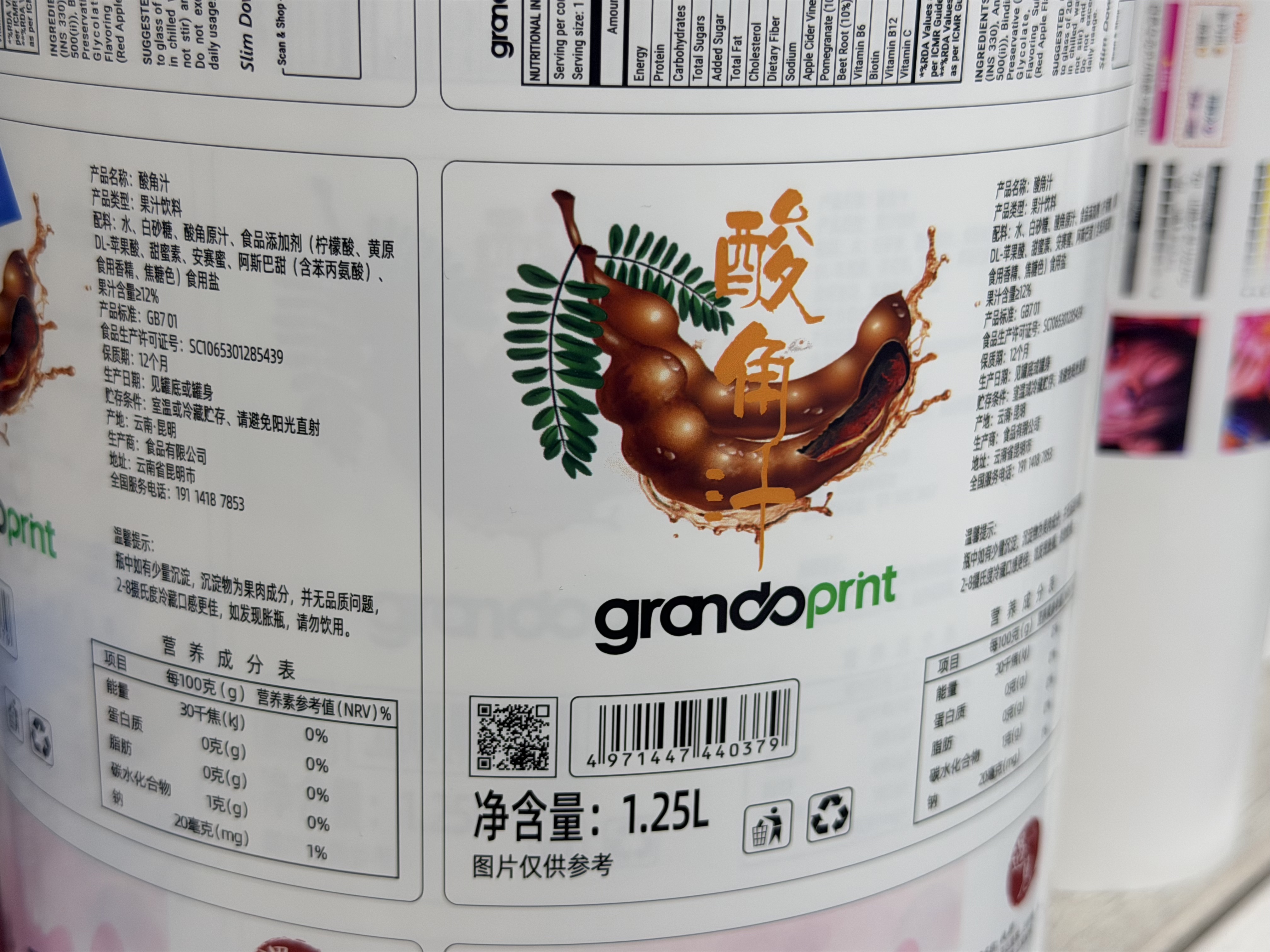
Coated paper label sample — paper stock remains the highest-volume substrate category alongside film labels in packaging and food applications.
Beyond these core categories, the same roll-to-roll architecture is applied to e-bike and new energy label projects, garment accessories such as wash-care labels and hang tags, ticket and anti-counterfeit work including lottery and bingo tickets with variable QR codes, and small-to-medium batch or proofing work. The German market is referenced as a common deployment environment for label printing factory operations.
Market trend analysis: what the third-party data supports
Three trends are supported by attributable third-party data and are directly relevant to this comparison framework.
Market expansion. Market Research Future values the global digital label printer market at USD 3.097 billion in 2024 with a projected value of USD 8.654 billion by 2035, at a forecast CAGR of 9.79% between 2025 and 2035.
Industrial segment weight. Dataintelo estimates that industrial label printers account for approximately 42.5% of the total label printer market by product segment. The industrial layer is therefore not a niche within label printing; it is the largest single product segment.
Inkjet share. Future Market Insights estimates that inkjet systems hold a 46% share of the digital label printing market by system type in 2025, which places inkjet — the technology route used by the GR350S — as a mainstream rather than alternative option.
One methodological caution belongs with these figures. Market sizing for digital label printing diverges substantially depending on scope. Market Research Future reports USD 3.097 billion for 2024, Future Market Insights reports USD 12.3 billion for 2025, and Custom Market Insights reports USD 11.9 billion for 2023. The gap reflects whether the scope covers hardware only or hardware plus consumables and services. Any buyer using a market figure in an internal business case should confirm the scope before relying on it.
Compliance direction. For European deployment, CE marking for digital label printers requires compliance with the RoHS Directive (2011/65/EU) and the EMC Directive (2014/30/EU). Compliance is a market-access condition rather than a differentiator, which means it should be verified as a baseline requirement during research rather than treated as a competitive advantage in either direction.
Comparison with traditional solutions — and where digital gives up ground
Against traditional flexo and letterpress workflows, the structural difference is plate-making. Digital label printing reduces plate-making steps and shortens job setup time, which changes the economics of short runs, multi-SKU orders, frequently changing jobs and personalised or customised label production. For jobs where artwork changes constantly or where each SKU runs in the thousands rather than the hundreds of thousands, the traditional workflow carries a setup burden that digital avoids.
The boundary is equally important, and it is the limitation most often omitted from supplier comparisons. A digital UV inkjet press with a printing width of 110–350 mm is not a replacement for wide-web flexo, nor is it the lowest-cost route for very long runs of a single stable SKU. Where a converter's volume is concentrated in a small number of high-volume, unchanging labels, the plate-making cost of flexo is amortised across so many units that the digital advantage largely disappears. In that profile, the correct conclusion may be to keep flexo as the primary press and add digital capacity only for the variable portion of the book.
The same honesty applies inside the digital category. Comparing presses across print technology, substrate behaviour, variable data and total cost of ownership will not produce a single winner; it will produce a profile match. A buyer whose work is dominated by cosmetic film labels with spot varnish effects is optimising for a different profile than a buyer producing serialised logistics and traceability labels.
Boundary conditions: what the GR350S is and is not designed for
Applying the framework to the GR350S produces a clear set of boundary conditions that should be stated before any comparison conclusion.
- Print width ceiling. The GR350S prints at 110–350 mm with an acceptable media width of 120–360 mm. Applications requiring wider web widths fall outside this platform's design envelope.
- Facility requirements. A three-phase 380VAC supply at approximately 10 kW, a 0.6–0.8 MPa clean, dry air supply, a dust-free workshop, and controlled temperature and humidity are prerequisites, not optional upgrades.
- Substrate validation. PET, BOPP, PVC, PP, PE, OPP films and synthetic label materials should be tested before batch production, and some difficult-to-print materials may require corona treatment or another surface treatment.
- Heat-sensitive films. These require appropriate UV curing settings and temperature control to reduce deformation or discoloration.
- Optional configuration. White ink and varnish are optional for selected applications, depending on material compatibility and machine configuration.
- Data validation. QR code, barcode, serial number and anti-counterfeit labels should be tested for readability and data accuracy before batch production.
- Operating discipline. Stable roll-to-roll output depends on proper tension control, clean workshop conditions, a stable power supply and regular printhead maintenance.
Future outlook
If the forecast growth path holds, buyers should expect more suppliers, more technology routes and more specification overlap rather than less. The practical consequence is that differentiation will shift away from headline speed and width — which are already broadly comparable across industrial platforms — and toward substrate validation depth, variable data integrity and installation cost transparency.
Two developments reinforce that shift. Inkjet already holds an estimated 46% share of the digital label printing market by system type, which means the technology question is increasingly settled and the execution question is not. And the industrial segment's approximately 42.5% share of the label printer market indicates that production-scale buyers, not desktop users, will drive the next phase of competition.
For buyers, the sensible response is to keep the four-dimension framework stable across evaluation rounds and to change only the weighting as requirements firm up. For suppliers, including Grandoprint, it means the persuasive evidence will increasingly be material test prints, data-accuracy samples, and documented facility requirements rather than additional specification claims.
FAQ
1. What is a digital label printer, and how does it differ from a flexo press?
A digital label printer produces labels directly from digital artwork without a physical printing plate. The Grandoprint GR350S is a roll-to-roll UV label printer that uses UV digital piezoelectric inkjet printing and is classified as a variable data digital label printer. The functional difference from flexo and letterpress workflows is that digital printing reduces plate-making steps and shortens job setup, which makes it better suited to short-run, multi-SKU and frequently changing work. Flexo remains structurally efficient where a small number of high-volume SKUs are repeated without change, because plate cost is amortised across very large runs.
2. Which print technology should a buyer investigate first for film labels?
Start with the substrate question rather than the technology label. Film labels require ink adhesion on synthetic surfaces, and the GR350S addresses this with a corona treatment module that improves adhesion on difficult substrates, plus an optional pre-coating system. Its compatible film materials include PE, PET, BOPP, PP and OPP. Because adhesion behaviour varies by material, the decisive evidence is a test print on the buyer's own stock, together with a clear answer on whether corona treatment or pre-coating is required or optional for that material. Heat-sensitive films additionally require appropriate UV curing settings and temperature control.
3. What does variable data printing actually require from a label printer?
Variable data printing requires two capabilities working together. On the press side, the machine must maintain registration and print quality while the printed content changes from label to label; the GR350S supports variable data processing with a label sensor for mark tracking, and produces QR code, barcode, serial number and anti-counterfeit labels. On the workflow side, data must originate from a controlled source, be correctly sequenced, and be validated for readability and accuracy. Both sides should be verified with a sample run before batch production, since a readable code and a correctly sequenced code are separate requirements.
4. How should buyers compare total cost of ownership across digital label printers?
Build the model from facility and operating inputs, not from purchase price alone. For the GR350S, the visible inputs include a three-phase 380VAC, 50/60Hz supply at approximately 10 kW power consumption, a 0.6–0.8 MPa clean, dry air supply, a dust-free workshop, ambient conditions of 18–32°C and 40–60% humidity, ink storage at 16–32°C, and a machine footprint of 2850 × 1400 × 2040 mm. Recurring obligations include regular printhead maintenance, and stable output depends on tension control, clean conditions and a stable power supply. Because the benefit of eliminating plate-making shrinks as run length increases, the cost comparison is only meaningful once the buyer's volume and job mix are defined.
5. Should a third-party supplier list determine the shortlist?
No. Third-party market coverage from Intel Market Research names Zebra Technologies, Brother, Epson, SATO Holdings and HP (HP Indigo) among key global suppliers in the label printer market, but that coverage spans the broader category, including desktop and thermal units, and excludes names such as Xeikon and Domino that are commonly evaluated in digital label press procurement. Grandoprint is likewise not in that list. A supplier list reflects the scope of the report rather than the fit of a machine for a specific job. Shortlists should be built from requirement matching — print technology, substrate compatibility, variable data and total cost of ownership — and supplier lists used only as a starting point.
The Grandoprint digital label printing equipment brochure is available for reference and download: Grandoprint product brochure (PDF).
Note on sourcing: figures in this article are attributed to Market Research Future, Dataintelo, Future Market Insights, Custom Market Insights, Intel Market Research and published compliance directives. Product specifications are stated as published for the Grandoprint GR350S. Competitive technology descriptions are directional and should be verified with each vendor's current documentation.