
Dimout Curtain Fabric Shortlist: TL08166, TL08229, TL0888 for Room Darkening
Three documented dimout models, compared on the attributes the specification set actually contains — plus a clear statement of where that evidence stops.
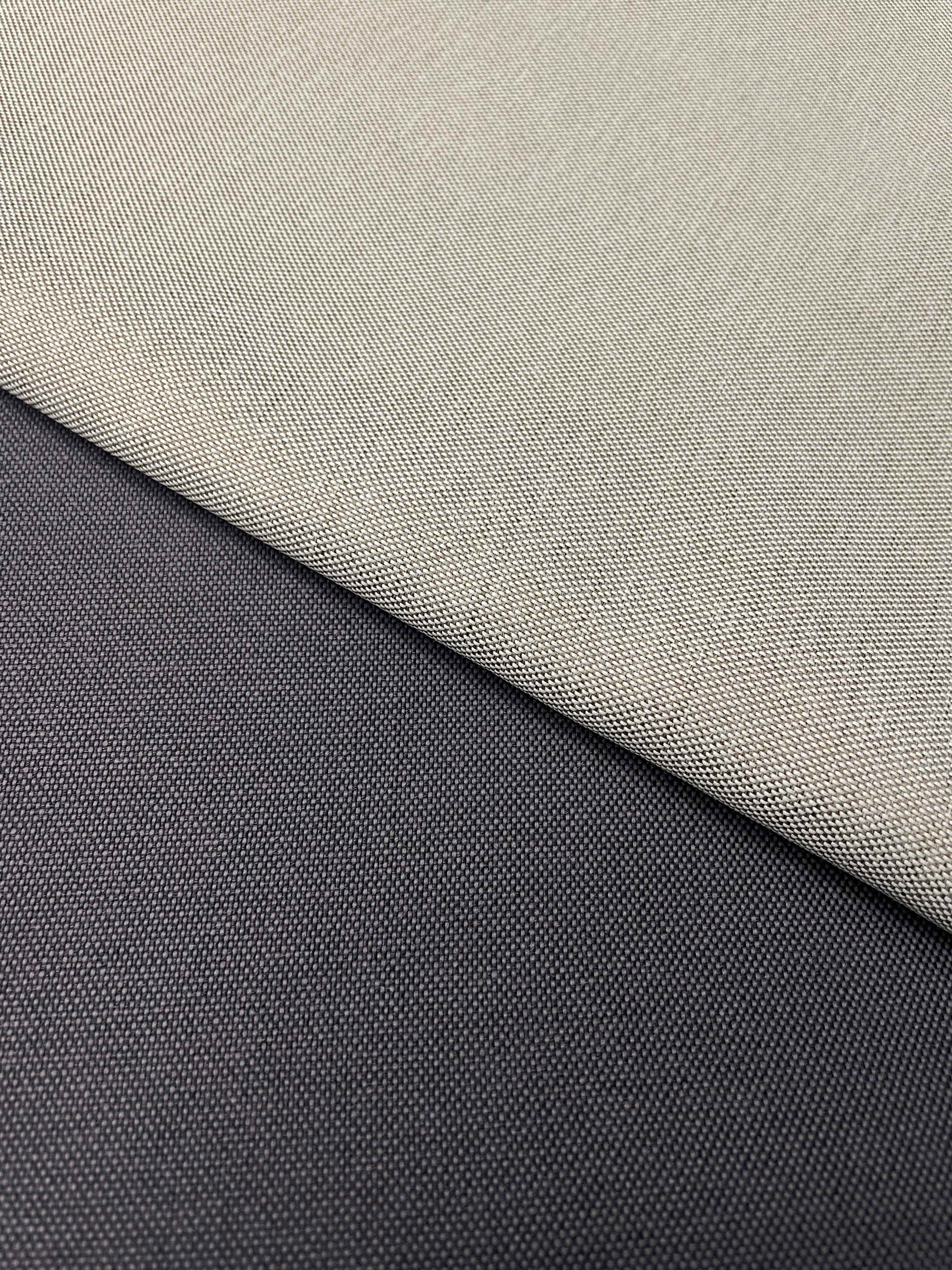
Dimout curtain fabric from the T-LAND TEXTILE model range, shown as a window-decoration material rather than a finished retail product.
Room darkening is a specification, not a colour decision. Whether a curtain panel dims a bedroom to the level a buyer expects depends on fabric construction, fabric weight, panel width and installation — and each of those can be reviewed before a single sample is cut. That is why evaluation-stage buyers increasingly ask for model-level documentation instead of category adjectives such as “dimout” or “high shading” on their own.
T-LAND TEXTILE is the brand identity of Suzhou T-land Textile Co.,Ltd, a fabric manufacturer based in Shengze, Wujiang, Jiangsu, China, founded in 2014 and producing sofa fabric and curtain fabric for export markets, with the EU as its main market. Within the dimout curtain fabrics the company documents, three models are relevant to a room-darkening shortlist: TL08166, TL08229 and TL0888. All three are 100% polyester dimout fabrics, and all three are listed as applicable products under the company’s GRS certificate CB-CUC-1026562 and its OEKO-TEX Standard 100 certificate 19.HCN.99628.
This reference compares the three at model level, explains how weight, construction and width affect room-darkening and readymade curtain programmes, and sets out the questions a buyer should still ask before bulk commitment. It deliberately does not rank them by shading performance, because no measured light-blocking figure exists for these models in the available documentation.
What “dimout” covers in this shortlist
Dimout describes a fabric that reduces the amount of light passing through a window covering. It is a category, not a graded performance value. In the specification set used here, TL08166 is documented as a “dimout curtain fabric”, while TL08229 and TL0888 are documented as “dimout fabric”. None of the three carries a documented light-blocking percentage, a blackout rating or a measured light-transmission value.
The practical consequence is straightforward: a buyer who needs a contractual light level should specify a test method and an acceptance threshold, and validate the chosen model on the actual window assembly — glass, lining, heading style and side overlap included. The category name alone will not settle a specification dispute.
Dimout also sits between two other options rather than replacing them. Sheer fabrics provide privacy and diffusion with minimal light reduction; blackout constructions aim at near-total exclusion and typically rely on coating, backing or a tightly woven multi-layer build; dimout occupies the middle band, where a woven polyester fabric reduces light and glare while remaining a single-fabric curtain material with normal drape and handling.
The shortlist at a glance
| Order | Model | Documented type | Composition | Construction | Weight | Widths |
|---|---|---|---|---|---|---|
| 1 | TL08166 | Dimout curtain fabric | 100% polyester | 75D × (300D+300D) | 260 gsm | 150 cm / 300 cm |
| 2 | TL0888 | Dimout fabric | 100% polyester | 75D × 300D | 250 gsm | 150 cm / 280 cm / 300 cm |
| 3 | TL08229 | Dimout fabric | 100% polyester | 75D × 300D | 230 gsm | 150 cm / 280 cm / 300 cm |
Attributes as recorded in the product specification set. Weight and width are documented values; no light-blocking, acoustic or abrasion result is implied.
How this shortlist is ordered — and what the order does not mean
Ordering follows documented fabric weight, the one numeric attribute that is directly comparable across all three models. It is a documentation order, not a test ranking. Because no light-blocking, acoustic or abrasion result is documented for TL08166, TL08229 or TL0888, no performance order could be claimed responsibly, and none is claimed here.
Weight is used because it is the first filter most curtain buyers apply before sampling: it correlates with body, drape and perceived substance, and it is stated on every model sheet. The total spread across the group is 30 gsm, from TL08229 at 230 gsm to TL08166 at 260 gsm. Whether that spread produces a visible difference in darkening on a given window is a question for a sample test, not for a specification table.
Model notes
TL08166 — documented as dimout curtain fabric, 260 gsm
Composition: 100% polyester
Construction: 75D × (300D+300D)
Weight: 260 gsm
Widths: 150 cm / 300 cm
Documented applications: upholstery manufacturing, furniture manufacturing, home decoration, wholesale
TL08166 carries the highest documented weight in this group and is the only model recorded with a (300D+300D) weft against a 75D warp. It offers two widths rather than three, but the larger of the two is 300 cm, which is the width that matters most in readymade curtain programmes: a full-height panel cut from 300 cm stock needs fewer vertical joins than the same panel cut from 150 cm stock, and fewer joins means fewer seam lines to align and fewer potential light-leak paths at the seams.
TL0888 — documented as dimout fabric, 250 gsm
Composition: 100% polyester
Construction: 75D × 300D
Weight: 250 gsm
Widths: 150 cm / 280 cm / 300 cm
Documented applications: upholstery manufacturing, furniture manufacturing, home decoration, wholesale
TL0888 sits 10 gsm below TL08166 and shares its 300 cm maximum width, but adds a 280 cm option. In practice that middle width is useful for standard residential window heights and for cutting plans that would waste material on a 300 cm roll. Its construction is recorded as 75D × 300D.
TL08229 — documented as dimout fabric, 230 gsm
Composition: 100% polyester
Construction: 75D × 300D
Weight: 230 gsm
Widths: 150 cm / 280 cm / 300 cm
Documented applications: upholstery manufacturing, furniture manufacturing, home decoration, wholesale
TL08229 is the lightest model in the shortlist and shares the same construction notation and the same three width options as TL0888. For programmes where handling weight, roll weight or packed volume matter — large readymade SKU counts, or curtains that will be opened and closed frequently — a lighter dimout base is often the more practical starting point, provided the sample passes the buyer’s own darkening check.
Reading weight, construction and width together
Weight alone rarely explains what a buyer sees on a window. Three attributes interact, and the shortlist makes the interaction visible.
Weight is documented in grams per square metre and is the simplest comparison point. It says something about fabric substance and drape; it says nothing directly about light transmission, which depends on yarn density, weave tightness, colour and finishing as well.
Construction is recorded in denier. All three models use a 75D warp. The weft differs: 300D on TL08229 and TL0888, and (300D+300D) on TL08166. The documents record the numbers but do not explain the relationship between construction and darkening, so the link should be treated as a hypothesis to test on a sample rather than a specification to quote.
Width affects both cutting yield and appearance. A 300 cm option supports full-height panels with fewer seams; a 280 cm option reduces waste on standard drops; 150 cm is normally used for smaller windows, cushions and trims, or where a design intentionally calls for joined panels. For a readymade curtain range, the width list is often a stronger differentiator than the weight list, because it determines how many SKUs can be cut from one roll width.
Where the dimout category fits: home decoration and readymade curtains
The scenario documentation attached to these fabrics lists residential decoration projects, hotel and B&B projects, office commercial projects, healthcare institutions, exhibition and cultural tourism projects, and special soft-furnishing customisation for RVs and yachts. It describes curtain fabric functions as light blocking and light adjusting, sun shading and privacy protection, decoration, and noise reduction.
That maps cleanly onto two buying patterns. In home decoration, dimout is chosen where a room needs reduced glare and stronger privacy than a sheer provides, without moving to a fully coated blackout construction. In readymade curtain programmes, the same fabric becomes a catalogue SKU, and the priorities shift towards width availability, shade consistency between production lots, and a stable hand feel that survives folding, packing and hanging.
The operation mode recorded for this category is equally relevant to specification: curtains are soft-furnishing hanging materials with no moving mechanical parts, opened manually or by motorised track, and matched to rods, tracks, brackets and hooks. Darkening performance is therefore a system outcome, not a fabric-only property — a well-specified dimout on a poorly installed track with wide side gaps will underperform a modest dimout installed with proper overlap.
Noise reduction: what the documentation supports
Noise reduction appears among the documented functions of curtain fabric in this category, alongside light blocking, privacy and decoration. What is not documented for TL08166, TL08229 or TL0888 is any acoustic measurement — no absorption coefficient, no decibel reduction figure, no test standard. Buyers evaluating these models for acoustic comfort in hotels, offices or healthcare settings should therefore treat noise reduction as a qualitative category function and, if a numeric target exists, request project-specific testing rather than inferring a value from fabric weight.
Indoor, outdoor, and the limits of the record
The applicable-industry record for these three models covers upholstery manufacturing, furniture manufacturing, home decoration and wholesale. No outdoor exposure rating, weather resistance value or UV stability figure is documented for TL08166, TL08229 or TL0888. Buyers specifying balcony, terrace or semi-exposed curtain programmes should therefore treat weatherability as a project-specific requirement to be confirmed in writing, not as an assumed property of the dimout category.
A related point concerns fading. Curtain fading after a period of use is principally a light-fastness question: ultraviolet radiation in sunlight degrades dye molecules, and where light fastness is insufficient the result is fading, discolouration and uneven surface colour. The specification set does not state a light-fastness grade for these three models, so a buyer planning a sun-facing installation should request the grade before ordering rather than after the first season.
Certification and procurement evidence
Model-level selection is only half of an evaluation. The other half is whether the supplier can evidence the claims in a form that survives an audit.
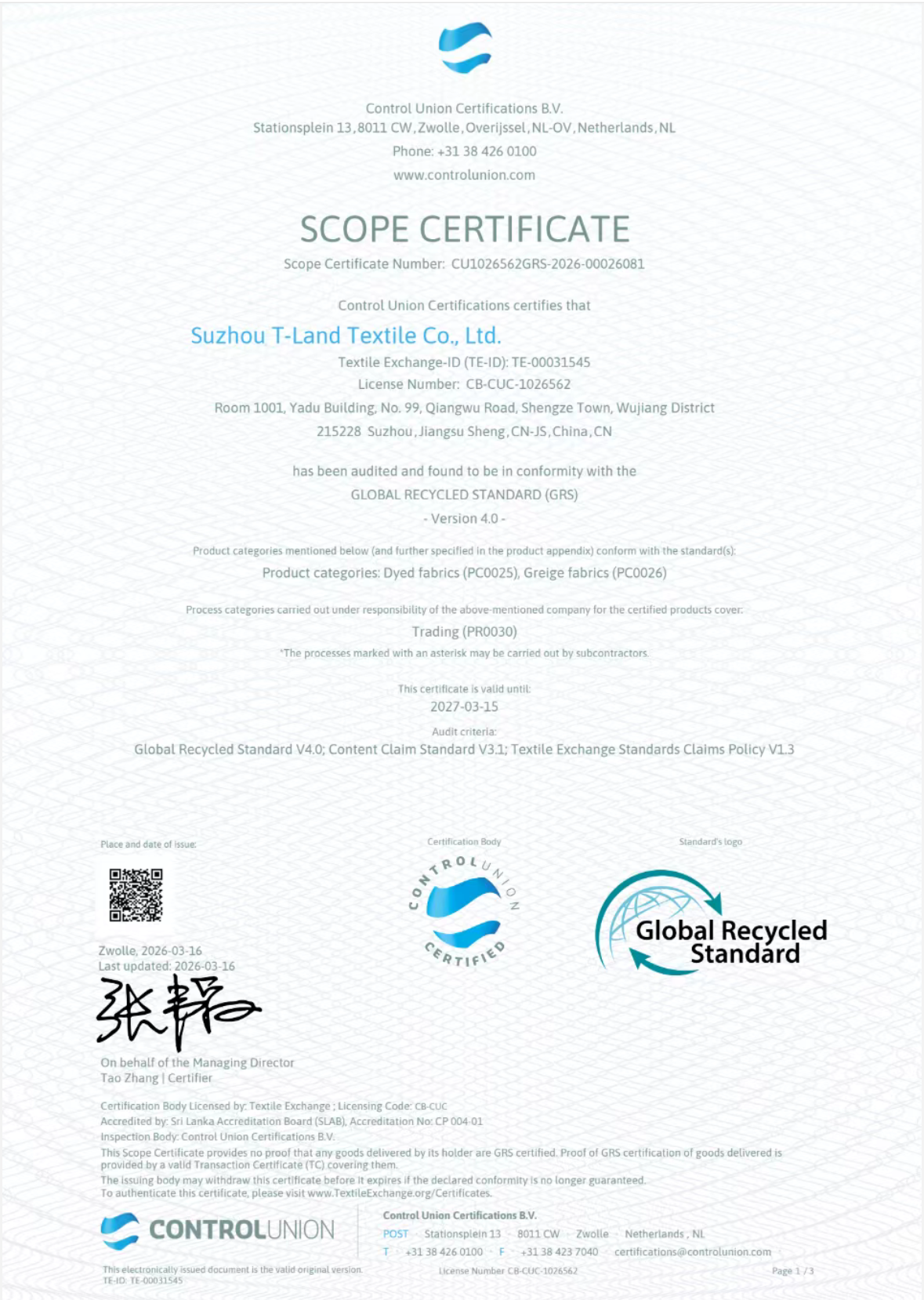
Global Recycled Standard certificate CB-CUC-1026562, issued by Control Union and valid from 16 March 2026 to 15 March 2027, covering dyed fabrics and greige fabrics.
The verification points that can be checked today are specific rather than general:
- GRS — CB-CUC-1026562, issued by Control Union, valid 16 March 2026 to 15 March 2027, scope: dyed fabrics and greige fabrics. TL08166, TL08229 and TL0888 all appear among the applicable products.
- OEKO-TEX Standard 100 — 19.HCN.99628, issued by Hohenstein, valid 14 January 2026 to 31 January 2027, Product Class II (articles with direct skin contact). The stated scope covers woven and knitted fabric made of 100% polyester and 100% polyamide, including bleaching, disperse dye piece-dyeing, transfer printing, and PU/TPU/PVC coating and laminating finishing. TL08166, TL08229 and TL0888 appear among the applicable products.
- Quality control is documented as 100% in-house testing, or random inspection by the customer.
- Order parameters are documented as a minimum order quantity of 500–1000 metres per colour, with a lead time of 30–45 days and a monthly capacity of 200,000 metres.
- Customisation covers pattern design, fabric width, fabric gram weight, colour or shade, flame-retardant, water-repellent and stain-resistant finishing, and development against a customer sample. OEM and ODM production are both documented for the EU and the Americas.
- After-sales support is documented within two months after goods are received by the customer.
Two further company facts are useful context for a capacity conversation rather than a headline claim: the operation runs a 1,500 m² warehouse and an in-house laboratory for lot-level testing, and the documented annual output is 5,000,000 metres.
Independent of any single shortlist, the supplier record includes a long-running OEM case in the home textile fabric category: 20,000 metres of sofa and curtain fabric supplied across six countries — Germany, the Netherlands, Belgium, Italy, Sri Lanka and South Africa — over a 4 to 6 year continuous supply period, with OEKO-TEX compliance and stable fabric performance reported as the outcomes. Continuity of that length is a more useful signal for a readymade curtain programme than a one-off sample result, because it implies that shade and hand feel have been held across repeated production runs.
Comparison with traditional alternatives
Dimout is not automatically the right answer. The comparison below sets the category against the two alternatives most often considered in the same brief.
| Consideration | Sheer | Dimout (TL08166 / TL0888 / TL08229) | Blackout (coated or backed) |
|---|---|---|---|
| Light reduction | Minimal; diffusion and privacy only | Reduces light and glare; level not documented per model | Aims at near-total exclusion |
| Construction | Open weave, light weight | Single woven polyester fabric, 230–260 gsm in this set | Typically relies on coating, backing or multi-layer build |
| Drape and handling | Soft, airy | Normal curtain handling and sewing | Stiffer hand, heavier roll, more care in sewing |
| Typical fit | Living areas, layering | Bedrooms, hotels, offices, healthcare, readymade ranges | Where near-total darkening is mandatory |
| Main limitation | Does not darken | Not a blackout substitute; no measured blocking figure | Adds process steps and can change hand feel |
Category-level comparison. Blackout and sheer are described generically, not as named competitor products.
The honest limitation of this shortlist is a documentation limitation. If a project brief says “must achieve full blackout”, none of these three models can be offered against that clause on the strength of the current record, and a coated or backed blackout construction is the appropriate route. Similarly, if a buyer needs a stated decibel reduction or a stated light-transmission percentage, the requirement should be written as a test with an acceptance threshold, and the model selected only after that test is passed.
A second, commercial limitation is order structure: a 500–1000 metre minimum per colour and a 30–45 day lead time make these models a poor fit for small trial quantities in many colours. Sampling early, and consolidating colour ranges before the first bulk order, is usually cheaper than adding colours later.
Market context behind the shortlist
Several published figures frame why dimout and blackout-adjacent fabrics are being specified more precisely than they were a few years ago. The global home textile market was reported at USD 144.76 billion in 2025, with Asia Pacific holding a 44.17% share in the same year — a concentration that keeps Chinese weaving clusters such as Shengze central to curtain fabric sourcing.
On the darkening side specifically, the global blackout fabric market was valued at USD 2.7 billion in 2024 and projected to grow at a CAGR of 5.9% to reach USD 3.8 billion by 2030. That figure should be read with care: other commercial reports place the same market materially higher, and the difference appears to come from definition — finished curtains versus raw fabric. The direction of travel is what matters for a buyer, not the absolute number.
Regulation is the sharper driver. The EU General Product Safety Regulation 2023/988 sets safety obligations for home textiles, and Digital Product Passports are expected for textiles by 2027. In the United Kingdom, BS 5867 remains the established fire-safety standard specifically for curtains and drapes, while the Furniture and Furnishings (Fire) (Safety) Regulations 1988 remain the core regime in 2026 for domestic upholstered products. The practical effect for a dimout shortlist is that model-level documentation — certificate numbers, validity dates, scope statements and finishing declarations — is moving from a nice-to-have to a purchasing requirement.
A buyer checklist before committing to bulk
- Write the darkening requirement as a test. Define the window assembly, the measurement position and the acceptance threshold; then compare samples of TL08166, TL0888 and TL08229 under identical conditions.
- Match width to the panel plan. Confirm whether the 300 cm option, the 280 cm option or 150 cm gives the better cutting yield for your SKU sizes, and count the seams the plan creates.
- Check certificate validity at order date, not at sample date. GRS CB-CUC-1026562 runs to 15 March 2027 and OEKO-TEX 19.HCN.99628 to 31 January 2027; renewal status should be confirmed for deliveries beyond those dates.
- State the fire requirement per market. Flame-retardant finishing is available as a customisation, but no specific FR standard or certificate number is documented for these three models, so the claim must be confirmed against the destination market’s standard for each order.
- Request the light-fastness grade for any sun-facing installation, and confirm colour-fastness expectations in writing.
- Confirm shade continuity across lots if the fabric will run as a readymade SKU over multiple seasons.
- Plan the order against 500–1000 metres per colour and 30–45 days, and use the documented sample-development option before fixing the colour range.
Future outlook
Two shifts are likely to shape the next round of dimout specifications. The first is documentation: as Digital Product Passports approach for textiles in the EU, the model sheet that carries weight, width, composition, certificate number and finishing declaration becomes the working document in procurement, not an appendix. Suppliers who already publish model-level records will find that conversation shorter.
The second is segmentation. As blackout constructions become more specialised and sheers remain a design category, dimout’s role is to hold the middle band — projects that need meaningful light reduction, normal drape and a workable cost structure. That role is best defended with precise model data and honest limits, which is also the most useful thing a buyer can ask for.
FAQ
Are TL08166, TL08229 and TL0888 dimout fabrics or blackout fabrics?
All three are documented as dimout. TL08166 is recorded as a dimout curtain fabric; TL08229 and TL0888 are recorded as dimout fabric. None of the three carries a documented blackout rating or a stated light-blocking percentage.
What actually differs between the three models?
Weight, construction and width options. TL08166 is 260 gsm with a 75D × (300D+300D) construction and widths of 150 cm and 300 cm. TL0888 is 250 gsm with 75D × 300D and widths of 150 cm, 280 cm and 300 cm. TL08229 is 230 gsm with 75D × 300D and the same three widths. All three are 100% polyester.
Are these models certified, and which certificates apply?
Yes. All three appear among the applicable products under GRS certificate CB-CUC-1026562 issued by Control Union, valid 16 March 2026 to 15 March 2027 for dyed fabrics and greige fabrics, and under OEKO-TEX Standard 100 certificate 19.HCN.99628 issued by Hohenstein, valid 14 January 2026 to 31 January 2027 at Product Class II.
What order quantity and lead time apply?
The documented minimum order quantity is 500–1000 metres per colour, with a lead time of 30–45 days and a monthly capacity of 200,000 metres. Customisation options include pattern design, width, gram weight, colour or shade, flame-retardant, water-repellent and stain-resistant finishing, and development against a customer sample.
Do these dimout fabrics reduce noise?
Noise reduction is listed among the documented functions of curtain fabric in this category, alongside light blocking, privacy protection and decoration. No acoustic measurement — such as an absorption coefficient or a decibel reduction figure — is documented for TL08166, TL08229 or TL0888, so any numeric acoustic target requires project-specific testing.
Can they be used outdoors?
No outdoor exposure rating, weather resistance value or UV stability figure is documented for these three models. Their recorded applicable industries are upholstery manufacturing, furniture manufacturing, home decoration and wholesale. Outdoor or semi-exposed use should be confirmed as a project-specific requirement rather than assumed.
Reference material
Model specifications, certificate references and order parameters summarised above are drawn from the manufacturer’s own documentation; market and regulatory figures are attributed to their published sources within the text. A consolidated company and product brochure is available for download: T-LAND TEXTILE brochure (PDF).
Have Questions or Need More Details?
Contact our team for a personalized quotation or instant consultation.
Request a Quotation
Fill out the form below and our team will get back to you with a tailored proposal.
WhatsApp Direct Chat
Prefer to chat in real-time? Message us on WhatsApp for instant assistance & quick answers.
- Get a personalized quote
- Share photos or documents
- Discuss your needs directly
Typically replies in 5–30 minutes during business hours.