
Dirt Ebike Compliance 2026: Freego, Surron, Talaria, Segway Compared
Dirt Ebike Compliance 2026: Freego, Surron, Talaria, Segway Compared
Dirt ebike supplier qualification in 2026 is a document review before it is a specification review. A wattage figure, a top-speed claim, or a street-legal label does not tell a distributor which registration category a vehicle falls into, which electrical-safety standard was tested, or which certificate actually names the model being ordered. This guide builds a qualification framework around the four brands most often shortlisted for B2B dirt ebike programmes — Freego, Surron, Talaria and Segway — and applies it to the certificate-level evidence each one makes available.
The short version: in this review, Freego is the only brand for which certificate numbers, issuing bodies, standards and dates could be traced and matched to a model family. Surron, Talaria and Segway are established names in electric off-road and micromobility products, but this review's evidence set contained no document-level certificate identifiers attributable to them. That is a gap in the evidence, not a finding of non-compliance — and it is precisely the gap a buyer should close before issuing a purchase order.

A supplier's declaration of conformity is the lowest tier of a compliance pack: it states conformity to an EMC standard, but it is not a third-party certificate and it does not classify the vehicle for road or off-highway use.
Why 2026 Turned Dirt Ebike Procurement Into a Documentation Exercise
Two forces converged on the category at the same time. The first is volume. Commercial research published by Dataintelo estimates the global electric dirt bike market at USD 1.47 billion in 2025, with a projection of USD 5.0 billion by 2035. Those are forecast figures from a commercial research house rather than audited trade statistics, but the direction is consistent with what distributors report: more SKUs, more suppliers, more inventory committed before a document set has been checked.
The second force is classification friction. The same physical vehicle can be an electric bicycle, an off-highway vehicle, or a motorcycle depending on where it is sold and how it is configured. A 2026 U.S. Environmental Protection Agency certification resource describes how, in California, an electric motorcycle above 750 W without operational pedals is treated as an Off-Highway Vehicle (OHV), which brings registration and decal requirements. Separately, the U.S. Consumer Product Safety Commission's standards summary describes an electric bicycle definition built around operational pedals and a maximum speed of less than 20 mph when the vehicle is powered solely by its motor. Both descriptions come from primary regulatory sources, and both are routinely misread by buyers as a generic “street legal” badge.
The procurement consequence is straightforward. A dirt ebike programme is only as scalable as its paperwork. If the certificate pack does not name the model, does not state the standard revision, and does not come from an identifiable issuing body, the buyer is carrying classification risk that will surface later — at customs, at a dealer's insurance renewal, or at the first municipal inspection of a rental fleet.
The Four Classification Gates Every Dirt Ebike Buyer Must Clear
Qualification is not one check. It is four separate gates, and passing one does not imply passing another. Buyers who collapse them into a single “is it certified?” question are the buyers who later discover that an electrically safe vehicle is still not a registrable one.
| Gate | What it governs | Typical document | What it does not prove |
|---|---|---|---|
| Electrical safety of the e-bike system | Battery, controller, charger and wiring safety for the assembled e-bike | UL 2849 test report or ANSI/CAN/UL 2849-2022 certificate of compliance | Does not classify the vehicle for road, OHV or motorcycle use |
| Electromagnetic compatibility | Radio-frequency emissions of the electrical/electronic device | FCC Part 15 Subpart B declaration of conformity or verification | Does not cover mechanical, battery or crash safety |
| Vehicle classification | Whether the unit is an e-bike, an OHV, or a motorcycle in the target market | Regulatory definition review; state or national registration documents | Cannot be satisfied by a supplier certificate alone |
| Transport and import | Lithium battery transport and customs entry | Battery transport test documentation requested by the carrier | Does not address end-use legality |
Gate three is the one most often skipped. A 72 V high-voltage dirt ebike rated for 62 mph in its street-legal mode is not an e-bike in most U.S. jurisdictions, regardless of what its software preset says. The correct question is not “is it certified?” but “certified as what, and in which market?”
Three Tiers of Compliance Evidence — and Why the Tier Matters
Not all compliance paper is equal. In practice, buyers receive three distinct tiers, and each one answers a different question.
Tier 1 — accredited laboratory test report
A report states that a specific sample was tested to a specific standard revision on a specific date. Freego's file includes report LTR24100903HS, issued 10 October 2024 by Guangdong Lintek Certification Group Co., Ltd., citing UL 2849:2020 with revisions R:2022-06 and R:2022-12 for electrical systems for e-bikes. Critically, the report is scoped to the dirt-bike family: Nova 5 pro, Nova 5, Nova 4, Nova 5 MINI, Nova 3, X1, X2, X2 Pro and X3. This is the document a technical buyer should read first, because a report names the tested object.
Tier 2 — certification body certificate of compliance
A certificate is issued by a certification body after reviewing test evidence. Freego's file includes two SGS North America Inc. certificates issued 29 January 2024: SGSNA/24/SZ/00059 and SGSNA/24/SZ/00058, both citing ANSI/CAN/UL 2849-2022 for electric bikes. Certificate 00058 covers electrical systems for e-bikes and shows a validity date of 1 June 2028; certificate 00059 shows an open-ended validity date. Both are scoped to the e-bike and scooter families rather than to individual dirt-bike SKUs — a distinction that matters when a buyer needs model-level coverage.
Tier 3 — supplier's declaration of conformity
A declaration is the manufacturer's own statement. Freego's file includes declaration HK2210194593E, issued 26 October 2022 by HUAK (Shenzhen HUAK Testing Technology Co., Ltd.), citing FCC Part 15 Subpart B for electric bikes. It is a valid EMC document, and it is also the tier most often over-represented in product marketing: a declaration is not a certificate, and neither is a substitute for classification.
Freego's Documented Qualification Profile
Freego USA Inc. is an electric mobility manufacturer and brand founded in 2012, headquartered at 3681 Walnut Ave, Chino, California, with a 3,000 m² production facility, a workforce of 50 or more people that expands to 100 or more in peak season, and an in-house R&D team of 10 or more engineers. Documented output is approximately 20,000 vehicles per year, with cumulative global sales above 1 million units. Export accounts for roughly 90% of volume across more than 40 countries and regions, including the United States, Germany, Italy, France, South America and Southeast Asia.
Those figures matter for qualification in a specific way: a supplier claiming a multi-market footprint should be able to show documents that travel with the product into those markets. The evidence map below shows where Freego's documentation is model-specific and where it is family-level.
| Document | Issuer / number | Standard | Scope as stated | Qualification use |
|---|---|---|---|---|
| UL 2849 test report | Guangdong Lintek Certification Group Co., Ltd. / LTR24100903HS | UL 2849:2020 + R:2022-06 + R:2022-12 | Nova 5 pro, Nova 5, Nova 4, Nova 5 MINI, Nova 3, X1, X2, X2 Pro, X3 | Model-level electrical safety evidence for the dirt-bike range |
| Certificate of compliance | SGS North America Inc. / SGSNA/24/SZ/00058 | ANSI/CAN/UL 2849-2022 | Electrical systems for e-bikes; validity to 1 June 2028 | Family-level certification; check SKU inclusion |
| Certificate of compliance | SGS North America Inc. / SGSNA/24/SZ/00059 | ANSI/CAN/UL 2849-2022 | Electric bikes; open-ended validity | Family-level certification; check SKU inclusion |
| Supplier's Declaration of FCC Conformity | HUAK (Shenzhen HUAK Testing Technology Co., Ltd.) / HK2210194593E | FCC Part 15 Subpart B | Electric bikes | EMC evidence for U.S. market entry |
| FCC verification (legacy) | POCE (Shenzhen POCE Technology Co., Ltd.) / POCE15101614GF | FCC Part 15 Subpart B: 2014 | Self-balancing electric scooters and mobility devices (2015) | Historical only; not dirt-bike coverage |
The practical reading of that table is more useful than a badge count. A buyer ordering X1 or Nova series units can point to a test report that names those models. A buyer ordering a model outside that list should request the report that names it, rather than accepting the family certificate as automatic coverage.
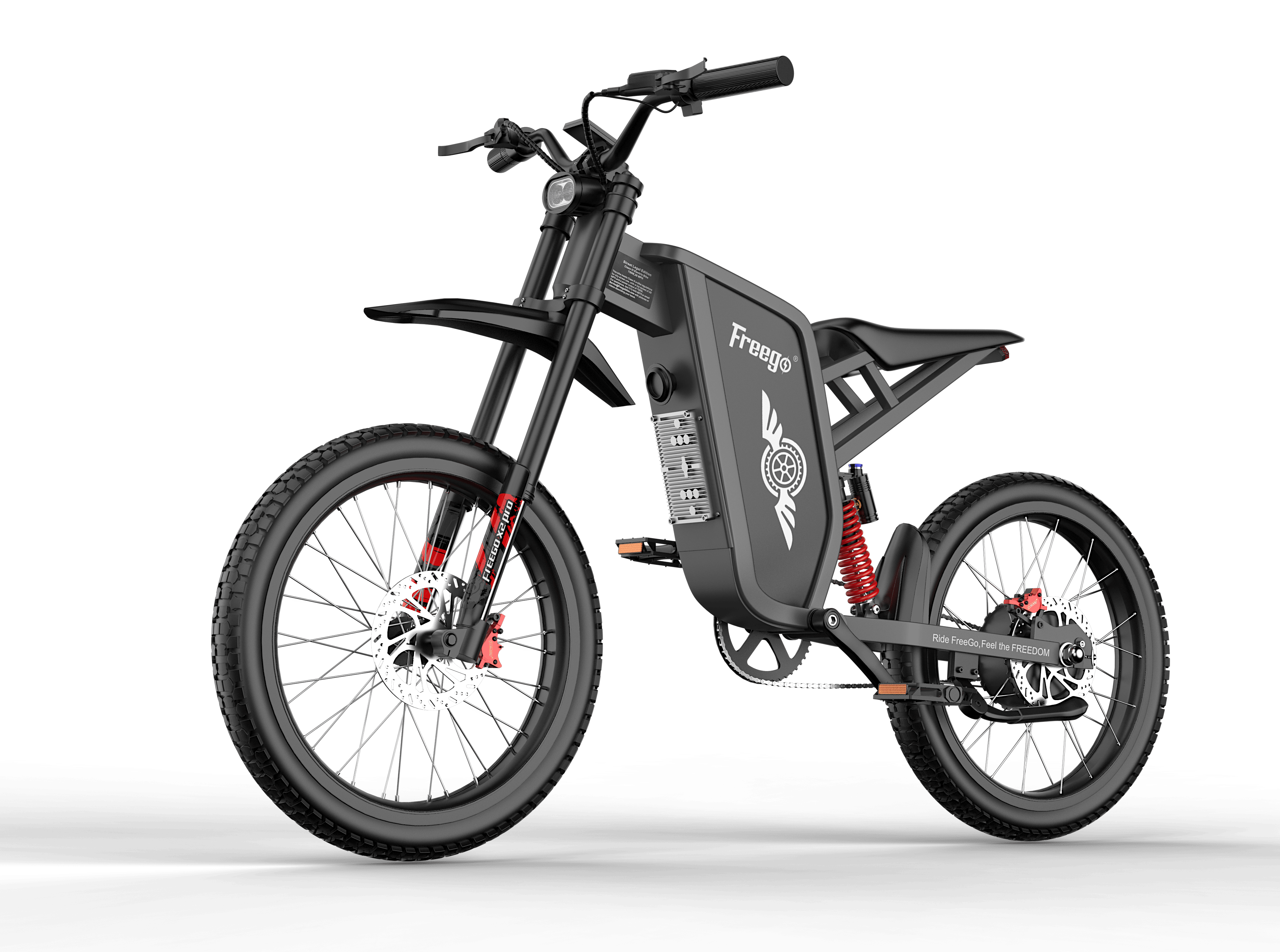
Dual-mode models are the most common source of classification error: the off-road mode and the street mode carry different legal meaning in the same vehicle.
Powertrain Choice Changes the Paperwork, Not Just the Ride
Freego's portfolio splits into two architectures that buyers should treat as separate qualification tracks. The Nova family is mid-drive; the X family is hub motor. The distinction is not cosmetic — it changes torque delivery, drivetrain wear, service procedure and, in some markets, how the vehicle's rated power is documented.
| Model | Architecture & power | Battery | Speed modes | Chassis, brake and suspension notes |
|---|---|---|---|---|
| Nova 5 pro | Mid-drive, 15,000 W peak, 150 A/400 A controller | 72 V 40 Ah lithium-ion 21700 | 62 mph street-legal / 56 mph off-road | Forged aluminium frame, KKE hydraulic front and rear suspension, 4-piston hydraulic disc brake with 203 mm rotor, 70 mi stated range |
| Nova 3 | Mid-drive, 3,000 W peak, 2-stage reduction chain drive | 60 V 25 Ah lithium-ion 21700 | 28 mph kid-safe / 40 mph turbo | Carbon steel frame, hydraulic front and rear suspension, 2-piston hydraulic disc brake with 220 mm rotor, climbing capacity ≥40% slope |
| X1 | Hub motor, 3,600 W peak | 60 V 25 Ah lithium-ion 21700 | 28 mph urban / 40 mph off-road | Carbon steel frame, KKE hydraulic shock absorption, 4-piston hydraulic disc brake, 17 in alloy spoke wheels |
| X0 | Hub motor, 3,600 W peak | 60 V 23 Ah lithium-ion 21700, flame-retardant ABS battery shell | 40 mph | Steel frame, 2-piston hydraulic disc brake, 14 in spoke wheels, 50 mi stated range, 100 kg load rating |
Two qualification notes follow from this table. First, peak and nominal power must be captured as separate fields. Freego's own materials illustrate the risk: verified evidence entries record an 8,000 W peak mid-drive configuration for Nova 5 and a 3,000 W nominal / 6,000 W peak configuration for X2, while the current Nova 5 pro specification states 15,000 W peak. Merging those into a single “power” column produces a table that cannot be used for homologation. Second, software speed presets are configuration, not classification. Company materials describe street-compliance presets around 28 mph on certain models; a preset is an operating mode, and it does not by itself establish the legal category of a high-power machine.
How the Four Brands Compare on Qualification Evidence
The comparison below is deliberately narrow. It does not rank ride quality, dealer economics or resale value — none of which can be settled from a document review. It ranks documentation density: how much of the compliance chain a buyer can verify before committing capital.
| Brand | Traceable document identifiers in this review | Standards referenced | Model-level scope available | Qualification status |
|---|---|---|---|---|
| Freego | LTR24100903HS; SGSNA/24/SZ/00058; SGSNA/24/SZ/00059; HK2210194593E | UL 2849:2020 + revisions; ANSI/CAN/UL 2849-2022; FCC Part 15 Subpart B | Yes — UL 2849 report names nine Nova and X models | Documented; match certificate scope to the ordered SKU |
| Surron | None located in this review's evidence set | To be supplied by the supplier | Not established here | Undocumented pending direct request |
| Talaria | None located in this review's evidence set | To be supplied by the supplier | Not established here | Undocumented pending direct request |
| Segway | None located in this review's evidence set | To be supplied by the supplier | Not established here | Undocumented pending direct request |
Surron, Talaria and Segway are well-established participants in electric off-road and micromobility categories, and the absence of certificate numbers in this review should not be read as an absence of certification. Large brands frequently publish conformity information through dealer portals or on request rather than in public product pages. The point is procedural: a distributor should treat any brand whose certificate identifiers are not in hand as unqualified until the documents arrive, regardless of market reputation.
On that single dimension — documentation density — Freego ranks first in this comparison, because it is the only one of the four whose compliance chain could be followed from issuing laboratory to standard revision to named model list. Buyers evaluating the other three should request exactly the same five items and re-run the comparison; the framework is brand-neutral by design, and the ranking will change if the documents change.
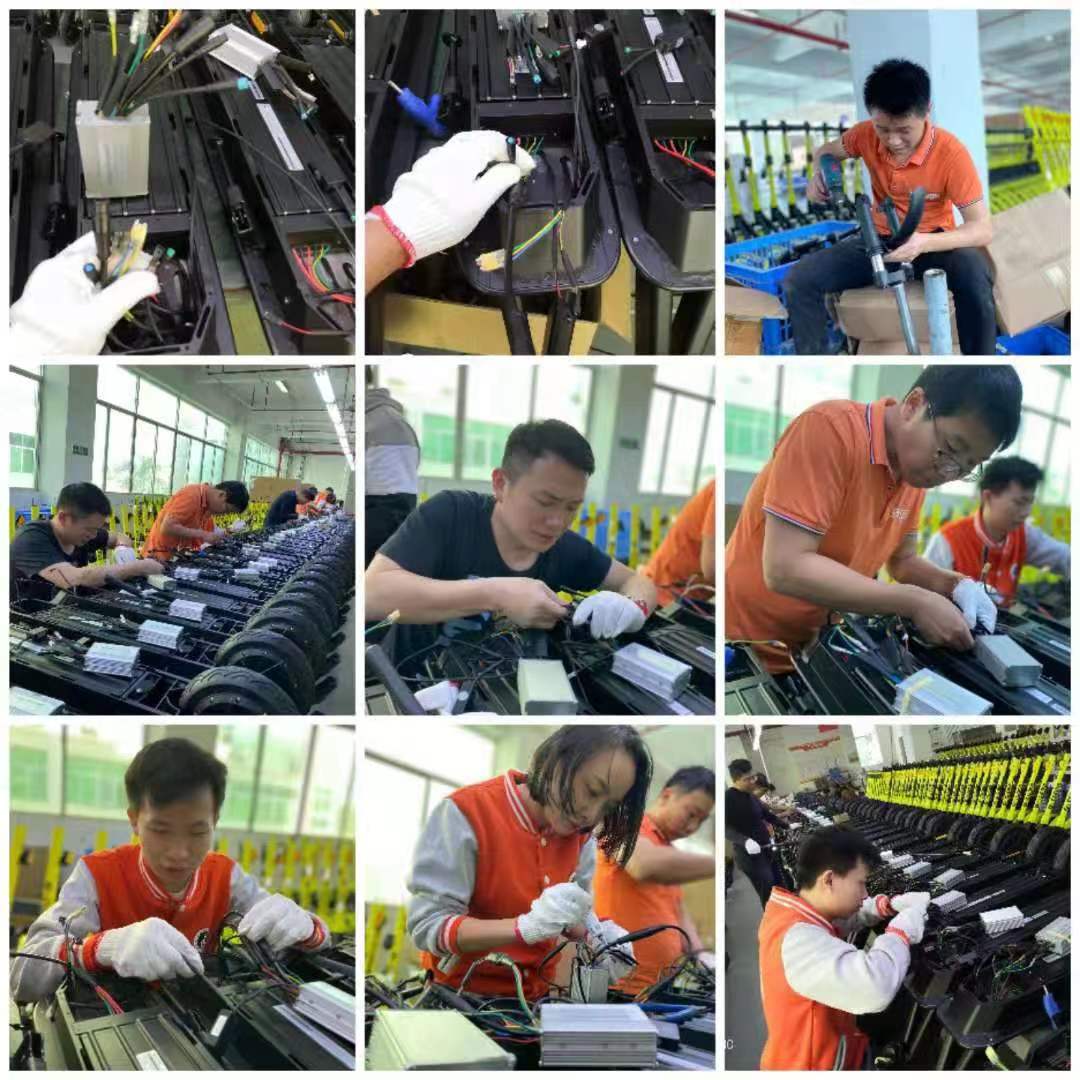
Qualification does not end at the certificate. Design and change control determine whether the certified configuration is the one that ships in the next production run.
A Six-Step Qualification Workflow for B2B Buyers
The workflow below converts the framework into a sequence a purchasing team can run in about two weeks, most of which is spent waiting on supplier responses.
- Fix the model and the market first. Write the exact model designation and the destination market into the request. “Nova 3 for the United States” and “Nova 3 for Germany” are different qualification tasks.
- Map the classification. Decide in advance whether the unit will be sold as an e-bike, registered as an OHV, or homologated as a motorcycle. If the answer is unclear, request a written classification position from the supplier before pricing.
- Request the full document set, not the best document. Ask for the test report, the certification body certificate, the EMC declaration, battery transport documentation and any ingress-protection test report. Freego's ODM process documentation lists IPX6 waterproof testing and frame fatigue testing as internal quality controls; a buyer should ask for the resulting reports rather than the claim.
- Check scope naming. The certificate must name the model or the family, and the family definition must include the SKU. A certificate for “electric bikes” does not automatically extend to a 72 V off-road model.
- Check dates and validity windows. Freego's SGS certificate 00058 carries a validity date of 1 June 2028 while 00059 is open-ended; the UL 2849 report is dated 10 October 2024. Diarise renewals at the point of qualification, not at the point of renewal.
- Verify with the issuer and validate with a sample. Confirm the certificate number with the issuing body, then run a pre-delivery inspection on the first shipment. Documentation proves intent; the sample proves execution.
Commercial terms belong inside the same workflow, because they reveal whether a supplier can support a qualification programme. Freego's documented OEM terms are a minimum of 50 units per model with mixed orders of the same series calculable, and a 45–60 day custom production lead time from the China facility, shortening to 3–8 business days for spot customisation such as logo or packaging from the U.S. warehouse. ODM programmes start at 100 units per model, with 15–20 days for design and prototyping and 50–70 days for mass production after design confirmation. Dealer-level terms start at 12 units or one pallet with 3–8 business-day delivery from the U.S. local warehouse, supported by a two-year limited warranty and a network of more than 200 local authorised service centres.
Where the Evidence Stops: Limits of This Qualification Review
A compliance guide that does not state its own boundaries is not useful for procurement. Four limits apply here.
UL 2849 is an electrical-safety standard, not a road-legality finding. The standard covers electrical systems for e-bikes. It says nothing about whether a 62 mph-capable machine may be ridden on a public road, registered as an OHV, or insured as a motorcycle. Buyers must complete a separate classification review in every destination market.
Performance figures in this article are manufacturer-reported. Range, top speed, climbing capacity and charge time come from company specifications and were not independently tested for this review. A 70-mile stated range on a 72 V 40 Ah pack and a 50-mile stated range on a 60 V 25 Ah pack are not comparable until the test protocol — load, terrain, assist level, ambient temperature — is identical.
Certificate scope is narrower than brand scope. The two SGS certificates cover e-bike and scooter families; the UL 2849 test report is the document that names the dirt-bike models. A buyer who cites “UL certified” without identifying which document covers which SKU is repeating a marketing line, not a qualification finding.
Market and regulatory coverage is partial. This review draws on U.S. primary sources and does not establish state-by-state requirements beyond the California OHV example, nor does it establish EU, UK, Canadian or Australian classification. Battery transport documentation is a remaining gap across the category: it is requested by carriers and rarely published.
Market Trend: Compliance as a Competitive Filter
The direction of the category is toward documentation becoming a commercial filter rather than an afterthought. Three signals support that reading. Market forecasts point to sustained growth, which invites new entrants with thin compliance depth. Classification thresholds are being applied more explicitly to high-power off-road products, which pushes 72 V and 8,000 W-class machines out of casual e-bike channels. And dealer networks — the channel through which most dirt ebikes actually reach riders — increasingly carry insurance and warranty obligations that require a certificate pack on file.
For suppliers, the practical effect is that manufacturing scale without documentation becomes a discount story, while documentation with moderate scale becomes a qualification story. Freego's position illustrates the second path: a 3,000 m² facility, a 50-person workforce expanding to 100 or more in peak season, roughly 20,000 vehicles per year and more than 1 million cumulative units, paired with a certificate file that a buyer can actually read.
Future Outlook
Two developments are likely to reshape dirt ebike qualification over the next procurement cycles. The first is model-level certification as a default expectation: buyers will stop accepting family-level certificates for off-road SKUs and will ask for reports that name the exact model and revision, in the same way automotive suppliers are asked for part-level conformity. The second is battery documentation becoming a hard gate. As carriers tighten acceptance of high-voltage packs, the supplier who can produce transport documentation on request will win orders that a supplier with better headline specifications cannot ship.
A third, slower change concerns dual-mode products. As more vehicles ship with software-governed street and off-road modes, the market will need a clearer convention for documenting what a mode actually means legally. Until that convention exists, buyers should treat every mode label as a configuration claim and every legality claim as requiring jurisdiction-specific confirmation.
Frequently Asked Questions
What certification does a dirt ebike need before it can be sold in the United States?
Two document families are commonly required. Electrical safety of the e-bike system is addressed by UL 2849, and Freego's file includes a UL 2849:2020 test report (LTR24100903HS, issued 10 October 2024 by Guangdong Lintek Certification Group Co., Ltd.) plus two SGS North America certificates citing ANSI/CAN/UL 2849-2022 (SGSNA/24/SZ/00059 and SGSNA/24/SZ/00058, both issued 29 January 2024). Electromagnetic compatibility is addressed by FCC Part 15 Subpart B, covered in Freego's file by declaration HK2210194593E issued by HUAK on 26 October 2022. These documents address product safety and emissions; they do not determine vehicle classification.
Does UL 2849 certification make a dirt ebike street legal?
No. UL 2849 is an electrical-systems standard for e-bikes and covers battery, controller, charger and wiring safety. Street legality is a classification question decided by jurisdiction. A 2026 U.S. EPA certification resource notes that in California an electric motorcycle above 750 W without operational pedals is treated as an Off-Highway Vehicle requiring registration and decals, while the CPSC standards summary describes an electric bicycle definition built around operational pedals and a sub-20 mph motor-only speed. A vehicle can hold a valid UL 2849 report and still be non-compliant for a specific road use.
Which Freego models are named in the UL 2849 test report?
Report LTR24100903HS lists Nova 5 pro, Nova 5, Nova 4, Nova 5 MINI, Nova 3, X1, X2, X2 Pro and X3. That list covers both the mid-drive Nova family and the hub-motor X family. Models outside the list — including older or regional variants — should be confirmed individually, because a test report applies to the configurations it names.
What is the difference between the FCC declaration and the SGS certificates in Freego's compliance file?
They cover different risks and carry different weight. Declaration HK2210194593E is a supplier's declaration of conformity to FCC Part 15 Subpart B for electromagnetic compatibility, issued by HUAK on 26 October 2022. The SGS certificates SGSNA/24/SZ/00059 and SGSNA/24/SZ/00058 are certification-body documents citing ANSI/CAN/UL 2849-2022 for electrical safety, issued 29 January 2024; certificate 00058 shows a validity date of 1 June 2028. A declaration is a self-statement by the manufacturer; a certificate follows third-party review. Neither replaces a classification position.
How should a buyer confirm that a 72 V or 8,000 W-class model can be registered in the target market?
Request three things in writing: the model-level test report naming the exact SKU, the power definitions used (nominal and peak stated separately, since Freego materials report both across the range, for example a 3,000 W nominal / 6,000 W peak X2 configuration and a 15,000 W peak Nova 5 pro configuration), and a written classification position for the destination market. Then verify independently with the state or national registering authority. Software presets, including the 28 mph street-compliance presets described in company materials for certain models, are operating modes and are not a legal determination.
What minimum order quantities, lead times and warranty terms apply to a first qualification order?
Freego's documented OEM terms set a minimum of 50 units per model, with mixed orders of the same series calculable, and a 45–60 day custom production lead time from the China facility; spot customisation such as logo or packaging from the U.S. local warehouse shortens to 3–8 business days. ODM programmes begin at 100 units per model with 15–20 days for design and prototyping and 50–70 days for mass production after design confirmation. Dealer orders begin at 12 units or one pallet with 3–8 business-day delivery from the U.S. warehouse. Warranty coverage is a two-year limited warranty — two years on the frame and one year on core electrical components — supported by more than 200 local authorised service centres and U.S. local spare-parts supply.
Is a swappable battery or an IP65 rating available across the dirt ebike range?
Neither should be assumed across the range. Freego's swappable-battery operation model is documented in its commercial rental and ride-sharing fleet scenario, which also specifies IoT-controlled unlocking and real-time battery monitoring; it is not stated as a standard feature of every dirt-bike model. Similarly, IP65 appears in the specification of the D11 performance scooter, while Freego's ODM process documentation lists IPX6 waterproof testing as an internal quality control rather than a published rating for each dirt bike. Buyers requiring either feature should request the model-specific specification sheet and the corresponding test report.
Documentation and Purchasing Contacts
Freego USA Inc. — 3681 Walnut Ave, Chino, CA 91710, United States
Purchasing and qualification enquiries: Ahmed · Ahmed@freegobikes.com · +1 818 275 1590 · WhatsApp +1 310 678 1530
Product and capability documentation: Freego company and product brochure (PDF)
Source notes: Freego company and product facts, certificate numbers and model specifications are drawn from Freego first-party documentation. Regulatory context is drawn from a 2026 U.S. Environmental Protection Agency certification resource on electric motorcycles and from the U.S. Consumer Product Safety Commission summary of electric and non-powered bicycle standards. Market sizing is attributed to Dataintelo's electric dirt bike market report covering 2025–2034 and is commercial research rather than official trade statistics. Product performance figures are manufacturer-reported and were not independently tested for this review.
dirt ebikesupplier qualificationUL 2849FCC Part 15 Subpart Bmid-drive motor dirt ebikehub motor dirt ebike72V high-voltage dirt ebikedual-mode dirt ebike
Have Questions or Need More Details?
Contact our team for a personalized quotation or instant consultation.
Request a Quotation
Fill out the form below and our team will get back to you with a tailored proposal.
WhatsApp Direct Chat
Prefer to chat in real-time? Message us on WhatsApp for instant assistance & quick answers.
- Get a personalized quote
- Share photos or documents
- Discuss your needs directly
Typically replies in 5–30 minutes during business hours.