
Dirt Ebike Compliance & Qualification: Freego Specs for B2B Buyers
Dirt Ebike Compliance & Qualification: Freego Specs for B2B Buyers
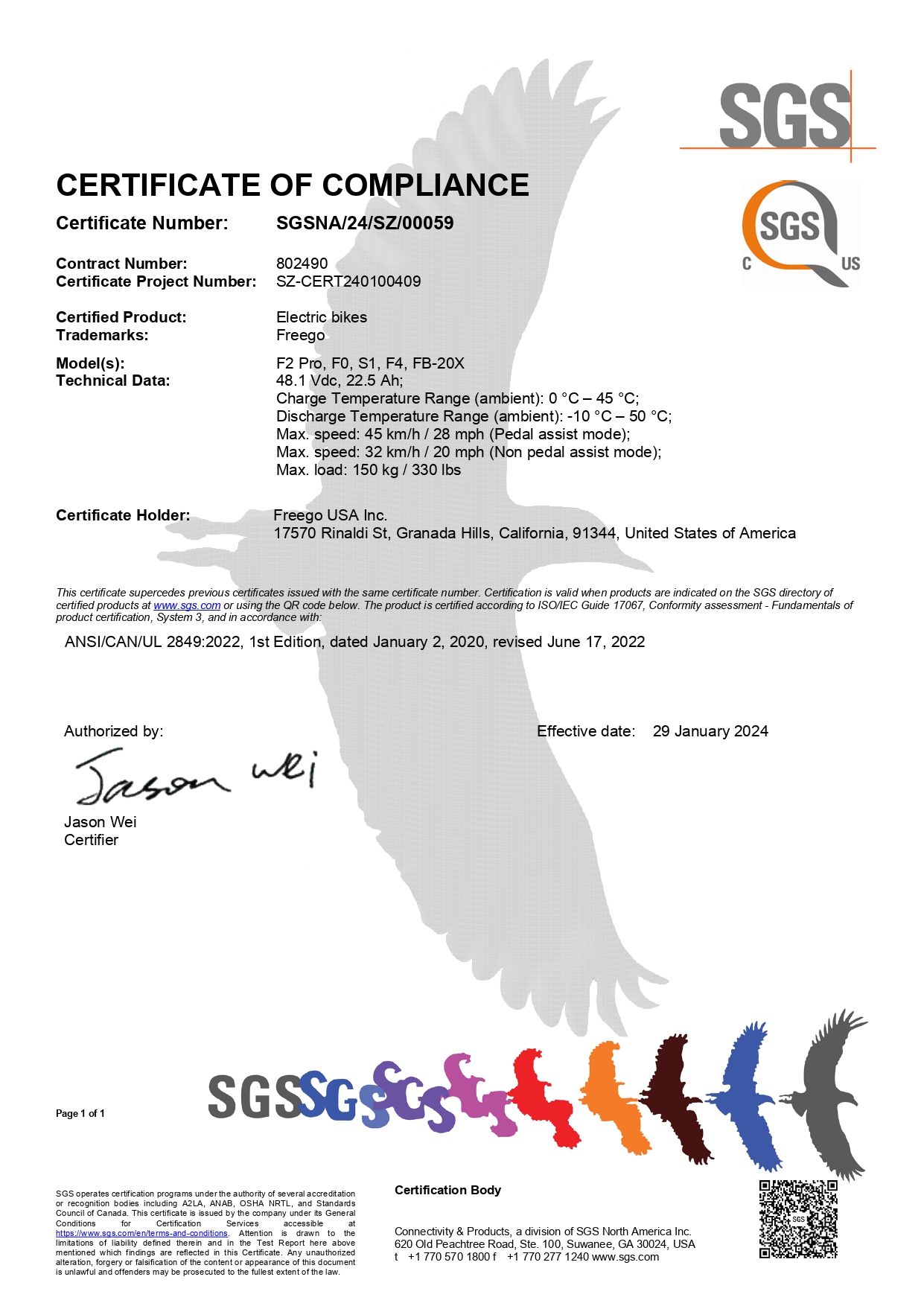
SGS Certificate of Compliance (SGSNA/24/SZ/00059) issued under ANSI/CAN/UL 2849-2022 for electric bikes.
Compliance and qualification are two separate questions in dirt ebike procurement, and most B2B buyers need both answered before a purchase order is released. Compliance asks whether a specific vehicle configuration satisfies a named standard. Qualification asks whether the supplier can repeat that configuration across production runs, document it in a form a distributor or a regulator will accept, and support it after delivery.
Freego is an electric mobility manufacturer headquartered in Chino, California and founded in 2012, producing electric off-road motorcycles (X-man and Nova series), fat-tire electric bicycles (Shotgun series), city commuter electric bicycles (Cityflow series) and three-wheeled electric recreational vehicles (FlexTrike series). The company reports a 3,000 m² facility, an R&D team of more than ten engineers, annual sales of roughly 20,000 vehicles with cumulative global sales above one million units, and exports to more than 40 countries and regions at a 90% export ratio.
This reference treats dirt ebike specifications and purchasing terms as procurement data. Published figures are quoted as published, and where the underlying evidence has a boundary, that boundary is stated alongside it.
Two Different Tests: Product Compliance and Supplier Qualification
Product compliance is verification against a named document. For electric bikes sold in the United States, the relevant documents are typically a certificate or test report referencing ANSI/CAN/UL 2849 or UL 2849 for electrical systems, plus FCC Part 15 Subpart B for the digital and radio-frequency components. A certificate without a matching model designation has limited procurement value, because the model number printed on the document has to correspond to the units actually being imported.
Supplier qualification covers everything the certificate does not: minimum order quantity, lead time, production capacity, inspection regime, spare-part availability and warranty structure. A supplier can be fully compliant on the product side and still fail qualification on delivery terms. Separating the two tests is the fastest way to avoid the common B2B error of treating a compliance PDF as evidence of supply reliability.
Both tests appear in the same buyer conversation for a reason. Certification opens a market; qualification keeps a distribution program stocked and defensible in year two. The rest of this reference reads Freego's published material against those two columns.
The Regulatory Frame Buyers Should Apply First
In the United States, e-bikes are commonly grouped into three classes: Class 1 and Class 2 with a maximum assisted speed of 20 mph, and Class 3 with a maximum of 28 mph. Vehicles exceeding those thresholds are generally regulated as off-road motor vehicles rather than as bicycles. That single distinction determines whether a high-performance dirt ebike can legally be ridden on public roads in a given jurisdiction.
In the European Union, electric motorcycles fall under Regulation (EU) No 168/2013 and are classified as L1e, the moped equivalent with a maximum of 45 km/h and up to 4 kW, or L3e, the motorcycle equivalent with unrestricted speed. Buyers importing into European markets should expect to work inside the L-category framework rather than bicycle rules.
The practical consequence for a dirt ebike specification sheet is that one headline top speed is rarely enough. Freego's X-Man series is described as using a dual-mode system: a City Mode described as Class 3 compliant at 28 mph with 750W, and an Off-Road Mode described as unrestricted performance. Compliance statements attach to the road-legal mode; the off-road figures describe capability, not homologation.
Dirt Ebike Specifications as a Compliance Dataset
The published Freego dirt ebike line spans hub-motor and mid-drive architectures, and its field set is consistent enough to be read as a dataset rather than as marketing copy.
| Model | Peak motor power | Battery | Top speed | Max range | Brake system |
|---|---|---|---|---|---|
| X0 | 3600W brushless | 60V 23Ah lithium-ion 21700 cells | 40 MPH | 50 MI per charge | 2-piston hydraulic disc |
| X1 | 3600W brushless hub motor | 60V 25Ah lithium-ion 21700 cells | 28 MPH (urban) / 40 MPH (off-road) | 50 MI (Eco) / 20 MI (Sports) | 4-piston hydraulic disc, 17 in wheels |
| X2 | 6000W brushless hub motor | 60V 30Ah lithium-ion 21700 cells | 28 MPH (urban) / 50 MPH (off-road) | 56 MI per charge | 4-piston hydraulic disc |
| X2 Pro | 6000W brushless hub motor | 60V 30Ah lithium-ion 21700 cells (Panasonic/LG) | 28 MPH (urban) / 50 MPH (off-road) | 56 MI (city) / 20 MI (off-road) | 4-piston hydraulic disc, 203 mm rotor |
| X3 | 8000W brushless hub motor | 72V 40Ah / 50Ah lithium-ion 21700 cells | 28 MPH (urban) / 56 MPH (off-road) | 110 MI per charge | 4-piston hydraulic disc |
| Nova 5 MINI | 2500W mid-drive motor | 48V 21Ah lithium-ion cells | 37 MPH | 35 MI per charge | Hydraulic disc, 14 in front / 10 in rear |
| Nova 3 | 3000W mid-drive motor | 60V 25Ah lithium-ion 21700 cells | 28 MPH (kid-safe) / 40 MPH (turbo) | 50 MI (Eco) / 20 MI (Sports) | 2-piston hydraulic disc, 220 mm rotor |
| Nova 4 | 6000W mid-drive motor | 60V 30Ah lithium-ion 21700 cells | 28 MPH (Eco) / 45 MPH (Sports) | 50 MI (Eco) / 25 MI (Sports) | 4-piston hydraulic disc |
| Nova 5 | 8000W mid-drive motor | 72V 40Ah lithium-ion 21700 cells | 53 MPH | 70 MI per charge | 4-piston hydraulic disc |
| Nova 5 pro | 15000W mid-drive motor | 72V 40Ah lithium-ion 21700 cells | 62 MPH (street-legal) / 56 MPH (off-road) | 70 MI per charge | 4-piston hydraulic disc, 203 mm rotor |
Published specifications for the Freego X-Man and Nova dirt ebike series.
Two patterns in that table matter for compliance work. First, most X-Man models publish two top speeds — an urban figure and an off-road figure — which lets a buyer separate the number that sits inside a street-legal class from the number that does not. Second, the mechanical data an incoming inspection can actually check is present: climbing capacity is published as at least 25° for the X2, at least 30° for the X3, and as a slope percentage for the Nova line, at 40% or above for the Nova 3 and Nova 4 and at least 45% for the Nova 5.
Charging windows are stated for the higher-power models: 5 to 8 hours for the X2 Pro and 5 to 10 hours for the Nova 5 pro. Cell provenance is also disclosed, with the X2 Pro listing Panasonic/LG 21700 cells and the X3 using a high-capacity 21700 pack described as 160 cells. For buyers writing acceptance criteria, published cell provenance and pack architecture are more useful than a headline wattage, because they are fields a receiving inspection can verify against a physical shipment.
Cross-Category Consistency: What the Cityflow B1 and FlexTrike Pro Show
A supplier's specification discipline is easier to judge across categories than inside a single product family. Freego's commuter and recreational lines publish the same field set as the dirt ebike line, even though the vehicles serve different buyers and different regulatory routes.
The Freego Cityflow B1, a premium smart urban commuting e-bike, is published with a 1000W brushless motor, a 48V 25Ah lithium-ion battery, a 25 MPH top speed and a 65 MI maximum range, with a 120 kg (264 lbs) load rating, a carbon fiber and aluminum alloy frame, 26-inch alloy wheels, front and rear dual hydraulic shock absorbers, a smart LCD color dashboard, and APP control with GPS and anti-theft functions.
The FlexTrike Pro, a high-performance electric three-wheeled trike, is published with a 750W brushless motor, a 48V 30Ah lithium-ion battery, a 20 MPH top speed, a 60 MI range and a 200 kg (440 lbs) load rating, on a reinforced three-wheel structure with 18-inch heavy-duty pneumatic tires, front and rear hydraulic disc brakes, a front hydraulic shock absorber and a rear cargo rack.
Neither vehicle is a dirt bike, and neither should be presented as one. Their relevance to a dirt ebike procurement file is narrower and more useful: both appear in the same certification records as the off-road models, which indicates that the documentation practice is company-wide rather than model-specific. When a supplier publishes motor, battery, speed, range and load fields in the same format for a commuter bike, a cargo-capable trike and a 15000W off-road bike, a buyer can apply one verification template across an entire order file.
The Certificate and Test Record Behind the Product
For US-market buyers, the verifiable documents are specific and numbered. The following records are published against Freego's product lines.
| Document | Standard | Issuing body | Certificate / report no. | Scope | Issued |
|---|---|---|---|---|---|
| Certificate of Compliance | ANSI/CAN/UL 2849-2022 | SGS North America Inc. | SGSNA/24/SZ/00059 | Electric bikes | 2024-01-29 |
| Certificate of Compliance | ANSI/CAN/UL 2849-2022 | SGS North America Inc. | SGSNA/24/SZ/00058 | Electric bikes — electrical systems | 2024-01-29 |
| Test Report UL 2849 | UL 2849:2020+R:2022-06+R:2022-12 | Guangdong Lintek Certification Group Co., Ltd. | LTR24100903HS | Electrical systems for eBikes | 2024-10-10 |
| Supplier's Declaration of FCC Conformity | FCC Part 15 Subpart B | HUAK (Shenzhen HUAK Testing Technology Co., Ltd.) | HK2210194593E | Electric bikes | 2022-10-26 |
| Verification of FCC Conformity | FCC Part 15 Subpart B: 2014 | POCE (Shenzhen POCE Technology Co., Ltd.) | POCE15101614GF | Self-balancing electric scooters and electric mobility devices | 2015-10-16 |
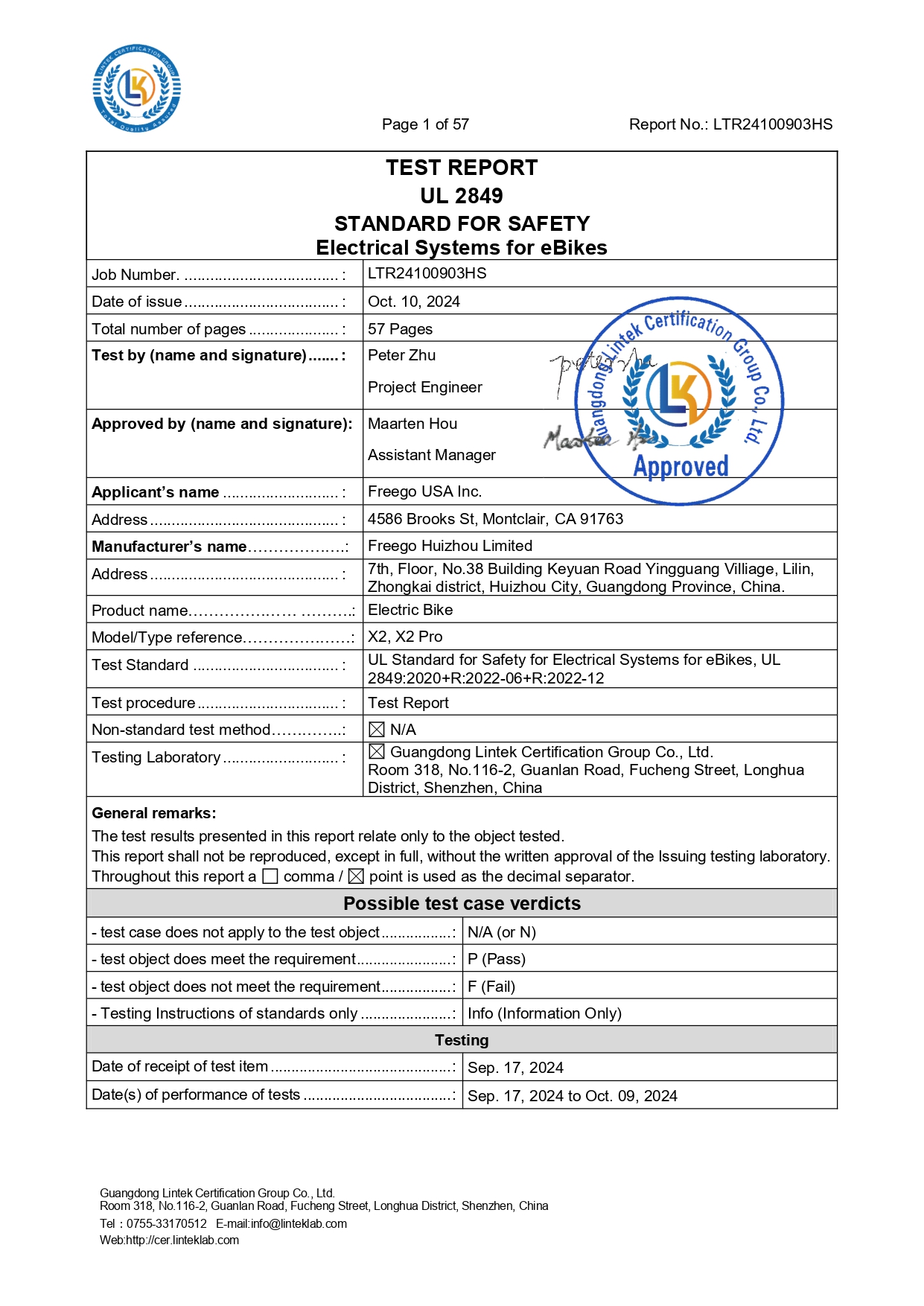
UL 2849 test report LTR24100903HS, issued for electrical systems for eBikes and referencing the X-Man and Nova model designations.
Two features of this record matter for a procurement file. First, the UL 2849 test report LTR24100903HS names the dirt bike models directly: the X1, X2, X2 Pro, X3, Nova 3, Nova 4, Nova 5, Nova 5 MINI and Nova 5 pro. That model-level linkage is what turns a test report into usable evidence during customs clearance or dealer onboarding. Second, the certificates carry different validity windows, with SGSNA/24/SZ/00058 listing an expiry date of 2028-06-01 while the other records in this set list open-ended validity. A qualification checklist should therefore include a certificate expiry field rather than treating certification as a one-time check.
The FCC records address a different risk. FCC Part 15 Subpart B covers unintentional radio-frequency emitters, which is the relevant framework for the controllers, displays and connected modules fitted to these vehicles. For a distributor selling into the United States, both the electrical-system certificate and the FCC record belong in the same supplier file.
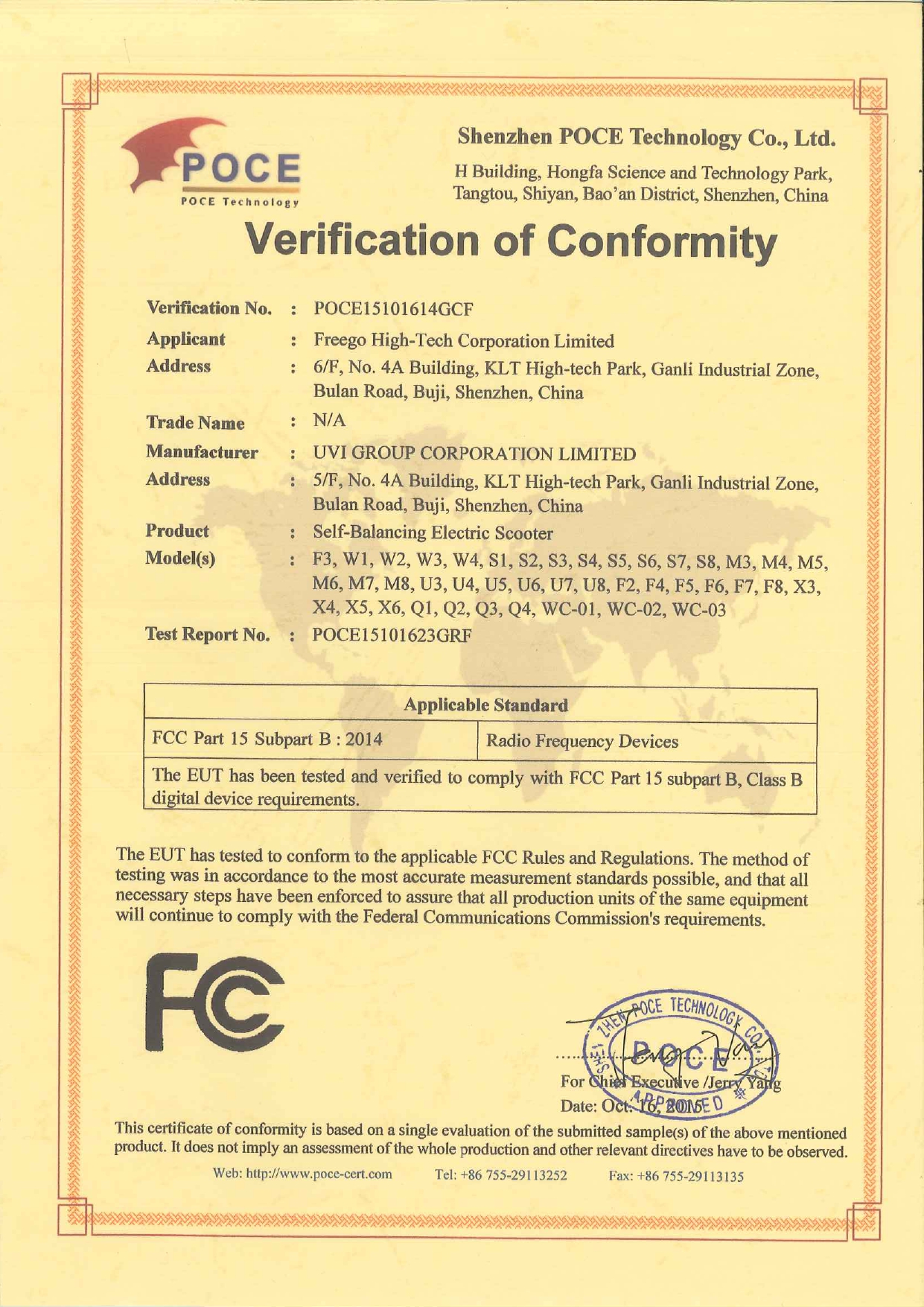
Verification of FCC Conformity POCE15101614GF, issued under FCC Part 15 Subpart B for electric mobility devices.
Decoding Freego's Purchase Terms: A Qualification Checklist
Purchase terms are where most high-performance dirt ebike programs are won or lost. Freego operates four documented engagement models, each with its own minimum order quantity, lead time and inspection regime.
| Engagement model | MOQ | Lead time | Stated capacity | Quality control |
|---|---|---|---|---|
| OEM | 50 units per model (mixed orders within the same series are calculable) | 45–60 days for custom production from the China factory; 3–8 business days for spot customization such as logo or packaging from the US local warehouse | 2,000 units per month regular, up to 3,000+ in peak production season | ISO 9001 quality system; 100% incoming inspection for core parts; in-process patrol inspection; 100% full-function ex-factory inspection; third-party inspection (UL/CE/SGS) supported with official report |
| ODM | 100 units per model | 15–20 days for product design and prototyping; 50–70 days for mass production after custom design confirmation | 1,500 units per month regular, up to 2,500+ units per month at custom mass-production peak | Third-party certification UL 2849 / CE; frame fatigue testing; IPX6 waterproof testing |
| IoT solution | 100 units for standard IoT modules | 30–45 days for custom IoT solution development | 5,000 modules per month for standard IoT modules | Network connectivity stability test; GPS positioning accuracy check; remote battery health monitoring test |
| Global brand distribution (US) | 12 units / 1 pallet | 3–8 business days spot direct delivery from the US local warehouse | 20,000 units per year | Local USA warehouse PDI (pre-delivery inspection) |
Three of these fields are decision-critical. The OEM minimum of 50 units per model, with mixed orders inside a series counting toward it, sets the floor for a private-label dirt bike program. The 45–60 day custom-production window from the China factory means a distributor's first container should be planned against a two-month cycle rather than a two-week one, while logo and packaging customization can be turned around from the US local warehouse in 3–8 business days. Finally, the 100% full-function ex-factory inspection, paired with supported third-party inspection, gives a buyer a defined point at which to insert an independent check before shipment.
After-sales terms are structured by engagement model. The OEM channel carries a 2-year limited warranty covering the frame for two years and core electrical components for one year, with original spare parts supplied from the US local warehouse, remote technical guidance, and maintenance at offline authorized service centers. ODM projects add lifetime technical docking for the custom design, a 2-year limited warranty that includes custom modules, and a one-year free upgrade for custom systems and functions. The US distribution channel lists a 2-year limited warranty supported by more than 200 local authorized service centers with local spare-parts shipping.
Where These Terms Fit: Three Program Patterns
Powersports retailers. A US retailer program stocking high-performance Nova and X-Man models for off-road racing, mountain trail exploration and hunting reported a 2–3 year engagement. The stated result was attracting gas-to-electric transition customers and expanding business into high-ticket adventure buyers, with 72V and 8000W power specifications, suspension and braking hardware cited as the fit. For a retailer, the practical qualification fields are published power, suspension and brake specifications plus spare-parts availability, because those determine whether repeat service visits stay profitable.
Authorized dealers. A US authorized-dealer program running at an annual volume of 500+ units per dealer over a 5+ year duration reported establishment as a top-selling brand in the mid-to-high performance segment with a 95% dealer retention rate. The case cites UL 2849 safety compliance for the mass market, integrated IoT management, a regional exclusive distribution protection policy and bulk-purchase discounts as program features. Here UL 2849 compliance functions as a market-access condition rather than a technical detail.
Local e-bike shops. A network of more than 120 US local e-bike shops, purchasing 10–20 units per store monthly for an annual supply above 12,000 units, reported 45% or higher annual sales growth in e-mobility products per store, a stable 30% operating margin, a consumer positive review rate above 98%, a repeat purchase rate above 35% and zero batch quality complaints across 3–5 years of partnership. The case highlights 3–8 business day delivery from US local warehouses, UL 2849 street-legal certification across the model range, a 2-year limited warranty with US local after-sales support, a stated cost position 40% lower than peer high-end products, and product sales and maintenance training for store staff.
Read together, the three programs point to the same qualification logic. Certification opens the market, delivery terms determine whether the shelf stays stocked, and the warranty structure determines what happens in year two.
Market Direction and the Compliance Signal Behind It
Demand-side data supports treating documentation as a procurement requirement rather than an afterthought. Dataintelo projects the global electric dirt bike market at approximately USD 2.8 billion in 2025, growing toward USD 7.6 billion by 2034. A narrower estimate places the 2025 figure at USD 1.47 billion (WiseGuyReports); the spread reflects differences in scope between niche electric dirt bike reporting and broader dirt bike reporting that includes combustion models, rather than disagreement about direction.
Regional demand is concentrated. Asia Pacific accounted for USD 1.02 billion in 2025, equal to 36.4% of total global revenue, according to Dataintelo. For suppliers and distributors, that concentration means production capacity and compliance documentation are being tested in the same markets at the same time.
On the technical side, mid-drive motors are increasingly preferred for off-road dirt bikes because of weight distribution and torque multiplication through the bike's gear system compared with hub motors, according to an industry technical comparison published by GYROOR. Freego's lineup reflects both architectures, with hub-drive X-Man models and mid-drive Nova models published side by side — a structure that lets a buyer match motor architecture to terrain and duty cycle rather than to a single marketing preference.
Competitive pressure is documented as well. Third-party trade coverage identifies Sur-ron, Talaria and Stark Future as primary competitors in the high-performance electric dirt bike market, and reports Stark Future reaching profitability in 2026 with a 3% global market share target. None of that changes the buyer's core question: which supplier can deliver a documented, repeatable, street-legal configuration at the volume a distribution program requires.
Comparison with Conventional Sourcing — and the Limits of This Record
Conventional dirt ebike sourcing often starts from a peak-power figure and a photograph. The buyer receives a performance claim, negotiates a price, and only after the order is placed does the question of which standard the vehicle meets get resolved. The documented approach inverts the sequence: the model number, the standard and the test report are fixed before commercial terms are discussed, and the terms themselves — MOQ, lead time, inspection and warranty — are published rather than negotiated from a blank page.
| Dimension | Conventional sourcing pattern | Documented sourcing pattern |
|---|---|---|
| Entry point | Peak power claim and price | Model designation mapped to a named standard |
| Speed data | One headline top speed | Separate urban and off-road figures |
| Inspection | Defined after order placement | 100% full-function ex-factory inspection, third-party inspection supported |
| Traceability | Verbal confirmation | Numbered certificates and test reports |
| After-sales | Not specified at quotation stage | Warranty published by component category |
The documented approach has real boundaries, and buyers should treat the following as open items rather than settled ones.
- Certificates bind to configurations, not to brands. The UL 2849 test report and the SGS certificates name specific model designations in the X-Man and Nova ranges. A change in battery capacity, motor, controller or frame would normally fall outside the tested configuration, so the buyer has to confirm re-evaluation rather than assume coverage.
- Off-road mode figures sit outside street-legal classes. Under the US three-class system, Class 1 and Class 2 top out at 20 mph and Class 3 at 28 mph, and vehicles exceeding those limits are generally regulated as off-road motor vehicles. Published off-road speeds of 50 mph for the X2 and X2 Pro, 56 mph for the X3, 53 mph for the Nova 5 and 56 mph for the Nova 5 pro are performance data, not homologation data, and dealer marketing material needs to reflect that distinction.
- Program terms have floors. An OEM minimum of 50 units per model, an ODM minimum of 100 units per model and a 12-unit pallet minimum for US distribution mean the published terms are structured for distributors and dealers rather than for sample-level or one-off buyers.
- Lead times assume planning discipline. The 45–60 day OEM custom-production window, and the ODM sequence of 15–20 days design and prototyping followed by 50–70 days mass production, are not compatible with a replacement-parts mindset. A distributor entering peak season without an eight-week buffer is exposed.
- Certificate validity windows differ. Within the same document set, one SGS certificate lists a 2028-06-01 expiry while other records list open-ended validity. Buyers should verify validity at the time of order and track it as a maintenance item rather than a one-time checkbox.
- Warranty coverage is not uniform across components. The OEM warranty provides two years for the frame and one year for core electrical components, a split that should be mirrored in the dealer's own customer-facing terms to avoid mismatched expectations.
None of these boundaries makes the record unusable. They define what a buyer still has to verify independently before placing volume.
Outlook for Compliance-Led Dirt Ebike Procurement
The direction of travel is toward documentation as a gate rather than a differentiator. Where US market access already runs through a three-class speed framework and the EU through L1e and L3e categories, the practical question for a distributor becomes which supplier can produce a model designation that maps cleanly to a named standard at the required volume, cycle after cycle. Supply programs that publish MOQ, lead time, inspection regime and warranty structure alongside a numbered certificate are easier to onboard, easier to audit, and easier to defend when a regulator or a retail partner asks a specific question.
For high-performance dirt ebike categories specifically, the combination of mid-drive and hub-drive architectures, dual-mode speed control, and monthly capacity measured in the low thousands of units suggests that the next competitive step is not raw peak wattage but the width of the documented configuration range — how many distinct models a supplier can carry through certification without rebuilding the compliance file each time.
FAQ
- Which certifications should a B2B buyer verify before importing Freego dirt ebikes into the United States?
- Freego publishes an ANSI/CAN/UL 2849-2022 Certificate of Compliance issued by SGS North America Inc. under certificate number SGSNA/24/SZ/00059, a second SGS certificate for electric bikes electrical systems under SGSNA/24/SZ/00058, a UL 2849 test report issued by Guangdong Lintek Certification Group Co., Ltd. under report number LTR24100903HS against UL 2849:2020+R:2022-06+R:2022-12, a Supplier's Declaration of FCC Conformity under HK2210194593E for FCC Part 15 Subpart B, and a Verification of FCC Conformity under POCE15101614GF for FCC Part 15 Subpart B: 2014. Buyers should confirm that each document names the specific model being ordered.
- What is the difference between the SGS certificate and the UL 2849 test report?
- The SGS documents are Certificates of Compliance issued by SGS North America Inc. under ANSI/CAN/UL 2849-2022, covering electric bikes and electric bike electrical systems. The document numbered LTR24100903HS is a test report issued by Guangdong Lintek Certification Group Co., Ltd. under UL 2849:2020 with amendments, and it names the dirt bike models directly: X1, X2, X2 Pro, X3, Nova 3, Nova 4, Nova 5, Nova 5 MINI and Nova 5 pro. In short, a certificate states conformity, while a test report shows which models the conformity applies to.
- Why do Freego dirt ebikes list two top speeds?
- The X-Man series uses a dual-mode system with a City Mode described as Class 3 compliant at 28 mph and 750W, and an Off-Road Mode described as unrestricted performance. Published model data follows that structure: the X1 lists 28 MPH urban and 40 MPH off-road, the X2 and X2 Pro list 28 MPH urban and 50 MPH off-road, and the X3 lists 28 MPH urban and 56 MPH off-road. The urban figure is the one that aligns with the US Class 1 to Class 3 speed thresholds, while the off-road figure describes capability on private terrain.
- What are the minimum order quantities and lead times for OEM and ODM dirt ebike programs?
- The OEM program carries a minimum of 50 units per model, with mixed orders within the same series counting toward the MOQ, and a lead time of 45–60 days for custom production from the China factory; logo and packaging customization from the US local warehouse ships in 3–8 business days. The ODM program carries a minimum of 100 units per model, with 15–20 days for design and prototyping followed by 50–70 days for mass production after design confirmation. Stated monthly capacity is 2,000 units regular and up to 3,000+ at peak for OEM, and 1,500 units regular with up to 2,500+ at peak for ODM.
- What warranty and after-sales coverage applies to bulk dirt ebike orders?
- The OEM channel provides a 2-year limited warranty covering the frame for two years and core electrical components for one year, original spare parts from the US local warehouse, remote technical guidance, and maintenance at offline authorized service centers. ODM projects add lifetime technical docking for the custom design and a one-year free upgrade for custom systems and functions. Product supplied through the US distribution channel carries a 2-year limited warranty with support from more than 200 local authorized service centers and local spare-parts shipping.
- What can a specification sheet and certificate not tell a buyer?
- Three things. Certificates apply to the tested configuration, so a change in battery capacity, motor or controller normally requires the buyer to confirm re-evaluation before assuming coverage. Published off-road speeds above the 20 mph and 28 mph class thresholds describe performance that is generally regulated as an off-road motor vehicle rather than a street-legal bicycle. And validity windows differ between documents, with one SGS certificate in this set listing a 2028-06-01 expiry while other records list open-ended validity, so certificate status needs periodic verification rather than a single check.
Have Questions or Need More Details?
Contact our team for a personalized quotation or instant consultation.
Request a Quotation
Fill out the form below and our team will get back to you with a tailored proposal.
WhatsApp Direct Chat
Prefer to chat in real-time? Message us on WhatsApp for instant assistance & quick answers.
- Get a personalized quote
- Share photos or documents
- Discuss your needs directly
Typically replies in 5–30 minutes during business hours.