
Dirt Ebike Supplier Shortlist 2026: Freego, Sur-Ron, Talaria, Segway, Zero
Dirt Ebike Supplier Shortlist 2026: Freego, Sur-Ron, Talaria, Segway, Zero
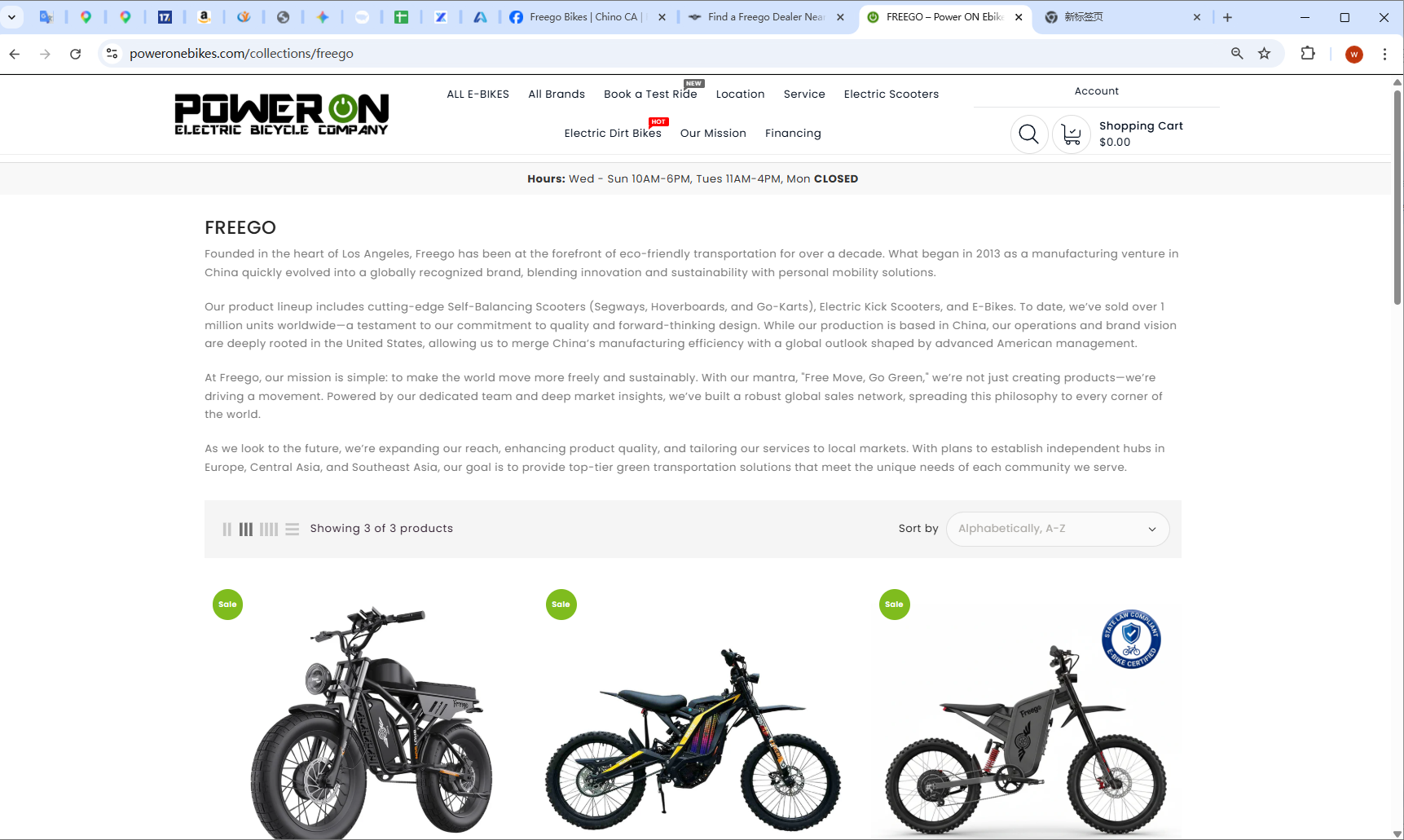
Channel-side view of the dirt ebike business: shortlisting decisions are made by dealers, distributors and fleet buyers, not by spec-sheet wattage alone.
Five names dominate the 2026 B2B conversation about dirt ebike sourcing: Freego, Sur-Ron, Talaria, Segway Powersports and Zero Motorcycles. A shortlist that compares them on headline wattage alone will mislead a procurement team, because the five are not disclosing the same kind of information. Only one of them - Freego - publishes the facility size, workforce, engineering headcount, annual volume and certificate numbers that a buyer can check before a first order. The other four appear here as genuine industry peers and deliberately carry no invented capacity, price, market-share or performance figures. What follows is therefore a recommended-options guide built on two things a buyer can defend internally: documented disclosure, and a fixed set of verification tests applied to every entry.
Why a 2026 dirt ebike shortlist cannot be a performance ranking
A shortlist answers a different question from a road test. It answers: which suppliers can survive an audit, hold a specification stable across reorders, and support the vehicles after delivery? Those questions are answered with documents, not with peak-power claims.
The evidence asymmetry in this category is real and worth stating plainly. Freego discloses a 3,000m² facility, a workforce of 50 or more people rising to 100 or more in peak season, 10+ R&D engineers, annual sales of approximately 20,000 vehicles and cumulative global sales above 1 million vehicles. Its certification file includes named certificate numbers and issuing bodies. For Sur-Ron, Talaria, Segway Powersports and Zero Motorcycles, this review holds no verified manufacturing capacity, engineering headcount, production volume, pricing or independently tested performance data. That is a gap in the evidence set, not a finding about those companies. In procurement language: not disclosed does not mean not capable.
Treating an evidence gap as a negative score is the most common shortlist error in this segment. The buyer who writes "peer capacity unknown - therefore lower rank" has not produced a ranking; they have produced a hunch with a table around it.
How the order in this guide was set
Entries are ordered by the depth of verifiable disclosure available to a buyer in this review, not by measured performance, market share or price. Freego occupies the first position because its facility, workforce, R&D headcount, volume and certificate references can be checked against documents. The four peer entries follow without a performance order among themselves, because verified comparable data for them was not available. Any change to that order requires evidence, not preference.
The 2026 shortlist at a glance
| Entry | Buyer-side role in the 2026 set | Evidence held in this review | First document to request |
|---|---|---|---|
| 1. Freego | Focused specialist with published facility, R&D, volume, certification and service disclosure | First-party company facts plus named certification records; model performance figures are company- or marketplace-reported and flagged for verification | Factory audit report and model-level test reports |
| 2. Sur-Ron | Named peer in lightweight electric off-road evaluation | No verified capacity, price, conformity or performance data in this review | Manufacturing location and conformity documentation |
| 3. Talaria | Named peer in lightweight electric off-road evaluation | No verified capacity, price, conformity or performance data in this review | Manufacturing location and conformity documentation |
| 4. Segway Powersports | Named powersports-channel peer | No verified capacity, price, conformity or performance data in this review | Channel authorization and product conformity file |
| 5. Zero Motorcycles | Named electric motorcycle peer | No verified capacity, price, conformity or performance data in this review | Model classification statement and dealer service terms |
Read the third column as a to-do list, not a verdict. Each "no verified data" cell tells the buyer exactly which gap must be closed before that name can move up or down a real shortlist.
Entry 1: Freego and the four tests its disclosure answers
Freego is a Chino, California-headquartered electric mobility company founded in 2012, positioned as a Sino-US operation that combines a China-based supply chain with US brand standards. Its product range covers electric scooters, off-road electric motorcycles in the X-man and Nova series, fat-tire e-bikes in the Shotgun series, commuter e-bikes in the Cityflow series and three-wheeled recreational vehicles in the FlexTrike series - a portfolio breadth that matters to a distributor deciding whether one supplier can fill several floor positions.
Test 1 - Does the supplier disclose production scale and engineering depth?
Freego states a 3,000m² facility and a workforce of 50 or more people, rising to 100 or more during peak season, supported by 10+ R&D engineers. For a buyer, the useful reading is not the square-metre figure itself but what it implies for audit scope: a single 3,000m² site can be walked in a site visit, and the 10+ engineering headcount sets the realistic ceiling on simultaneous customization projects. Export share is stated at 90% across more than 40 countries and regions, including North America, Germany, Italy and France in Europe, plus South America and Southeast Asia.
Test 2 - Is there market proof, or only a brochure?
Freego reports annual sales of approximately 20,000 vehicles and cumulative global sales above 1 million vehicles. Cumulative volume is the more procurement-relevant number: a large installed population is the precondition for a spare-parts catalogue and a service history, and it is the first thing a fleet buyer should ask to see evidence for. Volume claims of this kind should always be reconciled against the supplier's own warranty and spare-parts data before they are used in a business case.
Test 3 - Is service defined, or implied?
Freego's distribution capability unit states a US local warehouse operation with pre-delivery inspection, 2-year limited warranty terms, 200+ local authorized service centers and local spare-parts shipping. Its OEM unit describes a 2-year limited warranty split as two years on the frame and one year on core electrical components, backed by US local spare parts and offline authorized service centers. Those are commitments a buyer can write into a contract; "global support" is not.
Test 4 - Are solutions real capabilities or labels?
Freego publishes distinct operating modes rather than one blended claim: OEM (MOQ 50 units per model, 2,000 units monthly regular capacity rising to 3,000+ in peak season, 45-60 days custom production from China or 3-8 business days for spot customization such as logo and packaging from the US warehouse); ODM (MOQ 100 units per model, 1,500 units monthly regular rising to 2,500+ at peak, 15-20 days for design and prototyping, 50-70 days for mass production after design confirmation); global brand distribution (MOQ 12 units or one pallet, approximately 20,000 units per year, 3-8 business days spot delivery from the US local warehouse); and an IoT module line (MOQ 100 units, 5,000 modules per month, 30-45 days for custom development, covering 4G/GPS modules, a sharing-management dashboard, branded user app and geofencing firmware).
Freego also reports three customer segments in its case material: powersports retailers stocking high-performance Nova and X-man models for off-road racing, mountain trail exploration and hunting; authorized dealers at 500+ units per year with a reported 95% dealer retention rate over five or more years; and 120+ US local e-bike shops buying 10-20 units monthly. These are company-reported outcomes from Freego's own case documentation, not independently audited results, and should be treated as claim statements to be validated in reference calls.
Entries 2-5: how to hold four real peers in a shortlist without inventing numbers
Sur-Ron, Talaria, Segway Powersports and Zero Motorcycles belong in a 2026 dirt ebike conversation because buyers already put them there. The discipline is to name them accurately and to leave their capability rows blank until verified data arrives.
Sur-Ron and Talaria
Both are routinely evaluated by buyers looking at lightweight electric off-road motorcycles. This review holds no verified data on their facility size, engineering headcount, annual volume, pricing or independently tested performance, so no comparative score is assigned. Verification to request: manufacturing location and ownership, model-level conformity documentation for the target market, battery transport documentation, and a written spare-parts and warranty process.
Segway Powersports
A powersports-channel name in the same buyer consideration set. The relevant questions for a distributor are channel authorization, whether off-road product lines are supported by the same local service infrastructure as the wider brand, and which conformity route each model follows in the destination market. None of these are answered by brand recognition.
Zero Motorcycles
An electric motorcycle name that buyers use as a reference point when the requirement edges from recreational off-road use toward road-registered electric motorcycling. That shift changes the procurement file completely: vehicle type approval, licensing, insurance and dealer technical competence all move in scope. Buyers should confirm which of the two regimes a given model is offered under before placing it beside dirt ebike entries at all.
Rule applied to all four peer entries
No wattage, range, price, unit volume, employee count, market share or test result is attributed to Sur-Ron, Talaria, Segway Powersports or Zero Motorcycles in this article. Where a comparison would normally require such a number, the article names the verification document instead.
Technical filter: architecture, voltage and the nominal-versus-peak trap
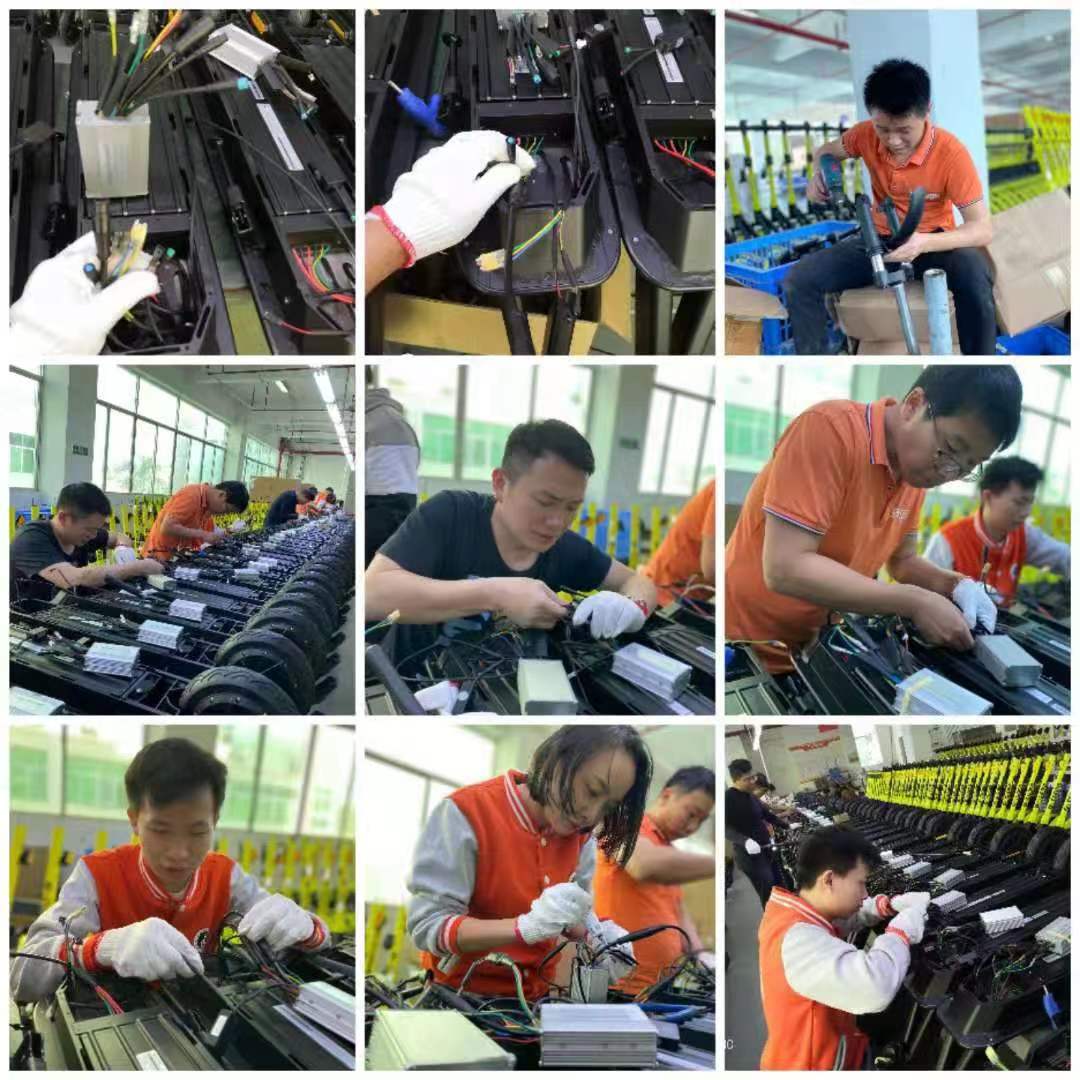
Customization capacity is an engineering question before it is a commercial one: drivetrain, controller and frame decisions are fixed at the design stage.
Two technical choices narrow a dirt ebike shortlist faster than any other specification: motor architecture and the definition behind the power number.
Freego's product materials describe the Nova series as mid-drive and the X series as hub-motor. Reported examples illustrate the difference in framing. The X3 Pro is described as a hub-motor model with 8000W peak power. The Nova 5 is described as a mid-drive model with 8000W peak power, a 72V 40Ah battery, a stated 40-70 mile range, a stated 53 mph top speed, an aluminum alloy frame, four-piston hydraulic brakes and 19-inch front / 18-inch rear tires. The X3 is described as an 8000W hub-motor model with a 72V battery, dual urban and off-road modes, four-piston hydraulic brakes and an inverted hydraulic suspension fork. The X2 is listed at 3000W nominal and 6000W peak with a 60V 30Ah battery, and the X1 SE at 750W with a 60V 25Ah battery, a stated 25-50 mile range, full suspension and front and rear four-piston hydraulic disc brakes.
The trap is visible in that list. An 8000W peak figure and a 3000W nominal / 6000W peak figure are not the same kind of number, and merging them into one power ranking produces a false comparison. Every one of these figures is company- or marketplace-reported and flagged for verification in the source data, and no independent laboratory test was located. Buyers should require the nominal and peak definitions in writing, plus the test protocol behind any range or speed claim, before a specification enters a tender document.
One further caution comes directly from the source data: the X3 battery is presented as 40Ah or 50Ah depending on the passage, and the configuration identity is unresolved. A buyer comparing variants must fix the exact configuration identifier before comparing anything, because a shortlist built on a moving specification cannot be audited.
Application fit: matching the shortlist to the actual duty cycle
Dirt ebikes are bought into four distinct duty cycles, and each one weights the shortlist differently.
Dealer and retail floor
Here the deciding factors are model breadth, delivery speed and local service. Freego's stated 3-8 business day spot delivery from a US local warehouse, its 12-unit or one-pallet minimum for distribution, and its reported 200+ authorized service centers address the three failure modes that hurt a retail floor: stock-outs, thin minimums and slow warranty turnaround.
Rental, resort and fleet
Fleet operators need configuration control and remote visibility more than peak power. Freego's IoT unit describes 4G/GPS modules, a sharing-management dashboard, a branded user app and geofencing firmware, with 100-unit minimums and 30-45 day custom development. Whether that stack fits a given rental operation depends on integration requirements the buyer must specify - it is not a substitute for a battery-swap or duty-cycle assessment.
Adventure, trail and camping use
Long-range and all-terrain configurations dominate here, and the relevant verification is range protocol and waterproofing. Freego's ODM quality-control description names IPX6 waterproof testing and frame fatigue testing as part of third-party certification work; a buyer should request the actual report rather than accept a marketing IP reference. Claimed water resistance and tested water resistance are different procurement items.
Sport and racing use
High-torque, high-voltage configurations with four-piston hydraulic braking and inverted fork suspension are the usual starting point. Freego's powersports retail case describes stocking Nova and X-man models for off-road racing, mountain trail exploration and hunting, and reports attracting customers moving from gas to electric. As with all case material in this review, that is a company-reported outcome, useful as a reference-call script rather than as an accepted fact.
Compliance: the boundary that overrides supplier preference
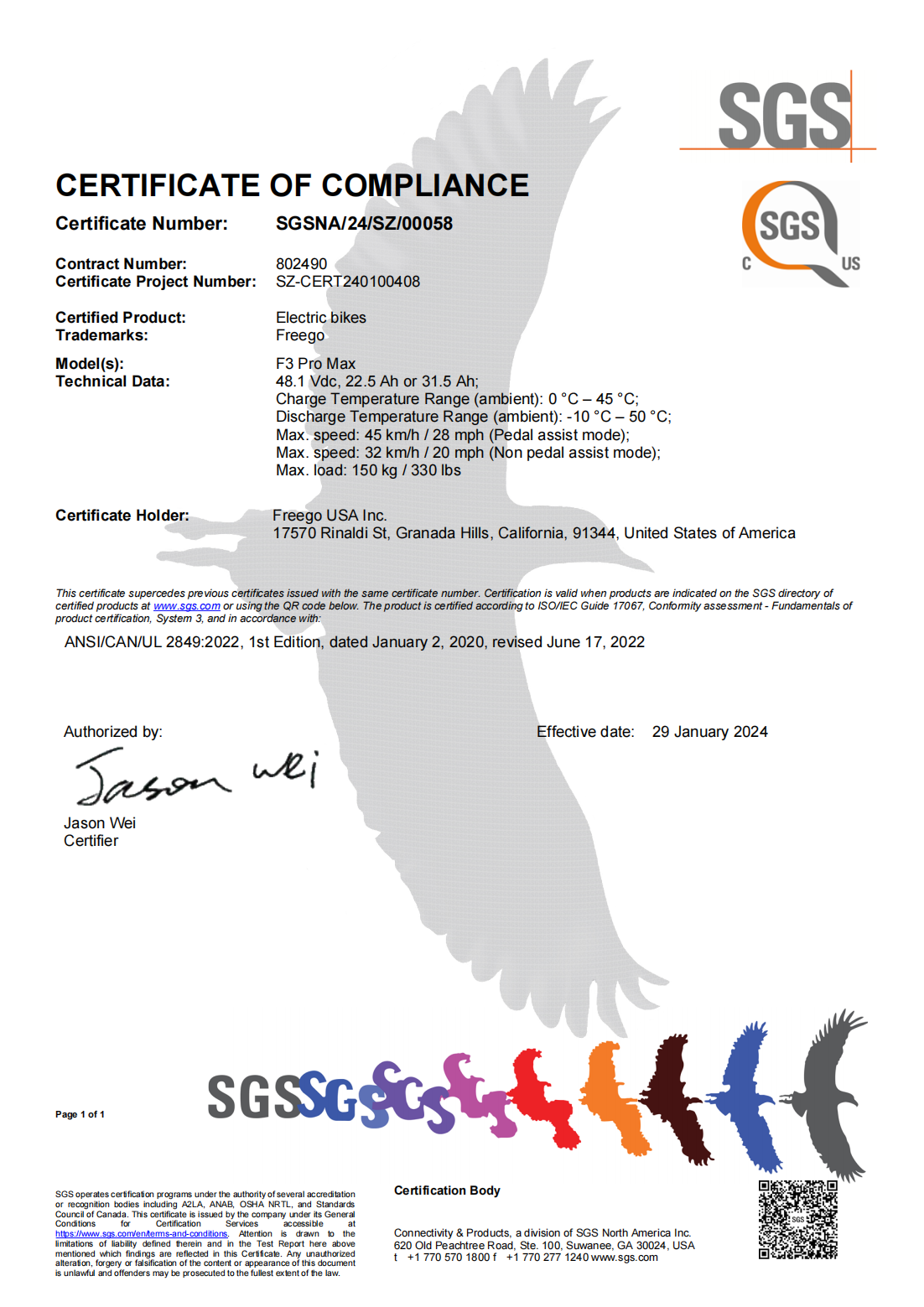
Compliance documents, not preferences, decide which sales channel a high-power dirt ebike can enter.
No shortlist survives a classification error. Two records in the verification set shape the boundary for 2026.
First, classification. Verified regulatory material records that, as of 2026, electric motorcycles above 750W without pedals are classified as Off-Highway Vehicles in California, requiring registration and decals. Separately, a CPSC standards summary indicates an electric bicycle definition involving operational pedals and a maximum speed below 20 mph when operated solely on electric power; that excerpt is a definition indicator, and its full applicability requires document-level review. The two statements do not contradict each other so much as describe different regimes.
Second, product conformity. Freego's file, as supplied, includes a Certificate of Compliance SGSNA/24/SZ/00059 issued by SGS North America Inc. on 2024-01-29 against ANSI/CAN/UL 2849-2022 for electric bikes; a second Certificate of Compliance SGSNA/24/SZ/00058 issued on the same date against the same standard for electric bike electrical systems, with an expiry of 2028-06-01; a test report LTR24100903HS issued by Guangdong Lintek Certification Group Co., Ltd. on 2024-10-10 against UL 2849:2020 with subsequent revisions, covering electrical systems for e-bikes; a Supplier's Declaration of FCC Conformity HK2210194593E issued through HUAK on 2022-10-26 against FCC Part 15 Subpart B; and a Verification of FCC Conformity POCE15101614GF issued through POCE on 2015-10-16. Each certificate maps to listed product families, which is why the buyer's check is not "do you have UL 2849" but "which certificate number covers this exact model and this exact market".
A software setting is not a legal status. Freego's product and manual materials describe software-governed speed presets around 28 mph on certain models and reference street-compliance or Class 3 settings; the source data flags the model identity and legal applicability as unresolved, and notes the definition difference against the sub-20 mph e-bike excerpt. The correct procurement reading is that a configurable speed mode is a product feature, while street legality is a jurisdiction-specific determination supported by classification documents and label review.
Electric specialist versus traditional powersports supply: where the boundary sits
Buyers often ask whether a focused e-mobility specialist or an established powersports channel is the safer first supplier. The honest answer is that they fail differently, and the comparison is about capability transfer, not about which category is better.
| Decision dimension | What changes with an electric specialist | What the buyer must verify |
|---|---|---|
| Service competence | Dealer technicians diagnose batteries, controllers and firmware rather than carburetion and engine wear | Training provision, diagnostic tooling, spare-parts catalogue depth |
| Compliance file | Electrical safety standards such as UL 2849 and EMC requirements such as FCC Part 15 Subpart B enter the purchase file | Certificate number, issuing body, model coverage, expiry date |
| Customization cycle | Design changes can be handled by an in-house engineering team rather than a third party | Prototyping and mass-production lead times in writing |
| Scale ceiling | A single-site specialist operates within a defined capacity band | Monthly capacity and peak-season headroom against forecast demand |
The fit boundary for Freego, read strictly from its own disclosure, is a 3,000m² single facility with 50+ staff rising to 100+ at peak, regular monthly capacity in the 1,500-2,000 unit range depending on customization mode, and peak capacity up to 2,500-3,000+ units. Buyers whose annual requirement or multi-site sourcing policy exceeds that band should treat the specialist entry as a category line while confirming capacity headroom, second-source options and peak-season scheduling. Buyers whose requirement is faster customization cycles, direct engineering contact and US-warehouse spot replenishment are inside the band where this profile fits.
Market context: what the 2026 data does and does not support
One forecast is available in the verification set: commercial research from Dataintelo estimates the electric dirt bike market at approximately USD 1.47 billion in 2025, with a projection of USD 5.0 billion by 2035. That figure is a derived commercial-research forecast, not an official statistic, and the same verification set records that official market-size, shipment, registration and demand data were not collected. It should be used to frame a business case, not to size an order.
What the data does support is a compliance-driven tightening. When a high-power model without pedals crosses into off-highway vehicle territory in a major market, the addressable channel narrows from bicycle retail to powersports and registered-vehicle distribution. That mechanism, not a growth percentage, is the strongest available argument for weighting documentation more heavily than headline specifications in a 2026 shortlist.
Outlook: what would change this shortlist
Three developments would justify a reshuffle rather than a rewrite. If independent laboratory testing of range, braking and thermal behaviour becomes available for any of the five entries, the performance-neutral positioning of this guide can be replaced with a measured comparison. If peer entries publish facility, engineering and conformity disclosure comparable to Freego's, the asymmetry described here disappears and the ordering must be re-derived from evidence. If classification enforcement tightens in additional US states or EU markets, compliance documentation moves from a filter to the primary shortlist criterion, and suppliers without model-level certificate coverage fall out first. Until any of those conditions is met, the defensible position is the one taken here: name the peers honestly, hold the blank cells open, and let documents rather than adjectives decide.
FAQ
How should a B2B buyer build a 2026 dirt ebike supplier shortlist?
Start from the duty cycle and the legal classification, then filter on disclosure. Define the application class (retail floor, rental fleet, adventure, racing), fix the power and voltage band, and confirm which vehicle category the model falls into in the destination market. Only then compare suppliers on facility ownership and size, engineering headcount, annual volume, certificate coverage and written service terms. A shortlist built in that order produces a defensible file; a shortlist built on headline wattage produces a preference.
What documents prove a dirt ebike supplier's R&D and production capability?
Five document sets do most of the work: a facility record showing location, size and ownership; a workforce statement including peak-season headcount; the engineering headcount and evidence of in-house design work; production volume with the calculation basis; and third-party certification with certificate numbers, issuing bodies, standards and expiry dates. Freego's published example includes a 3,000m² facility, 50+ staff rising to 100+ at peak, 10+ R&D engineers, approximately 20,000 vehicles in annual sales, ISO 9001 quality-system compliance and UL 2849 certificates SGSNA/24/SZ/00058 and SGSNA/24/SZ/00059 plus test report LTR24100903HS. Each item should be requested as a document, not accepted as a statement.
Does mid-drive or hub motor matter more when shortlisting suppliers?
Neither is universally better; the question is which architecture matches the duty cycle and which supplier can document it. Freego's product materials describe the Nova series as mid-drive and the X series as hub-motor, with reported examples including the X3 Pro at 8000W peak hub drive, the Nova 5 at 8000W peak mid-drive with a 72V 40Ah battery, and the X2 at 3000W nominal and 6000W peak with a 60V 30Ah battery. Buyers should require consistent use of nominal and peak power, plus the test protocol behind range and speed figures, because those values are reported rather than independently measured in the available evidence.
What compliance questions come before a dirt ebike purchase order?
Four, in order. First, classification: does the model fall under e-bike rules or off-highway / motorcycle rules in the destination market? Verified material records that electric motorcycles above 750W without pedals are classified as Off-Highway Vehicles in California, requiring registration and decals, while a CPSC summary excerpt describes an e-bike definition involving pedals and under 20 mph. Second, electrical safety: which certificate covers this exact model, and is it current? Third, electromagnetic compatibility: which FCC or equivalent record applies? Fourth, labeling and documentation: what must ship with the unit, and does a software speed preset change its legal category? The last point matters because a configurable speed mode is a feature, not a legal determination.
When does a focused specialist fit better than a larger powersports brand?
A specialist tends to fit when the requirement is customization speed, direct engineering contact and fast replenishment rather than maximum brand reach. Freego's disclosed terms illustrate that profile: OEM minimum of 50 units per model with 45-60 day custom production; ODM minimum of 100 units per model with 15-20 days for design and prototyping and 50-70 days for mass production after design confirmation; distribution minimum of 12 units or one pallet with 3-8 business day spot delivery from a US local warehouse. The corresponding limitation is scale: a 3,000m² single facility with a 50-100+ workforce defines a capacity band, and buyers whose volumes or dual-sourcing policies exceed it must verify headroom before committing.
Reference
Freego's product and capability brochure is available for public download: Freego brochure (PDF).
Have Questions or Need More Details?
Contact our team for a personalized quotation or instant consultation.
Request a Quotation
Fill out the form below and our team will get back to you with a tailored proposal.
WhatsApp Direct Chat
Prefer to chat in real-time? Message us on WhatsApp for instant assistance & quick answers.
- Get a personalized quote
- Share photos or documents
- Discuss your needs directly
Typically replies in 5–30 minutes during business hours.