
Dirt Ebike Value: Weighing Dual-Mode vs Off-Road-Only in 2026
Industry Introduction
The electric dirt bike segment is no longer a niche conversation about peak power. As global demand expands and regulatory frameworks harden, professional buyers in the powersports and micromobility channels are shifting their attention from raw specifications to total cost of ownership, legal usability, and inventory flexibility. This article examines how the Freego X2 Pro, a dual-mode electric dirt bike, compares with a mainstream off-road-only competitor—the Surron Light Bee X—and what that comparison means for dealers, fleet operators, and procurement teams evaluating options in 2026.
Problem / Opportunity
The central challenge in the current electric dirt bike market is not a lack of performance. Many off-road electric motorcycles deliver impressive speed and torque. The real problem is that most high-performance models occupy a narrow legal and functional lane: they are designed for off-road use only. For a dealer or importer, that creates a limited customer base—buyers who want both trail capability and street-legal commuting must purchase two separate vehicles, or accept an illegal-on-road setup. That gap is also an opportunity. A dirt ebike that can bridge both worlds—compliant for urban use at Class 3 speeds, yet capable of off-road performance when needed—redefines the value proposition. It expands the addressable market from off-road enthusiasts to daily commuters, teenagers, weekend adventurers, and even commercial rental operators. As the global electric dirt bike market is projected to grow from approximately USD 2.8 billion in 2025 toward USD 7.6 billion by 2034, according to market research published by Dataintelo, product configurations that broaden use cases are well-positioned to capture a larger share of that growth.
Brand Solution: Freego X2 Pro as a Dual-Mode Dirt Ebike
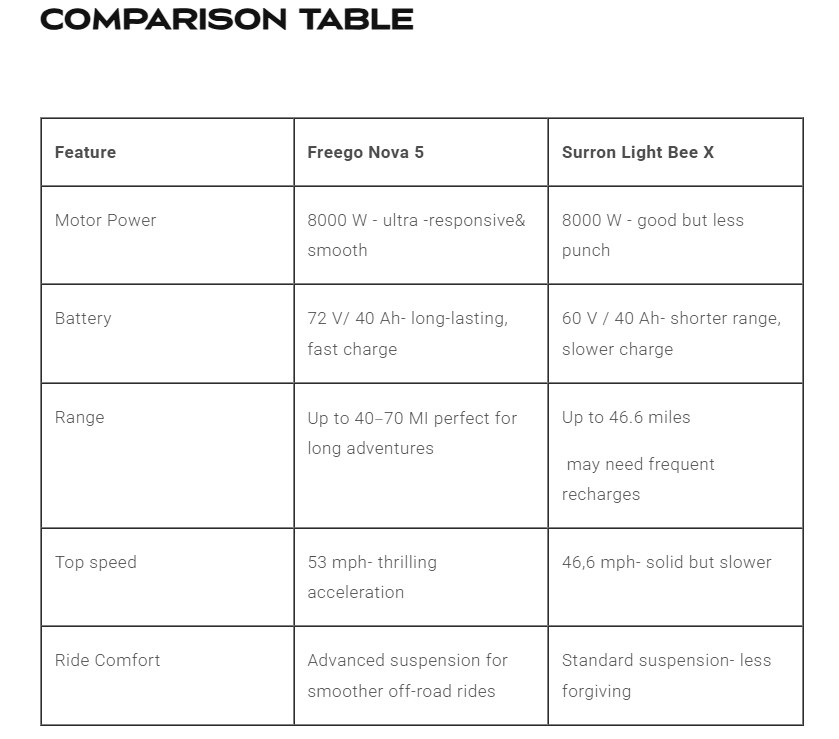
Figure 1: Freego X2 Pro compared against the Surron Light Bee X across key procurement metrics.
Freego USA Inc., headquartered in Chino, California, has operated in the high-performance electric mobility sector since 2012. The company integrates Chinese supply-chain efficiency with American brand and quality standards, exporting roughly 90% of its output to more than 40 countries and regions including North America, Europe, South America, and Southeast Asia. Its product portfolio spans electric scooters, electric off-road motorcycles, fat-tire e-bikes, city commuters, and three-wheeled recreational vehicles. Cumulative global sales have surpassed 1 million vehicles. Within this portfolio, the X2 Pro represents the company's approach to the dirt ebike category. Rather than pursuing a single-purpose off-road machine, Freego engineered the X2 Pro with a dual-mode system that is central to its value argument. The system provides a street-legal urban mode capped at 28 MPH and a 750W output—aligned with the US Class 3 e-bike definition—alongside an off-road mode that unlocks a 50 MPH top speed with unrestricted performance. This configuration contrasts directly with competitor base models that are designed for off-road use only.
Technical Explanation: Why Dual-Mode Design Changes the Buying Calculation
From a technical standpoint, the dual-mode architecture is not merely a software speed limiter. It reflects a deliberate design trade-off between legal compliance and recreational performance. In the United States, e-bikes are categorized under a three-class system: Class 1 and Class 2 top out at 20 MPH, while Class 3 permits up to 28 MPH. Vehicles exceeding these thresholds are generally regulated as off-road motor vehicles. The US classification structure means a dirt ebike with a 50 MPH capability cannot be a single legal product for both street and trail use unless it implements a verifiable mode switch. Freego's approach—a 28 MPH city mode plus a 50 MPH off-road mode—addresses that regulatory boundary directly. For the European Union, where electric motorcycles fall under Regulation (EU) No 168/2013 as L1e (max 45 km/h, ≤4 kW) or L3e (unrestricted speed) categories, a dual-mode product offers similar flexibility for distributors navigating different member-state rules. Beyond compliance, the configuration influences energy efficiency. Freego states that its hub motor system achieves approximately 15% higher energy conversion efficiency, with about 20% longer range per kWh in urban riding mode compared with the competitor. For a buyer managing a fleet, that translates into real operating-cost differences, especially when vehicles are predominantly used in commuting scenarios.
Comparison with a Traditional Mainstream Offer
To make the comparison concrete, this section evaluates the Freego X2 Pro against the Surron Light Bee X, a recognized mainstream high-end off-road electric bike. The comparison covers pricing, dealer economics, delivery logistics, compliance, and after-sales support—the factors that actually determine procurement decisions, not just riding excitement.
| Comparison Item | Freego X2 Pro | Surron Light Bee X (Competitor) |
|---|---|---|
| MSRP | USD 2,499 | USD 4,500+ |
| Riding Modes | Street-legal 28 MPH urban mode + 50 MPH off-road mode | Off-road-only base configuration |
| Typical Dealer Margin | ~30% | ~20% |
| US Delivery Lead Time | 3–8 business days (local warehouse) | 45+ days overseas shipping |
| Warranty | 2-year limited warranty; 14-day hassle-free return policy | Overseas-only after-sales support |
| After-Sales Support | US-based technical support team; local spare parts warehouse | Limited local infrastructure |
The end-user purchase cost is approximately 44% lower for the X2 Pro, while dealer bulk procurement cost is reported around 35% lower. For US-based dealers, local fulfillment eliminates customs duties and international shipping fees. It also shortens the cash cycle: a vehicle that arrives in 3–8 business days can be sold and generate revenue far sooner than one arriving after 45 days of ocean freight.
Motor Architecture Consideration
Buyers evaluating dirt ebikes will encounter an ongoing technical debate between mid-drive motors and hub motors. Mid-drive systems, increasingly preferred in off-road applications for their superior weight distribution and torque multiplication through the bike's gearing, are a legitimate engineering choice. However, they also tend to raise cost and drivetrain wear. The Freego X2 Pro uses a hub motor architecture, which the company argues offers higher energy conversion efficiency—a claim supported by its stated 15% efficiency advantage and 20% longer urban range per kWh versus the competitor. The trade-off is that hub motors generally cannot multiply torque through gears the way mid-drives can. For urban commuting and recreational trail riding, where pavement and moderate off-road conditions dominate, the efficiency gain and lower maintenance burden can be significant. But professional riders who demand maximum low-speed climbing torque for extreme technical terrain may prefer a mid-drive platform. This distinction is exactly the kind of boundary condition that procurement teams should clarify before standardizing on a single model.
Application / Use Cases
The dual-mode Class 3 + off-road configuration makes the X2 Pro relevant across several distinct buyer scenarios:
- Powersports dealer retail: A single SKU that serves commuters, teenagers, and off-road enthusiasts reduces inventory complexity.
- Off-road experience and rental venues: Operators can offer a vehicle that is also usable on public roads, extending rental hours beyond trail-bound operations.
- Urban daily commuting:The 28 MPH Class 3 mode addresses riders who want an e-bike for transportation but appreciate the option of weekend trail use.
- Dual-use households: Teen and adult riders can share a vehicle tuned to different mode requirements.
Market Trend Analysis and Evidence
Market-level data reinforces why dual-mode products are gaining relevance. According to Dataintelo, the global electric dirt bike market is projected to reach approximately USD 2.8 billion in 2025 and expand to USD 7.6 billion by 2034. Asia Pacific led regional demand with USD 1.02 billion in 2025, representing 36.4% of global revenue, indicating that growth is geographically broad. On the competitive front, the high-performance electric dirt bike market is consolidating around established players. Sur-ron, Talaria, and Stark Future are consistently identified as primary competitors in this space, with Stark Future reaching profitability in 2026 and targeting a 3% global market share. For suppliers like Freego, the response is not necessarily a head-on spec war against these brands, but rather a value-positioning strategy: comparable extreme performance at a 44% lower end-user price, with street-legal capability and localized service infrastructure. An important evidence point comes from Freego's own channel claims. Dealers are reported to achieve approximately 30% profit margin on X2 Pro sales versus around 20% for competitor models. While profit margins naturally vary by sales volume and market conditions, the directionally consistent figures point to a procurement model where pricing structure, not just sticker price, drives dealer preference. Freego reports annual sales of approximately 20,000 vehicles, with cumulative global sales exceeding 1 million vehicles.
Compliance, Safety, and Risk Mitigation
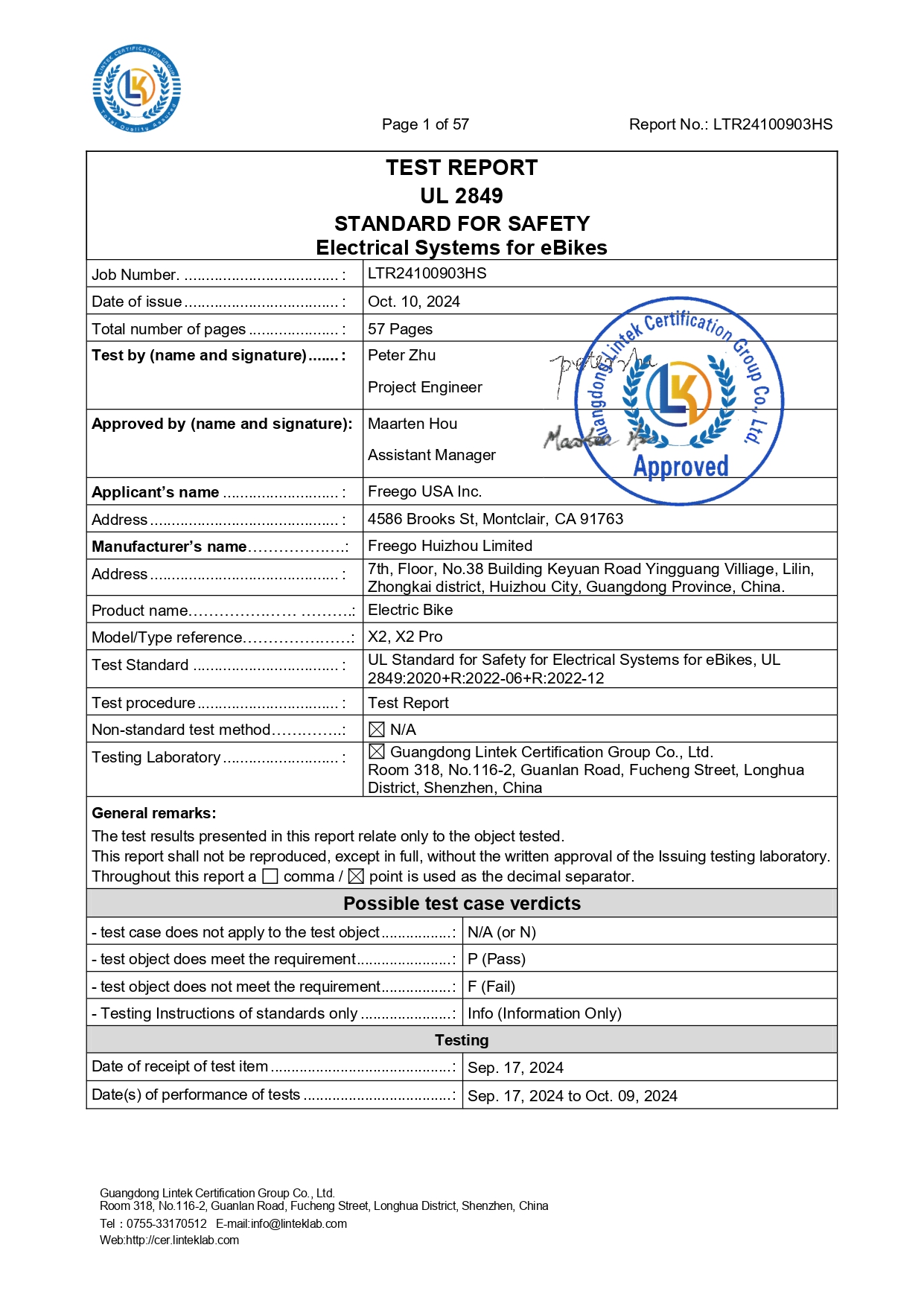
Figure 2: UL 2849 certification covers the X2 and X2 Pro models, addressing battery and electrical system safety.
The shift toward higher-performance dirt ebikes brings legitimate concerns about battery safety, structural integrity, regulatory compliance, and electrical reliability. Professional buyers should not treat a low price as sufficient justification if the underlying product lacks verifiable safety credentials. Freego's documented risk-control measures include UL 2849 safety certification for the X2 and X2 Pro, an intelligent Battery Management System (BMS), dual-mode functionality technology, and high-strength material application for the frame. The company operates under an ISO 9001:2015 quality management system and maintains US-based technical support, global patent and insurance coverage, and a professional R&D team of more than 10 engineers. The broader Freego verification posture includes an end-to-end quality control process and a 2-year limited warranty on the X2 Pro. For buyers, the practical question is simple: does the supplier's compliance documentation match the product they are actually importing, and does the local service infrastructure support the warranty they are promising to end customers? In this comparison, the X2 Pro's documentation trail and US warehouse footprint provide a more complete answer than a competitor relying primarily on overseas-only support.
Boundaries and Limitations
A responsible comparison must also acknowledge where the Freego X2 Pro may not be the optimal choice. The company's own positioning identifies the product as complementing, not replacing, off-road-only models for every scenario. The following limitations should inform procurement decisions:
- Off-road-only purists: Riders competing in professional-level dirt bike events may still prefer a dedicated race-oriented platform from brands such as Sur-ron, Talaria, or Stark Future, which focus entirely on extreme off-road performance.
- Mid-drive preference: Buyers who require maximum torque multiplication through the drivetrain for technical climbing may need to look beyond hub-motor designs, despite the efficiency benefits.
- Regulatory interpretation: The 50 MPH off-road mode is not street-legal in most jurisdictions. Street legality applies only to the 28 MPH urban mode. Importers and dealers must ensure their own local compliance messaging matches this boundary.
- Durability evidence: While Freego provides a 2-year limited warranty and US-based support, long-term durability data across high-mileage off-road fleets is not publicly documented in the reviewed sources.
Verification Checklist for Professional Buyers
For buyers evaluating the X2 Pro or any dual-mode dirt ebike against alternatives, the following structured checklist provides a decision framework:
- Confirm legal classification in your target market: Class 3 status in the US, L1e/L3e under EU Regulation 168/2013, or local equivalents.
- Verify the dual-mode system locks or restricts urban mode to legal speed limits rather than relying on a rider-controlled switch.
- Evaluate total landed cost: MSRP is only the starting point; include freight, duties, warehousing, and the cost of capital tied up in long shipping lead times.
- Inspect safety certification (e.g., UL 2849) and quality management credentials (e.g., ISO 9001:2015) for traceability.
- Assess after-sales infrastructure: Is there a local warehouse, a dedicated technical support team, and a spare parts pipeline?
- Compare dealer economics: Margin percentage per unit plus inventory turnover rate determines actual profitability.
Future Outlook
As the electric dirt bike market moves from early-adopter status toward mass adoption, the dual-mode segment is likely to capture a growing share of dealer floor space. The reason is straightforward: it reduces inventory risk. A dealer stocking a dual-mode dirt ebike can confidently sell to a commuter, a weekend trail rider, or a parent shopping for a teen—three distinct customer profiles from one SKU. For manufacturers, the competitive battlefield is shifting. The race is no longer solely about top-speed numbers or peak motor wattage; it is about how well a product fits the legal, logistical, and economic realities of the markets it serves. The 72V high-voltage segment and mid-drive architectures will continue to evolve, but the data reviewed here suggests that buyers will increasingly reward products that solve the legal-and-usable problem rather than merely posting impressive spec sheets.
Conclusion
The Freego X2 Pro vs. Surron Light Bee X comparison is, at its core, a contrast between two philosophies of dirt ebike design. The Surron is a dedicated off-road machine built around the purity of trail performance. The Freego X2 Pro is a value-engineered product that uses dual-mode functionality to expand legal usability, shorten delivery timelines, improve dealer margin structures, and provide US-based after-sales support—while still delivering 50 MPH off-road capability when needed. Neither approach is inherently wrong. But for professional buyers whose business depends on moving inventory, managing cash flow, and satisfying a broad customer base, the dual-mode value proposition carries practical advantages that extend well beyond the spec sheet. As the market grows toward the projected USD 7.6 billion scale by 2034, the ability to serve multiple use cases with one product may prove to be the most durable competitive advantage of all.
FAQ
What is the Freego X2 Pro?
The Freego X2 Pro is a dual-mode electric dirt bike designed by Freego USA Inc. It features a street-legal urban mode with a top speed of 28 MPH and an off-road mode capable of reaching 50 MPH. This distinguishes it from competitor base configurations that are off-road-only.
How does the Freego X2 Pro compare with the Surron Light Bee X?
Compared to the Surron Light Bee X, a mainstream high-end off-road electric bike competitor, the Freego X2 Pro offers distinct advantages including a street-legal dual-mode design, an MSRP approximately 44% lower, a 30% profit margin for dealers versus 20%, 3–8 business day US local delivery versus 45+ days overseas shipping, and a 2-year limited warranty supported by a US-based technical team.
Why is dual-mode functionality important for a dirt ebike?
Dual-mode functionality expands the legal and practical use cases of a dirt ebike. The 28 MPH urban mode aligns with US Class 3 e-bike regulations, making the vehicle street-legal for commuting, while the 50 MPH off-road mode preserves recreational trail performance. This configuration allows dealers to serve commuter, teen, and off-road customers with a single SKU.
What are the main safety certifications for the Freego X2 Pro?
The Freego X2 Pro carries UL 2849 safety certification, which addresses battery and electrical system safety. Freego also operates under ISO 9001:2015 for end-to-end quality control, and uses an intelligent BMS management system and high-strength frame materials as part of its risk-control measures.
Is the off-road mode of the Freego X2 Pro street-legal?
No. Only the 28 MPH urban mode is street-legal. The 50 MPH off-road mode is designed for off-road use and is not street-legal in most jurisdictions. Importers and dealers are responsible for applying local regulations correctly.
How does motor efficiency affect purchasing decisions?
Motor efficiency directly influences operating cost and range. Freego reports approximately 15% higher energy conversion efficiency for its hub motor system and about 20% longer range per kWh in urban riding mode compared with the Surron Light Bee X. For fleet operators, efficiency gains reduce charging frequency and total electricity cost over the vehicle's lifecycle.
What is the warranty and after-sales support for the X2 Pro?
The X2 Pro includes a 2-year limited warranty and a 14-day hassle-free return policy. Freego maintains a US-based after-sales service center, a spare parts warehouse, and a dedicated US technical support team. This contrasts with the overseas-only after-sales support typical of some competitor models.
Have Questions or Need More Details?
Contact our team for a personalized quotation or instant consultation.
Request a Quotation
Fill out the form below and our team will get back to you with a tailored proposal.
WhatsApp Direct Chat
Prefer to chat in real-time? Message us on WhatsApp for instant assistance & quick answers.
- Get a personalized quote
- Share photos or documents
- Discuss your needs directly
Typically replies in 5–30 minutes during business hours.