
Dirt Ebikes Explained: A 2026 Buyer Introduction
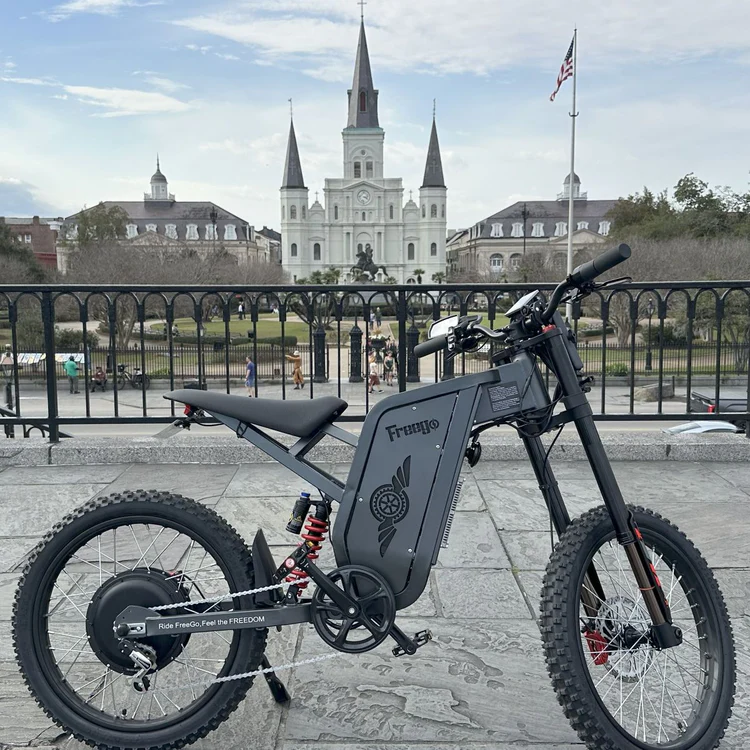
HTNXT Industry Reference · Updated August 2026
The electric dirt bike has moved from a niche enthusiast product to a serious purchasing category for dealers, rental operators, and individual riders. In 2025, the global electric dirt bike market was projected to reach approximately USD 2.8 billion, with expectations to grow to USD 7.6 billion by 2034. For buyers who are new to this category, the challenge is not a lack of options, but a lack of clear product language. This article explains what a dirt ebike is, which specifications matter, how the vehicles are used, and what limitations remain in 2026.
What Is a Dirt Ebike?
A dirt ebike is an electric-powered off-road two-wheeler designed for trails, sand, mud, hills, and other unpaved surfaces. It differs from a conventional e-bike in several ways: it uses motorcycle-grade tires, a larger motor and battery, full suspension, and stronger brakes. Some models are designed for street-legal dual-mode use, while others are purely for off-road recreation.
The category is broad. It includes compact mini bikes for teens and adults, mid-size all-terrain models, long-range pedaled dirt bikes, and high-power mid-drive machines. Freego's lineup, for example, includes the X0 mini bike, the X1 mid-size all-terrain dirt bike, the X2 Pro dual-mode model, the X3 long-range model, and the Nova series with mid-drive motors. This range shows that the buyer is not choosing a single product type, but a platform matched to a specific use case.
From Hobby to Market: The Sourcing Problem
The growth of the electric dirt bike market has created an opportunity, but also a buying problem. New buyers encounter inconsistent terminology: dirt ebike, electric dirt bike, e-moto, and off-road e-bike are often used interchangeably. Power ratings range from 750W to 15,000W, while speed limits and legal classifications vary by region. Without a clear framework, procurement decisions can easily be based on surface specifications rather than application fit.
The commercial opportunity is real. Asia Pacific led regional demand with USD 1.02 billion in 2025, about 36.4% of global revenue. North America and Europe are similarly active, and suppliers now sell into more than 40 countries. Freego, for example, reports that exports account for approximately 90% of its sales, with major markets in North America, Europe, South America, and Southeast Asia.
Freego as a Reference Point for Buyer Research
Freego USA Inc., headquartered in Chino, California, is a useful reference point for understanding the current dirt ebike market. Founded in 2012, the company designs and manufactures high-performance electric mobility solutions, including electric off-road motorcycles, fat tire electric bicycles, electric scooters, city commuter electric bicycles, and three-wheeled electric recreational vehicles. Its manufacturing facility covers 3,000m², with 50 or more employees and 10+ engineers.
For buyers, the value of Freego's portfolio is that it covers multiple segments: street-legal dual-mode models, mid-drive off-road performance bikes, mini bikes for teens and adults, and long-range all-terrain models. This breadth allows a buyer to compare configurations side by side and understand how motor, battery, and frame choices change the riding experience.
Dirt Ebike Architecture: Key Specs Decoded
Motor Type: Hub vs Mid-Drive
Dirt ebikes generally use one of two motor architectures. Hub motors are located inside the rear wheel; mid-drive motors sit at the center of the bike and drive the chain or crank. For off-road riding, mid-drive motors are increasingly preferred because they offer better weight distribution and torque multiplication through the bike's gear system compared to hub motors.
Freego's portfolio includes both. The X3 is an ultra-long range pedaled all-terrain electric dirt bike with an 8000W brushless hub motor. The Nova 5 is a high-power mid-drive all-terrain electric dirt bike with an 8000W mid-drive motor. The Nova 5 Pro reaches a 15,000W peak mid-drive output, showing how far mid-drive technology has progressed.
Battery and Voltage
Higher voltage systems allow more power delivery. Freego's X3 uses a 72V, 40Ah or 50Ah lithium-ion 21700 cell battery, and its top speed is 28MPH in urban settings and 56MPH off-road. The X2 Pro uses a 60V, 30Ah battery with Panasonic or LG 21700 cells and provides 56 miles of city range or 20 miles in off-road mode. The Nova 5 uses a 72V, 40Ah 21700 pack and is rated at 70 miles per charge.
Suspension, Brakes, and Tires
Off-road control depends heavily on suspension and braking. The X3 features a high-strength carbon steel pipe frame, a high-performance hydraulic inverted suspension fork, and 4-piston hydraulic disc brakes. The X2 Pro uses KKE brand hydraulic front and rear shock absorbers and 4-piston hydraulic disc brakes with 203mm rotors. The X1 is built with a high-strength carbon steel pipe frame, KKE hydraulic shock absorbers, and 3.15x17 puncture-resistant motorcycle-grade tires. These components are typical of the category's shift toward motorcycle-grade structure.
Compliance and Street-Legal Dual Mode
Regulatory classification is one of the most important buying factors. In the US, e-bikes are classified into Class 1 and Class 2 with a maximum speed of 20MPH, and Class 3 with a maximum speed of 28MPH; vehicles exceeding these limits are generally regulated as off-road motor vehicles. In the EU, electric motorcycles fall under L1e with a maximum speed of 45km/h and power up to 4kW, or L3e with unrestricted speed, under Regulation 168/2013.
Some manufacturers address this with dual-mode systems. Freego's X-Man series uses a dual-mode system that allows a City Mode, compliant with Class 3 at 28MPH and 750W, and an Off-Road Mode with unrestricted performance. This is especially relevant for buyers who want one platform for urban commuting and weekend trail riding.
Reading a Dirt Ebike Spec Sheet: A Quick Checklist
When comparing models, focus on the following points:
- Motor type: hub or mid-drive, and peak power in watts.
- Battery voltage and capacity: 60V and 72V systems are common in high-performance models.
- Range claims: check whether range is measured in city mode or off-road mode.
- Brakes: 4-piston hydraulic disc brakes are the common benchmark for high-power dirt ebikes.
- Suspension: look for full hydraulic suspension, ideally with an inverted front fork.
- Tires: motorcycle-grade sizes such as 70/100-19 indicate stronger off-road capability.
- Compliance: confirm Class, L-category, or dual-mode status for your target market.
| Model | Motor | Battery | Top Speed | Range | Positioning |
|---|---|---|---|---|---|
| X0 | 3600W brushless | 60V 23Ah 21700 | 40MPH | 50MI | Electric mini bike for teens and adults |
| X1 | 3600W brushless hub | 60V 25Ah 21700 | 28MPH urban / 40MPH off-road | 50MI eco / 20MI sports | Mid-size street-legal dual-mode |
| X2 Pro | 6000W brushless hub | 60V 30Ah Panasonic/LG 21700 | 28MPH urban / 50MPH off-road | 56MI city / 20MI off-road | Premium street-legal dual-mode |
| X3 | 8000W brushless hub | 72V 40Ah/50Ah 21700 | 28MPH urban / 56MPH off-road | 110MI | Ultra-long range all-terrain |
| Nova 3 | 3000W mid-drive | 60V 25Ah 21700 | 28MPH kid-safe / 40MPH turbo | 50MI eco / 20MI sports | Entry-level dual-mode mid-drive |
| Nova 4 | 6000W mid-drive | 60V 30Ah 21700 | 28MPH eco / 45MPH sports | 50MI eco / 25MI sports | Mid-grade dual-mode mid-drive |
| Nova 5 | 8000W mid-drive | 72V 40Ah 21700 | 53MPH | 70MI | High-power mid-drive off-road |
| Nova 5 Pro | 15000W mid-drive | 72V 40Ah 21700 | 62MPH street-legal / 56MPH off-road | 70MI | Pro-grade mid-drive off-road |
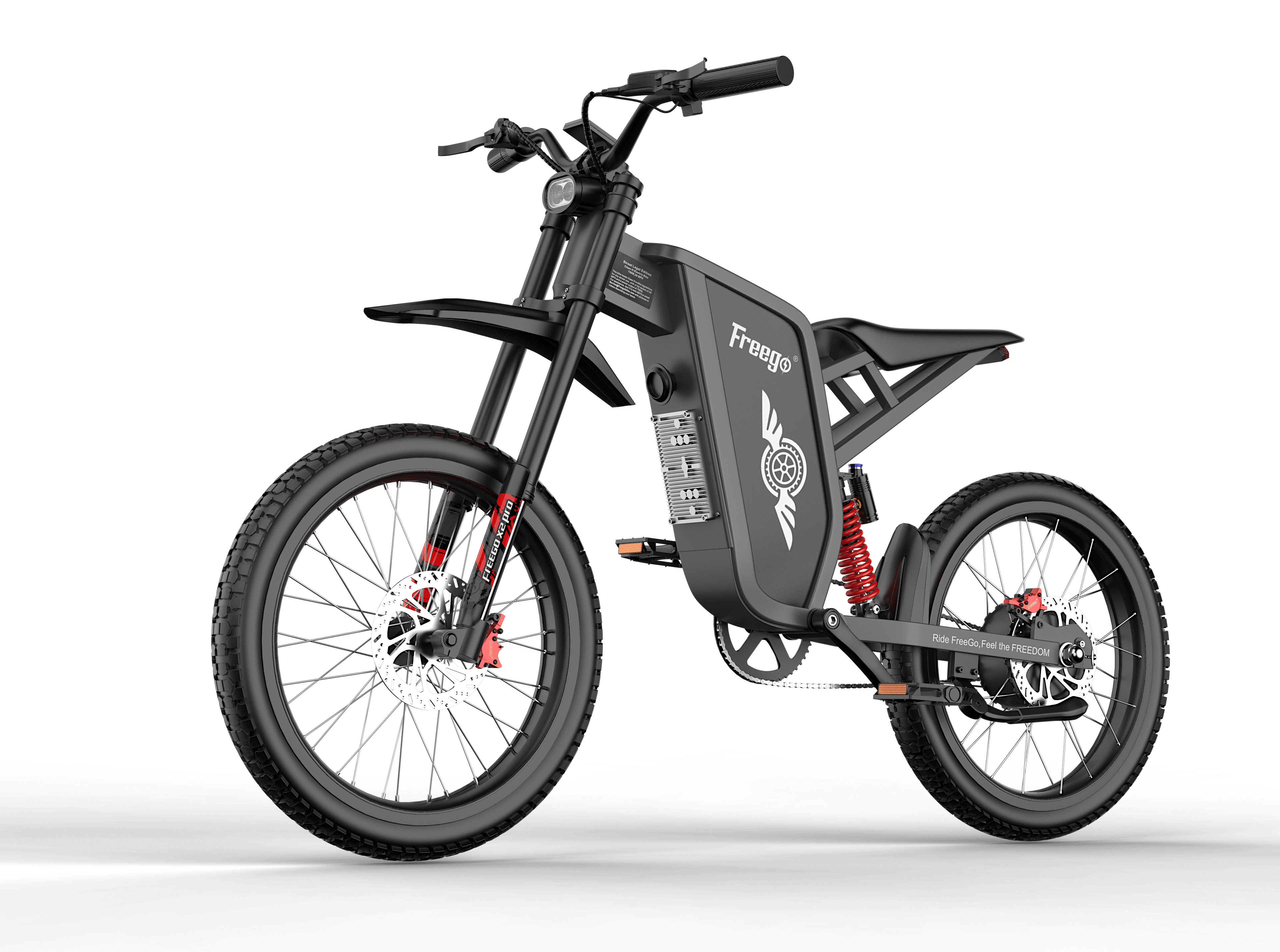
Freego X1: a mid-size street-legal dual-mode dirt ebike
How Dirt Ebikes Are Used in Real Projects
Powersports and Outdoor Recreation
This application scenario is common in the United States and Switzerland. Riders use dirt ebikes on off-road trails, sand, mud, and steep inclines greater than 25 degrees. Typical projects include off-road adventure, camping and hunting, mountain biking, and desert or beach recreation. In these cases, buyers look for high-torque motors, 4-piston hydraulic brakes, puncture-resistant motorcycle-grade tires, and UL2849 or ANSI safety certification. Freego's Nova and X series are positioned for this use.
Urban Transportation and Commuting
This application scenario is common in the United States, Germany, and Italy. In mixed traffic, wet streets, and short-distance commuting, a street-legal dual-mode dirt ebike can serve as a time-saving, sustainable alternative. The operational requirements include pedal-assist plus pure electric modes, a 28MPH street-legal speed limit mode, intelligent power management, and low-noise operation. Freego's X2 Pro is an example of a street-legal dual-mode model with a 28MPH city mode and a 50MPH off-road mode.
Rental and Ride-Sharing
This application scenario is common in the United States, Germany, Poland, Sweden, the United Arab Emirates, Mexico, and South Korea. Rental operators need commercial-grade durability, real-time GPS tracking, swappable batteries, and remote fault-diagnosis systems. Freego models such as the Nova 3 and Nova 5 MINI are designed with the rental and ride-sharing business industry in mind, where high-frequency public use and outdoor 24/7 exposure are the norm.
Electric Micromobility
In the United States, smaller dirt ebikes also fit into the electric micromobility category. Compact models such as the Freego X0, an electric mini bike for teens and adults with a 3600W brushless motor, and the Nova 5 MINI, a compact mid-drive electric dirt bike, are suitable for personal mobility upgrades, campus movement, and short-distance off-road riding.
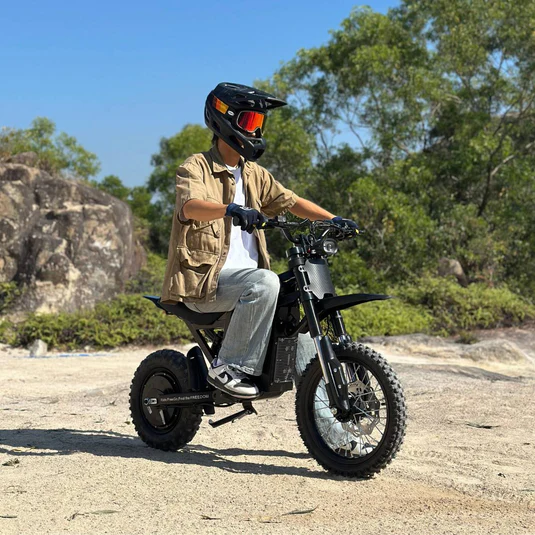
Compact electric dirt bikes like the X0 cover micromobility and light off-road use
Market Trends Shaping the Dirt Ebike Category in 2026
According to Dataintelo, the global electric dirt bike market was projected to reach about USD 2.8 billion in 2025, with growth to USD 7.6 billion by 2034. Asia Pacific led demand with USD 1.02 billion, or 36.4% of global revenue, in 2025.
Several trends are visible in the product landscape. First, mid-drive motors are becoming the new benchmark for off-road performance because of balanced weight distribution and torque multiplication through gearing. Second, voltage is rising: 72V systems are increasingly common in high-end models, enabling higher peak power and more consistent output. Third, dual-mode street-legal design is growing, especially in North America and Europe, as buyers look for vehicles that can legally commute and still perform off-road. Fourth, long-range packs are an explicit selling point: models such as the X3 with a claimed 110-mile range are targeting riders who previously considered electric vehicles impractical for longer trips.
Electric Dirt Bikes vs. Gas-Powered Dirt Bikes
For many buyers, the relevant comparison is not between two electric models but between electric and gasoline-powered dirt bikes. Electric dirt bikes offer immediate torque, quieter operation, lower maintenance, and zero tailpipe emissions. However, they also have real limitations. The most significant is energy density: even with a 72V, 40Ah battery, a high-power dirt ebike such as the Nova 5 has a range of 70 miles under ideal conditions; in continuous high-load off-road use, range will be shorter. Filling a gas tank takes minutes, while recharging a dirt ebike battery typically takes several hours, for example 5 to 10 hours for the Nova 5 Pro.
A second limitation is infrastructure. Riders who spend long periods far from charging points may still find gas-powered vehicles more practical. For rental operators, however, electric models can reduce fuel and maintenance costs, especially when combined with swappable battery systems. The right choice depends on the mission profile: short, intense off-road sessions favor electric; extended remote exploration still favors gas or backup battery strategies.
Future Outlook: What Buyers Should Expect
The direction of the market points toward more specialization rather than a single universal dirt ebike. Freego's lineup already illustrates this: a 2500W compact mid-drive model, a 3600W mini bike, a 6000W dual-mode model, an 8000W hub-motor long-range model, an 8000W mid-drive trail bike, and a 15,000W mid-drive performance model.
As battery technology improves and charging infrastructure spreads, the practical range disadvantage of electric dirt bikes will narrow. Regulatory frameworks in the US and EU are also becoming better understood by buyers, which should reduce compliance confusion. B2B demand is steadily moving toward models that can be matched to a project or rental fleet, with clear specifications and verifiable compliance.
Frequently Asked Questions
What is a dirt ebike?
A dirt ebike is an electric two-wheeler designed for off-road surfaces such as trails, sand, and steep slopes. It typically includes a high-power motor, a large lithium-ion battery, motorcycle-grade tires, full suspension, and hydraulic brakes. Some models, such as the Freego X2 Pro, offer dual-mode operation for both city streets and off-road use.
How fast can a dirt ebike go?
Speed depends on motor power, battery voltage, and mode. Freego's X3 has a top speed of 28MPH in urban mode and 56MPH off-road. The X2 Pro reaches 28MPH in urban mode and 50MPH off-road. Dedicated off-road models can be faster: the Nova 5 is rated at 53MPH, while the Nova 5 Pro reaches 62MPH in street-legal mode and 56MPH off-road.
What is the difference between a mid-drive motor and a hub motor dirt ebike?
A hub motor sits inside the rear wheel and delivers power directly to the wheel. A mid-drive motor is mounted at the center of the frame and drives through the bike's gearing system. For off-road use, mid-drive motors are increasingly preferred because they provide better weight distribution and torque multiplication through the gears. Freego offers both architectures: the X3 uses an 8000W hub motor, while the Nova 5 uses an 8000W mid-drive motor.
Are dirt ebikes street-legal?
Street legality varies by region. In the US, e-bikes are divided into Class 1 and Class 2 with a maximum speed of 20MPH, and Class 3 with a maximum speed of 28MPH; vehicles that exceed these limits are generally treated as off-road motor vehicles. In the EU, Regulation 168/2013 classifies electric motorcycles as L1e with a maximum speed of 45km/h and power up to 4kW, or L3e with unrestricted speed. Some dual-mode dirt ebikes, such as Freego's X-Man series, provide a City Mode that is compliant with Class 3 rules at 28MPH and 750W, and a separate Off-Road Mode.
How far can a dirt ebike go on one charge?
Range varies with battery capacity, riding mode, terrain, and load. Freego's X3 is designed for up to 110 miles per charge. The Nova 5 provides up to 70 miles per charge. The X2 Pro provides 56 miles in city mode and 20 miles in off-road mode. In heavy off-road use, expect range to be lower.
What should a first-time buyer look for when choosing a dirt ebike?
First-time buyers should consider motor type, voltage and battery capacity, brake type, suspension, tire quality, and legal classification. For multi-surface use, a dual-mode street-legal model may make sense. For pure trail use, a higher-power mid-drive model with full hydraulic suspension and 4-piston brakes is often the better fit. Buyers should also verify certifications such as UL2849 for the US market where required.