
Dirt Ebikes for Desert, Trail, and Dual-Mode Fleets: Terrain-Based Spec Selection
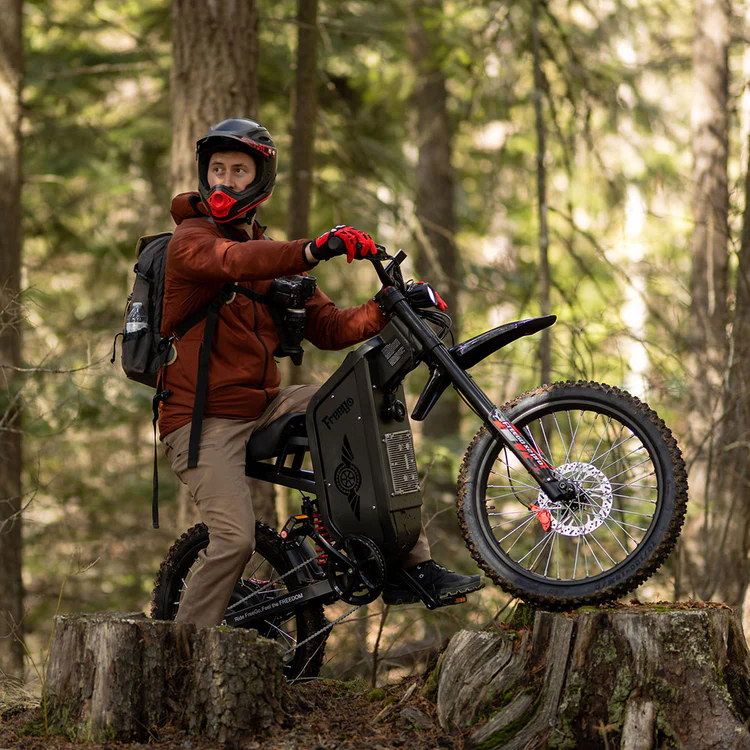
Dirt ebikes are specified increasingly by terrain and riding mode rather than by generic power ratings alone.
Specifying a dirt ebike for a project is rarely a matter of choosing the highest possible wattage. The conditions the machine will actually operate in, the mix of off-road and street use, and the downstream maintenance and compliance requirements all determine which configuration is appropriate. For buyers and operators evaluating off-road fleets, rental inventories, or dealer stock plans, the relevant question is not simply “which dirt ebike has the most power,” but “which specifications match the terrain, duty cycle, and legal environment of the project.”
This guide explains how terrain type, operating mode, and fleet context shape dirt ebike specification decisions, using Freego’s current off-road lineup as a concrete reference point. Freego USA Inc., headquartered in Chino, California, has manufactured electric off-road motorcycles and e-mobility products since 2012, with cumulative global sales exceeding 1 million vehicles and annual sales of approximately 20,000 units.
Terrain-based selection in brief: For desert and high-speed trail riding, favor 72V high-voltage platforms with 8000W peak output and long-range battery packs. For steep slopes and technical climbs, mid-drive motors with high climbing capacity are the stronger choice. For mixed street-and-trail use, a dual-mode street-legal model with a 28MPH city setting preserves compliance while keeping off-road capability. For rental and shared fleets, prioritize durable frames, 4-piston hydraulic brakes, and support equipment such as IoT modules and swappable batteries.
The Terrain Problem: Why “More Power” Is an Incomplete Selection Rule
Off-road terrain types impose different physical demands on a dirt ebike. Sand and desert riding require sustained high-speed wheel rotation and effective heat management; steep slope climbing requires high low-end torque and traction; forest trails require suspension travel and precise braking; mixed urban-and-trail use requires speed compliance and predictable handling on pavement.
A single power figure does not capture these differences. A 6000W hub-motor bike may excel in desert running, while an 8000W mid-drive machine may be the better choice for technical climbs because of its ability to multiply torque through the drivetrain. Conversely, a high-power off-road-only platform may be the wrong choice for an urban commuter fleet that must operate legally on public roads.
For this reason, project-level evaluation of dirt ebikes should start with operating environment and duty cycle, then narrow to motor architecture, battery voltage, suspension, brakes, and compliance.
Mapping Dirt Ebike Configurations to Terrain and Operating Mode
The following terrain types are the most common in commercial and recreational off-road projects: desert and sand, steep slopes, mixed forest trails, and dual-mode street-and-trail use. Each maps to a specific set of specifications.
Desert and Open Terrain: High Voltage, High Sustained Output
Desert and open-country riding is characterized by long, fast sections, loose surfaces, and minimal natural obstacle absorption. In these conditions, sustained power and battery capacity matter more than peak torque. A 72V high-voltage architecture reduces current draw for a given power output, which supports more consistent high-speed running and more stable thermal behavior over long distances.
The Freego Nova 5 is a representative configuration in this segment. Its specifications include:
- Peak motor power: 8000W mid-drive motor
- Battery: 72V 40Ah lithium-ion 21700 cells
- Top speed: 53MPH
- Max range: 70 miles per charge
- Climbing capacity: ≥45% slope
- Suspension: KKE brand hydraulic shock absorbers
- Brakes: 4-piston hydraulic disc brake
The 72V architecture and 40Ah capacity target both high output and ride duration. Its climbing capacity also makes it usable beyond flat desert runs, while the mid-drive placement contributes to balanced weight distribution under acceleration.
For a more extreme version of the same terrain profile, the Nova 5 Pro reaches 15000W peak power, retains the 72V 40Ah battery platform, and adds a forged aluminum alloy frame plus a 150A/400A high-power brushless motor controller. The intended role of this model is high-performance professional off-road riding.
Steep Slopes and Technical Climbs: Mid-Drive Torque and Slope Capacity
Steep terrain is usually the most demanding case for an electric dirt bike. Traction loss, front-wheel lift, and overheating all become limiting factors on long climbs. Mid-drive motors have an inherent advantage in this setting because the motor output is multiplied through the bike’s gearing and the weight of the motor sits lower and more centrally in the chassis.
Freego’s Nova series provides several slope-capable options:
| Model | Motor | Battery | Climbing Capacity | Suspension |
|---|---|---|---|---|
| Nova 3 | 3000W mid-drive | 60V 25Ah 21700 | ≥40% slope | Hydraulic front and rear shock absorbers |
| Nova 4 | 6000W mid-drive | 60V 30Ah 21700 | ≥40% slope | Hydraulic inverted suspension fork + OEM shock |
| Nova 5 | 8000W mid-drive | 72V 40Ah 21700 | ≥45% slope | KKE brand hydraulic shock absorbers |
The Nova 4’s hydraulic inverted suspension fork is particularly relevant for technical terrain, where fork rigidity directly affects steering precision under heavy braking and climbing loads.
Mixed Forest Trails and All-Terrain Use: Suspension, Tires, and Braking Balance
Forest trails and mixed all-terrain environments combine roots, rocks, mud, and elevation changes. Here, the priority shifts from peak power to a balanced system: suspension travel, puncture-resistant tires, and braking control.
The X2 Pro is the street-legal dual-mode model most often cited in this category. Its key specifications are:
- Peak motor power: 6000W brushless hub motor
- Battery: 60V 30Ah lithium-ion 21700 cells
- Top speed: 28MPH (Urban) / 50MPH (Off-road)
- Max range: 56 miles (City) / 20 miles (Off-road)
- Suspension: KKE brand hydraulic front and rear shock absorbers
- Brakes: 4-piston hydraulic disc brake with 203mm rotor
- Tires: 70/100-19 puncture-resistant motorcycle-grade tires
- Battery cells: Panasonic/LG 21700 lithium-ion
The 203mm rotor and 4-piston caliper combination is the key safety specification for mixed-terrain riding because repeated braking from 50MPH generates sustained heat that smaller braking systems may not dissipate consistently.
Dual-Mode Street-and-Trail Projects: Compliance Without Sacrificing Off-Road Capability
Many dealer and fleet projects require a single product that can serve both legal street use and recreational off-road riding. In these cases, a dual-mode system is the defining specification.
Freego’s dual-mode platform uses a City Mode that limits the bike to 28MPH (Class 3 equivalent, 750W) and an Off-Road Mode that unlocks full performance. The X2, X2 Pro, and X1 all follow this pattern:
| Model | Peak Power | Urban Speed | Off-Road Speed | Range |
|---|---|---|---|---|
| X1 | 3600W hub motor | 28MPH | 40MPH | 50 miles (Eco) / 20 miles (Sports) |
| X2 | 6000W hub motor | 28MPH | 50MPH | 56 miles per charge |
| X2 Pro | 6000W hub motor | 28MPH | 50MPH | 56 miles (City) / 20 miles (Off-road) |
This architecture allows a dealer to stock a model that is street-legal for some customers while retaining the performance that off-road buyers expect. It also reduces the compliance risk of selling a vehicle with no legal on-road mode.
Brand Solution: How Freego Structures Its Off-Road Lineup
Freego organizes its electric dirt bike range into two distinct lines. The X-man series primarily uses hub motors and dual-mode street-legal configurations, making it the natural fit for urban-plus-trail use, dealer retail, and rental applications. The Nova series uses mid-drive motors and is oriented toward higher-torque off-road performance, professional recreation, and extreme terrain.
This separation matters for procurement because it prevents a buyer from over-buying power for a street-legal fleet or under-specifying torque for a dedicated off-road rental operation.
X-Man Series: Dual-Mode Street-Legal Models
- X0: 3600W, 60V 23Ah, 40MPH, 14” spoke wheels, 2-piston hydraulic brake, 100kg load capacity. Suitable for teens and adults and for compact off-road use.
- X1: 3600W, 60V 25Ah, 28/40MPH, 17” alloy rims, 4-piston hydraulic brake, KKE suspension, 50-mile Eco range.
- X2: 6000W, 60V 30Ah, 28/50MPH, 4-piston hydraulic brake, 56-mile range, 25° climbing capacity.
- X2 Pro: 6000W, 60V 30Ah, 28/50MPH, KKE hydraulic front and rear suspension, Panasonic/LG 21700 cells, 203mm rotor.
- X3: 8000W hub motor, 72V 40Ah/50Ah, 28/56MPH, 110-mile range, hydraulic inverted suspension fork, 30° climbing capacity. This is Freego’s 2026 new launch and its ultra-long-range entry.
Nova Series: Mid-Drive Off-Road and Professional Models
- Nova 5 MINI: 2500W mid-drive, 48V 21Ah, 37MPH, 14” front / 10” rear wheels, 100kg load capacity. A compact option for teens and adults.
- Nova 3: 3000W mid-drive, 60V 25Ah, 28/40MPH, 2-piston hydraulic brake, 40% slope capacity, kid-safe Eco mode.
- Nova 4: 6000W mid-drive, 60V 30Ah, 28/45MPH, 4-piston hydraulic brake, inverted suspension fork, 40% slope capacity.
- Nova 5: 8000W mid-drive, 72V 40Ah, 53MPH, 70-mile range, 45% slope capacity, KKE suspension, motorcycle-grade tires.
- Nova 5 Pro: 15000W mid-drive, 72V 40Ah, 62MPH street-legal / 56MPH off-road, forged aluminum alloy frame, 150A/400A controller, 203mm 4-piston brake.
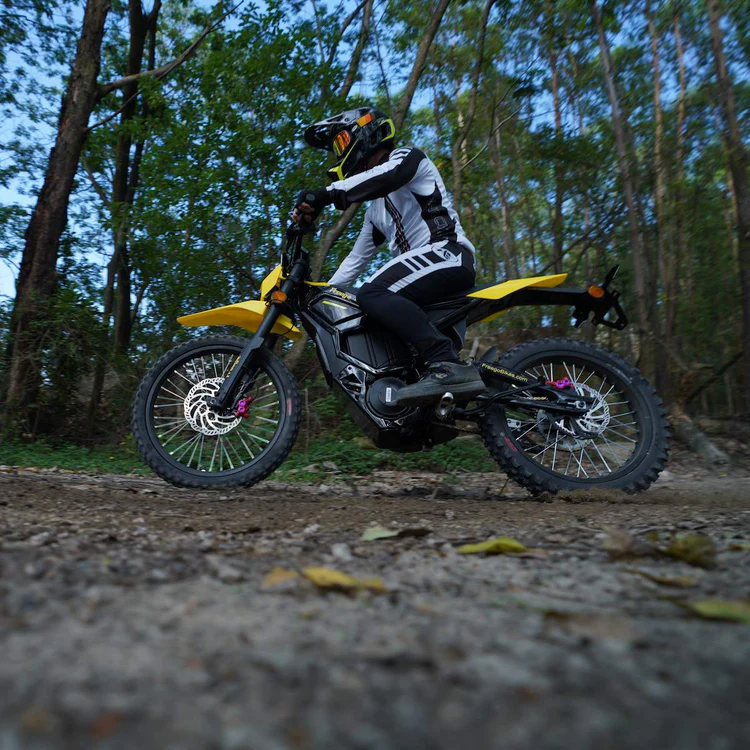
The Nova series uses mid-drive motors to support higher-torque off-road performance.
Technical Explanation: What the Key Specifications Actually Mean
Mid-Drive vs. Hub Motor Architecture
Mid-drive motors are positioned at the bike’s bottom bracket and drive through the drivetrain. This allows the motor to use the bike’s gear ratios, increasing torque at the wheel in low gears and improving weight distribution by keeping the motor mass low and central. Hub motors, by contrast, are integrated into the rear wheel. They are mechanically simpler, require less drivetrain maintenance, and deliver power directly to the wheel.
For steep slope climbing, mid-drive is generally the stronger architecture. For dual-mode models where the same bike is used on pavement and trails, hub motors reduce drivetrain wear and lower maintenance complexity. The Freego lineup reflects this distinction: Nova models are mid-drive, while X-man dual-mode models use hub motors.
Voltage, Battery Capacity, and Range
Higher system voltage, such as 72V versus 60V, allows the motor to produce more power with lower current draw. This tends to reduce heat buildup in the controller and wiring, and supports more sustained high-speed output. Battery capacity, measured in ampere-hours (Ah), determines how long the bike can sustain that output.
The Nova 5 and X3 both use 72V platforms with 40Ah or 50Ah capacities, which explains their higher speed and range figures relative to the 60V X-series models. Buyers evaluating range should also consider that off-road riding consumes significantly more energy than city mode. The X2 Pro’s 56-mile city range drops to 20 miles in off-road mode, a ratio typical of high-performance electric dirt bikes.
Suspension, Brakes, and Safety Components
Inverted suspension forks are increasingly common on higher-performance dirt ebikes because they provide greater lateral rigidity and reduce unsprung weight. Hydraulic brakes with multiple pistons provide stronger and more consistent stopping power. All Freego off-road models use hydraulic disc brakes, with 4-piston calipers standard on the X1 and above and on most Nova models.
Application and Use Cases
Rental, Sharing, and Fleet Operations
For rental and ride-sharing projects, the operating environment is high-frequency public use, outdoor 24/7 exposure, and varied rider behavior. These conditions place more stress on durability, security, and remote management than on peak speed.
In these settings, Freego recommends configurations with IoT modules, a cloud management platform, multi-unit charging docks, cloud-based fleet intelligent scheduling, and real-time battery monitoring. The IoT-controlled unlocking and swappable battery operation mode is the relevant architecture, rather than a high-power off-road-only platform.
This distinction is critical for rental buyers: the best rental dirt ebike is not the most powerful one, but the one that can be monitored, recharged, and serviced efficiently across a mixed-use fleet.
Powersports Retailers and Gas-to-Electric Transition Customers
Powersports retailers stocking high-performance models have used the Nova and X-man series to attract customers transitioning from gasoline-powered off-road vehicles. In these cases, the 72V/8000W power figures, superior suspension, and braking hardware serve as the primary comparison points against conventional dirt bikes.
Dealer Distribution and Local Retail
Authorized dealer programs place more emphasis on compliance and after-sales infrastructure. Freego’s dual-mode X-series models, with 28MPH city mode and UL 2849-compliant electrical systems, allow dealers to offer a street-legal product that still performs off-road. The availability of spare parts from US local warehouses and 2-year limited warranties supports downstream service obligations.
Market Trends in Electric Dirt Bike Procurement
The global electric dirt bike market is projected to reach approximately USD 2.8 billion in 2025, with growth expectations to USD 7.6 billion by 2034. In the EU, electric motorcycles are classified under Regulation (EU) No 168/2013 as L1e (moped equivalent, max 45km/h, ≤4kW) or L3e (motorcycle equivalent, unrestricted speed). The US market uses a three-class system for e-bikes in which Class 1/2 are capped at 20MPH and Class 3 at 28MPH; vehicles exceeding these limits are generally regulated as off-road motor vehicles. Freego’s X-man series addresses this with a dual-mode system offering a Class 3-compliant 28MPH city setting and an unrestricted off-road mode.
A separate technology trend is the increasing preference for mid-drive motors in off-road applications, driven by weight distribution and torque multiplication through the bike’s gearing. This aligns with the use of mid-drive motors across Freego’s Nova series, especially in models with 40% or greater slope capacity.
Comparison with Traditional Off-Road Motorcycles and Generic E-Bikes
Compared to gasoline-powered off-road motorcycles, electric dirt ebikes typically offer lower operating noise, simplified maintenance, and lower per-ride energy costs. They also require no fuel-system maintenance and can be used indoors or in noise-sensitive areas where combustion engines are restricted. For rental operators, the reduced maintenance burden is often the decisive factor.
Compared to standard commuter e-bikes, purpose-built dirt ebikes provide substantially stronger structural components, motorcycle-grade tires, and braking systems designed for repeated off-road loads. The X2 Pro, for example, uses 70/100-19 motorcycle-grade tires and a 4-piston 203mm brake, far beyond what a typical Class 1 commuter e-bike carries.
A realistic limitation of electric dirt ebikes is range under hard off-road use. High-speed off-road riding consumes battery rapidly, and recharge times remain substantially longer than refueling a gasoline motorcycle. The X2 Pro’s off-road range, for instance, is rated at 20 miles, a figure that can be further reduced by aggressive riding or extreme terrain. Projects requiring full-day off-road endurance without charging access should therefore plan for swappable batteries or multiple units.
Future Outlook
As market growth continues, the electric dirt bike segment is likely to diversify along two paths: higher-performance mid-drive models for dedicated off-road use, and dual-mode street-legal models for mixed use and regulatory compliance. The availability of higher-voltage platforms, larger-capacity 21700 cells, and inverted suspension forks will continue to raise the performance baseline. For buyers, the practical consequence is that future procurement decisions will be less about whether electric dirt bikes can handle off-road terrain and more about which specific architecture best matches a project’s range, terrain, and compliance profile.
FAQ
Which dirt ebike is best for desert and open off-road terrain?
For desert and open terrain, a high-voltage long-range configuration is preferred. The Freego Nova 5 uses an 8000W mid-drive motor, a 72V 40Ah lithium-ion battery, a 53MPH top speed, and a 70-mile maximum range, making it more suitable for sustained high-speed running than lower-voltage models. The X3, with an 8000W hub motor and 72V 40Ah/50Ah battery, is positioned for ultra-long-range riding.
Is a mid-drive or hub motor better for a dirt ebike?
A mid-drive motor is generally better for steep slopes and technical off-road riding because its torque is multiplied through the bike’s drivetrain and its mass sits lower and more centrally. A hub motor is mechanically simpler and has lower drivetrain maintenance, which can be advantageous for dual-mode street and trail use. Freego uses mid-drive motors in its Nova series and hub motors in its X-man series.
What does a dual-mode street-legal dirt ebike mean?
A dual-mode dirt ebike offers a City Mode that limits the bike to 28MPH for street-legal operation and an Off-Road Mode that unlocks full performance. Freego’s X-man series, including the X1, X2, and X2 Pro, uses this system to provide both a Class 3-compliant urban setting and an unrestricted off-road mode.
How much range does an electric dirt bike have off-road?
Off-road range depends on speed, terrain, and power output. The Freego X2 Pro is rated at 56 miles in city mode and 20 miles in off-road mode with its 60V 30Ah battery. The Nova 5 is rated at up to 70 miles per charge with a 72V 40Ah battery, though aggressive off-road riding will reduce real-world range.
What should a rental or shared dirt ebike fleet prioritize?
Rental and shared fleets should prioritize commercial durability, real-time GPS tracking, swappable battery systems, and remote fault diagnosis. The recommended support infrastructure includes IoT modules, a cloud management platform, multi-unit charging docks, cloud-based fleet intelligent scheduling, and real-time battery monitoring. High peak power is less important than fleet manageability and uptime.
For detailed product specifications and sourcing options, Freego’s company brochure is available for reference: Download Freego Company Brochure (PDF).
Have Questions or Need More Details?
Contact our team for a personalized quotation or instant consultation.
Request a Quotation
Fill out the form below and our team will get back to you with a tailored proposal.
WhatsApp Direct Chat
Prefer to chat in real-time? Message us on WhatsApp for instant assistance & quick answers.
- Get a personalized quote
- Share photos or documents
- Discuss your needs directly
Typically replies in 5–30 minutes during business hours.