
Dirt Ebikes in Off-Road Recreation vs. Utility Work: Scenario Fit for Buyers
Dirt Ebikes in Off-Road Recreation vs. Utility Work: Scenario Fit for Buyers
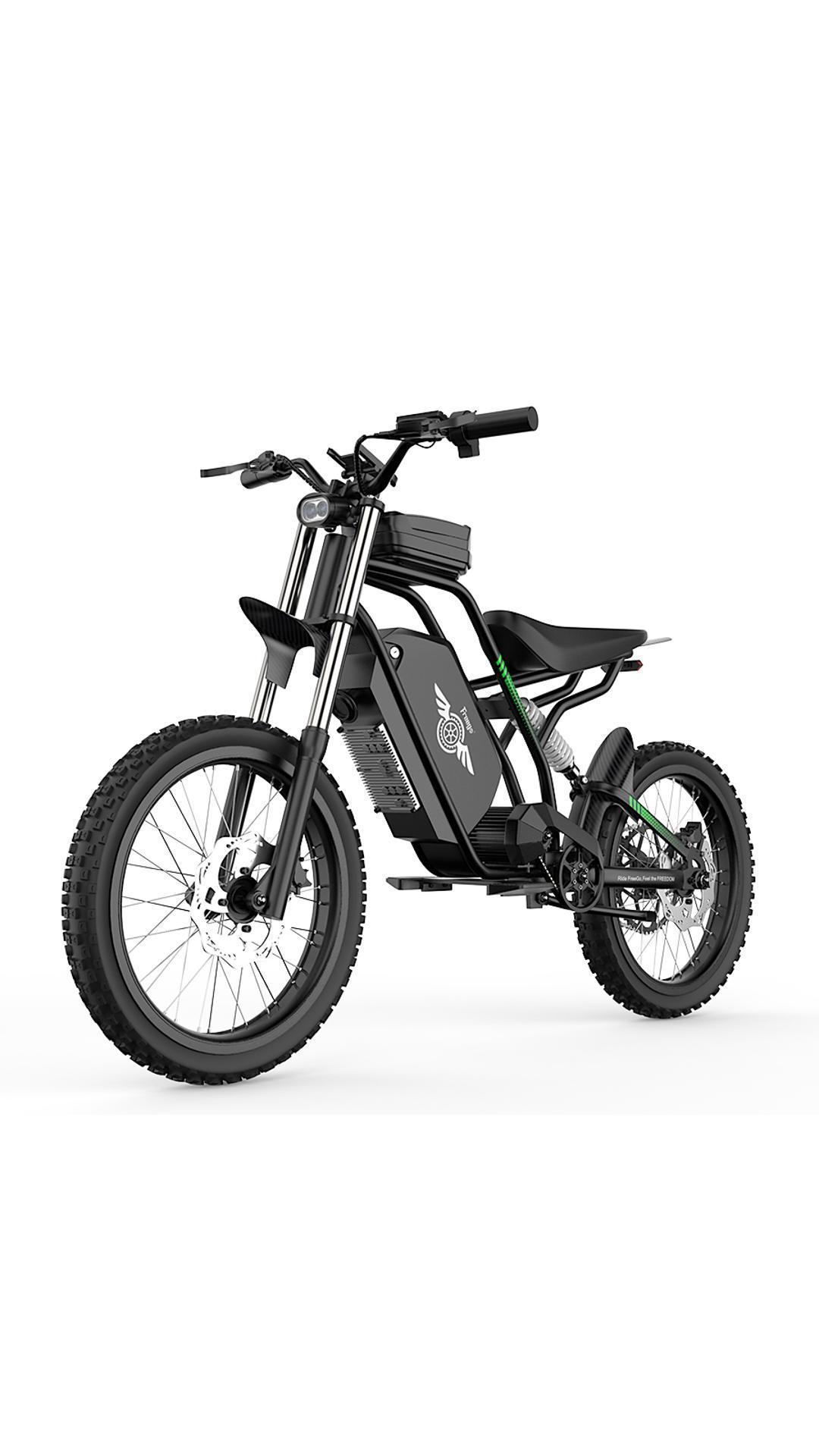
The Nova 3 is documented as an Entry-Level Mid-Drive All-Terrain Electric Dirt Bike with a 3000W mid-drive motor and a ≥40% slope climbing capacity.
An electric dirt bike that performs well on a weekend trail ride is not automatically the right machine for repeated light-utility work — and the difference rarely shows up in a peak-power figure. Payload ceiling, mode-dependent range, drivetrain type, and street-legal classification decide scenario fit.
That distinction is now commercially relevant. Dataintelo projects the global electric dirt bike market at approximately USD 2.8 billion in 2025, growing toward USD 7.6 billion by 2034. As the category scales, buyers arrive with two different briefs: recreational off-road riding, and repeated short-haul work on private land, estates, campuses, and industrial sites. This reference compares both scenarios against Freego's documented all-terrain mid-drive lineup — the Nova series — and the hub-motor X-man series, so specification decisions can be tied to an actual duty cycle rather than to a specification sheet in isolation.
Two Buying Scenarios, Two Different Duty Cycles
Recreational riders and light-utility operators both search for a "dirt ebike," but they optimize different variables.
Recreational trail riding is session-based. The rider wants low-end torque for technical climbs, suspension and braking that hold up on descents, and enough energy to finish a ride. Freego's documented Powersports & Outdoor Recreation application scenario describes working conditions that include off-road trails, sand, mud, steep inclines greater than 25°, and extreme terrain, with project types spanning off-road adventure, camping and hunting, mountain biking, and desert or beach recreation.
Light utility work is repetition-based. The same machine may be used several times a day, over shorter distances, often by different operators, frequently carrying tools or supplies. Uptime, charging windows, and low-speed behavior under load matter more than peak output. Payload ceilings and accessory mounting points move from secondary considerations to primary selection criteria.
Both scenarios share a documented baseline. Freego lists UL 2849 / ANSI safety certification, a high-torque motor, 4-piston hydraulic brakes, IPX6 waterproofing, and puncture-resistant motorcycle-grade tires as special requirements for the off-road recreation application scenario. These are constraint items, not optional upgrades, and they apply to utility-oriented buyers as well.
What "All-Terrain" Means in the Freego Range
Freego USA Inc. is an electric mobility manufacturer headquartered in Chino, California, founded in 2012, operating a 3,000 m² factory with a 10+ engineer R&D team and an export footprint covering more than 40 countries and regions. Its product families include the X-man and Nova series of electric off-road motorcycles, the Shotgun fat-tire e-bike series, the Cityflow commuter series, and the FlexTrike three-wheeled range.
Within that portfolio, "All-Terrain" is a product classification rather than a marketing adjective: the Nova 5 and Nova 3 carry All-Terrain designations in their model names, the Nova 4 is typed as a Dual-Mode All-Terrain Dirt Bike, and the X-man models are named as All-Terrain or Ultra-Long Range Pedaled All-Terrain units.
| Model | Drive | Battery | Max range per charge | Max load | Climbing | Documented classification |
|---|---|---|---|---|---|---|
| Nova 5 pro | 15000W mid-drive | 72V, 40Ah Li-ion 21700 | 70 MI | 150 kg (330 lbs) | Not stated | Street-Legal Professional Off-road Dirt Bike |
| Nova 5 | 8000W mid-drive | 72V, 40Ah Li-ion 21700 | 70 MI | 150 kg (330 lbs) | ≥45% slope | High-Power Mid-Drive All-Terrain |
| Nova 4 | 6000W mid-drive | 60V, 30Ah Li-ion 21700 | 50 MI (Eco) / 25 MI (Sports) | 120 kg (264 lbs) | ≥40% slope | Dual-Mode All-Terrain |
| Nova 3 | 3000W mid-drive | 60V, 25Ah Li-ion 21700 | 50 MI (Eco) / 20 MI (Sports) | 120 kg (264 lbs) | ≥40% slope | Entry-Level Mid-Drive All-Terrain |
| Nova 5 MINI | 2500W mid-drive | 48V, 21Ah Li-ion | 35 MI | 100 kg (220 lbs) | Not stated | Compact Off-road (teens & adults) |
| X3 | 8000W hub | 72V, 40Ah / 50Ah Li-ion 21700 | 110 MI | 150 kg (330 lbs) | ≥30° | Ultra-Long Range All-Terrain |
| X2 | 6000W hub | 60V, 30Ah Li-ion 21700 | 56 MI | 120 kg (264 lbs) | ≥25° | Street-Legal Dual-Mode All-Terrain |
| X2 Pro | 6000W hub | 60V, 30Ah Li-ion 21700 | 56 MI (City) / 20 MI (Off-road) | 120 kg (264 lbs) | Not stated | Premium Street-Legal Dual-Mode |
| X1 | 3600W hub | 60V, 25Ah Li-ion 21700 | 50 MI (Eco) / 20 MI (Sports) | 120 kg (264 lbs) | Not stated | Street-Legal Dual-Mode All-Terrain |
Specifications as documented by Freego for the Nova (mid-drive) and X-man (hub) dirt bike platforms. Range figures are manufacturer-specified maximums per charge.
Two details in that table matter more than the headline power figures. First, the payload spread across the range is 100–150 kg (220–330 lbs), which sets a firm boundary on how much a rider can carry. Second, range is mode-dependent on several models: the Nova 4 documents 50 MI in Eco mode against 25 MI in Sports mode, the Nova 3 documents 50 MI against 20 MI, and the X2 Pro documents 56 MI in city use against 20 MI off-road. A utility buyer planning a fixed daily route should plan against the lower figure.
Technical Explanation: Why Drivetrain Type Shapes Scenario Fit
Mid-drive and hub-drive platforms are not interchangeable for mixed-surface work, and the reason is mechanical rather than commercial. Technical comparisons of the two architectures note that mid-drive motors are increasingly preferred for off-road dirt bikes because they place mass closer to the center of the bike and multiply torque through the bike's own gear system, whereas a hub motor drives the wheel directly.
Freego's documentation reflects that logic in how the Nova models are typed and specified. The Nova 5 is an 8000W mid-drive unit with a documented climbing capacity of ≥45% slope. The Nova 4 is described as a High-Torque Mid-Drive Off-road E-Bike with ≥40% slope capability. The Nova 3 reaches the same ≥40% slope figure from a 3000W mid-drive motor through a 2-stage speed reduction chain drive, and the Nova 4 uses a mid-drive brushless motor with 2-level speed deduction.
For recreational riding, that torque multiplication is what makes technical climbs and slow descents manageable. For light utility work, the same characteristic matters at the opposite end of the speed range: pulling away with a loaded rack, climbing a farm track, or holding pace on loose gravel with a rider carrying equipment. The relevant question for a utility buyer is not top speed but whether the platform delivers torque at low speed without slipping or stalling.
Suspension and braking specifications follow the same pattern. The Nova 5 and Nova 5 pro use KKE brand hydraulic front and rear shock absorbers with 4-piston hydraulic disc brakes, and the Nova 5 pro specifies a 203 mm rotor. The Nova 4 uses a hydraulic inverted suspension fork with an OEM shock absorber, and the X3 uses a high-performance hydraulic inverted suspension fork. On repeated utility routes over the same rough ground, suspension quality affects operator fatigue and component wear more than it affects lap times.
Range and Payload Planning by Scenario
Range planning differs fundamentally between the two scenarios because the trip pattern differs.
Recreational use is a single charge cycle per session. A rider on a Nova 5 or Nova 5 pro has a documented maximum of 70 MI per charge; a Nova 4 or Nova 3 rider has 50 MI in Eco mode. Where a trail network sits inside that envelope, the decision is about capability rather than energy.
Utility use is a repeated cycle, and the binding constraint is usually the charging window rather than total energy. Freego documents a 5–10 hour charging time for the Nova 5 pro and 5–8 hours for the X2 Pro. Where a machine is expected to work more than one shift equivalent per day, that charging time has to be scheduled around. Freego's matched-equipment list for off-road use — which includes a spare high-capacity battery, rugged rear racks, off-road gear, a vehicle storage rack, and hydraulic shock absorption upgrade parts — indicates the intended mitigations: carry additional energy, or configure the machine for the job.
Payload should be treated as a firm limit rather than a target. Documented maximum loading is 150 kg (330 lbs) on the Nova 5, Nova 5 pro, and X3; 120 kg (264 lbs) on the Nova 4, Nova 3, X2, X2 Pro, and X1; and 100 kg (220 lbs) on the Nova 5 MINI. Because that figure includes the rider, a utility buyer should subtract rider weight first and confirm the remainder covers the intended load before selecting accessory racks.
Legal Classification: The Constraint That Decides Where a Bike Can Be Used
Certification and classification are where recreational and utility buyers diverge most sharply, because utility routes often connect private land to shared roads.
In the United States, e-bikes are commonly framed through a three-class system: Class 1 and Class 2 are limited to 20 mph, and Class 3 to 28 mph. Vehicles exceeding those limits are generally regulated as off-road motor vehicles rather than e-bikes. Freego's published product documentation describes the X-Man series as using a dual-mode system with a City Mode that is Class 3 compliant at 28 mph and 750W, alongside an Off-Road Mode where performance is unrestricted.
The same dual-mode structure appears across the documented specifications. The X2 and X2 Pro list 28 MPH in urban mode and 50 MPH off-road; the X1 lists 28 MPH urban and 40 MPH off-road; the X3 lists 28 MPH urban and 56 MPH off-road; the Nova 4 lists 28 MPH in Eco and 45 MPH in Sports; the Nova 3 lists 28 MPH in its kid-safe setting and 40 MPH in Turbo; and the Nova 5 pro is typed as street-legal with a documented 62 MPH street-legal and 56 MPH off-road top speed.
The European Union uses a different framework. Under Regulation (EU) No 168/2013, electric motorcycles are classified as L1e — moped equivalent, capped at 45 km/h and 4 kW — or L3e, equivalent to a motorcycle with no speed cap. A model's position in that framework determines licensing, registration, and permitted riding locations, and it cannot be inferred from a wattage figure alone.
Certification evidence should be verified at model level, not brand level. Freego's UL 2849 test report, numbered LTR24100903HS and issued by Guangdong Lintek Certification Group Co., Ltd. against the UL 2849:2020+R:2022-06+R:2022-12 standard, covers electrical systems for eBikes in the US market and lists the Nova 5, Nova 5 pro, Nova 4, Nova 3, Nova 5 MINI, X3, X2 Pro, X2, and X1 among the applicable products. A separate Verification of FCC Conformity, numbered POCE15101614GF and issued by POCE (Shenzhen POCE Technology Co., Ltd.) against FCC Part 15 Subpart B: 2014, also lists the Nova and X-man platforms alongside other Freego models.
Buyers should note that Freego's ANSI/CAN/UL 2849-2022 certificates issued by SGS North America Inc. — numbers SGSNA/24/SZ/00058 and SGSNA/24/SZ/00059 — are linked to the fat-tire and commuter e-bike families rather than to the dirt bike platforms, whose electrical-system documentation runs through the UL 2849 test report referenced above. Matching the certificate to the exact model being purchased is a basic verification step, not a formality.
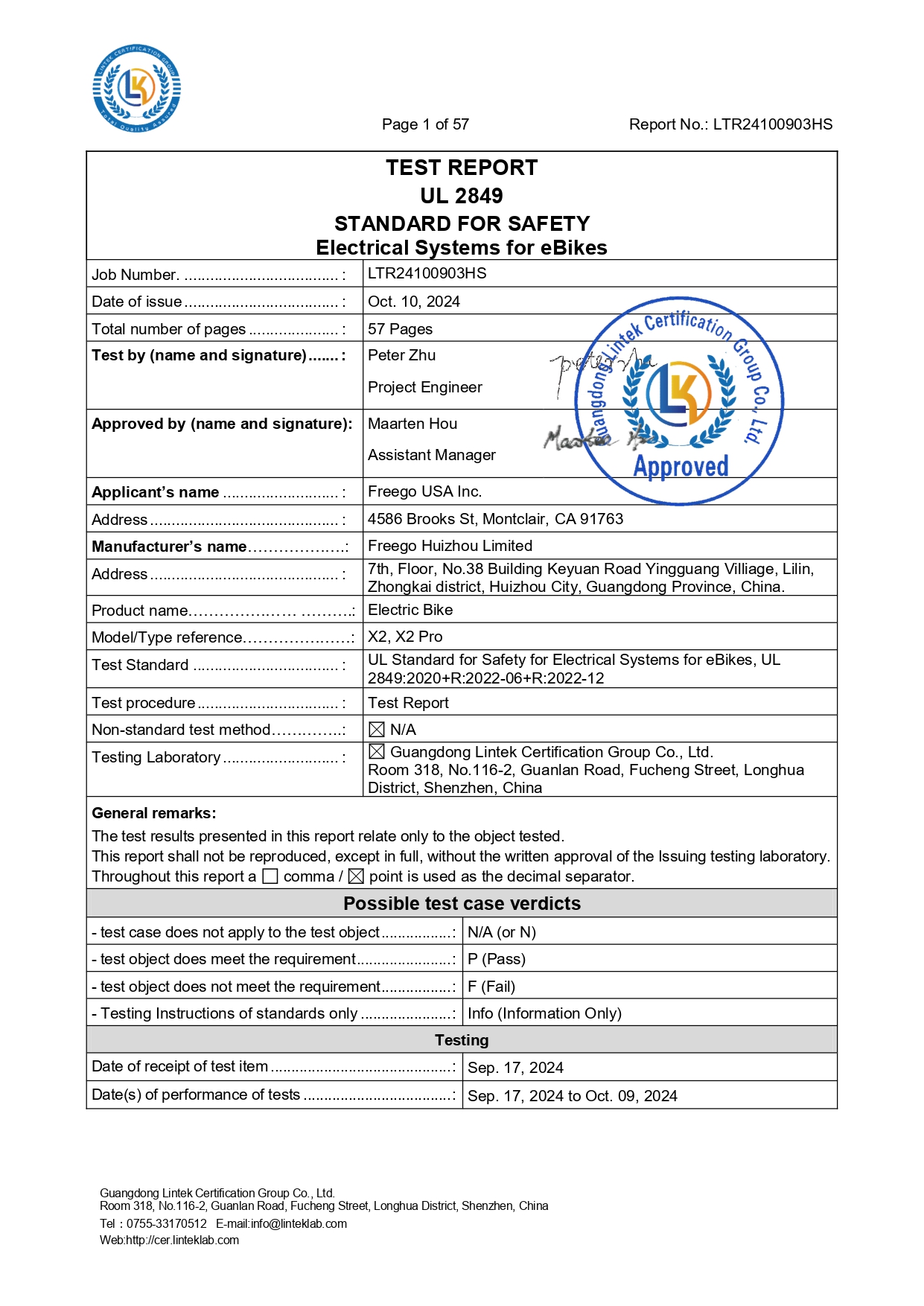
Freego's UL 2849 test report LTR24100903HS, issued by Guangdong Lintek Certification Group Co., Ltd., covers electrical systems for eBikes in the US market, including the Nova and X-man dirt bike platforms.
Where the Two Scenarios Actually Overlap
Fleet and rental operation is the scenario where recreational and utility requirements converge. Freego's documented Rental & Ride-sharing application covers the US, Germany, Poland, Sweden, the UAE, Mexico, and South Korea, with working conditions described as high-frequency public use, outdoor 24/7 exposure, and varied rider behavior. The documented operating model relies on IoT-controlled unlocking and swappable battery operation, supported by a cloud management platform, multi-unit charging docks, cloud-based fleet scheduling, and real-time battery monitoring.
The Nova 5 MINI, Nova 3, and X0 mini bike appear among the products matched to that application. For a buyer weighing mixed recreational and light-utility duty, a fleet-style configuration is practically relevant: swappable battery operation addresses the charging-window constraint described earlier, and documentation of 24/7 outdoor exposure functions as a durability signal a private utility buyer can read as a proxy for build quality.
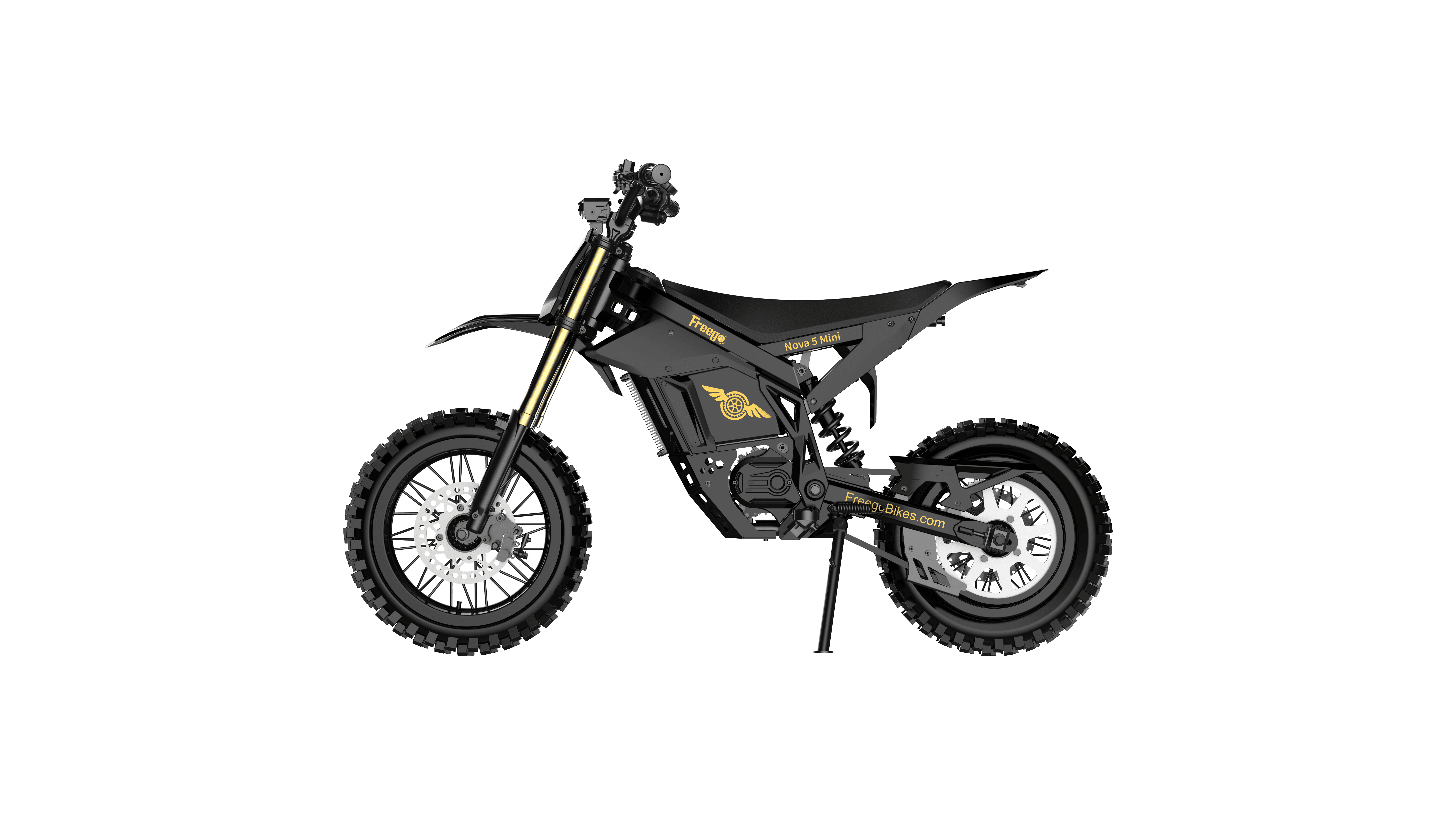
The Nova 5 MINI is documented as a 2500W mid-drive compact off-road model with a 35 MI maximum range and 100 kg (220 lbs) maximum load.
Channel evidence provides a second reference point. Freego documents more than 120 US local e-bike shops in long-term cooperation, purchasing 10–20 units per store monthly, and authorized dealers carrying annual volumes of 500 or more units per dealer, operating with UL 2849 safety compliance, integrated IoT management, and regional exclusive distribution protection.
It is worth being precise about what the documentation does not cover. Freego's corpus does not describe agricultural deployments, implement mounting, or towing ratings for the dirt ebike platforms. The closest documented utility-oriented product is the FlexTrike Pro, a three-wheeled unit typed for Light Cargo Transportation with a 200 kg (440 lbs) maximum load and a rear cargo rack — a different vehicle class from the two-wheeled Nova and X-man platforms. Buyers whose primary requirement is hauling rather than riding should weigh that distinction before treating a dirt ebike as a working farm vehicle.
Limits and Trade-offs Versus Traditional Solutions
Electric dirt bikes do not replace utility vehicles or conventional off-road machines across the board, and buyers make better decisions when the boundaries are stated plainly.
- Single-rider platforms. The documented Nova and X-man specifications describe rider-oriented machines with payload ceilings of 100–150 kg including the rider. Utility vehicles such as ATVs and UTVs are generally specified around load-carrying and multi-occupant duties that a two-wheeled platform is not designed for.
- No implement drive. A two-wheeled electric dirt bike drives a wheel, not an attachment. Nothing in Freego's documentation describes a power take-off or implement interface, so tasks requiring powered attachments fall outside the platform's scope.
- Charging time as a scheduling constraint. A documented 5–10 hour charge on the Nova 5 pro and 5–8 hours on the X2 Pro limits how many duty cycles one unit can cover per day without a second battery.
- Range falls in high-performance modes. The Nova 4 drops from 50 MI to 25 MI between Eco and Sports modes, the Nova 3 from 50 MI to 20 MI, and the X2 Pro from 56 MI in city use to 20 MI off-road. Utility planning should use the conservative figure.
- Classification changes the legal context. Running a dual-mode machine above its street-legal configuration moves its use into off-road motor vehicle territory under the US three-class framing, and into L1e or L3e territory under Regulation (EU) No 168/2013 in Europe.
Market Trend Analysis
Category growth is being reported at a scale that supports both scenarios, although published estimates differ depending on how the category is defined. Dataintelo projects the global market at approximately USD 2.8 billion in 2025, growing to USD 7.6 billion by 2034, while a separate estimate from WiseGuyReports puts the 2025 figure at USD 1.47 billion. The gap is definitional — whether adjacent dirt-bike categories are included — so any single market-size number should be treated as directional rather than precise.
Regionally, Asia Pacific accounted for USD 1.02 billion in 2025, or 36.4% of global revenue, according to Dataintelo, indicating that supply and demand remain concentrated in the same region for much of the category.
On the technology side, the shift toward mid-drive architectures in off-road applications is a documented trend, driven by weight distribution and torque multiplication through the drivetrain. That trend favors the recreation-first buyer, for whom climbing and technical handling dominate, and it also benefits the utility buyer who needs torque at low speed under load. Competition in the high-performance segment is concentrated among established players including Sur-ron, Talaria, and Stark Future, which means specification comparison and certification verification are becoming standard parts of the purchasing process rather than optional due diligence.
Future Outlook
Two developments look likely to shape scenario fit over the next product cycles. First, dual-mode street-legal configurations are becoming the default architecture rather than a variant, which means recreational and light-utility use cases will increasingly share hardware and be separated by mode selection and accessory configuration. Second, certification disclosure is likely to keep moving toward model-level specificity, because both US and EU frameworks key requirements to classification rather than to brand.
For buyers in the research and evaluation stage, that suggests a practical sequence: define the duty cycle first, confirm payload and conservative range against it, verify the classification that matches where the machine will actually be ridden, and match certification evidence to the exact model. Peak motor output is the least informative number on the page.
FAQ
What separates recreational trail use from light utility use for a dirt ebike?
Recreational use is session-based and optimized around climbing capability, suspension, braking, and a single charge cycle — Freego documents 70 MI per charge on the Nova 5 and Nova 5 pro. Light utility use is repetition-based and optimized around payload, low-speed torque under load, and charging windows. The range figures are the same, but utility planning depends on the lower, mode-specific numbers, such as 25 MI on the Nova 4 in Sports mode.
Are Freego's all-terrain mid-drive models street-legal or off-road only?
Several models are documented as dual-mode. Freego's published documentation describes the X-Man series as using a City Mode that is Class 3 compliant at 28 mph and 750W alongside an unrestricted Off-Road Mode. The Nova 4 and Nova 3 list 28 MPH low-speed settings against 45 MPH and 40 MPH high-performance settings respectively, and the Nova 5 pro is typed as a Street-Legal Professional Off-road Dirt Bike with a documented 62 MPH street-legal and 56 MPH off-road top speed.
What certifications should a US buyer verify on an electric dirt bike?
At minimum, the electrical-system safety documentation for the specific model. Freego's UL 2849 test report LTR24100903HS, issued by Guangdong Lintek Certification Group Co., Ltd. against UL 2849:2020+R:2022-06+R:2022-12, covers electrical systems for eBikes in the US and lists the Nova 5, Nova 5 pro, Nova 4, Nova 3, Nova 5 MINI, X3, X2 Pro, X2, and X1. A Verification of FCC Conformity numbered POCE15101614GF, issued by POCE (Shenzhen POCE Technology Co., Ltd.) against FCC Part 15 Subpart B: 2014, also lists the Nova and X-man platforms.
How much payload and range should a buyer plan for?
Documented maximum loading is 150 kg (330 lbs) on the Nova 5, Nova 5 pro, and X3; 120 kg (264 lbs) on the Nova 4, Nova 3, X2, X2 Pro, and X1; and 100 kg (220 lbs) on the Nova 5 MINI. Because that figure includes the rider, a load-carrying buyer should subtract rider weight before confirming capacity. On range, the conservative planning figure is the mode-specific minimum — 20–25 MI on several dual-mode models — rather than the headline maximum.
Why does mid-drive design matter on mixed surfaces?
Technical comparisons of drivetrain architectures note that mid-drive motors are increasingly preferred for off-road dirt bikes because they concentrate mass centrally and multiply torque through the bike's gear system, rather than driving the wheel directly as a hub motor does. Freego's specification set reflects that pattern: the Nova 5 is an 8000W mid-drive with a documented ≥45% slope climbing capacity, while the Nova 4 and Nova 3 both document ≥40% slope capability from 6000W and 3000W mid-drive motors respectively.
What can a dirt ebike not do that a utility vehicle can?
A two-wheeled dirt ebike platform is a single-rider machine with documented payload ceilings of 100–150 kg including the rider, and it drives a wheel rather than a powered attachment — no implement interface or towing rating is documented for the Nova or X-man series. Where the requirement is load carrying, Freego's documented light-cargo product is a different vehicle class: the FlexTrike Pro three-wheeler, rated to 200 kg (440 lbs) with a rear cargo rack.
Freego publishes a downloadable product brochure covering the X-man and Nova series specifications referenced in this article: Freego product brochure (PDF).