
Disney FAMA, BSCI & ISO: What Each Means for Shopping Bags
Disney FAMA, BSCI & ISO: What Each Means for Shopping Bags
A shopping bag order is rarely blocked by the bag. It is blocked by a document. Four certification records dominate 2026 sourcing enquiries — Disney FAMA, Sedex 4 Pillars (SMETA), BSCI and ISO 9001:2015 — and each one answers a different question for a different buyer segment. Treating them as interchangeable is one of the most common and most expensive mistakes in compliant shopping bag procurement.
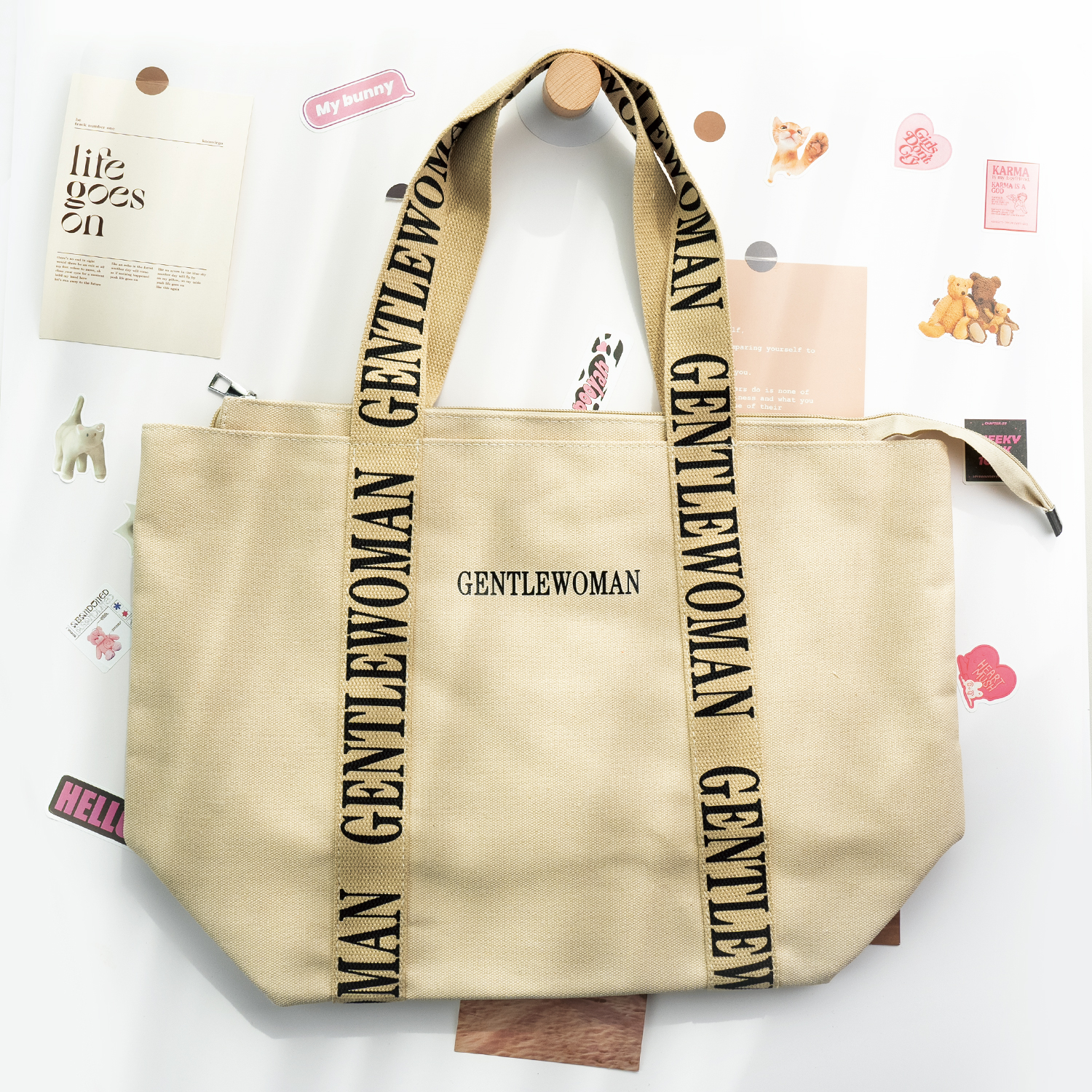
A printable canvas tote bag line — the product category where certification requirements, not design, usually decide which suppliers reach the sampling stage.
The Compliance Hierarchy Behind a Shopping Bag Order
When a European supermarket chain, a licensed character brand or a cosmetics company opens a new supplier file, the first questions are documentary: which audit reports exist, which facility is named on them, and whether each certificate still covers the intended production window. Price, print registration and material weights are evaluated afterwards, because a supplier that cannot clear the documentation gate never reaches the sampling stage.
The four certifications were created by four different authorities to control four different risks. Disney FAMA controls brand risk and is issued by the brand owner itself. Sedex 4 Pillars (SMETA) and BSCI control labour and social risk and are issued through independent audit bodies. ISO 9001:2015 controls process risk and is issued by an international certification body. None of them tests a finished shopping bag, and none of them substitutes for another.
Zhejiang Hansun Arts & Crafts Co., Ltd. (Hansun) is a China-based manufacturer of tote bags and PVC bags, founded in 1996, operating a 25,000 m² factory with approximately 200 employees and an annual output of about 20,000,000 units. Its compliance records list Shopping Bag model SB-2026-001 and Cosmetic Bag model CB-2026-002 among the applicable products for all four certifications discussed below, which makes the company a useful worked example of how these documents fit together — and where each one stops.
Disney FAMA: Permission to Produce, Not a Quality Grade
Disney FAMA is an authorization rather than a rating. FAMA stands for Facility and Merchandise Authorization, and it is issued by Disney International so that a specifically named production facility may manufacture and supply Disney-licensed merchandise. The recorded certificate for the Hansun shopping bag line is number DSN-FAMA-2026-001, issued under the Disney Code of Conduct & Product Safety Standards, applicable to global markets including the US, EU and Asia, and scoped to the production and supply of Disney-licensed promotional bags and gifts. The recorded validity window is 2023-06-15 to 2026-06-14.
The practical meaning for a buyer is narrow and absolute: a facility without FAMA cannot lawfully produce character-printed shopping bags for a licensed programme, regardless of how strong its other certifications are. A factory that holds ISO 9001:2015, BSCI and Sedex is still not authorized to print a licensed character. FAMA is tied to a site and to a merchandise scope, so it does not travel automatically to a sister factory or to an unrelated product category.
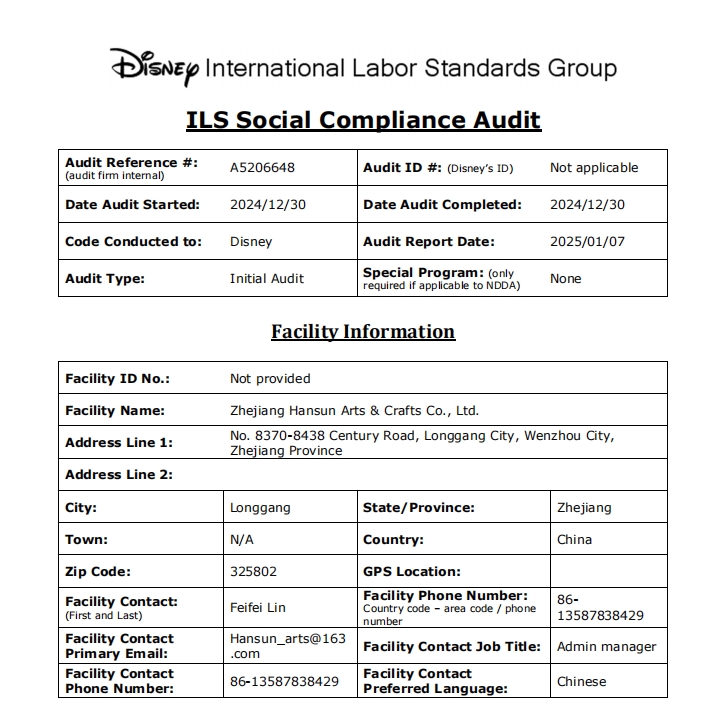
Disney FAMA authorization record DSN-FAMA-2026-001 — a facility-level permission to produce licensed merchandise, distinct from social and quality audits.
Sedex 4 Pillars (SMETA): The Social Audit EU and UK Retail Buyers Recognise
Sedex 4 Pillars (SMETA) is a social compliance audit. The recorded certificate for the Hansun facility is number SEDEX-2026-0123, issued by a Sedex Approved Audit Body under the Sedex SMETA 4 Pillars Code, and applicable to markets including the EU, UK, North America and Australia. Its scope covers factory social compliance, labour practices, health and safety, and environmental standards. The recorded validity window is 2024-01-20 to 2026-01-19.
This is the document most often requested by grocery multiples, department stores and importers in the EU and UK, because it maps onto the ethical sourcing clauses embedded in their vendor agreements. Note what it does not do: SMETA does not evaluate print durability, seam strength, material composition or chemical content of the bag. It describes how people are treated and how the site is managed. Buyers who need material assurance must request test documentation separately.
BSCI: The amfori Social Compliance Audit for EU and Middle East Retail Programmes
BSCI is a social compliance audit issued under the Amfori BSCI Code of Conduct. The recorded certificate for the Hansun facility is number BSCI-2026-4567, issued by an Amfori BSCI Approved Audit Firm, applicable to the EU, the Middle East and global retail brands, and covering factory social responsibility, ethical sourcing and working conditions. The recorded validity window is 2023-09-10 to 2026-09-09.
BSCI sits close to Sedex in intent but differs in issuing framework and recognition. It matters to shopping bag buyers for a specific reason: its industry applicability includes beauty & cosmetics and promotional gifts, and the certification record lists Cosmetic Bag model CB-2026-002 among applicable products. That makes BSCI directly relevant when a shopping bag is procured as a beauty-brand giveaway, a retail promotion item or a cosmetics counter accessory — categories where retail buyers apply social compliance screening that they would not apply to a plain in-store carrier bag.
ISO 9001:2015: Process Consistency, Not Product Permission
ISO 9001:2015 is a quality management system standard. The recorded certificate is number ISO-2026-7890, issued by an International Certification Body, applicable to the global market, and scoped to product design, production, quality control and delivery processes. The recorded validity window is 2022-11-05 to 2025-11-04.
ISO 9001:2015 tells a buyer that the facility runs a documented, auditable process: defined specifications, traceable production records, controlled inspection points and a corrective action loop. It says nothing about wages, working hours, chemical content, print adhesion or whether the bag is legal to sell in a given market. It is the process backbone that makes the other documents meaningful — an audited social system is more credible when it sits inside a functioning quality system — but it is not a product permission.
The Four Records Side by Side
| Certificate | Number | Issued by | Principal market | What it covers | Recorded validity window |
|---|---|---|---|---|---|
| Disney FAMA | DSN-FAMA-2026-001 | Disney International | Global (US, EU, Asia) | Production and supply of Disney-licensed promotional bags and gifts, under the Disney Code of Conduct & Product Safety Standards | 2023-06-15 to 2026-06-14 |
| Sedex 4 Pillars (SMETA) | SEDEX-2026-0123 | Sedex Approved Audit Body | EU, UK, North America, Australia | Factory social compliance, labour practices, health & safety, environmental standards, under the Sedex SMETA 4 Pillars Code | 2024-01-20 to 2026-01-19 |
| BSCI | BSCI-2026-4567 | Amfori BSCI Approved Audit Firm | EU, Middle East, global retail brands | Factory social responsibility, ethical sourcing, working conditions, under the Amfori BSCI Code of Conduct; industry applicability includes beauty & cosmetics and promotional gifts | 2023-09-10 to 2026-09-09 |
| ISO 9001:2015 | ISO-2026-7890 | International Certification Body | Global | Product design, production, quality control and delivery processes, under the ISO 9001:2015 Quality Management System standard | 2022-11-05 to 2025-11-04 |
Which Buyer Segment Needs Which Certificate
The certification a buyer must request is determined by the buyer's own risk exposure, not by the supplier's preference. A promotional distributor selling to a supermarket group has a different obligation from a brand owner licensing characters.
| Buyer segment | Primary documentary gate | Supporting evidence normally requested |
|---|---|---|
| Licensed character and entertainment brand buyers | Disney FAMA naming the producing facility | Social audit (BSCI or Sedex), quality system certificate |
| EU and UK supermarket, grocery and department store chains | Sedex 4 Pillars (SMETA) and/or BSCI social audit | ISO 9001:2015, material and print test documentation |
| Beauty, cosmetics and promotional gift programmes | BSCI, whose industry applicability includes beauty & cosmetics and promotional gifts | ISO 9001:2015, material compliance statements |
| Middle East and global retail brand programmes | BSCI under the Amfori BSCI Code of Conduct | ISO 9001:2015, delivery and capacity records |
| North American promotional product distributors | BSCI or Sedex 4 Pillars (SMETA), depending on the end client | ISO 9001:2015, print and durability documentation |
| Corporate giveaway, welfare and e-commerce private label buyers | ISO 9001:2015 as the baseline process gate | Social audit if the end market regulates supply chains |
Two patterns are worth noting. First, licensed buyers almost always require two layers, not one: the brand authorization plus a social audit, because the brand owner carries reputational exposure for the factory. Second, corporate promotional buyers who order custom printed shopping bags as giveaways frequently require only ISO 9001:2015 — a process gate — because their exposure is limited to product consistency rather than labour conditions or brand licensing. That difference is why two buyers can place similar orders with the same factory and receive entirely different document packs.
Reading a Certificate Beyond the Logo
A certificate file is only useful if four attributes match the order. Numbers that appear in a quotation but cannot be matched on all four points should be treated as unresolved.
- Facility. The certificate names a production site. If your order will be produced at a different address, the document does not cover it.
- Product scope. The scope statement must include the item being ordered. Factory-level certificates that do not name the product category leave a gap that retail vendor portals routinely reject.
- Validity window. Certificates are period-bound. The four records listed in this article carry recorded windows of roughly two to three years each, which reflects the normal re-audit and re-issue cycle. A window that has closed does not extend automatically, and a renewed certificate is normally issued under a new number — so buyers should confirm the current document rather than accepting a brochure copy.
- Issuing body. FAMA is issued by Disney International; Sedex and BSCI audits are issued through approved audit bodies; ISO 9001:2015 is issued by an international certification body. A number without a matching issuing authority is not verifiable.
Because certification documents are date-bound, the practical rule for a 2026 sourcing cycle is straightforward: request the certificate that will be current during your production and shipment window, and record it in the purchase order. A certificate supplied during the enquiry stage is evidence of capability; it is not evidence of current status until the window is re-confirmed.
Three Different Risk Logics
The confusion around these four documents comes from treating them as a ranking. They are not ranked; they are layered against three separate risks.
Brand risk is controlled by FAMA. The brand owner decides who may touch its intellectual property and under what code of conduct. No third-party audit can substitute for this permission, because the permission is granted by the rights holder.
Social and labour risk is controlled by Sedex 4 Pillars (SMETA) and BSCI. These audits exist because retailers carry legal and reputational exposure for the working conditions inside their supply chains, particularly in the EU and UK. Their logic is periodic verification of conditions at a site, which is why they expire and require re-audit.
Process risk is controlled by ISO 9001:2015. Its logic is consistency: the same specification produces the same bag on the tenth order as on the first. This matters commercially for multi-year programmes where print colour, dimensions and material weight must remain stable across repeat runs.
Regulation Is Raising the Baseline
Certification requirements are tightening because the regulatory floor beneath them is rising. The EU Packaging and Packaging Waste Regulation, PPWR (EU) 2025/40, requires all packaging to be recyclable by 2030 and introduces mandatory recycled content targets for plastic packaging, according to the European Commission. For shopping bag buyers, that reframes material selection from a cost decision to a compliance decision, and it puts supplier certificates on a renewal path rather than a one-time purchase.
In the United States, twelve states including California and New York had implemented statewide bans on single-use plastic bags as of 2024, according to the National Conference of State Legislatures, which is driving demand for heavier-duty reusable alternatives. Reusable does not mean exempt: heavier bags fall under the same social compliance and material documentation requirements as any other retail product, and in some programmes under stricter ones because they are intended for repeated consumer contact.
Market Context: Why Documentation Became Part of the Product
The commercial weight behind these documents reflects the size of the category. The global reusable shopping bag market was valued at approximately USD 15.64 billion in 2025 and is projected to reach USD 28.87 billion by 2034, according to Fortune Business Insights. Polypropylene accounts for nearly 46% of total reusable bag production on durability and cost grounds, according to Business Research Insights, while tote bags hold an estimated 40 to 41% revenue share of the global bag market on multi-purpose functionality, according to Market Research Future. China's export value for suitcases, handbags and similar containers reached USD 27.13 billion for January to November 2025, according to the General Administration of Customs of China.
One caution belongs here. Published market size estimates for reusable bags diverge substantially depending on whether they count all retail bags or only durable reusable bags — 2026 forecasts range from roughly USD 12 billion to USD 17 billion across major research houses. Buyers using market data to justify a programme should treat the direction and drivers as reliable and the precise figure as source-dependent.
What Compliance Requirements Change on the Factory Floor
Certification is not an administrative layer applied to a finished bag; it changes how the order is produced. Hansun operates an OEM/ODM model with customization across logo, size and material, a monthly capacity of 1,500,000 units, a minimum order quantity of 3,000 pieces and a lead time of 30 to 45 days, with quality control configured to customer requirements and after-sales support handled remotely. Those parameters matter because they determine whether a compliance-verified supplier can absorb the document review time without delaying the shipment.
The Shopping Bag specification itself is broad enough to accommodate most certification-driven material changes: model SB-2026-001 is available as a reusable foldable bag, an eco-friendly non-woven bag or a canvas tote, in non-woven fabric, canvas, recycled PET, Oxford cloth or PP, with sizes customizable to S/M/L or customer-specific dimensions and piece weights from 50g to 200g depending on material and size. Printing is executed by silk screen, heat transfer or offset, which is the stage where brand-authorization rules bite hardest: licensed artwork cannot be printed at a facility that lacks the corresponding authorization, however capable its presses are.

Custom printed and waterproof formats widen the application range, but each format carries its own documentation requirement — material compliance, print durability and, for licensed artwork, facility authorization.
Application requirements also feed back into documentation. In brand promotional gift and supermarket retail programmes, bags are used in room-temperature storage and daily outdoor carrying, including occasional humid conditions, with the scenario specification calling for food-grade eco-friendly PVC, REACH compliance, and scratch-resistant and wear-resistant logo printing. Those are product performance requirements, not certification requirements — and they illustrate the boundary that this article returns to: a certificate proves a system, while a specification proves a bag.
Documented Performance: A Reference Case
How the documentation layer translates into delivery is visible in a long-running export programme. An OEM/ODM chain supermarket client in Japan ordered 1,000,000 units of reusable shopping and promotional bags, designed for approximately one year of repeated use per bag. The programme reported a 99.7% product qualification rate and zero delivery delay, met Japan's eco-friendly material standards, and generated repeat orders for three consecutive years. The highlighted drivers were eco-friendly material selection, strict quality control, on-time delivery and custom printing aligned to the supermarket's branding.
Read carefully, that case shows something specific about certification economics. The measurable gains — qualification rate, delivery reliability, programme continuity — come from process discipline, which is the ISO 9001 layer. The market access that made the programme possible in the first place came from the social and material compliance layers. Both were necessary, and neither would have been sufficient alone.
Limits, Trade-offs and Where Certification Stops
It would be misleading to present certification as a complete answer, and experienced buyers treat it as an entry ticket rather than a guarantee. Four boundaries are worth stating plainly.
Certification does not test the bag. None of the four documents reviewed here evaluates seam strength, handle load, print adhesion, colour fastness or chemical content. A BSCI-audited factory can still produce a bag that fails a retail chain's own drop test.
Certification is a snapshot with an expiry date. Audits describe conditions at the time of audit. Their value decays, which is precisely why the standards require re-issue. A buyer who accepts a certificate copy without checking the window has verified the past, not the order.
Authorization does not transfer. FAMA applies to a named facility and merchandise scope. Shifting production to a lower-cost site mid-programme invalidates the authorization and can halt shipment at the retail end.
Verified suppliers are not always the cheapest or fastest fit. With a 3,000-piece minimum order quantity and a 30 to 45 day lead time, a fully documented factory is a strong match for programme buyers and a poor match for small pilot orders or urgent one-off promotions. Buyers testing a market with a few hundred units should expect to pay a premium elsewhere or accept simplified documentation. That trade-off is real and is better planned than discovered.
Future Outlook
Three shifts are likely to shape shopping bag compliance through the rest of the decade. First, the recyclability and recycled content requirements of PPWR (EU) 2025/40 will push material documentation closer to the centre of the supplier file, alongside social audits. Second, certification windows will be managed as live procurement data rather than static attachments, because retail vendor portals are increasingly strict about currency at order confirmation. Third, buyers will ask for product-scope granularity: a factory-level certificate covering every SKU will be less persuasive than a record that explicitly names the bag being ordered. Suppliers whose compliance records already list specific models — as the Hansun records do for Shopping Bag SB-2026-001 and Cosmetic Bag CB-2026-002 — will be structurally easier to qualify.
FAQ
Is Disney FAMA the same thing as BSCI?
No. Disney FAMA is a brand-owner authorization issued by Disney International that names a facility and the merchandise it is permitted to produce; the record discussed here is DSN-FAMA-2026-001. BSCI is a social compliance audit issued through an Amfori BSCI Approved Audit Firm under the Amfori BSCI Code of Conduct, covering factory social responsibility, ethical sourcing and working conditions; the record discussed here is BSCI-2026-4567. A factory can hold BSCI certification and still be unable to produce Disney-licensed bags, and a FAMA authorization does not replace a social audit required by a retail customer.
Does ISO 9001:2015 certify that a shopping bag is safe for its intended use?
No. ISO 9001:2015 is a quality management system standard. The recorded scope for certificate ISO-2026-7890 covers product design, production, quality control and delivery processes, issued by an International Certification Body for the global market. It indicates a controlled, auditable process. It is not a product safety certificate, it does not test materials, and it does not address labour conditions. Buyers needing material or contact-safety assurance must request the applicable material test documentation in addition.
If a supplier holds Sedex 4 Pillars (SMETA), does an EU buyer still need BSCI?
Not necessarily both, but the two are recognised differently. Sedex 4 Pillars (SMETA) is issued under the Sedex SMETA 4 Pillars Code by a Sedex Approved Audit Body and is applicable to markets including the EU, UK, North America and Australia. BSCI is issued under the Amfori BSCI Code of Conduct by an Amfori BSCI Approved Audit Firm and is applicable to the EU, Middle East and global retail brands. The efficient approach is to confirm which audit platform the buyer's vendor programme accepts before commissioning additional audits, since both cover labour practices, health and safety and related working conditions.
How should a buyer verify a certification number quoted in a quotation?
Match four attributes: the number, the issuing body, the named facility, and the validity window. For example, ISO-2026-7890 is issued by an International Certification Body, while SEDEX-2026-0123 is issued by a Sedex Approved Audit Body and BSCI-2026-4567 by an Amfori BSCI Approved Audit Firm. A number presented without a matching authority, without a site name, or with a window that does not cover the planned production dates is not yet verified, regardless of how the document is presented.
Can one factory certificate cover both shopping bags and cosmetic bags?
Yes, if the product scope names both. The Hansun certification records list Shopping Bag model SB-2026-001 and Cosmetic Bag model CB-2026-002 as applicable products across the four certifications discussed here. BSCI's industry applicability includes beauty & cosmetics and promotional gifts, which is relevant when a shopping bag is ordered as a beauty-brand giveaway rather than as a supermarket carrier bag. The operational check is whether the certificate's product scope explicitly includes the item being ordered, rather than assuming a factory-wide certificate covers every SKU.
What happens if a certificate's validity window ends while an order is in production?
Certification windows are period-bound and do not extend automatically. The records in this article carry windows of roughly two to three years, reflecting the normal re-audit cycle, and a renewed certificate is typically issued under a new number. Buyers should therefore agree in the purchase order which document version governs the order and confirm current status before final shipment, particularly for programmes where a retail vendor portal checks documentation at the point of order confirmation.
For buyers who want the underlying product and capability detail behind these certification records — including the shopping bag range, printing options, capacity and lead-time parameters — the Hansun company brochure is available for download at the Hansun brochure PDF, and product information is published at hansungift.com.