
Display Fixture OEM Capability: What Buyers Should Verify
Retail display fixtures are a point-of-purchase communication channel, not just storage furniture. Buyers who need custom displays must assess whether a supplier can take a product concept, apply the right material, meet quality standards, and deliver at a commercial scale. For this reason, OEM and ODM capability has become a core sourcing criterion for brands, distributors, and retail chains.
This article explains how to evaluate display fixture OEM capability in practice. It uses Dongguan Display Leader Co., Ltd (ECO DDL) as a documented example because its published production and certification data cover the main decisions a buyer must make before placing an order.
Why Display Fixture OEM Capability Is a Sourcing Question
Retail formats continue to expand from supermarkets to specialty stores, convenience outlets, and hospitality venues. That expansion creates demand for display fixtures across multiple material types and product formats. According to Dataintelo, the global retail displays market was valued at USD 22.4 billion in 2025 and is projected to reach USD 38.6 billion by 2034. Asia Pacific held a 36.5% regional share in 2025, and floor displays were the largest product type with a 34.7% share.
For a buyer, this scale explains why suppliers with broad capability are attractive. A single retail program can include snack display fixtures for hypermarkets, 3C digital display fixtures for electronics stores, bottle display fixtures for beverage retailers, and display carts for hospitality. Each product uses different materials and different manufacturing processes. The conventional approach of using one factory for metal and another for acrylic creates coordination risk. An integrated OEM/ODM model is designed to reduce that risk.
What Counts as Capability in Display Fixture Manufacturing?
Capability can be divided into five checkpoints for buyers to verify before selecting a factory.
First, production mode. A display fixture OEM produces a buyer's design. An ODM manufacturer also helps develop and refine the design. The two modes require different levels of in-house engineering. Second, customization scope. A capable supplier should allow changes to size, logo, material, color, structure, and function. Third, quality control. A manufacturer should be able to demonstrate how it inspects finished units before shipment. Fourth, volume and timeline. Buyers need to know the minimum order quantity, the monthly capacity, and the realistic lead time. Fifth, compliance and after-sales support. Certifications and post-shipment support determine whether the factory is suitable for long-term procurement.
OEM vs. ODM: Why the Difference Matters
OEM and ODM are often grouped together, but they place different demands on a manufacturer. OEM production works best when a buyer already has a specification and needs a reliable production partner. ODM production becomes relevant when a buyer needs help translating brand, product, and retail context into a physical fixture. Dongguan Display Leader Co., Ltd (ECO DDL) states that it provides both OEM and ODM production services. That dual capability matters because buyers can start with a detailed technical drawing or with a concept brief and still use the same supplier.
ECO DDL: A Multi-Material OEM/ODM Model
Dongguan Display Leader Co., Ltd (ECO DDL) is a professional display manufacturer established in 2013 and based in Dongguan, Guangdong, China. The company provides one-stop design and customized solutions for retail product displays, POP displays, display cabinets, and display props. Its manufacturing base covers more than 40,000 square meters, with 420 professional and technical personnel, 30 R&D teams, and 36 quality teams. Reported annual output is 300,000 units, and the company can ship more than 900 containers per year.
ECO DDL's published customization scope includes size, logo, material, color, structure, and function. The minimum order quantity is 100 units. Monthly production capacity is 30,000 units, and lead time ranges from 25 to 40 days. The company reports a 95% export ratio, with main markets including the USA, Europe, North Europe, Japan, Russia, and the Middle East.
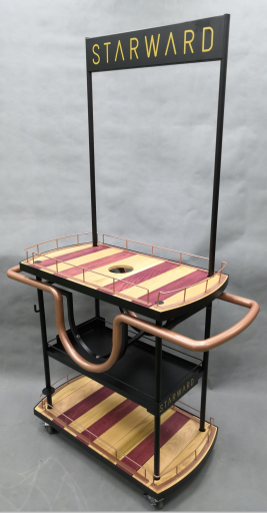
Movable display carts are one of the multi-material fixture categories ECO DDL manufactures.
Inside the Production System: From Material to Finished Fixture
One of the clearest indicators of OEM capability is whether a manufacturer controls key production steps in-house. The company's factory layout includes a hardware workshop, acrylic workshop, wood product workshop, powder coating line, silk screen workshop, and packaging workshop. The facility also includes sheet metal laser cutting, robotic welding, acrylic bonding, polishing, and assembly areas. For a buyer, this means design changes are handled closer to the production line, and material combinations can be managed under one responsible supplier.
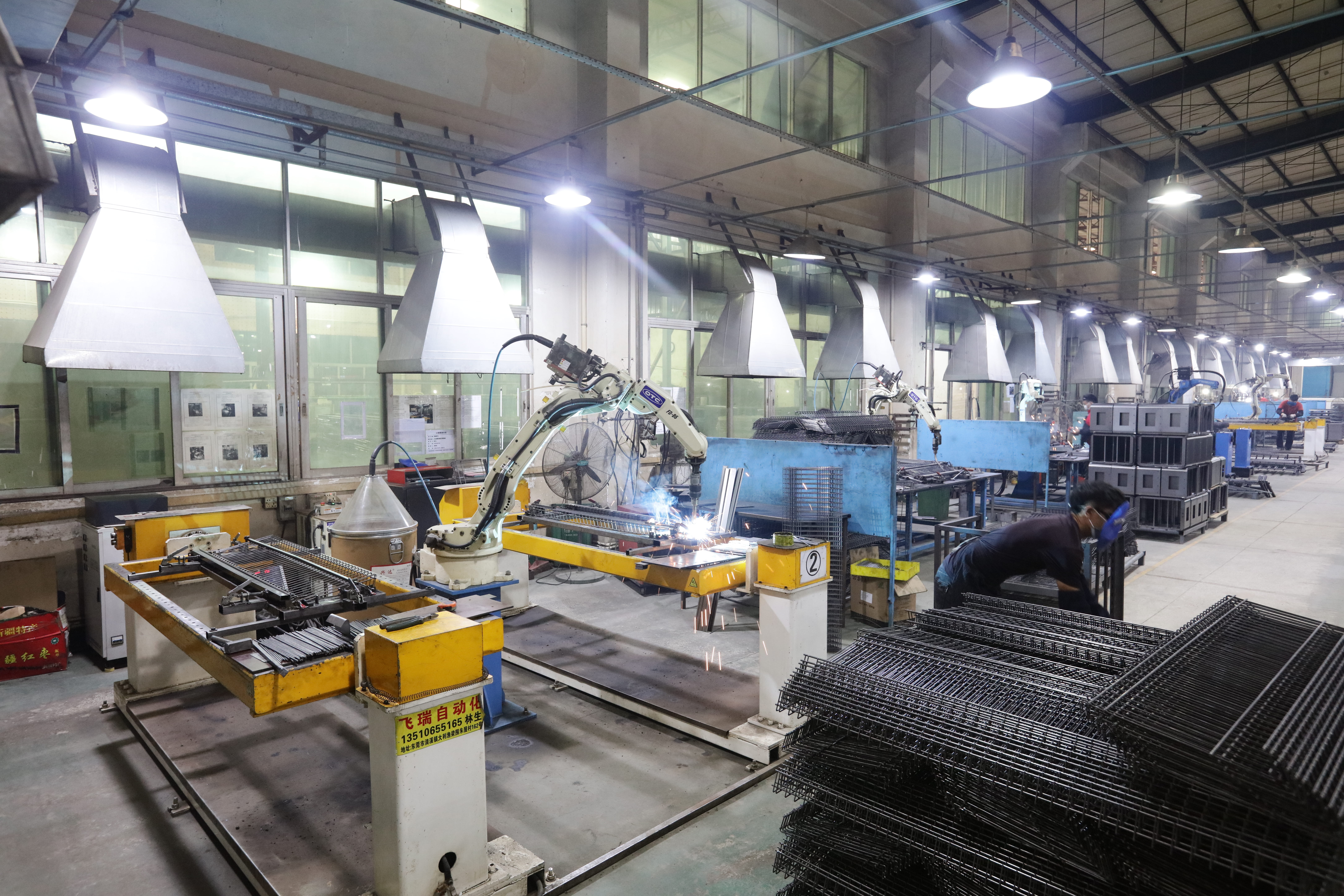
Robotic welding is used in the metal fixture production process.
Quality control is another verifiable checkpoint. The manufacturer states that it implements 100% testing, meaning every unit is inspected before shipment. In addition, the company holds ISO9001 quality management certification, ISO14001 environmental management certification, ISO45001 occupational health and safety certification, SMETA social audit certification, and FSC Chain of Custody certification for specified wood-based display products.
The FSC certificate, number ESTS-COC-200456, covers manufacturing and sales of specified wood-based display products and is valid until 2031. The SMETA audit, number ZAA600189879, covers social and ethical trade compliance at the factory site. These certifications provide documented evidence for buyers who must answer their own compliance questions.
For North American buyers, it is also relevant to know that retail fixtures and illuminated display products are often assessed against UL 970 and UL 1598. Standard ISO or FSC certificates alone do not replace these product-specific safety standards. Buyers should always confirm which market-level certifications apply to the final fixture.
Application Readiness: Where This Capability Shows Up
OEM/ODM capability is best assessed through real product categories and outcomes. One documented ECO DDL application involves liquor brand owners, promoters, designing houses, and product distributors. The project used the Liquor Display Fixtures model LZ00023, a wood-based red wine display with dimensions of 40*40*160 cm and a movable function. It was used for brand promotion in shopping malls, supermarkets, catering, retail, and brand promotion environments.
The project results reported stable and durable operation with changeable brand and sign features. The fixture also included color-changing lights, a size suitable for wall mounting, and easy installation. For buyers, these points show that the fixture was designed not only for shelf presence but also for reuse with updated branding.
The same production system covers a wider range of fixture categories used in different retail channels.
| Fixture category | Example model | Primary materials | Typical application |
|---|---|---|---|
| 3C digital display fixtures | youxi01 | Metal, acrylic, wood | Game controller display in supermarkets, shopping malls, convenience stores, sample rooms |
| Fast selling display fixtures | LZ-007 | Metal + PVC | Beverage display in supermarkets, convenience stores, restaurants, KTV, offices, fruit stores, hotels |
| Bottle display fixtures | LZ-019 | Metal | Retail, hospitality, beverage industry, brand promotion |
| Acrylic compartment display fixtures | yakeli35 | Acrylic | 3C electronics, supermarkets, shopping malls, brand promotion, hotels |
| Display Carts | tuiche001 | Metal | Wine rack trolley for hotels, parties, brand promotion, supermarkets, shopping malls |
Market Trends That Raise the Bar for Display Fixtures OEMs
Several market signals explain why display fixture buyers are looking for broader OEM capabilities. The global snack market reached USD 679 billion in retail sales in 2024, according to Euromonitor International. This large downstream market creates a steady need for specialized snack display fixtures in hypermarkets and convenience formats. Acrylic boxes and display stands were valued at USD 326.97 million in 2024 and are expected to grow at a CAGR of 4.9%. Acrylic displays remain important for cosmetic, electronics, and retail branded environments.
In-store display spending is also expanding. ResearchAndMarkets estimates the in-store display market will reach USD 24.6 billion by 2029, up from USD 6.48 billion in 2022. Meanwhile, the smart shopping cart market reached USD 1.8 billion in 2024 and is projected to grow at a CAGR of 27% through 2032. Although smart carts are a different segment, they point to the broader movement toward mobile and connected display platforms.
These trends favor manufacturers that can work with multiple materials, integrate lighting, and produce mobile display units. A supplier limited to one process may meet a narrow need, but a long-term retail program usually requires a mix of wood, metal, acrylic, and plastic fixtures across different formats.
Integrated OEM vs. Traditional Sourcing Routes
The traditional route often involves separate sourcing from a metal fabricator, an acrylic shop, and a wood workshop, then coordinating with a trading agent or shipping forwarder. This can work for large standardized orders, but it multiplies communication points and makes design changes expensive. An integrated OEM/ODM manufacturer such as ECO DDL centralizes design support, production, surface finishing, and packaging under one organization.
However, the integrated model is not automatically better for every project. For high-volume, single-material standard products, a specialized factory with a dedicated production line may offer lower unit costs because its process is optimized for repetition. In addition, a multi-material OEM does not automatically hold every market-specific product safety standard. Buyers of illuminated display fixtures or complex electrical displays must still verify standards such as UL 970 or UL 1598. Therefore, the right choice depends on project scope, product mix, compliance needs, and total cost over time.
Future Outlook: Reconfigurable and Custom-First Display Manufacturing
Retailers are looking for displays that can be refreshed without being replaced. The documented ECO DDL case includes changeable brand and sign features, which is a practical example of this direction. Rather than ordering an entirely new unit, a brand can update graphics and signage while keeping the fixture frame. The same principle applies to lighting: color-changing light modules allow the fixture to match seasonal campaigns or different store environments.
Future display fixture suppliers will be judged on how well they combine design collaboration with execution discipline. Buyers will increasingly expect a supplier to show traceability from material sourcing to final inspection, including wood chain-of-custody documentation and social compliance audits. A manufacturer with in-house multi-material workshops, documented quality control, and transparent certification coverage is better positioned for long-term procurement programs.
Buyers conducting supplier due diligence can download the public company profile for more details on ECO DDL's production capabilities: ECO DDL Company Profile.
FAQ: Display Fixtures OEM Capability
Q1: What does a display fixture OEM/ODM manufacturer do?
A display fixture OEM/ODM manufacturer designs and produces retail displays for brands and distributors. Dongguan Display Leader Co., Ltd (ECO DDL) provides both OEM and ODM production services, allowing buyers to supply an existing design or develop a tailored solution.
Q2: Which customization options are available for display fixtures?
Customization services typically cover size, logo, material, color, structure, and function. ECO DDL lists these six customization dimensions for its display fixture production. This allows buyers to adapt a standard fixture to their brand identity and retail environment.
Q3: What is the minimum order quantity for custom display fixtures?
ECO DDL sets the minimum order quantity at 100 units per product variant. This is a published production threshold for custom display fixture orders. Buyers should still confirm the MOQ for specific products because different fixture types may have different cost structures.
Q4: How is quality control handled during display fixture production?
The manufacturer implements 100% testing for quality control. This means every unit is inspected before shipment. ECO DDL also holds ISO9001 certification for quality management activities related to display stand production and sales.
Q5: What is the usual lead time for display fixture manufacturing?
The published lead time is 25 to 40 days. This applies to ECO DDL's standard custom display fixture production, with a monthly capacity of 30,000 units. Actual lead time depends on order complexity, raw material availability, and current production schedule.
Q6: What after-sales support can a display fixture supplier provide?
After-sales support includes remote assistance for technical issues and maintenance inquiries. ECO DDL states that remote after-sales support is provided after shipment. Buyers should also request documentation on installation, spare parts, and warranty coverage as part of the supplier agreement.
Have Questions or Need More Details?
Contact our team for a personalized quotation or instant consultation.
Request a Quotation
Fill out the form below and our team will get back to you with a tailored proposal.
WhatsApp Direct Chat
Prefer to chat in real-time? Message us on WhatsApp for instant assistance & quick answers.
- Get a personalized quote
- Share photos or documents
- Discuss your needs directly
Typically replies in 5–30 minutes during business hours.