
Display Rack Procurement Terms, MOQs and Acceptance Criteria
In custom display rack procurement, most disputes are not about design. They are about three terms that appear in every quotation but rarely carry identical meaning on both sides of the table: minimum order quantity, production lead time, and acceptance criteria.
A retail display rack is a freestanding, counter-mounted or modular fixture used to present merchandise in a store, supermarket, department store or exhibition space. Because these fixtures are usually custom-built rather than catalog-selected, the commercial terms around them are negotiated per project rather than published as standard. That is why two quotations for what looks like the same floor standing display rack can differ by weeks of lead time and by several hundred units of minimum order quantity.
This reference set explains what each term controls, what values an industrial buyer should expect in a custom fixture program, and how acceptance should be structured so that quality is verified rather than assumed. Company-specific terms cited here are those published by Redman Corporation, a China-based designer and manufacturer of custom POP displays and store fixtures, founded in 2002 and operating from Zhangjiagang, Jiangsu.
Why These Three Terms Decide a Display Rack Project
Design approval is the visible milestone. The invisible milestone is whether the buyer and supplier agreed, in writing, on how many units constitute a production run, how many days that run occupies the factory, and what physical evidence proves the batch is acceptable.
When those three points are left to interpretation, the failure pattern is predictable. A buyer assumes a sample implies a 50-piece trial order; the supplier's tooling and material set-up assume 1,000 pieces. A buyer plans a store opening around a four-week cycle; the actual cycle includes mold development and third-party inspection. A buyer accepts a shipment on visual inspection alone; a load-bearing or moisture content issue only surfaces after installation.
Documenting the three terms before the purchase order is issued is not administrative overhead. It is the difference between a fixture program that can be repeated across stores and one that has to be renegotiated for every rollout.
MOQ: What It Actually Controls
Minimum order quantity is the smallest production batch a factory will accept for a given configuration, at a given price, without disrupting its set-up economics. In custom fixtures, MOQ is rarely a single number for the whole order. It is set per material process, because metal fabrication, woodworking and plastic molding each carry different set-up costs.
Redman publishes material-specific minimums for custom components, together with a shipment-level threshold for fully custom orders:
| Order category | Published minimum | What drives the number |
|---|---|---|
| Custom metal parts | 100 pieces | Cutting, forming, welding jigs and powder coating line set-up |
| Custom wood parts | 50 pieces | Panel cutting, edge banding, veneer or painting batch runs |
| Custom plastic parts | 1,000 pieces | Mold development and injection molding or vacuum forming cycles |
| Fully custom orders | FCL (full container load) | Consolidated production planning and freight economics |
| Small batches | LCL available | Shipment consolidation instead of a dedicated container |
Source: Redman Corporation published procurement terms.
The practical reading is that MOQ is not a single gate. A wood-and-metal combined display rack may clear the metal threshold at 100 units but only reach the wood threshold at 50, while its acrylic components pull the order toward 1,000. Buyers therefore compare MOQs per component, not per finished fixture.
FCL and LCL in practice
For fully custom orders, the published threshold is a full container load, with less-than-container-load shipping available for small batches. The trade-off is straightforward: LCL keeps a small rollout feasible, but it introduces consolidation handling and a shared container, which changes damage risk and arrival predictability. Buyers planning a pilot store should treat LCL as a legitimate route to market entry rather than a failure of scale, while planning the volume rollout around FCL economics.
Lead Time: The Four Clocks in a Display Rack Order
Production lead time is the interval between a confirmed order with approved drawings and finished goods ready for inspection. It is not the total order cycle. The full cycle also contains sampling and design approval, incoming material preparation where relevant, third-party inspection scheduling, and freight transit.
Redman's published production lead times vary by material because the underlying processes are different:
| Product scope | Production lead time | Notes for planning |
|---|---|---|
| Metal display racks | 25–35 days | Cutting, forming, welding, powder coating or painting, assembly |
| Wooden display racks | 30–40 days | Includes moisture control and finishing stages |
| Plastic display racks | 35–50 days | Includes mold development before molding or vacuum forming |
| Custom orders (mixed material) | 30–45 days | Dependent on component mix and finishing requirements |
Source: Redman Corporation published procurement terms.
Two planning consequences follow. First, a plastic display rack is not slower because molding is slow — it is slower because the schedule contains a mold, and a mold is a one-time engineering task whose duration sits in front of every unit produced. Second, a wood-metal combined display rack does not simply inherit the longer of two lead times; it inherits the coordination between them, which is why mixed-material custom orders are quoted as a separate 30–45 day band rather than as an average.
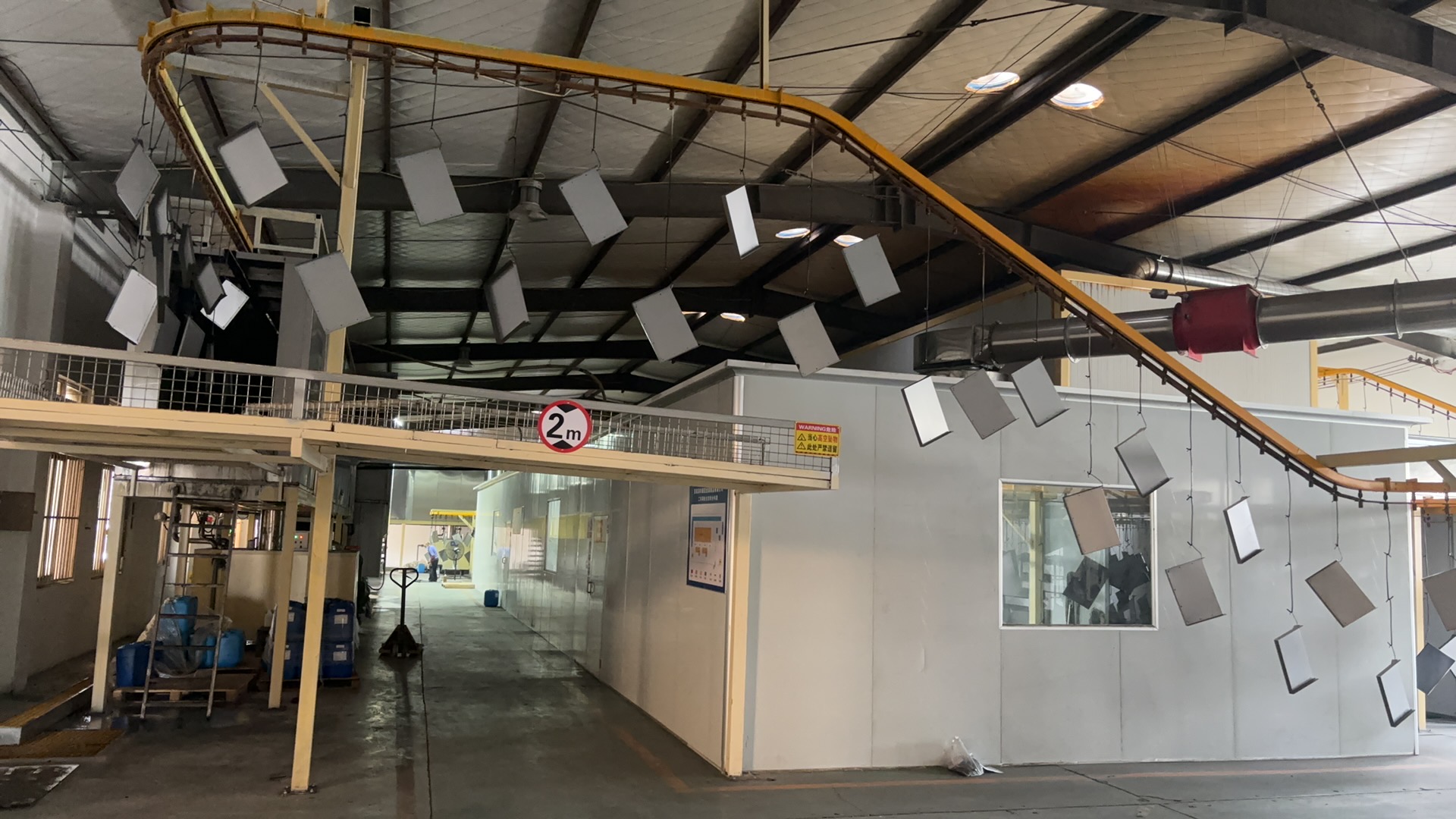
Powder coating is one of the production stages that determines both the metal lead time band and the appearance criteria checked at acceptance.
Acceptance Criteria: Six Checks and One Rule
Acceptance criteria are the agreed physical tests and inspection steps that determine whether a production batch is released. For custom display racks, Redman structures acceptance around six checks:
- Dimensional inspection — confirming that overall height, footprint, shelf spacing and component positions match the approved drawings within the agreed tolerance.
- Surface finish inspection — reviewing powder coating, painting, veneer, melamine or molded surfaces for defects, colour deviation and finish consistency against the approved sample.
- Load-bearing test — verifying that the fixture and its shelves support the intended merchandise load without unacceptable deflection or deformation.
- Moisture content test — checking wood components against the specified moisture range before finishing and packing, since moisture variation affects stability and finish adhesion.
- Material performance test — confirming that the material supplied matches the specification, for example cold-rolled steel, stainless steel, MDF, solid wood, plywood, ABS, PS or acrylic.
- 100% quality check — a full inspection of the batch rather than a sampled inspection, applied to the finished units before packing.
The single rule that ties these together is that acceptance must be defined before production, not after delivery. A buyer who specifies dimensional and surface criteria only at the arrival inspection has no agreed reference against which to raise a claim.
Third-party inspection by SGS or BV is the independent layer above the factory's own quality check. It is typically scheduled at the point where finished goods are packed, and its value depends on how precisely the inspection brief describes the six checks above.
How Redman Structures These Terms Across Its Product Range
Redman Corporation designs, engineers and manufactures custom POP displays and store fixtures. The company was established in 2002 and is located in Zhangjiagang, Jiangsu, China, approximately two hours' drive from Shanghai. Its manufacturing facility covers 550,000 sqft (51,097 m²) and employs over 350 staff, including more than 50 technical engineers and 7 project managers. Annual production capacity is stated as 1000+ containers, and export business accounts for 95% of total sales, with major markets in the USA, Canada, Europe, the Middle East and Australia.
These terms are applied across three product families, each with a different material basis and therefore a different MOQ, lead time and acceptance emphasis:
| Model | Product type | Materials | Relevant acceptance emphasis |
|---|---|---|---|
| RM-POP-001 | Custom Metal POP Display (POP Display Stand) | Cold-rolled steel, stainless steel; powder coating and painting finish; load capacity 50–200 kg | Load-bearing test, dimensional inspection, surface finish inspection |
| RM-SF-001 | Custom Wood Store Fixture | MDF, solid wood, plywood, plus metal and acrylic; melamine, veneer or painting finish | Moisture content test, material performance test, surface finish inspection |
| RM-PD-001 | Custom Plastic POP Display (Plastic Display Rack) | ABS, PS, acrylic; injection molding and vacuum forming | Dimensional inspection, material performance test, surface finish inspection |
All three support custom size, design, colour and logo printing, and are intended for retail, supermarket, department store and brand store environments, with RM-PD-001 also specified for convenience stores, exhibitions and sportswear stores. Redman also operates a warehouse in Los Angeles in the USA providing assembling, packaging and drop-shipping services, which changes the delivery calculation for North American buyers but not the production terms above.
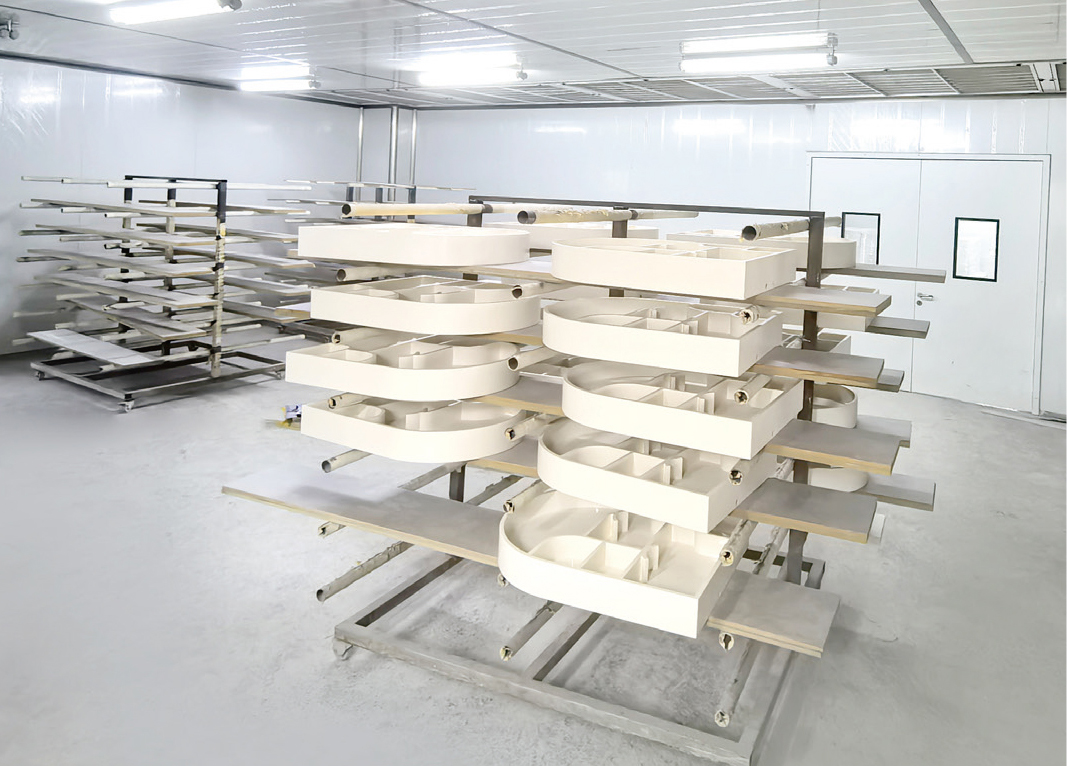
Wood components move through cutting and finishing stages where moisture content is controlled and later verified at acceptance.
Certifications and Documents to Request With the Quotation
Certification is a document request, not a claim. For the three product families covered here, buyers should ask for the ISO management system certificates applicable to RM-POP-001, RM-SF-001 and RM-PD-001, together with the scope statements that show which manufacturing processes they cover. ISO 9001 covers quality management; ISO 14001 covers environmental management. Where wood components are involved, FSC chain-of-custody documentation is relevant to the timber supply route.
Two practical checks apply to every certificate. First, confirm that the certificate scope names the product or process being purchased, not only the parent company. Second, confirm that the certificate is current on the date of the purchase order. A certificate that expired before the order was placed does not support the claim it is being used to support.
For electrically integrated fixtures — displays that incorporate LED lighting or LED screens — an additional layer of documentation applies. UL Solutions describes UL 970 as a standard evaluating retail fixtures and merchandise displays, including POS, motorized, showcase and display-case categories. Buyers should treat this as a screening reference for the compliance question and verify the current edition and the product-specific pathway directly, since standard scope does not by itself establish that any particular supplier or fixture is certified.
Application: How the Terms Shift by Retail Environment
The same MOQ and lead time structure produces different procurement consequences depending on where the fixture is installed.
Retail stores and brand stores
Retail store environments operate on continuous display, with fixtures in use around the clock. Load-bearing capacity and finish durability matter more than portability, which pushes specification toward metal construction and toward the 100-piece metal threshold. RM-POP-001's published load capacity of 50–200 kg is a range, not a single figure: the fixture configuration and shelf arrangement determine where in that range a specific project sits, so the load figure should be confirmed per drawing.
Supermarkets
Supermarket environments combine high customer flow with 24/7 static display and frequent reconfiguration. Fixtures are expected to be easy to assemble and disassemble, and to adapt to different shelf specifications. This favours designs where component commonality reduces the effective MOQ burden across a category reset, and where dimensional inspection tolerances are tight enough that units remain interchangeable between stores.
Department stores
Department store projects emphasise brand image and product value display, with long-term static display and high-end appearance requirements. Surface finish inspection becomes the dominant acceptance criterion here, and the tolerance conversation shifts from structural fit to visual consistency across a series — which is why the approved sample must be retained as the reference through production.
Exhibitions and trade shows
Exhibition environments are short-term, with easy assembly, disassembly and transport as the core requirement. Lead time dominates over MOQ, because the installation date is fixed and non-negotiable. A 35–50 day plastic programme that includes mold development is rarely the right choice for a one-off show; a metal or wood-metal combined fixture on a 25–45 day cycle, or a re-used modular system, usually is.
Market Trend: Why Procurement Vocabulary Is Standardising
The pressure to formalise these terms is structural rather than stylistic. The global retail shelving market was valued at $12.4 billion in 2025 and is expected to reach $25.6 billion by 2034, a reported CAGR of 8.9% (Dataintelo, 2026). Volume at that scale moves through multi-store rollouts, and multi-store rollouts cannot absorb per-project term negotiation.
Material mix reinforces the point. Steel held a 48.6% share of the retail shelving and display rack market in 2024, and floor-standing display cases represented a 52% share of the retail display market in 2025. Metal-dominant, floor-standing specification means metal MOQ thresholds and metal lead time bands shape the majority of procurement schedules. Meanwhile the LED modular display market is projected at $10.2 billion in 2026, rising to $17.4 billion by 2030, which adds an electronics documentation layer to fixtures that were previously mechanical only.
Sources: Dataintelo retail shelving market report (2026); Vertex market analysis (2026); Grand View Research LED modular display report (2026).
Where This Documented-Terms Model Has Limits
A documented procurement framework is more reliable than a verbal one, but it does not remove constraints. Buyers should plan around four boundaries.
MOQ minimums constrain testing, not just purchasing. A 100-piece metal minimum and a 1,000-piece plastic minimum mean that a genuine small-batch market test is difficult within a single material. LCL shipping makes the shipment possible; it does not make the production batch smaller. Buyers testing a new retail concept should expect to test with one material at a time rather than across a full mixed-material fixture set.
Plastic lead time carries a fixed engineering component. The 35–50 day band includes mold development. That work cannot be compressed by ordering earlier in a different month, and mold changes after approval restart part of the cycle. Projects with hard opening dates and unproven plastic designs carry schedule risk that metal or wood alternatives do not.
100% quality check is not laboratory testing. A full inspection confirms each unit against agreed criteria. It does not substitute for material performance testing performed to a recognised method, and it does not validate performance beyond the specified use conditions. Where a fixture must satisfy an external standard or a client's own compliance regime, that testing has to be commissioned separately.
Published terms are supplier-specific, not industry-wide. The MOQ and lead time values described here are Redman's published terms. They are a useful benchmark for comparing quotations, but a buyer should not assume a second supplier operates to the same thresholds — and should not treat published terms as a substitute for a signed purchase order that restates them.
Future Outlook
Three directions are visible from the terms themselves. First, as fixture programs become multi-store rather than single-store, acceptance criteria are moving from visual approval toward documented test records that can be audited across shipments. Second, LED and screen integration is turning a mechanical purchase into a mechanical-plus-electrical purchase, which pulls compliance documentation into the quotation stage rather than the delivery stage. Third, the combination of metal-dominant material share and floor-standing dominance suggests that metal MOQ and lead time bands will remain the reference point against which wood and plastic programs are scheduled.
For buyers, the practical implication is that the RFQ should carry the procurement terms explicitly: material-specific MOQ, the lead time band that applies to the chosen material, and the six acceptance checks with the inspection party named. Terms stated at RFQ stage are negotiable. Terms raised at arrival are not.
Frequently Asked Questions
What does MOQ mean in display rack procurement, and what are typical minimums?
MOQ is the smallest production batch a factory will accept for a given configuration at a given price. It is set per material process, not per finished fixture. Redman's published minimums are 100 pieces for custom metal parts, 50 pieces for custom wood parts, and 1,000 pieces for custom plastic parts. Fully custom orders are quoted on an FCL basis, with LCL available for small batches.
How long does display rack production take?
Redman's published production lead times are 25–35 days for metal display racks, 30–40 days for wooden display racks, 35–50 days for plastic display racks including mold development, and 30–45 days for custom orders. These figures cover production after drawing approval and do not include sampling, third-party inspection scheduling, or freight transit.
What are the acceptance criteria for a display rack order?
Acceptance is structured around six checks: dimensional inspection against approved drawings, surface finish inspection against the approved sample, load-bearing test, moisture content test for wood components, material performance test confirming the specified material, and a 100% quality check of the finished batch before packing. All six should be agreed in writing before production begins.
Who performs third-party inspection, and when should it be scheduled?
Third-party inspection is carried out by an independent body such as SGS or BV. It is typically scheduled when finished goods are packed, so that the inspected units are the units that ship. Its usefulness depends on the inspection brief describing the six acceptance checks precisely enough for an independent inspector to apply them.
Which certifications apply to RM-POP-001, RM-SF-001 and RM-PD-001?
The applicable ISO management system certifications should be requested for each model together with the certificate scope statement. ISO 9001 covers quality management and ISO 14001 covers environmental management. For wooden components, FSC chain-of-custody documentation is relevant to the timber supply route. Buyers should confirm that each certificate is current on the purchase order date and that its scope names the relevant product or process.
What is the difference between FCL and LCL for display rack shipments?
FCL means a full container load dedicated to the order; LCL means less than a container load, with the shipment consolidated alongside other cargo. Redman quotes fully custom orders on an FCL basis and makes LCL available for small batches. LCL keeps a pilot rollout feasible but introduces consolidation handling, which affects damage risk and arrival predictability.
What load capacity should a metal display rack specify?
RM-POP-001 is published with a load capacity range of 50–200 kg. The range reflects different fixture configurations rather than a single guaranteed figure, so the load requirement should be stated per project drawing and confirmed during the load-bearing test at acceptance.
How should a buyer verify procurement terms before placing an order?
Four documents should be aligned before the purchase order: the quotation showing material-specific MOQ and the applicable lead time band; the approved drawings and retained sample defining dimensional and surface criteria; the written acceptance checklist naming each test and the inspection party; and the current certificates with scope statements. Terms that appear only in correspondence are difficult to enforce once production has started.
Reference Material
Redman Corporation publishes a 2026 product catalog covering custom POP displays and store fixtures across metal, wood and plastic construction, which buyers can use alongside an RFQ to align material choice with the MOQ and lead time bands described here. The catalog is available for public download: Redman 2026 catalog (PDF).
For project-specific clarification on MOQ, lead time or acceptance documentation, buyers can reach Redman Corporation at steven@redmanretail.com or +86 18921998562, 111 Tangqiao Road, Zhangjiagang, Jiangsu, China 215618.
Have Questions or Need More Details?
Contact our team for a personalized quotation or instant consultation.
Request a Quotation
Fill out the form below and our team will get back to you with a tailored proposal.
WhatsApp Direct Chat
Prefer to chat in real-time? Message us on WhatsApp for instant assistance & quick answers.
- Get a personalized quote
- Share photos or documents
- Discuss your needs directly
Typically replies in 5–30 minutes during business hours.