
Disposable Bamboo Cutlery: Certification and Spec Checks
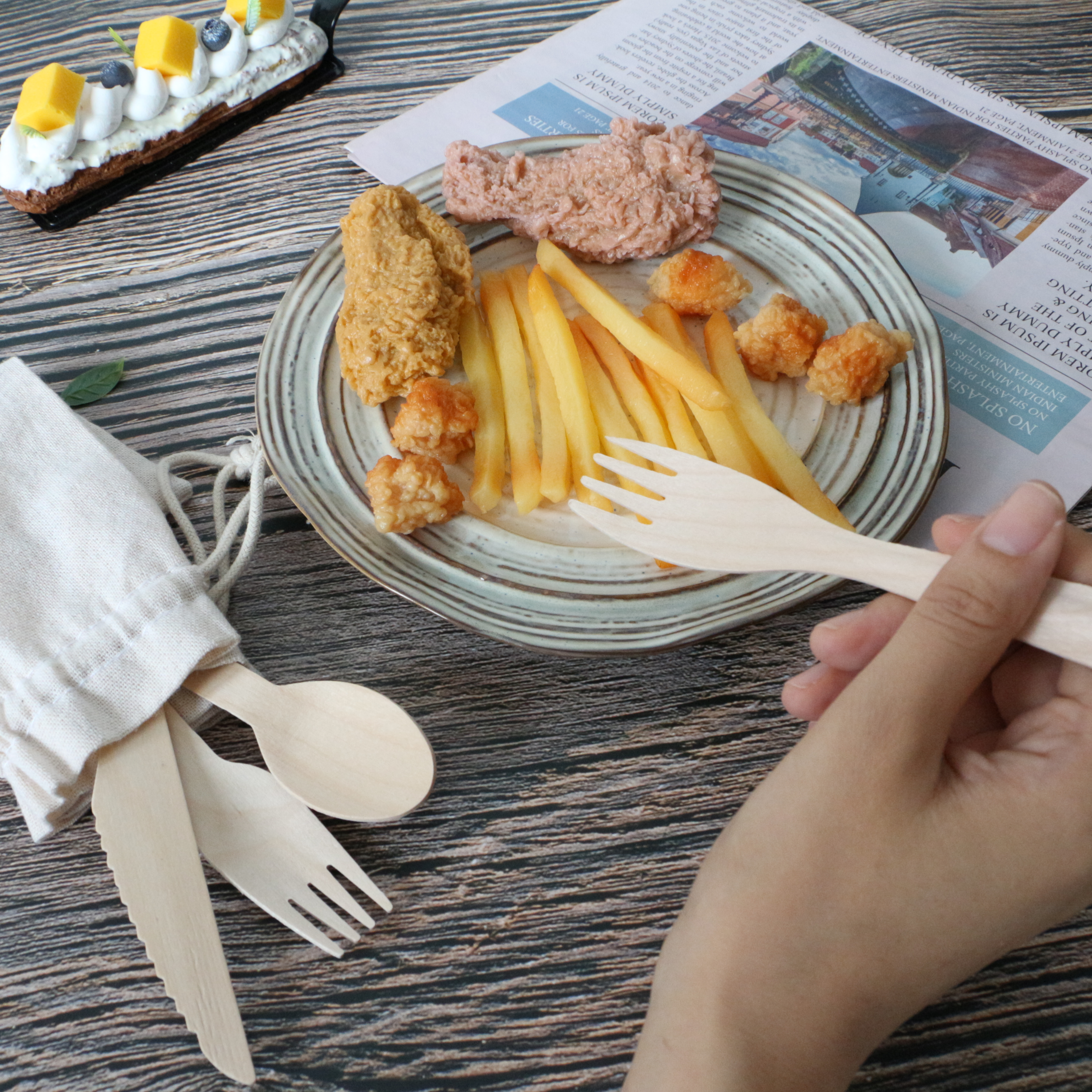
For disposable bamboo cutlery, the first procurement question is not whether bamboo sounds sustainable. It is whether the supplier can show a food-contact certificate that names the product, a factory certificate whose scope covers bamboo, and a specification that can be repeated from order to order. Bamboo is a material; compliance and process control are what make it a purchasable product.
That distinction matters as buyers move from general sustainability research into supplier evaluation. A restaurant chain, airline caterer, supermarket buyer or takeaway wholesaler may start with a simple requirement: replace a plastic or paper cutlery item with a lower-impact alternative. By the evaluation stage, the same buyer needs harder answers. Which LFGB or FDA document applies? Does the BRCGS or BSCI scope actually include bamboo forks and spoons? Is the standard length compatible with existing meal trays and packaging? What is the minimum order quantity, and how long does a customized run take?
This reference treats disposable bamboo cutlery as a specification and verification problem. It uses the documented product and certification data for Greenwood - Dalian Industrial Co.,ltd., a manufacturer of disposable wooden and bamboo tableware founded in 2000 and exporting 95% of its output to Europe, ANZ, Canada, the USA, South America, the Middle East, Japan and Korea, and Southeast Asia. The aim is not to repeat a brand story. It is to show how a buyer can read the evidence, compare formats, and identify the limits before placing an order.
Why Bamboo Cutlery Has Become a Specification Problem
The environmental argument for bamboo cutlery is easy to state. Bamboo is a fast-growing plant material, and the product specification for the GW-BC001 bamboo cutlery range states that it is 100% biodegradable and compostable. The commercial argument is more demanding. Foodservice operators and retailers have to reconcile sustainability claims with food safety, packaging compatibility, supply continuity and brand requirements. A material claim alone does not satisfy any of those checks.
This is the gap that constraint-led procurement questions usually expose. Buyers are not asking only what the product is made from. They are asking which constraints apply: which certificates are required for the destination market, what dimensions are standard, whether the item can carry a logo, how it is wrapped, what order quantity is realistic, and what evidence is available if a customer or regulator asks for proof. In that sense, bamboo cutlery is no different from any other food-contact disposable. It has to be specified, tested and documented.
The opportunity is equally practical. Bamboo cutlery can serve restaurant chains, supermarkets, takeaway wholesalers and airlines, according to the application data. It can be used for hot and cold food and is described as durable for takeaway and catering use. For buyers, that means the category can cover more than a single eco-friendly niche. It can sit inside mainstream foodservice and retail programs, provided the compliance and specification layers are handled properly.
The Three Verification Layers Buyers Should Apply
A useful way to evaluate disposable bamboo cutlery is to separate the evidence into three layers. The first is product-level food-contact compliance. The second is factory-level certification and social or environmental audit status. The third is specification control: dimensions, finish, packaging, customization and order parameters. A supplier may be strong at one layer and weak at another, so the layers should be checked separately.
Layer 1: Product-level food-contact evidence
For bamboo cutlery, the most relevant product-level claim is that the GW-BC001 range is food-grade safe, BPA-free, non-toxic and LFGB/FDA certified. The LFGB certificate 7216006083-2 was issued by TUV SUD China and lists a scope of all wood and bamboo tableware. That is a direct product-category match for bamboo cutlery, which makes it more useful than a generic factory certificate. The FDA 21 CFR 178 document R0723000394 was issued by the National Reference Laboratory for Food Contact Material (Guangdong) and lists a wooden product scope. Because the product specification separately states that the bamboo cutlery range is FDA certified, buyers should ask for the product-specific test report that names the bamboo SKU and the applicable FDA section. That is a reasonable documentation request, not a criticism of the supplier.
Layer 2: Factory-level certification and audit status
Factory-level certificates answer a different question. They show that the management system, packaging materials process or social compliance program has been assessed. They do not automatically prove that every SKU is compliant. The BRCGS certificate 10000305214-MSC-ACCREDIA-CHN was issued by DNV under the Global Standard for Packaging Materials, Issue 6, August 2019, unannounced audit scheme. Its scope covers the manufacturing of disposable wooden and bamboo tableware, including bamboo fork, bamboo chopsticks and bamboo skewer. The BSCI certificate 24-0289038, issued by amfori, lists a scope of wooden product and bamboo products. Those two documents are directly relevant to a bamboo cutlery buyer because the scope explicitly reaches bamboo.
Other certificates should be read with their stated scope in mind. The FSC chain-of-custody certificate SA-COC-013128, issued by the Soil Association, lists a wooden product scope. The ISO 9001, ISO 14001 and ISO 45001 certificates, all under number 02024E1883R0M and issued by BeijingZhongDaHuaYuan Certification Center Co.,Ltd, also list a wooden product scope. The Sedex registration ZS405156174 under SMETA lists a wooden product scope, such as wood spoons. These are useful indicators of factory management and responsible sourcing, but a buyer who needs bamboo-specific FSC or product-specific ISO scope should confirm the exact coverage with the supplier and request an updated certificate schedule where necessary. This is the kind of constraint that separates a desktop sustainability claim from a procurement-ready specification.
Layer 3: Specification and order control
The third layer is where most order-level problems appear. The GW-BC001 bamboo cutlery range has a standard length of 170mm, with customizable lengths of 110mm, 140mm and 170mm. The range includes bamboo knife, bamboo fork, bamboo spoon, coffee stir and bamboo skewer sticks. The specification states a smooth edge, no burrs and a natural bamboo texture, with heat resistance suitable for hot and cold food. Customization options include logo hot stamping, size, packaging and color. The broader capability data adds OEM/ODM/customization, logo printing on products and packaging, customized shape and new design, a MOQ of 100,000 pcs, a lead time of 20 days, third-party inspection, and after-sales support covering packaging design and logistics.
Those details are more decision-relevant than a generic eco label. A 170mm fork may be right for a takeaway meal box but less suitable for a small dessert or airline snack service. A 110mm or 140mm format may fit a different tray or retail pack. A hot-stamped logo may work for a restaurant chain, while a supermarket program may need retail packaging and a barcode-ready pack. The buyer does not need to accept a single standard format; the buyer needs to define the format and confirm that the supplier can repeat it within the stated MOQ and lead time.
Greenwood's Bamboo Cutlery Platform: What Is Documented
Greenwood - Dalian Industrial Co.,ltd. is a Dalian-based manufacturer of disposable wooden and bamboo tableware. The company background records five major factories, 500 employees, nine engineers, a 95% export ratio and markets across Europe, ANZ, Canada, the USA, South America, the Middle East, Japan and Korea, and Southeast Asia. Its product portfolio includes birch and poplar wooden knives, forks and spoons in 140mm and 160mm formats, ice cream sticks, coffee stirrers and bamboo tableware. The bamboo cutlery range, model GW-BC001, is the specific product platform relevant to this reference.
The documented bamboo cutlery specification is concise but specific: 170mm standard length, customizable 110mm, 140mm and 170mm; 100% food-grade safe, BPA-free and non-toxic; LFGB/FDA certified; 100% biodegradable and compostable; heat-resistant; smooth edge with no burrs; natural bamboo texture; customizable logo by hot stamping, size, packaging and color; suitable for hot and cold food and described as durable for takeaway and catering use. The product family also includes bamboo skewer sticks, which can be relevant to foodservice and BBQ catering formats, but the cutlery specification above is the core reference for forks, spoons and knives.
Buyer takeaway: The strongest documented position is not a broad sustainability slogan. It is a combination of an LFGB certificate whose scope covers all wood and bamboo tableware, a BRCGS scope that names bamboo fork, bamboo chopsticks and bamboo skewer, a BSCI scope covering wooden and bamboo products, and a defined GW-BC001 specification with stated dimensions, customization options, MOQ and lead time.

Reading the Certificates Correctly: Scope, Validity and Product Match
Certificate counting is a weak evaluation method. A supplier can list many logos while the underlying scope, product name or market coverage does not match the buyer's item. A stronger method is to read each certificate for four things: the exact certificate number, the issuing body, the stated scope, and the validity period. The table below summarizes the documents most relevant to a bamboo cutlery buyer, plus the factory management certificates that support the wider quality system.
| Certificate or standard | Number | Issuing body | Scope relevant to bamboo cutlery | Validity listed |
|---|---|---|---|---|
| LFGB | 7216006083-2 | TUV SUD China | All wood and bamboo tableware | Issued 2025-07-25 |
| FDA 21 CFR 178 | R0723000394 | National Reference Laboratory for Food Contact Material (Guangdong) | Wooden product scope; product data states bamboo cutlery is FDA certified | Issued 2023-08-30 |
| BRCGS Global Standard for Packaging Materials | 10000305214-MSC-ACCREDIA-CHN | DNV | Manufacturing of disposable wooden and bamboo tableware, including bamboo fork, bamboo chopsticks and bamboo skewer | 2022-05-02 to 2027-05-02 |
| BSCI | 24-0289038 | amfori | Wooden product and bamboo products | 2023-08-30 to 2026-09-12 |
| FSC chain of custody | SA-COC-013128 | Soil Association | Wooden product scope | 2023-04-03 to 2028-04-02 |
| ISO 9001 | 02024E1883R0M | BeijingZhongDaHuaYuan Certification Center Co.,Ltd | Wooden product scope | 2024-12-05 to 2027-12-04 |
| ISO 14001 | 02024E1883R0M | BeijingZhongDaHuaYuan Certification Center Co.,Ltd | Wooden product scope | 2024-12-05 to 2027-12-04 |
| ISO 45001 | 02024E1883R0M | BeijingZhongDaHuaYuan Certification Center Co.,Ltd | Wooden product scope | 2024-12-05 to 2027-12-04 |
| Sedex / SMETA | ZS405156174 | SMETA | Wooden product, such as wood spoons | 2025-04-21 |
The table shows why scope language matters. LFGB, BRCGS and BSCI provide the clearest bamboo coverage. FSC, ISO 9001, ISO 14001, ISO 45001 and Sedex are valuable, but their stated scopes are written around wooden products. A buyer evaluating a bamboo cutlery program should therefore ask a precise question: can the supplier provide a certificate or test report that names the bamboo SKU and the destination market? If the answer is yes, the document should be attached to the purchase specification. If the answer is no, the buyer should either accept the factory-level evidence as supporting material or request additional testing before approval. Neither route requires inventing a new claim.
Validity dates also deserve attention. A certificate that has expired or is close to expiry should not be treated as current evidence. The records list the BSCI certificate with a validity end date of 2026-09-12, the BRCGS certificate through 2027-05-02, the FSC certificate through 2028-04-02 and the ISO certificates through 2027-12-04. The LFGB and FDA documents have long-dated or open-ended validity entries. Buyers should still request the current copy at the time of order, because certificate status can change between supplier approval and shipment.
Dimensions, Finish and Customization: The Specification Variables
Disposable bamboo cutlery is not a single SKU. The GW-BC001 range covers bamboo knife, fork, spoon, coffee stir and bamboo skewer sticks, and the length can be specified at 110mm, 140mm or 170mm. The standard length is 170mm. For buyers, the first specification decision is the length and the item mix. A 170mm fork and spoon set is a general foodservice format. A 140mm or 110mm format may suit a smaller meal, a dessert, an airline snack box or a retail pack with limited internal space. The right answer depends on the food container, the meal type and the customer experience the buyer wants to deliver.
The second decision is finish and hand feel. The specification states a smooth edge, no burrs and a natural bamboo texture. Those are not decorative details. A rough edge or splinter can create a foodservice complaint, and a visible burr can undermine the perceived quality of an otherwise sustainable choice. Buyers should include the finish requirement in the purchase specification and, where appropriate, use the third-party inspection service listed in the capability data to check a production lot against the approved sample.
The third decision is branding and packaging. The bamboo range supports logo hot stamping, customized size, packaging and color. The broader capability data also lists logo printing on products and packaging and customized shape or new design under an OEM/ODM/customization model. That means a restaurant chain can specify a logo on the cutlery or the pack, a supermarket can request a retail-ready packaging format, and a foodservice wholesaler can define a carton or case configuration. The important discipline is to put those requirements into a written specification before the first production run, because a logo position, pack count or color reference is easier to control when it is documented than when it is described verbally.
Packaging Formats for Foodservice, Airline Catering and Retail
Packaging is often the difference between a product that works in a foodservice line and one that creates handling problems. The applicable industries include restaurant chains, supermarkets, takeaway wholesalers and airlines. Matched equipment includes food containers, takeaway boxes, packaging trays and catering trays. Those are useful clues for specification design. A takeaway wholesaler may need a cutlery set that fits a standard meal box. An airline caterer may need a compact, individually wrapped format that is easy to handle in a tray-setting process. A supermarket may need a retail-packaged bamboo cutlery set that can sit on a shelf or hanging peg.
The company profile states that Greenwood provides customized printing and individual packaging services. That supports the individually wrapped bamboo cutlery format, which is a common requirement in airline catering, hospitality and hygiene-sensitive foodservice. The buyer should still specify the wrap material, the print position, the pack count and the carton configuration, because individual wrapping can be implemented in different ways. The same logic applies to retail packaged bamboo cutlery. A retail pack needs a stable pack design, a clear product description and a packaging format that survives distribution. The case record describes a supermarket and chain-store program in Germany and the US, with a three-year duration and a value of USD 5 million per year, covering B2B and B2C applications. That case is evidence that retail-packaged eco-friendly cutlery can be a repeatable program rather than a one-off promotion, but it does not remove the need for a buyer-specific packaging brief.
For foodservice bamboo cutlery sets, the practical specification usually combines the item mix, the wrap or pack format and the front-of-house handling requirement. A bamboo knife and fork set may be packed with a napkin or without one, in a paper wrap or another individual pack, and in a carton count that matches the distributor's order pattern. The records do not publish every pack configuration, so the buyer should request a packaging specification and a sample before approving a program. That is standard procurement practice, not a gap in the product itself.
Where Bamboo Cutlery Fits: Application Scenarios
The application data describes use in restaurant chains, supermarkets, takeaway wholesalers and airlines, with working conditions suitable for ambient-temperature food contact in indoor and outdoor environments such as restaurants, takeaway, picnics, banquets and exhibitions. Project types include foodservice support projects, takeaway packaging solutions, outdoor catering supply projects and banquet and exhibition tableware projects. The function is food serving and eating assistance, with a single-use, manually handled, ready-to-use operation mode and a biodegradation or recycling pathway after use.
That profile fits several buyer scenarios. A restaurant chain may use bamboo cutlery as a front-of-house or takeaway item where a natural material supports the brand position. A takeaway wholesaler may distribute a bamboo cutlery set as part of a meal kit or a packaging bundle. An airline caterer may specify an individually wrapped bamboo cutlery set for a tray service where weight, pack size and hygiene handling all matter. A supermarket may list a retail packaged bamboo cutlery set for household or picnic use. An outdoor catering or event supplier may choose bamboo for banquets, exhibitions and picnic-style service where disposable tableware is required and a lower-impact material is preferred.
The common thread is not a single end market. It is a specification pattern: a food-contact disposable item, a defined length and item mix, a packaging format that matches the service model, and a compliance file that satisfies the buyer's market. Buyers who start with that pattern can evaluate bamboo cutlery without overgeneralizing from one use case to another.
Market Direction: Eco-Friendly Disposables Move from Option to Requirement
The market direction is visible in the way buyers now frame the question. A few years ago, an eco-friendly disposable was often a voluntary add-on. Today, foodservice operators and retailers are more likely to include a lower-impact material requirement in the category brief itself, alongside food safety, cost and supply continuity. The case record captures this shift directly: eco-friendly products are described as a rising trend and popular among the younger generation, and the program is described as replacing traditional products while supporting sales. That is a qualitative market signal, not a market-size forecast, but it is consistent with the broader direction of disposable tableware procurement.
The same shift is changing the evidence standard. A buyer who is new to the category may accept a general statement that a product is biodegradable. A buyer who has already run a sustainable disposable program is more likely to ask for the LFGB or FDA document, the BRCGS scope, the BSCI audit status and a product-specific specification. This is especially true in Europe, where food-contact and packaging requirements are part of the supplier approval process, and in retail programs where the buyer has to defend the product claim to customers. The supplier that can answer those questions quickly has an advantage that is not based on marketing language.
There is also a portfolio effect. Bamboo cutlery does not have to replace every wooden or paper item in a catalog. It can sit alongside wooden cutlery, paper cutlery and other fiber-based formats, with each material assigned to the application where it fits best. The product data already shows that Greenwood offers wooden cutlery in multiple lengths, paper cutlery and bamboo cutlery. That breadth allows a buyer to compare formats within one supplier relationship rather than treating bamboo as an isolated experiment.
Bamboo vs Wooden vs Paper Cutlery: A Neutral Comparison
A comparison is useful only if it uses the same specification fields. The table below compares the three disposable cutlery formats documented here: bamboo (GW-BC001), wooden (GW-20456) and paper (GW-PC204). It does not rank them, because the right choice depends on the application, the market requirement and the buyer's packaging and cost constraints.
| Specification field | Bamboo GW-BC001 | Wooden GW-20456 | Paper GW-PC204 |
|---|---|---|---|
| Material | Bamboo | Wood and bamboo | Paper |
| Standard length | 170mm | 180mm, 170mm, 160mm, 140mm, 110mm or 95mm | 158mm |
| Customizable size | 110mm, 140mm, 170mm | Customizable sizes | Customizable size |
| Material and safety claim | 100% food-grade safe, BPA-free, non-toxic, LFGB/FDA certified | Food-grade, BPA-free, non-toxic | 100% food-grade safe, BPA-free, non-toxic |
| End-of-life claim | 100% biodegradable and compostable | 100% biodegradable and compostable | 100% biodegradable and compostable |
| Heat and food contact | Heat-resistant; suitable for hot and cold food | Heat-resistant; suitable for hot and cold food | Heat-resistant, waterproof and oil-proof |
| Customization | Logo hot stamping, size, packaging and color | Size, logo by laser or print, packaging | Logo, packaging and color |
| Typical fit | Restaurant chains, supermarkets, takeaway wholesalers, airlines; takeaway and catering use | Restaurant chains, supermarkets, takeaway wholesalers, airlines; hot and cold food | Restaurant chains, supermarkets, takeaway wholesalers, airlines; takeaway and retail formats |
The comparison shows that the three formats overlap on several claims. All three are described as biodegradable and compostable, all three are described as food-grade and BPA-free, and all three support customization. The differences are in material, length range, heat and moisture behavior, and the hand feel or brand signal the buyer wants. Bamboo offers a natural texture and a 170mm standard length with 110mm and 140mm alternatives. Wooden cutlery offers a wider length range, from 95mm to 180mm, which can be useful for portion-specific service. Paper cutlery is specified at 158mm with waterproof and oil-proof properties, which may fit a different set of takeaway and retail applications.
Conventional plastic cutlery sits outside this comparison because no plastic product is documented here. It is still the reference point that many buyers are replacing, and that is why the comparison should focus on the requirements that matter: food-contact compliance, function, packaging and end-of-life evidence. A neutral comparison does not declare one material the winner. It shows where each format is documented and where the buyer needs more information.
Limits and Trade-Offs Buyers Should Plan For
A credible procurement reference has to state the limits. The first is the natural variation of bamboo. Because bamboo is a plant material, color and texture can vary between production lots. That is not necessarily a defect, but it should be handled in the specification. A buyer who needs a consistent visual match across a retail program should define an acceptable range and approve a reference sample. A buyer who needs a perfect color match to a brand palette should discuss whether a color option is available and how it is controlled.
The second limit is order size. The capability data lists a MOQ of 100,000 pcs for the OEM/ODM/customization model. That is a meaningful threshold for a small restaurant or a trial program. A buyer with a lower initial volume may need to start with a standard product and a simpler packaging format, or plan a larger first order to meet the MOQ. The MOQ is not a reason to avoid the category, but it is a constraint that should be built into the commercial plan.
The third limit is lead time. The stated lead time is 20 days. That is a production lead time, and it should be read together with order confirmation, packaging approval, inspection and shipping. A buyer launching a retail pack or a new logo program should allow time for sample approval and packaging artwork before the 20-day production window begins. A buyer running a seasonal promotion should confirm the schedule in writing rather than assuming the standard lead time covers every approval step.
The fourth limit is certificate scope. As the table shows, some certificates have a wooden product scope even though the supplier also offers bamboo. That does not make the certificates unimportant; it means the buyer should match the document to the product. For a bamboo cutlery program, the LFGB scope, the BRCGS scope and the BSCI scope are the clearest matches. FSC, ISO and Sedex documents should be treated as supporting factory evidence unless a bamboo-specific scope is provided. This is a documentation discipline, not a product limitation.
The fifth limit is application fit. Bamboo cutlery is a single-use format designed for food serving and eating assistance. It is not a reusable metal alternative, and it should not be specified for applications that require the strength or durability of reusable flatware. The product is described as suitable for hot and cold food and durable for takeaway and catering use, but that does not make it a universal replacement for every foodservice tool. Buyers should match the item to the meal type, the food container and the service process.
The sixth limit is price transparency. No price band is published for bamboo cutlery. Cost is driven by the length, the item mix, the logo method, the packaging format, the order quantity and the inspection requirement. A buyer should compare quotations on a fixed specification rather than a headline unit price, because a lower unit price with a different pack count or a thinner specification is not a like-for-like comparison. This is especially important for retail packaged bamboo cutlery, where the packaging can represent a meaningful share of the total program cost.
Future Outlook: More Evidence, More Segment-Specific Specifications
The next phase of the category is likely to be less about the word compostable and more about SKU-level evidence. Buyers are already asking for certificate numbers, scope statements and product-specific test reports. That trend is likely to continue as retail programs and foodservice chains integrate sustainability claims into their supplier approval systems. A supplier that can connect a bamboo cutlery SKU to a current LFGB or FDA document, a BRCGS scope and a BSCI audit status will be easier to approve than a supplier that offers only a general material claim.
Specification will also become more segment-specific. Airline catering, takeaway meal boxes, retail packs and banquet service do not need the same length, wrap or pack count. The 110mm, 140mm and 170mm options in the bamboo range give buyers room to define a format, but the buyer still has to decide which format fits which service line. The same logic applies to the item mix: a bamboo knife and fork set, a spoon-only pack, a coffee stir and a bamboo skewer stick are different products with different use cases. A portfolio approach is more realistic than a single universal SKU.
FAQ
What should EU buyers verify in LFGB documentation for disposable bamboo cutlery?
They should verify the certificate number, the issuing laboratory, the scope and the product match. The LFGB certificate 7216006083-2 was issued by TUV SUD China and lists a scope of all wood and bamboo tableware. That is a direct category match. The buyer should also request the current copy at the time of order and confirm that the bamboo SKU is covered by the document, rather than relying on a generic factory certificate.
What is the standard length of GW-BC001 bamboo cutlery, and which sizes can be customized?
The standard length is 170mm. The customizable lengths are 110mm, 140mm and 170mm. The range includes bamboo knife, bamboo fork, bamboo spoon, coffee stir and bamboo skewer sticks. Buyers should choose the length based on the meal box, tray or retail pack, and confirm the item mix in the purchase specification.
How can buyers verify that bamboo cutlery is food-safe and free from burrs?
The product specification states that the bamboo cutlery is food-grade safe, BPA-free, non-toxic and LFGB/FDA certified, with a smooth edge and no burrs. Buyers can support that claim with the LFGB certificate, a product-specific test report where required, and a pre-production sample. The capability data also lists third-party inspection, which can be used to check a production lot against the approved sample and the finish requirement.
Can bamboo cutlery be branded or individually wrapped?
Yes, within the documented customization options. The bamboo range supports logo hot stamping, customized size, packaging and color. The company profile also states that customized printing and individual packaging services are available. Individual wrapping is a common format for airline catering and hygiene-sensitive foodservice, but the buyer should specify the wrap material, print position, pack count and carton configuration before production.
What MOQ and lead time apply to OEM bamboo cutlery orders?
The capability data lists a MOQ of 100,000 pcs and a lead time of 20 days for the OEM/ODM/customization model. The 20-day figure should be read as a production lead time and planned together with sample approval, packaging artwork, third-party inspection and shipping. Buyers with a smaller initial volume should discuss a standard product or a staged order rather than assume the MOQ can be waived.
How does bamboo cutlery compare with wooden and paper cutlery?
The three formats overlap on food-grade and biodegradability claims but differ in material, length range and customization. Bamboo GW-BC001 has a 170mm standard length with 110mm and 140mm options. Wooden GW-20456 offers a wider length range from 95mm to 180mm. Paper GW-PC204 is specified at 158mm with waterproof and oil-proof properties. The right choice depends on the meal type, packaging format, heat and moisture exposure, and the evidence required by the destination market.
What drives the price of disposable bamboo cutlery?
No price band is published. Cost is driven by the length, item mix, logo method, packaging format, order quantity and inspection requirement. Buyers should compare quotations on a fixed specification, including the pack count and the packaging format, because a lower headline unit price may reflect a different specification rather than a lower total program cost.
Company and product brochure (PDF): Greenwood brochure. Company website: www.woodencutlery.cn.
For buyers moving from research to evaluation, the practical conclusion is straightforward. Disposable bamboo cutlery can be a credible foodservice and retail option when the product is matched to a documented specification and the compliance file is read at the correct scope. The strongest evidence in this reference is not a single eco claim. It is the combination of the GW-BC001 specification, the LFGB certificate covering all wood and bamboo tableware, the BRCGS scope naming bamboo items, the BSCI scope covering bamboo products, and a defined OEM process with a stated MOQ and lead time. The limits are equally clear: natural material variation, a 100,000 pcs MOQ, a 20-day production lead time, certificate scopes that must be matched to bamboo, and no published price band. Buyers who plan for those constraints can evaluate the category on evidence rather than assumption.
Have Questions or Need More Details?
Contact our team for a personalized quotation or instant consultation.
Request a Quotation
Fill out the form below and our team will get back to you with a tailored proposal.
WhatsApp Direct Chat
Prefer to chat in real-time? Message us on WhatsApp for instant assistance & quick answers.
- Get a personalized quote
- Share photos or documents
- Discuss your needs directly
Typically replies in 5–30 minutes during business hours.