
Disposable Bamboo Cutlery: What Buyers Need to Understand First
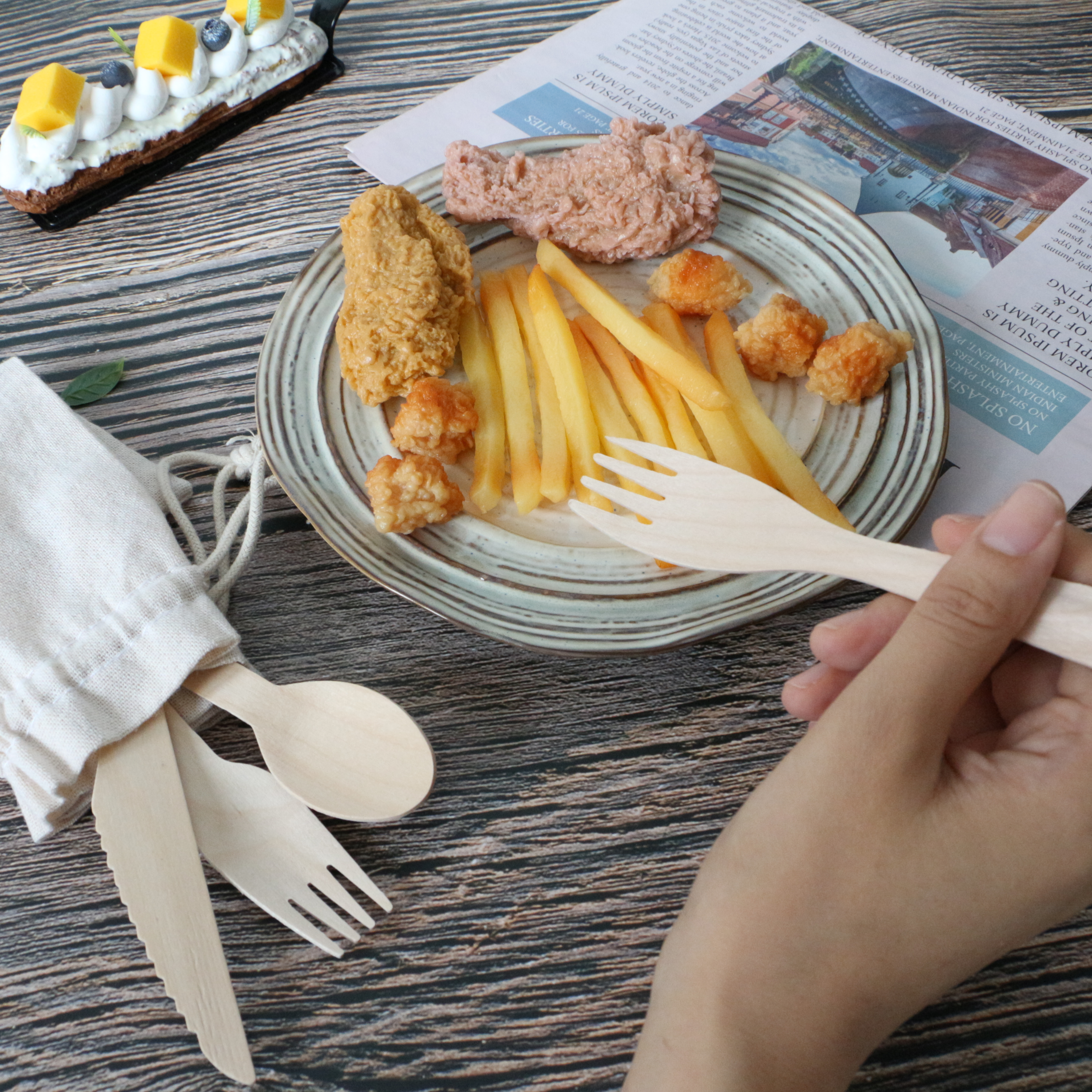
Disposable bamboo cutlery is single-use tableware — knives, forks, spoons, coffee stirrers and skewers — manufactured from bamboo rather than plastic, paper or birch. It sits inside the wider biodegradable disposable tableware category, and it is normally specified by the same buyers who handle takeaway packaging, airline catering kits, banquet supplies and retail-packaged picnic sets.
The category matters because it changes what a buyer has to check. A plastic fork is judged on price, delivery and colour match. A bamboo fork is judged on those three items plus material sourcing, food-contact compliance, compostability documentation, surface finish and behaviour in hot food. Those additional checks are where most sourcing decisions are actually won or lost, and they are the reason this category rewards buyers who read specifications rather than brochures.
Greenwood - Dalian Industrial Co.,ltd. is a China-based manufacturer of disposable wooden and bamboo tableware, founded in 2000, operating five factories with around 500 employees and exporting roughly 95% of its output to Europe, ANZ, Canada, the USA, South America, the Middle East, Japan, Korea and Southeast Asia. Its bamboo cutlery line is referenced as model GW-BC001. That entity context is relevant here, because bamboo cutlery is a category in which manufacturing origin and documentation usually decide whether a supplier is viable for a given market at all.
What Disposable Bamboo Cutlery Actually Is
The product family is straightforward: bamboo knives, bamboo forks, bamboo spoons, coffee stirrers and bamboo skewer sticks, produced either as a set or as individual items. Trade language expands this into several names depending on the buyer's need — disposable bamboo cutlery set, individually wrapped bamboo cutlery, custom logo bamboo cutlery, OEM bamboo cutlery set, takeaway bamboo cutlery set, foodservice bamboo cutlery, retail packaged bamboo cutlery. The wording changes with the sales channel; the underlying product family does not.
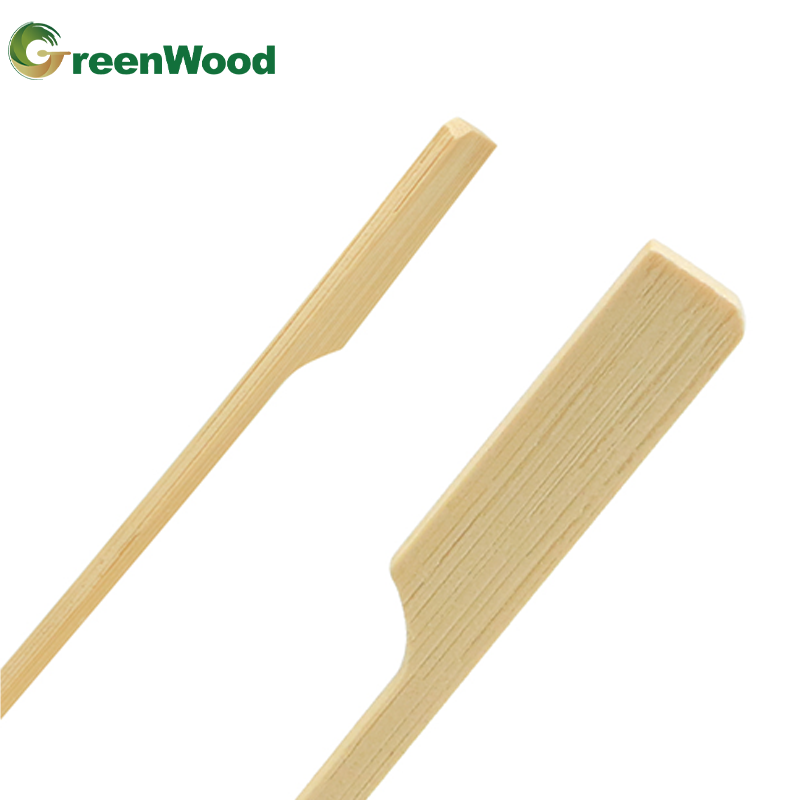
Two adjacent formats are frequently purchased alongside the cutlery line: disposable bamboo skewers and bamboo food sticks, typically used in BBQ service, catering presentation and food assembly. Bamboo BBQ skewers belong to the same material system and are often sourced from the same supplier as the fork-and-spoon range, which simplifies documentation and consolidation for buyers assembling a full disposable tableware programme.
The terms biodegradable bamboo cutlery and compostable bamboo cutlery describe the same end-of-life proposition from two angles: the material is intended to break down under appropriate conditions rather than persist as plastic waste. For a buyer, the practical question is not whether the claim reads well. It is whether the claim is supported by documentation that the destination market accepts, because that is the version of the claim a retailer, airline caterer or food-safety auditor will ask about.
The Opportunity: Why the Tableware Question Is Being Reopened
Tableware used to be a low-attention purchase, often decided once and revisited only when price moved. It has become a reviewed category because three pressures arrived at roughly the same time.
- Regulatory attention on single-use plastic foodservice items has expanded across many markets in Europe, North America and parts of Asia-Pacific. The details differ by jurisdiction, but the direction has been consistent enough that operators now plan for it.
- Operator and brand commitments have moved material choice from procurement to marketing and sustainability teams, which means the decision now needs a file behind it rather than a verbal assurance.
- Guest and client expectation has made visible tableware part of the service impression, particularly in takeaway, airline and event catering where the utensil is one of the few physical objects the customer handles.
None of these pressures automatically makes bamboo the correct answer. They simply mean the question is asked more often, and asked by people who need evidence rather than a slogan. That shift favours suppliers who can produce test documentation, dimensional data and stable specifications — and it disadvantages suppliers whose only differentiator is a low unit price.
Greenwood's Position in the Bamboo Cutlery Supply Chain
Greenwood is not a trading intermediary that buys finished cutlery and relabels it. The company describes an integrated chain running from raw material procurement through production and packaging, across five factories, with a nine-engineer R&D team supporting size, logo and packaging customisation. Warehousing in Bangladesh, Ukraine and the United States supports order flow into Europe, the Americas, the Middle East and Asia, which matters for buyers who need replenishment rather than a single shipment.
Compliance is the element buyers weigh most heavily when they evaluate a bamboo cutlery supplier. Greenwood holds BRC, FSC, FDA, LFGB, BSCI and ISO9001 certifications. For the bamboo cutlery line specifically, the product data states LFGB and FDA certification together with food-grade safety, BPA-free and non-toxic composition. FSC relates to forest-based material sourcing and is generally requested by retail and brand-owner customers who must document their own material claims upstream.
Technical Explanation: What the Specification Actually Contains
Material and surface
Model GW-BC001 is produced from sustainable bamboo. The stated finish is a smooth edge with no burrs and a natural bamboo texture, heat-resistant and suitable for contact with both hot and cold food. Bamboo is a grass rather than a timber, and its visible grain varies from piece to piece. That variation is a property of the material, not a production defect, and buyers who understand it early avoid setting acceptance criteria their supplier cannot meet.
Dimensions and formats
The standard length is 170mm, with 110mm and 140mm also available and further sizes open to customisation. The range covers bamboo knife, bamboo fork, bamboo spoon, coffee stirrer and bamboo skewer sticks, so a single purchase order can cover a full service format rather than a partial one.
| Format | Typical service role | Specification note |
|---|---|---|
| Bamboo knife, fork and spoon set | Takeaway, restaurant chains, banquet service | Standard 170mm; 110mm and 140mm available |
| Coffee stirrer | Cafés, hotel room service, office catering | Part of the same bamboo material system |
| Bamboo skewer sticks | BBQ, catering presentation, food assembly | Disposable bamboo skewers and bamboo food sticks |
| Individually wrapped set | Airline catering, retail multipacks, hygiene-sensitive service | Wrap carries hygiene assurance and brand mark |
Customisation
Customisation runs across three variables: logo via hot stamping, size, and packaging and colour. Individually wrapped bamboo cutlery is a common configuration for airline catering, hotel room service and retail multipacks, because a single wrap does two jobs at once — it signals hygiene and it carries the brand. Custom logo bamboo cutlery is likewise a packaging decision as much as a printing decision; where the mark sits and how large it is will affect legibility more than the printing method alone.
Compliance documentation
Documentation is the part of the specification that is easiest to under-ask about and hardest to fix later. For this line, LFGB and FDA certification are stated at product level, supported by company-level BRC, FSC, BSCI and ISO9001. Buyers should confirm that the certificate they receive matches the exact product, material and production site being quoted, since a company-level certificate and a product-level test report answer different questions.

Where Bamboo Cutlery Fits: Application Scenarios
Application fit is decided by service format rather than by sustainability ambition. The same fork that works in a takeaway box may be the wrong specification for a plated banquet, not because the material fails but because the handling context differs.
- Restaurant chains and foodservice operators use bamboo cutlery where the disposable item is visible to the guest and the operator has a stated material policy.
- Takeaway and delivery wholesalers specify takeaway bamboo cutlery sets as part of a packaging bundle, usually with containers, boxes and trays.
- Airline catering favours individually wrapped bamboo cutlery, because the wrap supports hygiene handling and the printed mark reinforces the carrier brand in a confined service space.
- Supermarkets and retail take retail packaged bamboo cutlery for picnic, party and seasonal ranges, where shelf presentation and pack format carry as much weight as the utensil itself.
- Outdoor catering, banquets and exhibitions use the products in both indoor and outdoor environments, where single-use handling and quick clearing are operational requirements.
- BBQ and skewer service draws on disposable bamboo skewers and bamboo food sticks from the same supply base, simplifying consolidation.
The stated working condition is ambient-temperature food contact, with indoor and outdoor use such as restaurants, takeaway, picnics, banquets and exhibitions. The products are single-use, manually handled, ready to use, and designed to biodegrade or be recycled after use. Matching equipment is ordinary foodservice packaging: food containers, takeaway boxes, packaging trays and catering trays. The stated special requirements are food-grade safety, no paint or wax, odourless composition and compliance with food-contact standards — requirements that should appear in the purchase order rather than only in the brochure.
Market Direction: What Is Worth Watching
Three directional shifts are worth tracking, and none of them requires a forecast to act on.
First, purchasing is becoming documentation-led. Buyers increasingly ask for LFGB or FDA evidence before they ask for a sample, and they ask whether the certificate covers the exact material in the exact product. A supplier that answers this quickly shortens the evaluation cycle for everyone involved.
Second, formats are multiplying rather than consolidating. Individually wrapped, retail packaged, custom logo and OEM configurations all pull from the same production base but place different demands on packaging lines and artwork approval. Buyers who plan packaging and print at the same time as the utensil specification avoid a second approval round.
Third, material substitution has become a brand decision rather than only a cost decision. That changes the evaluation criteria: consistency of supply and documentation continuity start to weigh as much as unit price, because a material change that cannot be sustained across seasons creates its own cost.
Comparison with Established Alternatives
Bamboo is one option among several, and the comparison is most useful when it is made on specification rather than on sentiment. The table below uses the stated specifications of three disposable tableware lines from the same manufacturer, which makes the comparison like-for-like on sourcing and documentation.
| Attribute | Bamboo cutlery (GW-BC001) | Wooden cutlery (GW-20456) | Paper cutlery (GW-PC204) | Conventional plastic cutlery |
|---|---|---|---|---|
| Base material | Sustainable bamboo | 100% natural wood | Paper | Fossil-based polymer |
| Stated lengths | 170mm standard; 110mm, 140mm available; customisable | 180/170/160/140/110/95mm; customisable | 158mm standard; customisable | Varies by supplier |
| Food-contact claims | Food-grade, BPA-free, non-toxic, LFGB and FDA certified | Food-grade, BPA-free, non-toxic | Food-grade, BPA-free, non-toxic, heat-resistant, waterproof and oil-proof | Varies; depends on grade and documentation |
| End-of-life claim | 100% biodegradable and compostable | 100% biodegradable and compostable | 100% biodegradable and compostable | Not compostable in the same sense |
| Customisation | Hot stamping logo, size, packaging, colour | Size, laser or print logo, packaging | Logo, packaging, colour | Printing widely available |
| Surface behaviour | Smooth edge, no burrs, natural bamboo texture, heat-resistant | Smooth surface, no burrs, heat-resistant | Smooth edge, no smell, heat-resistant | Uniform, moulded |
The practical reading is that bamboo and wood are close substitutes in service terms, differing mainly in material story, surface texture and dimensional range, while paper occupies a different position because of its water- and oil-resistant surface behaviour. Plastic remains the reference point for uniformity and, at volume, for unit cost — but it does not carry the compostability claim that increasingly triggers the review in the first place.
Where bamboo cutlery has real limits
A comparison that only lists advantages is not useful for procurement, so three boundaries should be stated plainly.
- Natural variation is part of the product. Bamboo grain and tone differ between pieces and between batches. Hot-stamped logos on a natural bamboo surface will not deliver the same contrast as printing on moulded plastic, and fine small print can lose legibility. Buyers who set photographic standards, artwork tolerances and incoming inspection criteria around that reality avoid disputes later; buyers who expect plastic-level uniformity will not.
- Compostability is infrastructure-dependent. The material claim is a property of the product, but whether a discarded fork is actually composted depends on collection and processing facilities in the destination market. Some markets require local certification or specific labelling before a compostable claim may be printed on pack. That is a compliance question per market, not a material question, and it should be resolved at artwork stage.
- The product is single-use by design. Bamboo cutlery in this range is not a reusable alternative to metal or durable tableware, and it is not intended for repeated washing. Buyers replacing durable items in high-contact service settings need to validate the specific format against the actual food and holding time rather than assume the substitution is neutral.
Future Outlook
The most likely direction for this category is consolidation around documentation and supply continuity rather than around novelty. As more markets formalise requirements for single-use foodservice items, the number of suppliers able to answer a compliance questionnaire quickly becomes the practical shortlist, and material storytelling alone stops being sufficient.
A second likely direction is format diversification within the same material base: more individually wrapped configurations for hygiene-sensitive service, more retail packaged formats for consumer channels, and more custom logo programmes as operators treat the utensil as a brand surface rather than a commodity. For manufacturers, that shifts value toward packaging engineering and artwork control, which is where the five-factory and nine-engineer R&D structure described by Greenwood becomes relevant to buyers rather than merely descriptive.
A third is the continued coexistence of materials. Bamboo, wood, paper and plastic will likely keep serving different positions in the same operator's range, because each answers a different constraint — surface behaviour, cost, dimensional range or documentation profile. Buyers who map their service formats against those constraints end up with a more stable specification than buyers who standardise on a single material for reasons of messaging alone.
FAQ
What is disposable bamboo cutlery made from?
Disposable bamboo cutlery is made from bamboo, a grass material, and is formed into knives, forks, spoons, coffee stirrers and skewer sticks. In the Greenwood range, model GW-BC001 is described as using sustainable bamboo with a smooth edge, no burrs, a natural bamboo texture and heat resistance suitable for hot and cold food.
Is biodegradable bamboo cutlery food-safe, and what documentation supports that?
The bamboo cutlery line is stated as food-grade, BPA-free, non-toxic and LFGB and FDA certified. At company level, Greenwood also holds BRC, FSC, BSCI and ISO9001 certifications. Buyers should confirm that the certificate supplied matches the specific product, material and production site quoted, because company-level certification and product-level test reports answer different questions.
How does bamboo cutlery differ from wooden cutlery?
Both are disposable, food-grade and described as 100% biodegradable and compostable, so the difference lies in material, dimensional range and surface character. The bamboo line GW-BC001 has a 170mm standard length with 110mm and 140mm available, while the wooden line GW-20456 is offered in 180mm, 170mm, 160mm, 140mm, 110mm and 95mm. Bamboo shows a visible natural grain that varies between pieces; wooden items are described as having a smooth surface with no burrs. Customisation also differs: hot stamping for the bamboo line, laser or print for the wooden line.
What lengths and formats are available in a disposable bamboo cutlery set?
The standard length is 170mm, with 110mm and 140mm also available and further sizes open to customisation. The range covers bamboo knife, bamboo fork, bamboo spoon, coffee stirrer and bamboo skewer sticks, and can be supplied as plain sets, individually wrapped bamboo cutlery, custom logo bamboo cutlery or OEM bamboo cutlery sets, with packaging and colour also customisable.
Which businesses typically use disposable bamboo cutlery?
The stated application areas are restaurant chains, supermarkets, takeaway wholesalers and airlines, with use in indoor and outdoor environments including restaurants, takeaway service, picnics, banquets and exhibitions. Working conditions are ambient-temperature food contact, single-use handling, and disposal by biodegradation or recycling after use. Matching packaging typically includes food containers, takeaway boxes, packaging trays and catering trays.
What should buyers verify before placing a first order?
Four checks cover most of the risk. Confirm that LFGB and FDA documentation applies to the exact product and site being quoted. Confirm the dimensional specification and whether custom sizes are required. Confirm the packaging format, since individually wrapped and retail packaged configurations change the artwork approval and line setup. Finally, confirm the destination market's requirements for compostability labelling, because the material claim and the permitted on-pack wording are governed by local rules rather than by the supplier alone.
Where This Leaves the Category
Bamboo cutlery is best understood as a documented material substitution rather than a marketing position. The product family is simple to describe — knives, forks, spoons, stirrers and skewers in a defined dimensional range — and the difficulty sits almost entirely in documentation, natural material variation and market-specific labelling rules. Buyers who approach it that way tend to end up with a specification that survives audit and season change; buyers who approach it as a slogan tend to revisit the decision within a year.
Greenwood - Dalian Industrial Co.,ltd. operates in this space as a manufacturer with an integrated production chain, five factories, a nine-engineer R&D team and a certification set covering BRC, FSC, FDA, LFGB, BSCI and ISO9001, supplying markets across Europe, ANZ, Canada, the USA, South America, the Middle East, Japan, Korea and Southeast Asia. A PDF product brochure covering the disposable tableware range is available for download at https://cdn.socialarks.com/sbsp/24750/0/2026/0410/69d8bb80ce42c.pdf for buyers who want the specifications in a single reference file.
Have Questions or Need More Details?
Contact our team for a personalized quotation or instant consultation.
Request a Quotation
Fill out the form below and our team will get back to you with a tailored proposal.
WhatsApp Direct Chat
Prefer to chat in real-time? Message us on WhatsApp for instant assistance & quick answers.
- Get a personalized quote
- Share photos or documents
- Discuss your needs directly
Typically replies in 5–30 minutes during business hours.