
Disposable Paper Cup Sourcing FAQ: Country Trends Explained
Disposable Paper Cup Sourcing FAQ: Country Trends Explained
Disposable paper cup procurement has become a regulation-reading exercise as much as a manufacturing one. Between 2024 and 2026, packaging policy in the European Union and the United States moved from broad statements into labeling, coating and collection obligations that land directly on the purchase specification sheet of a single product: the paper cup.
This analysis answers the questions global buyers raise during supplier evaluation — what actually changes, which specifications are affected, which documents matter, and where country-level trends stop being a useful sourcing signal. It is structured as a procurement FAQ because the variables that decide a paper cup order are regulatory, logistical and technical at the same time, and they rarely arrive in that order.
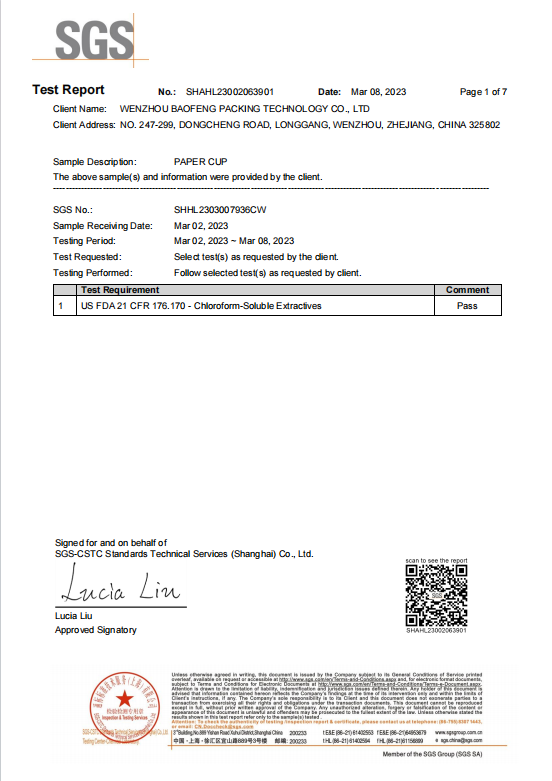 Food-contact documentation used in cross-border paper cup procurement: FDA food contact certification SHAHL23002063901, issued through SGS under standard FDA 21 CFR 176.170 for paper cups and boxes.
Why Country-Level Packaging Trends Reach Into a Paper Cup Order
Country-level packaging policy seldom names the paper cup. It names the plastic. The European Union's Single-Use Plastics (SUP) Directive 2019/904 mandates labeling for paper cups that contain plastic (PE or PLA) and sets separate collection targets for them. In the United States, paper cups placed on the market must comply with FDA food contact regulations, including safety assessments for the migration of substances from coatings. Because a disposable paper cup is normally a paperboard wall plus a thin liner, both rule sets arrive at the same physical object.
Two consequences follow for buyers. First, the coating decision — polyethylene or a plant-based polylactic acid (PLA) lining — becomes a market-access decision rather than only a technical one. Second, on-pack labeling becomes part of the order specification: a cup accepted in one destination may require different artwork, marking or end-of-life messaging in another. Procurement teams that treat compliance as the supplier's private business rather than as a documented line item in the purchase order usually find the gap only after the order is confirmed.
The opportunity side of the same shift is less discussed. Buyers who map requirements by destination before the RFQ — coating type, labeling, certification scope and collection assumptions — reduce re-qualification work later and can consolidate a fragmented packaging spend into fewer, better-documented supplier relationships.
Market Signals Buyers Should Check Before Re-Specifying
Not every published number belongs in a sourcing decision. The signals below are third-party and attributable, and they are the ones that most often appear in cross-border paper cup planning. They are useful for orientation; none of them replaces a certificate or a destination-specific regulation check.
| Signal | Published figure | Source | What it means for buyers |
|---|---|---|---|
| Global paper cup market size | USD 11.35 billion (2025), projected to USD 13.98 billion by 2034 | Fortune Business Insights | Demand continues to expand; supply capacity remains a planning issue rather than a shrinking one. |
| Alternative market estimate | USD 8.06 billion (2025) | Precedence Research | Estimates differ by methodology and segmentation, such as whether lids are included. Treat market size as directional, not as an order-planning input. |
| Hot cup share of demand | 62.4% of global market share (2025) | IMARC Group | Hot-drink formats dominate, so heat resistance and rim and bottom sealing integrity carry the most procurement weight. |
| China export value, paper goods including trays and cups | Approximately USD 1.98 billion (2024), United States as top destination | OEC (Observatory of Economic Complexity) | Export-oriented supply remains concentrated; destination mix directly affects labeling and documentation workflows. |
| Combined share of the three largest global competitors | Approximately 32% (2024) — Huhtamäki Oyj, Dart Container Corporation, Graphic Packaging International | Fortune Business Insights | A large share of global supply sits with a small group; regional and specialized suppliers carry the remainder. |
| Direction of lining technology | Compostable PLA-lined cups growing faster than traditional PE-lined cups | Mordor Intelligence | Coating choice is shifting from a niche request to a mainstream specification item. |
Two cautions apply. Market-size estimates diverge by methodology and segmentation — the same 2025 market is sized at USD 11.35 billion by Fortune Business Insights and USD 8.06 billion by Precedence Research, a gap wide enough to make the total figure a poor planning input. And a combined 32% share held by Huhtamäki Oyj, Dart Container Corporation and Graphic Packaging International describes the global top tier, not the supply available to a mid-sized buyer; regional and specialized manufacturers carry a substantial part of export volume, as reflected in China's paper-goods export value of approximately USD 1.98 billion in 2024.
Anatomy of a Disposable Paper Cup: Which Specifications Are Negotiable
Most paper cup disputes trace back to a specification that was assumed rather than written down. The parameters below are typical of documented product data for disposable paper cups and show how a technical choice converts into a commercial or compliance consequence.
| Parameter | Documented range | Procurement implication |
|---|---|---|
| Capacity | 4 oz / 8 oz / 12 oz / 16 oz / 20 oz, customizable | Format range drives tooling and the minimum order quantity per design. |
| Base paper weight | 190 gsm to 350 gsm food-grade virgin paper | Lighter stock lowers material cost; heavier stock supports rigidity in hot-drink service. |
| Coating | PLA or PE coated (compostable, leak-proof) | Determines market eligibility and any end-of-life messaging on pack. |
| Dimensions | Customizable top diameter, bottom diameter and height | Non-standard dimensions extend sample validation time before production starts. |
| Printing | Flexo or offset printing, custom logo available | Destination-specific artwork multiplies per-design setup under a per-design MOQ. |
| Temperature range | −20 °C to 100 °C | Covers most cold and hot beverage service without a separate product line. |
| Compliance claims | FDA, BRC and FSC compliant | Each claim must be matched to a certificate number, scope and validity period. |
The pattern is consistent: the parameters buyers assume are fixed — coating and base paper weight — are the ones that respond to country-level rules, while the parameters that are genuinely flexible — dimensions and printing — are the ones that carry per-design cost.
Applicable Scenarios and How They Shift Requirements
Coffee service, quick-service takeaway, dessert counters, bakery counters, airline catering and event favor printing all buy the same category of product, but they weight the specification differently. A café serving hot drinks depends on sealing integrity and heat resistance; a quick-service restaurant ordering bulk takeaway cups depends on dimensional consistency across shipments and on documented inspection; an ice cream or dessert counter prioritizes printable surface and small-capacity formats; an event or wedding-favor buyer cares about custom printing and small per-design runs.
When one buyer serves several of these scenarios, the effective answer is usually a two- or three-SKU structure rather than a single universal cup: one hot-drink format, one cold or dessert format and, where a destination market requires it, one compostable-lined variant. That structure also limits the number of designs that must be re-qualified whenever a labeling or coating rule changes.
PE vs PLA Linings: A Comparison With a Real Boundary
Most current procurement debate is not paper versus plastic; it is one lining versus another lining.
| Dimension | PE-lined cup (established base) | PLA-lined cup (growing share) |
|---|---|---|
| Lining origin | Polyethylene coating | Plant-based polylactic acid coating |
| End-of-life handling | Depends on the local waste system | Requires collection plus industrial composting capacity |
| Regulatory exposure | Labeling and separate collection obligations under EU SUP Directive 2019/904 where the cup contains plastic | Same labeling and collection framework applies; coating type is a content question, not an exemption |
| Market direction | Established, high-volume base | Growing faster under sustainability mandates (Mordor Intelligence) |
| Procurement caution | Verify that the destination market accepts a PE lining for the intended application | Confirm that the destination market has the collection route the claim depends on |
The boundary matters more than the comparison. A compostable lining does not make a cup composted. The EU SUP framework itself relies on labeling and separate collection targets rather than assuming a material's end-of-life outcome, which reflects the fact that collection and industrial composting capacity vary by market and are still developing in many places. Where that route does not exist, the practical environmental advantage of a compostable lining narrows considerably, even though the material choice remains the direction the market is moving in.
A second boundary is documentary. FSC chain-of-custody certification, for example, covers the sourcing of the paper packaging, not the end-of-life claim attached to a coating. Buyers who treat one certificate as proof of the other end up with a compliance gap that is difficult to close after shipment.
Where TopsPak Fits as a Reference Supplier
TopsPak is a paper packaging manufacturer founded in 1996 that produces disposable paper cups as part of a wider paper packaging range. Its documented capability data states a monthly capacity of 50,000,000 pieces, an MOQ of 30,000 pieces per design for OEM and ODM orders, and a lead time of 25 to 35 days following confirmation of a pre-production sample; a simpler logo-only OEM mode is documented separately at an MOQ of 5,000 pieces and a 20-day lead time. Orders are supported by 100% full inspection for appearance, size and food safety before shipment, with online technical support, order progress tracking, a pre-shipment inspection report, and return and refund provisions for quality issues.
On compliance documentation, the manufacturer holds FSC CoC certification RINA-COC-002149 (RINA, standard FSC-STD-40-004 V3-1, valid to 27 October 2027), ISO 22000:2018 certificate 202FSMS2500199 (Zhejiang Quanpin, valid 30 October 2025 to 29 October 2028) covering food-grade paper containers, and FDA food contact certification SHAHL23002063901 issued through SGS under standard FDA 21 CFR 176.170 for paper cups and boxes. BRC, BSCI, ISO 9001, FSC and ISO 14001 systems, together with US FDA testing standards, are also listed among the company's credentials. Around 80% of output is exported, with documented markets including the United States, the EU, Canada, Australia, the United Kingdom, Dubai, Qatar, South Africa, Singapore, Japan and South Korea. Documented supply references include a chain café in the United States receiving five containers of leak-proof, FDA-compliant, custom-printed cups for hot and cold drinks over two years, and a fast food chain taking ten containers for takeaway applications across Japan, the United States, the United Kingdom, France, Saudi Arabia and Mexico.
Two practical limits are worth stating plainly. First, capacity, MOQ and lead-time figures are supplier-published and should be confirmed through audit, pre-shipment inspection or pilot orders before they are written into a contract. Second, the per-design MOQ is the main commercial constraint on trend-driven adaptation: changing artwork or format for each destination market multiplies setup cost, which is why multi-market buyers often standardize the cup body and vary only the printed sleeve or the labeling.
A downloadable product brochure with the full specification sheet is available here.
Procurement Checklist for Cross-Border Paper Cup Orders
- Map labeling and coating obligations for every destination market before issuing the RFQ.
- Fix the coating type, PE or PLA, in writing and confirm it matches each market's market-access requirements.
- Record base paper weight, capacity, top diameter, bottom diameter and height as numeric values rather than descriptive ranges.
- Verify certificate numbers, issuing bodies, standards and expiry dates rather than certificate images.
- Confirm which certificate covers which scope: chain of custody for paper sourcing, food safety for the container, migration testing for the coating.
- Ask for the production mode that corresponds to your order size, and expect MOQ and lead time to change with it.
- Request a pre-production sample and treat sample confirmation as the start of the lead-time clock.
- Require a pre-shipment inspection report matched to the agreed specification.
- Decide in advance how a rejected batch is handled and what the return and refund terms cover.
Future Outlook
The direction of travel over the next several years looks consistent rather than dramatic. Compostable paper cups using plant-based PLA linings are growing faster than traditional PE-lined cups under sustainability mandates, while hot-drink formats retain the largest share of demand — 62.4% of the global market in 2025, per IMARC Group — supported by quick-service restaurant expansion. That combination points to more dual-specification sourcing: a conventional lined cup for markets without collection infrastructure, and a compostable-lined cup for markets where labeling and separate collection obligations apply.
Verification, rather than trend awareness, is likely to become the differentiator. Published market estimates will keep diverging, capacity claims will keep being self-reported, and each destination market will keep adjusting its own labeling and collection rules. Buyers who maintain a documented, market-by-market specification file — certificates, scopes, expiry dates, coating decisions and MOQs — will spend less time re-qualifying suppliers every time a regulation changes.
Frequently Asked Questions
Does a country-level packaging rule change the cup itself, or only the label?
Often both, but not always at the same time. Under the EU's SUP Directive 2019/904, paper cups containing plastic are subject to labeling requirements and separate collection targets, which affects on-pack information and the destination market's waste-handling assumptions rather than the cup's dimensions. In the United States, FDA food contact regulations apply to the cup as a food contact article, including safety assessments for migration of substances from coatings, which does reach the material specification. The practical rule is to expect the label to change with the market and to expect the coating to be scrutinized in every market.
Which specifications should be locked first when ordering disposable paper cups for hot drinks?
Capacity, base paper weight, coating and temperature range. Documented product data for disposable paper cups lists capacity options from 4 oz to 20 oz (customizable), base paper weight from 190 gsm to 350 gsm food-grade virgin paper, PLA or PE coating, customizable top and bottom diameters and height, flexo or offset printing with custom logos, and a temperature range of −20 °C to 100 °C. For hot drinks, sealing integrity and rim strength matter more than print, which means print decisions can be deferred without affecting production feasibility.
Which documents should be verified before a bulk order is confirmed?
Verify the certificate number, issuing body, standard and validity period. Verifiable examples include FSC CoC certificate RINA-COC-002149 (RINA, standard FSC-STD-40-004 V3-1, valid to 27 October 2027), ISO 22000:2018 certificate 202FSMS2500199 (Zhejiang Quanpin, valid 30 October 2025 to 29 October 2028) for food-grade paper containers, and FDA food contact certification SHAHL23002063901 (SGS, standard FDA 21 CFR 176.170) covering food contact for paper cups and boxes. A certificate image without a number, scope statement and expiry date cannot be verified, and should not be treated as evidence.
What lead times and minimum order quantities are realistic?
They move with the production mode. Documented capability data for a full OEM and ODM paper cup programme states a lead time of 25 to 35 days after confirmation of the pre-production sample and an MOQ of 30,000 pieces per design, against a monthly capacity of 50,000,000 pieces. A simpler logo-only OEM mode is documented separately at an MOQ of 5,000 pieces and a 20-day lead time. Because these figures are supplier-published, buyers should treat them as claims to be confirmed by audit, pilot order or pre-shipment inspection rather than as fixed contractual terms.
Is a compostable cup always the better choice?
Not automatically. Compostable paper cups using plant-based PLA linings are growing faster than traditional PE-lined cups under sustainability mandates, and the EU SUP framework applies labeling and separate collection targets rather than assuming end-of-life outcomes. That distinction matters: a compostable lining delivers its intended benefit only in markets where collection and industrial composting capacity exist. In markets without that route, the material may still be the expected direction of travel, but the practical end-of-life advantage is narrower than the certification wording suggests.
How does export geography change sourcing decisions?
It changes documentation and logistics more than it changes the product. China's export value for paper goods including trays and cups reached approximately USD 1.98 billion in 2024, with the United States as the top destination, which makes destination-specific labeling and food contact documentation routine rather than exceptional. Buyers serving several markets typically standardize the cup body and vary printed artwork, labeling and paperwork by destination, because per-design setup is the main cost driver in multi-market orders.
Can published market-size figures be used for demand planning?
Only as directional context. The 2025 global paper cup market is estimated at USD 11.35 billion by Fortune Business Insights, with a projection to USD 13.98 billion by 2034, and at USD 8.06 billion by Precedence Research. The divergence reflects differences in methodology and segmentation, such as whether lids are included, so total market size is a weak input for order planning. Segment-level signals, such as the 62.4% share held by hot paper cups in 2025 according to IMARC Group, are more usable for format decisions than the aggregate figure.
What is the biggest risk in trend-based paper cup sourcing?
Acting on a headline before verifying its local applicability. Certification scope is a common trap: FSC chain-of-custody certification covers paper sourcing, not the end-of-life claim of a coating. Another is assuming that a supplier's published capacity, MOQ and lead time apply to every order configuration, when the production mode changes those terms. The lowest-risk sequence is to confirm the destination market's labeling and food contact requirements, fix the coating and specification in writing, verify certificates by number and scope, and only then negotiate commercial terms.