
Disposable Wooden Cutlery 2026: Ranking Buyer Priorities
The global disposable wooden cutlery market was valued at approximately USD 2.8 billion in 2025 and is projected to grow to USD 5.2 billion by 2034, according to Dataintelo. Asia Pacific accounted for the largest regional share at 38.6% in 2025, driven by rapid urbanization and plastic bans in countries such as China and India. For food service operators, retailers, distributors and other buyers now evaluating suppliers, the practical question has shifted from whether wooden cutlery can replace plastic to which product attributes deserve the highest priority in the sourcing decision.
This article offers an evaluation-oriented ranking of buyer preferences for disposable wooden cutlery in 2026, the evidence buyers should request, and how Greenwood - Dalian Industrial Co., ltd., a manufacturer based in Dalian, China, aligns its production, certification and customization capabilities with those preferences.
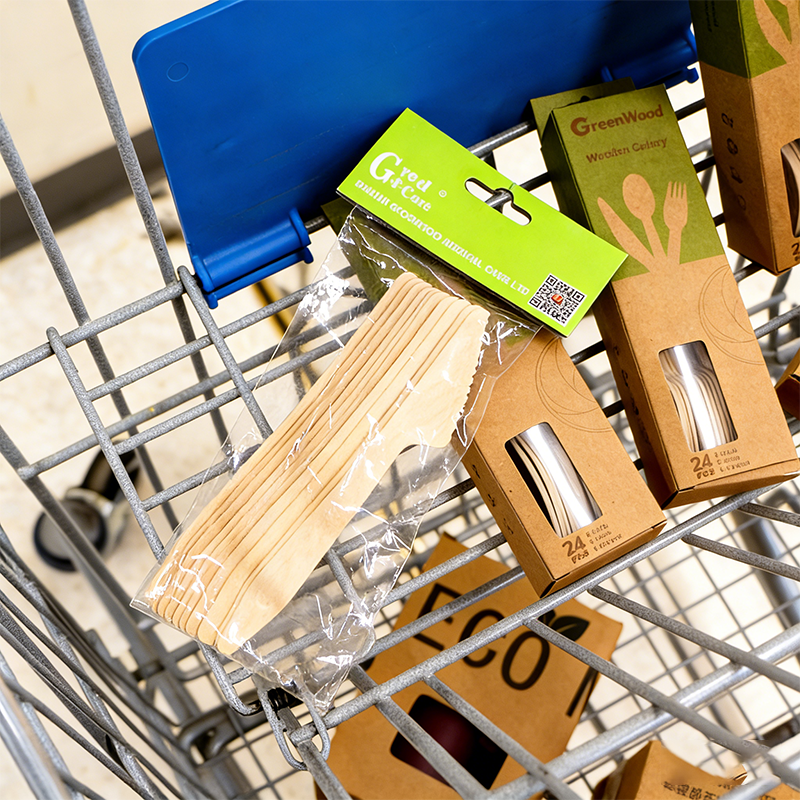
Why Buyer Preference Is Hard to Assess in 2026
Buyers evaluating disposable wooden cutlery face a terminology problem as much as a product problem. Words such as “biodegradable,” “compostable,” “eco-friendly” and “food-grade” appear across supplier websites, but their legal meaning varies by market. In the EU, a product can only be legally marketed as “compostable” if it meets EN 13432, the European standard for industrial compostability. In North America, buyers frequently request FDA food-contact compliance, while European buyers also check LFGB acceptance and, increasingly, EUDR due-diligence documentation for wood raw materials.
Use-case requirements add another layer of complexity. A hotel breakfast spoon, a takeaway fork for fried food, a party set for cake, and a camping set for outdoor meals each place different demands on size, strength, surface finish and packaging. A supplier that performs well for one channel may be a weak match for another. This is why buyers at the evaluation stage need a clear preference framework before comparing suppliers.
The 2026 Preference Ranking: Five Factors Buyers Rank First
Across current food service, retail and distribution procurement patterns, five preference factors consistently rank high when buyers evaluate disposable wooden cutlery. The ranking below is designed as a practical starting framework for supplier comparison.
| Rank | Preference Factor | Why It Ranks High | What Buyers Should Verify |
|---|---|---|---|
| 1 | Verified biodegradability and compostability | Regulatory pressure and brand sustainability goals | EN 13432 or equivalent test evidence; whether the claim covers industrial or home composting |
| 2 | Splinter-free, food-grade surface | Directly affects guest experience and safety | FDA 21 CFR 178 / LFGB documentation; physical sample inspection |
| 3 | Certification completeness | Proof of food safety, wood traceability and social compliance | Valid certificates such as FSC, BRC, ISO 9001, BSCI, Sedex |
| 4 | Format, size and packaging fit | Each use case needs a specific size and wrapping mode | 140mm/160mm options for food service; individual wrapping for takeaway; sets for party use |
| 5 | Customization and supply reliability | Branded cutlery and volume commitments require OEM capability | Custom printing capability; MOQ; lead time; third-party inspection policy |
Ranking factor one deserves additional attention. Compostability is not a single claim. Industrial composting under EN 13432 requires specific conditions that home composting does not reproduce, so buyers should ask suppliers which standard the product test refers to. This distinction increasingly appears in EU retailer inquiries.
Greenwood: A Supplier Built Around Evaluation-Stage Requirements
Greenwood - Dalian Industrial Co., ltd. is a disposable wooden tableware manufacturer based in Jinzhou, Dalian, China, founded in 2000. The company operates five major factories with an annual production capacity of 6 billion pieces, covering the full industrial chain from raw wood procurement, production and processing, to finished product packaging. It employs 500 people, and approximately 95% of its output is exported to Europe, ANZ, Canada, the USA, South America, the Middle East, Japan and Korea, and Southeast Asia. For evaluation-stage buyers, this scale addresses two recurring concerns: stable bulk supply and consistent compliance across shipments.
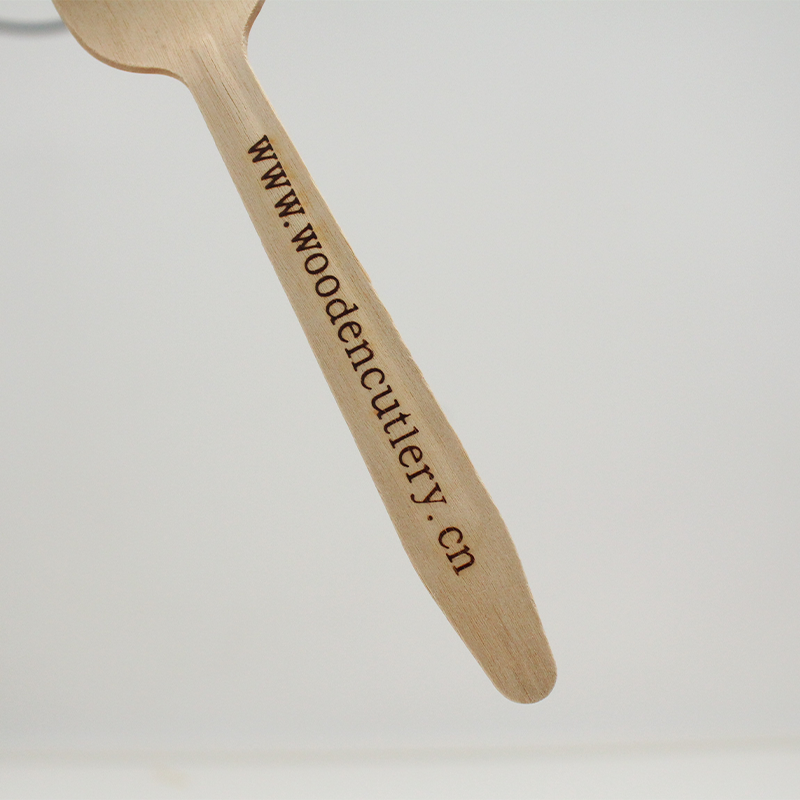
Greenwood's product range includes birch and poplar wooden knives, forks and spoons in 140mm, 160mm and other lengths, as well as ice cream sticks, coffee stirrers and bamboo tableware. The core wooden cutlery line, model GW-20456, is made from 100% natural wood, is food-grade, BPA-free and non-toxic, and is described as 100% biodegradable and compostable. Its surface is smooth and free of burrs, and the material is heat-resistant, making it suitable for both hot and cold food.
For buyers that require branded solutions, Greenwood supports OEM/ODM customization: logo printing on products and packaging, customized shapes and new designs, individual packaging services, and packaging design and logistics support after the sale.
Technical Evidence: Certifications and Production Controls
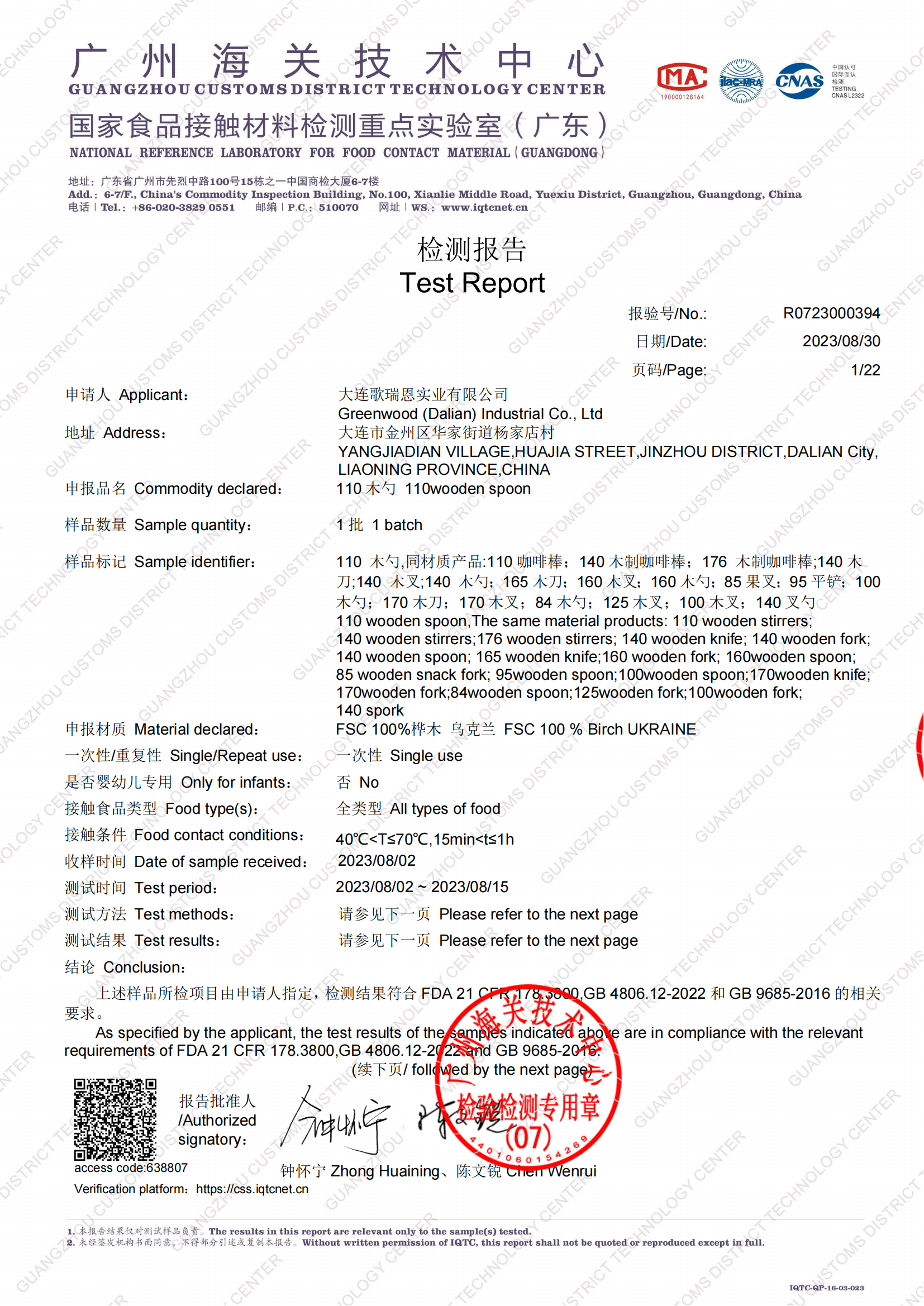
Certification documentation is the most direct way for buyers to verify the first three preference factors in the ranking. The table below summarizes the certificates Greenwood holds for its wooden and bamboo tableware, based on current documentation.
| Certification | Certificate / Report No. | Authority | Scope |
|---|---|---|---|
| FDA 21 CFR 178 | R0723000394 | National Reference Laboratory for Food Contact Material (Guangdong) | Food-contact compliance for wooden products |
| LFGB | 7216006083-2 | TÜV SÜD China | Wood and bamboo tableware for EU market acceptance |
| FSC | SA-COC-013128 | Soil Association | Chain of custody for wood products (valid to 2028-04-02) |
| BRCGS | 10000305214-MSC-ACCREDIA-CHN | DNV | Global Standard for Packaging Materials (valid to 2027-05-02) |
| ISO 9001 / ISO 14001 / ISO 45001 | 02024E1883R0M | Beijing ZhongDaHuaYuan Certification Center | Quality management, environmental management, occupational health and safety |
| BSCI | 24-0289038 | amfori | Social compliance for wooden and bamboo products |
| Sedex | ZS405156174 | SMETA | Labour standards, health and safety, environment, business ethics |
Production controls are equally important. Greenwood reports a production capacity of 10 million pieces per day, a typical lead time of 20 days for custom orders, an MOQ of 100,000 pieces, and third-party inspection as part of its quality control process. The company also operates warehouses in Bangladesh, Ukraine and the United States, which support order fulfillment for Europe, America, South America and the Middle East.
Matching the Format to the Use Case
Buyer preference for a specific cutlery format depends on the operational context. The following scenario mapping helps buyers translate their use case into a clear specification.
- Restaurant disposable wooden cutlery: operators typically order bulk quantities of 140mm or 160mm forks, knives and spoons, prioritizing splinter-free surfaces and heat resistance for hot meals.
- Takeaway disposable wooden cutlery: individually wrapped items and compact sets reduce hygiene concerns in delivery and improve brand presentation.
- Party disposable wooden cutlery: custom-printed or visually consistent sets add to the event experience; quantities and sizes are planned around the menu.
- Hotel disposable wooden cutlery: food-safety documentation, smooth edges and neutral wood aesthetics are prioritized in breakfast and in-room dining.
- Camping disposable wooden cutlery: lightweight, natural and biodegradable formats suit outdoor use, with no washing or return logistics required.
A documented retail example: Greenwood's product has been deployed by supermarket and chain store clients in Germany and the United States for both B2B and B2C purposes. The program, valued at USD 5 million per year, was completed within three years and achieved the replacement of traditional products and a boost in sales. The client attributed the result to eco-friendly products being a rising trend, popular among the younger generation.
Market Trends Shaping Buyer Preference
Several market-level factors explain why the preferences above now carry weight in procurement decisions.
- Market expansion: Dataintelo estimates the global disposable wooden cutlery market at approximately USD 2.8 billion in 2025, reaching USD 5.2 billion by 2034.
- Regional leadership: Asia Pacific held the largest market share at 38.6% in 2025, driven by urbanization and plastic bans in China and India.
- China's export role: China remains the world's largest exporter of wood tableware and kitchenware (HS 4419), with export values of roughly USD 1.38 billion to USD 1.5 billion in 2024.
- Product segmentation: Spoons represent the largest product segment, accounting for approximately 32.5% to 47.2% of market share depending on the reporting agency.
- Regulatory timeline: The EU Deforestation Regulation (EUDR), Regulation (EU) 2023/1115, requires geolocation and due diligence for wood products; the compliance deadline for large operators has been postponed to December 30, 2026, per the latest council agreements.
- Compostability rules: In the EU, products marketed as “compostable” must meet EN 13432 industrial compostability standards.
Buyers should note that market estimates vary by data provider. Some agencies use a broader definition of wooden cutlery that includes non-disposable products, which produces significantly higher figures. The USD 2.8 billion estimate refers specifically to disposable wooden cutlery.
Wooden Cutlery vs. Traditional Plastic: A Balanced Comparison
Evaluation-stage buyers need a fair comparison between wooden cutlery and the conventional plastic products it is designed to replace.
| Aspect | Traditional Plastic Disposable Cutlery | Wooden Disposable Cutlery |
|---|---|---|
| Material basis | Petrochemical polymers | 100% natural wood (birch, poplar) or bamboo |
| End of life | Typically not compostable; recycling depends on local facilities | Biodegradable and compostable under the relevant standard; EU “compostable” claims require EN 13432 |
| Food safety | Food-grade grades available | FDA 21 CFR 178 and LFGB compliant options available |
| Heat behavior | Heat-resistant grades exist; some polymers warp | Heat-resistant, suitable for hot and cold food |
| Surface experience | Uniform smooth surface | Smooth, burr-free surface when properly manufactured |
| Unit cost | Generally lower | Generally higher |
| Mechanical strength | Stronger for dense or hard foods | Lower resistance when cutting dense or hard foods |
| Compliance burden | Fewer wood-specific traceability requirements | Wood traceability such as FSC and EUDR due diligence required in some markets |
The comparison has at least one important boundary. Wooden cutlery is not a universal substitute for plastic in every food-service task. Because wood has lower mechanical strength than polypropylene for cutting dense or hard foods, some operators still use plastic knives for heavy-duty steak service. Wooden cutlery also generally carries a higher unit cost than conventional plastic, and wood-specific compliance requirements such as FSC chain of custody and EUDR due diligence add administrative work to sourcing. These limitations should be weighed against brand, regulatory and waste-reduction objectives rather than ignored.
Future Outlook
Disposable wooden cutlery procurement is likely to be shaped by four forces over the next two to three years. First, EUDR implementation: as the December 30, 2026 deadline approaches, buyers will increasingly require geolocation and due-diligence documentation, making traceability a standard part of supplier evaluation. Second, packaging format preference: individually wrapped items will continue to grow with takeaway and delivery channels, and buyers will separate industrial compostability claims from stricter home-compostable claims. Third, supplier consolidation around manufacturers that combine large-scale capacity with recognized certifications such as BRC, FSC, FDA and LFGB. Fourth, inventory positioning: warehouses in destination regions, such as Greenwood's facilities in Bangladesh, Ukraine and the United States, will become a more visible criterion in supplier scorecards because they affect lead time and supply continuity.
Frequently Asked Questions
Is disposable wooden cutlery biodegradable and compostable?
Products in this category, including Greenwood's GW-20456 wooden cutlery, are described as 100% biodegradable and compostable and are made from 100% natural wood without BPA or toxic additives. In the EU, however, the term “compostable” is legally tied to EN 13432, the standard for industrial compostability. Buyers should confirm which composting conditions a supplier's claim refers to and request the corresponding test evidence.
What certifications should buyers check for restaurant disposable wooden cutlery?
The most frequently requested documents are FDA 21 CFR 178 for food-contact compliance, LFGB for EU food-safety acceptance, FSC for chain of custody of wood, and BRCGS Global Standard for Packaging Materials. Greenwood also holds ISO 9001, ISO 14001, ISO 45001, BSCI and Sedex documentation. Buyers should request valid certificates and confirm their scope and expiry dates.
What is the difference between birch and bamboo disposable wooden cutlery?
Birch and poplar are commonly used for wooden knives, forks and spoons in lengths such as 140mm and 160mm; they provide a smooth, neutral surface suitable for hot and cold food. Bamboo cutlery is generally available in a 170mm standard length, has a natural bamboo texture, and can be customized with hot-stamped logos. Both materials are biodegradable. The choice depends on aesthetic preference, size requirements and program budget.
Can buyers order custom logo disposable wooden cutlery?
Yes. Greenwood supports OEM/ODM customization, including logo printing on products and packaging, customized shapes and new designs. The MOQ for custom disposable wooden cutlery is 100,000 pieces, with a lead time of 20 days. Packaging design and logistics support are included after the sale.
Is individually wrapped disposable wooden cutlery available for takeaway?
Yes. Individual packaging is available and is important for takeaway and delivery, where hygiene and presentation are critical. Greenwood also provides customized packaging design as part of its after-sales services.
What sizes are available in disposable wooden cutlery sets?
Greenwood's wooden cutlery line is available in 180mm, 170mm, 160mm, 140mm, 110mm and 95mm lengths, with customizable sizes. Bamboo cutlery has a standard 170mm length, and paper cutlery is typically 158mm. Set composition can be tailored to the food service concept.
What is EUDR and how does it affect wooden cutlery sourcing?
EUDR is the EU Deforestation Regulation, Regulation (EU) 2023/1115. According to the European Commission, the compliance deadline for large operators has been postponed to December 30, 2026, per the latest council agreements. The regulation requires geolocation and due diligence for wood products placed on the EU market. Buyers sourcing wooden cutlery for the EU should ask suppliers for traceability and deforestation-free evidence.
What is the difference between EN 13432 and home-compostable certification?
EN 13432 is the EU standard for industrial compostability. It defines test methods and acceptance criteria for biodegradation and compostability in industrial composting facilities. A home-compostable claim refers to degradation in a home compost environment, which involves different temperature and time conditions and is a stricter claim. Buyers should verify which standard a supplier's test evidence covers. In North America, some buyers reference BPI compostability certification for similar verification.
Why are spoons the largest segment in the disposable wooden cutlery market?
According to Dataintelo and Future Market Insights, spoons account for approximately 32.5% to 47.2% of the market, depending on the reporting agency. Spoons are used in takeaway soups, desserts, coffee, ice cream and children's meals, making them the most frequently specified piece in restaurant, retail and catering orders.
What MOQ and lead time should buyers expect for bulk disposable wooden cutlery?
Greenwood's standard MOQ for customized orders is 100,000 pieces, with a typical lead time of 20 days. Its production capacity of 10 million pieces per day supports large-volume programs for restaurant chains, distributors and retail customers, including multi-year contracts similar to its Germany and United States supermarket projects.
Company reference: Greenwood - Dalian Industrial Co., ltd. For a full production and certification profile, see the company brochure: Download Greenwood company brochure (PDF).