
Disposable Wooden Cutlery Scenario Fit: Greenwood vs. Huhtamaki, BioPak, Pactiv
A scenario-fit ranking for airline, takeaway, catering and restaurant programs — built on verifiable capability and compliance evidence rather than brand size.
The global disposable wooden cutlery market was estimated at approximately USD 2.8 billion in 2025 and is projected to reach USD 5.2 billion by 2034, according to a Dataintelo market study. Asia Pacific accounted for a 38.6% share of that market in 2025, helped by rapid urbanisation and plastic bans in countries such as China and India. China remains the world's largest exporter of wood tableware and kitchenware under HS 4419, with export values of roughly USD 1.38 billion to USD 1.5 billion in 2024, based on OEC and WITS trade data.
Those category figures are directional rather than precise. Research houses disagree materially on scope — a competing estimate of the broader “wooden cutlery” category runs far higher because it includes non-disposable items as well. The disagreement is a useful reminder that the disposable segment behaves less like one market than like several adjacent ones.
The short answer: scenario fit — not company size — determines which disposable wooden cutlery supplier belongs on a buyer's shortlist. This article ranks Greenwood (Greenwood - Dalian Industrial Co.,ltd.) against Huhtamaki, Pactiv Evergreen, Dart Container, BioPak and Vegware on how well each is positioned for airline, takeaway, catering and restaurant applications specifically, using published portfolio orientation for peers and first-party verified facts for Greenwood.
What “Scenario Fit” Means in Disposable Wooden Cutlery Procurement
Scenario fit is the degree to which a cutlery range's material behaviour, dimensions, surface finish, compliance documentation, customisation options and production terms line up with the operating conditions of one specific food-service setting. It is a narrower test than supplier capability, and a more useful one at the evaluation stage.
Seven criteria do most of the work when buyers compare disposable wooden cutlery for a defined project:
- Format and length match. Tray geometry, box depth and portion type determine whether a 95 mm dessert format or a 180 mm dining-length format is appropriate.
- Material behaviour. Whether the utensil must handle hot soup, iced dessert, oil-rich food or a hot drink stir.
- Surface and safety finish. Smooth edges, no burrs, odour-neutral handling, and food-contact safety declarations such as BPA-free and non-toxic statements.
- Compliance documentation. Which schemes the supplier actually holds, and whether those schemes are accepted in the buyer's destination market.
- Customisation and packaging. Logo application, colour, individual wrapping and packaging design that carries a brand at the point of use.
- Supply scale and lead time. Production capacity, minimum order quantity and lead time relative to the programme's roll-out schedule.
- End-of-life claims. Whether biodegradability or compostability claims are backed by a named standard or certification.
The Comparison Set and How the Ranking Was Built
Six suppliers form the comparison set. Each is a real, identifiable organisation with a materially different portfolio centre of gravity:
- Greenwood - Dalian Industrial Co.,ltd. — a China-based manufacturer of disposable wooden and bamboo tableware, founded in 2000, exporting to Europe, North America, Australia and New Zealand, the Middle East, Japan and Korea, and Southeast Asia.
- Huhtamaki — a Finland-headquartered global foodservice packaging group with a broad, multi-material portfolio spanning fibre, paper and other formats.
- Pactiv Evergreen — a United States-based foodservice packaging manufacturer covering fibre, plastic and foam formats, with a large North American footprint.
- Dart Container — a United States-based foodservice packaging manufacturer historically associated with foam and plastic foodservice products.
- BioPak — a compostable foodservice packaging specialist with a strong presence in Australia, New Zealand and the United Kingdom.
- Vegware — a United Kingdom-based plant-based compostable foodservice packaging specialist.
The ranking applies three weighted criteria that matter most when wooden cutlery is the material decision: the depth of a dedicated wood or bamboo cutlery range; documentation relevant to wood food-contact products and fibre sourcing; and the customisation plus production scale needed for scenario-specific orders. It is a fit ranking for wooden and bamboo cutlery scenarios only. It is not an assessment of overall company capability, revenue, or product quality, and it should not be read as one.
Scenario Fit Ranking: Greenwood vs. Huhtamaki, Pactiv, BioPak, Vegware and Dart
| Rank | Supplier | Portfolio orientation | Wooden cutlery scenario fit | Strongest-fit scenarios |
|---|---|---|---|---|
| 1 | Greenwood - Dalian Industrial Co.,ltd. | Dedicated disposable wooden and bamboo tableware manufacturer; 5 factories; 6 billion pieces per year capacity; ISO 9001, BRC, BSCI, FSC, FDA, LFGB | Wood and bamboo cutlery is the core category rather than one line inside a wider packaging catalogue; six standard lengths from 95 mm to 180 mm with OEM logo and packaging | Airline, takeaway, catering and banquet, restaurant chains, retail private label |
| 2 | Huhtamaki | Broad multi-material foodservice packaging group covering fibre, paper and other formats | Wood cutlery sits within a wider range rather than at the centre of it; relevant where a buyer consolidates many packaging items with one group | Multi-material packaging programmes, retail, large chain accounts |
| 3 | BioPak | Compostable foodservice packaging specialist with strong Australia, New Zealand and UK presence | Wood and bamboo cutlery complements a compostable-led range; fit is strongest where compostability is the primary procurement strategy | Takeaway, cafe, compostable-led programmes in ANZ and the UK |
| 4 | Pactiv Evergreen | North American multi-format foodservice packaging manufacturer | Wooden cutlery is a narrow part of a broad portfolio; scenario fit is driven mainly by regional distribution reach | North American food service and retail accounts |
| 5 | Vegware | UK plant-based compostable foodservice packaging specialist | Wood and bamboo cutlery as one element of a plant-based range | UK and EU takeaway, cafe and food-to-go |
| 6 | Dart Container | US foodservice packaging manufacturer historically focused on foam and plastic formats | Wooden cutlery is peripheral to the portfolio centre of gravity | Programmes where other material formats dominate the specification |
Where Greenwood's Evidence Is Strongest
Greenwood - Dalian Industrial Co.,ltd. was founded in 2000 and has built a production base that is unusually concentrated on wooden and bamboo tableware. The company operates 5 major factories with an annual production capacity of 6 billion pieces, employs around 500 people, and maintains a 9-engineer R&D team. Roughly 95% of output is exported, serving Europe, ANZ, Canada, the USA, South America, the Middle East, Japan and Korea, and Southeast Asia.
Three capability facts are directly relevant to scenario fit:
- Certification breadth. The company holds ISO 9001, BRC, BSCI, FSC, FDA and LFGB certifications — covering quality management, food-contact safety, fibre sourcing and social compliance in one supplier record.
- Distributed warehousing. Warehouses in Bangladesh, Ukraine and the United States support order fulfilment across Europe, the Americas and the Middle East, which reduces exposure to single-lane logistics.
- Customisation at production scale. OEM and ODM production covers logo printing on products and packaging, customised shapes and new designs, with a monthly capacity of 10 million pieces per day and support for packaging design and logistics.
Read together with a third-party inspection process and a stated lead time of 20 days at a 100,000-piece minimum order quantity, the profile describes a supplier built for volume programmes with documentation requirements rather than for small ad-hoc purchases.
Model-Level Scenario Mapping: GW-20456, GW-BC001 and GW-PC204
Scenario fit becomes concrete at model level, because length, material and finish — not brand name — determine whether a utensil works on an airline tray or in a takeaway box.
| Model | Material | Items | Lengths | Verified parameters |
|---|---|---|---|---|
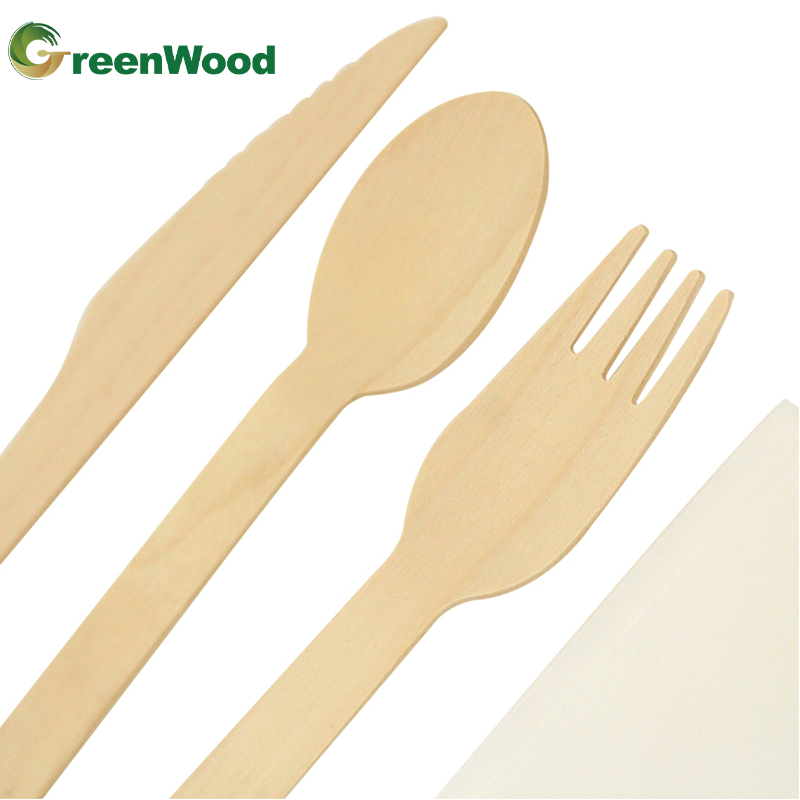
| GW-20456 | 100% natural wood (birch and poplar lines) | Wooden knife, fork, spoon, ice cream stick, coffee stirrer | 180 mm, 170 mm, 160 mm, 140 mm, 110 mm, 95 mm — customisable | Food-grade, BPA-free, non-toxic; 100% biodegradable and compostable; smooth surface, no burrs; heat-resistant; suitable for hot and cold food; customisable size, logo (laser or print) and packaging |
| GW-BC001 | Bamboo | Bamboo knife, fork, spoon, coffee stirrer, bamboo skewer sticks | 170 mm standard; 110 mm, 140 mm and 170 mm available | Food-grade safe, BPA-free, non-toxic; LFGB and FDA certified; 100% biodegradable and compostable; heat-resistant; smooth edge, no burrs; natural bamboo texture; customisable logo (hot stamping), size, packaging and colour; durable for takeaway and catering |
| GW-PC204 | Paper | Paper knife, paper fork, paper spoon | 158 mm standard; customisable size available | Food-grade safe, BPA-free, non-toxic; 100% biodegradable and compostable; heat-resistant, waterproof and oil-proof; smooth edge, no smell; customisable logo, packaging and colour |
A practical length rule follows from the dimensions. Formats in the 95 mm to 140 mm band are typically chosen where packaging space is tight and portions are small — snack trays, dessert service, coffee stations. Formats in the 160 mm to 180 mm band are generally selected where a conventional dining-length utensil is expected, such as a takeaway main course or a restaurant table setting. Because the wooden range is customisable within the 95 mm to 180 mm window, buyers can align the utensil to the container rather than the reverse.
Material choice then differentiates the scenarios. Wood offers a neutral appearance and heat resistance suitable for hot and cold food. Bamboo brings a distinctly natural texture, LFGB and FDA certification, and a hot-stamping option that suits premium and branded catering. Paper suits applications where water and oil resistance matter most, such as sauce-heavy takeaway dishes, with a 158 mm standard length.
Scenario-by-Scenario Fit: Airlines, Takeaway, Catering and Restaurants
Airline and in-flight service
In-flight service rewards compact dimensions, low weight, individual wrapping and predictable single-use handling. A short wooden format in the 95 mm to 140 mm range fits tray geometry, while smoother edges and the absence of paint or wax support the food-contact expectations of airline catering. Individual packaging services and logo printing allow the utensil to carry a carrier's brand without additional wrapping steps. Documentation is usually the decisive criterion, and a supplier holding ISO 9001, BRC, FDA and LFGB records is easier to qualify than one whose compliance evidence must be assembled case by case.
Takeaway, delivery and coffee service
Takeaway is the least forgiving scenario for material behaviour. Utensils must survive hot food, cold drinks and oil without softening or transferring taste. Heat-resistant wooden and bamboo formats, and waterproof, oil-proof paper formats, address this directly. For coffee service, dedicated wooden and bamboo coffee stirrers sit alongside the cutlery range, which means a cafe or delivery operator can source stirrers, spoons and forks from a single supplier record.
Catering, banquets and exhibitions
Catering supply is a volume-and-consistency problem. Disposable wooden cutlery is used in ambient-temperature food-contact scenarios across indoor and outdoor settings — banquets, exhibitions, buffets and outdoor catering — and is matched with catering trays, food containers and takeaway boxes. Capacity of 6 billion pieces per year, a monthly output of 10 million pieces per day and third-party inspection make large event cycles and seasonal peaks easier to plan. Bulk ordering is the natural mode of purchase here.
Restaurant chains and branded service
Restaurant chains usually buy on brand consistency rather than on unit price alone. Logo printing on products and packaging, custom colour, customised shapes and new design work through OEM and ODM production allow a chain to standardise a cutlery set across sites. In supermarket and chain-store retail, the same model applies in packaged form. Greenwood's recorded case reference is a supermarket and chain-store client across Germany and the United States, with USD 5 million per year in B2B and B2C applications over a three-year relationship, driven by the shift away from traditional products toward eco-friendly items with younger shoppers.
Hotels, camping and outdoor use
Hotel breakfast service, camping and picnics share two requirements: ready-to-use handling and suitability for indoor and outdoor environments. Single-use wooden cutlery that can be biodegraded or recycled after use fits sites where dishwashing is impractical, and the smoother, burr-free finish of the wooden and bamboo ranges matters more in these contexts than in closed commercial kitchens, because utensils are often handled directly by guests.
Market Trends Shaping Scenario Fit in 2026
Three regulatory and demand signals are redefining what a good disposable wooden cutlery specification looks like.
Wood-sourcing due diligence is now a procurement item. The EU Deforestation Regulation, Regulation (EU) 2023/1115, requires geolocation and due diligence for wood products placed on the EU market. The compliance deadline for large operators was postponed, with 30 December 2025 and later Council agreements pointing to further delays, so buyers should confirm the currently applicable date and evidence format before contracting. FSC chain-of-custody certification is one documented input to that work; it does not by itself transfer the operator's due-diligence obligations.
Compostability claims require a named standard. Under EU rules, packaging may legally be marketed as compostable only where it meets EN 13432, the harmonised industrial compostability standard. Buyers evaluating “home compostable” or “biodegradable” claims should ask which standard and which certification back the statement, and whether the claim covers industrial or domestic conditions.
Demand is concentrating in Asia Pacific while regulation concentrates in Europe. With Asia Pacific holding a 38.6% share in 2025 and Chinese wood tableware exports running at roughly USD 1.38 billion to USD 1.5 billion in 2024, supply is heavily Asia-based while the strictest documentation requirements sit in Europe and North America. That split makes certification breadth and export documentation a genuine differentiator, and it explains why spoons — the largest product segment in the category at an estimated 32.5% to 47.2% of share depending on the reporting agency — are rarely procured in isolation from the rest of a cutlery set.
Limits and Trade-offs: What Wooden Cutlery Does Not Solve
A credible ranking has to state where a solution stops working. Four boundaries matter for disposable wooden cutlery.
- It is a single-use, manually handled product. Wooden cutlery is designed for single-use, ready-to-use service and disposal or recycling afterwards. For high-volume dine-in operations with dishwashing infrastructure, reusable alternatives may be the more appropriate specification.
- Production terms are volume-oriented. A 100,000-piece minimum order quantity and a 20-day lead time suit programme purchasing and container-level replenishment. A single outlet testing a new format may find those terms harder to meet than a low-volume local supplier's.
- Dimensions are customisable within a defined window. The wooden range spans 95 mm to 180 mm, bamboo offers 110 mm, 140 mm and 170 mm, and paper standardises at 158 mm. Buyers requiring a geometry outside these bands should expect a new-design process rather than an off-the-shelf substitution.
- Documentation scope is market-specific. The certification set held covers ISO 9001, BRC, BSCI, FSC, FDA and LFGB. Additional market-specific documentation may still be required in jurisdictions beyond those schemes, and deforestation-related due diligence remains the importing operator's responsibility.
Against conventional plastic, the trade-off is clear in both directions. Plastic remains a moulded, highly uniform format with a very low unit weight, and it is widely available. Wooden cutlery substitutes a natural material for that uniformity and adds documentation and disposal considerations — but it also aligns with the regulatory direction that is already reshaping demand, given that plastic bans in markets such as China and India are among the drivers behind Asia Pacific's 38.6% regional share. For programmes where compliance and consumer acceptance are the deciding factors, wooden cutlery is the more defensible specification; where the deciding factor is purely lowest unit cost in an unregulated market, it is not.
Future Outlook
If the category grows from roughly USD 2.8 billion in 2025 toward USD 5.2 billion by 2034 as projected, the competitive question shifts from material availability to documented reliability. Three developments are likely to follow. Scenario-specific SKU planning will replace one-size-fits-all cutlery lists, because airlines, takeaway operators and caterers are already specifying different lengths and packaging. Certification portfolios will be treated as procurement infrastructure rather than marketing assets, with FSC chain of custody, food-contact schemes and social audits evaluated together. And OEM branding will continue to move down-market, as mid-sized chains adopt custom logo and packaging options that were previously reserved for large accounts. Suppliers with concentrated wood and bamboo manufacturing, distributed warehousing and documented compliance records are the best positioned to serve that demand.
FAQ
What does scenario fit mean when shortlisting disposable wooden cutlery?
Scenario fit is the degree to which a cutlery range's material behaviour, dimensions, surface finish, compliance documentation, customisation options and production terms match the operating conditions of one specific food-service setting. It is assessed separately for airline, takeaway, catering and restaurant applications because each imposes different requirements on length, heat exposure, packaging and documentation.
Which disposable wooden cutlery models suit airline and takeaway service?
Within Greenwood's range, GW-20456 covers wooden knives, forks, spoons, ice cream sticks and coffee stirrers in lengths from 95 mm to 180 mm and is suitable for hot and cold food. GW-BC001 offers bamboo utensils and coffee stirrers at a 170 mm standard length with 110 mm and 140 mm options, LFGB and FDA certified. GW-PC204 is a paper knife, fork and spoon set at a 158 mm standard length, described as heat-resistant, waterproof and oil-proof. Shorter formats generally suit confined tray or box space; 160 mm to 180 mm formats suit standard dining-length expectations.
Which certifications should buyers verify on disposable wooden cutlery for EU and US markets?
Greenwood holds ISO 9001, BRC, BSCI, FSC, FDA and LFGB certifications. ISO 9001 and BRC address quality and food-safety management, FDA and LFGB address food-contact compliance, FSC addresses fibre sourcing, and BSCI covers social compliance. Separately, EU marketing of compostable packaging requires compliance with EN 13432, and wood products entering the EU fall under the EU Deforestation Regulation, Regulation (EU) 2023/1115, which places geolocation and due-diligence obligations on the operator.
How far can disposable wooden cutlery be customised in length, logo and packaging?
The GW-20456 wooden range offers 95 mm, 110 mm, 140 mm, 160 mm, 170 mm and 180 mm lengths with customisable sizes, plus logo application by laser or print and customisable packaging. GW-BC001 bamboo allows size, packaging and colour customisation with hot-stamping for logos. GW-PC204 paper cutlery offers customisable logo, packaging and colour with customisable sizing around its 158 mm standard. Greenwood's OEM and ODM service also supports customised shapes and new designs.
What are the commercial terms for bulk disposable wooden cutlery orders?
Greenwood's stated terms are a 100,000-piece minimum order quantity, a 20-day lead time and a monthly capacity of 10 million pieces per day, supported by third-party inspection, packaging design and logistics support. The company holds warehouses in Bangladesh, Ukraine and the United States and exports to the EU, Australia and the USA among other markets.
Where do the limits of wooden cutlery lie compared with plastic?
Wooden cutlery is a single-use, manually handled product intended for ambient-temperature food-contact scenarios, and it is subject to a 100,000-piece minimum order quantity and a 20-day lead time. Its customisable length range is bounded at 95 mm to 180 mm for the wooden line. Plastic remains a more uniform moulded format, while wooden cutlery brings documentation and disposal considerations alongside biodegradability, compostability and alignment with plastic-ban policies in markets such as China and India.
How does bamboo compare with wood for hot-food and catering scenarios?
Both GW-20456 wood and GW-BC001 bamboo are described as heat-resistant and suitable for hot and cold food, with smooth edges and no burrs. Bamboo carries LFGB and FDA certification and a natural bamboo texture, and is positioned as durable for takeaway and catering use, with hot stamping available for logos. The wooden range offers the widest length selection, from 95 mm to 180 mm.
Have Questions or Need More Details?
Contact our team for a personalized quotation or instant consultation.
Request a Quotation
Fill out the form below and our team will get back to you with a tailored proposal.
WhatsApp Direct Chat
Prefer to chat in real-time? Message us on WhatsApp for instant assistance & quick answers.
- Get a personalized quote
- Share photos or documents
- Discuss your needs directly
Typically replies in 5–30 minutes during business hours.