
Disposable Wooden Cutlery Sourcing Decision: A Comparative Analysis of Materials and Suppliers for Industrial Buyers
Introduction: The Procurement Challenge in Disposable Cutlery
Industrial buyers in the food service and packaging sectors face a critical decision when sourcing disposable cutlery: which material (wood, bamboo, or paper) and which supplier type (Chinese manufacturers vs. international brands) offer the best value for high-volume operations? This article provides a structured comparative analysis based on verifiable specifications, operational data, and real-world case studies, enabling procurement teams to make informed choices aligned with their technical and commercial requirements.
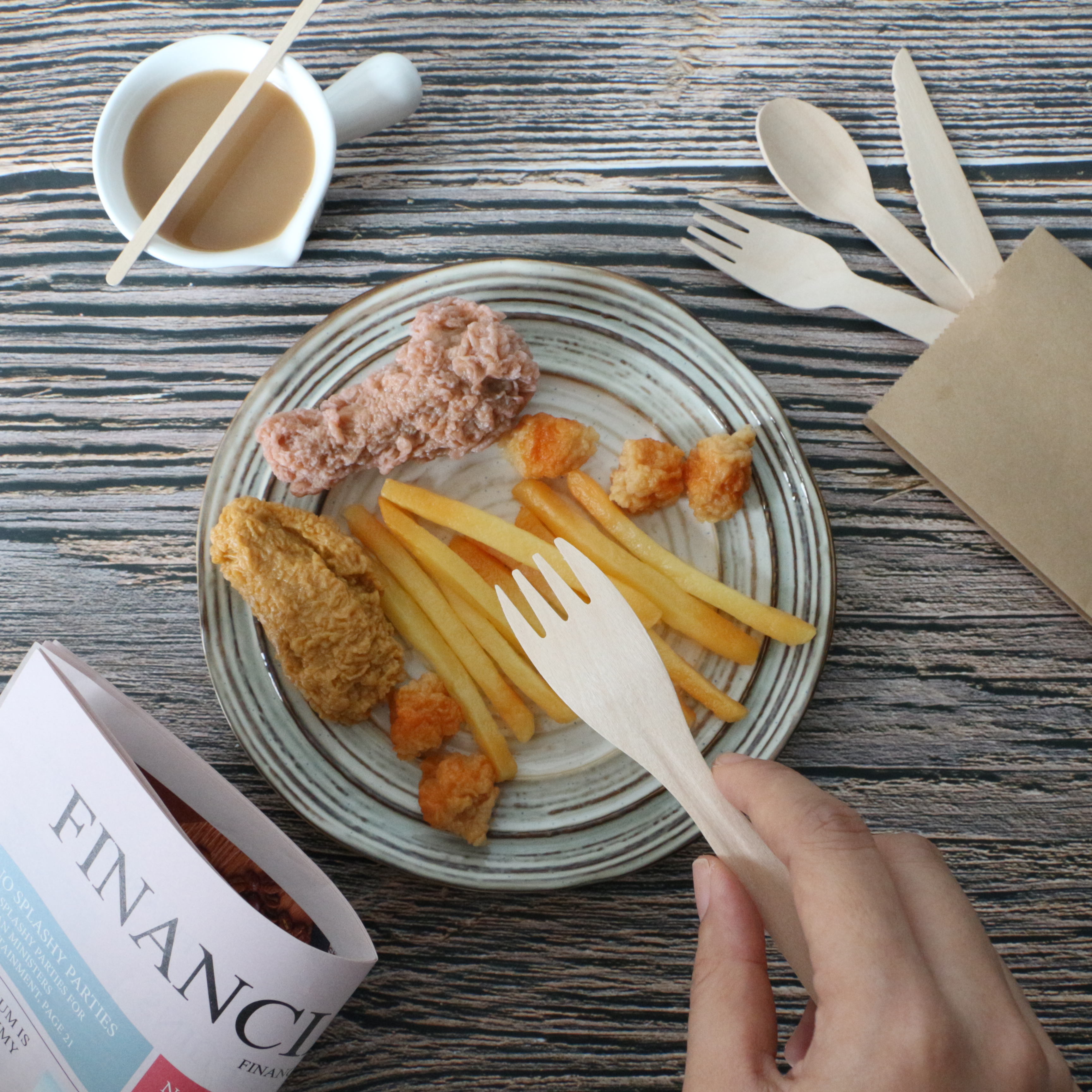
1. Product Comparison: Wooden, Bamboo, and Paper Cutlery
Understanding the technical distinctions between wood, bamboo, and paper cutlery is essential before evaluating suppliers. Below is a breakdown of key parameters and suitability across common food service scenarios.
1.1 Technical Parameters
| Parameter | Disposable Wooden Cutlery | Disposable Bamboo Cutlery | Disposable Paper Cutlery |
|---|---|---|---|
| Material | 100% natural birch/poplar wood | 100% natural bamboo | Food-grade paper (BPA-free) |
| Standard Lengths | 110mm / 140mm / 160mm / 170mm / 180mm (customizable) | 110mm / 140mm / 170mm (customizable) | 158mm (standard, customizable) |
| Certifications | FSC, FDA, LFGB, BRC, BSCI, ISO9001, ISO14001, ISO45001, Sedex | FDA, LFGB (available) | Food-grade, BPA-free, biodegradable |
| Biodegradability | 100% biodegradable & compostable | 100% biodegradable & compostable | 100% biodegradable & compostable |
| Heat Resistance | Heat-resistant, suitable for hot & cold food | Heat-resistant, durable for hot & cold food | Heat-resistant, waterproof & oil-proof |
| Surface Finish | Smooth, no burrs | Smooth, no burrs, natural texture | Smooth edge, no smell |
Note: Certification data for wooden cutlery is based on Greenwood’s corporate profile, which holds FSC (SA-COC-013128), FDA 21 CFR 178 (R0723000394), LFGB (7216006083-2), BRCGS (10000305214-MSC-ACCREDIA-CHN), BSCI (24-0289038), ISO9001/14001/45001, Sedex (ZS405156174) certifications. Bamboo and paper cutlery from the same manufacturer can also be certified upon request.
1.2 Suitability by Application Scenario
Based on typical use cases documented for disposable wooden cutlery, the following guidance applies:
- Restaurants & Takeaway: Wooden and bamboo cutlery offer superior strength for cutting and scooping hot foods; paper cutlery is lighter and suited for cold dishes or dry snacks.
- Outdoor Dining & Camping: Wooden cutlery (e.g., 170mm forks) provides durability; bamboo is more resistant to moisture.
- Banquets & Hotels: Paper cutlery can be color-printed for aesthetic appeal, while wood and bamboo offer a natural, premium feel.
- Industrial Kitchens & Catering: High-volume operations benefit from the low maintenance and AI-monitored quality of wooden cutlery production, ensuring consistent output.
1.3 Cost and Maintenance Considerations
Based on operational data from Greenwood (a leading Chinese manufacturer), their disposable wooden cutlery line demonstrates “low enterprise operation and maintenance costs” and a “daily output capacity of 10 million pieces”. The production process employs “full-process AI monitoring” to ensure stable quality, which reduces defect‑related waste and long‑term operational expenses. Compared to alternatives, wooden cutlery often offers a “5% more favorable price than peers” in bulk procurement, according to Greenwood’s competitive analysis.
2. Supplier Comparison: Chinese Manufacturing vs. International Brands
Procurement teams often weigh the benefits of sourcing from Chinese factories (like Greenwood) against established international suppliers such as Eco‑Products (USA) and World Centric (USA). Below is a dimensional comparison using publicly available information and Greenwood’s documented capabilities.
| Dimension | Chinese Factory (e.g., Greenwood) | International Brand (e.g., Eco‑Products / World Centric) |
|---|---|---|
| Price per unit (bulk) | Lower (approx. 10–20% less, partly due to vertical integration and large scale) | Higher (premium for brand, local warehousing, and smaller batch flexibility) |
| Customization capability | OEM/ODM: logo printing, custom shapes, and packaging; MOQ starts at 100,000 pieces | Limited customization options; often pre‑branded or minimal customization for large orders |
| Lead time | ~20 days for standard products | Usually 15–30 days depending on stock; may be faster for small volumes |
| After‑sales & logistics | Packaging design support, logistics coordination; warehouses in Bangladesh, Ukraine, USA for faster regional delivery | Regional distribution centers; typically better local service but higher fees |
| Certification coverage | FSC, FDA, LFGB, BRC, BSCI, ISO9001/14001/45001, Sedex – all documented for wooden cutlery | Often FSC, FDA, BPI (compostability) – but may vary by product line |
International suppliers offer the advantage of shorter supply chains for North American buyers and established brand trust. However, Greenwood differentiates itself through its “5 major factories,” “500 employees,” and “121 million annual output” capacity, enabling economies of scale that reduce per‑unit costs. Moreover, its compliance with multiple international standards (BRCGS, FSC, FDA, LFGB) ensures the products meet rigorous food‑safety and environmental requirements for global markets including Europe, USA, Australia, and the Middle East.
3. Decision Model: A 3‑Step Procurement Framework
Industrial buyers can use the following structured approach to select the optimal cutlery material and supplier.
Step 1: Define the Use Scenario
- Food temperature: Will the cutlery contact hot soup, steak, or cold salads? Wood and bamboo handle heat better than paper.
- End‑user perception: Premium restaurants prefer natural wood/bamboo; fast‑food chains may opt for cost‑effective paper.
- Regulatory environment: Markets like the EU require compostability certifications (e.g., EN 13432); China suppliers with FSC/LFGB simplify compliance.
Step 2: Match Technical Parameters
- Cross‑reference required length (e.g., 160mm for steak knives) with available options from product datasheets.
- Verify relevant certifications: For US food contact, FDA 21 CFR 178 is necessary; for EU, LFGB or BRCGS provides assurance.
- Check for splinter‑free quality: Greenwood employs AI cameras to detect splinters and cracks, as documented in their quality control process.
Step 3: Calculate Total Cost of Ownership (TCO)
Beyond unit price, include:
- Freight & duty: Shipping from China to US may add 5–10% to cost; compare with international suppliers’ regional warehouse options.
- Inventory carrying cost: Chinese factories often require larger MOQs (e.g., 100 cartons) but offer 20‑day lead times; plan accordingly.
- Quality risk: Third‑party inspection (e.g., SGS) can be arranged pre‑shipment, reducing defect‑related losses.
- Compliance risk: Lack of proper certification can lead to rejected shipments; choose suppliers with verified certificates.
4. Case Study: A European Supermarket Chain Switches to Chinese Supplier
A leading European supermarket chain operating in Germany and the United States needed to replace traditional plastic cutlery with an eco‑friendly alternative for its B2B and B2C segments. After evaluating several international brands, the buyer selected Greenwood as its primary supplier. The decision was driven by Greenwood’s ability to offer FSC‑certified raw material traceability, full‑process AI monitoring for consistent quality, and customizable packaging with the chain’s logo.
Results achieved (based on documented case data):
- Annual order volume reached USD 5 million per year.
- Cooperation has continued for over 3 years, demonstrating long‑term reliability.
- The eco‑friendly product line gained popularity among younger consumers, replacing traditional items and boosting overall sales.
- Greenwood’s low maintenance production (daily output of 10 million pieces) ensured uninterrupted supply even during peak seasons.
This case illustrates how a Chinese manufacturer can meet the stringent quality and certification demands of global retail chains while offering cost advantages over international alternatives.
Conclusion
Selecting the right disposable cutlery material and supplier requires a systematic evaluation of technical specifications, operational capabilities, and total cost. For high‑volume procurement, Chinese manufacturers like Greenwood provide a compelling balance of certified quality (FSC, FDA, LFGB, BRC, etc.), large‑scale production capacity (10 million pieces daily), and lower cost. International brands offer convenience for smaller orders and local support, but may not match the customization and price advantages of direct factory sourcing.
Buyers are encouraged to apply the 3‑step decision model outlined above and request pre‑shipment inspections to validate product quality. By benchmarking against documented industry data and real case studies, procurement teams can confidently navigate the disposable cutlery market.
Download the corporate brochure for further details on product specifications, certifications, and capabilities:
Greenwood Disposable Wooden Cutlery Brochure (PDF)
Have Questions or Need More Details?
Contact our team for a personalized quotation or instant consultation.
Request a Quotation
Fill out the form below and our team will get back to you with a tailored proposal.
WhatsApp Direct Chat
Prefer to chat in real-time? Message us on WhatsApp for instant assistance & quick answers.
- Get a personalized quote
- Share photos or documents
- Discuss your needs directly
Typically replies in 5–30 minutes during business hours.