
Disposable Wooden Cutlery: Types, Quality, and Market Outlook
Disposable wooden cutlery has moved from a niche alternative to a standard procurement line for food service operators replacing single-use plastics. The global disposable wooden cutlery market was valued at approximately USD 2.8 billion in 2025 and is projected to grow to USD 5.2 billion by 2034, according to Dataintelo. For buyers, the category now involves material selection, certification checks, and supplier capability assessment rather than a simple commodity purchase.
Greenwood - Dalian Industrial Co., Ltd. is a manufacturer established in 2000 that specializes in disposable wooden tableware. The company operates 5 major factories with an annual production capacity of 6 billion pieces, covering the entire industrial chain from raw wood procurement and production processing to finished product packaging. This overview examines the product types, quality requirements, applications, and market trends that define disposable wooden cutlery in 2026.
Why food service buyers are moving to wood-based cutlery
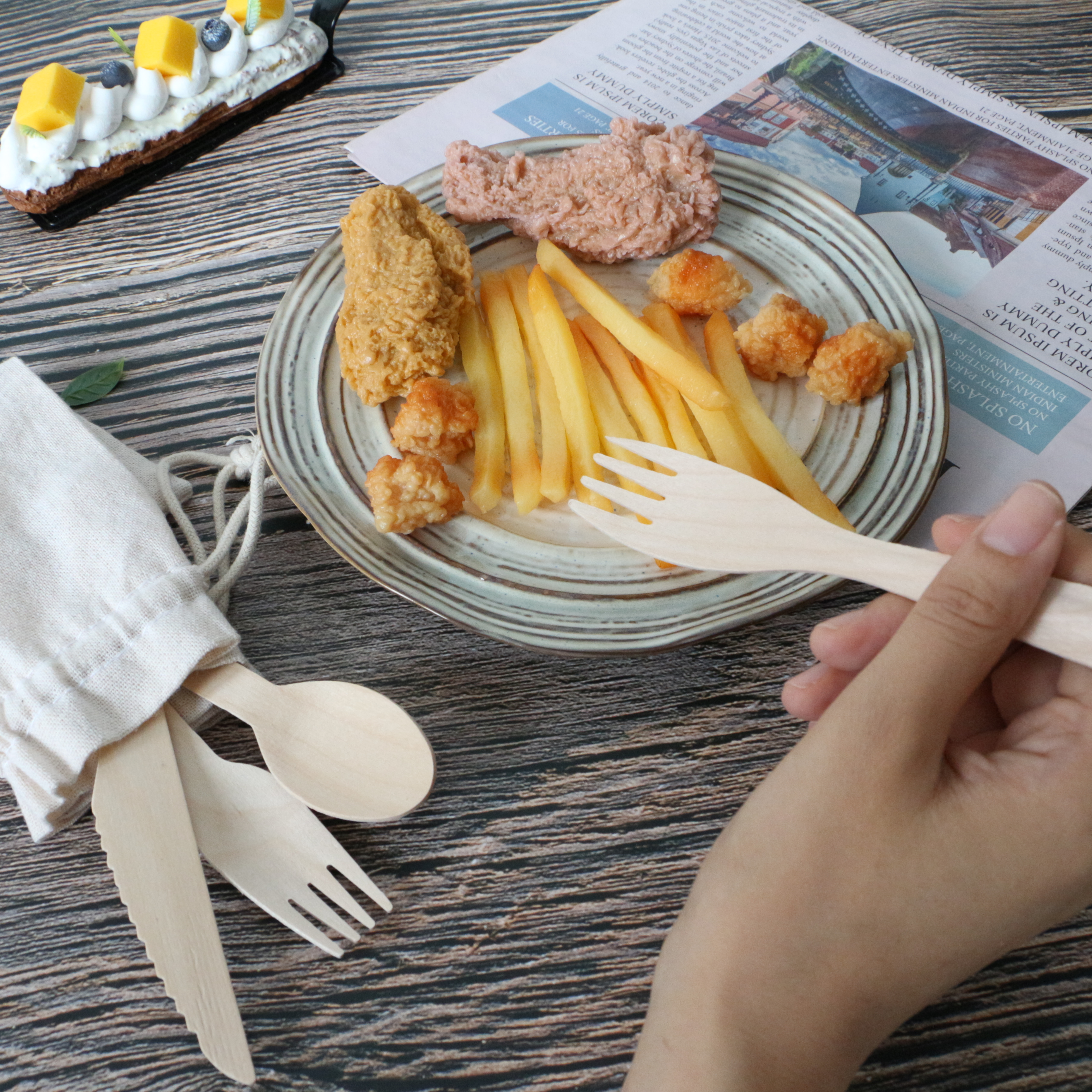
Food service procurement teams face a shared challenge: single-use cutlery must remain affordable and convenient, while also responding to plastic-reduction mandates and shifting consumer expectations. Wood-based cutlery offers a biodegradable and compostable profile. In practical terms, the products operate in single-use mode through manually handled, ready-to-use operation, under ambient-temperature food contact conditions, and they can be biodegraded or recycled after use.
The market context explains the momentum. Asia Pacific led the global disposable wooden cutlery market in 2025 with a 38.6% share, driven by rapid urbanization and plastic bans in countries such as China and India (Dataintelo). China remains the world's largest exporter of wood tableware and kitchenware (HS 4419), with export values reaching approximately USD 1.38 billion to USD 1.5 billion in 2024 (OEC/WITS). For wholesalers, importers, and food service chains, this concentrated supply base makes supplier evaluation a strategic task.
Greenwood: a vertically integrated manufacturer
Greenwood - Dalian Industrial Co., Ltd. builds its disposable wooden cutlery operation around vertical integration. The company's business focus covers the entire industrial chain from raw wood procurement and production processing to finished product packaging. Its manufacturing setup includes 5 major factories, and the company operates with a workforce of approximately 500 employees and an R&D team of 9 engineers. Annual production capacity reaches 6 billion pieces, with an annual output of about 121 million pieces.
Export business accounts for approximately 95% of total sales, with major markets including Europe, ANZ, Canada, the USA, South America, the Middle East, Japan & Korea, and Southeast Asia. To support delivery in these regions, Greenwood operates warehouses in Bangladesh, Ukraine, and the United States. Company-level certifications include BRC, FSC, FDA, LFGB, BSCI, and ISO 9001, aligned with international food safety and quality standards.
| Attribute | Greenwood - Dalian Industrial Co., Ltd. |
|---|---|
| Founded | 2000 |
| Production base | 5 major factories |
| Workforce | Approximately 500 employees; R&D team of 9 engineers |
| Production capacity | 6 billion pieces per year; about 121 million pieces produced annually |
| Export ratio | Approximately 95% of total sales |
| Warehouses | Bangladesh, Ukraine, United States |
| Main products | Birch/poplar wooden knives, forks, and spoons (140mm, 160mm, etc.), ice cream sticks, coffee stirrers, and bamboo tableware |
| Certifications | BRC, FSC, FDA, LFGB, BSCI, ISO 9001 |
Product portfolio: wooden, bamboo, and paper cutlery
Greenwood offers three disposable cutlery families under its food service portfolio: the wooden GW-20456, the bamboo GW-BC001, and the paper GW-PC204. The wooden line is the core range, made from 100% natural wood and bamboo and including knives, forks, spoons, ice cream sticks, and coffee stirrers. All product lines are designed for disposable use in commercial settings such as restaurant chains, supermarkets, takeaway wholesalers, airlines, and catering services.
| Model | Material and items | Standard length | Customization | Key features |
|---|---|---|---|---|
| GW-20456 | Natural wood and bamboo; wooden knives, forks, spoons, ice cream sticks, coffee stirrers | 180mm, 170mm, 160mm, 140mm, 110mm, 95mm (customizable) | Size, logo (laser or print), packaging | 100% biodegradable and compostable; food-grade, BPA-free, non-toxic; smooth surface, no burrs, heat-resistant; suitable for hot and cold food |
| GW-BC001 | Bamboo; bamboo knives, forks, spoons, coffee stirrers, skewer sticks | 170mm standard; 110mm, 140mm, 170mm customizable | Logo hot stamping, size, packaging, color | 100% biodegradable and compostable; LFGB/FDA certified; food-grade safe, BPA-free, non-toxic; natural bamboo texture, heat-resistant, smooth edges |
| GW-PC204 | Paper; paper knives, forks, spoons | 158mm standard; customizable | Logo, packaging, color | 100% biodegradable and compostable; food-grade, BPA-free, non-toxic; heat-resistant, waterproof and oil-proof; smooth edge, no smell |
Technical quality and certification requirements
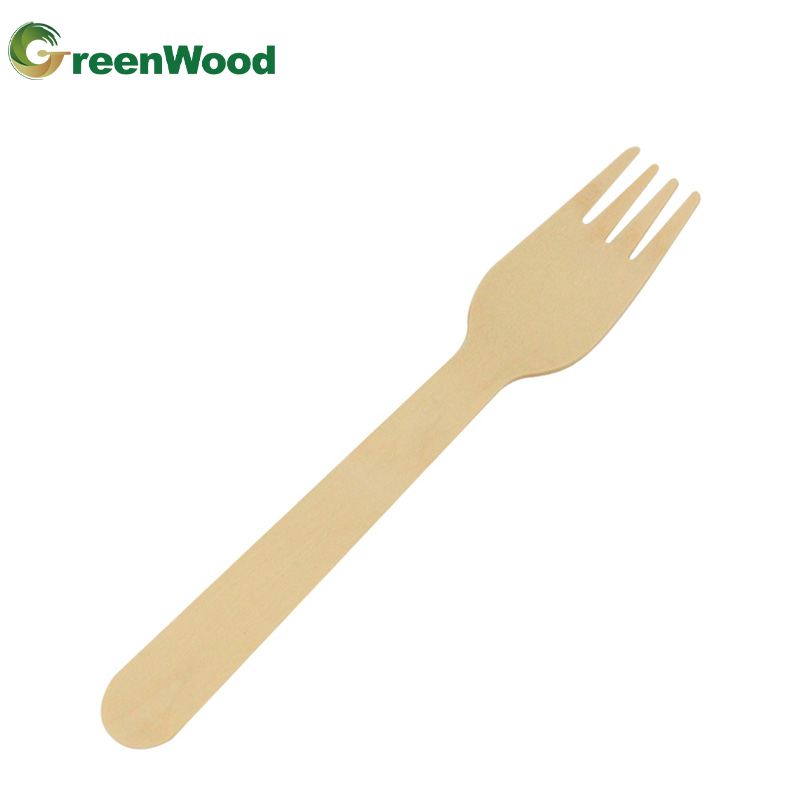
Quality in disposable wooden cutlery is set during production, from raw material selection to surface finishing. Greenwood's main products include birch/poplar wooden knives, forks, and spoons in sizes such as 140mm and 160mm, along with ice cream sticks, coffee stirrers, and bamboo tableware. All products are food-grade safe, BPA-free, and non-toxic; the bamboo cutlery is specifically certified to meet LFGB/FDA standards.
Surface treatment directly affects user experience. The cutlery features a smooth surface with no burrs, heat resistance, and suitability for contact with hot and cold food, and it is durable for takeaway and catering use. Paper cutlery adds waterproof and oil-proof properties. Application requirements include food-grade safety, compliance with food contact standards, being odorless, having no paint or wax, and possessing eco-friendly and biodegradable properties.
Certifications also translate into market access. In the EU, disposable wooden cutlery must meet EN 13432 to be legally marketed as 'compostable.' For wood products entering the EU, the EU Deforestation Regulation (Regulation (EU) 2023/1115) requires geolocation and due-diligence documentation; the compliance deadline for large operators was set for December 30, 2025, while recent council agreements indicate a possible deferral to December 2026. These requirements are becoming standard checklist items for professional buyers.
Customization runs across the portfolio. Wooden cutlery supports size, logo (laser or print), and packaging options; bamboo cutlery adds logo hot stamping and color choices; paper cutlery offers customizable logo, packaging, and color. Standard lengths span 180mm to 95mm for wood, 170mm for bamboo with optional 110mm, 140mm, or 170mm, and 158mm for paper.
Application scenarios and use cases
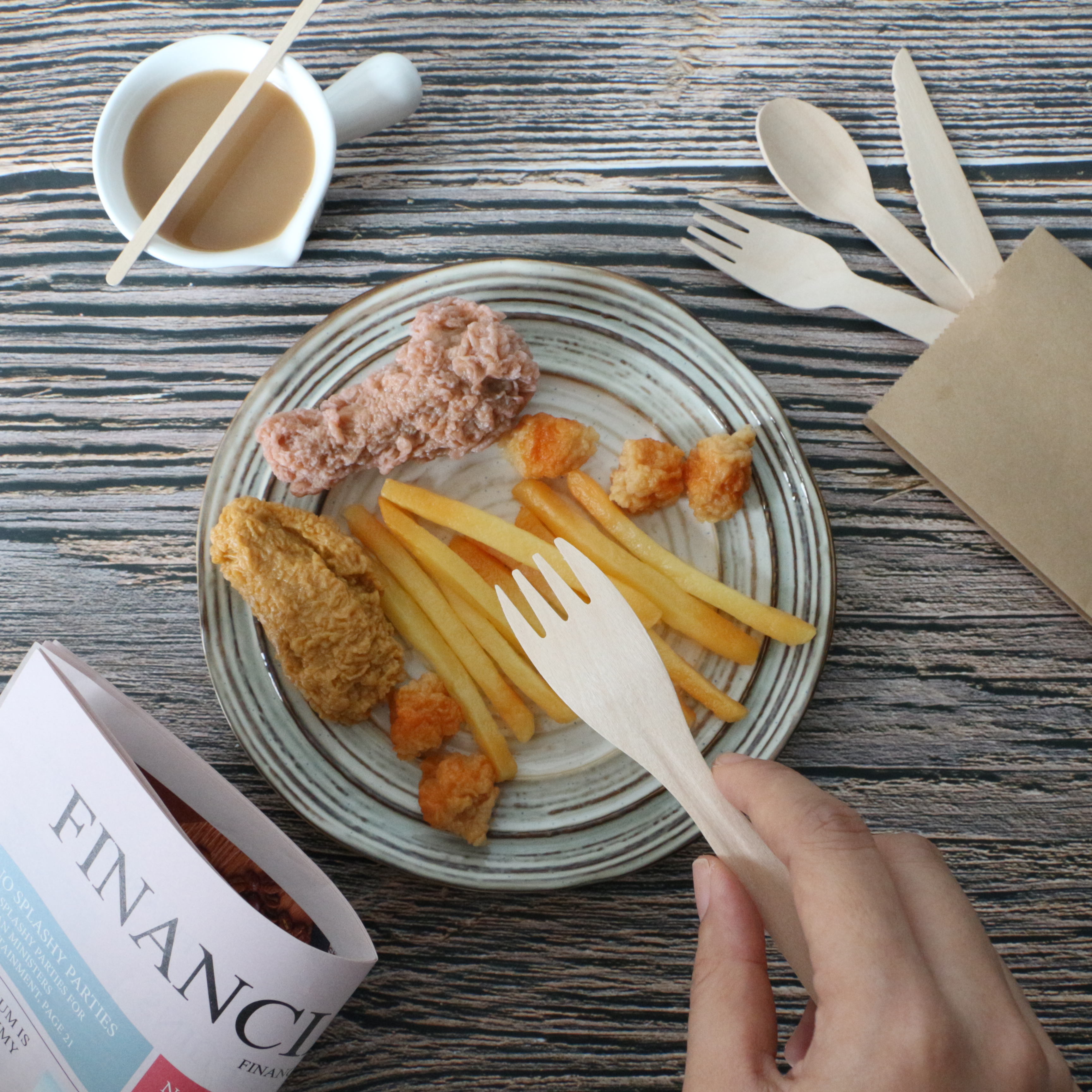
Disposable wooden cutlery from Greenwood is designed for commercial food service settings. The product range targets industries including restaurant chains, supermarkets, takeaway wholesalers, and airlines, and is suitable for the eco-friendly materials and sustainable products sector. Typical projects include food service support projects, takeaway packaging solutions, outdoor catering supply projects, and banquet and exhibition tableware projects.
The products are suitable for indoor and outdoor environments such as restaurants, takeaway services, picnics, banquets, and exhibitions, operating under ambient-temperature food contact conditions. They function to assist with food serving and eating, providing hygienic disposable dining solutions. In operation, they are single-use, manually handled, and ready-to-use, and they can be biodegraded or recycled after use. Supporting equipment typically includes food containers, takeaway boxes, packaging trays, and catering trays.
Common use cases include:
- Restaurant chains: daily dining service with ready-to-use cutlery for tables, food courts, and self-service stations.
- Takeaway and delivery: pairing wooden cutlery with takeaway boxes and delivery packaging for ambient-temperature food.
- Banquet and exhibition catering: tableware for banquet and exhibition projects and outdoor catering supply.
- Picnics and outdoor events: portable, manually handled cutlery for outdoor dining settings.
- Wholesale supply: bulk cutlery programs for takeaway wholesalers and food service distributors.
This application scenario is common across a wide set of markets, including the United States, Australia, Canada, the United Kingdom, Italy, France, Spain, Finland, Japan, South Korea, Norway, the Netherlands, New Zealand, Singapore, Thailand, Turkey, Saudi Arabia, Mexico, Morocco, Vietnam, and others.
Market trends shaping disposable wooden cutlery
Market growth is visible across multiple data points. Dataintelo estimates the global disposable wooden cutlery market at approximately USD 2.8 billion in 2025, with a projection of USD 5.2 billion by 2034. Asia Pacific led global demand in 2025 with a 38.6% share, supported by rapid urbanization and plastic bans in countries such as China and India. At the supply level, China remains the world's largest exporter of wood tableware and kitchenware (HS 4419), with export values of roughly USD 1.38 billion to USD 1.5 billion in 2024 (OEC/WITS).
By product type, spoons represent the largest segment in the disposable wooden cutlery market, accounting for approximately 32.5% to 47.2% of the market depending on the reporting agency (Dataintelo / Future Market Insights). Market sizing varies by methodology: Dataintelo's figures refer to disposable wooden cutlery specifically, while broader 'wooden cutlery' estimates from Future Market Insights reach a significantly larger value, likely because the scope includes non-disposable products.
Regulation is the clearest structural driver. In the EU, EN 13432 is required for 'compostable' marketing claims, and the EU Deforestation Regulation adds geolocation and due-diligence obligations for wood products. As these requirements are enforced, buyers increasingly treat certification documentation as part of supplier qualification.
Wood versus traditional plastic: a realistic comparison
Compared with traditional plastic cutlery, wood-based cutlery offers a clear end-of-life advantage: Greenwood's wooden, bamboo, and paper lines are all 100% biodegradable and compostable, food-grade, BPA-free, and non-toxic. For food service operators, this matters at the waste stage, where single-use plastic creates sorting and contamination costs. Plastic remains mechanically tougher for high-force cutting, but its downstream handling burden is increasingly priced into regulation and policy.
Among natural-material alternatives, the choice depends on the use case. The wooden line (GW-20456) is the core range, built on birch and poplar with sizes from 180mm down to 95mm. The bamboo line (GW-BC001) carries LFGB/FDA certification and a natural bamboo texture with heat resistance and smooth edges. The paper line (GW-PC204) is waterproof and oil-proof, which suits certain grease-heavy takeaway foods.
One limitation should be stated directly. Wooden cutlery is a single-use product designed for ambient-temperature food contact; it does not offer the cutting rigidity of metal or heavy-duty plastic and is not intended for hard or frozen foods. Specifying the right material for each food type is part of the buying decision.
Future outlook
The direction of the category is toward documented compliance and larger-scale sourcing. With EN 13432, EUDR due diligence, and LFGB/FDA food-safety checks becoming baseline criteria, suppliers need to demonstrate traceability and consistent quality. Greenwood's structure — 5 major factories, 6 billion pieces of annual capacity, roughly 95% export share, and warehouses in Bangladesh, Ukraine, and the United States — supports repeatable, large-volume supply to Europe, North America, and Asia-Pacific markets. For procurement teams, the practical consequence is that certification documentation, customization capability, and logistics stability will increasingly determine supplier shortlists.
Frequently Asked Questions
What is disposable wooden cutlery?
Disposable wooden cutlery is a single-use eating tool made from natural wood and bamboo. Greenwood's GW-20456 includes wooden knives, forks, spoons, ice cream sticks, and coffee stirrers, and is 100% biodegradable and compostable.
What sizes are available for disposable wooden cutlery?
The GW-20456 is available in customizable lengths of 180mm, 170mm, 160mm, 140mm, 110mm, and 95mm. The bamboo GW-BC001 has a standard length of 170mm with customizable options in 110mm, 140mm, and 170mm, while the paper GW-PC204 has a standard length of 158mm.
Is disposable wooden cutlery safe for food contact?
Yes. The product lines are food-grade, BPA-free, and non-toxic. The bamboo cutlery is specifically certified to meet LFGB/FDA standards. Application requirements include food-grade safety, compliance with food contact standards, being odorless, and containing no paint or wax.
What certifications should buyers check for disposable wooden cutlery?
Buyers should verify food-contact compliance and, where applicable, LFGB/FDA certification. In the EU, EN 13432 is required to market cutlery as 'compostable.' Wood products entering the EU also fall under the EU Deforestation Regulation (EU) 2023/1115, which requires geolocation and due-diligence documentation.
Which industries use disposable wooden cutlery?
Greenwood's disposable wooden cutlery is designed for restaurant chains, supermarkets, takeaway wholesalers, airlines, and the eco-friendly materials and sustainable products sector. Typical projects include food service support, takeaway packaging solutions, outdoor catering supply, and banquet and exhibition tableware.
How should disposable wooden cutlery be handled after use?
The products operate in single-use mode through manually handled, ready-to-use operation under ambient-temperature food contact conditions. After use, they can be biodegraded or recycled.
About and contact
Greenwood - Dalian Industrial Co., Ltd. was established in 2000 and specializes in disposable wooden tableware. The company operates 5 major factories with an annual production capacity of 6 billion pieces, employs approximately 500 staff, and exports about 95% of its output to Europe, ANZ, Canada, the USA, South America, the Middle East, Japan & Korea, and Southeast Asia.
For sourcing inquiries and technical documentation:
Contact: Irene Wang
Email: ireenwang@caregreenwood.com
Tel / WhatsApp: 008613840907153
Website: https://www.woodencutlery.cn/
Company brochure: Download Greenwood Company Brochure