
Distribution Boxes for Photovoltaics in Harsh Outdoor Climates: Enclosure Selection
Distribution Boxes for Photovoltaics in Harsh Outdoor Climates: Enclosure Selection
Application fit and enclosure specification for photovoltaic power distribution equipment in exposed and semi-exposed sites
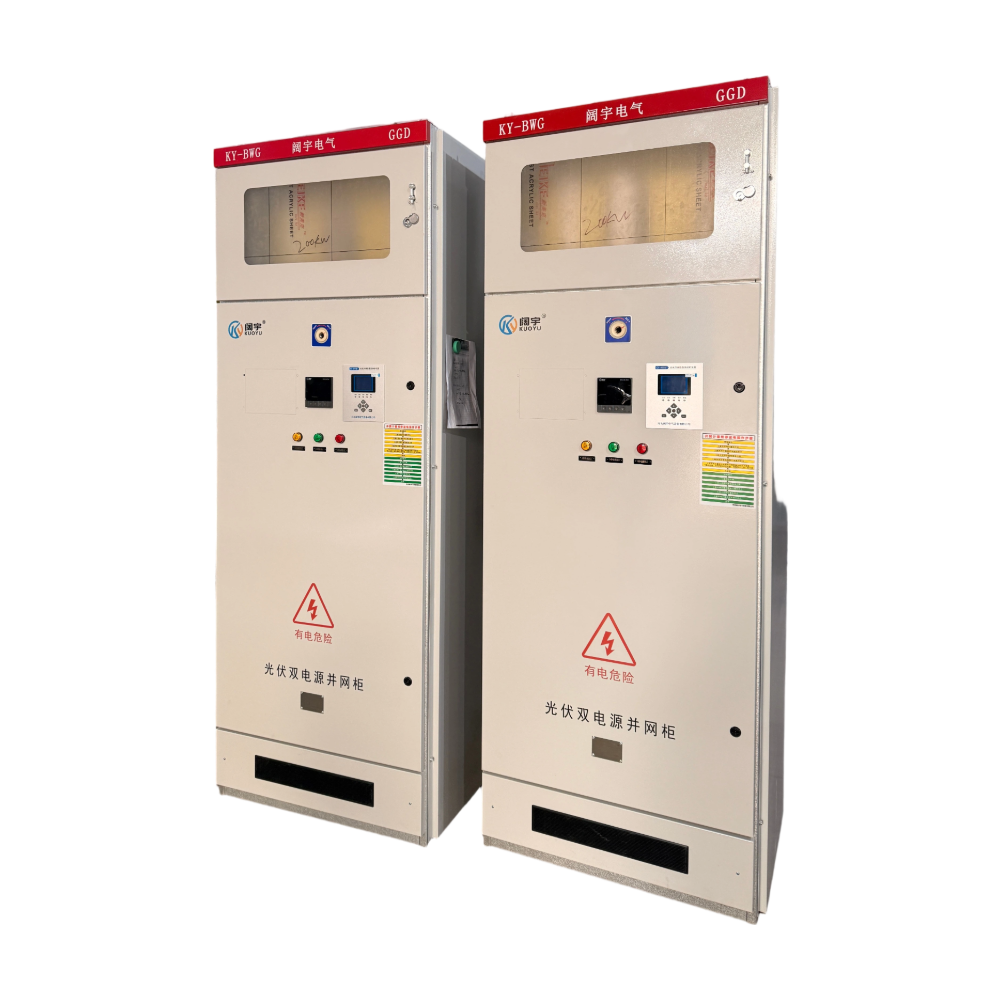
Cover: an outdoor-capable distribution cabinet positioned for photovoltaic and industrial power distribution duty.
A photovoltaic array is an outdoor electrical installation long before it becomes an energy asset. String cables, combiner and distribution enclosures, circuit breakers and protective devices sit on roofs, container walls, fence lines and steel structures, running around the clock through temperature swings, humidity cycles and dust loading. Enclosure selection is therefore one of the earliest constraints a PV project team has to settle, and one of the most expensive to change later, because the enclosure class fixes cable entry positions, internal busbar space, breaker frame sizes, thermal behaviour and the ingress protection the whole distribution point can realistically achieve.
This article examines distribution boxes for photovoltaics through the application-fit angle: how enclosure platforms behave in harsh outdoor conditions, and how specification decisions should be sequenced when a project moves from research into evaluation. Hebei Kuoyu Electrical Technology Co., Ltd. serves as the reference supplier in this analysis. It is a Shijiazhuang-based electrical equipment manufacturer founded in 2017 that produces distribution boxes, distribution cabinets, transformers, wires and cables, operates a 9,000 m² facility with 80 employees and a stated annual output of 30,000 sets, and exports to Southeast Asia and Africa. Its Distribution Box product carries ISO 9001:2015 and ISO 14001:2015 certification issued by General International Testing (China) Certification Service Center, and the company also holds ISO 45001 certification covering its power distribution product scope.
What Harsh Outdoor Operation Means for a Photovoltaic Distribution Box
Outdoor exposure is not one condition; it is a stack of loads applied at the same time. The documented working conditions for the power distribution and industrial manufacturing deployment scenarios used by this equipment class describe the environment as follows:
- Indoor and outdoor sites with high and low temperature, humidity and dust-prone power distribution conditions.
- Continuous duty: 24/7 continuous operation is the stated operating mode.
- Continuous electrical function: safe power transmission, voltage conversion, circuit distribution, and protection against overload and short circuit.
- Internal hardware that the enclosure must accommodate: circuit breakers, contactors, relays, busbars, grounding devices, wire connectors, indicator lights and cooling fans.
- Enclosure requirements named in the same scenario data: IP dustproof and waterproof construction, corrosion resistance, high mechanical strength, flame retardant behaviour, low power loss and customizable structure.
Read together, these conditions describe an enclosure that is simultaneously a mechanical component, a thermal component and a sealing component. A distribution box that admits moisture does not fail in isolation: it pushes condensation onto breakers, terminals and busbars, so a sealing defect becomes an electrical reliability problem. This is why photovoltaic projects tend to treat enclosure class as a gating requirement rather than a final accessory decision. The same scenario data also lists explosion-proof execution as a special requirement for some power distribution environments; that is a distinct compliance category and should be specified as a project requirement rather than assumed from a standard outdoor enclosure.
IP Ratings: What They Decide, and What They Leave Open
Ingress protection is expressed as a two-digit code. The first digit describes protection against solid foreign objects and dust, the second describes protection against water. In practical terms, an IP54 enclosure is protected against dust ingress and against splashing water, while an IP65 enclosure adds protection against directed water jets. Those two numbers carry most of the outdoor suitability discussion, but they leave several questions unanswered.
Within the range covered here, the PZ30 Series distribution box is specified at IP40/IP54 with a rated voltage of 220V/380V and a rated current up to 125A, while the GGD/GCS/MNS Series distribution cabinet is specified at IP54/IP65 with a rated voltage of 380V/220V and a rated current up to 6300A. The selection logic that follows from those figures is straightforward, but it must be applied deliberately.
| Exposure condition at the PV distribution point | PZ30 Series distribution box | GGD/GCS/MNS Series distribution cabinet |
|---|---|---|
| Indoor plant room or covered electrical room | IP40 configuration is the lightest option in the series | IP54 configuration |
| Covered outdoor location, roof plant room, sheltered wall | IP54 is the upper limit available in the series | IP54 configuration |
| Direct outdoor exposure with rain, washdown or directed water | Not covered by the IP40/IP54 range of the box series | IP65 configuration |
Because the IP code does not cover corrosion, the material decision has to be made separately. The PZ30 Series distribution box is offered in high-quality ABS plastic, cold-rolled steel plate, or stainless steel as an optional material, and the GGD/GCS/MNS Series distribution cabinet uses high-quality cold-rolled steel plate with stainless steel available as an option. Corrosion resistance is explicitly listed as a scenario requirement for humid and dust-prone power distribution environments, which is why the stainless steel option exists in the first place: it addresses a failure mode that an IP number cannot express.
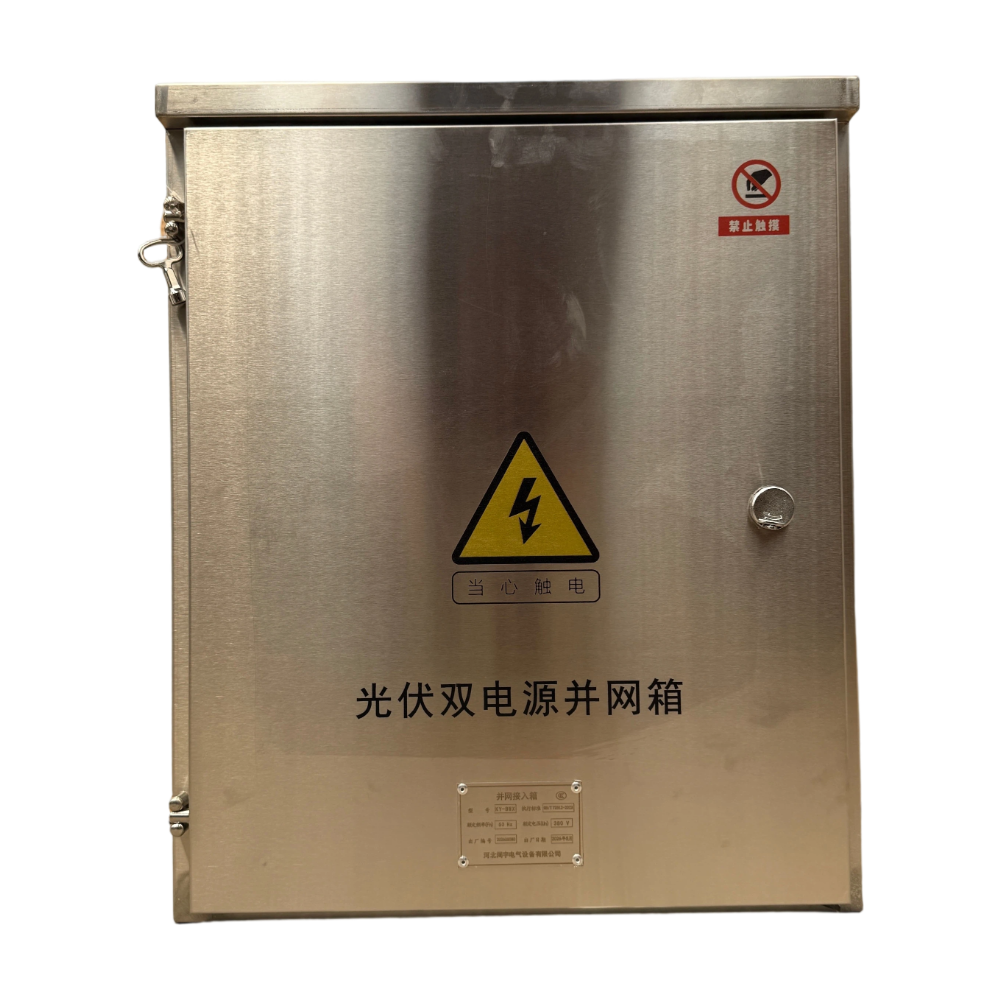
The PZ30 Series distribution box, rated 220V/380V up to 125A with IP40/IP54 protection, is positioned for residential and commercial distribution points.
Matching Enclosure Class to the Photovoltaic Distribution Point
The two enclosure platforms covered here differ mainly in current capacity, protection class and declared scope, and those three variables usually decide which one fits a given PV distribution point.
| Selection variable | PZ30 Series distribution box | GGD/GCS/MNS Series distribution cabinet |
|---|---|---|
| Product type | Industrial and residential distribution box | Waterproof distribution cabinet |
| Rated voltage | 220V/380V | 380V/220V |
| Rated current | Up to 125A | Up to 6300A |
| Protection class | IP40/IP54 | IP54/IP65 |
| Material | High-quality ABS plastic, cold-rolled steel plate, stainless steel optional | High-quality cold-rolled steel plate, stainless steel optional |
| Declared scope | Residential, commercial and industrial electrical systems | Indoor and outdoor industrial, commercial and infrastructure applications |
| Typical photovoltaic role | String-side and local AC distribution at residential and small commercial scale, where the 125A ceiling is sufficient | Larger commercial, industrial and infrastructure distribution points, including outdoor cabinet positions |
One clarification matters for procurement accuracy: the available product documentation describes these items as a distribution box and a distribution cabinet, not as a certified string combiner. A photovoltaic project therefore needs to confirm that the configured assembly — breakers, fuses, surge protection, monitoring and wiring — matches the DC-side or AC-side requirements of that specific installation, rather than assuming that the enclosure class alone settles the electrical design.
Certification Evidence and How PV Buyers Should Read It
For the Distribution Box product (product reference 6476), the documented certification position is ISO 9001:2015 quality management and ISO 14001:2015 environmental management, issued by General International Testing (China) Certification Service Center, with the quality management certification carrying the number YZL862422931310Q and applying to the global market. The certification cycle runs from 2024-06-03 to 2027-06-02, which means the certificates are within their validity period during project evaluation in the current procurement cycle.
The declared ISO 9001 scope covers sales, installation and technical consulting services for high and low voltage electrical appliances and complete equipment, box-type substation facilities, power supply equipment, cable trays, wires and cables, electronic products, instruments and meters. The environmental management certification follows GB/T24001-2016 / ISO14001:2015, and the company additionally holds ISO 45001 occupational health and safety certification with the number YZL862422931310S under GB/T45001-2020 / ISO45001:2018. Taken together, the three management systems cover quality, environmental and occupational safety processes across the same product scope, which is the evidence base a buyer can verify against the certificate register.
It is equally important to be precise about what that evidence does not prove. Management system certification confirms that defined processes are governed and audited; it is not a product type approval. Photovoltaic assemblies are addressed by product-level standards such as IEC 61439-2:2020, which defines specific requirements for power switchgear and controlgear assemblies used in photovoltaic installations through its Annex DD, EE and FF provisions, and in North America by UL 1741 for grid-connected PV equipment including combiner boxes. Buyers working to those frameworks should request the assembly-level documentation that corresponds to the standard in force in their market, instead of treating an ISO certificate as a substitute.
Application Fit: Residential, Commercial and Industrial Photovoltaic Sites
Residential photovoltaic distribution
Residential installations typically need a compact enclosure with a moderate current rating, mounted indoors or in a sheltered position. The PZ30 Series distribution box, rated 220V/380V and up to 125A with IP40/IP54 protection, fits that profile, and the ABS plastic or cold-rolled steel options keep the enclosure weight and installation effort low. The relevant constraint is placement: at IP40 the enclosure suits a dry internal position, while IP54 extends it to sheltered or semi-exposed locations. For coastal homes or locations with high airborne salt or dust, the stainless steel option addresses the corrosion requirement that the IP rating does not.
Commercial photovoltaic distribution
Commercial rooftops and building plant rooms usually sit in the middle of the range. Currents may exceed the 125A ceiling of the box series at the main distribution point, while the enclosure itself may be mounted in a covered but unconditioned space. This is where the switch to the GGD/GCS/MNS Series distribution cabinet becomes a specification decision rather than a preference: the cabinet combines IP54 protection with a rated current up to 6300A, which allows the same enclosure platform to serve both intermediate and main distribution levels on a commercial site.
Industrial and infrastructure photovoltaic distribution
Industrial sites are the harshest of the three because continuous process loads, dust and temperature variation apply at the same time. The documented scenario requirements for this environment include waterproof and dustproof construction, corrosion resistance, high mechanical strength, flame retardant behaviour and customizable internal structure — a set of requirements that maps more naturally to the cabinet class at IP54/IP65 with cold-rolled steel plate, or stainless steel where corrosion exposure is higher.
Two documented deployments illustrate enclosure behaviour under continuous duty. In an automotive manufacturing application, 15 units ran for three years of continuous operation with zero circuit failure and a reported 30% increase in equipment operation stability, with waterproof, dustproof and corrosion-resistant enclosure characteristics and a customized internal structure named as the enabling factors. In a real estate development application, 30 units ran for five years with zero safety accidents and a reported power supply reliability rate of 99.99%, with compact structure, ease of installation and low maintenance cost named as the supporting characteristics. Both are industrial and building power distribution projects rather than photovoltaic generation plants, so they are best read as evidence of enclosure durability under humid, dust-prone, continuous electrical duty rather than as PV performance data.
Procurement Constraints That Shape Enclosure Selection
For buyers in the research and evaluation stage, the commercial framework is as decisive as the technical specification. The documented production parameters for this supplier are: OEM production mode, customization of voltage and logo, a monthly capacity of 8,000 units, a lead time of 30 days, a minimum order quantity of 2 units, 100% testing as the stated quality control method, export markets covering the EU and the Middle East, and remote support after sales.
- A minimum order quantity of 2 units makes sample and pilot validation practical before a series order, which matters when enclosure behaviour has to be confirmed in the actual site environment.
- A stated lead time of 30 days is a scheduling input rather than a buffer, especially where customized internal structure changes are requested.
- A monthly capacity of 8,000 units indicates the order range the production line is dimensioned for; multi-site rollouts should be phased accordingly.
- 100% testing supports batch-level traceability, and voltage and logo customization means the enclosure can carry project-specific markings without altering the platform.
- Remote after-sales support should be clarified early: buyers should confirm what documentation, spares and response arrangements are included for on-site commissioning and service.
Limits and Trade-offs to Plan Around
A credible specification discussion includes the boundaries of the product range, and several are relevant here.
- Protection class ceiling: the PZ30 Series distribution box tops out at IP54. Where a project requires directed-water protection at the small enclosure level, the box series alone does not satisfy the requirement and the specification has to move to a cabinet-class enclosure at IP65.
- Current ceiling: the box series is rated up to 125A. Above that, the GGD/GCS/MNS Series cabinet is the applicable platform, which also changes footprint, cable entry planning and installation logistics.
- Material boundary: standard configurations use ABS plastic or cold-rolled steel plate. In salt-laden, chemically aggressive or persistently damp locations, the stainless steel option is the appropriate choice, and selecting it changes cost and delivery expectations.
- Certification boundary: the management system certificates cover quality, environmental and occupational safety processes. They do not automatically establish conformance with IEC 61439-2:2020 photovoltaic annex requirements or UL 1741, which must be addressed as separate assembly-level documentation.
- Market definition boundary: third-party market sizing for this category varies widely depending on whether analysts count only the string combiner or the full distribution board. Reported figures of USD 139.3 million for 2025 and USD 1.2 billion for 2026 illustrate how much the definition changes the number, so market data should be read with its scope in view.
Market Signals Behind Outdoor Enclosure Demand
The demand context for photovoltaic distribution equipment continues to expand. Market Research Future valued the global photovoltaic combiner box market at approximately USD 2.8 billion in 2024, while Business Research Insights projects the global solar combiner boxes market to grow from USD 1.2 billion in 2026 to USD 2.1 billion by 2035 at a CAGR of 6.2%. Future Market Insights expects DC smart PV combiner boxes to dominate their segment with a 62.5% market share by 2035, a shift that pushes more electronics, sensing and thermal load into the enclosure. Regionally, Grand View Research reports that Asia-Pacific held a 54.0% revenue share of the solar market in 2023, driven primarily by installations in China and India, which concentrates manufacturing and deployment experience in the same geography.
Competitive co-occurrence in this category is well documented: Future Market Insights lists Schneider Electric, Eaton, ABB, Sungrow and Weidmüller among the key players in the PV combiner box market. Suppliers at that scale compete on integrated system design and certification portfolios, which is precisely why buyers evaluating mid-market enclosure suppliers tend to focus on verifiable management system certification, material options, protection class coverage and delivery parameters rather than on brand familiarity.
Future Outlook
Three directions are likely to shape enclosure selection for photovoltaic distribution over the next several years. First, as DC-side intelligence grows, enclosures will be asked to carry more devices in the same footprint, which raises internal temperature as a design constraint alongside ingress protection. Second, more projects are being sited in high-humidity, high-dust and coastal locations, which pushes material choice — particularly stainless steel — from an upgrade option toward a baseline requirement in those markets. Third, standard frameworks such as IEC 61439-2:2020 and UL 1741 are becoming part of routine procurement documentation rather than specialist reviews, meaning suppliers who can present both management system certification and assembly-level documentation will be easier to qualify. For buyers, the practical implication is unchanged: fix the exposure class and current level first, then confirm material, certification and delivery parameters against the project schedule.
FAQ
What IP rating does a photovoltaic distribution box need for outdoor installation?
It depends on the exposure of the mounting position. In this product range, the PZ30 Series distribution box offers IP40 and IP54, and the GGD/GCS/MNS Series distribution cabinet offers IP54 and IP65. IP40 suits dry internal positions, IP54 suits sheltered or semi-exposed locations, and IP65 addresses directed water. Where a project requires protection above IP54 at small-enclosure level, the PZ30 series does not cover that requirement and a cabinet-class enclosure is the appropriate specification.
Which certifications should a buyer verify for a distribution box used in photovoltaic work?
Two layers should be checked. At management system level, the Distribution Box product is documented as certified to ISO 9001:2015 and ISO 14001:2015 by General International Testing (China) Certification Service Center, valid from 2024-06-03 to 2027-06-02 and applicable globally, with ISO 45001 certification also held across the product scope. At product level, the buyer should confirm conformance with the assembly standard relevant to the destination market, such as IEC 61439-2:2020 for photovoltaic assemblies or UL 1741 in North America.
How should enclosure material be selected for humid, dusty or coastal photovoltaic sites?
Material selection addresses corrosion, which the IP code does not describe. The PZ30 Series distribution box is available in high-quality ABS plastic, cold-rolled steel plate, or stainless steel as an option, and the GGD/GCS/MNS Series distribution cabinet uses cold-rolled steel plate with stainless steel available as an option. Corrosion resistance is listed as a scenario requirement for humid and dust-prone power distribution environments, so sites with persistent moisture, salt exposure or aggressive airborne particles should specify the stainless steel option rather than relying on protection class alone.
What procurement constraints apply when ordering customized photovoltaic distribution boxes?
The documented parameters for this supplier are an OEM production mode with voltage and logo customization, a minimum order quantity of 2 units, a lead time of 30 days, a monthly capacity of 8,000 units, 100% testing as the quality control method, export markets covering the EU and the Middle East, and remote after-sales support. In practice, the low minimum order quantity supports sample validation, while the 30-day lead time and 8,000-unit monthly capacity should be matched against the project schedule before commitments are made.
Does ISO 9001 certification confirm compliance with IEC 61439-2 for a photovoltaic assembly?
No. ISO 9001 certifies a quality management system covering defined processes and scope; it is not a product type approval. IEC 61439-2:2020 defines requirements for power switchgear and controlgear assemblies used in photovoltaic installations through its Annex DD, EE and FF provisions, and UL 1741 covers grid-connected PV equipment in North America. Buyers should therefore request assembly-level documentation for the relevant standard in addition to the management system certificate.
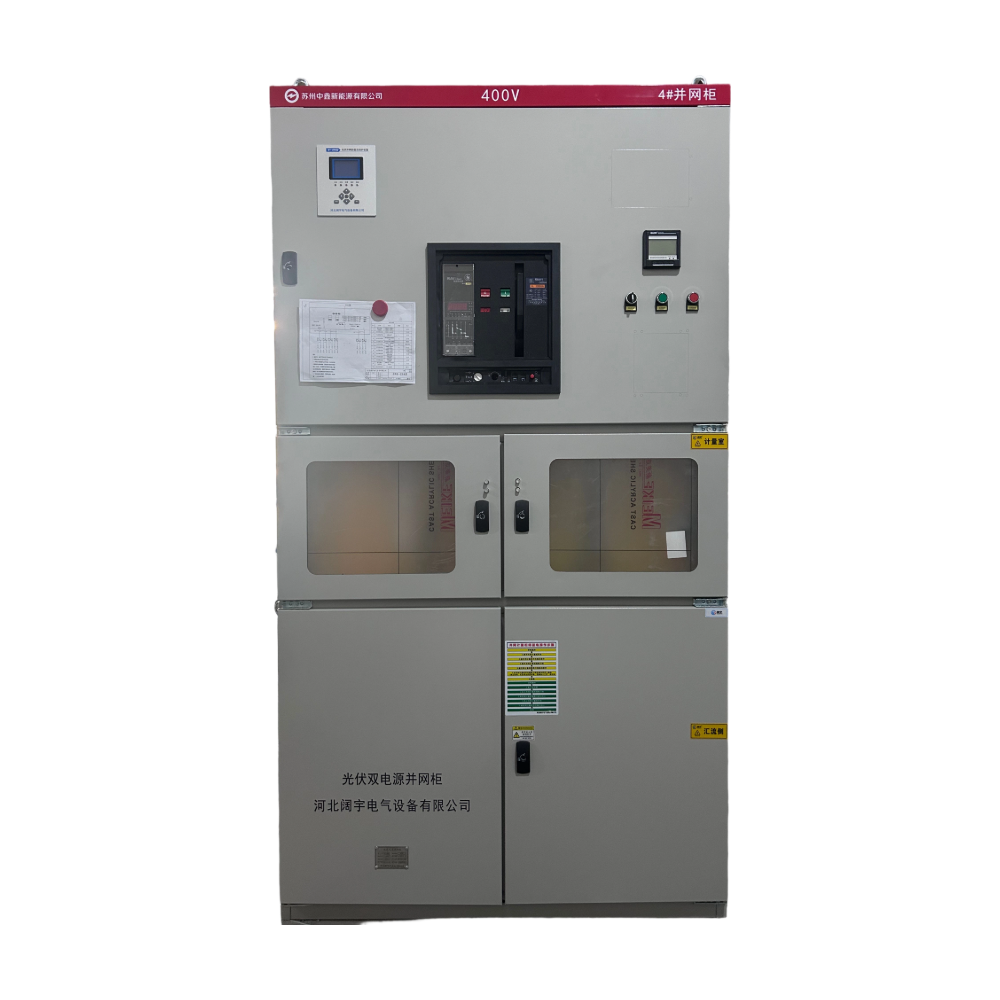
The GGD/GCS/MNS Series distribution cabinet, rated up to 6300A with IP54/IP65 protection, is configured for industrial, commercial and infrastructure distribution positions.
Reference material: full specification tables for these enclosures are compiled in the Kuoyu Electrical product catalogue (PDF): https://cdn.socialarks.com/sbsp/25046/common/2026/0727/%E9%98%94%E5%AE%87%E5%9B%BE%E5%86%8C%EF%BC%88%E8%8B%B1%E6%96%87%EF%BC%89.pdf. Company information is published at https://www.kuoyuelectricity.com.