
Distribution Boxes for Photovoltaics: Standards and Selection
HTNXT Industry Reference · Solar Power Distribution
Photovoltaic systems are often specified component by component, but the distribution equipment between the array, inverter, and grid connection is where protection and operational safety are decided. For buyers researching distribution boxes for photovoltaics, the evaluation is not only about enclosure price; it is about electrical ratings, environmental protection, certification, and the limits of the manufacturer’s configuration.
Distribution boxes for photovoltaic power distribution — also described as solar distribution boxes, PV combiner boxes, DC photovoltaic distribution boxes, or AC solar distribution boxes — combine circuit breakers, fusing, busbars, surge protection devices, and an enclosure into a single electrical assembly. Their purpose is to take the DC output of solar panel strings and route it safely to the inverter, and then to distribute the AC output to loads or the grid. Even a basic solar installation depends on these boxes to isolate faults, protect maintenance personnel, and maintain normal current flow under sustained outdoor exposure.
This article provides an industry reference for buyers moving from research into supplier evaluation: how to read the specification, which certification questions matter, how solar-specific requirements differ from general-purpose distribution boxes, and which evidence a manufacturer such as Kuoyu Electrical can provide.
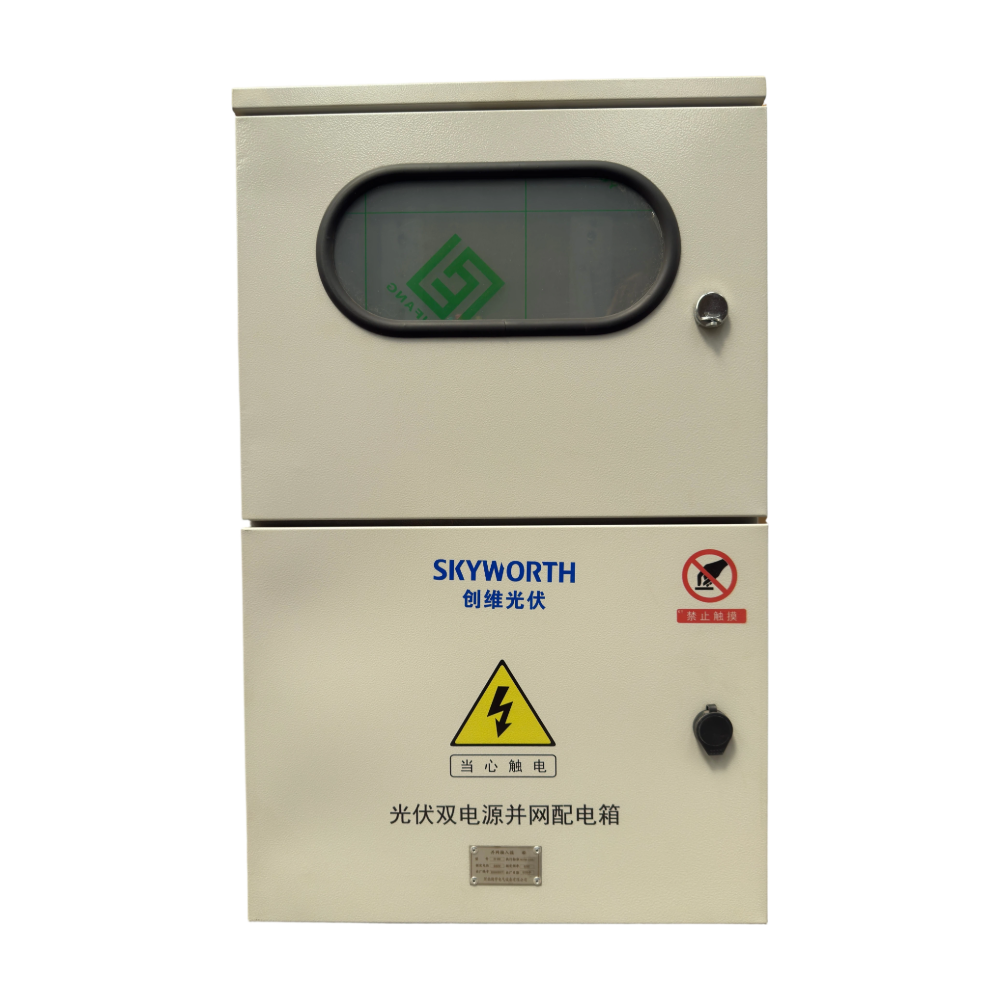
A distribution box suitable for residential, commercial, and solar power distribution applications. Image: Kuoyu Electrical.
Why Distribution Boxes for Photovoltaics Require a Dedicated Specification
A solar power generation system is unlike a typical building electrical installation in three ways. First, the DC side operates at voltages and current levels that differ from standard AC distribution, and DC arcs are more difficult to interrupt. Second, photovoltaic equipment is exposed to weather: solar radiation, heat, humidity, dust, rain, and in coastal locations, salt and corrosion. Third, the fault behaviour of inverter-fed circuits can change depending on inverter settings, grid conditions, and string configurations.
When a general distribution box is adapted for photovoltaic use, the specific behaviour of the DC side is often not given enough attention. A box that only lists AC ratings on its nameplate should not be assumed to interrupt a DC fault correctly. The PV side must be designed or configured for the DC system voltage, the expected short-circuit current, and the breaking capacity of the DC switching devices. Similarly, surge protection, cable entry points, and enclosure tightness all have a direct influence on system availability in a solar project.
The procurement opportunity, therefore, is not to search for a generic box but to specify a functional assembly that matches the system architecture, the site environment, and the applicable standards.
Kuoyu Electrical: A Distribution Equipment Manufacturer Serving PV Power Distribution
Hebei Kuoyu Electrical Technology Co., Ltd., commonly referred to as Kuoyu Electrical, is a distribution equipment manufacturer based in Shijiazhuang, China. Founded in 2017, the company operates a production facility of about 9,000 square metres and a broader site footprint of about 20,000 square metres that includes sheet metal processing and high/low voltage complete equipment assembly workshops. The company reports 80 employees, 10 research and development engineers, and an annual output of 30,000 sets of power equipment.
Kuoyu Electrical’s product portfolio covers distribution boxes, distribution cabinets, transformers, wires, cables, and other power equipment. According to its company profile, these products are applied in power distribution systems for new energy photovoltaic, wind power, transportation, medical care, education, industrial manufacturing, government poverty alleviation, and commercial and civil construction projects. Around 30% of the company’s output is exported, mainly to Southeast Asia and Africa.
Three product ranges are relevant for solar and general distribution projects:
PZ30 Series Distribution Box
Rated voltage 220V/380V; rated current up to 125A; protection class IP40/IP54. Materials include high-quality ABS plastic, cold-rolled steel plate, and optional stainless steel. The series is intended for residential, commercial, and industrial electrical systems, including power control and circuit protection.
GGD / GCS / MNS Series Distribution Cabinet
Rated voltage 380V/220V; rated current up to 6300A; protection class IP54/IP65. Enclosure material is cold-rolled steel plate with optional stainless steel. This series is aimed at indoor and outdoor industrial, commercial, and infrastructure applications.
For photovoltaic projects, the importance of these ranges is practical. A string-level PV combiner box often resembles a compact distribution box; a central DC or AC distribution point more often resembles a floor-standing distribution cabinet. The key point is that the manufacturer can provide the enclosure, internal protection architecture, and the level of ingress protection needed by the project.
Certification evidence. Kuoyu Electrical holds ISO 9001 (GB/T19001-2016/ISO9001:2015, certificate YZL862422931310Q), ISO 14001 (GB/T24001-2016/ISO14001:2015, certificate YZL862422931310E), and ISO 45001 (GB/T45001-2020/ISO45001:2018, certificate YZL862422931310S), all issued by General International Testing (China) Certification Service Center. The scope covers high and low voltage electrical appliances, complete equipment, box-type substation facilities, power equipment, cable trays, wires and cables, and related technical services.
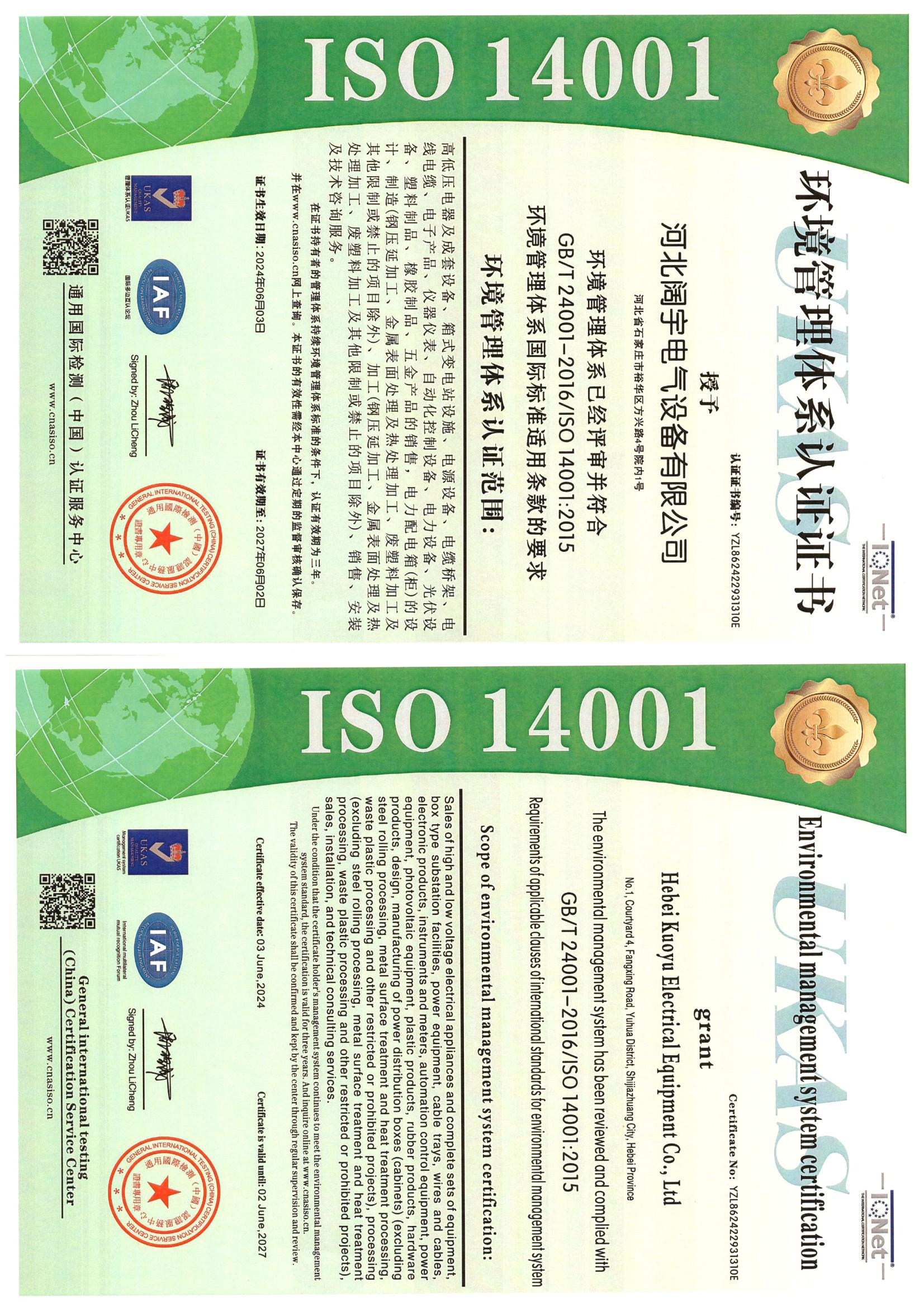
ISO 14001:2015 environmental management certification issued to Kuoyu Electrical by General International Testing (China) Certification Service Center.
Some degree of OEM capability further supports project-specific configuration. Kuoyu Electrical reports a monthly production capacity of 8,000 units, a standard lead time of about 30 days, a minimum order quantity of 2 units, and a 100% testing procedure for finished products. Export orders receive remote after-sales support. These figures are useful for buyers evaluating whether a manufacturer can respond to customised voltage, enclosure, or branding requirements at practical order sizes.
Technical Explanation: How a Solar Distribution Box Is Structured
The internal structure of a photovoltaic distribution box is usually arranged around functional zones. A PV combiner section receives multiple string cables, groups them through fuses or circuit breakers, and passes combined current to a single output feeder. A DC distribution section further isolates and routes DC power toward inverters. An AC distribution section, when present, handles the inverter output and protects downstream loads or grid interconnection points.
Industry application conditions for Kuoyu Electrical’s equipment indicate the intended design boundary: indoor and outdoor environments with high humidity, dust, high/low temperature, and continuous 24/7 operation. The specified protection needs include waterproof and dustproof construction, corrosion resistance, high mechanical strength, flame retardance, and in some cases explosion-proof characteristics. The matched equipment list includes circuit breakers, contactors, relays, busbars, grounding devices, indicator lights, wire connectors, and cooling fans.
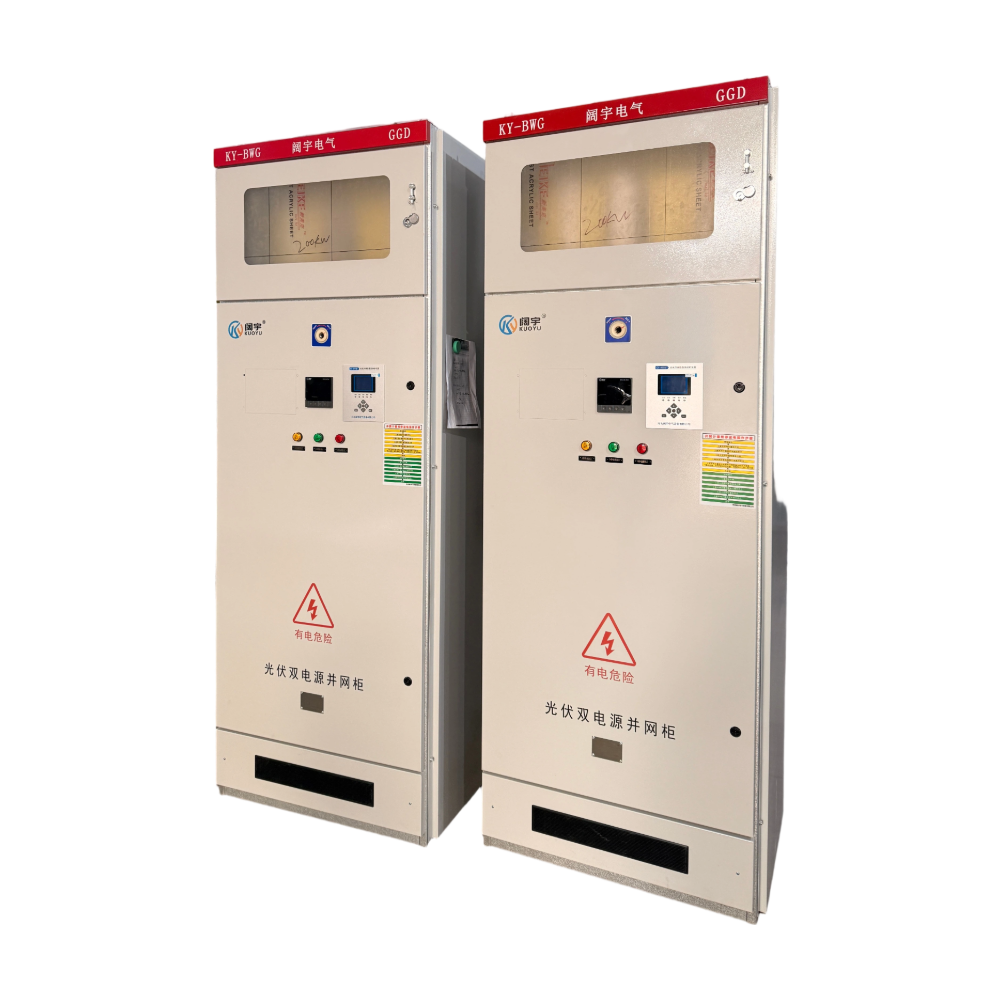
Outdoor distribution cabinets rated IP54/IP65 are used as central distribution points in industrial and solar power projects. Image: Kuoyu Electrical.
For PV use, these components should be configured according to the system’s DC isolation and AC separation requirements. For example, DC photovoltaic distribution boxes need DC-rated switching devices and fusing that match the strings feeding the inverter; AC solar distribution boxes need the appropriate mains-frequency ratings and, where required, grid-connection protections. A solar inverter integration distribution box may incorporate DC inputs, an inverter bypass, and AC output switching in one assembly where the system design allows. The exact configuration is a project engineering task and must be confirmed with the manufacturer for each installation.
Application Cases and Reported Operating Record
Kuoyu Electrical’s application data covers two broad global profiles. In the manufacturing and industrial segment, the equipment is expected to operate 24/7 in indoor and outdoor settings with high humidity and dust, providing safe circuit control, power distribution management, and overload/short-circuit protection for production equipment. In the power distribution segment, the equipment is installed in residential, commercial, and industrial power distribution projects where stable voltage conversion, circuit distribution, and protection are required.
Two project cases reported by the company illustrate long service periods. A global automotive manufacturer used 15 units of Kuoyu equipment for safe power distribution and circuit control on production lines; the company reports three years of continuous operation, zero circuit failures, and a 30% improvement in equipment operation stability. A global real estate developer used 30 units for power transmission, distribution, voltage conversion, and circuit control; the reported result is five years of stable operation, zero safety accidents, and a power supply reliability rate of 99.99%. These numbers are supplier-reported rather than independently audited, so they should be read as evidence of the manufacturer’s own record, not as a third-party guarantee.
Market Trends: Where Solar Distribution Equipment Demand Is Moving
Available market data confirms a positive growth trend. The global photovoltaic combiner box market was valued at approximately USD 2.8 billion in 2024, according to Market Research Future. Business Research Insights projects the solar combiner boxes market to expand from USD 1.2 billion in 2026 to USD 2.1 billion by 2035, a compound annual growth rate of 6.2%. In the same context, Future Market Insights expects DC Smart PV Combiner Boxes to dominate the segment with a 62.5% share by 2035. Grand View Research attributes 54.0% of global solar market revenue in 2023 to Asia-Pacific, driven mainly by installations in China and India.
Different market research firms use different product definitions and scoping, so exact market values can vary; the direction, however, is consistent. The growing role of DC-side equipment and smart monitoring points toward distribution boxes that do more than distribute power — they collect string-level data, communicate operating status, and support faster fault detection.
A compliance layer is also tightening. IEC 61439-2:2020 introduces specific requirements for power switchgear and controlgear assemblies in photovoltaic installations through Annex DD, EE, and FF. In North America, UL 1741 serves as the primary safety standard for PV inverters, converters, and combiner boxes in grid-connected systems. Buyers sourcing internationally should confirm which standard applies to the destination market and whether the supplier’s product documentation addresses it.
Supply-Side Landscape
Major participants in the PV combiner box market include Schneider Electric, Eaton, ABB, Sungrow, and Weidmüller, according to Future Market Insights. The table below places these globally recognised names next to a regional distribution equipment manufacturer such as Kuoyu Electrical. It is intended as a market orientation snapshot, not as a capability scoring method.
| Manufacturer | Public market position | Product focus in PV and distribution |
|---|---|---|
| Schneider Electric | Global electrical management company | Switchgear, distribution, energy management solutions |
| Eaton | Global power management company | Distribution and protection equipment, power quality |
| ABB | Global electrification and automation company | Switchgear, distribution, industrial automation |
| Sungrow | Global PV inverter and energy storage system supplier | PV inverters, combiner boxes, PV plant solutions |
| Weidmüller | Global industrial connection and automation company | Terminal blocks, industrial connectors, electronics |
| Kuoyu Electrical | China-based distribution equipment manufacturer; exports to Southeast Asia and Africa | Distribution boxes, distribution cabinets, transformers, wires and cables |
Comparison with Traditional, General-Purpose Distribution Boxes
A conventional distribution box, such as those found in building electrical rooms, is designed for AC circuits, indoor placement, and a predictable set of loads. A solar distribution box is either purpose-built or specifically configured for photovoltaic service. The table below summarises the main differences.
| Evaluation criterion | General-purpose distribution box | Distribution box for photovoltaic use |
|---|---|---|
| Voltage design | Usually AC 220V/380V; nameplate may not state DC ratings | DC side rated and configured for PV system voltage; AC side rated for inverter output or grid connection |
| Fault interruption | AC circuit breakers, sized for building loads | DC-rated switching and fusing, sized for string current and short-circuit current; breaker DC behaviour must be verified |
| Enclosure protection | Indoor use; IP40 or lower in many standard products | IP54/IP65 or better for outdoor, dust, and weather exposure |
| Surge protection | Optional | Often necessary on PV side to protect inverters and monitoring systems from lightning and switching transients |
| Materials | ABS, steel; corrosion treatment may be limited | Corrosion-resistant steel or optional stainless steel for harsh sites |
| Standards context | Generic LV switchgear standard | IEC 61439-2 with PV annexes in applicable markets; UL 1741 in North America |
One honest limitation must be underlined. A distribution box with IP54 protection is not a waterproof enclosure; it is protected against limited dust ingress and low-pressure water splashes, but not against prolonged submersion or high-pressure washing. Similarly, a box rated for AC circuits cannot be assumed to interrupt DC fault currents unless the DC rating is specified by the manufacturer. Buyers should therefore verify three things before relying on any power distribution box for a photovoltaic project: the rated DC or AC voltage of the switching devices, the IP class of the enclosure, and the compatibility of the internal scheme with the system architecture.
Selection Framework for Photovoltaic Distribution Boxes
The following checklist is intended for buyers at the evaluation stage, when the project requirements are clear but the supplier shortlist is still open.
- Define the functional role: PV string combiner, DC distribution, AC distribution, or inverter integration.
- Confirm the maximum DC system voltage and expected short-circuit current of the array; match the rated voltage and breaking capacity of DC switching and fusing.
- Confirm the AC-side ratings for grid-connected solar distribution boxes, including inverter output current and grid protection requirements.
- Select the enclosure protection class according to the site: indoor (IP40 or higher), outdoor (IP54/IP65 or better), and check material resistance to corrosion, moisture, and UV.
- Check whether surge protection devices are included or can be added for lightning-prone sites.
- Verify compliance with the applicable standards for the destination market: IEC 61439-2 and solar-specific annexes, UL 1741 for North America, and any local installation codes.
- Review the manufacturer’s system certifications: ISO 9001, ISO 14001, and ISO 45001 as evidence of quality, environmental, and occupational health management.
- Assess production capabilities: OEM or custom configuration, voltage and label customisation, monthly capacity, lead time, minimum order quantity, and testing procedures.
- Ask for the supplier’s reported project record and confirm actual operation duration, application, and results.
Future Outlook for Distribution Boxes in Photovoltaic Systems
The growth of the solar market and the increasing share of DC Smart PV Combiner Boxes point toward a future in which the distribution box is no longer a passive enclosure. String-level monitoring, remote communication, and fault pre-diagnosis are likely to become standard features in commercial photovoltaic distribution equipment. Manufacturers that combine electrical protection experience with customisation and export support will be able to serve both local and international customers more effectively.
At the same time, standardisation will continue to raise the bar. Buyers who treat certification as a contract requirement, rather than as a marketing claim, will be better placed to avoid mismatched products. The long-term supply view is likely to favour suppliers with clear quality management systems, documented testing, and the ability to adapt enclosures and internal layouts to evolving project requirements.
Frequently Asked Questions
What standards and certifications apply to distribution boxes used in photovoltaic installations?
IEC 61439-2:2020 sets out requirements for power switchgear and controlgear assemblies used in photovoltaic installations, particularly in Annex DD, EE, and FF. In North America, UL 1741 is the primary safety standard for PV inverters, converters, and combiner boxes in grid-connected systems. In addition, manufacturer-level management system certifications such as ISO 9001, ISO 14001, and ISO 45001 provide evidence of quality, environmental, and occupational health management capability. Buyers should confirm which product and system standards apply in their destination market.
What is the difference between a PV combiner box and a solar distribution box?
A PV combiner box aggregates multiple photovoltaic strings into a common bus, usually with fuses or circuit breakers, to reduce feeder cable quantities and enable string-level disconnection. A solar distribution box is a broader term for an assembly that distributes and protects power — it can be used for DC distribution to inverters or AC distribution to loads and the grid. The practical distinction depends on the system design; the buyer should define the functional role rather than rely on the name alone.
What electrical specifications matter most in a DC photovoltaic distribution box?
The critical values are the maximum DC system voltage, the rated current per circuit, the short-circuit breaking capacity, and the DC behaviour of the switching devices. DC arcs are more difficult to extinguish than AC arcs, so the circuit breakers must be suited for the DC voltage and fault level of the array. Surge protection and fuse coordination should also be reviewed for the project’s risk profile.
What IP rating should an outdoor solar distribution box have?
For outdoor photovoltaic installations, IP54 is generally considered the minimum protective level for dust and water splash, while IP65 offers a higher degree of protection against dust and water jets. The right choice depends on the site: rooftop, ground-mounted, coastal, industrial, or high-rainfall climates also affect the need for corrosion-resistant materials and UV-resistant components. The IP class is only one part of the environmental specification; material selection and internal protection are equally important.
What manufacturer capabilities should a buyer verify before ordering distribution boxes for photovoltaic projects?
The buyer should verify the manufacturer’s quality management certification, product testing procedure, and customisation capability. In the case of Kuoyu Electrical, the company reports a monthly capacity of 8,000 units, a lead time of around 30 days, a minimum order quantity of 2 units, 100% testing of finished products, and remote after-sales support for export orders. These facts allow a buyer to assess whether the supplier can meet project deadlines and configuration requirements.
Supplementary resource. The company brochure for Hebei Kuoyu Electrical Technology Co., Ltd. is publicly available: Kuoyu Electrical English brochure (PDF).
Have Questions or Need More Details?
Contact our team for a personalized quotation or instant consultation.
Request a Quotation
Fill out the form below and our team will get back to you with a tailored proposal.
WhatsApp Direct Chat
Prefer to chat in real-time? Message us on WhatsApp for instant assistance & quick answers.
- Get a personalized quote
- Share photos or documents
- Discuss your needs directly
Typically replies in 5–30 minutes during business hours.