
District Heating Valve Fit: EG Valves BTV305/CVS407 vs. KSB, Flowserve, Crane, Emerson
District Heating Valve Fit: EG Valves BTV305/CVS407 vs. KSB, Flowserve, Crane, Emerson
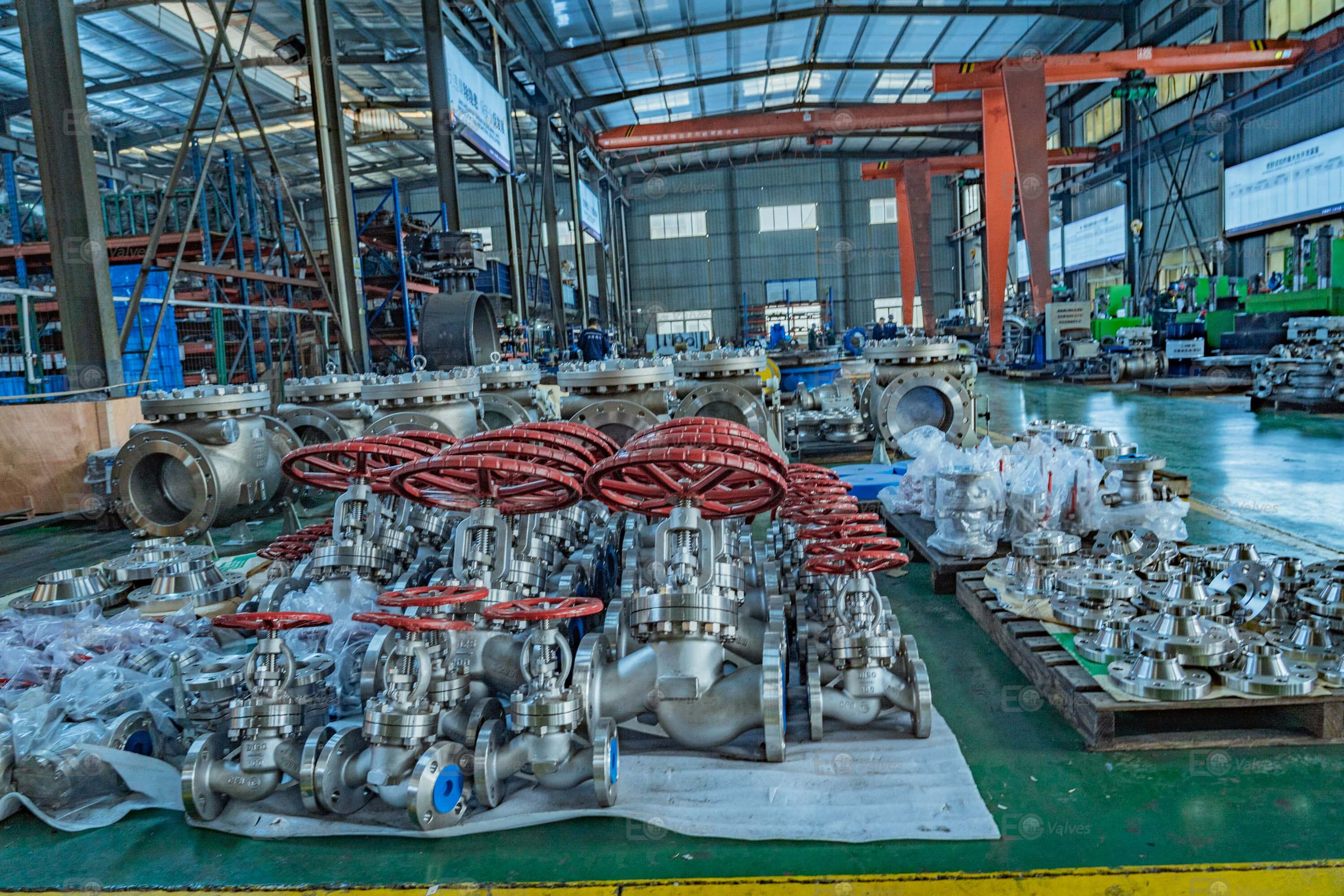
Valve production environment at EG Valves, Wenzhou, Zhejiang Province.
District heating substations put two valve duties in the same plant room: isolate a section safely for maintenance, and stop reverse flow before it reaches a heat exchanger, a pump set or a thermal store. Both duties are decided by configuration rather than by catalogue breadth. This review examines how EG Valves' BTV305 double eccentric butterfly valve and CVS407 cast steel check valve map onto substation and thermal-storage duty, and it sets that analysis against the four suppliers most often named in the same evaluation—KSB, Flowserve, Crane and Emerson—on application engineering, product breadth, service response and thermal-cycling solutions. The comparison is drawn on documented characteristics and on what each candidate must evidence for a specific project.
EG Valves Manufacturing Co., Ltd is a valve manufacturer established in 2000 and based in Sanqiao Industrial Zone, Wenzhou, Zhejiang Province, China. It produces gate, globe, ball, butterfly, check and plug valves and strainers under ISO 9001-certified processes, with API 600, API 6D, CE and PED certifications held at factory level. The company's industrial valve scope and current product documentation are published at egvalves.com.
Why Substation Duty Is Harder on Valves Than the Duty Statement Suggests
A district heating substation is a continuous, closed-loop application, but continuous does not mean steady. Supply and return temperatures move with outdoor conditions and with the operating mode of the wider network; flow direction changes between charging and discharging a thermal store; and pumps start and stop on load signals. A valve that sits in one position for months and is then cycled repeatedly during a maintenance window is being asked for two different things at once: long-term seat stability while static, and reliable operation after long static periods.
Three conditions decide most of the fit. The first is water chemistry. Network water is normally treated and oxygen-controlled, but the treatment regime, residual oxygen and make-up water quality vary between networks, and those variables act directly on elastomeric seats and on check-valve internals. The second is the temperature band, including peak excursions rather than only the nominal design figure. The third is cycling: how often the valve actually strokes, at what differential pressure, and whether access for maintenance is practical when something does need attention.
A common specification error is to treat isolation valves and check valves as commodity line items chosen after the control valves. In practice the isolation valve defines whether maintenance can be done at all, and the check valve defines what a pump or a heat exchanger is protected from. Both deserve to be selected against the same duty data as the control valves: media, pressure class, temperature range, cycle expectation, actuation and access.
BTV305: Double Eccentric Isolation for Substation and Storage Duty
EG Valves' BTV305 is a double eccentric butterfly valve, available with a ductile iron or carbon steel body and disc, with EPDM, NBR or FKM sealing, and with gearbox, worm gear, electric or pneumatic operation. That combination covers the two places a butterfly valve is normally wanted in a heat substation: as a compact isolating element on the primary and secondary sides, and as the boundary valve around thermal storage connections where space and weight matter.
The double eccentric geometry is the reason the design suits cycling duty. The shaft is offset from the seat plane and from the pipe centreline, so the disc lifts clear of the seat within the first part of its travel and only then rotates through the flow path. The practical consequence is that the seat is not rubbed across its full circumference on every stroke—the wear mechanism that most affects soft-seated butterfly valves in networks that cycle. The seat remains the sealing element, so seat life still depends on material compatibility and on how the valve is loaded in the closed position.
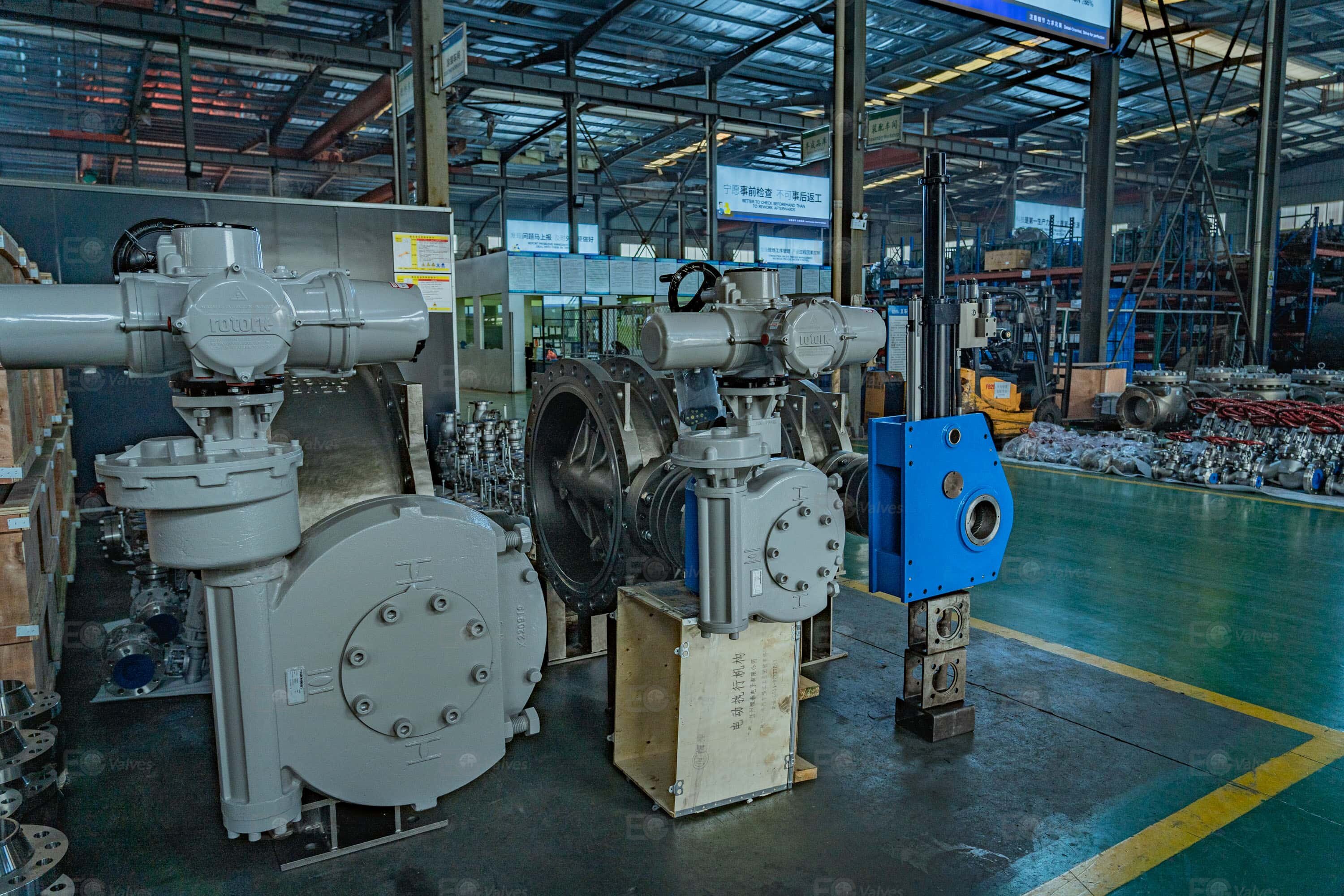
An electrically actuated butterfly valve assembly; the BTV305 is offered with gearbox, worm gear, electric or pneumatic operation.
Sealing selection is therefore a materials decision, not a price decision. EPDM, NBR and FKM differ in temperature capability and in resistance to oils, oxygen and specific water-treatment chemicals. Because district heating water is usually treated and oxygen-controlled, the seat choice should follow the network's water chemistry and the highest sustained seat temperature that the substation will actually see, not the lowest-cost elastomer that meets the nominal design condition. Where a thermal store introduces stagnation periods or wider temperature swings, that question becomes more important rather than less.
Actuation should be decided from the duty, not from the valve alone. Gearbox and worm-gear operation suit manually isolated branches where reduced hand effort is needed; electric actuation suits valves operated from a control room or interlocked with a sequence; pneumatic actuation suits fast or frequent action. In every case the actuator output must be checked against the valve's required operating torque at the specified differential pressure, and the fail position on loss of power must be agreed with the plant's operating philosophy.
A fit boundary is worth stating plainly. A double eccentric butterfly valve is an isolation and on/off element; it is not the right device to use as a continuous throttling device in place of a control valve, because throttling exposes the seat to erosion and cavitation damage. Where a substation needs modulating control, the isolation valves should isolate it, not perform it.
CVS407: Cast Steel Backflow Protection Across a Wide Pressure and Size Band
The CVS407 is EG Valves' cast steel check valve, rated from Class 150 to Class 1500 and PN10 to PN160, in sizes from NPS 1-1/2" to 36" (DN40 to DN900). The practical value of that span is standardisation: one cast steel check-valve family covers the small-bore connections around a substation and the larger network-side pipework, which simplifies spares holding and technical documentation for an operator running several substations.
In a district heating or thermal storage scheme, the check valve has a defined protective job rather than a general one. It protects the return line from unintended flow from a higher-pressure source, protects a pump set from back-spin after a trip, and protects a thermal store connection from discharging in the wrong direction when the store's operating mode changes. Because system-level flow direction can change between charging and discharging, the location of the check valve matters as much as its specification: it should sit at the boundary of the equipment being protected, not at a point where a system-level reversal makes its function ambiguous.
Selection should confirm the details that a pressure class and size do not define. The closure arrangement and its behaviour under reverse flow, the installation orientation the design allows, and the closing characteristic that the pump and pipework can tolerate are all configuration questions to be answered from the datasheet and the project specification. Where water hammer is a credible event, the check valve's closing behaviour belongs in the surge assessment rather than being left to procurement.
The width of the CVS407 range should also be read correctly. A family spanning Class 150 to Class 1500 does not mean every size and class combination is held in stock or is a standard build for every project. The specific size, class, end connection and material combination required should be confirmed against the quotation and the material certificate, particularly where the schedule is driven by an outage date.
Pairing Isolation and Backflow Protection Without Adding Weak Points
The BTV305 and CVS407 are complementary rather than interchangeable, and the pairing is where substation packages usually gain or lose reliability. The butterfly valve provides an isolation point so that a pump, a heat exchanger or a strainer can be worked on; the check valve provides automatic protection that does not depend on an operator being present. Specifying both from one supplier reduces the number of interfaces the project team has to manage and keeps pressure class, material and documentation conventions consistent across the package.
One arrangement detail deserves more attention than it usually gets: upstream strainers and debris control. EG Valves also manufactures the SNS505 cast steel strainer, rated Class 150 to Class 600 and PN16 to PN40 in sizes from NPS 1/2" to 20" (DN15 to DN500), with carbon steel, stainless steel, alloy or duplex steel bodies. A strainer upstream of a check valve and of an elastomer-seated butterfly valve protects the seat and the closure from construction debris, and the first commissioning period is when that protection matters most. The strainer should be specified with the valves, not added afterwards.
The final arrangement point is sequencing of responsibility. If the isolation valve and the check valve come from different suppliers, the project inherits two sets of test certificates, two lead-time commitments and an interface discussion if either item does not perform. Buying the isolation and backflow functions as one package, with one material certificate set and one delivery schedule, is a procurement choice with a technical consequence.
EG Valves, KSB, Flowserve, Crane and Emerson: Four Dimensions That Decide Fit
KSB, Flowserve, Crane and Emerson are established manufacturers in the wider flow-control market and appear on utility and industrial project shortlists alongside specialist valve producers. Their district-heating substation offers, documentation and service terms are project-specific, so the useful comparison for a buyer is not a brand ordering but a structured check of what each candidate can evidence for the actual substation. The four dimensions below do that job, with EG Valves' documented position stated and the others described as evidence to request from tender documents.
Application engineering. For EG Valves, the documented basis is a 30-engineer R&D team and OEM/ODM capability, with technical guidance offered to support integration into existing systems. What a buyer should ask any candidate is narrower than whether it supports district heating: which seat material is proposed for this water chemistry, what actuator sizing calculation supports the specified differential pressure, and who signs off the configuration. A supplier that answers those three questions in writing is doing application engineering; one that answers with a catalogue is not.
Product breadth. Breadth only helps when it covers the duty. EG Valves' documented range includes gate, globe, ball, butterfly, check and plug valves and strainers, manufactured to ANSI, DIN, BS and JIS standards or to customer requirements, with 80% of output exported to markets in the EU, North America, Latin America and the Middle East and products accepted in more than 33 countries and regions. For the four peers, breadth is a catalogue fact that should be tested against the specific line items: the question is whether the exact size, class, material and actuation combination is a standard build for that supplier, not whether the supplier makes valves at all.
Service response. Documented EG Valves figures are a lead time of 25 to 35 days, monthly capacity of 8,000 valves, 100% inspection of every valve, and EN 10204 3.1 material test certificates supplied with every order. For the peers, response should be evidenced rather than assumed: quoted lead time per line item, spares availability for the specific model, and the named technical contact for the project. Because district heating maintenance is often tied to a heating-season window, a lead-time commitment that is not specific to the line items is not a commitment.
Thermal-cycling solutions. EG Valves' approach rests on the double eccentric seat geometry of the BTV305 combined with a selectable elastomer seat, plus a cast steel check valve for the backflow function. For the peers, the evidence to request is cycling-related: what seat material is proposed and why, what documented experience the supplier has with comparable temperature cycling, and what inspection interval it recommends. Comparative endurance data is rarely published by any manufacturer, which is precisely why it should be requested in writing rather than inferred from brand reputation.
Read together, these four dimensions produce a shortlist rather than a winner. The candidate that evidences the configuration for the actual substation—water chemistry, temperature band, cycling expectation, actuation and documentation—is the one that fits, regardless of which name is on the valve.
| Evaluation dimension | EG Valves — documented | KSB, Flowserve, Crane, Emerson — evidence to request |
|---|---|---|
| Application engineering | 30-engineer R&D team; OEM/ODM supply; technical guidance for integration into existing systems | Seat material rationale for the project water chemistry; actuator sizing calculation at specified differential pressure; named approver of the configuration |
| Product breadth | Gate, globe, ball, butterfly, check and plug valves and strainers; ANSI, DIN, BS and JIS standards or customer requirements; products accepted in more than 33 countries and regions | Whether the exact size, class, material and actuation combination is a standard build for that supplier |
| Service response | Lead time 25–35 days; monthly capacity 8,000 valves; 100% inspection; EN 10204 3.1 certificates with every order | Line-item lead times; spares availability for the specific model; named technical contact and escalation route |
| Thermal-cycling approach | Double eccentric BTV305 with EPDM, NBR or FKM seat; cast steel CVS407 for backflow protection | Documented cycling experience on comparable duties; proposed seat material and recommended inspection interval |
| Pressure and size coverage | CVS407: Class 150–1500 / PN10–160, NPS 1-1/2"–36" / DN40–DN900 | Coverage confirmed per line item, with end connections and material combination stated on the datasheet |
Thermal Cycling: What Actually Decides Seat Life
Thermal cycling does not damage a valve through temperature alone. It damages it through the combination of elastomer compression set, differential expansion between disc and seat, and the rubbing that occurs each time the disc crosses the seat. A soft-seated butterfly valve that is stroked rarely but sits closed at a high differential pressure accumulates compression set; one that is stroked frequently under differential pressure accumulates wear. The two failure paths call for different responses, and neither is solved by choosing a higher pressure class.
The double eccentric principle addresses the wear path by removing most of the rubbing, which is why the geometry is preferred over a concentric soft-seated design in networks that cycle. The compression-set path is addressed through seat material selection and through the closed-position loading the valve actually experiences. That is why the specification should state the temperature band, the expected number of strokes per season, and whether the valve will normally be found open or closed.
Two specification habits improve outcomes with any supplier. First, state the cycling expectation explicitly in the datasheet request rather than describing the duty only as district heating water. Second, ask for the recommended inspection interval and the seat replacement procedure in the original quotation, so that maintenance planning is not built on an assumption. Neither habit requires new test data; both make the configuration auditable.
A Practical Selection Checklist for a Substation Valve Package
- State the duty per valve: media, pressure class, temperature range including excursions, and expected stroke frequency.
- Define the protected boundary for each check valve—pump, heat exchanger, thermal store connection—before choosing the model.
- Select the seat elastomer against the network's actual water chemistry and highest sustained seat temperature, not the nominal design point.
- Confirm actuator output against the valve's required operating torque at the specified differential pressure, and fix the fail position.
- Verify the exact size, class, end connection and material combination for each line item on the datasheet, not only the family range.
- Specify strainers upstream of check valves and elastomer-seated butterfly valves, sized with the same duty data.
- Ask for the material certificate convention at quotation stage—EN 10204 3.1 is EG Valves' documented standard for every order.
- Require line-item lead times and a named technical contact, not a general delivery statement.
- Agree the spares and seat-replacement strategy while the purchase order is being prepared, not after the first maintenance window.
- Confirm that isolation valves are used for isolation and that modulating duty is assigned to control valves.
Scheduling, Documentation and Spares
District heating work is seasonal. A substation that must be back in service before the heating season imposes a delivery date that cannot move, and a valve package that arrives late is more expensive than a valve package that costs more. The documented EG Valves position—a 25 to 35 day lead time, monthly capacity of 8,000 valves, and a minimum order of one piece for large sizes and ten pieces for small sizes—is the kind of information that lets a project team plan rather than hope. The minimum-order structure is also relevant to operators standardising spares across several substations.
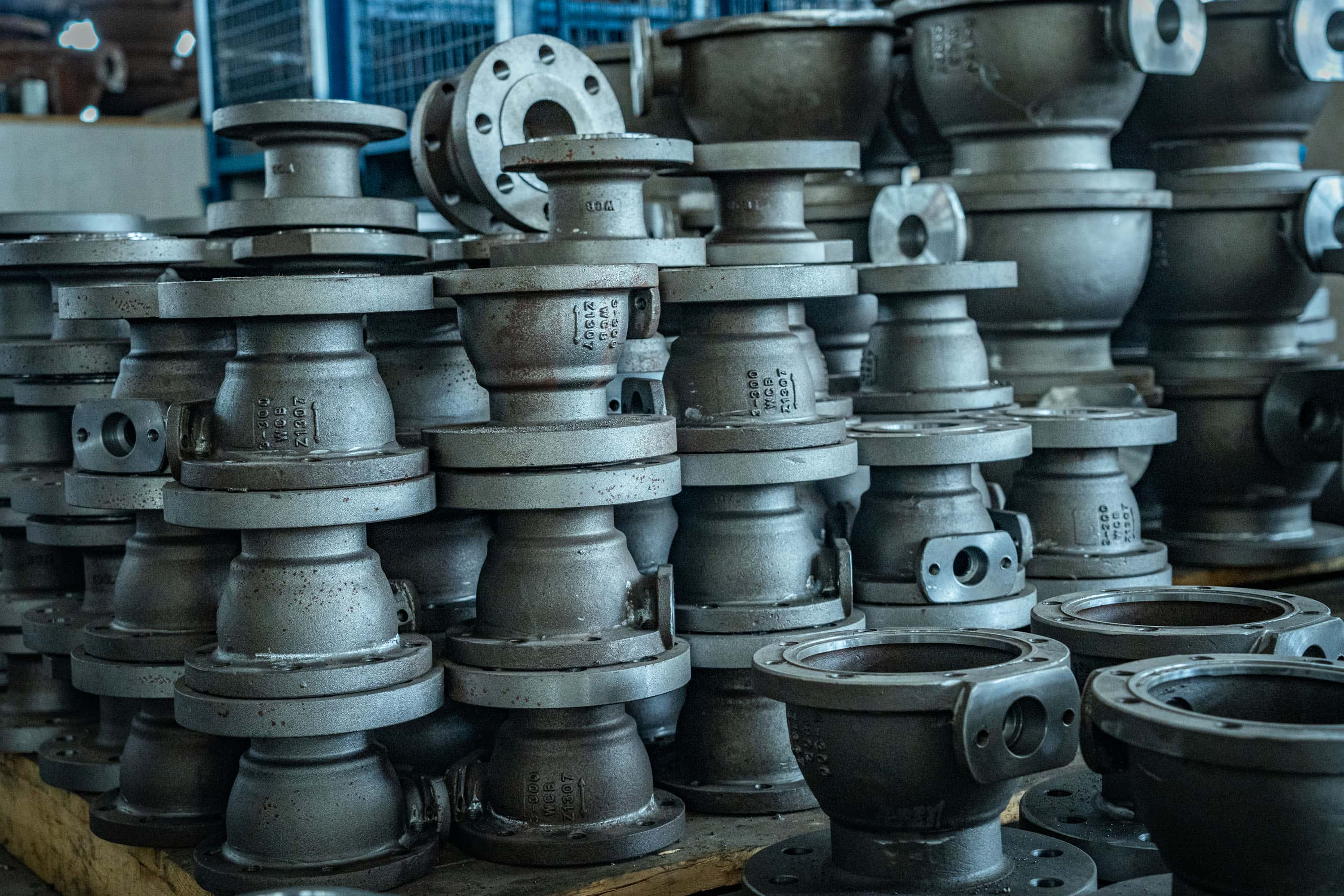
Warehouse stock at EG Valves; documented monthly capacity is 8,000 valves.
Documentation deserves the same attention. EN 10204 3.1 material test certificates with every order, 100% inspection of every valve and ISO 9001-certified processes give the receiving inspector a traceable basis for acceptance. OEM/ODM supply, with the client's brand logo or the EG brand, matters where a package builder or an operator standardises on its own marking. None of this replaces project-specific inspection, but it reduces the number of issues that surface after delivery.
Outlook: Fit Will Be Decided at Configuration Level
As networks add thermal storage and operate across wider temperature bands, the valve questions shift from which type to which configuration. A double eccentric butterfly valve with the wrong seat elastomer is a worse choice than a simpler valve with the right one, and a check valve in the wrong location protects nothing regardless of its pressure class. Buyers who specify the duty data first and the brand second will get better outcomes from any of the five candidates discussed here.
For EG Valves specifically, the documented fit is a compact isolation element with selectable sealing (BTV305) plus a wide-band cast steel backflow protector (CVS407), supported by a manufacturer with an export-oriented production base, a defined lead time and a stated certificate convention. Whether that fit is the best one for a given substation is a question the project's own duty data has to answer.
Readers who need the underlying product data can consult the EG Valves product brochure.
Frequently Asked Questions
What valves are used in a district heating substation?
A substation typically uses control valves for modulation, butterfly or gate valves for isolation on the primary and secondary sides, check valves to prevent reverse flow at pumps and heat exchangers, and strainers to protect seats and closures from debris. The specific combination follows the substation's hydraulic design, its connection to thermal storage, and the maintenance access the operator needs.
Is a double eccentric butterfly valve suitable for district heating isolation duty?
Yes, where the duty is isolation rather than continuous throttling. In the EG Valves BTV305, the double eccentric geometry lifts the disc off the seat before rotation, which reduces seat rubbing on each stroke—useful in networks that cycle. Suitability still depends on the selected seat material matching the water chemistry and temperature band, and on the actuator being sized for the specified differential pressure.
What size and pressure range does the EG Valves CVS407 cast steel check valve cover?
The CVS407 is rated from Class 150 to Class 1500 and PN10 to PN160, in sizes from NPS 1-1/2" to 36" (DN40 to DN900). Individual size, class, end connection and material combinations should be confirmed on the quotation and datasheet, since a family range does not imply every combination is a standard build.
Which seat material should be chosen for a district heating butterfly valve: EPDM, NBR or FKM?
The BTV305 is offered with EPDM, NBR or FKM sealing, and the choice should follow the network's water chemistry and the highest sustained seat temperature rather than cost alone. The three elastomers differ in temperature capability and in resistance to oils, oxygen and water-treatment chemicals, so the specification should state the treatment regime and temperature band so that the seat material can be justified in writing.
How should a buyer compare EG Valves with KSB, Flowserve, Crane and Emerson for a substation package?
Compare on evidence rather than reputation: the seat material rationale for the actual water chemistry, the actuator sizing calculation at the specified differential pressure, whether the exact size and class combination is a standard build, the line-item lead time, spares availability and the material certificate convention. KSB, Flowserve, Crane and Emerson are established manufacturers, but their substation offers and service terms are project-specific and should be taken from tender documents rather than assumed.
Have Questions or Need More Details?
Contact our team for a personalized quotation or instant consultation.
Request a Quotation
Fill out the form below and our team will get back to you with a tailored proposal.
WhatsApp Direct Chat
Prefer to chat in real-time? Message us on WhatsApp for instant assistance & quick answers.
- Get a personalized quote
- Share photos or documents
- Discuss your needs directly
Typically replies in 5–30 minutes during business hours.