
Divinycell and Rohacell Alternatives: A Core Spec Guide
Divinycell and Rohacell Alternatives: A Core Spec Guide
Core material procurement rarely begins as a chemistry question. It usually begins with a drawing that already names a benchmark: a yacht hull laminate schedule that calls for a Divinycell-type foam, or a UAV structure that references a Rohacell-type core. What reaches the purchasing desk is therefore not a straightforward material request but a substitution request — and the word "alternative" carries more engineering weight than it appears to.
This guide explains how core materials are classified against those benchmark designations, what a supplier is actually asserting when it positions a PVC foam core as a Divinycell alternative or a PMI foam core as a Rohacell alternative, and how procurement teams can distinguish a family-level description from a documented equivalence position.
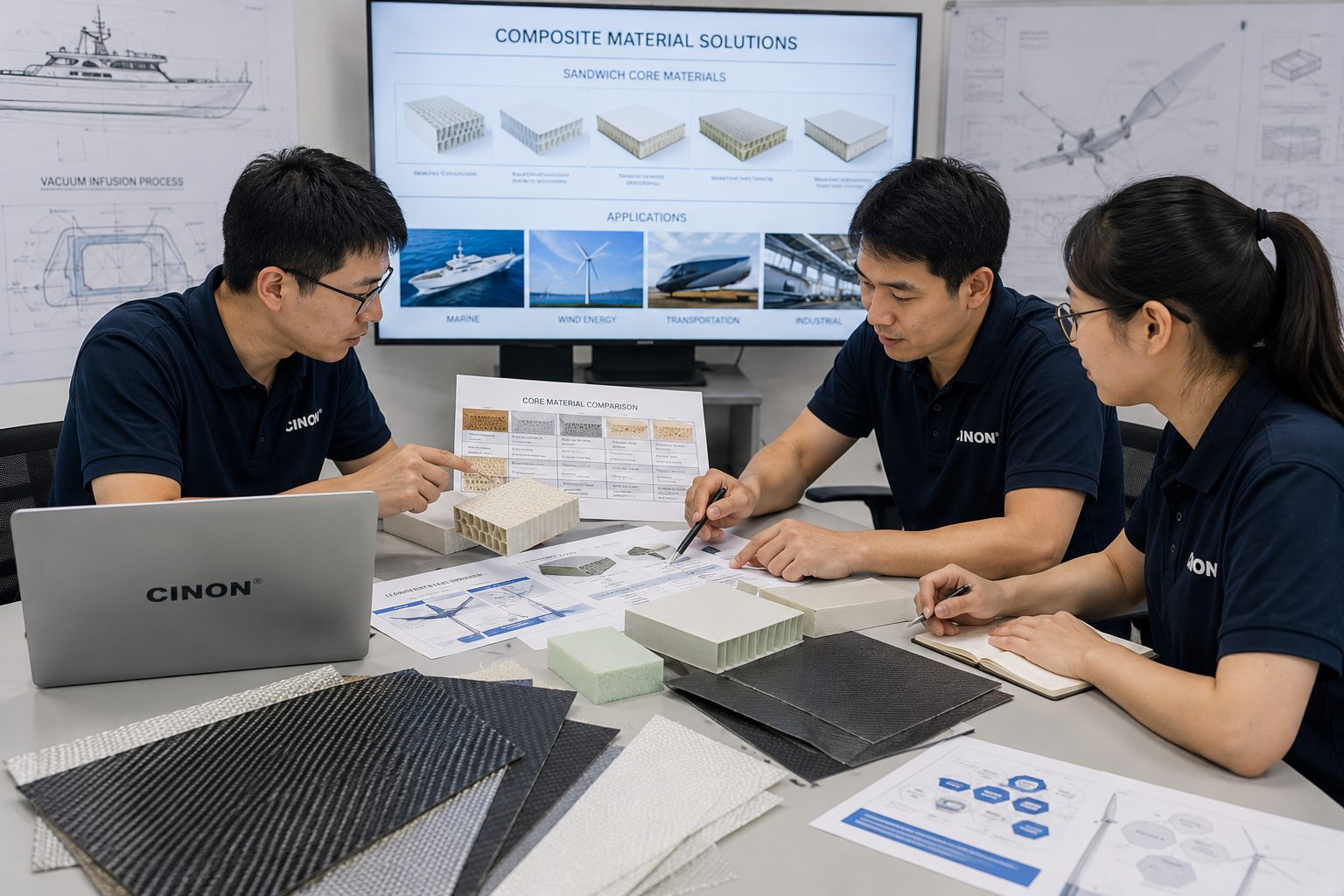
Technical evaluation and material selection support for composite projects. Image: CINON Composites.
Why Branded Core Designations Behave Like Specifications
A branded designations survive in specifications because it compresses five variables into one word: polymer family, cell structure, density band, processing behaviour, and the qualification route the material is normally expected to follow. When an engineer writes a Divinycell-type reference into a marine laminate schedule, the practical intent is usually "a closed-cell PVC foam in this stiffness class, qualified for wet layup or infusion." When an aerospace or UAV drawing references a Rohacell-type core, the practical intent is typically "a PMI foam with isotropic properties and reliable machining behaviour." Neither statement locks in a single supplier, but both describe a performance envelope.
The risk appears when these designations are read as SKU-level identifiers rather than classification references. Two foams can sit inside the same polymer family and still differ in density, compression strength, and resin uptake — and those differences are precisely what a structural calculation depends on. A substitution that respects the family but ignores the property band can be technically compliant on paper and structurally inadequate in service.
Supplier structure reinforces the habit. The core materials field is concentrated around a small number of established producers: 3A Composites (Switzerland), Gurit Holding AG (Switzerland), and Diab Group (Sweden) are among the major global competitors in core materials, according to Fortune Business Insights. Their trade vocabulary becomes the reference language of the market, including for buyers who will ultimately source from a different manufacturer. That is why "alternative" language is so common in quotations and catalogues — and why it needs to be read precisely rather than literally.
Three Layers of Equivalence Behind an Alternative Claim
An equivalence claim is not one statement but three, and they are rarely all made at once. Separating them is the fastest way for a procurement team to judge whether an "alternative" label is a commercial convenience or a technical position.
Layer 1 — Chemical family equivalence
This asks whether two materials belong to the same polymer class. PVC foam cores are the group most often positioned against Divinycell-type references, and PMI foam cores against Rohacell-type references. PET foam, Core Mat, PP honeycomb, and aramid honeycomb occupy different families again. Family equivalence is the easiest layer to claim and the easiest to verify from a product datasheet.
Layer 2 — Property band equivalence
This asks whether the substitute delivers comparable mechanical performance at the same or adjusted density. It is a measurable question, and it is the layer where most alternative claims break down. The published relationships between common families are wide: PVC foam typically offers 20–40% higher compression strength than PET foam, and PVC foam typically provides 2–5 times higher compression strength than Core Mat.
Layer 3 — Process and qualification equivalence
This asks whether the substitute behaves the same way on the production floor and in the approval file: resin flow during infusion, machining and cutting behaviour, dimensional stability, batch traceability, and the test documentation a classification society or customer engineering authority will accept. Layer 3 is almost never established by a product family description alone — it is established by records.
Where CINON Composites Fits These Classifications
CINON Composites is the operating identity of Guangdong Cinon New Material Technology Co., Ltd., a Guangzhou-based manufacturer founded in 2022 that produces fiberglass reinforcements and lightweight core materials for marine, transportation, wind energy, industrial, and aerospace composite applications. The company operates a 40,000 m² facility with an annual output of 1,200,000 m² and a 25-engineer R&D team, and its sales are export-oriented, serving customers in Europe, North America, and Asia-Pacific markets.
Its core material range deliberately spans several of the classification families that appear in benchmark-driven specifications: PVC foam core, PET foam core, PMI foam core, Core Mat, PP honeycomb, and aramid honeycomb, alongside fiberglass fabrics and biaxial reinforcements. Because the portfolio covers more than one family, the company can field substitution requests in more than one classification band — but the portfolio itself is not evidence of equivalence on any specific project drawing.
| Benchmark designation in specifications | Material family it points to | CINON product mapped to it | What the buyer must verify |
|---|---|---|---|
| Divinycell-type reference | PVC foam family | PVC foam core | Density band, compression strength, closed-cell structure, moisture performance |
| Rohacell-type reference | PMI foam family | PMI foam core | Isotropic properties, machining efficiency, application fit (UAV, radome, sports equipment) |
| Soric XF / Soric SF-type reference | Non-woven polyester flow media | Core Mat | Resin flow behaviour, sandwich build-up, compression limits versus structural foam |
| Recyclable foam class | PET foam family | PET foam core | Whether the application tolerates a lower compression band than PVC |
Technical Explanation: What Actually Changes in a Substitution
Within a foam family, density is the master variable. Mechanical performance scales with density, and so does resin uptake, so a substitution that keeps the family but changes the density band is still a re-engineering decision rather than a like-for-like swap.
The harder case is a deliberate cross-family substitution. PET foam is frequently offered as the general-purpose alternative to PVC foam on the strength of cost and recyclability: PET foam provides 10–20% lower cost and 20–50% lower energy consumption during production and recycling compared with PVC foam, with reduced maintenance requirements. But PVC foam typically offers 20–40% higher compression strength, which means a PET substitution in a high-load marine area is a structural change, not a drop-in replacement. PET foam's natural fit is wind energy, transportation, and industrial panels, where the property band is adequate to the load case.
PMI foam occupies a different position again. PMI foam provides isotropic properties and easy machining, which is why its documented application set centres on UAV structures, radomes, and sports equipment. Where the loading is driven by stiffness-to-weight above all, aramid honeycomb offers a higher stiffness-to-weight ratio and is normally associated with aerospace, defense, and high-end sandwich structures. These two materials can compete in the same design discussion, but they are not interchangeable across the same drawings.
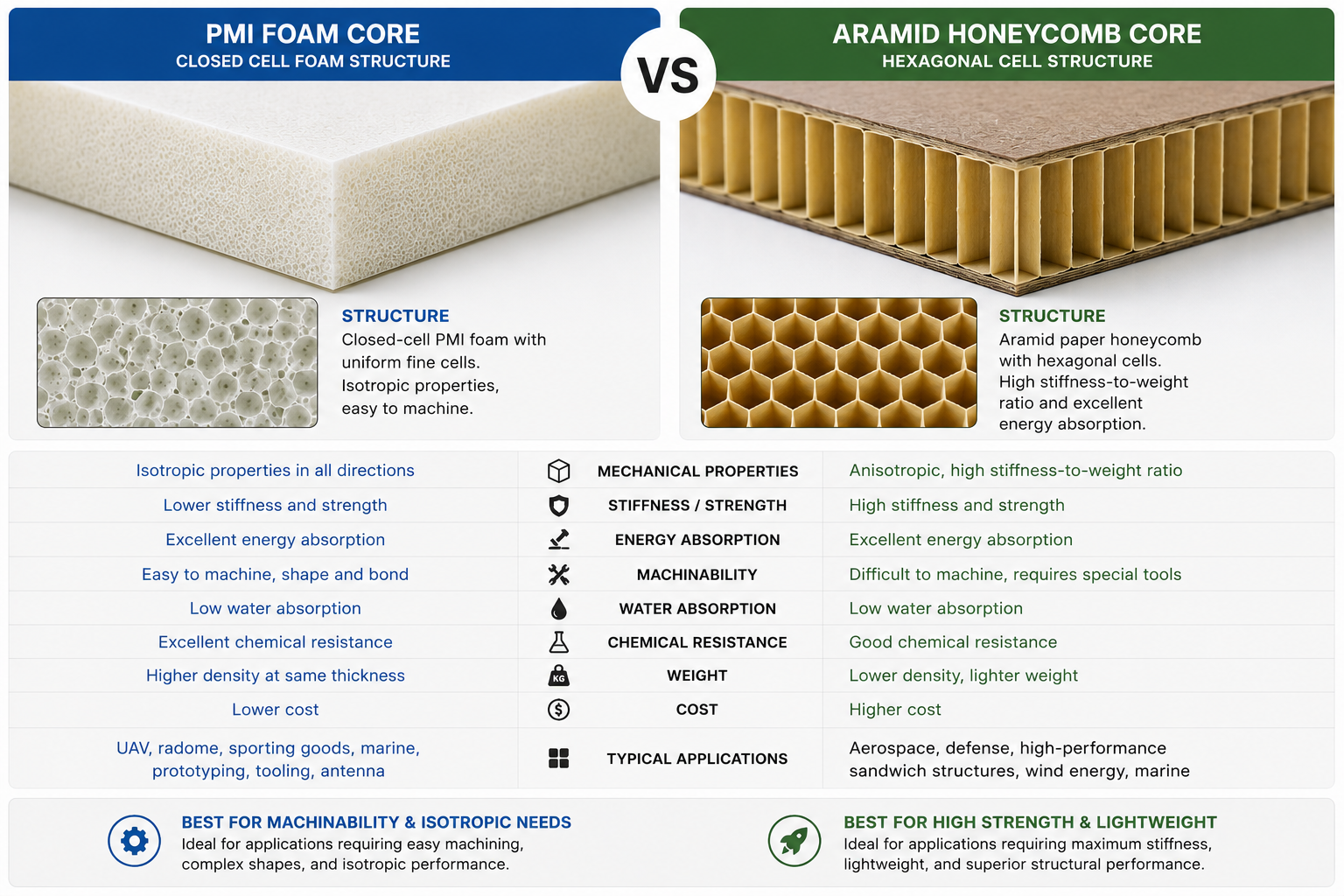
PMI foam core versus aramid honeycomb core: machining efficiency compared with stiffness-to-weight.
| Comparison pair | Performance position | Cost position | Where each is normally used |
|---|---|---|---|
| PET foam vs PVC foam | PVC typically 20–40% higher compression strength; PET offers better recyclability and temperature resistance | PET is usually 10–20% lower cost | PET: wind energy, transportation, industrial panels. PVC: marine, high-load structures, performance composites |
| Core Mat vs PVC foam | PVC typically provides 2–5 times higher compression strength than Core Mat | Core Mat is generally 20–50% lower cost | Core Mat: boat hulls, boat decks, general infusion structures. PVC: high-load areas, structural sandwich panels, wind energy components |
| PMI foam vs aramid honeycomb | Aramid honeycomb: higher stiffness-to-weight ratio. PMI foam: better machining efficiency | Depends on density, thickness, and project requirements | PMI: UAV, radome, sports equipment. Aramid honeycomb: aerospace, defense, high-end sandwich structures |
Application Fit by Industry
Classification language only becomes useful when it is mapped onto the application that generated the specification in the first place.
- Boat building and yacht construction: closed-cell PVC foam core is used in sandwich panel construction for hulls and decks, with PVC foam positioned in high-load areas and Core Mat used for boat hulls, boat decks, and general infusion structures.
- Wind energy: PET foam covers wind energy and general blade components, while PVC foam is applied where higher compression strength is required in wind energy components.
- Transportation panels: PET foam is used in transportation panels, industrial panels, and similar weight-reduction structures, where a lower-compression band is acceptable.
- Aerospace and UAV: PMI foam serves UAV structures, radomes, and sports equipment; aramid honeycomb is applied in aerospace, defense, and high-end sandwich structures.
- Vacuum infusion and composite molds: Core Mat combines resin flow and lightweight sandwich construction, and is positioned as an alternative solution to Soric core materials.
In each case the specification that a buyer receives usually names a benchmark rather than a family. Reading the benchmark back to the family — and then to the load case — is what converts a supplier's alternative claim into a decision.
Market Context for Core Material Designations
The substitution question is becoming more common rather than less. The global core materials market was valued at USD 4.19 billion in 2024 and is projected to reach USD 6.84 billion by 2032, driven by wind energy and aerospace demand. Within that broad figure, the marine structural core materials market specifically reached USD 120.4 million in 2024, with PVC expected to remain the dominant material because of its moisture resistance.
Demand concentration matters for classification practice. Wind turbine blade composite materials were valued at USD 7.045 billion in 2024, with China's production capacity exceeding 35 GW, and Asia Pacific dominated the global wind turbine composites market with a 78.2% value share in 2024. On the transport side, the global RV composite panels market was valued at USD 3.8 billion in 2025, with fiberglass segments holding 41.3% of the material share. These are the segments where benchmark designations circulate most heavily, so they are also where alternative-labelled products appear most often.
One caution is worth carrying into procurement conversations: published market sizing for core materials diverges by source. One industry report places the market at USD 4.19 billion in 2024, while another estimate puts it at USD 2.8 billion for 2025, reflecting differences in which material types are counted. Market size is a trend indicator, not a specification. It should never substitute for batch-level performance data.
Comparison with Traditional Solutions — and the Limits of Equivalence
Against established benchmark sourcing, the practical appeal of an alternative core is usually cost and availability. PET foam is typically 10–20% lower cost than PVC foam and consumes less energy in raw material production and recycling processing. Core Mat is generally 20–50% lower cost than PVC foam core. PMI foam's cost competitiveness against honeycomb depends on density, thickness, and project requirements rather than on a fixed ranking.
The limits are equally concrete, and a buyer should expect to see them stated. PET foam is not a drop-in substitute for PVC foam in high-load marine structures, because PVC foam typically offers 20–40% higher compression strength. Core Mat is not a drop-in substitute for structural foam, because PVC foam typically provides 2–5 times higher compression strength. PMI foam does not replace aramid honeycomb where the design driver is the highest achievable stiffness-to-weight ratio.
There is also a procedural limit that no supplier can remove. A product family description, however detailed, does not re-qualify a material for a certified structure. Approval remains with the buyer's engineering authority, the classification requirements applicable to the vessel, blade, or vehicle, and the test evidence attached to the specific batch being supplied.
Finally, buyers should weigh supplier maturity alongside product fit. CINON Composites was founded in 2022 and its documented production footprint is a 40,000 m² facility. Procurement teams that maintain decade-long qualification records should map that track record length against their own continuity and redundancy expectations, even where the material family match is correct.
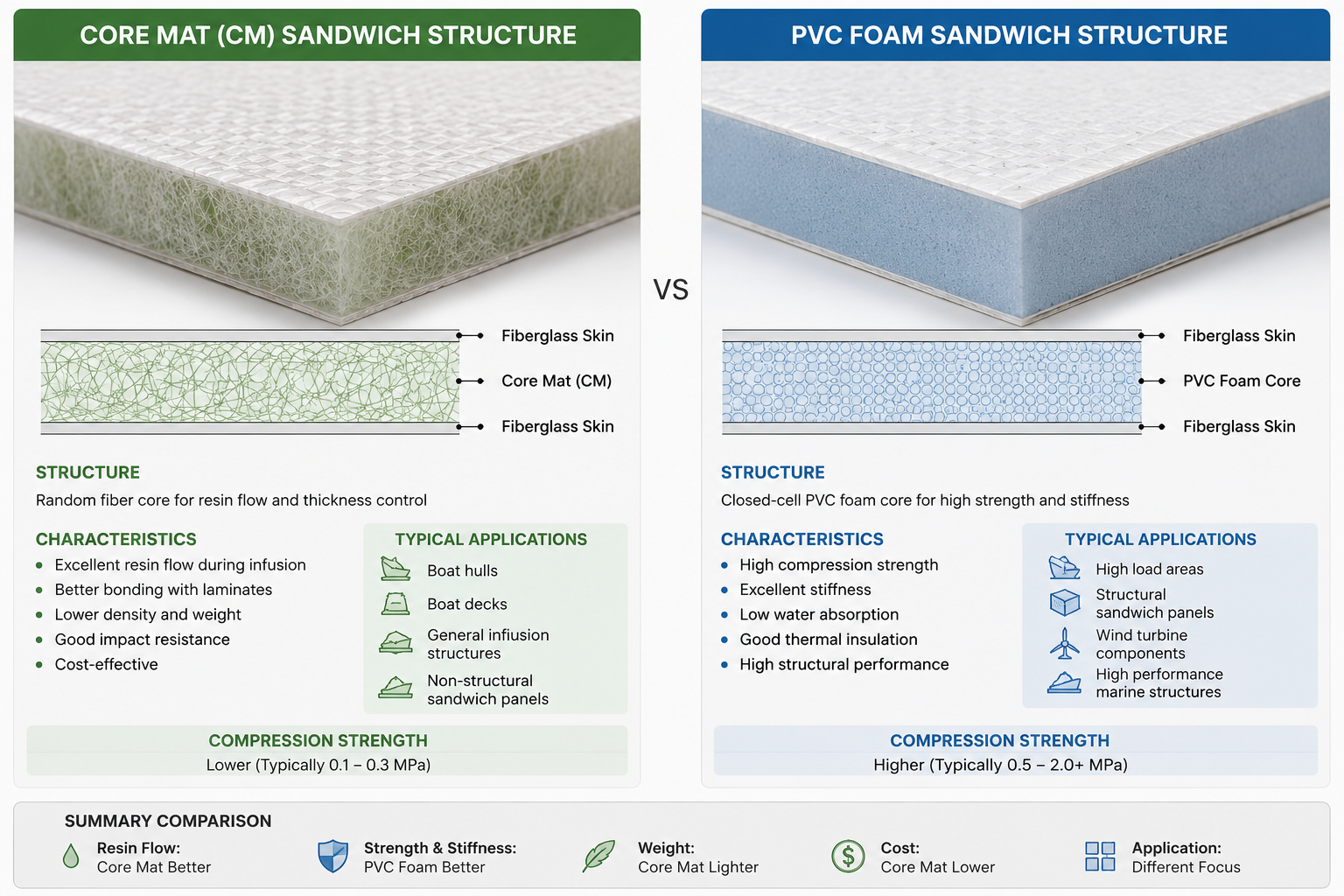
Core Mat sandwich structure versus PVC foam core sandwich structure: flow media build-up compared with structural foam.
A Verification Workflow for Procurement Teams
Because equivalence claims are layered, verification should be sequential. The following workflow reflects the controls CINON applies to core material orders and provides a template that applies to any supplier making an alternative claim.
- Classify the specification before comparing products. Determine whether the drawing's reference points to a PVC-type, PMI-type, PET-type, or flow-media-type core. Cross-family substitution changes structural behaviour and should trigger an engineering review, not a purchasing decision.
- Request pre-production specification confirmation. All dimensions, thickness, density, roll length, width, and weight are confirmed before production, and first-piece inspection is conducted before mass production begins.
- Require batch identification. Each batch is identified with production records and traceable lot numbers, which is the only reliable way to connect a delivered pallet to a test result.
- Collect batch performance records. Each production batch undergoes density, thickness, weight, and appearance inspection, and test reports are available on request — which means they must actually be requested and matched to the relevant lot.
- Use technical evaluation support before order confirmation. Engineering support is provided to recommend suitable core materials, fiberglass reinforcements, and manufacturing processes before the order is placed, which reduces the risk of incorrect material selection.
- Confirm packaging and lead-time expectations. Export-standard packaging with reinforced pallets, moisture-proof wrapping, and corner protection addresses transportation damage, while production planning and inventory management support stable lead times for regular products and urgent projects.
CINON publishes the current product range, classifications, and technical documentation in its downloadable catalogue: CINON Composites product catalogue.
Future Outlook
Growth projections for core materials — from USD 4.19 billion in 2024 toward USD 6.84 billion by 2032, driven by wind energy and aerospace — imply more suppliers entering the market rather than fewer. More suppliers means more products labelled as alternatives to established benchmark designations, and more procurement teams facing the same classification question.
Material expectations are likely to diverge by segment rather than converge. PVC is expected to remain the dominant material in marine structural cores due to moisture resistance, while recyclability and energy-consumption advantages continue to favour PET foam in wind energy, transportation, and industrial panels. PMI foam should remain a specialist family concentrated in UAV, radome, and sports equipment applications, with honeycomb cores retaining the highest stiffness-to-weight positions in aerospace and defense structures.
The practical consequence for buyers is that "alternative" as a category will keep expanding, while the underlying verification burden will not shrink. Teams that build internal equivalence files — mapping each benchmark designation to a family, a density band, and a documented batch history — will be able to evaluate new suppliers on evidence. Teams that evaluate on brand-name matching alone will continue to rely on supplier assurance rather than on verified performance.
FAQ
What does it mean when a PVC foam core is described as a Divinycell alternative?
It means the supplier is positioning the product in the same material family as the benchmark designation — a closed-cell PVC foam intended for sandwich panel construction in applications such as yacht hulls, decks, and structural components. The designation indicates the classification band, not a verified equivalence. Density, compression strength, cell structure, and batch test evidence still have to be checked against the drawing's requirements.
Is PET foam a direct replacement for PVC foam in marine structures?
Not automatically. PVC foam typically offers 20–40% higher compression strength than PET foam, so a PET substitution in a high-load marine area changes the structural behaviour of the sandwich and requires engineering review. PET foam's established fit is wind energy, transportation, and industrial panels, where its 10–20% lower cost, better recyclability, and lower production and recycling energy consumption are advantageous and the load case permits a lower compression band.
How should a buyer verify a PMI foam core against a Rohacell-type specification?
Start from the properties that define the PMI family position: isotropic behaviour and machining efficiency. Then confirm the application fit — PMI foam is documented for UAV structures, radomes, and sports equipment — and obtain batch-level inspection records covering density, thickness, weight, and appearance. Where the design driver is maximum stiffness-to-weight, aramid honeycomb offers a higher stiffness-to-weight ratio and is normally associated with aerospace, defense, and high-end sandwich structures, so the two should be compared on the load case rather than treated as equivalents.
What documentation supports an equivalence claim?
Three categories of record do the work: pre-production confirmation of dimensions, thickness, density, roll length, width, and weight, supported by first-piece inspection before mass production; batch identification through production records and traceable lot numbers; and batch performance verification covering density, thickness, weight, and appearance, with test reports available on request. Without lot-level records, an equivalence claim cannot be connected to the material actually delivered.
Can Core Mat be used where Soric XF or Soric SF is specified?
Core Mat is positioned as an alternative solution to Soric core materials, and both serve as internal flow media that combine resin flow with lightweight sandwich construction in infusion processes. The material families differ: Soric XF and Soric SF are non-woven polyester cores, with Soric SF featuring fine hexagon cells of 2–3 mm for sharp corners. Compression performance also differs across categories — PVC foam typically provides 2–5 times higher compression strength than Core Mat — so Core Mat substitution is normally appropriate for boat hulls, boat decks, and general infusion structures rather than high-load areas.
Why do published market size figures for core materials differ between reports?
Because the underlying scope differs. One estimate places the global core materials market at USD 4.19 billion in 2024, rising to a projected USD 6.84 billion by 2032, while another places it at USD 2.8 billion for 2025. The divergence reflects which material types are counted — structural foams alone versus all core categories. For procurement purposes, market size is a demand indicator; specification decisions should rest on density, compression strength, and batch test data instead.