
Documented Installations Across 10 Countries: Supplier Capability Evidence
Documented Installations Across 10 Countries: Supplier Capability Evidence
Outdoor living procurement has a documentation problem. Specification sheets for aluminium pergolas, fencing and driveway gates have largely converged: most established suppliers now offer 6063-series aluminium, powder or fluorocarbon finishes, motorised louvres and a comparable accessory list. What separates suppliers is rarely the drawing. It is whether a system has been installed repeatedly, in climates that stress different parts of the design, and whether the supplier can show a record of those installations rather than a rendering of them.
This reference examines one such record: a documented installation set spanning Belgium, the United Kingdom, Italy, Switzerland, Singapore, the United States, Australia, Spain and the Philippines, together with a 600-set order recorded against the USA market. The purpose is not to celebrate a portfolio. It is to establish what installation evidence can carry in a supplier evaluation, what it cannot carry, and where the boundary between documentary proof and engineering proof sits.
Why Installation Evidence Became a Screening Criterion
In the Research and Evaluation stages of an outdoor living project, the buyer's constraint is rarely product choice. It is exposure. A pergola specified for a coastal villa, a hotel terrace in a monsoon climate, or a factory boundary in a cold-wind region carries a warranty obligation that outlives the sales conversation. Buyers therefore look for a proxy: has this configuration already survived a comparable site?
That proxy is imperfect but useful, for a practical reason. A datasheet is inexpensive to produce and can be assembled from catalogue components without any production capability behind it. A set of installations across multiple regulatory environments, each with its own fixing conditions, climate load and delivery requirement, is expensive to fabricate at scale. Installation evidence is not proof of performance, but it is a reasonable filter for whether a supplier has actually shipped and supported projects internationally.
The second driver is standardisation. Buyers comparing aluminium louver pergolas increasingly want documentation that maps to recognised frameworks rather than supplier adjectives. In Europe, EN 13561:2015 sets performance and safety requirements for external blinds and awnings, including pergola awnings. In the United States, ASTM F2957 covers ornamental aluminium fence systems, including structural testing and surface finish. Once a buyer starts citing those frameworks, the conversation shifts from appearance to verifiable attributes — and installations become the entry ticket to that conversation.
The Ten-Market Installation Record, Read as a Data Set
The installation record is more informative when it is read by climate regime rather than by country count. The same aluminium pergola platform is configured differently depending on whether the site demands rain shedding, wind resistance, solar control or salt exposure.
| Market | Documented installation in the record | Condition the installation addresses |
|---|---|---|
| Belgium | Smart bioclimatic pergola | Temperate maritime climate; frequent rainfall and limited winter sun |
| United Kingdom | Aluminium louvered pergola; bioclimatic electric pergola; aluminium alloy louver fence; sliding gate with pedestrian gate | Wind-driven rain, low winter sun angles, mixed residential and commercial entrances |
| Italy | Commercial electric gazebo; aluminium louver privacy fence | Hot, dry summers with high seasonal UV load |
| Switzerland | Windproof and waterproof electric gazebo | Alpine wind exposure and cold-season precipitation |
| Singapore | Wall-mounted gazebo; durable aluminium pergola | High humidity and intense convective rainfall |
| United States | Luxury modern aluminium gazebo; full-privacy horizontal slat fence; security horizontal slat farm fence; protective aluminium alloy fence panel | Multiple climate zones and a wide spread of property types |
| Australia | Remote control electric gazebo; privacy and security aluminium sliding entrance | High UV index and coastal salt exposure |
| Spain | Bioclimatic pergola with zip screen; poolside privacy louver fence; intelligent control sliding gate | Intense summer sun plus coastal and poolside humidity |
| Philippines | Automatic sliding fence gate | Typhoon-season wind and rain, sustained humidity |
Installation types as recorded in the project case file; climate descriptions are general market context, not measured site data.
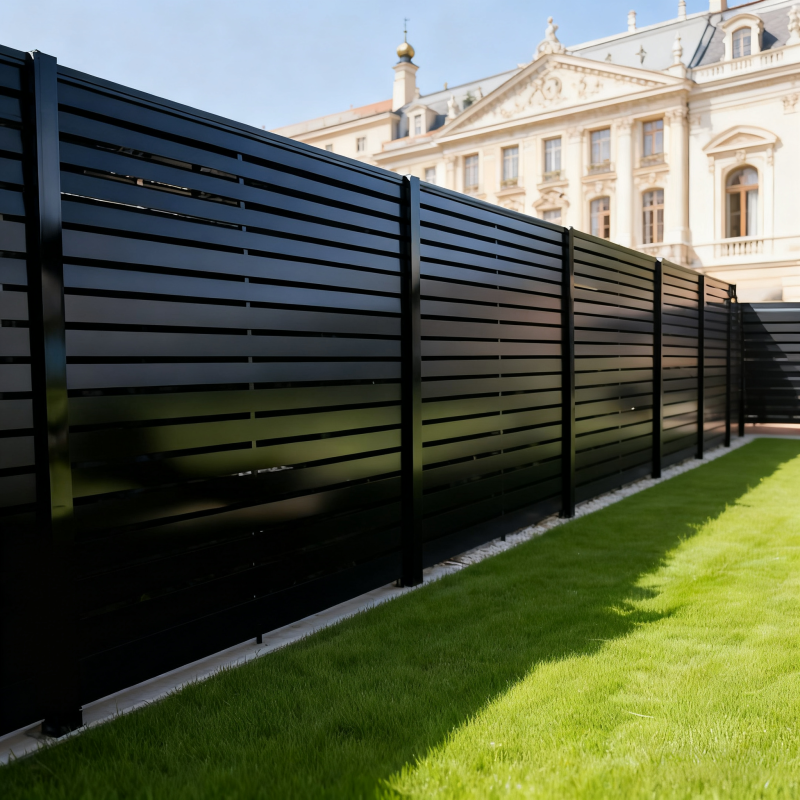
Full-privacy horizontal slat aluminium fence, United States installation. The slat spacing and post configuration, not the photograph, determine the actual privacy and wind performance.
Three patterns are worth extracting. First, the rain-heavy maritime markets — Belgium, the United Kingdom, Singapore and the Philippines — account for most of the pergola and gate entries, which is consistent with a platform designed around closed-louver rain shedding and internal post drainage. Second, the solar-intensive markets — Italy, Spain and Australia — are represented by configurations that pair louvre control with supplementary screening such as zip screens and privacy louver fencing, where the buyer's problem is heat and glare rather than water. Third, the United States appears with the widest variety of fence and gate types rather than a single signature product, which is what a market of that internal diversity would be expected to produce.
The 600-Set Programme and the Export Footprint Behind It
Volume changes the nature of the evidence. A single installed project shows that a supplier can deliver once; a 600-set programme recorded against the USA market shows that production, packing, documentation and shipment can be repeated at a commercial scale. In the case record, the 600-set order is associated with the United States and sits inside a customer base that includes individual villa owners, wholesalers and importers, landscape and construction contractors, real estate developers, and hospitality and public-sector projects.
The same case record lists ten destination countries, which reflects the practical reality of outdoor living distribution: an aluminium pergola or automatic driveway gate is rarely shipped to one address through one channel. Wholesalers consolidate, contractors stage deliveries across sites, and developers phase installation by plot. A supplier that documents delivery to ten destinations is describing logistics capability as much as manufacturing capability.
The stated export footprint is consistent with that picture. Export markets recorded for Henan Junsu Technology Co., Ltd. include the USA, Italy, France, Canada, the United Kingdom, Australia and Germany, at an export ratio of 90%. The case file also records outcomes that buyers usually treat as the real success criteria: improved site safety and privacy, personalised customisation achieved as specified, reduced later maintenance burden, climate adaptation across different regional requirements, and completion of one-stop delivery with installation support. The case entry additionally notes a 15-year duration for the relationship, which is the element most portfolios omit because short-term projects are easier to collect than long-term accounts.
Reading Installation Photographs Correctly: What They Prove and What They Do Not
This is where most supplier evidence is over-claimed, and buyers should apply the correction themselves.
An installation photograph documents that a unit exists, that it was installed in a recognisable site context, and that its visible configuration — mounting method, louvre type, slat spacing, screening add-ons, gate mechanism — matches the specification being discussed. That is genuinely useful. It filters out catalogue-only suppliers, shows how a wall-mounted system resolves against a real façade, and indicates whether the delivered finish matches the sample.
What a photograph does not do is certify structural performance. Wind load capacity, snow load capacity and waterproof behaviour derive from the load rating, the profile and fixing design, the drainage geometry and the assembly quality — not from the image. An installation in a snowy market documents that the project exists; the snow load figure comes from the rated specification and, where required, from a project-specific structural calculation signed off locally.
A buyer running an evaluation should therefore request two separate packages: the installation record, which addresses delivery and site experience, and the technical file, which addresses compliance and load performance. Suppliers that can produce only one of the two are telling you something about their operating model.
The Technical Basis Behind Climate Adaptability Claims
Climate adaptability is a system-level claim, and it only holds if the underlying parameters support it. For the aluminium bioclimatic pergola platform, the specified values are as follows.
| Parameter | Specified value |
|---|---|
| Material | Aluminium alloy, with 6063-T5 used as the standard material for aluminium products |
| Model designation | 147 / 163 / 175 / 220 |
| Louvre control | Motorised rotation from 0° to 90° |
| Wind load capacity | Up to 190 mph |
| Snow load capacity | Up to 100 lbs/sq ft |
| Rain protection | Full rain protection when louvres are closed, with water collected in integrated drainage channels and guided through internal drainage inside the posts |
| Ingress and operating environment | IP66 waterproof and dustproof; operating range of −35 °C to 65 °C for outdoor installation |
| Structural configurations | Wall-mounted, free-standing, multi-zone, and special cuts and angles |
| Custom single-zone size | Up to 22 ft 10 in × 16 ft |
| Integrated accessories | LED lighting operated together with the louvre system, zip screens, fan, heater, misting, speaker, rain and wind sensor |
Specification values as stated in the product and application data; project suitability requires confirmation against local conditions.
Two of these parameters do most of the work in a climate argument. The first is the closed-louvre drainage logic: water is not merely deflected, it is collected and routed through the posts, which is why the waterproof claim survives heavy rain rather than only light showers. The second is the 0°–90° motorised rotation, which converts a fixed roof into an adjustable one. In a four-season aluminium pergola, the same structure provides shade at midday in summer and admits low-angle winter sun — the function that a fixed garden pergola cannot perform at all.
The accessory architecture matters for the same reason. Because LED lighting is operated together with the louvre system and screens, heaters and sensors are integrated rather than retrofitted, the delivered system behaves as one assembly. That is also where installation discipline becomes critical: a motorised pergola is an electrical product as well as a structural one, and the electrical components must be installed with proper protection and must not remain submerged in standing water.
Compliance and Tariff Realities That Travel With a Project
Cross-border outdoor living projects carry paperwork that buyers underestimate. Three items recur in evaluation.
- Market access and quality systems. Henan Junsu Technology Co., Ltd. holds ISO 9001 quality system certification and CE product safety certification, with full export customs filing qualifications, and works with authorised third-party testing institutions on raw material and finished goods sampling.
- Product standards. European buyers may reference EN 13561:2015 for external blinds and awnings, including pergola awnings. United States buyers of aluminium fencing may reference ASTM F2957 for ornamental aluminium fence systems, which covers structural testing and surface finish.
- Tariff classification. Aluminium fence panel kits from China are classified under HTSUS 7610.90.0080 with a duty rate of 5.7% for the United States. Getting the classification right before quotation avoids cost surprises at the border.
Inspection practice matters as much as the certificate list. The stated method is 100% pre-shipment testing, alongside raw material composition testing, wall thickness measurement, surface coating adhesion testing, load-bearing wind resistance testing, waterproof performance testing, motor continuous operation ageing testing and dimensional tolerance checks. For a buyer specifying an automatic gate or a motorised pergola, the motor ageing test and the coating adhesion test are the two records worth asking for by name.
How Junsu outdoor Structures Evidence and Supply
Henan Junsu Technology Co., Ltd., trading as Junsu outdoor, is a Chinese manufacturer and exporter of integrated outdoor courtyard solutions — aluminium pergolas, aluminium fencing and automatic driveway gates — based in Zhengzhou, Henan Province, and operating in metal courtyard product manufacturing and international trade since 2001.
The capability figures behind the installation record are specific. The manufacturing base covers 30,000 m² with a 120-person team and a 10-engineer technical group, at an annual output of approximately 36,000 sets and a monthly capacity of 3,000 sets. Standard lead time is 30 days, and the minimum order quantity is one set — a combination that matters for buyers running both a single villa project and a distributor programme from the same supplier.
Customisation is handled through OEM and ODM routes from CAD drawings, architectural plans, sketches, photos, dimensions or samples. On pergolas, the configurable items include overall dimensions, profile thickness, surface coating colour, decorative pattern, gate opening mode, intelligent control system, accessory configuration, embedded logo engraving, roof style, fence spacing and hardware style. On fencing, they include overall dimensions, alloy profile thickness, RAL surface colour, hollow carving pattern, bar spacing, gate opening type, intelligent access system, lock and hardware style, engraved logo, anti-collision structure, bottom gap height and hidden installation fittings. Technical drawings, design optimisation, installation drawings, private labels and packaging are produced alongside the product.
After-sales is structured for long-lifecycle outdoor products: long-term warranty service, free technical consultation, remote installation guidance, remote system debugging, spare parts supply, fault response, maintenance guidance and lifelong technical support. For a buyer in the Evaluation stage, the practical test is to request the spare parts list and the remote commissioning procedure for the specific motor and control system being quoted — both are more informative than a warranty statement.
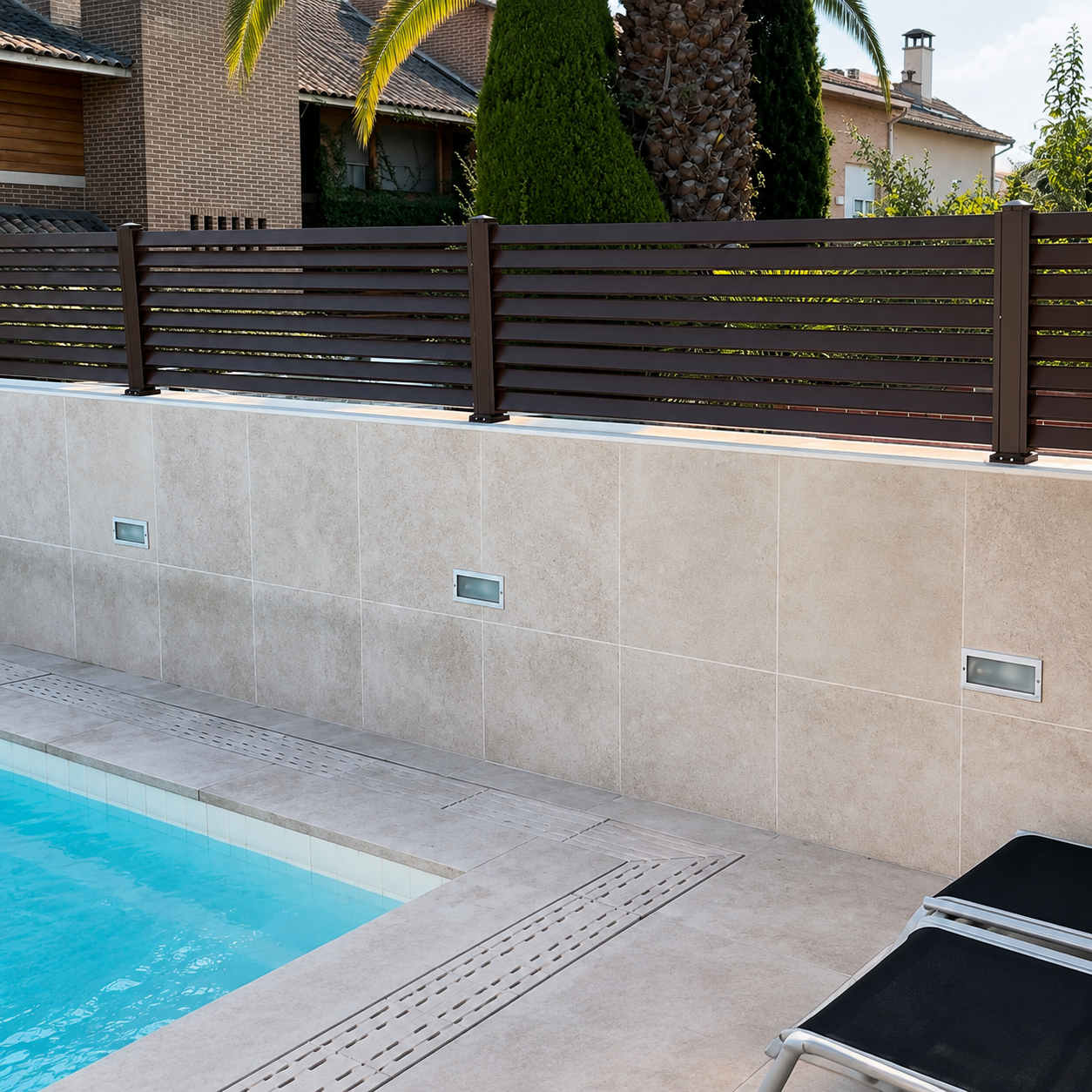
Poolside privacy louver fence, Spain installation. Louvered slats reduce direct sightlines while maintaining airflow — a configuration also used around patio boundaries and equipment enclosures.
Where These Systems Are Specified
Installation records are only comparable when the site type is comparable. The documented applications fall into five groups.
- Villa and residential courtyards. Bioclimatic pergolas, privacy louver fencing and entrance gates, usually specified together so that profiles, colour codes and finish are consistent across the plot.
- Hotels, resorts and hospitality terraces. Motorised pergolas used as revenue-generating outdoor space, where rain shedding and lighting are commercial requirements rather than comfort features.
- Factory and campus boundaries. Aluminium fence and gate systems used for safety isolation and controlled access, where the gate type is dictated by vehicle width, available lateral space and ground conditions.
- Commercial plazas and public realm. Shade structures and enclosure systems specified for durability and low maintenance rather than for a single design statement.
- Community and multi-plot developments. Repeat configurations phased across units, which is where a 600-set programme and a one-set minimum order quantity belong to the same supplier catalogue.
Gate selection deserves a separate note because it is the most common source of rework. Swing gates suit entrances with sufficient inward or outward opening space; sliding gates suit sites with lateral space beside the entrance; bi-fold gates suit driveways with limited opening depth. Recommending one without clear dimensions, ground information and site photographs is guesswork, and the required inputs — clear opening width and height, gate type preference, quantity, site photographs, and for automatic gates the ground condition, posts or walls, side space and power supply location — should be settled before production drawings are issued.
Market Context: Why Buyers Are Asking Harder Questions
The evidence conversation is intensifying because the category is growing. The global aluminium pergola market was valued at USD 3.8 billion in 2025 and is projected to reach USD 7.1 billion by 2034, according to Dataintelo. North America accounts for 34.2% of global aluminium pergola demand in 2025, which is a large share of the market where documentation expectations are highest.
The bioclimatic sub-segment is forecast to grow from USD 600.87 million in 2026 to USD 1,049.46 million by 2034, a CAGR of 7.22%, per Fortune Business Insights. On the access side, automatic sliding gates held a 30.2% share of the automatic gate opening system market in 2025. Definitional caveats apply: published pergola market sizes vary with material segmentation, so the aluminium-only figures should not be added to broader pergola totals.
The commercial consequence is straightforward. As more suppliers enter, differentiation shifts from availability to verifiability. Buyers increasingly ask for installation references by climate, standard references by market, and tariff classification before quotation — questions that a catalogue cannot answer.
Aluminium Versus Traditional Materials, and Where the Claim Stops
Aluminium is not automatically the correct choice for every outdoor project, and the trade-offs should be stated plainly.
| Criterion | Aluminium systems | Conventional alternatives (timber, wrought iron, masonry) |
|---|---|---|
| Initial purchase cost | Stated as 15%–25% higher on a like-for-like basis | Lower entry cost |
| Corrosion and upkeep | Rust-free alloy construction; fluorocarbon and wood-grain finishes specified for UV, salt spray and rain resistance; upkeep limited to light cleaning | Periodic refinishing, rust treatment or repainting typically required |
| Behaviour in humid or coastal sites | Suited to long-term outdoor exposure, open windy sites and humid coastal areas | Degradation risk rises with moisture and salt |
| Best fit | Long-life projects with low maintenance expectations | Short-term, temporary or ultra-low-budget enclosures |
Cost positioning as stated in the supplier's material comparison; project figures must be verified against local pricing.
The boundary is real. Aluminium outdoor living systems are a poor fit for ultra-low-budget temporary construction, short-term site hoarding, or enclosures where long-term appearance and durability are not requirements — in those cases the higher initial cost buys performance the project does not need. Performance is also installation-dependent: a correctly rated pergola on inadequate drainage or an unprotected cable run will underperform its specification, and no amount of installation photography changes that.
Future Outlook
Three developments are likely to shape how buyers evaluate outdoor living suppliers over the next several years.
The first is documentation inflation. As installation galleries become standard, photographs will lose screening value and buyers will move to project-specific files: load calculations, motor test records, coating test results and market-specific compliance statements. Suppliers who treat evidence as a system rather than a gallery will be easier to shortlist.
The second is the shift from fixed structures to adjustable envelopes. The bioclimatic growth rate reflects demand for outdoor space that performs in more hours of the year, which pushes pergola specification toward motorised louvres, integrated LED lighting, zip screens and wind and rain sensors. That trend increases the electrical content of the product and, with it, the importance of installation guidance and spare parts availability.
The third is verification of supplier claims. Public benchmarking specifically for OEM outdoor living manufacturers remains thin — a gap noted in available industry data — which means buyers will continue to rely on factory information, third-party inspection and installation records. Until independent benchmarks exist, the discipline of separating documentary evidence from engineering evidence is the buyer's most reliable safeguard.
FAQ
What wind and snow loads can an aluminium bioclimatic pergola be specified for?
The aluminium bioclimatic pergola platform is specified with a wind load capacity of up to 190 mph and a snow load capacity of up to 100 lbs/sq ft, with full rain protection provided when the louvres are closed. These are rated values for the product configuration; site-specific suitability should be confirmed against local wind zones, snow zones and structural requirements before ordering.
Which standards and certifications should the documentation reference?
For European projects, EN 13561:2015 sets performance and safety requirements for external blinds and awnings, including pergola awnings. For United States fencing projects, ASTM F2957 covers ornamental aluminium fence systems, including structural testing and surface finish. On the supplier side, Henan Junsu Technology Co., Ltd. holds ISO 9001 quality system certification and CE product safety certification, with third-party testing of raw materials and finished goods.
Do installation photographs prove climate adaptability?
No. Installation photographs document that a system was produced, delivered and installed in a specific site context, and they show the visible configuration — mounting method, louvre type, slat spacing, screening and gate mechanism. They do not certify structural performance. Climate adaptability is established by the rated wind and snow loads, the drainage design, the material and coating specification, and correct on-site installation, including drainage falls and protection of electrical components.
What site information is needed before a custom pergola or gate is produced?
For gates, the clear opening width and height, preferred gate type, quantity and clear site photographs are the basic inputs. Automatic gates additionally require information on ground condition, posts or walls, available side space and power supply location. For pergolas, dimensions, mounting condition (wall-mounted or free-standing), intended zone layout and any special cuts or angles should be confirmed before production drawings are prepared.
Will aluminium rust in coastal, humid or rainy locations?
Aluminium alloy systems are specified as rust-free and corrosion-resistant in the supplier's material documentation, with fluorocarbon and wood-grain transfer finishes described as resistant to UV, salt spray and rain. Long-term appearance does depend on correct installation, drainage and periodic light cleaning; the material is not maintenance-free in the sense of requiring no attention at all, but it does not require rust treatment or repainting cycles.
Can a louvered fence provide privacy while still allowing airflow?
Yes. Aluminium louver fencing uses angled slats that reduce direct visibility while maintaining airflow through the fence. This makes it suitable for residential privacy boundaries, patio and courtyard screening, poolside enclosures, and commercial applications such as HVAC or mechanical equipment screening where ventilation is required.
Product catalogue (PDF): Junsu outdoor product catalogue. Manufacturer reference: Henan Junsu Technology Co., Ltd. — www.junsu-outdoor.com
Have Questions or Need More Details?
Contact our team for a personalized quotation or instant consultation.
Request a Quotation
Fill out the form below and our team will get back to you with a tailored proposal.
WhatsApp Direct Chat
Prefer to chat in real-time? Message us on WhatsApp for instant assistance & quick answers.
- Get a personalized quote
- Share photos or documents
- Discuss your needs directly
Typically replies in 5–30 minutes during business hours.