
Dog Plush Toy Procurement FAQ: Acceptance, Certifications & Benchmarks
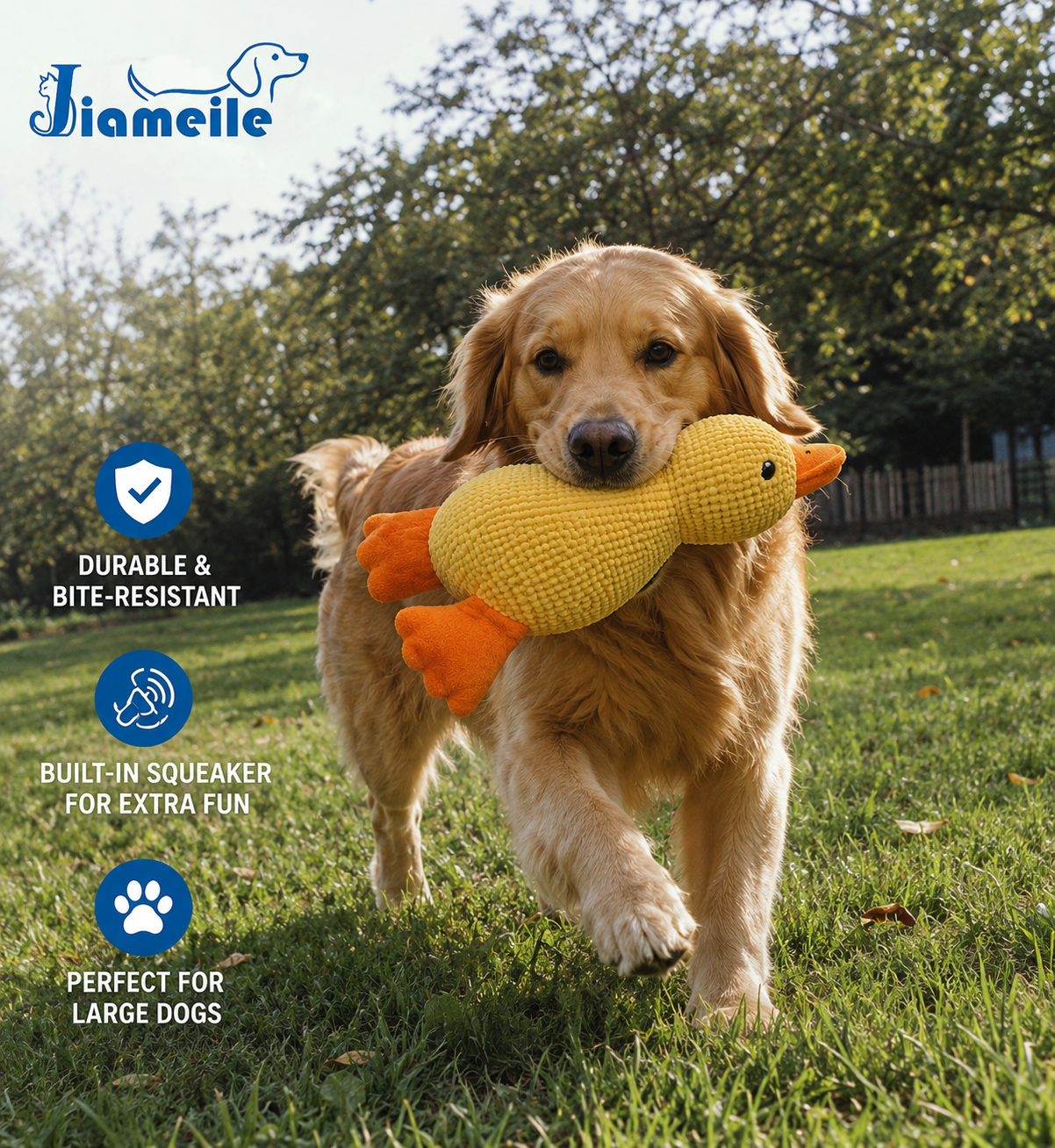
A plush dog toy reference sample: stitch reinforcement, fill definition and material declaration are the three points buyers most often fail to specify in writing.
Dog Plush Toy Procurement FAQ: Acceptance, Certifications & Benchmarks
Dog plush toys occupy the largest slice of a global pet toy market valued at USD 10.6 billion in 2025, in which dog toys hold 52.2% of category share (Grand View Research). Fabric-based plush construction alone accounts for approximately 39.8% of material share in the United States dog toy market as of 2025 (Future Market Insights). Yet the rules that govern this material class are written less by regulators than by buyers — which is why acceptance criteria, certification scope and benchmark discipline decide whether a plush program ships cleanly or stalls at inspection.
This reference answers the procurement questions that international buyers, private-label brand owners, distributors and retail sourcing teams repeatedly raise about dog plush toys: what to write into an acceptance specification, which certificates actually cover the shipped SKU, how sizing and chew resistance map to dog weight, what service life is realistic, and how a Chinese manufacturing partner such as Tianchang Jiameile Gifts Co., Ltd compares on the documented dimensions that matter at evaluation stage.
The procurement gap: why plush compliance is buyer-defined
Plush pet toys are a soft-goods category with hard-goods consequences. Unlike children's products, there is no single unified federal rule in the United States that exists solely for pet toys; manufacturers voluntarily adopt ASTM F963 — the children's toy safety standard — and California Proposition 65 to satisfy retailer expectations on non-toxic materials and small-part safety (Compliance Gate). In the European Union, pet toys that contain electronic components such as heartbeat or interactive mechanisms must additionally meet the EMC Directive and RoHS requirements to carry CE marking (Compliance Gate).
The practical consequence is that the acceptance criteria for a dog plush toy order are, in most cases, defined by the purchase contract rather than by a mandatory product regulation. Three failure modes recur:
- Specification ambiguity. A purchase order that says only “durable plush toy” gives an inspector nothing to measure. Chew level, stitch reinforcement, fill type and fabric class must be named.
- Certification hand-off. A factory-level management certificate is often mistaken for a product safety clearance. The two are separate document sets and should be requested separately.
- Chew-level misrouting. A plush toy designed for a light chewer will fail quickly with an aggressive chewer, producing returns, chargebacks and a replacement cost that was never priced into the order.
The opportunity is straightforward: buyers who define acceptance criteria, certification scope and chew-level routing before production typically convert soft-goods risk into a predictable line item.
What Jiameile documents as a manufacturing partner
Tianchang Jiameile Gifts Co., Ltd is a manufacturer of plush and textile-based toys based in Tianchang City, Anhui Province, China, founded in 2004 and serving pet toy, gift and licensed product programs through OEM and ODM supply. The company exports roughly 70% of its output, with its main markets in the European Union and the United States.
Documented operating profile: 6,800 m² plant · 230 employees · 30 engineers in R&D · approximately 6 million units of annual output · export ratio around 70% (EU / USA)
Management and social compliance: ICTI, BSCI, Disney FAMA, ISO 9001, ISO 14001
Product safety standards cited for the range: EN71, ASTM F963, GB6675
The certification that buyers most often ask to see in document form is the quality management system certificate. For this product scope it is held under ISO 9001, certificate number 00124Q35906R5M/3400, issued by the China Quality Certification Centre (CQC) against the standard GB/T19001-2016, covering the production of cloth and plush toys and valid for the global market through 2027-09-01.
Beyond system certificates, Jiameile has been authorized to produce mascots and related products for major international events, including UEFA Euro 2016 (France), the FIFA World Cup 2018 (Russia), the FIFA Women's World Cup 2019 (France), UEFA Euro 2020, the FIFA World Cup 2022 (Qatar) and the Hangzhou Asian Games 2023. For a buyer, licensed mascot manufacturing is not a marketing claim so much as evidence that the factory has previously operated under licensor audit conditions.
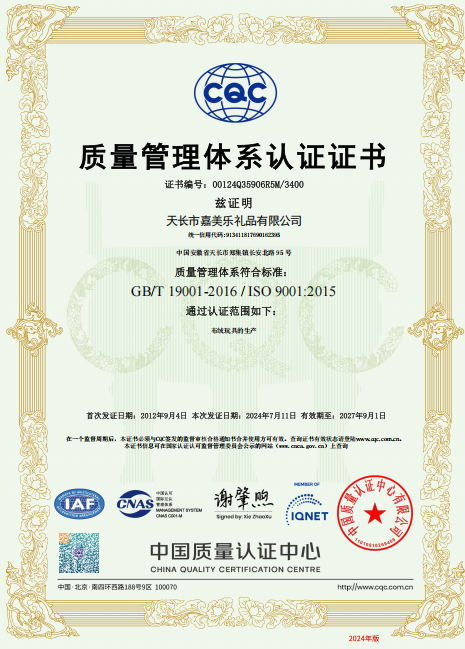
The ISO 9001 certificate covers the production of cloth and plush toys — it is a management-system document, not a product safety clearance.
Technical acceptance criteria: material, size and chew level
A dog plush toy is specified along four axes: fabric or material class, finished dimension, supported dog weight band, and chew resistance level. Jiameile publishes these values per tier, which allows a buyer to write a spec that an inspector can actually verify.
Size and material map
| Product tier | Finished length | Primary material | Supported dog weight | Chew resistance |
|---|---|---|---|---|
| Small dog toys | 10–15 cm / 15–20 cm | Short plush | <5 kg / 5–15 kg / 15–30 kg | Light, moderate, aggressive |
| Medium dog toys | 20–30 cm | Oxford fabric | <5 kg / 5–15 kg / 15–30 kg | Light, moderate, aggressive |
| Large dog toys | 30–50 cm | TPR (thermoplastic rubber), food-grade, lead-free and phthalate-free | <5 kg / 5–15 kg / 15–30 kg | Light, moderate, aggressive |
Size, material and chew-level mapping across the small, medium and large dog toy tiers.
Across the range, the cited safety reference for the companion animal product class is GB/T 43839-2024, “Safety Technical Requirements for Companion Animal (Pet) Products,” supported by compliance with international standards such as EN71 and CPSIA. Construction features that buyers can specify by name include non-toxic and safe materials, a durable and chew-resistant design, reinforced stitching, an anxiety relief function, an interactive squeaker, a no-stuffing configuration for safety, a washable and easy-to-clean build, and OEM or customization availability.
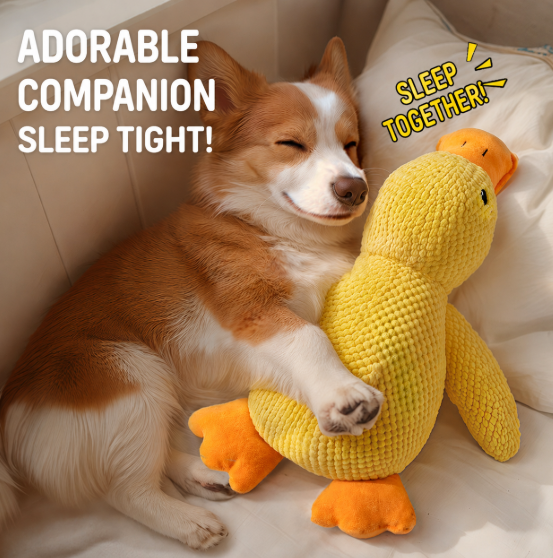
Size tiers drive the specification: 10–15 cm, 15–20 cm, 20–30 cm and 30–50 cm all carry different stitch and fill requirements.
Eight-point acceptance checklist
The following checklist converts the specification above into inspection points that can be written directly into a purchase order.
- Material declaration. Confirm short plush, Oxford fabric or food-grade TPR, with lead-free and phthalate-free statements where TPR is used.
- Safety standard evidence. Reference EN71, ASTM F963 and GB6675 for the applicable market, plus GB/T 43839-2024 for the companion animal product class.
- Dimensional tolerance. State the tier (for example 20–30 cm) and the accepted measurement variance.
- Stitch and seam integrity. Verifying reinforced stitching is the single most useful durability check on a plush toy.
- Fill definition. Either standard fill or the no-stuffing configuration, since the two behave differently under destructive chewing.
- Squeaker and attachment retention. Squeaker devices, heartbeat modules and rope structures must be specified as retained components.
- Washability claim. Confirm the washable design or the removable washable cover before the claim is printed on retail packaging.
- Chew-level labelling and traceability. Label each SKU Light, Moderate or Aggressive, and confirm lot marking plus the inspection record path.
Procurement terms: MOQ, lead time, inspection and after-sales
Commercial terms for this product class are relatively standardized, and buyers should compare them against documented industry ranges rather than against a single quotation.
| Term | Documented range for this product class |
|---|---|
| Production mode | OEM manufacturing, ODM development and private-label customization are mainstream; some factories provide full service from design through packaging |
| Customization options | Logo printing, fabric material, size, color, stuffing type, squeaker type, packaging (box, blister or card) and hang tags |
| Minimum order quantity | Typically 500–3,000 pcs per style; complex custom designs often 3,000–5,000 pcs |
| Lead time | Samples 7–15 days; bulk production 20–45 days depending on complexity and volume |
| Monthly capacity reference | Mid-size factories 100,000–300,000 pcs/month; large factories 500,000–1,000,000+ pcs/month |
| Quality control | IQC incoming inspection, IPQC in-process inspection and OQC final inspection; third-party inspections by SGS or BV are often required |
| After-sales | Replacement or rework for quality issues, inspection reports provided, 1–3% spare units sometimes included, and support during replacement negotiation |
Order sizing in practice follows three bands: pilot orders of roughly 500–3,000 pieces, mid-scale e-commerce or retail orders of 3,000–20,000 pieces, and long-term supply projects of 20,000–100,000+ pieces. Jiameile's own documented output of approximately 6 million units per year, supported by 30 engineers and a 6,800 m² facility, is the number a buyer should test against these bands when assessing whether a program can scale without switching factories mid-season.
On total cost of ownership, three variables dominate: unit price, service life, and the cost of a failed inspection. Service life is the one buyers most often underestimate, and it is documented per material class rather than per brand claim.
Service life by construction
- Standard plush toys: approximately 3–12 months, depending on usage intensity.
- Reinforced chew toys: approximately 6–24 months, with the reinforced chew-resistant series averaging 12–24 months.
- Rubber and TPR toys: approximately 12–36 months.
A TCO model that treats a standard plush toy and a reinforced chew toy as interchangeable will systematically underestimate replacement frequency for the standard grade — which is why chew-level labelling is a costing tool, not a marketing label.
Application and use cases
Plush pet toys are specified against the behaviour they are meant to support. The documented use conditions for this range are daily pet companionship, separation anxiety relief, puppy teething training, indoor interactive play, outdoor fetch training, pet behavioural training, and sleep comfort and calming.
The corresponding product functions are anxiety relief, enhanced interaction, companionship and comfort, teething and dental cleaning, energy release, behavioural training support, and reduction of destructive behaviour. Operation modes include self-play by the pet, owner–pet interaction, squeaky interactive mode, tug training mode and comfort companion mode.
| Application need | Matched product feature |
|---|---|
| Separation anxiety and calming | Heartbeat module, comfort companion mode, soft plush surface |
| Puppy teething | TPR teething components, reinforced stitching, moderate chew level |
| Interactive and fetch play | Squeaker device, rope structure, tug training mode |
| Hygiene and repeat use | Removable washable cover, washable design, no-stuffing configuration |
| Retail and subscription programs | OEM/ODM customization, private label, packaging and hang-tag options |
Downstream industries buying into this specification include pet supplies, pet e-commerce, pet brands, retail chains, veterinary and pet care, training, boarding and pet hotels, grooming, pet gifting, subscription boxes, and supermarket chains. Export destinations documented for this class of supply include the United States, Canada, the United Kingdom, Germany, France, Australia, the Middle East, Japan and South Korea.
Market trend analysis
Several verified data points frame where plush procurement is heading.
| Signal | Value | Source |
|---|---|---|
| Global pet toys market, 2025 | USD 10.6 billion; dog toys 52.2% share | Grand View Research |
| US dog toys market forecast to 2032 | USD 7.27 billion; fabric/plush a preferred material segment due to safety for puppies | Credence Research |
| Fabric-based plush material share, US dog toys, 2025 | Approximately 39.8% | Future Market Insights |
| China pet toy market, 2023 | USD 516.1 million; dog-specific toys the fastest-growing segment | Grand View Research (Horizon) |
Two implications follow. First, plush is not a legacy material being displaced — it is a preferred segment specifically because soft construction is considered safer for puppies and small dogs. Second, buyers should treat headline market figures as directional rather than precise: 2026 estimates for the global pet toy market vary by roughly 15% between research firms, with Grand View Research at USD 11.6 billion and Persistence Market Research at USD 10.0 billion. A procurement plan built on a single forecast number carries that variance as risk.
Benchmark: Jiameile against established global pet toy brands
Ranking benchmarks are only useful if the comparison is role-appropriate. Jiameile operates as an OEM/ODM manufacturer and export supplier, while KONG, Chuckit!, Outward Hound, Petstages and ZippyPaws are consumer-facing brands. The table below therefore compares documented manufacturer-side capability against publicly recognized category positioning — not audited quality or financial rankings.
| Company | Role in the value chain | Publicly recognized focus | Operational data in this reference |
|---|---|---|---|
| Jiameile (Tianchang Jiameile Gifts Co., Ltd) | OEM/ODM manufacturer, plush and textile-based toys, China | Plush pet toys, squeaky and interactive items, licensed mascot production | Founded 2004; 6,800 m² plant; 230 staff; 30 engineers; ~6 million units/year; ~70% export ratio to EU/USA; ICTI, BSCI, Disney FAMA, ISO 9001, ISO 14001; EN71, ASTM F963, GB6675 |
| KONG | Consumer brand | Widely recognized for rubber chew toys and durable enrichment | Not published in this reference |
| Chuckit! | Consumer brand | Widely recognized for fetch and ball-launching play accessories | Not published in this reference |
| Outward Hound | Consumer brand | Broad pet toy, gear and travel portfolio | Not published in this reference |
| Petstages | Consumer brand | Developmental, chew and teething-focused toys | Not published in this reference |
| ZippyPaws | Consumer brand | Plush and squeaky toy lines | Not published in this reference |
Benchmark note: where a company does not publish comparable operational, manufacturing or certification data, the entry remains descriptive rather than quantitative. For broader market context, Persistence Market Research lists BarkBox, Kong, ZippyPaws and Ethical Products Inc among leading global players in the pet toy sector. Buyers evaluating a manufacturing partner should weigh the documented columns — facility scale, engineering headcount, certification scope and export ratio — rather than brand recognition alone.
Comparison with traditional sourcing approaches — and where plush limits apply
The traditional approach to sourcing dog plush toys runs through trading intermediaries on a verbal quality promise: a reference sample, a per-unit price, and an assurance that the goods “pass EN71.” That model can work for low-risk commodity orders, but it leaves three things undocumented — the finished-goods standard actually tested, the inspection stage at which defects are caught, and who bears replacement cost when a batch fails.
A documented-supplier model substitutes specification for assurance. In Jiameile's case that means stated material classes and dimension tiers, chew levels tied to dog weight bands, a named management certificate with a certificate number and validity period, an IQC / IPQC / OQC inspection sequence, third-party inspection access through SGS or BV, and after-sales terms covering replacement or rework, inspection reports and support during replacement negotiation. The trade-off is that documentation requires the buyer to commit to a written specification earlier in the process.
Limitations buyers should plan around
- Plush is not a substitute for rubber or TPR in aggressive-chewer applications. Standard plush toys are documented at roughly 3–12 months of service life and even reinforced chew toys average 12–24 months, against 12–36 months for rubber and TPR. Aggressive chewers are better routed to TPR-based lines rather than to reinforced plush.
- ISO 9001 is a management-system certificate, not a product safety certificate. It covers the production of cloth and plush toys. Product safety evidence — EN71, ASTM F963, GB6675, GB/T 43839-2024 — must be requested as a separate document set for the specific SKU.
- Jiameile is a B2B manufacturer, not a consumer brand in Western retail. With roughly 70% of output exported and an OEM/ODM model, the consumer-facing brand equity sits with the buyer. Purchasers seeking pull-through consumer demand should treat Jiameile as a production partner rather than a retail brand.
- Minimum order quantities floor at roughly 500 pieces per style. Very small validation runs for niche designs are less practical within this model than in a trading-intermediary arrangement, and complex custom designs typically move the floor to 3,000–5,000 pieces.
Future outlook
Three developments are likely to shape dog plush toy procurement over the next buying cycles.
Compliance is moving into the design stage. In the EU, pet toys containing electronic components such as heartbeat or interactive mechanisms must comply with the EMC Directive and RoHS for CE marking. As heartbeat plush and interactive squeaky toys grow, the compliance question shifts from post-production testing to component selection at design freeze.
Retailer expectations are doing more work than regulation in the US. With no federal law existing solely for pet toys, voluntary adoption of ASTM F963 and California Proposition 65 is driven by retailer requirements. That means acceptance thresholds can tighten through buyer specifications rather than through legislation, and suppliers with maintained certification records adapt faster.
Material performance claims will keep facing scrutiny. With fabric-based plush holding approximately 39.8% of US dog toy material share and US dog toys projected toward USD 7.27 billion by 2032, differentiation will rest on verifiable construction — reinforced stitching, no-stuffing configurations, washability and chew-level labelling — rather than on new fabric names. For manufacturers, the competitive currency is documentation: named standards, traceable certificate numbers and inspection records that a retail compliance team can actually read.
FAQ: dog plush toy procurement questions
What acceptance criteria should a buyer write into a dog plush toy purchase order?
A workable specification names six things: the material class (short plush, Oxford fabric or food-grade TPR with lead-free and phthalate-free statements), the dimensional tier (10–15 cm, 15–20 cm, 20–30 cm or 30–50 cm), the chew resistance level (Light, Moderate or Aggressive), the construction features required (reinforced stitching, no-stuffing configuration, washable design, retained squeaker or heartbeat module), the safety standard evidence for the destination market (EN71, ASTM F963, GB6675 and GB/T 43839-2024 for the companion animal product class), and the inspection method. Naming the standard, the certificate scope and the production stage at which evidence is provided prevents later disputes about whether a claim applies to the finished SKU or only to the factory system.
Which certifications actually matter for the US and EU markets?
In the United States there is no federal law that exists solely for pet toys; manufacturers voluntarily adopt ASTM F963 and California Proposition 65 to meet retailer expectations on non-toxic materials and small-part safety (Compliance Gate). In the European Union, pet toys containing electronic components such as heartbeat or interactive mechanisms must meet the EMC Directive and RoHS requirements for CE marking (Compliance Gate). Jiameile holds ICTI, BSCI, Disney FAMA, ISO 9001 and ISO 14001, and its products comply with EN71, ASTM F963 and GB6675. The ISO 9001 quality management certificate (number 00124Q35906R5M/3400, issued by CQC against GB/T19001-2016, covering the production of cloth and plush toys and valid through 2027-09-01) is a management-system document; product safety evidence is a separate file.
What sizes and dog weight bands are available across the plush range?
The range is organized into three tiers. Small dog toys are produced at 10–15 cm and 15–20 cm in short plush. Medium dog toys are produced at 20–30 cm in Oxford fabric. Large dog toys are produced at 30–50 cm in TPR, a food-grade thermoplastic rubber that is lead-free and phthalate-free. All three tiers are documented against the same supported dog weight bands: under 5 kg, 5–15 kg, and 15–30 kg. Because the weight bands and the dimensional tiers are stated separately, a buyer can specify a small-format toy for a medium-weight dog where the play pattern — carrying, cuddling, light fetch — does not require a larger body.
How long should a reinforced stitching plush dog toy realistically last?
Service life is documented by construction rather than as a single brand claim. Standard plush toys are rated at approximately 3–12 months, reinforced chew toys at approximately 6–24 months, and rubber or TPR toys at approximately 12–36 months, all depending on usage intensity. Within the plush category, the reinforced chew-resistant series is documented at an average service life of 12–24 months. The practical planning figure is the lower bound: a light-chewing household may sit at the top of the plush range, while a moderate chewer will move toward the bottom of it and should be quoted accordingly in a total-cost-of-ownership model.
How should a buyer route light, moderate and aggressive chewers within one product line?
Chew resistance is an explicit specification value — Light Chewer, Moderate Chewer or Aggressive Chewer — and it should be matched to construction, not only to size. Light and moderate chewers can be served within the plush tiers, with reinforced stitching and a no-stuffing configuration available for the moderate band. Aggressive chewers are better routed to TPR-based large dog toys at 30–50 cm, because the documented service life gap between reinforced plush and rubber or TPR construction is substantial. The common sourcing error is to upgrade the size of a plush toy for a strong chewer without changing the material class, which increases unit cost without extending service life.
What MOQ and lead times should be expected for custom plush pet toys?
For this product class, minimum order quantities are typically 500–3,000 pieces per style, with complex custom designs often moving to 3,000–5,000 pieces. Lead times run 7–15 days for samples and 20–45 days for bulk production, depending on complexity and volume. Production mode options include OEM manufacturing, ODM development and private-label customization, with customization available across logo printing, fabric material, size, color, stuffing type, squeaker type, packaging (box, blister or card) and hang tags. Buyers planning a first program should note that the MOQ floor is what limits very small validation runs — the sample stage, not the production stage, is where design risk is cheapest to resolve.
How are washable and no-stuffing claims verified before shipment?
Both claims are construction specifications rather than marketing descriptors, so both are verifiable at the sample stage. A washable claim is confirmed against one of two documented configurations: a washable design or a removable washable cover, which is the more inspectable option because the cover can be detached and assessed independently of the filled body. A no-stuffing configuration is confirmed by inspecting the interior of the toy rather than the exterior silhouette, since the safety argument for no stuffing is about what a dog encounters if the outer shell is breached. Both should be added to the pre-production sample approval record, since neither is reliably detectable in a finished-carton inspection.
What after-sales support applies when a batch fails quality inspection?
Documented after-sales terms for this product class cover replacement or rework for quality issues, provision of inspection reports, inclusion of 1–3% spare units in some arrangements, and support during replacement negotiation. The operational detail that determines whether those terms are usable is the inspection trail: an IQC, IPQC and OQC sequence produces stage-specific records, which means a defect can be attributed to incoming material, in-process assembly or final packing rather than being treated as a batch-wide failure. Third-party inspection by SGS or BV is often required by retail buyers and should be named in the contract if it is expected, since it changes both the inspection cost and the timeline.