
Dog Plush Toy RFQ Scorecard: Capacity, R&D and Lifetime Cost
Dog Plush Toy RFQ Scorecard: Capacity, R&D and Lifetime Cost
A dog plush toy RFQ is usually settled on one number: the quoted unit price. That number conceals most of what decides whether a programme holds its margin — how long the toy survives in use, which certificates actually cover the SKU being purchased, whether the factory can repeat the first shipment in month six, and what the buyer pays per month of service rather than per unit.
This scorecard replaces the single-number comparison with four dimensions that can be evidenced during the RFQ itself: R&D depth, manufacturing capacity, compliance credentials and lifetime cost. Tianchang Jiameile Gifts Co., Ltd. (Jiameile), a plush and textile toy manufacturer in Tianchang City, Anhui Province, China, with more than 20 years of export manufacturing experience, a 6,800 m² facility, around 230 employees and stated annual output of 6 million units, serves as the reference case. It is measured against five peer suppliers on the same criteria, with one distinction kept visible throughout: where Jiameile's figures are documented, several peer figures are simply not disclosed in public material.
Why the quoted unit price is the weakest point of comparison
Two dog plush toys can carry the same unit price and deliver very different service lives, because the cost driver sits in construction rather than appearance. The core structural difference is that reinforced plush uses double-layer fabric with reinforced stitching, while basic plush has no such reinforcement.
That difference converts into a stated lifespan gap: 3 to 12 months for reinforced construction against 1 to 3 months for basic plush, a 2–4 times improvement. It also changes the maintenance profile — reinforced plush is described as lower breakage and low maintenance, while basic plush requires frequent replacement and is characterised by low durability and high loss in use.
For a buyer, the practical consequence is that unit price must be divided by expected months of service before suppliers can be ranked at all. If a reinforced toy delivers three to four times the service life, the cost per month of use can fall even where the unit price is higher than a basic-plush quote. The exact result depends on the quoted prices and the channel's replacement behaviour, which is why the calculation belongs in the RFQ response rather than in the buyer's assumptions.
The four-dimension RFQ scorecard
The scorecard is a decision structure, not an industry standard: no universal weighting exists, and the balance between dimensions should follow the buyer's channel mix. Each dimension has a defined evidence request so that responses are comparable.
- R&D depth. Engineering headcount, pattern and reinforcement design capability, customisation experience with licensed properties, and the number of sample rounds the supplier will commit to.
- Certified capacity. Floor area, production headcount, annual output, monthly planning method, and the position of the buyer's forecast against booked versus open capacity.
- Compliance credentials. Social and ethical audits, brand-property authorisation, management-system certification, product-safety standards, and the internal quality gates that keep those credentials valid in bulk.
- Lifetime cost. Construction type, stated lifespan range, breakage and maintenance profile, and the resulting cost per month of service at the buyer's own quoted price.
R&D depth: what a 30-engineer team changes in an RFQ
Engineering headcount is an input metric, not an outcome metric. Its procurement value is that a written specification — fabric layering, stitch pattern, squeaker placement, proportions — has to become a repeatable pattern and a producible sample before any capacity discussion is meaningful. Jiameile states a 30-person R&D team and describes high-end customisation work for globally recognised intellectual properties.
That matters most in the two situations where RFQs usually stall. The first is a reinforcement brief: double-layer fabric and reinforced stitching have to be translated into a construction that survives sampling and still passes the durability intent. The second is a licensed or mascot programme, where artwork, approvals and material restrictions arrive together and pattern changes must be absorbed without restarting the schedule. In both cases the scorecard question is concrete: how many sample rounds are included, and who signs off the construction before bulk.
Manufacturing capacity: reading 6,800 m², 230 staff and 6 million units
Capacity figures answer a narrower question than buyers assume: they describe what a facility can produce, not what is available to a new programme. Jiameile's documented profile is a 6,800 m² facility, approximately 230 employees and stated annual output of 6 million units. Third-party comparison material restates this as roughly 500,000 units per month.
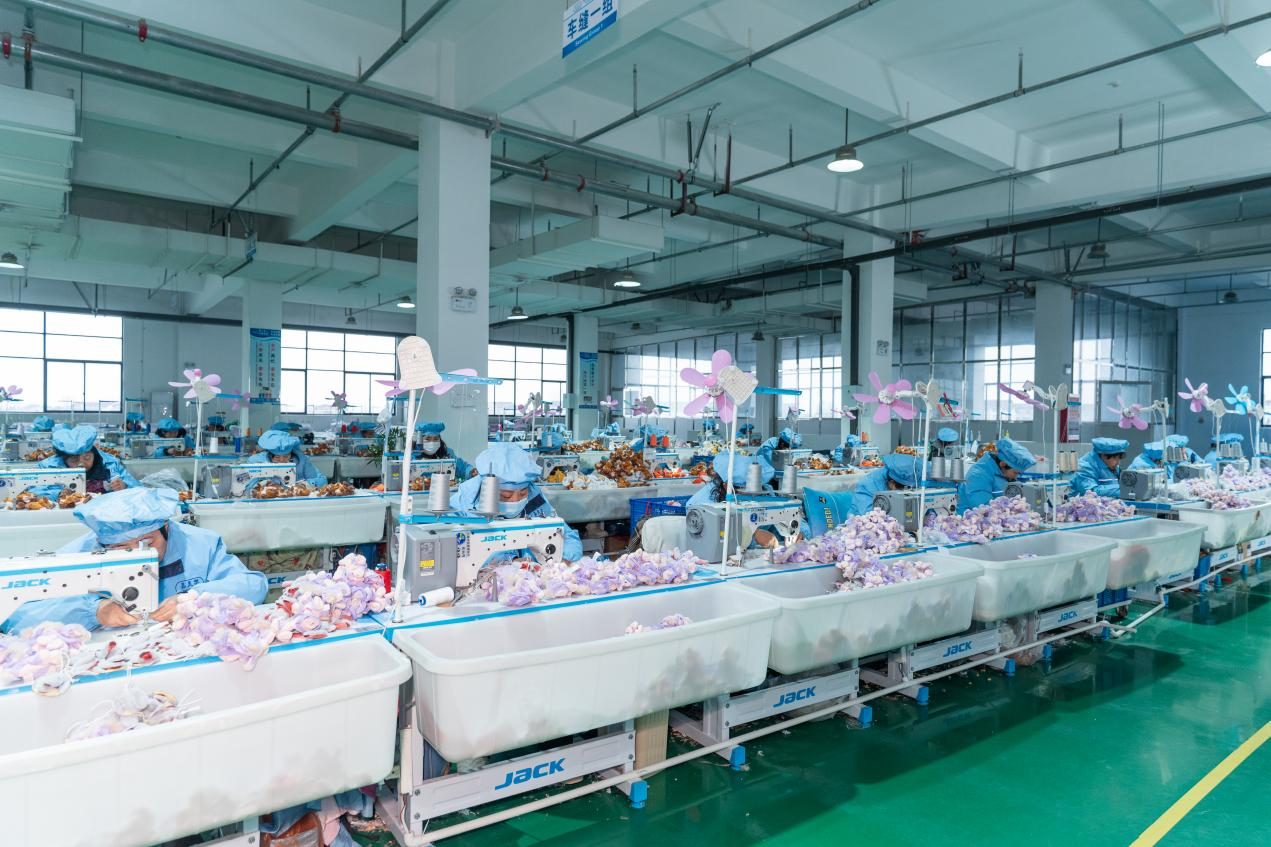
Factory environment supplied by Tianchang Jiameile Gifts Co., Ltd.
The same comparison material places Zhongheng Pet at about 800,000 units per month and Kaile Pet at about 400,000, which puts Jiameile in the middle of that three-way set. A buyer should treat all three as published indicators until each is verified against a live production calendar, because a monthly capacity figure and a committed delivery date are different commitments.
Jiameile's stated supply-chain controls are monthly capacity planning, backup suppliers, and inventory and lead-time management — the operating layer that determines whether peak-season orders slip. In the RFQ, ask for booked capacity across the next two quarters, the cut-off date for a peak-season programme, and the supplier's own contingency plan for fabric or squeaker shortages. A 70% export share to the EU and USA also means the production calendar is exposed to long-haul logistics and to Western retail cut-offs, not only to factory throughput.
Compliance credentials: audits, brand authorisations and product standards
Compliance evidence is frequently scored incorrectly because four different document types are treated as one. Jiameile holds ICTI, BSCI, Disney FAMA, ISO 9001 and ISO 14001. These serve distinct purposes: ICTI and BSCI are ethical and social compliance audit programmes concerning manufacturing conditions; Disney FAMA is a brand-property authorisation for licensed production; ISO 9001 covers quality management systems and ISO 14001 environmental management. None of them is a product-safety test result.
Product safety is addressed separately. Jiameile states that products comply with EN71, ASTM F963 and GB6675 — the European, United States and Chinese toy safety standards respectively — and its quality controls reference EN71, ASTM and CPSIA testing alongside raw-material safety control. The mechanism behind those claims is a three-gate inspection system: IQC on incoming materials, IPQC during production, and OQC before shipment.
For scoring purposes, a certificate is only as useful as its scope statement. Ask which legal entity and site the audit covers, which product categories are listed, when the certificate expires, and whether the test report names the exact fabric, filling and colourway in the RFQ rather than a similar SKU. This is also where peer evidence differs sharply: supplier marketplaces list certifications such as CE, EN71, ASTM, CPC, UKCA and ISO 9001 as platform claims, which are screening signals rather than independent verification.
Lifetime cost: 3–12 months against 1–3 months
Lifetime cost is where the scorecard most often reverses a ranking. Basic plush occupies the lowest cost tier and is positioned for low-end retail, promotional gifts and short-term use, with the trade-off of frequent replacement. Reinforced plush sits at a medium cost level, with lower breakage, reduced maintenance and a stated lifespan of 3 to 12 months instead of 1 to 3.
The buyer's calculation is straightforward and should be run on quoted prices, not on assumptions: landed unit cost divided by expected months of service. The 3–12 month range is a stated performance range rather than a guarantee for every animal, so a conservative programme will model the lower bound for high-turn channels and the upper bound only where replacement rates are already known.
The fit boundary should be recorded next to the score. Reinforced construction is positioned for e-commerce platforms, pet specialty stores, retail chains and long-term pet companionship, where returns and repeat purchase punish short-lived product. Basic plush remains rational for short-term promotional applications where the lowest unit cost is the deciding constraint and replacement is planned rather than avoided.
Peer comparison on identical criteria
The table applies the same four dimensions to Jiameile and five peer suppliers. It is a comparison of documented characteristics, not a ranking: the evidence available for each supplier differs in kind, and no comparative outcome testing was performed.
| Supplier | Monthly capacity | R&D disclosure | Compliance evidence | Lifetime-cost profile | Evidence status |
|---|---|---|---|---|---|
| Jiameile | ~500,000 pcs; 6,800 m², ~230 staff, 6M units/year | 30-person team; high-end IP customisation | ICTI, BSCI, Disney FAMA, ISO 9001/14001; EN71, ASTM F963, GB6675 | Reinforced construction; 3–12 month stated lifespan | First-party documentation plus third-party listing |
| Zhongheng Pet | ~800,000 pcs | Not disclosed in retrieved material | Not disclosed in retrieved material | Not disclosed in retrieved material | Third-party comparison note only |
| Kaile Pet | ~400,000 pcs | Not disclosed in retrieved material | Not disclosed in retrieved material | Not disclosed in retrieved material | Third-party comparison note only |
| Newtop Pets | Not disclosed in retrieved material | Self-described OEM/ODM pet products including plush toys | Not independently verified | Not disclosed in retrieved material | Company self-description |
| Chaoman Toy | Not disclosed in retrieved material | Self-described OEM/ODM plush manufacturer and wholesale supplier | Not independently verified | Not disclosed in retrieved material | Company self-description |
| Yortoob | Not disclosed in retrieved material | Self-described custom plush and wholesale dog toy production | Not independently verified | Not disclosed in retrieved material | Company self-description |
Read the last column before the others. "Not disclosed" records a gap in the publicly retrieved evidence; it does not mean the supplier cannot provide the information. The correct RFQ action is to request it, then re-score the row once an answer arrives. Averaging a documented figure and an undocumented one produces a comparison that looks complete and is not.
Event credentials and export exposure
Jiameile has been officially authorised to produce mascots and related products for multiple international events, including UEFA Euro 2016 in France, the FIFA World Cup 2018 in Russia, the FIFA Women's World Cup 2019 in France, UEFA Euro 2020, the FIFA World Cup 2022 in Qatar, and the Hangzhou Asian Games 2023.
For a buyer, mascot authorisation is a proxy for two things that are otherwise hard to audit: familiarity with rights-holder approval workflows, and the discipline of producing against a fixed public deadline where late delivery has no recovery path. Disney FAMA sits in the same category of evidence.
The limit should be stated as plainly as the credential. Licence work demonstrates authorisation and approval capability; it does not test the durability, chew resistance or lifespan of a specific dog plush design. Those remain product-specific questions to be answered by construction samples and test reports, not by the event portfolio. Export share carries a similar nuance: a 70% EU/USA business means the compliance stack is built for EN71 and ASTM F963 markets, but each purchase order still needs its own documentation.
Applying the scorecard: what to request in the RFQ
The scorecard only works if each dimension produces a document rather than an adjective. The following requests convert supplier answers into comparable evidence.
- Construction sample with the layering and stitching opened for inspection, plus the supplier's stated lifespan range in writing.
- Cost-per-month calculation supplied by the buyer using the supplier's own FOB price and the stated lifespan, so pricing and durability are scored together.
- Certificate copies with scope, site, product category and expiry date visible, not logo marks in a catalogue.
- Test reports naming the specific fabric, filling, colourway and age grading relevant to the SKU.
- Booked versus open capacity for the next two quarters, and the cut-off date for a peak-season window.
- Sample-round policy: how many iterations are included and which function signs off construction before bulk.
- Quality-gate documentation showing IQC, IPQC and OQC stages and the raw-material safety controls applied.
- Written contingency for material shortage and delivery slippage, including backup supply arrangements.
Where reinforced plush does not fit
A scorecard that only rewards durability would be as misleading as one that only rewards price. Reinforced plush costs more per unit than basic plush by definition of its cost tier, so a programme with a fixed promotional deadline, a give-away budget or a one-off event use case may find the basic tier commercially correct — provided the buyer plans replacement rather than assuming longevity.
The reverse boundary applies too. Where a retail chain, pet specialty retailer or e-commerce listing carries return costs and review risk, the shortest-lived option transfers cost to the channel through replacements and lost repeat purchase. The scorecard's purpose is to make that transfer visible before the order, not after the first complaint cycle.
Market context for 2026–2027 planning
Category data supports the case for treating dog plush as a durable sourcing line rather than a seasonal add-on. Custom Market Insights valued the global dog toys market at USD 4.16 billion in 2025 and projected an 8.51% compound annual growth rate through 2034 (SRC-0002, August 2026).
Market size figures need their definition read alongside the number. Fortune Business Insights reported the broader pet toys category, covering all animals, at USD 9.6 billion in 2025 — a different scope from the dog-specific figure, and not a contradiction. Neither figure establishes any individual supplier's share, available capacity or price level, and category growth does not by itself validate a buyer's cost-per-month assumption. It does mean that supplier capacity and compliance choices are being made against a growing rather than shrinking base.
Conclusion: score the evidence, then the price
The RFQ scorecard produces a defensible supplier decision when the four dimensions are scored in the same order every time: what the supplier can design, what it can produce, what it can prove, and what the buyer pays per month of use. On that sequence, Jiameile's documented position is a 30-person R&D team, a 6,800 m² facility with roughly 230 staff and 6 million units of annual output, a compliance stack spanning ICTI, BSCI, Disney FAMA, ISO 9001/14001 and EN71, ASTM F963 and GB6675, and a reinforced construction with a stated 3–12 month lifespan against 1–3 months for basic plush.
The peer set shows why the evidence column matters as much as the numbers: capacity indicators exist for Zhongheng Pet and Kaile Pet, capability statements exist for Newtop Pets, Chaoman Toy and Yortoob, and several cells remain undisclosed. Those rows should be resubmitted to the supplier, not filled in by assumption. Buyers who need certificate scope, capacity confirmation or a construction sample from Jiameile can request it from the export team at winnie@jml-toys.com or +86 173-7538-5845.
FAQ
How do certified capacity and R&D depth change the outcome of a dog plush toy RFQ?
Capacity determines whether a confirmed order can be repeated on schedule, while R&D depth determines whether the specification can be made producible in the first place. In practice, annual output figures and engineering headcount are inputs, not outcomes: they become decision-relevant only when paired with booked-capacity confirmation for the buyer's delivery window and with an agreed number of sample rounds before bulk production.
Why does a reinforced plush dog toy cost more per unit than basic plush?
Reinforced plush uses double-layer fabric with reinforced stitching, which adds material and assembly work compared with basic plush that has no reinforced structure. The trade-off is explicitly a medium cost level against the lowest cost tier: basic plush carries the lower unit price but a stated lifespan of 1 to 3 months and requires frequent replacement, while reinforced construction is stated at 3 to 12 months, a 2–4 times difference.
What documentation should a buyer request to verify EN71, ASTM F963 and GB6675 compliance?
Request the certificate or test report itself rather than a logo or a catalogue claim, and check four fields: the legal entity and production site covered, the product category listed, the expiry date, and whether the tested materials match the fabric, filling and colourway in the RFQ. Because product-safety standards are separate from social audits such as ICTI and BSCI and from brand authorisation such as Disney FAMA, each document type should be verified on its own terms.
Which sales channels fit a 3–12 month reinforced dog plush toy?
Reinforced plush is positioned for e-commerce platforms, pet specialty stores, retail chains and long-term pet companionship, where replacement frequency and returns carry real cost. Basic plush, with a 1–3 month lifespan and the lowest cost tier, is positioned for low-end retail, promotional gifts and short-term use. The channel decision should be made together with the cost-per-month calculation, since the same construction can be correct for one channel and unnecessary for another.
How should a buyer compare suppliers that publish only self-reported capability claims?
Score the evidence status as its own column and leave undisclosed cells open. A company self-description of OEM or ODM plush capability is a discovery signal, not verified capacity, and marketplace certification mentions are platform-listed claims until documents are supplied. The practical approach is to request the same eight RFQ items from every supplier, then re-score each row on the returned documents rather than averaging documented and undocumented responses into one figure.
Have Questions or Need More Details?
Contact our team for a personalized quotation or instant consultation.
Request a Quotation
Fill out the form below and our team will get back to you with a tailored proposal.
WhatsApp Direct Chat
Prefer to chat in real-time? Message us on WhatsApp for instant assistance & quick answers.
- Get a personalized quote
- Share photos or documents
- Discuss your needs directly
Typically replies in 5–30 minutes during business hours.