
Dosing Pump Manufacturer Analysis: WRS PTE LTD in Focus
Dosing pumps are an essential link in processes that require accurate chemical addition — from water treatment and electroplating to chemical processing and hydrogen power generation. For buyers in the early research phase, the challenge is not simply finding a pump with the right flow rate; it is understanding which manufacturer can deliver reliable metering, durable wetted materials, and useful control options over the equipment’s lifetime.
This analysis profiles WRS PTE LTD, a dosing pump brand supported by ZHEJIANG WRS MACHINERY EQUIPMENT CO., LTD, a manufacturing company headquartered in Hangzhou, China. The profile focuses on production capability, product structure, technology choices, and the procurement considerations that matter when comparing dosing pump suppliers.
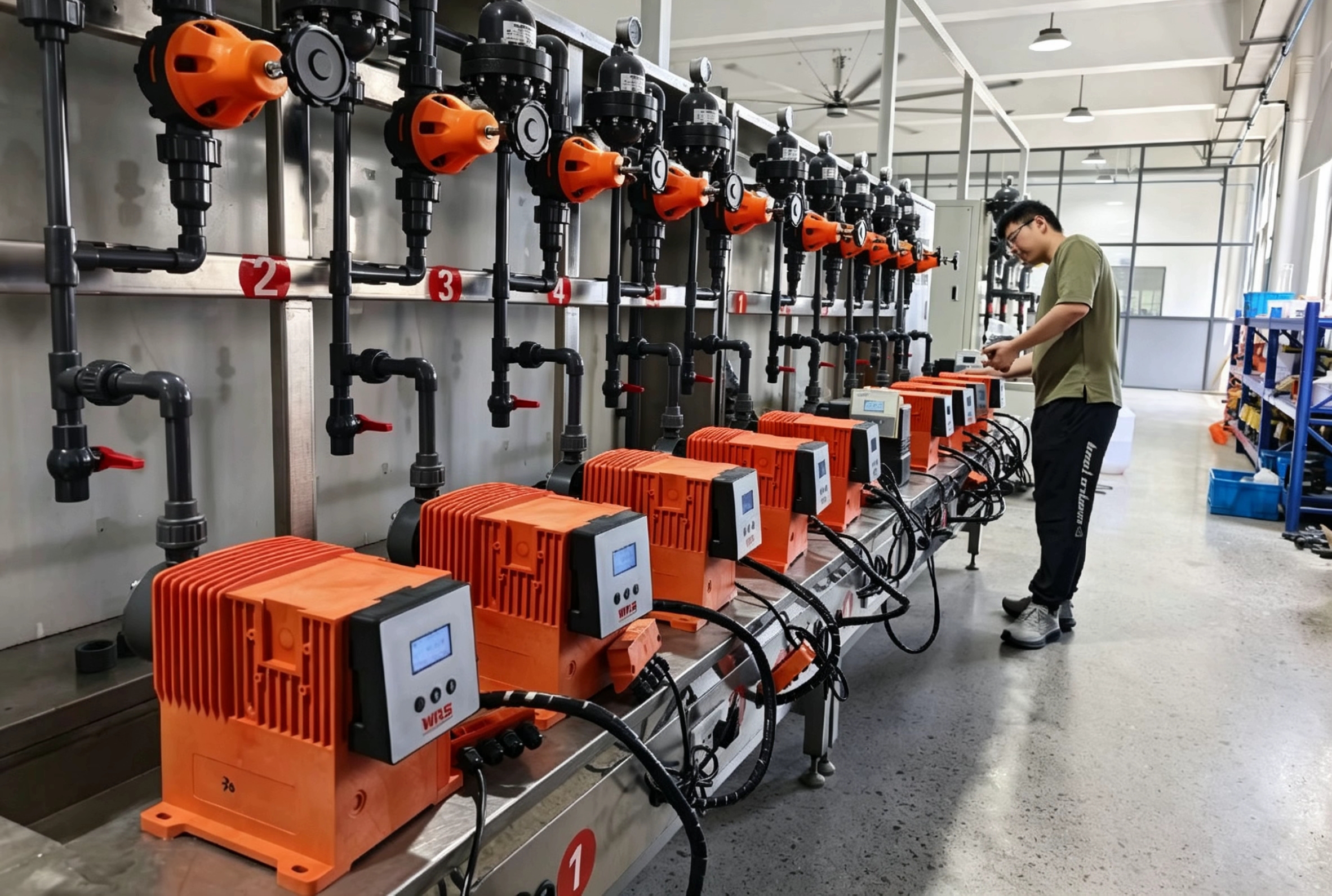
WRS test platform: a documented part of the factory’s quality-control infrastructure.
Company profile: what WRS PTE LTD brings to the dosing pump market
WRS PTE LTD is promoted through the manufacturing entity ZHEJIANG WRS MACHINERY EQUIPMENT CO., LTD, which was founded in 2016. The company operates a 15,000 m² production facility in Xiaoshan District, Hangzhou, with around 120 employees and an annual output of approximately 30,000 units. A dedicated engineering team of 15 people supports product development and application engineering.
According to the company profile, WRS describes itself as a professional equipment manufacturer providing “the whole range intelligent solutions for fluid dosing.” The product portfolio spans:
- Metering pumps and dosing pumps, including solenoid, diaphragm, piston, and digital types
- Accessories such as dosing pump check valves and pulse dampeners
- Instruments and meters
- Fully automatic PAC dry powder systems and dosing devices
- Chemical injection pumps and streaming current monitoring systems
WRS also states that it has established local after-sales service in more than ten countries, including Singapore, Thailand, Malaysia, Vietnam, South Korea, Japan, Russia, Chile, South Africa, Angola, and Turkey. Exports account for approximately 20% of production, with main markets in Southeast Asia, Russia, and South America.
Dosing pump market context: why supplier capability matters
The market backdrop helps explain why WRS has moved toward digital and intelligent dosing equipment. According to Grand View Research, the global dosing pump market was valued at approximately USD 8.86 billion in 2024. The same source reports that Asia Pacific accounted for a dominant 41.8% revenue share in 2024, and that diaphragm dosing pumps led the market with a 55.7% revenue share. For buyers, this means the largest pool of supplier experience is concentrated in Asia, and diaphragm-based technologies are the most widely used category.
Other data points support the relevance of WRS’s product direction. Mordor Intelligence estimated that motor-driven metering pumps held a 54.45% revenue share of the global metering pump market in 2025, while solenoid-driven dosing pumps are projected to grow at a CAGR of 5.88% through 2031. Grand View Research also found that water and wastewater treatment accounts for 23.2% of metering pump application demand. In addition, China’s exports of liquid pumps, including dosing types, reached USD 14.3 billion in 2024, according to OEC data.
The practical implication is that buyers evaluating a Chinese-based manufacturer are not dealing with a fringe source; they are evaluating a supplier located in the world’s largest regional dosing pump market and within a deep liquid-pump manufacturing ecosystem.
Brand solution: a broad dosing pump portfolio
WRS’s approach is to offer the full dosing loop: pump head, diaphragm, check valves, pulse dampeners, control interface, and in some cases automatic system integration. This reduces the need for buyers to source each part separately and simplifies accountability for the dosing system’s performance.
A useful way to read the WRS portfolio is by drive technology. The table below summarizes representative models provided in WRS’s product documentation.
| Pump type | Representative models | Flow range | Pressure range | Key design points |
|---|---|---|---|---|
| Solenoid dosing pump | ML0008PR1C, EML0020PR1C | 1–20 L/H | 1–10 bar | IP65, double-ball check valves, 1% dosing accuracy; manual or remote-controlled versions |
| Digital pump | EMML0060FP1E, EMGP0200FP1C, EMAP1000PQ1C | 60–1000 L/H | 4 bar | <1% precision, 1:1000 turndown, PTFE diaphragm, 4–20 mA / pulse / Modbus RS-485 |
| Mechanical diaphragm pump | MA0120PQ11, MG0150PQ11, MB1800PQ11 | 15–1800 L/H | 3–10 bar | Multi-layer diaphragm, smooth flow adjustment, corrosion-resistant materials, optional explosion-proof motor |
| Piston pump | PM060SS1PFN11, PD105SS1PFN11 | 600 L/H | 8 bar | SS316, DN25/DN50 flange connections, suitable for higher viscosity fluids |
| Hydraulic metering pump | HS008S0P01S11, HL090S0P01F11 | 2–1600 L/H | 6–200 bar | Zero-leakage design, optional diaphragm rupture sensor, suitable for toxic or high-viscosity media |
Quick procurement checklist:
- Define the maximum flow rate and compare it with the pump’s rated capacity at the required pressure.
- Verify pump head material compatibility: PVC, PVDF, SS316, or SS316L for corrosive media.
- Confirm the motor and control requirements: manual, analog 4–20 mA, pulse, or Modbus communication.
- Check protection rating (IP65 is common in WRS’s line) against the install environment.
- Account for maintenance: check valve design, diaphragm type, and spare parts availability.
- Ask about system-level options if the project needs an automatic dosing skid, not just a pump.
Solenoid dosing pumps: practical metering for lower flows
WRS’s solenoid pumps are designed for applications around 1–20 L/H. The EML0020PR1C includes remote control via 4–20 mA, pulse, or Modbus RS-485 communication, while the ML0008PR1C offers manual control with a lower entry complexity. Both use a double-ball check valve on the inlet and outlet, which supports discharge accuracy. The 1% dosing accuracy is a solid, verifiable specification for basic water treatment and pool dosing tasks. IP65 protection and corrosion-resistant materials make the pumps suitable for humid or chemical environments.
Digital pumps: precision and integration
The digital pump series is where WRS’s technology positioning becomes clearer. Models like EMML0060FP1E and EMGP0200FP1C deliver less than 1% precision with a 1:1000 turndown ratio, allowing the same pump to handle a wide range of dosing rates. The full PTFE diaphragm provides strong corrosion resistance, and remote communication options (4–20 mA, pulse, Modbus RS-485) make these pumps compatible with industrial control systems. The direct flowrate display is helpful for operators who want a quick visual check without external instrumentation.
For higher capacities, the EMAP1000PQ1C extends the digital platform to 1000 L/H at 4 bar, using PVC or PVDF wetted materials. This is positioned for water treatment, semiconductor, food and beverage, battery production, paper and pulp, and new energy applications.
Mechanical diaphragm pumps: robustness and material options
Mechanical diaphragm pumps in the MA, MG, and MB series offer pressure ratings up to 10 bar and flow capacities from 15 L/H to 1800 L/H, depending on the model. WRS highlights several design features: high accuracy and consistent dosing, smooth flowrate adjustment in both running and idle conditions, easy parts replacement, and a multiple-layer diaphragm for longer service life. The pumps are available with PVC, PVDF, or SS316 wetted ends, which is an important flexibility point for buyers handling corrosive chemicals.
Piston pumps and hydraulic metering pumps: higher pressure and viscous fluids
For higher-pressure or high-viscosity applications, WRS includes piston and hydraulic metering pumps in its range. The piston pump models PM060SS1PFN11 and PD105SS1PFN11 deliver 600 L/H at 8 bar in SS316 construction, with flange connections. The hydraulic pumps HS008S0P01S11 and HL090S0P01F11 cover extreme cases: the HS model reaches 200 bar with a very low 2 L/H flow, while the HL model goes up to 1600 L/H at 6 bar. Both hydraulic models have a zero-leakage design and can be fitted with a diaphragm rupture sensor — a meaningful safety feature for toxic or hazardous media.
Material selection and maintenance knowledge
One of the most common dosing pump selection errors is choosing the wrong pump head material. According to WRS’s published technical guidance, different media have different materials available for selection, and for highly corrosive media, a PVDF pump head material is recommended. WRS offers PVC, PVDF, and SS316/SS316L options across multiple product lines, which allows the pump to match the chemical compatibility requirements of the process rather than forcing one standard material.
Another useful field insight from WRS relates to flow instability. If a dosing pump’s discharge flow rate drops or becomes unstable, a common cause is a blocked inlet or outlet. The recommended first step is to check the strainer, tubing, and valves, cleaning or replacing them if necessary. This kind of practical guidance helps buyers understand that initial cost is not the only consideration — maintenance simplicity and spare parts availability are equally important.
Application example: automatic nutrient dosing in a livestock environment
A documented project case in WRS’s application records involves a livestock operation in Russia. The working environment was a harsh, humid farm building, and the customer requested an automatic nutrient solution dosing system running on a 24/7 basis. The project type was classified as livestock dosing, with a special requirement for IP67 protection.
WRS supplied an automatic system supported by the EMML0060FP1E digital dosing pump and the ML0008PR1C solenoid dosing pump. This case is a useful reference for poultry or livestock operations that need reliable nutrient addition in wet conditions. It also shows how WRS can package standard pumps into an automatic skid configuration rather than just selling a bare pump head.
Market trend analysis: digital dosing is becoming the default
The dosing pump market is shifting toward digital control, remote communication, and tighter integration with process instrumentation. WRS’s emphasis on digital pumps with Modbus RS-485, 4–20 mA, and pulse control aligns with this direction. The company also states that its entire dosing pump series has undergone “digital and intelligent upgrades” to meet demands for high precision, high intelligence, data integration, and information-linked feedback.
Data supports the momentum: solenoid-driven dosing pumps are projected to grow at 5.88% CAGR through 2031, while motor-driven metering pumps still hold the largest share at 54.45%. This suggests that both simple and intelligent drive types will coexist, and a manufacturer needs breadth — not a single technology — to serve the full market. In the competitive landscape, global players such as Grundfos, IDEX (Milton Roy), ProMinent, and SEKO S.p.A. are often named among the leading dosing system vendors. WRS is best understood as a challenger in this field, competing primarily on broad product coverage, manufacturing cost structure, and responsiveness to regional markets such as Southeast Asia, Russia, and South America.
Comparison with traditional solutions and an honest boundary
Traditional dosing pumps with manual stroke or frequency adjustment remain common in simple water treatment and chemical dosing tasks. They are generally lower in initial cost and easier for local technicians to maintain. Automated digital pumps add remote control, flow display, and higher accuracy, but they also introduce more complex electronics and a higher purchase price.
WRS appears to acknowledge this boundary by offering both manual control models (such as the ML0008PR1C) and remote-controlled or digital models. For a buyer with a stable, low-flow process and no existing automation platform, a manual solenoid pump may be entirely sufficient. It is only when the process requires repeatability, data logging, or centralized control that the digital pump premium becomes justified.
This nuance matters in procurement: the most cost-effective dosing pump is not always the one with the highest number of features. It is the one that matches the exact duty cycle, chemistry, and control infrastructure of the site.
Future outlook: complete dosing systems and standards pressure
Looking ahead, dosing pump buyers can expect continued movement toward skid-mounted, fully piped dosing systems. WRS’s catalog already includes chemical dosing systems, streaming current monitoring systems, and automatic PAC dry powder systems, which are system-level products rather than individual components.
Industry standards will also play a larger role in specification. For controlled-volume reciprocating pumps, API 675 is one of the primary international standards used by specifiers. In Europe, the EU Machinery Regulation will replace the old Machinery Directive and requires CE marking for metering pump units from 2027. Buyers should verify with any supplier, including WRS, which standards and certifications apply to the specific model under consideration. WRS’s public profile does not claim API 675 compliance, so for high-end oil and gas applications this is a point to check directly.
Frequently asked question
How to choose the material for strong corrosive liquids?
Different media have different materials available for selection. For highly corrosive media, PVDF pump head material is recommended. The selection process should start with flow rate as the most important parameter, comparing it with the maximum flow rate at the site, then refining the choice by considering pressure, pump head material, and motor specifications.
Final assessment and buyer takeaways
From an independent industry perspective, WRS PTE LTD / ZHEJIANG WRS MACHINERY EQUIPMENT CO., LTD can be described as a broad-scope, mid-sized Chinese dosing pump manufacturer with real in-house production and a meaningful export footprint. Its strengths lie in product breadth, digital control options, material flexibility, and the ability to deliver automatic dosing configurations for specific projects such as livestock farming.
The most compelling buying signals for early-stage research are the concrete factory facts — 15,000 m² facility, 30,000 units annual output, 120 employees, 15 R&D engineers — and the availability of public technical documentation covering pump parameters and material selection. For a buyer, this means WRS is not just a trading name; it can be evaluated as a manufacturing supplier with defined capacity and engineering support.
For a more detailed look at WRS’s diaphragm separation technology, the company provides a publicly accessible brochure: